Proceedings of the 9th Workshop on Computational Approaches to Subjectivity, Sentiment and Social Media Analysis, pages 116–122 116
Aspect Based Sentiment Analysis into the Wild
Caroline Brun, Vassilina Nikoulina∗
Naver Labs Europe, 6 chemin de Maupertuis, 38240 Meylan
Abstract
In this paper, we test state-of-the-art Aspect Based Sentiment Analysis (ABSA) systems trained on a widely used dataset on actual data. We created a new manually annotated dataset of user generated data from the same domain as the training dataset, but from other sources and analyse the differences between the new and the standard ABSA dataset. We then anal-yse the results in performance of different ver-sions of the same system on both datasets. We also propose light adaptation methods to in-crease system robustness.
1 Introduction
The aim of Aspect Based Sentiment Analysis (ABSA) is to detect fine-grained opinions ex-pressed about different aspects of a given entity, on user-generated comments.
Aspects are attributes of an entity, e.g. the screen of a cell phone, the service for a restau-rant, or the picture quality of a camera, and can be described by an ontology associated to the entity. ABSA includes therefore to identify aspects of an entity, and the sentiment expressed by the writer of the comment about different aspects. For exam-ple, from a sentence extracted from a review about a museum, an ABSA system could extract the fol-lowing information: This museum hosts remark-able collections, however, prices are quite high and the attendants are not always friendly.
”collections”: aspect=museum#collection, polarity=positive; ”prices”: aspect=museum#price, polarity=negative; ”attendants”: aspect=museum#service, polarity=negative;
ABSA receives now a specific interest from the scientific community, especially with the SemEval dedicated challenges, (Pontiki et al.,2014), (
Pon-tiki et al., 2015), (Pontiki et al., 2016), that
pro-vided a framework to design and evaluate ABSA
∗
Both authors contributed equally.
systems, for different domains, initially on English but for 8 languages in the 2016 (last) edition. Be-sides SemEval, other challenges focussing on the task have been also launched recently, for exam-ple TASS, dedicated to Spanish, (Villena-Rom´an
et al., 2015b), (Villena-Rom´an et al., 2015a),
(Cumbreras et al., 2016), or GermanEval,
dedi-cated to German ABSA, (Wojatzki et al.,2017). Following this particular interest, the technol-ogy performing ABSA becomes more and more mature, however, experiments and evaluation are restricted to a small number of academic datasets, in relatively favorable settings. The goal of this paper is to test a state-of-the-art ABSA system on actual data, to evaluate the performance loss in real-world application conditions, and to experi-ment potential solutions to it. To achieve this goal, we’ve created a new ABSA annotated dataset, de-veloped on Foursquare data. We also performed evaluation of the full ABSA processing chain (as opposed to sub-tasks evaluation which is tradition-ally performed). We also propose a weakly super-vised method for aspect-based lexical acquisition designed to improve the robustness of our initial system.
2 Related Work
Most of the systems dedicated to ABSA use ma-chine learning algorithms such as SVMs (
Wag-ner et al., 2014; Kiritchenko et al., 2014), or
languages of the challenge. Deep Learning meth-ods are also emerging: for example, (Ruder et al., 2016) proposed a method using multiple filters CNNs and obtained competitive results on both polarity and aspect detection tasks. However, ABSA datasets are very costly to annotate by hu-mans, and they are usually small, which is a prob-lem for Deep Learning supervised methods.
3 Datasets
Usually, ABSA systems are tested on the same dataset as they are developped on. One of the widely used ABSA datasets was released in Se-meval2016 challenge (Pontiki et al.,2016), in par-ticular the dataset for restaurant domain. It is based on the dataset of (Ganu et al.,2009) who ex-tracted restaurant reviews from City Search New York over year 2006. Since then, the notion of the user review has evolved. Many factors may im-pact the linguistic structure of a review, e.g. the support it was written on (computer vs. smart-phone), the age of the user, the location (US vs. UK English), the user mother tongue (native vs. non-native speakers), etc. How would a system trained on Semeval2016 dataset perform on a new data coming from different sources?
In order to assess ABSA real-world perfor-mances, we manually annotated a completely new dataset from Foursquare1comments. We have ac-cess to about 215K user reviews of restaurants all over the world in English2. The reviews were writ-ten during the period between 2009 to 2018. From these reviews, we randomly selected 585 sam-ples, which contain 1006 sentences and annotate these sentences with the SemEval2016 annotation guidelines for the restaurant domain. The annota-tions have been performed by a single annotator, expert linguist with a very good knowledge of the SemEval2016 annotation guidelines, usingBRAT,
(Stenetorp et al.,2012).
Each sentence contains annotations about: 1. Opinion Target Expression (OTE), i.e. the lin-guistic expression (term) used in the text to re-fer to the reviewed entity, annotated as “NULL” if the aspect is implicit; 2. Aspect Categories, i.e. the semantic categories of the opinionated as-pects, which are part of a predefined ontology (12 semantic classes for the restaurant domain from
1
https://foursquare.com/
2Countries with most of English comments include US,
UK, Australia, Canada, Indonesia, Malaysia, Philippines, In-dia, Thailand
Dataset #Rev #S #W/S #A/S Semeval 92 676 12.8 1.27 Foursquare 585 1006 8.0 1.15
Table 1: Dataset statistics: Semeval 2016 test set and Foursquare dataset. #Rev: number of reviews, #S: number of sentences, #W/S : number of words per sentence, #A/S: number of <OTE, Aspect Category, Polarity>tuples per sentence
(Pontiki et al.,2016)); 3. Sentiment Polarities:
po-larities (positive, negative or neutral) associated to the tuple<OTE, Aspect Category>. An illustra-tion of such annotaillustra-tion is given on figure1.
<text>Their sake list was extensive, but we were looking for Purple Haze, which wasn’t listed but made for us upon request!</text>
<Opinions>
<Opinion target="sake list"
category="DRINKS#STYLE_OPTIONS" polarity="positive"/>
<Opinion target="NULL"
category="SERVICE#GENERAL" polarity="positive"/> </Opinions>
Figure 1: ABSA: an annotated sentence from the Semeval-2016 training corpus
Table 1 gives some statistics about the Foursquare and Semeval2016 datasets. One may notice, that in average, Foursquare reviews are shorter and therefore contain less aspects per sen-tence. We believe this is due to the generalisation of smart-phones (and other mobile devices) usage over the world in the last decade, which influenced the way users write. We release the Foursquare dataset to the community in order to better assess robustness of ABSA systems3.
4 Evaluation Procedure
We consider different evaluation measures. First, we re-use the SemEval2016 ABSA evaluation paradigm and scripts, where the evaluation was run in two phases, phase A and phase B. In phase A, raw reviews have to be annotated with aspects (slot 1 of the challenge) and OTE (slot 2 of the challenge). In phase B, gold annotations for phase A, i.e. tuples <OTE, aspect>, have to be an-notated with polarities (slot 3 of the challenge).
3
Thus, we evaluate separately the OTE detection, aspect detection and finally, we evaluate the po-larity of opinion detection on the ground truth of phase A. The advantage of this evaluation proce-dure is of course to assess the quality of the sys-tems on each of the different subtasks involved in the full ABSA system. However, these mea-sures do not reflect the overall results such sys-tems would obtain on the full chain of annotations starting from raw data, in end-to-end application settings. Therefore, we also propose to evalu-ate the results obtained with the complete anno-tation chain, i.e. computing F1-measure on the triplets <OTE, Aspect, Polarity>. In addition, we compute the F1-measure on the pairs<Aspect, Polarity>at sentence level. This last measure can be useful to assess ABSA general Aspect-Polarity performance since many ABSA applications may not require the OTE step. In what follows, we refer to these measures as slot1,3 and slot1,2,3 to make connection with the challenge tasks.
5 Baseline ABSA Systems
In our experiments, we use several baseline sys-tems. Each of the systems consists in the follow-ing pipeline of different components: 1. Opinion-ated domain term extraction (OTE); 2. aspect cat-egorization, for opinionated term (OT), and whole sentence level; final aspect is predicted as a com-bination of both; 3. polarity classification of each aspect identified in the previous step. The differ-ence between baselines lies in the implementation of each component of the pipeline, and the level of external resources involved.
5.1 Baseline-1
The first system is resource-rich system relying on available syntactic and semantic parser, and domain-specific semantic lexicons. It is based on composite models combining sophisticated lin-guistic features with machine learning algorithms. The linguistic features are extracted via a NLP pipeline (based on in-house parser) comprising lexical semantic information, POS tagging, syn-tactic parsing and a partial semantic parsing that outputs semantic relations between polarity pred-icates and their opinionated targets (OTE). These linguistic features are then used by classifiers to perform each step of the pipeline.
The OTE detection is performed with
Condi-tional Random Fields (implemented with CRF++4 toolkit), trained with some standard features (POS, lemma, presence of upper-case letters, features combining syntactic/semantic dependencies with semantic lexicons, embedding-based features).
Aspect and polarity classification components rely on the same features as for OTE, exclud-ing embeddexclud-ing-based features, but extended with bi-grams features. In addition, polarity classi-fier feature representation is extended with entity and attribute of aspect category (e.g. RESTAU-RANT#PRICES results in two additional features:
(restaurant, prices)). Classification is performed with CoreNLP (Manning et al.,2014) implemen-tation of Maximum Entropy.
5.2 Baseline-2
The second baseline system (baseline-2) replaces each component of the previous pipeline with neu-ral network classifiers. Aspect classification and polarity classification components are based on multiple filters CNNs as in (Ruder et al., 2016). OTE component is based on Bidirectional GRU architecture (similar to (Jebbara and Cimiano, 2016)). All the components are implemented with the keras (Chollet et al.,2015) library.
Since the size of the training data is relatively small, we attempt to enrich an input with prior knowledge to help the system to generalize bet-ter. In order to do so, we enrich word representa-tion with semantic lexicon features5, which are en-coded as one-hot vector of dimension 100 and con-catenated with word embedding. These new word representations are fed to the same pipeline as
baseline-2. We’ll refer to this system as baseline-2’.
Both baseline-2 andbaseline-2’ are initialised with pre-trained word embeddings.
5.3 Baseline Results
Common ressources between all baselines are pre-trained word embeddings and semantic lexicon. We use word2vec (Mikolov et al., 2013) 300-dimensional Google News word embeddings, on which some“noise” filtering has been performed. Semantic lexicon was created semi-automatically using existing polarity lexicons and capitalizing on the annotated vocabulary present in the SemEval
4
https://taku910.github.io/crfpp/
5This is close to the idea of
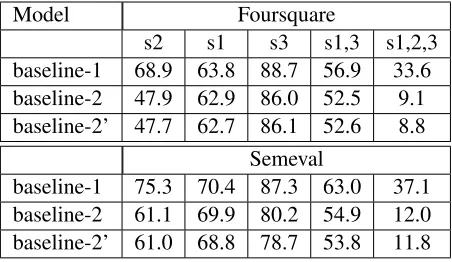
Model Foursquare
s2 s1 s3 s1,3 s1,2,3 baseline-1 68.9 63.8 88.7 56.9 33.6 baseline-2 47.9 62.9 86.0 52.5 9.1 baseline-2’ 47.7 62.7 86.1 52.6 8.8
Semeval
baseline-1 75.3 70.4 87.3 63.0 37.1 baseline-2 61.1 69.9 80.2 54.9 12.0 baseline-2’ 61.0 68.8 78.7 53.8 11.8
Table 2: Performance of various baseline systems. s1: Aspect Category detection (F1), s2: Opinion Target Expression (F1), s3: Sentiment Polarity (Ac-curacy). s1,3: Aspect,Polarity (F1), s1,2,3: As-pect,OTE,Polarity (F1).
ABSA datasets. It contains∼1000 words with as-pect categories and/or polarities associated to each word.
Results for all the baselines are summarized in the table2. Note, that forbaseline-2,2’, we report an average performance after executing the whole pipeline 10 times.
First, we observe an important performance drop in aspect prediction (tasks s2, s1) for the new Foursquare dataset for both baselines. This is of course related to the fact that this dataset is differ-ent from the one the training has been performed on. Thus, the aspects may not be expressed in the same way, style of the reviews are different6. However, for polarity prediction we observe bet-ter results on Foursquare dataset than on Semeval dataset. It can be explained by shorter length of Foursquare comments, resulting in less aspect mentions per sentence (rarely more that one opin-ionated term per sentence), and thus less ambigu-ity in polarambigu-ity prediction.
The second observation is a pretty low overall pipeline performance (s1,3 and s1,2,3). Although our baseline-1 has pretty good performances on each individual task (best, or close to best official SemEval2016 results) when putting all together, it results in63.0F1-score on aspect-polarity tuples. The performance on<OTE, Aspect, Polarity> tu-ples drops down to F1 of 37.1. This evaluation procedure allows us to get an idea on what would be “real-world” system performance, and also in-dicates the capacities and limitations of the sys-tem.
6a lot of emojis are used in Foursquare dataset, but not in
Semeval dataset
Finally, we note that baseline-1 (“ressource rich” baseline) has the best performances from all the baselines we explored (as expected). The per-formances ofbaseline-2andbaseline-2’are pretty close on the Semeval dataset, butbaseline-2seems to perform slightly better.
6 Exploring Additional Ressources for Adaptation
One of the natural resources to explore for system adaptation is a set non-annotated reviews. In our case, we exploit all Foursquare reviews in English we have access to.
6.1 Domain Specific Embeddings
First, we learn domain dependent words embed-dings (300-dimensional) on the Foursquare restau-rant data using Gensim (Reh˚uˇrek and Sojkaˇ ,2010) implementation of word2vec. We filtered out the words occurring less than 5 times, and used a con-text window of 10 words, which resulted in 60K word embeddings.
6.2 Weakly Supervised Lexical Acquisition
Among other components, our system relies on semantic lexical ressources encoding domain as-pect and polarity vocabulary, that were developed semi-automatically, based on SemEval2016 train-ing datasets. In order to enrich these lexicons, we have adapted a semantic clustering method de-scribed in (Pelevina et al.,2016)7. The core idea of this approach is to induce a sense inventory from existing word embeddings via clustering of ego-networks of related words. An ego network consists of a single node (ego) together with the nodes they are connected to and the edges between the connected nodes. Words referring to the same sense tend to have a large number of connections, and to be clustered together. The clustering is done with the Chinese Whispers algorithm (Biemann,
2006).
In the case of the present experiments, we ini-tialize the algorithm with a set of seed words to-gether with their semantic aspect (e.gcider:drink,
tikka:food), in order to obtain clusters of aspect words. We used 60 seed words randomly selected from our existing semantic lexicon and learned clusters from Foursquare embeddings. Table 4
7This method was initially experimented for word sense
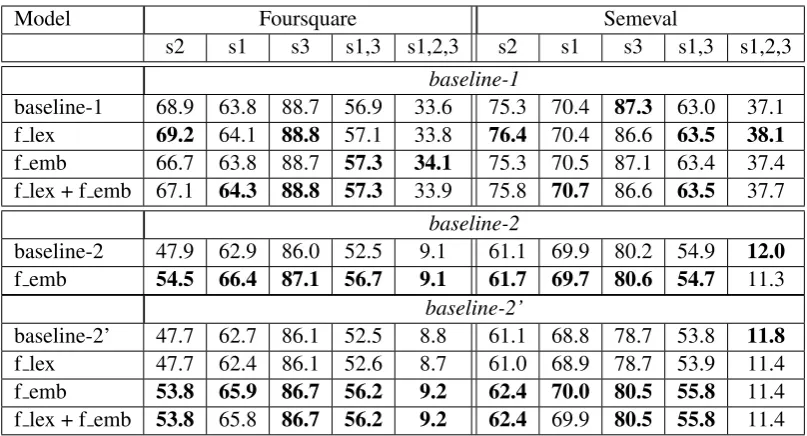
[image:4.595.72.298.62.193.2]Model Foursquare Semeval
s2 s1 s3 s1,3 s1,2,3 s2 s1 s3 s1,3 s1,2,3
baseline-1
baseline-1 68.9 63.8 88.7 56.9 33.6 75.3 70.4 87.3 63.0 37.1 f lex 69.2 64.1 88.8 57.1 33.8 76.4 70.4 86.6 63.5 38.1
f emb 66.7 63.8 88.7 57.3 34.1 75.3 70.5 87.1 63.4 37.4 f lex + f emb 67.1 64.3 88.8 57.3 33.9 75.8 70.7 86.6 63.5 37.7
baseline-2
baseline-2 47.9 62.9 86.0 52.5 9.1 61.1 69.9 80.2 54.9 12.0
f emb 54.5 66.4 87.1 56.7 9.1 61.7 69.7 80.6 54.7 11.3
baseline-2’
baseline-2’ 47.7 62.7 86.1 52.5 8.8 61.1 68.8 78.7 53.8 11.8
[image:5.595.97.501.60.278.2]f lex 47.7 62.4 86.1 52.6 8.7 61.0 68.9 78.7 53.9 11.4 f emb 53.8 65.9 86.7 56.2 9.2 62.4 70.0 80.5 55.8 11.4 f lex + f emb 53.8 65.8 86.7 56.2 9.2 62.4 69.9 80.5 55.8 11.4
Table 3: Experimental results with foursquare embeddings and automatically acquired lexicon
Seed:Aspect Aspect Cluster
kimchi:food kimchee, bulgogi, galbi, bibimbap, jigae, chigae, ... waiter:service waitress, server, hostess,
nikki, melissa, kyle, kelly, ... expensive:price over-priced, pricey, costly
pricy, cheap, spendy, ...
Table 4: Clusters learnt on Foursquare embeddings
gives some cluster examples. It’s interesting to ob-serve that we obtain a cluster of first names, often used to mention a waiter in Foursquare data, with semantic classservice.
We use these clusters of aspect words by con-catenating them to the existing lexicon of the sys-tem.
6.3 Experimental Results
We’ve performed following series of experiments (summarized in table 3): 1. f lex: foursquare lexicon extending existing lexicon (for systems using lexicons); 2. f emb: all baselines with foursquare embeddings replacing generic embed-dings (GoogleNews-based) 3.f lex +f emb: com-bination of the previous two. We observe light improvements forbaseline-1which are especially due to lexicon enrichment experiments. We think that Foursquare embeddings didn’t bring expected improvements for baseline-1 (embed-dings are used only for OTE/s2 task, which in it’s turn impacts s1 task), mostly because these
embeddings are much smaller and we lose some non domain-specific knowledge when they replace GoogleNews embeddings.
The impact of embedding is opposite for
baseline-2 experiments. Foursquare pretrained embeddings bring important gains on Foursquare dataset thus moving baseline-2 system above
baseline-1 for s1 evaluation. It also improves (although less) system performance on Semeval dataset. Automatically acquired lexicon on
baseline-2systems seems to be very low. We plan to explore other ways to integrate this knowledge into deep learning framework.
7 Conclusion
References
Chris Biemann. 2006. Chinese whispers: An efficient graph clustering algorithm and its application to nat-ural language processing problems. In Proceed-ings of the First Workshop on Graph Based Meth-ods for Natural Language Processing, TextGraphs-1, pages 73–80, Stroudsburg, PA, USA. Association for Computational Linguistics.
Franc¸ois Chollet et al. 2015. Keras. https:// keras.io.
Miguel ´Angel Garc´ıa Cumbreras, Julio Villena-Rom´an, Eugenio Mart´ınez C´amara, Manuel Carlos D´ıaz-Galiano, Maria Teresa Mart´ın-Valdivia, and Luis Al-fonso Ure˜na L´opez. 2016. Overview of TASS 2016. In Proceedings of TASS 2016: Workshop on Senti-ment Analysis at SEPLN co-located with 32nd SE-PLN Conference (SESE-PLN 2016), Salamanca, Spain, September 13th, 2016., pages 13–21.
G. Ganu, N. Elhadad, and A. Marian. 2009. Beyond the stars: Improving rating predictions using review text content. In Proceedings of the 12th Interna-tional Workshop on the Web and Databases, Prov-idence, Rhode Island.
Hussam Hamdan, Patrice Bellot, and Frederic Bechet. 2015. Lsislif: Crf and logistic regression for opinion target extraction and sentiment polarity analysis. In
Proceedings of the 9th International Workshop on Semantic Evaluation (SemEval 2015), pages 753– 758, Denver, Colorado. Association for Computa-tional Linguistics.
Soufian Jebbara and Philipp Cimiano. 2016. Aspect-Based Sentiment Analysis Using a Two-Step Neural Network Architecture. InSemantic Web Challenges. Third SemWebEval Challenge at ESWC 2016. Re-vised Selected Papers, volume 641, pages 153–170. Springer.
Svetlana Kiritchenko, Xiaodan Zhu, Colin Cherry, and Saif Mohammad. 2014. Nrc-canada-2014: Detect-ing aspects and sentiment in customer reviews. In
Proceedings of the 8th International Workshop on Semantic Evaluation (SemEval 2014), pages 437– 442, Dublin, Ireland. Association for Computational Linguistics and Dublin City University.
Ayush Kumar, Sarah Kohail, Amit Kumar, Asif Ek-bal, and Chris Biemann. 2016. Iit-tuda at semeval-2016 task 5: Beyond sentiment lexicon: Combin-ing domain dependency and distributional seman-tics features for aspect based sentiment analysis. In
Proceedings of the 10th International Workshop on Semantic Evaluation (SemEval-2016), pages 1129– 1135, San Diego, California. Association for Com-putational Linguistics.
Christopher D. Manning, Mihai Surdeanu, John Bauer, Jenny Finkel, Steven J. Bethard, and David Mc-Closky. 2014. The Stanford CoreNLP natural lan-guage processing toolkit. InAssociation for Compu-tational Linguistics (ACL) System Demonstrations, pages 55–60.
Tomas Mikolov, Ilya Sutskever, Kai Chen, Greg Cor-rado, and Jeffrey Dean. 2013. Distributed represen-tations of words and phrases and their composition-ality. InProceedings of the 26th International Conference on Neural Information Processing Systems -Volume 2, NIPS’13, pages 3111–3119.
Maria Pelevina, Nikolay Arefyev, Chris Biemann, and Alexander Panchenko. 2016. Making sense of word embeddings. InProceedings of the 1st Workshop on Representation Learning for NLP, pages 174–183.
Maria Pontiki, Dimitrios Galanis, Haris Papageor-giou, Ion Androutsopoulos, Suresh Manandhar, Mo-hammad AL-Smadi, Mahmoud Al-Ayyoub, Yanyan Zhao, Bing Qin, Orph´ee De Clercq, V´eronique Hoste, Marianna Apidianaki, Xavier Tannier, Na-talia Loukachevitch, Evgeny Kotelnikov, Nuria Bel, Salud Mar´ıa Jim´enez-Zafra, and G¨uls¸en Eryiˇgit. 2016. SemEval-2016 task 5: Aspect based senti-ment analysis. InProceedings of the 10th Interna-tional Workshop on Semantic Evaluation, SemEval ’16, San Diego, California. Association for Compu-tational Linguistics.
Maria Pontiki, Dimitris Galanis, Haris Papageorgiou, Suresh Manandhar, and Ion Androutsopoulos. 2015. Semeval-2015 task 12: Aspect based sentiment anal-ysis. InProceedings of the 9th International Work-shop on Semantic Evaluation (SemEval 2015), pages 486–495, Denver, Colorado. Association for Com-putational Linguistics.
Maria Pontiki, Dimitris Galanis, John Pavlopoulos, Harris Papageorgiou, Ion Androutsopoulos, and Suresh Manandhar. 2014. Semeval-2014 task 4: As-pect based sentiment analysis. InProceedings of the 8th International Workshop on Semantic Evaluation (SemEval 2014), pages 27–35, Dublin, Ireland. As-sociation for Computational Linguistics and Dublin City University.
Radim ˇReh˚uˇrek and Petr Sojka. 2010. Software Frame-work for Topic Modelling with Large Corpora. In
Proceedings of the LREC 2010 Workshop on New Challenges for NLP Frameworks, pages 45–50, Val-letta, Malta. ELRA. http://is.muni.cz/ publication/884893/en.
S. Ruder, P. Ghaffari, and J. G. Breslin. 2016. INSIGHT-1 at SemEval-2016 Task 5: Deep Learn-ing for MultilLearn-ingual Aspect-based Sentiment Analy-sis.ArXiv e-prints.
Pontus Stenetorp, Sampo Pyysalo, Goran Topi, Tomoko Ohta, and Sophia Ananiadou. 2012. Brat: a web-based tool for nlp-assisted text annotation. In
Proceedings of the Association for Computational Linguistics (ACL), pages 102–107.
for Computational Linguistics and Dublin City Uni-versity.
Julio Villena-Rom´an, Janine Garc´ıa-Morera, Miguel ´
Angel Garc´ıa Cumbreras, Eugenio Mart´ınez-C´amara, Maria Teresa Mart´ın-Valdivia, and Luis Alfonso Ure˜na L´opez. 2015a. Overview of TASS 2015. InProceedings of TASS 2015: Workshop on Sentiment Analysis at SEPLN co-located with 31st SEPLN Conference (SEPLN 2015), Alicante, Spain, September 15, 2015., pages 13–21.
Julio Villena-Rom´an, Eugenio Mart´ınez-C´amara, Ja-nine Garc´ıa-Morera, and Salud M. Jim´enez Zafra. 2015b. TASS 2014 - the challenge of aspect-based sentiment analysis. Procesamiento del Lenguaje Natural, 54:61–68.
Joachim Wagner, Piyush Arora, Santiago Cortes, Utsab Barman, Dasha Bogdanova, Jennifer Foster, and Lamia Tounsi. 2014. Dcu: Aspect-based polarity classification for semeval task 4. InProceedings of the 8th International Workshop on Semantic Evalu-ation (SemEval 2014), pages 392–397, Dublin, Ire-land. Association for Computational Linguistics and Dublin City University.