Efficient Decoding for Statistical Machine Translation
with a Fully Expanded WFST Model
Hajime Tsukada
NTT Communication Science Labs. 2-4 Hikaridai Seika-cho Soraku-gun
Kyoto 619-0237 Japan
Masaaki Nagata
NTT Cyber Space Labs. 1-1 Hikari-no-Oka Yokosuka-shi
Kanagawa 239-0847 Japan
Abstract
This paper proposes a novel method to compile sta-tistical models for machine translation to achieve efficient decoding. In our method, each statistical submodel is represented by a weighted finite-state transducer (WFST), and all of the submodels are ex-panded into a composition model beforehand. Fur-thermore, the ambiguity of the composition model is reduced by the statistics of hypotheses while de-coding. The experimental results show that the pro-posed model representation drastically improves the efficiency of decoding compared to the dynamic composition of the submodels, which corresponds to conventional approaches.
1 Introduction
Recently, research on statistical machine translation has grown along with the increase in computational power as well as the amount of bilingual corpora. The basic idea of modeling machine translation was proposed by Brown et al. (1993), who assumed that machine translation can be modeled on noisy chan-nels. The source language is encoded from a target language by a noisy channel, and translation is per-formed as a decoding process from source language to target language.
Knight (1999) showed that the translation prob-lem defined by Brown et al. (1993) is
NP-complete. Therefore, with this model it is
al-most impossible to search for optimal solutions in
the decoding process. Several studies have
pro-posed methods for searching suboptimal solutions. Berger et al. (1996) and Och et al. (2001) pro-posed such depth-first search methods as stack de-coders. Wand and Waibel (1997) and Tillmann and Ney (2003) proposed breadth-first search methods, i.e. beam search. Germann (2001) and Watanabe and Sumita (2003) proposed greedy type decoding methods. In all of these search algorithms, better representation of the statistical model in systems can improve the search efficiency.
For model representation, a search method based
on weighted finite-state transducer (WFST) (Mohri et al., 2002) has achieved great success in the speech recognition field. The basic idea is that each statis-tical model is represented by a WFST and they are composed beforehand; the composed model is op-timized by WFST operations such as determiniza-tion and minimizadeterminiza-tion. This fully expanded model permits efficient searches. Our motivation is to ap-ply this approach to machine translation. However, WFST optimization operations such as determiniza-tion are nearly impossible to apply to WFSTs in ma-chine translation because they are much more biguous than speech recognition. To reduce the am-biguity, we propose a WFST optimization method that considers the statistics of hypotheses while de-coding.
Some approaches have applied WFST to
sta-tistical machine translation. Knight and
Al-Onaizan (1998) proposed the representation of IBM model 3 with WFSTs; Bangalore and Ric-cardi (2001) studied WFST models in call-routing tasks, and Kumar and Byrne (2003) modeled phrase-based translation by WFSTs. All of these studies mainly focused on the representation of each submodel used in machine translation. However, few studies have focued on the integration of each WFST submodel to improve the decoding efficiency of machine translation.
To this end, we propose a method that expands all of the submodels into a composition model, re-ducing the ambiguity of the expanded model by the statistics of hypotheses while decoding. First, we explain the translation model (Brown et al., 1993; Knight and Al-Onaizan, 1998) that we used as a base for our decoding research. Second, our pro-posed method is introduced. Finally, experimental results show that our proposed method drastically improves decoding efficiency.
2 IBM Model
to English attempts to find the that maximizes
. Using Bayes’ rule,
is rewritten as
where
is referred to as a language model and
is referred to as a translation model. In this paper, we use word trigram for a language model and IBM model 3 for a translation model.
The translation model is represented as follows considering all possible word alignments.
The IBM model only assumes a one-to-many word
alignment, where a Japanese word in the -th
po-sition connects to the English word in the -th
position.
The IBM model 3 uses the following
. ! #"%$ "%$ &('*)%+-,/. $ 0 & $ ,.21 3 465 $ " 4879 " 4 4 1 ' 5: ; =< > ? =@6 (1) " 4
the a number of words connecting to
4
,
and it is called fertility. Note, however, that "%$
is the number of words connecting to null words.
9 " 4
is conditional probability where English
word
4
connects to "
words in . 9
" 4 is
called fertility probability. ;
4 is conditional
probability where English word
4
is translated to
Japanese word
and called translation probability.
> AB =@6
is conditional probability where the
En-glish word in theB -th position connects to the the
Japanese word in the -th position on condition that
the length of the English sentence and Japanese
sentence are @
and
, respectively. >
B =@C
is called distortion probability. In our experiment, we used the IBM model 3 while assuming constant distortion probability for simplicity.
3 WFST Cascade Model
WFST is a finite-state device in which output sym-bols and output weights are defined as well as in-put symbols. Using composition (Pereira and Riley,
1997), we can obtain the combined WFSTD
:FE
D
+
by connecting each output ofD
:
to an input ofD
+
. If we assume that each submodel of Equation (1) is represented by a WFST, a conventional decoder can be considered to compose submodels dynamically.
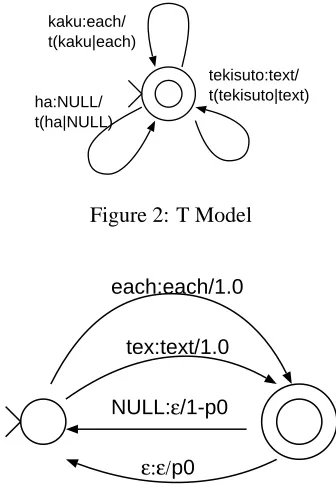
[image:2.595.342.510.73.318.2]kaku:each/ t(kaku|each) tekisuto:text/ t(tekisuto|text) ha:NULL/ t(ha|NULL)
Figure 2: T Model
NULL:ε/1-p0
ε:ε/p0 each:each/1.0
tex:text/1.0
Figure 3: NULL Model
The main idea of the proposed approach is to com-pute the composition beforehand.
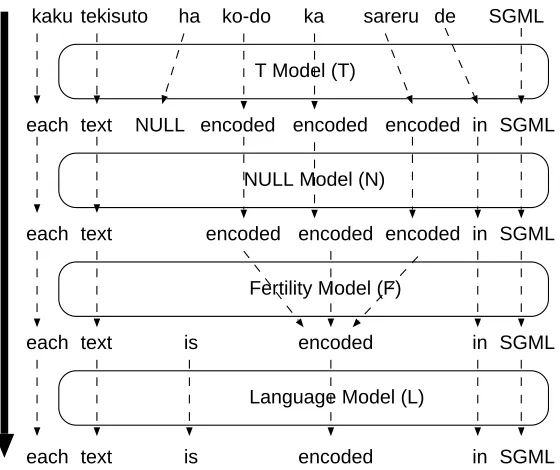
Figure 1 shows the translation process modeled by a WFST cascade. This WFST cascade model (Knight and Al-Onaizan, 1998) represents the IBM model 3 described in the previous section. Any possible permutations of the Japanese sentence are
inputed to the cascade. First, T model(D )
trans-lates the Japanese word to an English word. NULL
model(G ) deletes special word NULL. Fertility
model(H ) merges the same continuous words into
one word. At each stage, the probability represented by the weight of a WFST is accumulated. Finally,
the weight of language model (I ) is accumulated.
If WFST J represents all permutations of the input
sentence, decoding can be considered to search for
the best path ofJ
E D E G E H E
I . Therefore,
com-putingD E G E H E
I in advance can improve the
efficiency of the decoder.
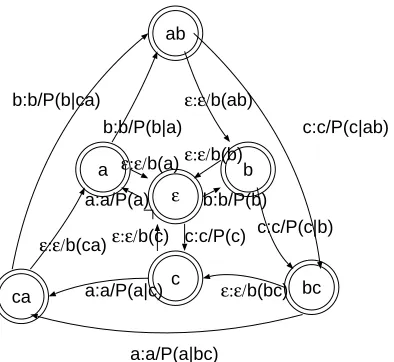
ForD ,G , andH , we adopt the representation of
Knight and Al-Onaizan (1998). ForI , we adopt the
representation of Mohri et al. (2002). Figures 2– 5 show examples of submodel representation with
WFSTs. K
in Figure 5 stands for a back-off pa-rameter. Conditional branches are represented by nondeterministic paths in the WFST.
4 Ambiguity Reduction
kaku tekisuto ha ko-do ka sareru de SGML
each text NULL encoded encoded encoded in SGML
T Model (T)
NULL Model (N)
Fertility Model (F)
Language Model (L)
each text encoded encoded encoded in SGML
each text is encoded in SGML
[image:3.595.168.448.72.307.2]each text is encoded in SGML
Figure 1: Translation with WFST Cascade Model
encoded:encoded/ n(1|encoded)
ε:encoded/ n(0|encoded)
encoded:encoded/ n(2|encoded)
encoded:ε/
n(3|encoded)/n(2|encoded)
encoded:ε/
n(4|encoded)/n(3|encoded)
encoded:ε/1.0 encoded:ε/1.0
encoded:ε/1.0
Figure 4: Fertility Model
However, the composed WFST for machine trans-lation is not obviously determinizable. The
word-to-word translation modelD strongly contributes to
WFST’s ambiguity while the L transition of other
submodels also contributes to ambiguity. Mohri et al. (2002) proposed a technique that added special symbols allowing the WFST to be determinizable. Determinization using this technique, however, is not expected to achieve efficient decoding in ma-chine translation because the WFSTs of mama-chine translation are inherently ambiguous.
To overcome this problem, we propose a novel WFST optimization approach that uses decoding in-formation. First, our method merges WFST states by considering the statistics of hypotheses while de-coding. After merging the states, redundant edges
whose beginning states, end states, input symbols, and output symbols are the same are also reduced. IBM models consider all possible alignments while a decoder searches for only the most appropriate
alignment. Therefore, there are many redundant
states in the full-expansion WFST from the view-point of decoding.
We adopted a standard decoding algorithm in the speech recognition field, where the forward is
beam-search and the backward isMON search. Since
[image:3.595.131.485.359.494.2]ab ca bc a b c ε c:c/P(c|ab) b:b/P(b|ca) a:a/P(a|bc) ε:ε/b(ca) b:b/P(b|a) ε:ε/b(ab) c:c/P(c|b) ε:ε/b(bc) a:a/P(a|c)
ε:ε/b(c) c:c/P(c) b:b/P(b) ε:ε/b(b) ε:ε/b(a)
[image:4.595.90.287.70.251.2]a:a/P(a)
Figure 5: Trigram Language Model
the finite-state acceptor.
The WFST states that always appear together in the same hypothesis list of the forward beam-search should be equated if the states contribute to
cor-rect translation. Let P be a full-expansion WFST
model andQR
=S
be a WFST that represents the
cor-rect translation of an input sentence . For each
, the states of P that always appear together in
the same hypothesis list in the course of decoding
withP
E
QR =S
are merged in our method. Simply
merging states ofP may increase model errors, but
QR =S
corrects the errors caused by merging states. Unlike ordinary FSA minimization, states are merged without considering their successor states. If the weight represents probability, thesum of the weights of output transitions may not be 1.0 after merging states, and then thecondition of probability may be destroyed. Since the decoder does not sum up all possible paths but searches for the most ap-propriate paths, this kind of state merging does not pose a serious problem in practice.
In the following experiment, we measured the
association between states by "
+ in Gale and
Church (1991). "
+ is a
T
+ -like statistic that is
bounded between 0 and 1. If the "
+ of two states
is higher than the specified threshold, these two
states are merged. The definition of "
+ is as
fol-lows, where U
V V : V + , K U V V : W , X Y V V + Z
, and >[
G
Z \
K
]X
. G
is the total number of hypothesis lists.
V V ( V V : V +
) is the number of hypothesis lists in
whichV appears (bothV
: andV + appear). " + > K X + O^ _^`X ^ >/ Xa^ >(
{}
{1}
{2}
{3}
{1,2}
{2,3}
{1,3}
{1,2,3}
Figure 6: FSA for All Input Permutations
Merging the beginning and end states of a
tran-sition whose input isL (L transition for short) may
cause a problem when decoding. In our
implemen-tation, weight is basically minus@6b
probability, and its lower bound is 0 in theory. However, there exists
negative L transition that originated from the
back-off value of n-gram. If we merge the beginning and
end states of the negative L transition, the search
process will not stop due to the negative L loop. To
avoid this problem, we rounded the negative weight
to 0 if the negativeL loop appears during merging.
In the preliminary experiment, a weight-pushing operation (Mohri and Riley, 2001) was also
effec-tive for deleting negaeffec-tive L transition of our
full-expansion models. However, pushing causes an im-balance of weights among paths if the WFST is not deterministic. As a result of this imbalance, we can-not compare path costs when pruning. In fact, our preliminary experiment showed that pushed full-expansion WFST does not work well. Therefore, we adopted a simpler method to deal with a
nega-tiveL loop as described above.
5 Experiments
5.1 Effect of Full Expansion
To clarify the effectiveness of a full-expansion ap-proach, we compared the computational costs while using the same decoder with both dynamic com-position and static comcom-position, a full-expansion model in other words. In the forward beam-search,
any hypothesis whose probability is lower than0dcd0de
of the top of the hypothesis list is pruned. In this ex-periment, permutation is restricted, and words can be moved 6 positions at most. The translation model was trained by GIZA++ (Och and Ney, 2003), and the trigram was trained by the CMU-Cambridge
Statistical Language Modeling Toolkit v2 (Clarkson
and Rosenfeld, 1997).
[image:4.595.329.530.73.144.2]for the test. The average length of Japanese sen-tences was 8.4 words, and that of English sensen-tences was 6.7 words. The Japanese vocabulary consisted of 15,510 words, and the English vocabulary was 11,806 words. Table 1 shows the size of the WFSTs used in the experiment. In these WFSTs, special symbols that express beginning and end of sentence are added to the WFSTs described in the previous section. The NIST score (Doddington, 2002) and BLEU Score (Papineni et al., 2002) were used to measure translation accuracy.
Table 2 shows the experimental results. The full-expansion model provided translations more than 10 times faster than conventional dynamic composition submodels without degrading accuracy. However, the NIST scores are slightly different. In the course of composition, some paths that do not reach the fi-nal states are produced. In the full-expansion model these paths are trimmed. These trimmed paths may cause a slight difference in NIST scores.
5.2 Effect of Ambiguity Reduction
To show the effect of ambiguity reduction, we com-pared the translation results of three different
mod-els. Modelf is the full-expansion model described
above. Model Q is a reduced model by using our
proposed method with a 0.9 "
+ threshold. Model
QRg is a reduced model with the statistics of the
de-coder without using the correct translation WFST.
In other words, QRg reduces the states of the
full-expansion model more roughly than Q . The
"
+
threshold for QRg is set to 0.85 so that the size of
the produced WFST is almost the same asQ . Table
3 shows the model size. To obtain decoder statistics
for calculating "
+ , all of the sentence pairs in the
training set were used. When obtaining the statis-tics, any hypothesis whose probability is lower than
0dcd0de $hi
of the top of the hypothesis list is pruned in the forward beam-search.
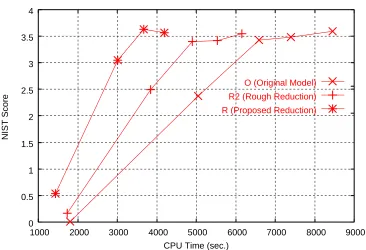
The translation experiment was conducted by successively changing the beam width of the for-ward search. Figures 7 and 8 show the results of the translation experiments, revealing that our pro-posed model can reduce the decoding time by ap-proximately half. This model can reduce decoding time to a much greater extent than the rough reduc-tion model, indicating that our state merging criteria are valid.
6 Conclusions
We proposed a method to compile statistical mod-els to achieve efficient decoding in a machine trans-lation system. In our method, each statistical sub-model is represented by a WFST, and all subsub-models
are composed beforehand. To reduce the ambiguity of the composed WFST, the states are merged ac-cording to the statistics of hypotheses while decod-ing. As a result, we reduced decoding time to
ap-proximately 0dc
g
e
of dynamic composition of sub-models, which corresponds to the conventional ap-proach.
In this paper, we applied the state merging method to a fully-expanded WFST and showed the effectiveness of this approach. However, the state merging method itself is general and independent of the fully-expanded WFST. We can apply this method to each submodel of machine translation. More generally, we can apply it to all WFST-like models, including HMMs.
Acknowledgements
We would like to thank F. J. Och for providing
GIZA++ and mkcls toolkits, and P. R. Clarkson for the CMU-Cambridge statistical language modeling toolkit v2. We also thank T. Hori for providing the
n-gram conversion program for WFSTs and F. Bond and S. Fujita for providing the bilingual corpus.
References
Srinivas Bangalore and Giueseppe Riccardi. 2001. A finite-state approach to machine translation. In
Proc. of North American Association of Compu-tational Linguistics (NAACL 2001), May.
Adam L. Berger, Peter F. Brown, Stephen A. Della Pietra, Vincent J. Della Pietra, Andrew S. Kehler, and Robert L. Mercer. 1996. Language transla-tion apparatus and method of using context-based translation models. United States Patent.
Peter F. Brown, Stephen A. Della Pietra, Vincent J. Della Pitra, and Robert L. Mercer. 1993. The mathematics of statistical machine translation: Parameter estimation. Computational
Linguis-tics, 19(2):263–311.
P.R. Clarkson and R. Rosenfeld. 1997. Statisti-cal language modeling using the cmu-cambridge toolkit. In Proc. of European Conference on
Speech Communication and Technology (EU-ROSPEECH’97).
G. Doddington. 2002. Automatic evaluation of machine translation quality using n-gram co-occurrence statistics. In Proc. of HLT 2002. William A. Gale and Kenneth W. Church. 1991.
Identifying word correspondences in parallel texts. In Proc. of Fourth DARPA Speech and
Nat-ural Language Processing Workshop, pages 152–
157.
de-# of States # of Transitions
T Model (D ) 3 59,026
NULL Model (G ) 4 11,810
Fertility Model (H ) 91,513 194,360
Language Model (I ) 14,532 30,140
Full Expansion(D
E
G
E
H
E
[image:6.595.158.454.73.150.2]I ) 233,045 2,452,621
Table 1: Submodel/Full-Expansion Model Size
NIST Score BLEU Score Decoding Time (sec.)
Static Composition (Full-Expansion Model) 3.4 0.037 6,596
Dynamic Composition (Conventional Method) 3.5 0.037 84,753
Table 2: Static / Dynamic Composition
coding and optinal decoding for machine trans-lation. In Proc. of the 39th Annual Meeting of
the Association for Computational Linguistics (ACL), pages 228–235, July.
Kevin Knight and Yaser Al-Onaizan. 1998. Trans-lation with finite-state devices. In Proc. of the 4th
AMTA Conference.
Kevin Knight. 1999. Decoding complexity in
word-replacement translation models.
Computa-tional Linguistics, 25(4):607–615.
Shankar Kumar and William Byrne. 2003. A
weighted finite state transducer implementation of the alignment template model for statistical machine translation. In Proc. of Human
Lan-guage Technology Conference of the North Amer-ican Chapter of the Association for Computa-tional Linguistics (HLT-NAACL), pages 142–149,
May - June.
Mehryar Mohri and Michael Riley. 2001. A weight pushing algorithm for large vocabulary speech recognition. In Proc. of European Conference
on Speech Communication and Technology (EU-ROSPEECH’01), September.
Mehryar Mohri, Fernando C. N. Pereira, and Michael Riley. 2002. Weighted finite-state trans-ducers in speech recognition. Computer Speech
and Language, 16(1):69–88.
Franz Josef Och and Hermann Ney. 2003. A
systematic comparison of various statistical alignment models. Computational Linguistics, 29(1):19–51.
Franz Josef Och, Nicola Ueffing, and Hermann
Ney. 2001. An efficient M N search algorithm
for statistical machine translation. In Proc. of
the ACL2001 Workshop on Data-Driven Machine Translation, pages 55–62, July.
Kishore Papineni, Salim Roukos, Todd Ward, and
Wei-Jing Zhu. 2002. BLUE: a method for auto-matic evaluation of machine translation. In Proc.
of the 40th Annual Meeting of the Association for Computational Linguistics (ACL), pages 311–
318, July.
Fernando Pereira and Michael Riley. 1997. Speech recognition by composition of weighted finite au-tomata. In Emmanuel Roche and Yves Schabes, editors, Finite-State Language Processing, chap-ter 15, pages 431–453. MIT Press, Cambridge, Massachusetts.
Christoph Tillmann and Hermann Ney. 2003. Word reordering and a dynamic programming beam search algorithm for statistical machine transla-tion. Computational Linguistics, 29(1):97–133, March.
Ye-Yi Wang and Alex Waibel. 1997. Decoding algorithm in statistical machine translation. In
Proc. of the 35th Annual Meeting of the Associa-tion for ComputaAssocia-tional Linguistics.
Taro Watanabe and Eiichiro Sumita. 2003.
[image:6.595.94.532.190.232.2]# of States # of Transitions
Proposed Model (Q ) 183,432 2,278,096
Rough Reduction Model (QRg ) 182,212 2,345,255
[image:7.595.138.486.174.416.2]Original Model (f ) 233,045 2,452,621
Table 3: Original/Reduction Model Size
0 0.005 0.01 0.015 0.02 0.025 0.03 0.035 0.04 0.045
1000 2000 3000 4000 5000 6000 7000 8000 9000
BLEU Score
CPU Time (sec.)
O (Original Model)
R2 (Rough Reduction) R (Proposed Reduction)
Figure 7: Ambiguity Reduction (BLEU)
0 0.5 1 1.5 2 2.5 3 3.5 4
1000 2000 3000 4000 5000 6000 7000 8000 9000
NIST Score
CPU Time (sec.)
O (Original Model) R2 (Rough Reduction)
R (Proposed Reduction)
[image:7.595.124.490.465.715.2]