Attention for Implicit Discourse Relation Recognition
Andre Cianflone, Leila Kosseim
Department of Engineering and Computer ScienceConcordia University
{a cianfl, kosseim}@encs.concordia.ca
Abstract
Implicit discourse relation recognition remains a challenging task as state-of-the-art approaches reach F1 scores ranging from 9.95% to 37.67% on the 2016 CoNLL shared task. In our work, we explore the use of a neural network which exploits the strong correlation between pairs of words across two discourse arguments that implicitly signal a discourse relation. We present a novel approach to Implicit Discourse Relation Recognition that uses an encoder-decoder model with attention. Our approach is based on the assumption that a discourse argument is “generated” from a previous argument and conditioned on a latent discourse relation, which we detect. Experiments show that our model achieves an F1 score of 38.25% on fine-grained classification, outperforming previous approaches and performing comparatively with state-of-the-art on coarse-grained classification, while computing alignment parameters without the need for additional pooling and fully connected layers.
Keywords:discourse relation recognition, sequence-to-sequence
1.
Introduction
Shallow discourse relation recognition refers to the auto-matic identification of the relation between two segments of text. For example in:
(1) I will go to ScotlandafterI complete my studies.
The underlined discourse connective connects the first dis-course argument (in italic) to the second disdis-course argu-ment (in bold) via atemporalrelation. Connectives consti-tute strong signals to identify discourse relations. In fact, given two arguments and a discourse connective many dis-course parsers at the 2016 CoNLL Shared Task on Multi-lingual Shallow Discourse Parsing (SDP) (Xue et al., 2016) were around 78% accurate in recognizing the discourse re-lation on the SDP blind dataset. On the other hand, in im-plicit relations no connective is used. This is the case in:
(2) I need to file my taxes.Tomorrow is the deadline.
In (2) the connective because is implied and the contin-gencyrelation is understood by the context. Unfortunately when the connective is absent, identifying the relation au-tomatically becomes much more challenging. At the same 2016 CoNLL SDP shared task, the best implicit discourse relation (IDR) score on the blind test set without connec-tives reached 37.67% (Xue et al., 2016). In this paper we present a model to automatically recognize implicit dis-course relations using an encoder-decoder with attention, a cross-argument word-pair alignment statistic in this con-text. We show that our model, with an F1 score of 38.25, outperforms other approaches on fine-grained classifica-tion, while performing comparatively with the state-of-the-art on coarse-grained classification.
2.
Previous Work
Beginning with (Zhang et al., 2015a) and notably in the past year with the CoNLL SDP (Xue et al., 2016), neu-ral network techniques have been used for IDR. Most of
these models are based on convolutional neural networks (CNN), inspired by (Zhang et al., 2015a) and other work on sentence classification with CNN (such as (Kim, 2014; Zhang et al., 2015b)). The insight into these many works is that neural networks are better suited at capturing seman-tic clues between the two arguments of an implicit relation than traditional methods heavily reliant on feature engineer-ing, as in (Pitler et al., 2009; Xue et al., 2015).
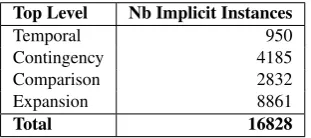
Top Level Nb Implicit Instances
Table 1: Top-level breakdown of the PDTB with entrel
merged intoexpansion
3.
Datasets & Tasks
3.1.
Datasets
Following the standard in the field, we used both the PDTB and the CoNLL SDP datasets. The PDTB dataset (Rashmi Prasad, 2008) contains 40,600 annotated discourse relations and their arguments over the 1 mil-lion word Wall Street Journal (WSJ) corpus (Prasad et al., 2008). The dataset includes four top-level classes of dis-course relations; temporal, contingency, comparison and
expansion; as well as level 2 and lever 3 types. For ex-ample, in the PDTB:
(3) USAir has great promise.By the second half of 1990, USAir stock could hit 60.
is labeled as “Contingency.Cause.Reason”. A fifth top-level relation,entrel (short forentity-based coherence), is also defined but has no lower-level types. Table 1 shows statistics of the PDTB dataset.
The CoNLL SDP dataset consists of the full PDTB dataset with a minor reduction in the number of subtypes (Xue et al., 2016). Additionally, the SDP dataset includes ablind test set, a second test set created specifically for the 2015 and 2016 editions of the shared task. The blind test set consists of newswire text selected from English Wikinews1 consistent with WSJ-style text and manually annotated with discourse relations and connectives (Xue et al., 2015).
3.2.
Tasks
Given the difficulty of automatic IDR, most work focuses only on top-level classification; i.e. classifying only the four top-level relations withentrel merged intoexpansion
as preferred by (Pitler et al., 2009; Rutherford and Xue, 2014; Ji and Eisenstein, 2015). The standard WSJ tion breakdown is to use sections 2-20 for training, sec-tions 21-22 for testing, and the other secsec-tions for develop-ment. Given the unbalanced dataset, as shown in Table 1, the task has traditionally been formulated as four binary classifiers. For the development and test sets, the negative samples consist of all other relations. The training set is evenly balanced between positive and negative where neg-atives samples are randomly drawn from WSJ sections 2 to 20 (excluding positives).
A notable exception to only top-level IDR was the 2015 and 2016 edition of the CoNLL SDP, which included fine-grained non-explicit discourse relation recognition.2 The fine-grained task is to recognize the 16 low-level subtypes
1https://en.wikinews.org
2Non-explicit discourse includes typesimplicit, entrel, and a
thirdaltlex, short foralternative lexicalization. Only a small
frac-with a single classifier. Additionally, the WSJ section breakdown is different compared to the top-level dataset. The SDP training set consists of WSJ sections 2-21, sec-tion 22 for development, and secsec-tion 23 for testing.
4.
Our Model
We describe our model in two modules, the encoder-decoder Recurrent Neural Network (RNN) with attention and two varieties of the classifier.
4.1.
Encoder-Decoder RNN with Attention
The standard encoder (Cho et al., 2014) encodes an in-put vector x, where x is represented as a sequence of word embedding vectors, into a single context vectorc =q(h1, . . . , hTx)and hidden stateht =f(xt, ht−1).
Func-tions f andq are nonlinearities, in our case Bidirectional RNN (Schuster and Paliwal, 1997) of type long short-term memory (LSTM) (Hochreiter and Schmidhuber, 1997). Normally, the decoder predicts a sequence of words yt
where eachytprediction is conditioned on past predictions
and context vectorc, maximizing the following joint prob-ability:
In the context of RNNs, the conditional probability of each ytin the joint probability of Eq.1 is modeled as a nonlinear
functiongwith inputyt, context vectorcand hidden state
st:
p(yt|{y1, . . . , yt−1}, c) =g(yt−1, st, c) (2)
(Bahdanau et al., 2015) propose a unique context vectorci
for each decoding time step, redefining the decoder condi-tional probability for each wordyias:
p(yi|y1, . . . , yi−1,x) =g(yi−1, si, ci) (3)
The context vectorciis a weighted sum over all input
hid-den states(h1, . . . , hT):
ais a feedforward neural network.
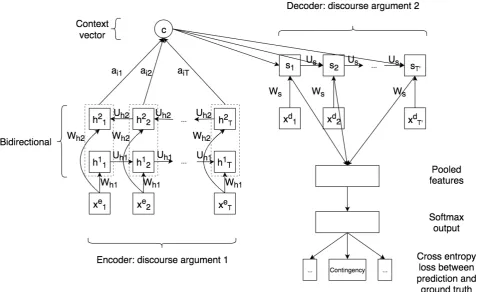
Using attention leads to a vectorized representation of the second argument (decoder output) which is not only in-formed of its context but also of its alignment, unlike Gated Relevance Networks (GRN) (Chen et al., 2016) where the arguments are not informed of the alignment. In the case of GRN, the two discourse arguments are vectorized with separate RNN layers (no interaction), followed by rele-vance layers (that compute word-pair interaction), and fi-nally pooling and fully connected layers.
4.2.
Classifiers
Given our classification task and since the decoder inputs (the second discourse argument words) are known and not predicted, the model is not trained by maximizing the like-lihood of the decoder targets, as in Eq.1, but rather by min-imizing the cross-entropy error between the predicted label
ˆ
yand the true labelyfor all possible labelsl:
E(y,yˆ) =−
l
X
i=1
yilog(ˆy) (5)
We experimented with two classifiers to predictyˆ. In the simplest case:
ˆ
y=f(W hT +b) (6)
wheref is the softmax function, hT is the final decoder
hidden state of size d,W ∈ Rl×d is a parameter matrix
andb ∈ Rl a bias vector. In this case the classifier only
relies on the last hidden state, minimizing the total number of parameters at the expense of information loss. We denote this Classifier with Attention CA, shown in Figure 1. In the second classifier,yˆis a function of:
p=maxTt=1(hdec1, . . . , hdect) (7)
h=g(Wdp+bd) (8)
ˆ
y=f(Wsh+bs) (9)
wherepis aT sized concatenated vector of the maximum values over each decoder hidden statehdec, i.e. 1D max
pooling. Wd ∈ Rv×T andW s∈Rl×v are parameter ma-trices, b ∈ Rv andb ∈ Rl are bias terms, and g a non-linearity. In this case each decoded time step informs the relation classification. We denote this Classifier from Se-quence with Attention CSA, as shown in Figure 2
5.
Experiments
In this section we outline our data preprocessing and ex-periments. The raw texts from the PDTB and the CoNLL SDP are converted to lower case and tokenized. Then we keep only the 10,000 most common words. After forming a dictionary of unique tokens, we substitute each token with a dense word embedding from a pretrained model. Fol-lowing the preferred embeddings used at the 2016 CoNLL SDP (Xue et al., 2016), we used the 300 dimensional pre-trained Word2Vec binaries3, trained by continuous skip-gram (Mikolov et al., 2013) for both top-level and fine-grained classification. While the PDTB samples contain additional data such as part-of-speech tags and parse trees, no additional data is used.
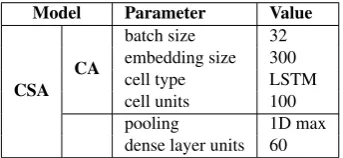
The top-level classification consists of four separately trained binary classifiers, while we train a single classi-fier for the fine-grained classification. We experiment us-ing LSTM and GRU (Cho et al., 2014) cells, optus-ing for LSTM since it showed slightly better results. The number of cell parameters were randomly searched at each train-ing run. We randomly switched between bidirectional en-coder or single direction. For the CSA, we additionally per-formed hyper-parameter search on the number of hidden
3
Table 2: Architecture parameters. Dense layer refers to the CSA model’s fully connected layer between pooling and softmax layers.
ID Author Blind Test Dev
ecnucs Wang 34.18 40.91 46.40 tbmihaylov Mihaylov 34.51 39.19 40.32 tao0920 Qin 35.38 38.20 46.33
gtnlp n/a 36.75 34.95 40.72
ttr Rutherford 37.67 36.13 40.32
CSA ours 35.07 28.05 36.58
CA ours 38.25 35.63 39.42
Table 3: F1 scores of fine-grained IDR compared to top 5 teams. (Wang and Lan, 2016; Mihaylov and Frank, 2016; Qin et al., 2016; Rutherford and Xue, 2016)
units. Our main parameters that produced the best perfor-mance are listed in Table 2. Our models were optimized with the Adam algorithm (Kingma and Ba, 2015). Models evaluated on the test sets are based on optimal validation set F1 score.
6.
Results & Analysis
Given the unbalanced datasets, performance is evaluated solely on F1 scores. Table 3, summarizes our top-level clas-sification results on the PDTB dataset in comparison with other authors and Table 4 our fine-grained classification re-sults4on the CoNLL SDP dataset.
As shown in Table 3, our CA model scored 38.25% on the fine-grained classification, over state-of-the-art F1 score of 37.67%. Observing the blind test set results in Table 3 we note how our model generalizes well to a different dataset (Wikinews). Other top models such as “gtnlp” and “ec-nucs” have a more than 10 point difference between the de-velopment score and blind test score compared to 2 points in the CA case.
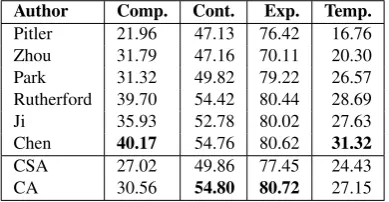
For the top-level classification, our CA model (see Table 4) scored well in the case ofexpansionwith 80.72% F1 score, the largest relation class, andcontingency, whiletemporal
was better than most other approaches. The F1 of 30.56% forcomparisonwas far from the top result in Table 4, likely due to the small dataset size.
It is interesting to note that the results achieved by the CA model are based on a relatively shallow, single bidirectional RNN encoder layer and single RNN decoder layer with at-tention. It is possible that the chosen input embedding had a minor impact on our results. We would have liked to measure the embedding effect to compare with (Chen et al., 2016), but to our knowledge the embedding is not publicly available.
4We used the official CoNLL scorer for comparison:
Figure 1: Our classifier with attention (CA): an encoder-decoder recurrent neural network with attention with the last hidden state used for classification. In the doted rectangles, the forward and backward hidden states are concatenated. Note there is no backpropagation through time from output predictions at each time step. Only the final cross-entropy error is backpropagated through time.
Author Comp. Cont. Exp. Temp. Pitler 21.96 47.13 76.42 16.76 Zhou 31.79 47.16 70.11 20.30 Park 31.32 49.82 79.22 26.57 Rutherford 39.70 54.42 80.44 28.69
Ji 35.93 52.78 80.02 27.63
Chen 40.17 54.76 80.62 31.32 CSA 27.02 49.86 77.45 24.43
CA 30.56 54.80 80.72 27.15
Table 4: F1 scores of top-level IDR for: comparison, con-tingency, expansion, temporal. Note thatentrelis merged into expansion, as done in previous works. (Pitler et al., 2009; Zhou et al., 2010; Park and Cardie, 2012; Rutherford and Xue, 2014; Ji and Eisenstein, 2015; Chen et al., 2016)
We were surprised by the CSA’s lower performance in all cases. We believed the model would be more robust if the classification layer had inputs from all decoded hidden states directly. However, using only the final state vector resulted in higher classification score while using less pa-rameters. This may be due to overfitting. We would need to reevaluate the model on a larger dataset.
7.
Conclusion
We presented an efficient encoder-decoder model with at-tention for implicit discourse relation recognition. Our model computes attention between discourse argument word pairs without feature engineering and without the need for additional fully connected layers, minimizing the number of trainable parameters. Finally, we show that our model generalizes well to unseen datasets on fine-grained classification, outperforming state-of-the-art without large variance in scoring between development and test sets, and outperforms in two categories in the coarse-grained case. In future work we would like to explore in more detail au-tomatically learned alignment for IDR and text generation based on these models.
Acknowledgement
The authors would like to thank the anonymous reviewers for their feedback on the paper. We gratefully acknowledge the financial support of NSERC and the NVIDIA Corpora-tion for the donaCorpora-tion of the Titan X Pascal GPU used for this research.
8.
Bibliographical References
Bahdanau, D., Cho, K., and Bengio, Y. (2015). Neural ma-chine translation by jointly learning to align and trans-late. InAdvances in Neural Information Processing Sys-tems (NIPS 2015), pages 649–657, Montreal, Canada, December.
Biran, O. and McKeown, K. (2013). Aggregated word pair features for implicit discourse relation disambiguation. InProceedings of the 51st Annual Meeting of the Associ-ation for ComputAssoci-ational Linguistics (ACL), pages 69–73, Sofia, Bulgaria.
Chen, J., Zhang, Q., Liu, P., Qiu, X., and Huang, X. (2016). Implicit discourse relation detection via a deep architec-ture with gated relevance network. InProceedings of the
54th Annual Meeting of the Association for Computa-tional Linguistics (ACL-2016), pages 1726–1735. Cho, K., Van Merri¨enboer, B., Gulcehre, C., Bahdanau,
D., Bougares, F., Schwenk, H., and Bengio, Y. (2014). Learning phrase representations using RNN encoder-decoder for statistical machine translation. pages 1724ˆa– 1734, Doha, Qatar.
Cui, Y., Chen, Z., Wei, S., Wang, S., Liu, T., and Hu, G. (2017). Attention-over-attention neural networks for reading comprehension. pages 593–602.
Hochreiter, S. and Schmidhuber, J. (1997). Long short-term memory.Neural Computation, 9(8):1735–1780. Ji, Y. and Eisenstein, J. (2015). One vector is not enough:
Entity-augmented distributional semantics for discourse relations. Transactions of the Association for Computa-tional Linguistics, pages 329–344, June.
Kim, Y. (2014). Convolutional neural networks for sen-tence classification. arXiv preprint arXiv:1408.5882. Kingma, D. and Ba, J. (2015). Adam: A method for
stochastic optimization. InProceeding of the 2015 Inter-national Conference on Learning Representation (ICLR 2015), San Diego, California.
Lee, K., He, L., Lewis, M., and Zettlemoyer, L. (2017). End-to-end neural coreference resolution.
Mihaylov, T. and Frank, A. (2016). Discourse relation sense classification using cross-argument semantic simi-larity based on word embeddings. InProceedings of the Twentieth Conference on Computational Natural Lan-guage Learning: Shared Task (CoNLL), pages 100–107, Berlin, Germany.
Mikolov, T., Sutskever, I., Chen, K., Corrado, G. S., and Dean, J. (2013). Distributed representations of words and phrases and their compositionality. In Advances in neural information processing systems (NIPS 2013), pages 3111–3119, Lake Tahoe, USA, December. Park, J. and Cardie, C. (2012). Improving implicit
dis-course relation recognition through feature set optimiza-tion. InProceedings of the 13th Annual Meeting of the Special Interest Group on Discourse and Dialogue (SIG-DIAL), pages 108–112. Association for Computational Linguistics.
Pitler, E., Louis, A., and Nenkova, A. (2009). Auto-matic sense prediction for implicit discourse relations in text. In Proceedings of the Joint Conference of the 47th Annual Meeting of the ACL and the 4th Interna-tional Joint Conference on Natural Language Processinf (ACL/IJCNLP). Volume 2, pages 683–691. Association for Computational Linguistics.
Prasad, R., Dinesh, N., Lee, A., Miltsakaki, E., Robaldo, L., Joshi, A. K., and Webber, B. L. (2008). The Penn Discourse TreeBank 2.0. InProceedings of the 6th Inter-national Conference on Language Resources and Evalu-ation (LREC), Marrakech, Morocco.
Qin, L., Zhang, Z., and Zhao, H. (2016). Shallow discourse parsing using convolutional neural network. In Proceedings of the Twentieth Conference on Com-putational Natural Language Learning: Shared Task (CoNLL), pages 70–77, Berlin, Germany.
re-current neural model with attention for the recognition of chinese implicit discourse relations. InProceedings of the 55th Annual Meeting of the Association for Com-putational Linguistics (ACL), pages 256–262.
Rutherford, A. and Xue, N. (2014). Discovering implicit discourse relations through brown cluster pair represen-tation and coreference patterns. In Proceedings of the 14th Conference of the European Chapter of the Associ-ation for ComputAssoci-ational Linguistics (EACL), pages 645– 654, Gothenburg, Sweden, April. Association for Com-putational Linguistics.
Rutherford, A. and Xue, N. (2016). Robust non-explicit neural discourse parser in english and chinese. In Pro-ceedings of the Twentieth Conference on Computational Natural Language Learning: Shared Task (CoNLL), pages 55–59, Berlin, Germany.
Schuster, M. and Paliwal, K. K. (1997). Bidirectional re-current neural networks. IEEE Transactions on Signal Processing, 45(11):2673–2681.
Wang, J. and Lan, M. (2016). Two end-to-end shallow discourse parsers for english and chinese in conll-2016 shared task. InProceedings of the Twentieth Conference on Computational Natural Language Learning: Shared Task (CoNLL), pages 33–40, Berlin, Germany.
Xue, N., Ng, H. T., Pradhan, S., Bryant, R. P. C., and Rutherford, A. T. (2015). The conll-2015 shared task on shallow discourse parsing. InProceedings of the Twen-tieth Conference on Computational Natural Language Learning: Shared Task (CoNLL), pages 1–16, Beijing, China.
Xue, N., Ng, H. T., Rutherford, A., Webber, B., Wang, C., and Wang, H. (2016). Conll 2016 shared task on mul-tilingual shallow discourse parsing. Proceedings of the Twentieth Conference on Computational Natural Lan-guage Learning: Shared Task (CoNLL), pages 1–19.
Zhang, B., Su, J., Xiong, D., Lu, Y., Duan, H., and Yao, J. (2015a). Shallow convolutional neural network for im-plicit discourse relation recognition. In Proceedings of the 2015 Conference on Empirical Methods in Natural Language Processing, pages 2230–2235, Lisbon, Portu-gal, September. Association for Computational Linguis-tics.
Zhang, X., Zhao, J., and LeCun, Y. (2015b). Character-level convolutional networks for text classification. In
Proceedings of the 29th Annual Conference on Neu-ral Information Processing Systems (NIPS 2015), pages 649–657, Montreal, Canada, December.
Zhou, Y. and Xue, N. (2012). Pdtb-style discourse annota-tion of chinese text. InProceedings of the 50th Annual Meeting of the Association for Computational Linguis-tics: (ACL), pages 69–77. Association for Computational Linguistics.
Zhou, Z.-M., Xu, Y., Niu, Z.-Y., Lan, M., Su, J., and Tan, C. L. (2010). Predicting discourse connectives for implicit discourse relation recognition. InProceedings of the 23rd International Conference on Computational Linguistics: Posters, pages 1507–1514. Association for Computational Linguistics.