*Corresponding author:Yashswi Chauhan ISSN: 0976-3031
Research Article
EFFICACY OF STRUCTURED TEACHING PROGRAMME (STP) ON PATIENT’S
KNOWLEDGE REGARDING COLOSTOMY CARE
Yashswi Chauhan
1*., Muraleedharan S
2and Sanam Jindal
31
School of Nursing, Noida International University, Greater Noida
2
Department of Medical Surgical Nursing, Maharaja Agrasen Nursing College, Bahadurgarh, Haryana
3Department of Surgical Oncology, Sir Ganga Ram Hospital, New Delhi
DOI: http://dx.doi.org/10.24327/ijrsr.2017.0811.1062
ARTICLE INFO ABSTRACT
A colostomy is an artificial opening in the abdominal wall that is made during surgery, which changes normal body function to allow stools to pass after a disease or injury. The study was planned to assess the effectiveness of structured teaching programme on patient’s knowledge on self care management of colostomy in tertiary care hospitals. Experimental approach with one group pre test - post test design was used for 30 patients. Majority 46.7 % of patients belonged to the age group of 31-40 years, and 86.7% were males. The knowledge score gained by the respondents in the results shows that the mean value of knowledge in pre test was 8.63 and at post assessment was 17.1. Since, the “p” value for the test is 0.05. Structured teaching programme was highly effective to improve the knowledge score of subjects towards colostomy care.
INTRODUCTION
A colostomy is an opening in the abdominal wall that is made during surgery, which changes normal body function to allow stools to pass after a disease or injury. The end of the colon is brought out through this opening to form a stoma. Where the stoma will be on the abdominal wall depends on which part of the colon is exteriorized (Gayner, 1990).
Ostomy care was an isolated field until 1950s even in developed countries. It was only in 1975; ostomy care was inaugurated in India at Mumbai by formation of Ostomy Association of India. The association was started at Tata Memorial Hospital under the aegis of Indian Cancer Society. In 1978, the first stoma clinic came into existence at the same hospital. Now there are many Ostomy Associations and Stoma Clinics established all over the country to guide an ostomate towards comprehensive rehabilitation (Center, 2009).
Intestinal ostomy is a procedure that is implemented to treat several conditions, like acute diverticulitis, rectal cancer, trauma, or inflammatory bowel disease. This therapeutic approach can be temporary or permanent, and creates many challenges in terms of quality of life and functioning. In
colostomy and ileostomy surgeries, normal bowel function is interrupted, and waste is passed through the abdominal wall through an opening called a stoma into an appliance that must be emptied periodically. Reasons for this surgery are varied, but the most common causes are colon cancer and inflammatory bowel disease (Lewis, 2011).
Although every effort is made to preserve intestinal and tissue integrity, a large number of patients undergo ostomy surgery each year. The purpose of ostomy is to treat and reduce patients’ pain and discomfort, but in many cases ostomy leads to intensified distress and suffering for patients, and causes severe psychological stress (Gayner, 1990) as a result of skin irritation (76%), pouch leakage (62%), offensive odor (59%), reduction in pleasurable activities (54%), and depression/anxiety (53%) (Umar et al., 2009). In such circumstances, it is worthwhile to assess quality of life in the evaluation of the outcomes of various therapeutic procedures along with their final impact on patients’ lives (Voergaard et al., 2007).
Making good decisions to control disease complications, treatment, and improving quality of life is a very important goal in treating and caring for patients with cancer. After
Recent Scientific
Research
International Journal of Recent Scientific Research
Vol. 8, Issue, 11, pp. 21378-21382, November, 2017
Copyright © Yashswi Chauhan et al, 2017, this is an open-access article distributed under the terms of the Creative Commons Attribution License, which permits unrestricted use, distribution and reproduction in any medium, provided the original work is properly cited.
DOI: 10.24327/IJRSR
CODEN: IJRSFP (USA)
Article History:
Received 18th August, 2017 Received in revised form 10th
September, 2017
Accepted 06th October, 2017
Published online 28th November, 2017
Key Words:
Knowledge Regarding Colostomy Care
surgery, many cancer patients with a stoma experience more stress and a variety of physical problems causing worry and shame. The stoma is usually red, swollen, and large immediately after surgery, which is unpleasant for the patient to look at for the first time. This emotional distress, along with physical problems and pain, isolation from others, and fear of death, will inevitably reduce quality of life further in ostomy patients (Ratliff et al., 2005).
The nursing role of caring for ostomy patients has evolved from the bedside nurse to an enterstomal therapist (ET) or a nurse clinical specialist with ostomy care experience. Routine practice calls for staff nurses and physicians to refer patients with a new ostomy or patients with stoma problems to these specialists. The responsibility for successful outcomes typically falls on these specialized nurses (Lian et al., 2011).
Need For the Study
Teaching patients practical skills in stoma care is a complex process and although, arguably, at the very heart of stoma care nursing practice, has been largely ignored in the literature. Teaching principles are based upon social learning theory and educationalists provide guidelines on the most effective way to teach a practical skill. These guidelines have been utilized by nurses when teaching patients with newly formed stomas how to change a pouch. The process of adapting to a stoma and its daily management takes time. Psychologically, however, some patients will adapt more easily than others and researchers have attempted to identify factors which may account for this. Studies have demonstrated that patients who are satisfied with the amount of preoperative information they receive are less likely to develop psychological problems. Psychological adjustment may be affected if patients feel that they have developed insufficient pouch changing skills or have problems with leakage from their pouch or sore skin around their stoma. Studies have also demonstrated that cognitive factors, such as patients feeling in control of their illness and stoma, have been found to play a role in psychological adaptation. Clinical nurse specialists in stoma care are in an ideal position to target these cognitive factors using a variety of strategies including effective practical teaching to empower patients, thus facilitating psychological adaptation following stoma surgery. Ostomy education is based on principles of adult learning, including assessment of the learners' readiness, ability, and need to learn. Such teaching incorporates specific strategies designed to promote cognitive, affective, and psychomotor learning and strategies to overcome potential cultural barriers. So as a researcher I have a wide experience in working with colostomy patient in Gastro-intestinal surgical unit and have observed patient after colostomy and majority of patient showed poor care of colostomy, lack of awareness about colostomy and living with colostomy. Therefore the study was conducted to evaluate the effectiveness of structured teaching program on knowledge regarding self care management among patients with colostomy at selected hospital of Delhi NCR.
MATERIALS AND METHODS
The research design used for this study is Pre Experimental - One Group Pre-Test Post-Test Design.
Setting of the Study: The study was conducted in selected tertiary care hospitals of Delhi, NCR.
Study Duration: Four weeks
Study Population: Colostomy patients at selected hospitals in Delhi, NCR.
Sample Size: A total of 30 patients with colostomy were selected to evaluate knowledge of self care management of colostomy.
Inclusion Criteria
1. Patients with colostomy who are admitted in selected Hospital.
2. Patients who are able to read and write English or Hindi.
3. Patients who are available during the period of data-collection.
4. Patients who are willing to participate in the study.
Exclusion Criteria
1. Patients who are not willing to participate.
2. Patient who are not able to perform self care activities.
Data Collection Procedure
A formal permission was obtained from the ethical committees of the selected hospitals of Delhi NCR. A total of 30 patients were selected for the study as per the inclusion criteria of study. Self introduction was also given to the patients along with their attendants. The purpose of the study was explained to the subjects and Questionnaire and attitude scale for assessment of knowledge of colostomy was given on the same day. Structured teaching programme (STD) on colostomy was administered to the patient on the same day of pre-test. Post-test assessment of knowledge of colostomy patient was done by giving Questionnaire and attitude scale on seventh day.
Statistical Analysis
Analysis of data was done in accordance with the objectives. The data was analyzed using frequencies and percentage for demographic characteristics. Mean, Mean Difference, Median and Standard Deviation was used to describe the level of knowledge score. Paired‘t’ test was also done to find out the effectiveness of the structured teaching programme in terms of knowledge. Chi-square was used to describe the association between the post- test score of knowledge with the selected demographic variables.
RESULTS
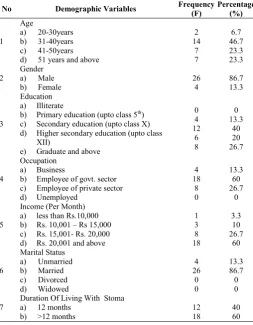
Distribution of subjects based on socio demographic variables
S. No Demographic Variables Frequency
(F) Percentage (%) 1 Age a) 20-30years b) 31-40years c) 41-50years
d) 51 years and above
2 14 7 7 6.7 46.7 23.3 23.3 2 Gender a) Male b) Female 26 4 86.7 13.3 3 Education a) Illiterate
b) Primary education (upto class 5th)
c) Secondary education (upto class X)
d) Higher secondary education (upto class
XII)
e) Graduate and above
0 4 12 6 8 0 13.3 40 20 26.7 4 Occupation a) Business
b) Employee of govt. sector
c) Employee of private sector
d) Unemployed 4 18 8 0 13.3 60 26.7 0 5
Income (Per Month)
a) less than Rs.10,000
b) Rs. 10,001 – Rs 15,000
c) Rs. 15,001- Rs. 20,000
d) Rs. 20,001 and above
1 3 8 18 3.3 10 26.7 60 6 Marital Status a) Unmarried b) Married c) Divorced d) Widowed 4 26 0 0 13.3 86.7 0 0 7
Duration Of Living With Stoma
a) 12 months
b) >12 months
12 18
40 60
In the present study, majority of patients (46.7%) were in the age group 31-40 years while 86.7% patients were males. As regard to education level majority of patients (40%) had secondary education and 60% patient were employed in government sector with income of Rs. 20,000 or above. Majority of the patients were married and had stoma for more than 12 months.
Table 2 Distribution of overall knowledge score
S. No.
Knowledge Score
Pre Test Post Test
Frequency Percentage Frequency Percentage
1 Poor 11 36.7% 0 0%
2 Average 19 63.3% 5 16.7%
3 Good 0 0% 25 83.3%
In pre-test assessment 63.3% of the subjects had average (8-10) knowledge; 36.7% of the subjects had poor knowledge (0-7) and none of the subject had good (11-15) knowledge. Whereas, post-test knowledge of the subjects received the score between 11-15 (good) score the maximum 83.3% and 16.7% of the subjects received the score 8-10 (Average), no sample got the poor score in study group as shown in table 2.
Table 3 Pair t test for the knowledge score
S. No Observations Mean Mean
Difference
Standard
Deviation ‘t’ Value df “p”
1 Pre Test 8.63
8.67 2.45 3.319* 29 0.05
2 Post test 17.1 2.86
The knowledge score gained by respondents in results shows that the mean value of knowledge in pretest was 8.63 ± 1.30 and at post test was 17.1 ± 1.65 (table 3). Since the “p” value for the test is 0.05. The calculated ‘t’ value was 3.319 which
shows that there was a significant difference between mean pre test and mean post test knowledge score. This shows that the obtained mean difference of pre-test and post-test knowledge score was a true difference and not by chance. So, It can be concluded that STP is effective for self care and management of the colostomy patients.
Table 4 Association between the Post-test Knowledge Score and Socio demographic variables
S.No Characteristics Below Mean Above Mean df
Chi Square Value S/ NS 1 AGE a) 20-30years b) 31-40years c) 41-50years
d) 51 years and above
1 4 3 6 1 10 4
1 3
6.30 NS 2 GENDER a) Male b) Female 12 2 14
2 1 0.011 NS
3
EDUCATION LEVEL
a) Illiterate
b) Primary education (upto
class 5th)
c) Secondary education ( upto
class X)
d) Higher secondary education
( upto class XII)
e) Graduate and above
0 2 5 2 5 0 2 7 4 3
3 11.17 S
4
OCCUPATION
a) Business
b) Employee of govt. sector
c) Employee of private sector
d) Unemployed 2 6 6 0 2 12 2 0
2 3.819 NS
5
FAMILY INCOME PER MONTH
a) less than Rs.10,000
b) Rs. 10,001 – Rs 15,000
c) Rs. 15,001- Rs. 20,000
d) Rs. 20,001 and above
0 2 2 10 1 1 6 8
3 3.39 NS
6 MARITAL STATUS a) Unmarried b) Married c) Divorced d) Widowed 3 11 0 0 1 15 0 0
1 1.424 NS
7
DURATION OF LIVING WITH STOMA
a) 12 months
b) >12 months
6 8
6
10 1 0.06 NS
Chi-square is used to find out the association between post-test score of knowledge with socio demographic variables. The result shows a positive significant association with the education level with chi value of (11.17) which was greater than the table value of chi square (9.49) at d/f at 0.05 level of significance (table 4). This indicated that the education level and their post test score had significant association and were dependent on each other. Hence it shows that there is an impact of the education level on the knowledge. On computation it was found that there was no significant association between the post test knowledge score with the demographic variables including age, gender, occupation, family income, marital status, duration of living with stoma at 0.05 level of significance. This shows that these demographic variables did not have significant association with knowledge score and were not dependent on each other.
DISCUSSION
41-Knowledge Regarding Colostomy Care
50 years, 23.3% of respondents belonged to 51 years and above. 6.6% of respondents belonged to 21-30 years. There was no study to support this sample characteristic.
Level of knowledge of patient about colostomy care before structured education. The knowledge questionnaire consisted of 20 items regarding colostomy care of patient. The knowledge score gained by the respondents in the results shows that the mean value of knowledge in pre-test was 8.63 ± 1.30. The effectiveness of structured education programme on the level of knowledge about colostomy care of the patient as a part of the present study, pre-test statistically proved that study subjects had poor knowledge about colostomy care of patient (Lewis, 2011). Indicated the various level of knowledge from poor, average and good, based on these findings, the intensity, duration of class hours, teaching learning activity and the teaching aid were decided. The session of planned/ structured education programme with suitable modifications were carried out. On the 7th day, post test was carried out by read ministering the knowledge questionnaire. Comparison of pre test score with post test score was analyzed and found that there was statistically significant gain in the knowledge score obtained by subjects towards colostomy care of patient. The knowledge score gained by the respondents in the results shows that the mean value of knowledge in pre test was 8.43 and at post test was 17.1, the “p” value for the test is 0.05, Paired ’t’ test revealed that subjects had significant knowledge gain after STP. Thus, it is stated that the study “There will be a statistically significant difference in the scores obtained by the patients on the level of knowledge about colostomy care prior to and after the structured education program” was retained (Pittman et al., 2008).
CONCLUSION
Intervention of STP and how to change colostomy bag were effective in pre experimental group to improve self care management of colostomy. The STP was effective in maintaining proper hygiene, prevent infection, self care management, changing bag in colostomy patients.
Nursing Implications
The study has several implications in nursing practice, nursing research, nursing administration and nursing education.
Nursing Practice
Furthermore implication of this study will help in reducing the hospital stay and cost of the treatment in colostomy patients. Colostomy increases the risk of infection of the surrounding skin and infection of stoma, malnutrition, discontinuation of treatment, complications of the stoma that are stoma retraction, prolapsed, hernia, psychosexual problems in cancer patients. Colostomy also leads to poor quality of life so this research will build up basis to improve the quality of life of patients with lifelong colostomy.
Nursing Education
The study has an important implication for nursing education. It is the student life where a young student can be shaped or molded and helped to develop sense of responsibility towards the patients. Students should be taught about holistic care. In order to provide evidence based nursing, the nurse educator
should teach and provide learning experience to student nurses regarding colostomy care and changing of bag. They should be taught in detail about assessment and care of stoma. Education has the opportunity to plan and play an important role in changing the behavior of learners. There is urgent need to take up the studies which identify the prevalence of colostomy. More nursing personnel should take interest in developing scientifically tested material on prevention and control of colostomy surgery.
Nursing Administration
There is need to sensitize the administration about the colostomy care and changing of colostomy bag as an effective nursing intervention so that, they should feel the need to introduce use of colostomy care and bag changing as a routine in the care of patient with colostomy. As administration to ensure quality, they should utilize and rely upon evidence based nursing practice. As the study reveals that the patients self care have more comfort in terms of relief from infections as compared to those not using. The nurse administrator should organize in service education program for the nurses to teach them about colostomy care.
Nursing Research
There must be constant research to develop its body of knowledge, to test its strategies and ensure that is action makes a difference thoughtful people in nursing remind us that we must lay emphasis on the use of research as well as conduct research. No profession can exist without research to develop its body of knowledge, to test its strategies and ensure that its action make a difference. Thoughtful people in nursing remind us that we must lay emphasis on the use of research findings as well as on the conduct of research. The health care environment today is dynamic and more demanding. There is a need to promote research based practice as nursing moves towards as an independent professional practice mode. The researcher found that no enough studies had been conducted in this aspect to improve the quality of life of patient with colostomy. So nurses must take up research in this area so that quality care can be developed and implemented in this area. Nursing administrators at all levels of organization must create environment for research in nursing. They should encourage nursing personnel to make use of these results in the practice field.
Limitations
The limitations of the study were,
1. The duration of the study is limited for four weeks only. This limits the generalization of study findings. 2. Sample size is limited to 30 only.
Recommendations
On the basis of the findings of the study, the following recommendations were made.
1. This study can be done at community level to assess the knowledge of people on colostomy.
References
1. Gayner S.E. (1990) The long houl; The effect of home care on caregiver image. Journal of nursing scholarship, 22(4); 208-212.
2. Center et al. (2009) International Trends in Colorectal Cancer Incidence Rates. Cancer Epidemiology Biomarkers and Prevention, 18(6): 1688.
3. Lewis, Heitkemper Driksen, O’Brien Bucher. Medical Surgical Nursing, Assessment and management of clinical problems.7th ed: South Asian adaptation. 2011. 4. Umar et al. (2009) Alarming Colorectal Cancer
Incidence Trends: A Case for Early Detection and Prevention. Cancer Epidemiology Biomarkers and Prevention, 18(6): 1672.
5. Voergaard, L.L., Vendelbo, G., Carlsen, B., Jacobsen, L., Nissen, B., Mortensen, J., Hansen, G., Bach, K., Baech, S.B. (2007) Ostomy bag management: comparative study of a new one- piece closed bag. Br J Nurs, 16(2): 95-96.
6. Ratliff, C.R., Scarano, K.A., Donovan, A.M., Colwell, J.C. (2005) Descriptive study of peristomal complications: 32(1): 33-37.
7. Lian, L., Wu, X.R., He, X.S., Zou, Y.F., Wu, X.J., Lan, P., Wang, J.P. (2011) Extraperitoneal vs. intraperitoneal route for permanent colostomy: a meta-analysis of 1,071 patients. Int J Colorectal Dis, 27(1):59-64.
8. Pittman, J., Rawl, S.N., Schmidt, C.M., GrantM, K.O.C.Y., Wendel, C., Krouse, R.S. (2008) Demographic and clinical factors related to ostomy complications and Quality of life in veterans with an ostomy. J Wound Continence Nurs, 35(5): 493-503.
*******
How to cite this article: