
University of South Carolina
Scholar Commons
Theses and Dissertations
1-1-2013
Benthic Boundary Layer Processes: Bedform
Evolution and Bottom Turbulence
Timothy Robert Nelson University of South Carolina
Follow this and additional works at:https://scholarcommons.sc.edu/etd
Part of theGeology Commons
This Open Access Dissertation is brought to you by Scholar Commons. It has been accepted for inclusion in Theses and Dissertations by an authorized administrator of Scholar Commons. For more information, please [email protected].
Recommended Citation
B
ENTHICB
OUNDARYL
AYERP
ROCESSES:
B
EDFORME
VOLUTION ANDB
OTTOMT
URBULENCEby
Timothy Robert Nelson
Bachelor of Science University of Kentucky, 2004
Master of Science
University of South Carolina, 2011
Submitted in Partial Fulfillment of the Requirements
For the Degree of Doctor of Philosophy in
Geological Sciences
College of Arts and Sciences
University of South Carolina
2013
Accepted by:
George Voulgaris, Major Professor
Alexander E. Yankovsky, Committee Member
Scott M. White, Committee Member
John C. Warner, Committee Member
A
CKNOWLEDGEMENTSFinancial support for this work was partially provided by the National Science
Foundation (NSF OCE-0451989, OCE-0535893, and OCE-1132130, awarded to George
Voulgaris) and by the South Carolina Coastal Erosion Project, a cooperative study
supported by the US Geological Survey and the South Carolina Sea Grant Consortium
(Sea Grant Project no: R/CP-11). The Georgia data set was collected onboard the R/V
Savannah of the Skidaway Institute of Oceanography while the Long Bay data set was
collected onboard the R/V Dan More with assistance from the US Geological Survey
field support personnel. Additional support was provided in the form of instructional
assistantships through the University of South Carolina.
I would like to express my personal gratitude to my advisor, Dr. George
Voulgaris, for the opportunity to work in his lab and his guidance throughout graduate
school. I also express my thanks to my committee members Dr. Alexander Yankovsky,
Dr. Scott White, and Dr. John Warner for their helpful feedback. Previous and current
members of the CPSD lab have been invaluable with data collection, interpretation, and
have been there to answer any questions.
I would also like to thank my family, without whom I would not have finished.
My parents, Robert and Marijo Nelson, and grandfather, Donald Keil, have always been a
constant source of encouragement and motivation throughout my life and always
encouraged me to follow my dreams. I would also like to thank my in-laws, Dwayne and
degree. My deepest heart felt gratitude goes to my awesome wife Tania Nelson, who has
always encouraged me to pursue my goals, provided tremendous support through rough
days, and has been very understanding of the long work hours and months apart while
working on research. Her constant support, encouragement, and love have kept me going
A
BSTRACTBedform roughness, caused by ripples on the seabed, plays an important role in
controlling sediment dynamics in the nearshore region. In this dissertation, the temporal
and spatial evolution of ripples from two field sites located in the South Atlantic Bight,
offshore Long Bay, SC and Georgia are used to relate wave-induced ripple geometry
(wavelength and orientation) to near bed directional wave velocities. 2-D spectral
analysis techniques were developed to automate detection of ripple wavelength, direction,
and irregularity. This analysis showed that magnitude, direction, and duration of wave
forcing controls ripple geometry and irregularity. During highly energetic events, ripple
geometry changes rapidly and the ripples align with the main wave direction. During
periods of low energy conditions, close to the critical conditions for initiation of sediment
motion, ripple evolution occurs at a much slower rate often leading to irregularities such
as terminations and bifurcations along the ripple crest. Under constantly changing wave
direction, the rippled bed becomes highly disorganized.
Equilibrium ripples were found to occur only when either strong wave forcing
was present or the forcing remained constant for a long duration. These equilibrium
ripples, when combined to a database of existing published ripple measurements, were
found to have a wavelength that scales with the wave orbital semi-excursion and
sediment grain diameter. Ripple steepness was found to remain relatively constant and it
development of a new equilibrium ripple predictor suitable for application in a wide
range of wave and sediment conditions.
In order to describe the temporal variability between equilibrium states, a 2-D
time-variable ripple prediction model developed. This new model allowed for the
prediction of ripple wavelength, height, and orientation. Since ripple irregularity is
associated with directionality, the new model also predicts the irregularity of the rippled
seabed and second order ripples (i.e. cross-ripples). This model was tested against
existing time-dependent models and found to improve predictions of wavelength, height,
and orientation, especially for relict ripples.
Turbulence was measured via the eddy correlation and inertial dissipation
methods from which drag coefficients were calculated. The data reveal a trend of
decreasing drag for increasing ripple irregularity and increasing ripple height. In similar
fashion, suspended sediment concentrations were calculated from ABS systems and it
was found that convective sediment resuspension extended to greater elevation above the
T
ABLE OFC
ONTENTSACKNOWLEDGEMENTS ... iii
ABSTRACT ...v
LIST OF TABLES ...x
LIST OF FIGURES ... xi
CHAPTER 1:INTRODUCTION ...1
1.1BACKGROUND ...1
1.2SCOPE OF DISSERTATION ...4
CHAPTER 2:PREDICTING WAVE-INDUCED RIPPLE EQUILIBRIUM GEOMETRY ...8
2.1INTRODUCTION ...9
2.2EXISTING EQUILIBRIUM MODELS ...13
2.3DATA AVAILABILITY ...24
2.4RESULTS ...34
2.5DISCUSSION ...46
2.6CONCLUSIONS ...58
CHAPTER 3:TEMPORAL AND SPATIAL EVOLUTION OF WAVE-INDUCED RIPPLE GEOMETRY: REGULAR VS.IRREGULAR RIPPLES ...60
3.1INTRODUCTION ...60
3.2DATA COLLECTION...63
3.3METHODOLOGY ...66
3.5DISCUSSION ...89
3.6CONCLUSIONS ...101
CHAPTER 4:PREDICTING RIPPLE TEMPORAL AND SPATIAL EVOLUTION ...103
4.1INTRODUCTION ...103
4.22-DTRANSIENT RIPPLE MODEL DESCRIPTION ...107
4.3RESULTS ...114
4.4DISCUSSION ...127
4.5SUMMARY AND CONCLUSIONS ...135
CHAPTER 5:TURBULENCE AND BOTTOM ROUGHNESS IN THE PRESENCE OF BEDFORMS ..137
5.1INTRODUCTION ...137
5.2BED SHEAR STRESS ESTIMATION METHODS ...138
5.3DATA DESCRIPTION ...143
5.4ANALYSIS ...163
5.5SUMMARY AND CONCLUSIONS ...171
CHAPTER 6:THE INFLUENCE OF THE RIPPLE GEOMETRY AND SHAPE ON SUSPENDED SEDIMENT CONCENTRATION ...176
6.1INTRODUCTION ...176
6.2EXTRACTION OF ABSDATA THEORY ...178
6.3DATA DESCRIPTION ...185
6.4ANALYSIS ...198
6.5SUMMARY AND CONCLUSIONS ...209
CHAPTER 7:CONCLUSIONS ...211
7.3FUTURE DIRECTIONS ...214
REFERENCES ...216
L
IST OFT
ABLESTable 2.1 Equilibrium ripple predictors examined in this study ...14
Table 2.2 Definitions and subscripts used for wave statistics ...15
Table 2.3 Data sources used in this study ...26
Table 2.4 Normalized RMS errors between measurements and predictions ...57
Table 3.1 Long Bay and Georgia event descriptions ...75
Table 4.1 Model errors for wavelength and orientation ...130
L
IST OFF
IGURESFigure 2.1 Long Bay, South Carolina equilibrium ripple time series ...31
Figure 2.2 Georgia equilibrium ripple time series ...31
Figure 2.3 Hydrodynamic forcing and ripple dimensions histograms ...33
Figure 2.4 Mobility number ...35
Figure 2.5 Mobility number normalized by non-dimensional sediment parameter...37
Figure 2.6 Shields parameter ...38
Figure 2.7 Ratio of Shields parameter to critical Shields parameter ...39
Figure 2.8 Period parameter ...40
Figure 2.9 Ratio of wave semi excursion to sediment grain size...42
Figure 2.10 Equilibrium ripple fit against the Traykovski [2007] predictor ...44
Figure 2.11 Equilibrium ripple fit against the Faraci and Foti [2002] predictor ...45
Figure 2.12 Equilibrium ripple fit against the Pedocchi and García [2009a] predictor ....47
Figure 2.13 New equilibrium predictor fits ...51
Figure 2.14 Scatter plots of equilibrium ripple wavelength against predicted values ...54
Figure 2.15 Scatter plots of equilibrium ripple height against predicted values ...55
Figure 3.1 Location of experimental sites ...64
Figure 3.2 Example of sonar imagery analysis ...69
Figure 3.3 Long Bay hydrodynamics and bed morphology ...73
Figure 3.4 Long Bay events I to V ...76
Figure 3.6 Georgia events I and II ...81
Figure 3.7 Ripple height decay ...82
Figure 3.8 Georgia events III to VI ...86
Figure 3.9 Influence of organisms on the seabed ...88
Figure 3.10 Soulsby and Whitehouse [2005] model predictions for Georgia event VI ...93
Figure 3.11 Ripple classification scheme ...95
Figure 3.12 Regular and irregular ripple predictions ...99
Figure 4.1 Model performance against synthetic data ...115
Figure 4.2 Seabed imagery and corresponding 2-D FFT spectra ...119
Figure 4.3 Time series of seabed spectral width for Long Bay and Georgia ...120
Figure 4.4 Equilibrium ripple fits for Long Bay and Georgia ...121
Figure 4.5 Model performance for Long Bay data set ...124
Figure 4.6 Model performance for Georgia data set ...126
Figure 4.7 Model predicted vs. measured wavelength and orientation for Long Bay ...129
Figure 4.8 Model predicted vs. measured wavelength and orientation for Georgia ...131
Figure 4.9 Ripple steepness predictions...132
Figure 5.1 Long Bay hydrodynamics and bedform geometries ...144
Figure 5.2 Georgia hydrodynamics and bedform geometries ...145
Figure 5.3 Ripple height and steepness...147
Figure 5.4 Tripod interference ...148
Figure 5.5 Eddy correlation shear velocities ...150
Figure 5.8 Standard error of covariance for EC method ...155
Figure 5.9 Turbulence spectra ...156
Figure 5.10 Calculated inertial subrange slope ...157
Figure 5.11 Comparison of sensor 1 and 2 inertial dissipation shear velocities ...158
Figure 5.12 Inertial dissipation shear velocities ...159
Figure 5.13 Comparison of inertial dissipation and eddy correlation shear velocities ....160
Figure 5.14 Stability parameter and shear production vs. dissipation ...161
Figure 5.15 Shear velocity vs. current speed ...163
Figure 5.16 Histograms of wave orbital velocity, current speed, and drag coefficient ...165
Figure 5.17 Variation in drag coefficient for various parameters of ripple geometry ...167
Figure 5.18 Variation in drag coefficient for ripple type ...168
Figure 5.19 Variation in drag coefficient for ripple height ...169
Figure 5.20 Variation in drag coefficient for ripple wavelength ...170
Figure 5.21 Variation in drag coefficient for ripple steepness...172
Figure 5.22 Variation in drag coefficient for ripple asymmetry ...173
Figure 5.23 Variation in drag coefficient for ripple orientation ...174
Figure 6.1 Long Bay grain size distribution ...186
Figure 6.2 Long Bay ABS calibration voltages and system constant ...189
Figure 6.3 Average Long Bay ABS system constant ...189
Figure 6.4 Georgia ABS calibration voltages ...191
Figure 6.5 Georgia ABS system constant ...192
Figure 6.6 Georgia hydrodynamic and sediment concentration time series ...196
Figure 6.8 Reference concentrations and predictions for Long Bay ...201
Figure 6.9 Long Bay and Georgia reference concentrations and predictions ...202
Figure 6.10 Concentration and grain size suspension profiles for Georgia ...205
Figure 6.11 Mean concentration profiles for Long Bay ...206
Figure 6.12 Convective vs. diffusive profiles for Long Bay ...207
CHAPTER
1
I
NTRODUCTION1.1. Background
As surface gravity waves propagate from deep water into shallow water, their
orbital motions begin to interact with the seabed sediment. As the wave orbital motions
increase, the bed sediment begins to move back and forth forming parallel ridges on the
seabed [Bagnold, 1946; Sleath, 1984]. These features play an important role in boundary
layer processes. As the ripple steepness (height (η) to wavelength (λ) ratio) increases, a
vortex forms on the lee side of the ripple. This erodes the ripple and traps sediment
eroded from the crest. Upon flow reversal, the vortex is ejected up and over the ripple
crest and the sediment is convected to greater heights than if the bed were flat [e.g.
Thorne et al., 2003]. A rippled bed increases the roughness of the seabed, which alters
the mean current profile [Grant and Madsen, 1986] and increases nearbed turbulence.
The enhanced turbulence increases the capability of the flow to keep sediment in
suspension, thereby increasing the vertical distribution of sediment in suspension and
resulting in greater sediment transport by mean flows.
The roughness due to ripples, termed form roughness, has been related to the
ripple height and wavelength taking the form η2/λ [Grant and Madsen, 1982; Nielsen,
1993]. Assuming constant steepness the form roughness can be written as a function of η
alone [Wikramanayake and Madsen, 1994]. The form roughness was also found to be a
[2000] and Madsen et al. [2010]. This roughness can lead to significant wave energy
attenuation (up to 93%) for large ripples present on wide continental shelves [Ardhuin et
al., 2003].
Ripples are also a source and/or sink of nutrients and contaminants [e.g., Precht
and Huettel, 2004; Rocha, 2008 and references therein], which are released to the
overlying water column when the ripple adjust geometries due to a change wave or
current forcing. Furthermore, a pressure gradient forms between the high-pressure side
and low-pressure side of the ripple, forcing fluid through the pore space and flushing out
trapped nutrients. Ripples also improve the detection of buried objects by enhancing the
penetration of acoustic energy into the seabed [Chotiros et al., 2002; Jackson et al., 2002;
Thorsos and Richardson, 2002].
Ripples can form in various shapes and sizes depending on the strength and
duration of the forcing. Once the forcing is large enough to mobilize sediment, ripples
will continue to grow until a stable “equilibrium” geometry is obtained at which point the
sediment removed from the ripple is the same as that added. As long as the flow remains
the same strength, the ripple will not change in wavelength, height, or orientation.
However, when the forcing changes, the ripple is no longer in equilibrium with the flow
and begins to adjust towards a new equilibrium configuration. The amount of time
required for the ripple to attain the new geometry depends on the strength of the flow and
whether or not the flow is steady [Davis et al., 2004; Voropayev et al., 1999; Soulsby and
Whitehouse, 2005; Traykovski, 2007; and references therein].
settings [e.g. Yalin and Russell, 1962; Kennedy and Falcon, 1965; Lofquist, 1978; and
others] as field measurements were difficult to obtain. Subsequently divers [e.g., Miller
and Komar, 1980] conducted surveys followed by the deployment of underwater
cameras. Over the past two decades, acoustic imaging via stationary sector scanning
sonar systems have been used [e.g., Hay and Wilson, 1994; Traykovski et al., 1999; and
others]. These new systems have allowed regular sampling over long deployments and
have resulted in numerous databases of ripple geometries. As more data has been
collected numerous methods have been developed to predict the equilibrium geometry for
a specific forcing and sediment type [e.g., Nielsen, 1981; Van Rijn; 1993;
Wikramanayake and Madsen; 1994; Grant and Madsen, 1982]; the various methods
differ and often result in a wide range of predictions.
When ripples do not obtain equilibrium prior to the flow strength becoming too
weak to mobilize sediment, the ripple becomes “frozen” and the geometry no longer
changes due to waves or currents. These relict ripples can remain on the seabed for hours
to months until the flow strength increases. While the flow does not alter the geometry,
the ripple height does decay due to biological and diffusive processes [Hay 2008;
Voulgaris and Morin, 2008]. Since these features can remain present on the seabed in a
stable configuration for a long duration, their geometry can continue to influence
turbulence and the mean flow structure. The prediction of this value is not as simple as
assuming the previous equilibrium condition, since the ripple was likely not in
equilibrium with the flow but in a transient stage.
During the transient stage, ripples actively adjust from one configuration to
focused on the evolution of only ripple height and wavelength and these studies have
found that the time required for adjustment depends on the strength of the flow and
duration [Davis et al., 2004, Traykovski, 2007; references therein]. These studies have led
to the development of time dependent models that predict the evolution of ripple
wavelength and height from one equilibrium geometry to another. However, these
predictors ignore the influence of a change in ripple orientation due to a new forcing
direction. The model of Soulsby and Whitehouse [2005] predicts a gradual change in
orientation; however, this adjustment does not result in a change in ripple height or
wavelength. Furthermore, the Soulsby and Whitehouse [2005] model cannot predict the
presence of multiple ripple trains and does not provide information about the irregularity.
In order to predict the spatial geometry and irregularity of transient and relict
ripples, the response of ripple height and wavelength to a change in orientation needs to
be taken into account. Since seabed roughness has been shown to depend on both ripple
height, wavelength, and orientation, all of these parameters need to be accurately
calculated.
1.2. Scope of this Dissertation
The focus on this dissertation is the prediction of the temporal and spatial ripple
evolution of ripple geometry and the influence of ripple irregularity on seabed roughness
and sediment resupsension. In chapters 2 through 4, the temporal and spatial evolution of
ripple geometry is examined. A new equilibrium ripple geometry model is developed in
chapter 2. In chapter 3, the spatial configurations during various hydrodynamic forcing
addresses the ripple evolution observed in chapter 3. In chapters 5 and 6, the influence of
ripple shape and geometry on turbulence and suspended sediment concentration is
examined. A brief description of each chapter is given below.
1.2.1. Chapter 2
In this chapter, a new equilibrium ripple model is developed through the
compilation of existing ripple geometries published in literature and two new field sites
further discussed in chapter 3. The analysis focuses on the performance of existing
predictors and the fit of the combined data set to various hydrodynamic parameters. From
this analysis a new equilibrium predictor is developed which best describes the data set
for the range of hydrodynamics present in the data set. The questions addressed in the
chapter are:
(a) How well do existing equilibrium ripple models perform against the combined
database?
(b) Is there a difference between ripple geometry due to regular vs. irregular
waves?
(c) Which parameters scale best with equilibrium ripple geometry?
1.2.2. Chapter 3
In this chapter, the temporal and spatial evolution of ripples is described for a
variety of storm conditions. The spectral characteristics are used to describe the ripple
irregularity and provide a quantitative means of defining ripple shape. The main
questions addressed in the chapter are:
(a) Can ripple shapes be defined quantitatively from the seabed spectra?
(c) How do ripples respond to a change in wave direction?
1.2.3. Chapter 4
In this chapter, a 2-D time variable ripple model is developed to predict the
transient, relict, and equilibrium ripple geometries as a function of time as well as predict
multiple ripple trains and seabed irregularity. The main questions addressed in this
chapter are:
(a) Can a 2-D spectral time dependent model accurately predict the spatial and
temporal ripple evolution?
(b) What are the strength and weakness of the model and is there an improvement
over existing methods of predicting ripple geometry?
1.2.4. Chapter 5
In this chapter, shear stresses are calculated using 3-D velocity time series. Drag
coefficients are then calculated and compared to the ripple geometry and shape to
determine which ripple characteristics are most important for calculating form drag. The
main questions addressed in this chapter are:
(a) How do the estimates of shear stress using the eddy correlation and inertial
dissipation method compare to each other?
(b) Which ripple characteristic (η, λ, orientation, or shape) or combination is most
responsible for the shear stress experienced by currents?
1.2.5. Chapter 6
In this chapter, acoustic backscatter is converted to suspended sediment
the vertical extent of convective and diffusive sediment resuspension. The main questions
addressed in this chapter are:
(a) Does the spatial configuration of ripple influence the near bed reference
concentration?
(b) Does the spatial configuration of ripples influence the shape of the sediment
CHAPTER
2
P
REDICTINGW
AVE-I
NDUCEDR
IPPLEE
QUILIBRIUMG
EOMETRY11Nelson, T. R., G. Voulgaris, and P. Traykovski. 2013. Journal of Geophysical Research -
Oceans, 118, 3202–3220.
2.1. Introduction
In the coastal ocean, ripples are formed by surface gravity waves travelling in
water depths shallow enough for the oscillatory motion to be felt by the bed sediments.
Once these oscillatory motions become large enough for the sediment grains to mobilize,
the seabed begins to organize into a series of parallel ridges oriented perpendicular to the
direction of wave propagation. These initial ripples have a small steepness (defined as the
ratio of ripple height to wavelength) and are commonly known as rolling grain ripples
[Bagnold, 1946]. Once the ripple steepness becomes greater than approximately 0.1, a
vortex (eddy) forms on the lee side of the ripple that traps any sediment eroded from the
ripple surface. Upon flow reversal, this sediment is ejected higher into the water column
[Bagnold, 1946] contributing to increased sediment resuspension. In addition to their
effect on resuspension, ripples play an important role in bottom friction as they affect
turbulence levels and mean flow structure in the benthic boundary layer [e.g., Grant and
Madsen, 1986] and also contribute to enhancing wave attenuation [e.g., Ardhuin et al.,
2003]. More recently, Madsen et al. [2010] showed that wave-induced ripples could also
alter the direction of the mean current close to the seabed, possibly having implications
on the overall direction of sediment transport.
Ripples can also act as a source (or sink) of seabed nutrients which are released to
the overlying water column (or injected into the seabed) when they adjust their size,
shape or are eroded during sheet flow conditions [e.g., Precht and Huettel, 2004]. Even
pressure (lee) sides of the ripple can contribute to fluid permeating the ripple body
thereby flushing out nutrients or contaminants trapped in the space between the
sedimentary particles that constitute the ripple [Huettel et al., 1998; Rocha, 2008].
Furthermore, the presence of ripples affects the use of acoustics in the marine
environment as they facilitate the penetration of acoustic waves in the seabed [Chotiros et
al., 2002; Jackson et al., 2002; Thorsos and Richardson, 2002] a condition that improves
the detection of buried objects. On the other hand, they provide a backscattering surface
that complicates seabed classification using acoustic backscattering techniques [e.g.,
Voulgaris et al., 1992; Collins and Voulgaris, 1993].
Because of their importance, a number of studies have been carried out aiming at
predicting the ripple dimensions for a given wave forcing. Earlier studies focused on
identifying the geometric characteristics of ripples (wavelength and height) for a given
wave orbital velocity, wave period and sediment size [e.g., Komar, 1974; Clifton, 1976;
Nielsen, 1981; Grant and Madsen, 1982; and references therein] and produced models
that predict ripple wavelength and height assuming that a final form has been achieved
(equilibrium ripple geometry). More recently, time-variable ripple prediction models
[e.g., Traykovski, 2007; Soulsby et al., 2012] have been developed that are able to predict
ripple dimensions at any time independently if the ripples are in equilibrium or not. These
models, based on sediment transport principles, assume that when the seabed is not in
equilibrium with the hydrodynamic forcing, the ripple reorganizes itself in order to
achieve the equilibrium conditions. As the wave forcing changes in time so does the
depends on the definition of the equilibrium ripple predictor. To date a large number of
equilibrium models have been described in the literature. Table 1 shows the references of
13 most commonly used predictors spanning the years 1981 to 2009 as well as the type of
data they used for deriving their corresponding model.
The basis for many of the equilibrium ripple predictors is a set of dimensionless
parameters based on the flow properties and sediment characteristics. This approach was
first used by Yalin and Russell [1962] and further developed by others [Carstens et al., 1969; Mogridge and Kamphuis, 1972; Dinger, 1974; Pedocchi and García, 2009a]. The
parameters commonly include wave bottom orbital velocity (ub), wave period (T), median
sediment grain diameter (D50), sediment density (ρs), density of fluid (ρw), and gravity
(g). This has led to the development of the following non-dimensional parameters:
2 3
50 , b 50 , 1 50 , 1 ,
T D u D s gD s
(2.1)
where s=ρs/ρw, ν is the kinematic viscosity of the fluid and ϕ is the angle of repose which
for sand is approximately equal to 32°. Various combinations of the above
non-dimensional numbers constitute the basis for many of the parameters commonly used in
sediment dynamics such as the mobility number, the wave Reynolds number, the
non-dimensional sediment parameter, the wave period parameter, and the ratio of the wave
orbital semi excursion to the sediment grain size (Ab/D50). A detailed description of the
derivation of these parameters can be found in Pedocchi and García [2009a] while the
corresponding equations are further described in section 2.2.
The plethora of equilibrium ripple predictors, the different scaling used between
them and the lack of agreement amongst them emphasizes the point that the problem has
used in the development of these models, with some of them being obtained in the field
and others in the laboratory; the quality of the data and the accuracy of the assumption
that the data used represent real equilibrium conditions.
Many of the early studies were primarily conducted in laboratory settings where
the hydrodynamics can be easily controlled and ripples consistently observed [e.g., Yalin
and Russell, 1962; Kennedy and Falcon, 1965; Carstens et al., 1969; Lofquist 1978). Later on, use of divers allowed for field observations under conditions conducive to the
diver’s safety and water visibility [e.g., Inman, 1957; Miller and Komar, 1980].
Subsequently, such observations were automated using underwater cameras which
allowed for regular sampling intervals but were hindered by reduced visibility during
energetic conditions [e.g., Boyd et al., 1988; Powell et al., 2000; Xu, 2005, and references
therein]. During the past two decades, the use of a stationary sector scanning sonar
system has allowed for continuous sampling during long deployments regardless of water
visibility [e.g., Hay and Wilson, 1994; Traykovski et al.,1999; Voulgaris and Morin,
2008; Warner et al., 2012] and wave activity levels. This proliferation of ripple
measurements and the collection of additional data allow for testing the performance of
existing models, their improvement, and possibly the development of a new model that
better predicts wave-induced ripples in the marine environment.
The objectives of this study are to: (i) assemble all existing data (field and
laboratory) of equilibrium ripples in a common database with commonly described
hydrodynamic forcing; (ii) enrich this database with additional information that has
is attempted by collecting existing data of ripple measurements from the published
literature as well as including data from two new field experiments. All data assembled
are presented in an electronic tabular form (see auxiliary material) for use by other
investigators and enrichment over time as new data become available.
The manuscript organization is so that section 2.2 presents a brief overview of the
most widely used equilibrium ripple predictors. This is followed with a presentation of
the ripple database and the source of the data (section 2.3). In section 2.4, an evaluation
of the existing predictors against all the data assembled is carried out, while a discussion
of their performance together with a new formulation is presented in section 2.5. Finally,
in section 2.6 the conclusions of the study are presented.
2.2. Existing Equilibrium Models
In this section, selective existing equilibrium models (see Table 2.1) are briefly
presented. The main criterion for their selection was their wide application in the
literature and their diversity in terms of forcing parameters used. All of the models
presented relate the ripple height and/or wavelength to hydrodynamic conditions usually
normalized by parameters describing the sedimentary particles. At this junction it should
be noted that different investigators have been defining the bottom orbital velocity
parameter differently depending on the method they used to make their estimates (i.e.,
from direct velocity time-series or wave height measurements) and the statistical
representation adopted. For example ub in Wikramanayake and Madsen [1994]
corresponds to standard deviation (σ) of oscillatory velocity, while in Grant and Madsen
[1982] and Styles and Glenn [2002] the same parameter corresponds to amplitude of
derived from significant wave height measurements correspond to 2∙σ [e.g., Traykovski et
al., 1999; Wiberg and Sherwood, 2008]. In order to avoid confusion, the parameters used
Table 2.1.Equilibrium ripple predictors examined in this study.
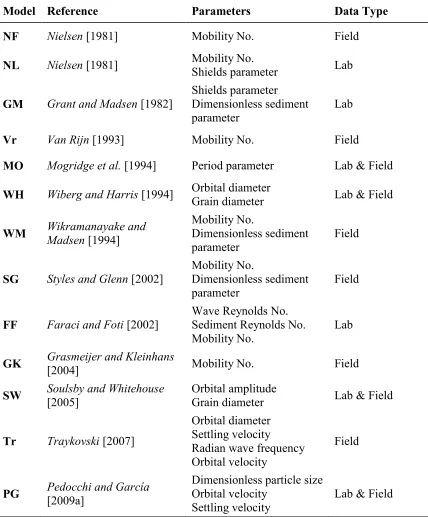
Model Reference Parameters Data Type
NF Nielsen [1981] Mobility No. Field
NL Nielsen [1981] Mobility No.
Shields parameter Lab
GM Grant and Madsen [1982] Shields parameter Dimensionless sediment parameter
Lab
Vr Van Rijn [1993] Mobility No. Field
MO Mogridge et al. [1994] Period parameter Lab & Field
WH Wiberg and Harris [1994] Orbital diameter
Grain diameter Lab & Field
WM Wikramanayake and Madsen [1994]
Mobility No.
Dimensionless sediment
parameter Field
SG Styles and Glenn [2002]
Mobility No.
Dimensionless sediment parameter
Field
FF Faraci and Foti [2002]
Wave Reynolds No. Sediment Reynolds No.
Mobility No. Lab
GK Grasmeijer and Kleinhans [2004] Mobility No. Field
SW Soulsby and Whitehouse [2005] Orbital amplitude Grain diameter Lab & Field
Tr Traykovski [2007]
Orbital diameter Settling velocity
Radian wave frequency Orbital velocity
Field
PG Pedocchi and García
Dimensionless particle size
through the adoption of appropriate subscripts are used that reveal the method of
estimation as well as the relationship between different parameters (see Table 2.2).
Table 2.2. Definitions and subscripts used for wave statistics.
Subscript Velocitya Wave height
rms ub,rms=(σu2+σv2)1/2 0.5∙Hsig
eq(br) ub,eq=[2 ∙ (σu2+σv2)]1/2 Hrms=∙Hsig/√2
1/3 ub,1/3=2 ∙ (σu2+σv2)1/2 Hsig
1/10 ub,1/10=1.27 ∙ 2 ∙ (σu2+σv2)1/2 H1/10=1.27∙H1/3 aσ
u2and σv2 denote variance of wave induced velocity.
In the remainder of this section, the existing equilibrium models are described in
sub-sections organized by the main parameter used in the model.
2.2.1. Mobility Number
One of the most common non-dimensional parameters used to determine ripple
geometry is the mobility number (ψ), which represents the ratio of mobilizing forces
acting on the sediment to the stabilizing forces:
2
50
1
b
u s g D
(2.2)
where s is the normalized sediment density, g is the acceleration due to gravity and D50 is
the median particle size.
Nielsen [1981], proposed two sets of equations based on field/irregular and
laboratory/regular wave conditions denoted as NF and NL, respectively. The equations
developed for the regular monochromatic wave generated ripples were based on the
Mogridge and Kamphuis [1972], Dingler [1974], Nielsen [1979] and used laboratory data
from the Danish Hydraulic Institute. Nielsen [1981] found these ripples to be best
described by the equations:
,1/3 0.275 0.022 1/3 b
A
(2.3)
0.34 ,1/3 2.2 0.345 1/3
b
A
(2.4)where Ab is the wave orbital amplitude (=2π∙ub/T) and T is the wave period.
For field conditions, Nielsen [1981] used data collected from Inman [1957],
Dingler [1974], and Miller and Komar [1980] to propose the following set of equations:
1.85
,1/3 21 1/3 , 1/3 10
b
A
(2.5)
8
7
,1/3 693 0.37 1/3 1000 0.75 1/3
b
A exp ln ln
(2.6)
For ψ1/3 < 10, Nielsen [1981] recommends using the ripple height from equation (2.3).
Nielsen [1981] also proposed a set of equations for ripple steepness based on the Shields
parameter, which is further discussed in section 2.3.
Van Rijn [1993] (Vr), also noted the potential scaling of ripple geometry with the
mobility number. He used ripple dimensions measured under irregular waves from Inman
[1957], Dingler [1974], Ribberink and Van Rijn [1987], Nieuwjaar and Van der Kaay
[1987] and Van Rijn [1987] and he suggested that equilibrium ripple geometry can be
predicted by:
1/3 5 ,1/3 13 1/3 1/30.22 , 10 2.8 10 250 , 1 0 250 b A
(2.7)
1/3 0.18 , 10
Grasmeijer and Kleinhans [2004] (GK) analyzed the ripple measurements of
Inman [1957], Van Rijn et al. [1993], Van Rijn and Havinga [1995], Grasmeijer and Van
Rijn [1999] and Hanes et al. [2001] as well as their own data collected off the coast of
Egmond aan Zee, Netherlands, and to suggest that:
0.5
1/3 1/3 ,1/3 1
1/3 1/3
0.275 0.022 , 10 2 , 10
b
A
(2.9)
1/3 0.221
1/3 1/3
0.14 , 10
0.078 0.355 , 10
(2.10)
One commonality between the latter two models (i.e., Vr and GK) is that wave
steepness is assumed to be constant (0.14 and 0.18 for the GK and Vr models,
respectively) for low energy flows while it decreases under more energetic wave activity.
2.2.2. Mobility Number & Dimensionless Sediment Parameter
Another non-dimensional parameter used to determine ripple geometry is the ratio
of the mobility number (ψ) and the dimensionless sediment parameter (S*) with the latter
being defined as:
3*
1
504
S
s
g D
(2.11)This parameter was first proposed by Wikramanayake and Madsen [1994] and
later adopted by Styles and Glenn [2002]. In addition to taking into account the sediment
properties and orbital wave forcing, this parameter also accounts for water viscosity (ν)
and therefore requires knowledge of the water temperature, salinity and pressure (i.e.,
Wikramanayake and Madsen [1994] (WM) utilized the data from the field
measurements of Inman [1957], Miller and Komar [1980] and Nielsen [1984] and
suggested the following equations to predict ripple height and wavelength:
1/2 * * , 1.1 * *0.27 / , / 3
0.52 / , / 3
rms rms b rms rms rms S S A S S
(2.12)
and
1/2 * * , 0.7 * *1.70 / , / 3
2.10 / , / 3
rms rms b rms rms rms S S A S S
(2.13)
Equations (2.12) and (2.13) were later revised by Styles and Glenn [2002] (SG)
who incorporated additional field data from Wiberg and Harris [1994] and Traykovski et
al. [1999] to derive an improved fit between data and model so that:
0.38 * * , 1.1 * *0.30 / , / 2
0.48 / , / 2
eq eq b eq eq eq S S A S S (2.14)
0.30 * * , 0.82 * *1.95 / , / 2
2.80 / , / 2
eq eq b eq eq eq S S A S S (2.15)
where ψeq is the mobility number attained from calculating ub using the root mean square
(rms) wave height (or √2 times the variance of flow velocity). At this juncture, it should
be noted that equations (2.14) and (2.15) vary slightly from those in the original
manuscript of Styles and Glenn [2002] due to a typographical error in the original
manuscript [Styles, pers. comm.].
2.2.3. Shields Parameter Based Equilibrium Models
the wave Shields parameter (θ) [Shields, 1936]. For regular laboratory waves, Nielsen
[1981] suggested:
1.5 1/3
0.182 0.24
(2.16)while for irregular field waves, he proposed:
4 1/3 0.342 0.34
(2.17)
where θ is defined as:
2
50
0.5 f uw b s 1 g D
(2.18)
with the wave friction coefficient (fw) defined as [Jonsson, 1966]:
0.194
50 50
50
5.213 2.5 / 5.977 , / 2.5 1.57
0.3 , / 2.5 1.57
b b
w
b
exp D A A D
f A D
(2.19)
Grant and Madsen [1982] (GM) utilized data from Carstens et al. [1969] and found a relationship between the Shields parameter and ripple dimensions that defines
increasing ripple wavelengths with increasing Shields parameter value up to 1.8∙S*2 and
decreasing wavelengths thereafter. This led to a new set of equations for the prediction of
equilibrium ripples:
0.16 2 * , 1.5 0.6 2 * *0.22 / , / 1.8
0.48 / , / 1.8
eq cr eq cr
b eq
eq cr eq cr
S A S S
(2.20)
0.04 2 * 1.0 0.6 2 * *0.16 / , / 1.8
0.28 / , / 1.8
eq cr eq cr
eq cr eq cr
S S S
(2.21)
2.2.4. Period Parameter
Mogridge et al. [1994] (MO) used the data of Bagnold [1946], Inman [1957],
Yalin and Russell [1962], Kennedy [1965], Horikawa [1967], Carstens et al. [1969], Mogridge [1972], Dingler [1974], Miller and Komar [1980], and Willis [1993] to
develop a set of equations that provide an upper limit on the ripple dimensions rather than
an actual prediction. These upper limits were related to a newly defined parameter χ as
follows:
0.03967 8.542 10.822 50 10
D
(2.22)
0.02054
7
50 13.373 13.772 7 1,394 , 1.5 10
10 , 1.5 10
D
(2.23)
where χ relates sediment size to wave period as follows:
2
50
w D s g T
(2.24)
While Nielsen [1981] argued that this parameter does not have any physical
meaning, Mogridge et al. [1994] suggested that the wave period directly reflects
velocities, accelerations, and forces of the oscillatory motion. Mogridge et al. [1994]
found η/D50 to be accurately described by a single equation; however, the ripple
wavelength diverges at χ values smaller than 1.5×10⁻⁵. They found that field data best
conforms to a constant λ/D50 value of 1,394.
2.2.5. Orbital Excursion and Grain Size
Another parameter widely used to predict ripple dimensions is the wave orbital
excursion (do=2Ab) normalized by the sediment grain diameter (do/D50). Clifton [1976]
grain size (do /D50). For smaller values of do /D50, these orbital ripples have a wavelength
that scales with the wave orbital diameter.
Wiberg and Harris [1994] proposed a set of equations based on
orbital-suborbital-anorbital classification scheme using laboratory and field data from Inman [1957],
Kennedy and Falcon [1965], Carstens et al. [1969], Mogridge and Kamphuis [1972], and Dingler [1974]. The original Wiberg and Harris [1994] model requires an iterative
approach but Malarkey and Davies [2003] presented a modification that simplifies the
estimation of ripple characteristics:
,1/3 1 2 3 ,1/3
o o
d exp C C C ln d
(2.25)
,1/3 ,1/3 ,1/3 1/3 50 ,1/3 50 500.62 , / 20
0.62 0.01
535 , 20 / 100
535 5
535
o o ano
o
o ano
d d
d ln d
D exp ln d
D ln D
, do,1/3/ano 100
(2.26)
where do,1/3/ηano is calculated using equation (2.25) with λ=λano=535∙D50, C1=7.59,
C2=33.60, C3=10.53, d o,1/3 is the significant wave orbital diameter, (ano) indicates the
anorbital ripple geometry and the equilibrium η is found using λ in equation (2.25).
Soulsby and Whitehouse [2005] (SW) used data from an extensive database of
published ripple dimensions, including the ones mentioned above, to suggest that scaling
of ripple geometry characteristics with the ratio of wave orbital semi-excursion of the
highest 1/10 velocities (Ab,1/10=1.27∙Ab,1/3) to the median particle diameter (D50) provides
the least scatter suggesting:
11.5
3 4
,1/10 1 1.87 10 ,1/10/ 50 1 2 10 ,1/10/ 50
b b b
A A D exp A D
3.5
50 ,1/10
0.15 1 exp 5000 D Ab
(2.28)
2.2.6. Orbital Excursion (do) and ws/ω
Similar to the predictors described above, Traykovski [2007] also noted that
ripples do tend to scale with orbital diameter. However, his predictor assumes that the
cutoff for orbital ripples (i.e., where ripples scale with the orbital diameter) occurs at a
value of ub,1/3/ws ≤ 4.2. Above this value, the ripples scale as a function of sediment
settling velocity (ws) and wave radian frequency (ω=2π/T). Traykovski [2007] found
strong agreement between ripples observed off the coast of Martha’s Vineyard
[Traykovski et al., 1999; Traykovski, 2007], using the following set of equations:
,1/3 ,1/3
,1/3
0.75 , / 4.2 6.3 / , / 4.2
o b s
s b s
d u w
w u w
(2.29)
where ws is the particle settling velocity calculated from Gibbs et al. [1971]. Assuming a
constant value for ripple steepness of η/λ = 0.16, the ripple equilibrium height is obtained
as:
,1/3 ,1/3
,1/3
0.12 , / 4.2 1.008 / , / 4.2
o b s
s b s
d u w
w u w
(2.30)
It is worth noting that according to equations (2.29) and (2.30), for ub,1/3/ws>4.2,
ripple geometry depends solely on wave period and sediment settling velocity. This
follows the observations of Mogridge et al. [1994] and might explain some of the scatter
and different trends observed in their predictor.
2.2.7. Reynolds Numbers
,1/3 ,1/3
w b b
Re
u
A
(2.31),1/3 50
d b
Re
u
D
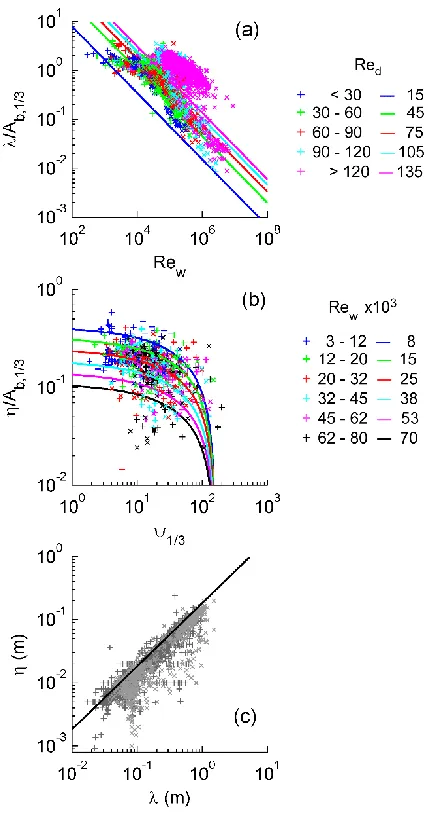
(2.32)Using ripple geometry data from wave tank experiments with both
monochromatic and irregular waves, they developed the following expressions for ripple
wavelength and height:
0.68 ,1/3 12.0613
b d w
A Re Re
(2.33)
1 2
0.5
,1/3 1 0.022 1 3 0.275 0.0076 0.1681
b w
A exp Re
(2.34)
Although they found the measured ripple steepness to agree with Nielsen [1979],
they also noticed that the average steepness was 0.18, which corresponds to fully
developed vortex ripples. They suggested that ripple steepness must depend on the angle
of repose (ϕ) and recommended, as in Nielsen [1979, 1981], that:
0.32 tan
(2.35)
which leads to η/λ=0.185 if an angle of repose of 30° is assumed.
2.2.8. Orbital Velocity / Settling Velocity
Pedocchi and García [2009a] used published ripple dimension data as well as
data from a wave tunnel experiment [Pedocchi and García, 2009b] to suggest that ripple
dimensions should be related to the ratio of ub,1/3/ws for three different grain size regimes
based on the particle Reynolds number (Rep). The latter relates to the dimensionless
particle size parameter (S*) as follows:
350 *
1 4
p
Re s gD S
(2.36)
1 2 ,1/3 1 2 50 ,1/3 1 3 ,1/30.65 0.050 / 1 , 13
0.65 0.040 / 1 , 9 13
0.65 0.054 / 1 , 9
b s p
b s p
b s p
u w Re
D u w Re
u w Re
(2.37)
1 3 ,1/3 1 4 50 ,1/3 1 5 ,1/30.1 0.055 / 1 , 13
0.1 0.055 / 1 , 9 13
0.1 0.055 / 1 , 9
b s p
b s p
b s p
u w Re
D u w Re
u w Re
(2.38)
where ws is the particle settling velocity calculated using the method of Dietrich (1982).
These equations are divided into three grain size regions with Rep=13 corresponding to
220 μm and Rep=9 corresponding to 177 μm at 20°C.
2.3. Data Availability
2.3.1. Existing Data Sources
Numerous experiments on oscillatory flow ripples have been carried out over the
years resulting in a large number of ripple wavelength and height data for a variety of
wave conditions and sediment sizes. Various subsets of these data were used in the
development of the equilibrium prediction models described in section 2.2. As part of this
study, all data available (see Table 2.3) are compiled into a single database to be used for
the production of a more comprehensive formulation for ripple equilibrium dimensions
that is not experiment or site specific. The ripple geometry data found in the literature
include descriptions of hydrodynamic forcing, sediment type and ripple dimensions;
orbital velocity (ub,1/3), wave period (T), median grain diameter (D50), water temperature
(Temp), water density (ρw), sediment density (ρs), water depth (h), salinity (S), ripple
wavelength (λ) and ripple height (η). For the experiments where wave forcing was listed
as wave height alone, the significant (1/3) bottom orbital velocity was calculated using
linear wave theory:
,1/3 1/3 2 sinh b
u H kh
(2.39)
where ω is the wave radial frequency, H1/3is the significant wave height, k is the
wavenumber, and h is the local water depth.
Another parameter, which is often omitted but required by several of the
predictors presented in section 2.2, is the water viscosity (ν). When water temperature,
salinity, and water depth data are provided, the viscosity is calculated from these values,
otherwise a water temperature of 20°C and a salinity of 0 is assumed for laboratory
experiments. For field experiments, temperature and salinity information obtained at a
nearby buoy from the national data buoy center (http://www.ndbc.noaa.gov/) is used.
When no historical data exist, an average (climatological) value of water temperature for
the specified month(s) of the experiment is taken and if no salinity is recorded, a value of
35 psu is assumed.
2.3.2. New Data Sources
In addition to the existing data described above, new data sets from two
experimental sites, representing different wave environments and sediment
characteristics, are also included in this database and subsequent analysis. Both sites are
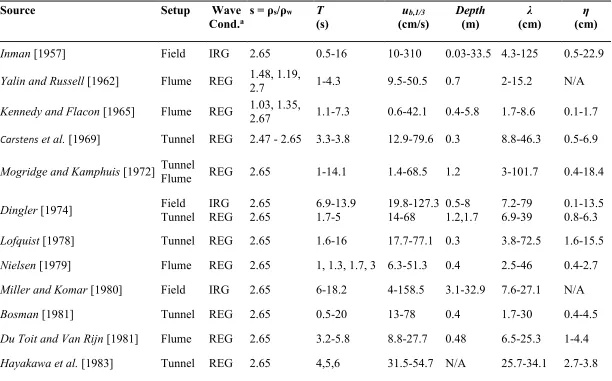
Table 2.3. Data sources used in this study.
Source Setup Wave
Cond.a
s = ρs/ρw T
(s) ub,1/3 (cm/s) Depth (m) λ (cm) η (cm)
Inman [1957] Field IRG 2.65 0.5-16 10-310 0.03-33.5 4.3-125 0.5-22.9
Yalin and Russell [1962] Flume REG 1.48, 1.19, 2.7 1-4.3 9.5-50.5 0.7 2-15.2 N/A
Kennedy and Flacon [1965] Flume REG 1.03, 1.35,
2.67 1.1-7.3 0.6-42.1 0.4-5.8 1.7-8.6 0.1-1.7
Carstens et al. [1969] Tunnel REG 2.47 - 2.65 3.3-3.8 12.9-79.6 0.3 8.8-46.3 0.5-6.9
Mogridge and Kamphuis [1972] Tunnel Flume REG 2.65 1-14.1 1.4-68.5 1.2 3-101.7 0.4-18.4
Dingler [1974] Field Tunnel IRG REG 2.65 2.65 6.9-13.9 1.7-5 19.8-127.3 14-68 0.5-8 1.2,1.7 7.2-79 6.9-39 0.1-13.5 0.8-6.3
Lofquist [1978] Tunnel REG 2.65 1.6-16 17.7-77.1 0.3 3.8-72.5 1.6-15.5 Nielsen [1979] Flume REG 2.65 1, 1.3, 1.7, 3 6.3-51.3 0.4 2.5-46 0.4-2.7 Miller and Komar [1980] Field IRG 2.65 6-18.2 4-158.5 3.1-32.9 7.6-27.1 N/A Bosman [1981] Tunnel REG 2.65 0.5-20 13-78 0.4 1.7-30 0.4-4.5 Du Toit and Van Rijn [1981] Flume REG 2.65 3.2-5.8 8.8-27.7 0.48 6.5-25.3 1-4.4 Hayakawa et al. [1983] Tunnel REG 2.65 4,5,6 31.5-54.7 N/A 25.7-34.1 2.7-3.8
Nielsen [1984] Field IRG 2.65 5.3-14.4 39.1-113.6 0.8-1.8 5-150 0.5-20
Steetzel [1984] Tunnel REG
IRG 2.65 3-7 20-50 N/A 13-31.5 2-4.5
Sakakiyama et al. [1985] Flume REG 2.65 3-12 17-197 N/A 14.3-148 1.9-11.7 Nieuwjaar and van der Kaay
[1987] Tunnel IRG 2.65 2.4,2.5 21.2-47.6 N/A 8.5-9.3 1.1-1.8
Ribberink et al. [1987] Tunnel IRG 2.65 2-5 38.5-71.3 N/A 8-13.5 1-1.8 Boyd et al. [1988] Field IRG 2.65 3.1-11.4 6.4-121.6 9.6-12.5 7-24 N/A Van Rijn [1987] Tunnel IRG 2.65 4.6-6.3 62.2-178.2 N/A 20 0.1-2 Southard et al. [1990] Duct REG 2.65 3.1-19.3 10-100 0.2 12-196 2.1-23.9 Van Rijn [1993] Flume IRG 2.65 2.2-2.7 13.7-36.1 0.5 6-20 0.6-2.9 Ribberink and Al-Salem [1994] Tunnel REG 2.65 2-12 20-150 0.8 8.4-270 0.3-35
Van Rijn & Havinga [1995] Basin REG
IRG 2.65 2.1-2.3 14.4-29.9 0.4 5.9-11.1 0.6-1.4 Li & Amos [1998] Field IRG 2.65 8-12.8 1.9-28.8 38.7-40 7.7-15.4 0.8-2.2 Grasmeijer and Van Rijn [1999] Flume IRG 2.65 2.3 27-52.1 0.3-0.6 3.8-8.3 0.5-1.3 Hume et al. [1999] Field IRG 2.65 11 20-75 25 40-90 3-13 Traykovski et al. [1999] Field IRG 2.65 5.1-14.3 4.6-49.2 11.8-13.7 36.7-107 N/A Doucette [2000] Field IRG 2.65 4.7-12.2 17-102.8 0.3-1.7 5-70 0.5-11
Khelifa and Ouellet [2000] Basin REG 2.65 0.9-1.4 8.2-25.5 0.3 2.8-12.1 0.4-1.7 Williams et al. [2000] Flume REG 2.65 3.5-5 19-69 6.5 8-35 1.5-6 Faraci and Foti [2001] Flume REG
IRG 1.2, 2.65 1.3-4.2 5.4-86 0.2,0.3 3.7-12 0.4-2.1 Hanes et al. [2001] Field IRG 2.65 7.1-19.7 9.2-271.8 1.6-6.8 6-270 0.4-9.9 O’Donoghue and Clubb [2001] Tunnel REG
IRG
2.65 2-15 18-106 0.6 6-121
0.9-19.4 Ardhuin et al. [2002] Field IRG 2.65 11.4-13.8 37-67
19.7-27.6 77-137 N/A Doucette [2002] Field IRG 2.65 2.2-12.2 15.6-59.1 0.2-1.1 8-91 2-14 Faraci and Foti [2002] Flume REG
IRG 2.65 1.3-4.2 12.7-35 0.3 4.4-10.7 0.7-2.1 Sleath and Walbridge [2002] Tunnel REG 2.65 2.8-6.8 8-164 0.3 10-50 1.7-9 Thorne et al. [2002] Flume IRG 2.65 4-6 25.7-65.8 4.5 26.2-51.3 4-6.5 Grasmeijer and Kleinhans [2004] Field IRG 2.65 4-10.5 23-98.5 2 19-200 0.7-10 Williams et al. [2004] Flume IRG 2.65 4-6
13.1-102.6
4,4.5 20-104 1-7
Dumas et al. [2005] Tunnel REG 2.65 7.9-11
20.1-165.3 0.7 6.5-723.8 0.4-53.2 Smith & Sleath [2005] Tray REG 2.65 0.9-3.8 15.6-49 0.4 3.5-30.7 0.3-4.1 Xu [2005] Field IRG 2.65 8.8-18.3 15.6-43.8 15 4.6-7.5 N/A Brown [2006] Flume REG
IRG
2.65 4,6,8 26.5-66.8 4.6 5.5-23 0.2-2.3
Doucette and O’Donoghue [2006] Tunnel REG IRG 2.65 2-12.5 29.8-146.6 0.5 8.7-82.3 1.3-12.8
O’Donoghue et al. [2006] Tunnel REG
IRG 2.65 3.1-12.5 27-88 0.5,0.8 11.4-110.7 1.5-13.9 Traykovski [2007]
Martha's Vineyard Coastal Observatory 2002 2005 Field Field IRG IRG 2.65 2.65 1-12.9 6.2-11.6 5.5-133.1 12-80.9 12-13.9 12.3-13.7 10-127 39.4-127.8 N/A 2.9-16.6
Pedocchi and García[2009b] Tunnel REG 2.65 2-25 20-100 0.6 5-180 0.6-19 This Study
Long Bay, SC Georgia Shelf Field Field IRG IRG 2.65 2.65 4.8-12.7 6.5-12.3 6.6-43.9 3.1-45.6 8.2-10.6 26.1-29 7-22.4 9.5-75.8 N/A N/A
aREG (IRG) denote regular (irregular) wave conditions.
respectively. The first field data set is from the shelf on the northern part of South
Carolina (USA) off Long Bay (33° 43.35’N, 78° 46.75’W) (Figure 2.1). These data were
collected as part of the U.S. Geological Survey’s South Carolina Coastal Erosion Study,
which took place from October 2003 to April 2004 [Sullivan et al., 2006; Schwab et al.,
2009; Warner et al., 2012]. The seabed sediment at this site consists of fine to medium
quartz sand with a median grain diameter (D50) of 177 μm. Data from the period 30
January 2004 to 15 March 2004 is used in this study as this provides the most complete
record of hydrodynamic and bedform wavelength data. The second data set is from the
continental shelf off the coast of Georgia, USA (31° 22.343’N, 80° 34.073’W) (Figure
2.2). The seabed at this site consists of medium to coarse sand with a mean diameter of
388 μm. Two periods of simultaneous hydrodynamic and bedform imagery data
collection is used, corresponding to 16 September 2007 to 7 October 2007 and 13
December 2007 to 15 February 2008. These periods include several sediment
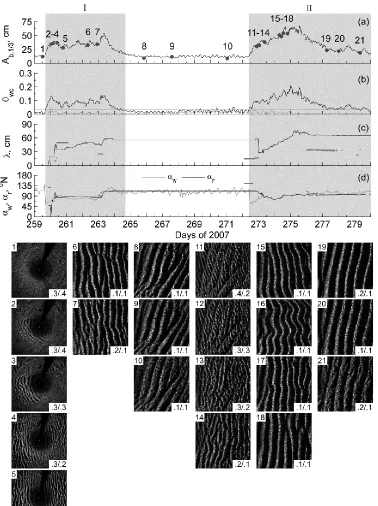
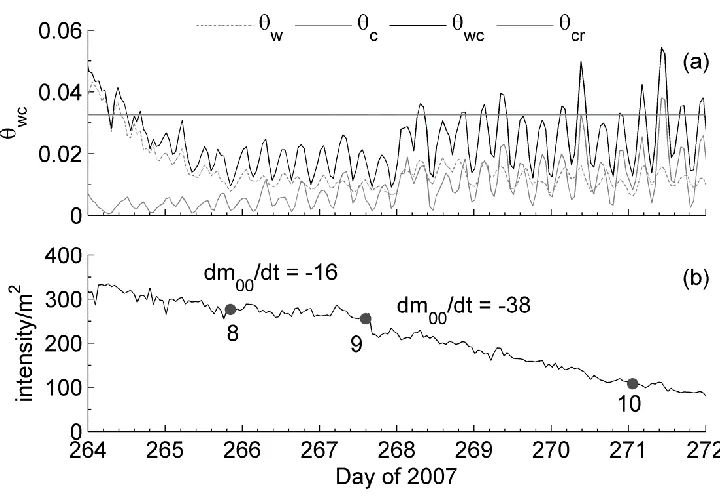
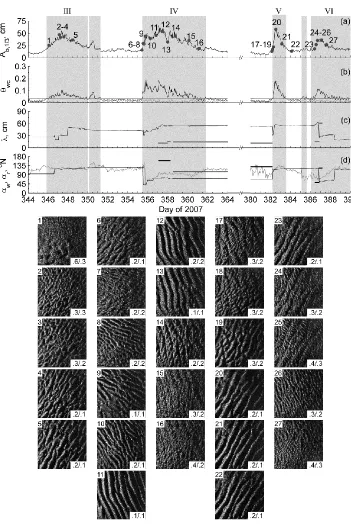
mobilization events where bedforms change dimension and orientation (Figure 2.2). The
detailed description of the experimental setup, hydrodynamic conditions, ripple evolution
description as well as the methodologies used are presented in detail in chapter 3 and in
Voulgaris and Morin [2008]. It should be noted that these data sets do not contain any
ripple height observations and are limited to wavelength information only.
2.3.3. Equilibrium Ripple Criterion
Some of the data sources contain measurements of mega ripples with wavelengths
of up to 8 m; since this study focuses on wave ripples only, any ripples with wavelengths
Figure 2.1. Time series of data collected in Long Bay, South Carolina (USA) during 2004: (a) significant wave orbital velocity (black) and wave period (gray); (b) wave Shields parameter (black) and critical Shields parameter (gray); (c) measured ripple wavelength. The shaded areas indicate periods when 0<dθ/dt<0.1∙θ1/3 (t)/Tk(t) and
θ1/3>1.5θcr (see text).
Figure 2.2. Time series of data collected in the South Atlantic Bight off Georgia (USA) during 2007-2008: (a) significant wave orbital velocity (black) and wave period (gray); (b) wave Shields parameter (black) and critical Shields parameter (gray); and (c) measured ripple wavelength. The shaded areas indicate periods when
0<dθ/dt<0.1∙θ1/3 (t)/Tk(t) andθ1/3>1.5θcr (see text).
experiments carried out at high water temperature (~60°C) [e.g., Southard et al., 1990;
Dumas et al., 2005]. The following criteria were used to ensure that the data used
represent equilibrium conditions with the flow. Since laboratory experiments are run until
Shields parameter greater than the critical Shields parameter for sediment motion
(θ1/3>θcr), is assumed to represent ripples in equilibrium with the flow. For field
conditions, where an objective definition of equilibrium is difficult without information
of the time history of the ripple evolution, only ripple data corresponding to θ1/3>2∙θcr are
considered to be in equilibrium. For the cases where time history of the ripple evolution
is known (Traykovski et al. [1999], Traykovski [2007] and the data discussed in section
2.3.2), equilibrium ripples were identified as those recorded during periods where the
hydrodynamic forcing (i.e., excess Shields parameter) does not change significantly over
the time required for a ripple to adjust itself to the given hydrodynamic forcing. This
corresponds to the time scale (Tk) given in Traykovski [2007, equation (9)] and it is a
function of the Shields parameter (θ1/3). Thus only ripple data corresponding to
conditions where 0<dθ1/3/dt<0.1∙θ1/3(t)/Tk(t) are assumed to be in equilibrium with the
flow. A further criterion of θ1/3>1.5∙θcr was applied to eliminated low energy conditions
where the bed may only experience intermittent sediment mobilization during a wave
group and hence would require more time than what the time scale Tk predicts.
The database developed from all sources of data described in the previous two
sections includes ripple data from experiments conducted with both
regular/monochromatic waves and irregular/random waves, with the former consisting of
data from laboratory experiments only. After applying the wavelength and equilibrium
criteria, the regular wave data set left consists of 1,145 measurements of wavelength and
1,049 measurements of ripple steepness. The irregular wave data set consists of all field
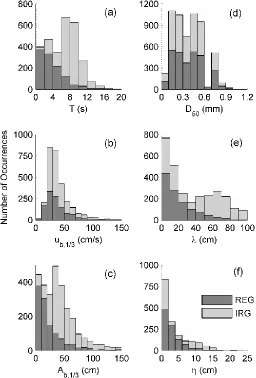
dimensions (height and wavelength), hydrodynamic conditions (wave period, orbital
velocity and bottom excursion), and grain sizes incorporated in this data set are shown in
Figure 2.3. The combination of regular and irregular wave data results in a total of 2,910
measurements of ripple wavelength and 1,748 measurements of ripple steepness.
Figure 2.3. Frequency distribution of range of values for parameters representing hydrodynamic forcing and ripple dimensions for the ripple data sets compiled for this study (N=2,968). Data
2.4. Results
In this section, all previously published and the newly collected data that have
passed the equilibrium criteria are used to evaluate the predictors presented in section 2.2.
2.4.1. Mobility Number based Equilibrium Models
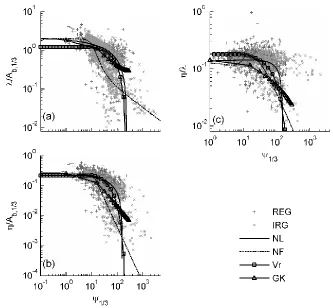
The predictions of equilibrium ripple length, height and steepness using the
mobility number based models (i.e., NF, NL, Vr and GK) are plotted against the
observations in Figure 2.4. All ripple dimensions have been normalized by the bottom
orbital semi-excursion (Ab,1/3).
It is worth noting that all four models converge for ψ1/3 < 10 predicting a nearly
constant value indicating a sole dependence of ripple dimensions on Ab. However, this
trend is not supported by the data, which show a gradually increasing λ/Ab ratio for
decreasing ψ1/3. The ripple wavelength data (see Figure 2.4a) suggests either an inverse
relationship between normalized wavelength and ψ1/3 or a constant value that should be
larger than that predicted by these models. For ψ1/3 > 10, the models start deviating from
each other with the irregular wave data suggesting two trends. One trend follows the
predictors of NL, Vr, and to an extent, that of GK while the remaining data follow that of
NF and yield a smaller λ/Ab,1/3 ratio value for the same ψ1/3. This deviation was also noted
by Nielsen [1981], who attributed it to differences between laboratory/regular vs.
field/irregular waves. However, this is not the case in here, as ripples under different
wave forcing appear to follow either trend without a specific reference to
regular/irregular forcing or sediment size.

![Figure 3.10. Comparison of the Soulsby and Whitehouse [2005] model with the data from GA, event VI (see Figures 3.5 and 3.8)](https://thumb-us.123doks.com/thumbv2/123dok_us/8457299.1389397/108.612.160.449.73.484/figure-comparison-soulsby-whitehouse-model-data-event-figures.webp)
