Coreference Semantics from Web Features
Mohit Bansal and Dan Klein Computer Science Division University of California, Berkeley {mbansal, klein}@cs.berkeley.edu
Abstract
To address semantic ambiguities in corefer-ence resolution, we use Webn-gram features that capture a range of world knowledge in a diffuse but robust way. Specifically, we ex-ploit short-distance cues to hypernymy, se-mantic compatibility, and sese-mantic context, as well as general lexical co-occurrence. When added to a state-of-the-art coreference base-line, our Web features give significant gains on multiple datasets (ACE 2004 and ACE 2005) and metrics (MUC and B3), resulting in the best results reported to date for the end-to-end task of coreference resolution.
1 Introduction
Many of the most difficult ambiguities in corefer-ence resolution are semantic in nature. For instance, consider the following example:
When Obama met Jobs, the president dis-cussed the economy, technology, and educa-tion. His election campaign is expected to [...]
For resolving coreference in this example, a sys-tem would benefit from the world knowledge that Obamais the president. Also, to resolve the pro-noun histo the correct antecedentObama, we can use the knowledge thatObamahas anelection cam-paign while Jobs does not. Such ambiguities are difficult to resolve on purely syntactic or configu-rational grounds.
There have been multiple previous systems that incorporate some form of world knowledge in coref-erence resolution tasks. Most work (Poesio et al., 2004; Markert and Nissim, 2005; Yang et al., 2005; Bergsma and Lin, 2006) addresses spe-cial cases and subtasks such as bridging anaphora,
other anaphora, definite NP reference, and pronoun resolution, computing semantic compatibility via Web-hits and counts from large corpora. There is also work on end-to-end coreference resolution that uses large noun-similarity lists (Daum´e III and Marcu, 2005) or structured knowledge bases such as Wikipedia (Yang and Su, 2007; Haghighi and Klein, 2009; Kobdani et al., 2011) and YAGO (Rahman and Ng, 2011). However, such structured knowledge bases are of limited scope, and, while Haghighi and Klein (2010) self-acquires knowledge about corefer-ence, it does so only via reference constructions and on a limited scale.
In this paper, we look to the Web for broader if shallower sources of semantics. In order to harness the information on the Web without presupposing a deep understanding of all Web text, we instead turn to a diverse collection of Web n-gram counts (Brants and Franz, 2006) which, in aggregate, con-tain diffuse and indirect, but often robust, cues to reference. For example, we can collect the co-occurrence statistics of an anaphor with various can-didate antecedents to judge relative surface affinities (i.e., (Obama, president) versus (Jobs, president)). We can also count co-occurrence statistics of com-peting antecedents when placed in the context of an anaphoric pronoun (i.e.,Obama’s election campaign versusJobs’ election campaign).
All of our features begin with a pair of head-words from candidate mention pairs and compute statistics derived from various potentially informa-tive queries’ counts. We explore five major cat-egories of semantically informative Web features, based on (1) general lexical affinities (via generic co-occurrence statistics), (2) lexical relations (via Hearst-style hypernymy patterns), (3) similarity of entity-based context (e.g., common values of y for
whichh is a y is attested), (4) matches of distribu-tional soft cluster ids, and (5) attested substitutions of candidate antecedents in the context of a pronom-inal anaphor.
We first describe a strong baseline consisting of the mention-pair model of the Reconcile system (Stoyanov et al., 2009; Stoyanov et al., 2010) us-ing a decision tree (DT) as its pairwise classifier. To this baseline system, we add our suite of features in turn, each class of features providing substantial gains. Altogether, our final system produces the best numbers reported to date on end-to-end coreference resolution (with automatically detected system men-tions) on multiple data sets (ACE 2004 and ACE 2005) and metrics (MUC and B3), achieving signif-icant improvements over the Reconcile DT baseline and over the state-of-the-art results of Haghighi and Klein (2010).
2 Baseline System
Before describing our semantic Web features, we first describe our baseline. The core inference and features come from the Reconcile package (Stoy-anov et al., 2009; Stoy(Stoy-anov et al., 2010), with modi-fications described below. Our baseline differs most substantially from Stoyanov et al. (2009) in using a decision tree classifier rather than an averaged linear perceptron.
2.1 Reconcile
Reconcile is one of the best implementations of the mention-pair model (Soon et al., 2001) of coref-erence resolution. The mention-pair model relies on a pairwise function to determine whether or not two mentions are coreferent. Pairwise predictions are then consolidated by transitive closure (or some other clustering method) to form the final set of coreference clusters (chains). While our Web fea-tures could be adapted to entity-mention systems, their current form was most directly applicable to the mention-pair approach, making Reconcile a par-ticularly well-suited platform for this investigation.
The Reconcile system provides baseline features, learning mechanisms, and resolution procedures that already achieve near state-of-the-art results on mul-tiple popular datasets using mulmul-tiple standard met-rics. It includes over 80 core features that exploit
various automatically generated annotations such as named entity tags, syntactic parses, and WordNet classes, inspired by Soon et al. (2001), Ng and Cardie (2002), and Bengtson and Roth (2008). The Reconcile system also facilitates standardized em-pirical evaluation to past work.1
In this paper, we develop a suite of simple seman-tic Web features based on pairs of mention head-words which stack with the default Reconcile fea-tures to surpass past state-of-the-art results.
2.2 Decision Tree Classifier
Among the various learning algorithms that Recon-cile supports, we chose the decision tree classifier, available in Weka (Hall et al., 2009) as J48, an open source Java implementation of the C4.5 algorithm of Quinlan (1993).
The C4.5 algorithm builds decision trees by incre-mentally maximizing information gain. The train-ing data is a set of already classified samples, where each sample is a vector of attributes or features. At each node of the tree, C4.5 splits the data on an attribute that most effectively splits its set of sam-ples into more ordered subsets, and then recurses on these smaller subsets. The decision tree can then be used to classify a new sample by following a path from the root downward based on the attribute val-ues of the sample.
We find the decision tree classifier to work better than the default averaged perceptron (used by Stoy-anov et al. (2009)), on multiple datasets using multi-ple metrics (see Section 4.3). Many advantages have been claimed for decision tree classifiers, including interpretability and robustness. However, we sus-pect that the assus-pect most relevant to our case is that decision trees can capture non-linear interactions be-tween features. For example, recency is very im-portant for pronoun reference but much less so for nominal reference.
3 Semantics via Web Features
Our Web features for coreference resolution are sim-ple and capture a range of diffuse world knowledge. Given a mention pair, we use the head finder in Rec-oncile to find the lexical heads of both mentions (for
1
example, the head ofthe Palestinian territoriesis the wordterritories). Next, we take each headword pair (h1, h2) and compute various Web-count functions
on it that can signal whether or not this mention pair is coreferent.
As the source of Web information, we use the Google n-grams corpus (Brants and Franz, 2006) which contains Englishn-grams (n = 1 to5) and their Web frequency counts, derived from nearly 1 trillion word tokens and 95 billion sentences. Be-cause we have many queries that must be run against this corpus, we apply the trie-based hashing algo-rithm of Bansal and Klein (2011) to efficiently an-swer all of them in one pass over it. The features that require word clusters (Section 3.4) use the out-put of Lin et al. (2010).2
We describe our five types of features in turn. The first four types are most intuitive for mention pairs where both members are non-pronominal, but, aside from the general co-occurrence group, helped for all mention pair types. The fifth feature group applies only to pairs in which the anaphor is a pronoun but the antecedent is a non-pronoun. Related work for each feature category is discussed inline.
3.1 General co-occurrence
These features capture co-occurrence statistics of the two headwords, i.e., how oftenh1 and h2 are
seen adjacent or nearly adjacent on the Web. This count can be a useful coreference signal because, in general, mentions referring to the same entity will co-occur more frequently (in large corpora) than those that do not. Using then-grams corpus (for n
= 1 to 5), we collect co-occurrence Web-counts by allowing a varying number of wildcards betweenh1
andh2in the query. The co-occurrence value is:
bin
log10
c12 c1·c2
2
These clusters are derived form the V2 Google n-grams corpus. The V2 corpus itself is not publicly available, but the clusters are available athttp://www.clsp.jhu.edu/ ˜sbergsma/PhrasalClusters
where
c12=count(“h1 ? h2”) +count(“h1 ? ? h2”)
+count(“h1 ? ? ? h2”), c1 =count(“h1”),and
c2 =count(“h2”).
We normalize the overall co-occurrence count of the headword pairc12by the unigram counts of the indi-vidual headwordsc1and c2, so that high-frequency headwords do not unfairly get a high feature value (this is similar to computing scaled mutual infor-mation MI (Church and Hanks, 1989)).3 This nor-malized value is quantized by taking its log10 and binning. The actual feature that fires is an indica-tor of which quantized bin the query produced. As a real example from our development set, the co-occurrence countc12for the headword pair (leader, president) is 11383, while it is only 95 for the head-word pair (voter, president); after normalization and
log10, the values are -10.9 and -12.0, respectively. These kinds of general Web co-occurrence statis-tics have been used previously for other supervised NLP tasks such as spelling correction and syntac-tic parsing (Bergsma et al., 2010; Bansal and Klein, 2011). In coreference, similar word-association scores were used by Kobdani et al. (2011), but from Wikipedia and for self-training.
3.2 Hearst co-occurrence
These features capture templated co-occurrence of the two headwords h1 and h2 in the Web-corpus.
Here, we only collect statistics of the headwords co-occurring with a generalized Hearst pattern (Hearst, 1992) in between. Hearst patterns capture various lexical semantic relations between items. For ex-ample, seeing X is a Y or X and other Y indicates hypernymy and also tends to cue coreference. The specific patterns we use are:
• h1 {is|are|was|were} {a|an|the}?h2
• h1 {and|or} {other|the other|another}h2
• h1 other than{a|an|the}?h2
3We also tried adding count(“h1 h2”) to c
12 but this
• h1such as{a|an|the}?h2
• h1, including{a|an|the}?h2
• h1, especially{a|an|the}?h2
• h1of{the|all}?h2
For this feature, we again use a quantized nor-malized count as in Section 3.1, butc12 here is
re-stricted ton-grams where one of the above patterns occurs in between the headwords. We did not al-low wildcards in between the headwords and the Hearst-patterns because this introduced a significant amount of noise. Also, we do not constrain the or-der of h1 and h2 because these patterns can hold for either direction of coreference.4 As a real ex-ample from our development set, thec12 count for
the headword pair (leader, president) is 752, while for (voter, president), it is 0.
Hypernymic semantic compatibility for corefer-ence is intuitive and has been explored in varying forms by previous work. Poesio et al. (2004) and Markert and Nissim (2005) employ a subset of our Hearst patterns and Web-hits for the subtasks of bridging anaphora, other-anaphora, and definite NP resolution. Others (Haghighi and Klein, 2009; Rah-man and Ng, 2011; Daum´e III and Marcu, 2005) use similar relations to extract compatibility statis-tics from Wikipedia, YAGO, and noun-similarity lists. Yang and Su (2007) use Wikipedia to auto-matically extract semantic patterns, which are then used as features in a learning setup. Instead of ex-tracting patterns from the training data, we use all the above patterns, which helps us generalize to new datasets for end-to-end coreference resolution (see Section 4.3).
3.3 Entity-based context
For each headwordh, we first collect contextseeds
yusing the pattern
h{is|are|was|were} {a|an|the}? y
taking seeds y in order of decreasing Web count. The corresponding orderedseed listY ={y}gives us useful information about the headword’s entity type. For example, for h = president, the top
4
Two minor variants not listed above areh1 includingh2
andh1especiallyh2.
30 seeds (and their parts of speech) include impor-tant cues such as president is elected (verb), pres-ident is authorized (verb), president is responsible (adjective),president is the chief (adjective), presi-dent is above(preposition), andpresident is the head (noun).
Matches in the seed lists of two headwords can be a strong signal that they are coreferent. For ex-ample, in the top 30 seed lists for the headword pair (leader, president), we get matches including elected,responsible, andexpected. To capture this effect, we create a feature that indicates whether there is a match in the topkseeds of the two head-words (wherekis a hyperparameter to tune).
We create another feature that indicates whether the dominant parts of speech in the seed lists matches for the headword pair. We first collect the POS tags (using length 2 character prefixes to indi-cate coarse parts of speech) of the seeds matched in the top k0 seed lists of the two headwords, where
k0 is another hyperparameter to tune. If the domi-nant tags match and are in a small list of important tags ({JJ, NN, RB, VB}), we fire an indicator feature specifying the matched tag, otherwise we fire a no-matchindicator. To obtain POS tags for the seeds, we use a unigram-based POS tagger trained on the WSJ treebank training set.
3.4 Cluster information
The distributional hypothesis of Harris (1954) says that words that occur in similar contexts tend to have a similar linguistic behavior. Here, we design fea-tures with the idea that this hypothesis extends to reference: mentions occurring in similar contexts in large document sets such as the Web tend to be compatible for coreference. Instead of collecting the contexts of each mention and creating sparse fea-tures from them, we use Web-scale distributional clustering to summarize compatibility.
Specifically, we begin with the phrase-based clters from Lin et al. (2010), which were created us-ing the Googlen-grams V2 corpus. These clusters come from distributionalK-Means clustering (with
(Lin et al., 2010).
Our cluster-based features assume that if the headwords of the two mentions have matches in their cluster id lists, then they are more compatible for coreference. We check the match of not just the top 1 cluster ids, but also farther down in the 20 sized lists because, as discussed in Lin and Wu (2009), the soft cluster assignments often reveal different senses of a word. However, we also assume that higher-ranked matches tend to imply closer mean-ings. To this end, we fire a feature indicating the valuebin(i+j), whereiandjare theearliest match positions in the cluster id lists ofh1andh2. Binning
here means that match positions in a close range generally trigger the same feature.
Recent previous work has used clustering infor-mation to improve the performance of supervised NLP tasks such as NER and dependency parsing (Koo et al., 2008; Lin and Wu, 2009). However, in coreference, the only related work to our knowledge is from Daum´e III and Marcu (2005), who use word class features derived from a Web-scale corpus via a process described in Ravichandran et al. (2005).
3.5 Pronoun context
Our last feature category specifically addresses pro-noun reference, for cases when the anaphoric men-tionN P2(and hence its headwordh2) is a pronoun,
while the candidate antecedent mentionN P1 (and
hence its headword h1) is not. For such a head-word pair (h1,h2), the idea is to substitute the non-pronounh1 into h2’s position and see whether the result is attested on the Web.
If the anaphoric pronominal mention ish2 and its
sentential context isl’ lh2 r r’, then the substituted
phrase will bel’ lh1r r’.5 High Web counts of
sub-stituted phrases tend to indicate semantic compati-bility. Perhaps unsurprisingly for English, only the right context was useful in this capacity. We chose the following three context types, based on perfor-mance on a development set:
5
Possessive pronouns are replaced with an additional apos-trophe, i.e.,h1’s. We also use features (see R1Gap) that allow
wildcards (?) in between the headword and the context when collecting Web-counts, in order to allow for determiners and other filler words.
• h1r (R1)
• h1r r’ (R2)
• h1?r (R1Gap)
As an example of the R1Gap feature, if the anaphorh2+ context ishis victoryand one candidate antecedenth1isBush, then we compute the normal-ized value
count(“Bush0s ? victory”) count(“? 0s ? victory”)count(“Bush”)
In general, we compute
count(“h10s ? r”)
count(“? 0s ? r”)count(“h
1”)
The final feature value is again a normalized count converted tolog10and then binned.6 We have three separate features for the R1, R2, and R1Gap context types. We tune a separate bin-size hyperparameter for each of these three features.
These pronoun resolution features are similar to selectional preference work by Yang et al. (2005) and Bergsma and Lin (2006), who compute seman-tic compatibility for pronouns in specific syntacseman-tic relationships such as possessive-noun, subject-verb, etc. In our case, we directly use the general context of any pronominal anaphor to find its most compat-ible antecedent.
Note that all our above features are designed to be non-sparse by firing indicators of the quantized Web statistics and not the lexical- or class-based identities of the mention pair. This keeps the total number of features small, which is important for the relatively small datasets used for coreference resolution. We go from around 100 features in the Reconcile base-line to around 165 features after adding all our Web features.
6
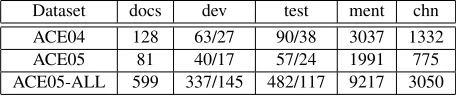
Dataset docs dev test ment chn
ACE04 128 63/27 90/38 3037 1332
ACE05 81 40/17 57/24 1991 775
[image:6.612.74.302.62.112.2]ACE05-ALL 599 337/145 482/117 9217 3050
Table 1: Dataset characteristics –docs: the total number of doc-uments;dev: the train/test split during development;test: the train/test split during testing;ment: the number of gold men-tions in the test split;chn: the number of coreference chains in the test split.
4 Experiments
4.1 Data
We show results on three popular and comparatively larger coreference resolution data sets – the ACE04, ACE05, and ACE05-ALL datasets from the ACE Program (NIST, 2004). In ACE04 and ACE05, we have only the newswire portion (of the original ACE 2004 and 2005 training sets) and use the standard train/test splits reported in Stoyanov et al. (2009) and Haghighi and Klein (2010). In ACE05-ALL, we have the full ACE 2005 training set and use the standard train/test splits reported in Rahman and Ng (2009) and Haghighi and Klein (2010). Note that most previous work does not report (or need) a stan-dard development set; hence, for tuning our fea-tures and its hyper-parameters, we randomly split the original training data into a training and devel-opment set with a 70/30 ratio (and then use the full original training set during testing). Details of the corpora are shown in Table 1.7
Details of the Web-scale corpora used for extract-ing features are discussed in Section 3.
4.2 Evaluation Metrics
We evaluated our work on both MUC (Vilain et al., 1995) and B3 (Bagga and Baldwin, 1998). Both scorers are available in the Reconcile infrastruc-ture.8 MUC measures how many predicted clusters need to be merged to cover the true gold clusters. B3 computes precision and recall for each mention by computing the intersection of its predicted and gold cluster and dividing by the size of the predicted
7Note that the development set is used only for ACE04, be-cause for ACE05, and ACE05-ALL, we directly test using the features tuned on ACE04.
8Note that B3has two versions which handle twinless
(spu-rious) mentions in different ways (see Stoyanov et al. (2009) for details). We use the B3All version, unless mentioned otherwise.
MUC B3
Feature P R F1 P R F1
AvgPerc 69.0 63.1 65.9 82.2 69.9 75.5
DecTree 80.9 61.0 69.5 89.5 69.0 77.9
+ Co-occ 79.8 62.1 69.8 88.7 69.8 78.1 + Hearst 80.0 62.3 70.0 89.1 70.1 78.5 + Entity 79.4 63.2 70.4 88.1 70.9 78.6 + Cluster 79.5 63.6 70.7 87.9 71.2 78.6 + Pronoun 79.9 64.3 71.3 88.0 71.6 79.0
Table 2: Incremental results for the Web features on the ACE04 development set. AvgPerc is the averaged perceptron baseline, DecTree is the decision tree baseline, and the +Feature rows show the effect of adding a particular feature incrementally (not in isolation) to the DecTree baseline. The feature categories correspond to those described in Section 3.
and gold cluster, respectively. It is well known (Recasens and Hovy, 2010; Ng, 2010; Kobdani et al., 2011) that MUC is biased towards large clus-ters (chains) whereas B3is biased towards singleton clusters. Therefore, for a more balanced evaluation, we show improvements on both metrics simultane-ously.
4.3 Results
We start with the Reconcile baseline but employ the decision tree (DT) classifier, because it has signifi-cantly better performance than the default averaged perceptron classifier used in Stoyanov et al. (2009).9 Table 2 compares the baseline perceptron results to the DT results and then shows the incremental addi-tion of the Web features to the DT baseline (on the ACE04 development set).
The DT classifier, in general, is precision-biased. The Web features somewhat balance this by increas-ing the recall and decreasincreas-ing precision to a lesser ex-tent, improving overall F1. Each feature type incre-mentally increases both MUC and B3 F1-measures, showing that they are not taking advantage of any bias of either metric. The incremental improve-ments also show that each Web feature type brings in some additional benefit over the information al-ready present in the Reconcile baseline, which in-cludes alias, animacy, named entity, and WordNet
9
[image:6.612.313.542.62.173.2]MUC B3
System P R F1 P R F1
ACE04-TEST-RESULTS
Stoyanov et al. (2009) - - 62.0 - - 76.5
Haghighi and Klein (2009) 67.5 61.6 64.4 77.4 69.4 73.2 Haghighi and Klein (2010) 67.4 66.6 67.0 81.2 73.3 77.0 This Work: Perceptron Baseline 65.5 61.9 63.7 84.1 70.9 77.0
This Work: DT Baseline 76.0 60.7 67.5 89.6 70.3 78.8
This Work: DT + Web Features 74.8 64.2 69.1 87.5 73.7 80.0 This Work:∆of DT+Web over DT (p <0.05) 1.7 (p <0.005) 1.3
ACE05-TEST-RESULTS
Stoyanov et al. (2009) - - 67.4 - - 73.7
Haghighi and Klein (2009) 73.1 58.8 65.2 82.1 63.9 71.8 Haghighi and Klein (2010) 74.6 62.7 68.1 83.2 68.4 75.1 This Work: Perceptron Baseline 72.2 61.6 66.5 85.0 65.5 73.9
This Work: DT Baseline 79.6 59.7 68.2 89.4 64.2 74.7
This Work: DT + Web Features 75.0 64.7 69.5 81.1 70.8 75.6 This Work:∆of DT+Web over DT (p <0.12) 1.3 (p <0.1) 0.9
ACE05-ALL-TEST-RESULTS
Rahman and Ng (2009) 75.4 64.1 69.3 54.4 70.5 61.4
Haghighi and Klein (2009) 72.9 60.2 67.0 53.2 73.1 61.6 Haghighi and Klein (2010) 77.0 66.9 71.6 55.4 74.8 63.8 This Work: Perceptron Baseline 68.9 60.4 64.4 80.6 60.5 69.1
This Work: DT Baseline 78.0 60.4 68.1 85.1 60.4 70.6
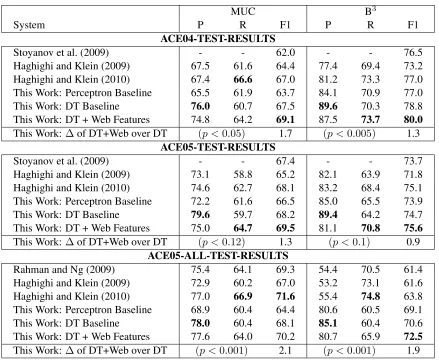
[image:7.612.88.527.56.416.2]This Work: DT + Web Features 77.6 64.0 70.2 80.7 65.9 72.5 This Work:∆of DT+Web over DT (p <0.001) 2.1 (p <0.001) 1.9
Table 3: Primary test results on the ACE04, ACE05, and ACE05-ALL datasets. All systems reported here use automatically extracted system mentions. B3 here is the B3All version of Stoyanov et al. (2009). We also report statistical significance of the improvements from the Web features on the DT baseline, using the bootstrap test (Noreen, 1989; Efron and Tibshirani, 1993). The perceptron baseline in this work (Reconcile settings: 15 iterations, threshold = 0.45, SIG for ACE04 and AP for ACE05, ACE05-ALL) has different results from Stoyanov et al. (2009) because their current publicly available code is different from that used in their paper (p.c.). Also, the B3variant used by Rahman and Ng (2009) is slightly different from other systems (they remove all and only the singleton twinless system mentions, so it is neither B3All nor B3None). For completeness, our (untuned) B3None results (DT + Web) on the ACE05-ALL dataset are P=69.9|R=65.9|F1=67.8.
class / sense information.10
Table 3 shows our primary test results on the ACE04, ACE05, and ACE05-ALL datasets, for the MUC and B3metrics. All systems reported use au-tomatically detected mentions. We report our re-sults (the 3 rows marked ‘This Work’) on the percep-tron baseline, the DT baseline, and the Web features added to the DT baseline. We also report statistical significance of the improvements from the Web
fea-10
We also initially experimented with smaller datasets (MUC6 and MUC7) and an averaged perceptron baseline, and we did see similar improvements, arguing that these features are useful independently of the learning algorithm and dataset.
tures on the DT baseline.11 For significance testing, we use the bootstrap test (Noreen, 1989; Efron and Tibshirani, 1993).
Our main comparison is against Haghighi and Klein (2010), a mostly-unsupervised generative ap-proach that models latent entity types, which gen-erate specific entities that in turn render individual mentions. They learn on large datasets including
11
Wikipedia, and their results are state-of-the-art in coreference resolution. We outperform their system on most datasets and metrics (except on ACE05-ALL for the MUC metric). The other systems we compare to and outperform are the perceptron-based Reconcile system of Stoyanov et al. (2009), the strong deterministic system of Haghighi and Klein (2009), and the cluster-ranking model of Rahman and Ng (2009).
We develop our features and tune their hyper-parameter values on the ACE04 development set and then use these on the ACE04 test set.12 On the ACE05 and ACE05-ALL datasets, we directly trans-fer our Web features and their hyper-parameter val-ues from the ACE04 dev-set, without any retuning. The test improvements we get on all the datasets (see Table 3) suggest that our features are generally use-ful across datasets and metrics.13
5 Analysis
In this section, we briefly discuss errors (in the DT baseline) corrected by our Web features, and ana-lyze the decision tree classifier built during training (based on the ACE04 development experiments).
To study error correction, we begin with the men-tion pairs that are coreferent according to the gold-standard annotation (after matching the system men-tions to the gold ones). We consider the pairs that are wrongly predicted to be non-coreferent by the base-line DT system but correctly predicted to be corefer-ent when we add our Web features. Some examples of such pairs include:
Iran ; the country the EPA ; the agency athletic director ; Mulcahy Democrat Al Gore ; the vice president
12Note that for the ACE04 dataset only, we use the ‘SmartIn-stanceGenerator’ (SIG) filter of Reconcile that uses only a fil-tered set of mention-pairs (based on distance and other proper-ties of the pair) instead of the ‘AllPairs’ (AP) setting that uses all pairs of mentions, and makes training and tuning very slow.
13
For the ACE05 and ACE05-ALL datasets, we revert to the ‘AllPairs’ (AP) setting of Reconcile because this gives us base-lines competitive with Haghighi and Klein (2010). Since we did not need to retune on these datasets, training and tuning speed were not a bottleneck. Moreover, the improvements from our Web features are similar even when tried over the SIG baseline; hence, the filter choice doesn’t affect the performance gain from the Web features.
Barry Bonds ; the best baseball player Vojislav Kostunica ; the pro-democracy leader its closest rival ; the German magazine Das Motorrad One of those difficult-to-dislodge judges ; John Marshall
These pairs are cases where our features on Hearst-style co-occurrence and entity-based context-match are informative and help discriminate in favor of the correct antecedents. One advan-tage of using Web-based features is that the Web has a surprising amount of information on even rare entities such as proper names. Our features also correct coreference for various cases of pronominal anaphora, but these corrections are harder to convey out of context.
Next, we analyze the decision tree built after training the classifier (with all our Web features in-cluded). Around 30% of the decision nodes (both non-terminals and leaves) correspond to Web fea-tures, and the average error in classification at the Web-feature leaves is only around 2.5%, suggest-ing that our features are strongly discriminative for pairwise coreference decisions. Some of the most discriminative nodes correspond to the general co-occurrence feature for most (binned) log-count val-ues, the Hearst-style co-occurrence feature for its zero-count value, the cluster-match feature for its zero-match value, and the R2 pronoun context fea-ture for certain (binned) log-count values.
6 Conclusion
We have presented a collection of simple Web-count features for coreference resolution that capture a range of world knowledge via statistics of general lexical co-occurrence, hypernymy, semantic com-patibility, and semantic context. When added to a strong decision tree baseline, these features give sig-nificant improvements and achieve the best results reported to date, across multiple datasets and met-rics.
Acknowledgments
References
Amit Bagga and Breck Baldwin. 1998. Algorithms for scoring coreference chains. InProceedings of MUC-7 and LREC Workshop.
Mohit Bansal and Dan Klein. 2011. Web-scale features for full-scale parsing. InProceedings of ACL. Eric Bengtson and Dan Roth. 2008. Understanding the
value of features for coreference resolution. In Pro-ceedings of EMNLP.
Shane Bergsma and Dekang Lin. 2006. Bootstrap-ping path-based pronoun resolution. InProceedings of COLING-ACL.
Shane Bergsma, Emily Pitler, and Dekang Lin. 2010. Creating robust supervised classifiers via web-scale n-gram data. InProceedings of ACL.
Thorsten Brants and Alex Franz. 2006. The Google Web 1T 5-gram corpus version 1.1.LDC2006T13.
Kenneth Ward Church and Patrick Hanks. 1989. Word association norms, mutual information, and lexicogra-phy. InProceedings of ACL.
Hal Daum´e III and Daniel Marcu. 2005. A large-scale exploration of effective global features for a joint en-tity detection and tracking model. InProceedings of EMNLP.
B. Efron and R. Tibshirani. 1993. An introduction to the bootstrap.Chapman & Hall CRC.
Aria Haghighi and Dan Klein. 2009. Simple coreference resolution with rich syntactic and semantic features. In
Proceedings of EMNLP.
Aria Haghighi and Dan Klein. 2010. Coreference resolu-tion in a modular, entity-centered model. In Proceed-ings of NAACL-HLT.
Mark Hall, Eibe Frank, Geoffrey Holmes, Bernhard Pfahringer, Peter Reutemann, and Ian H. Witten. 2009. The WEKA data mining software: An update.
SIGKDD Explorations, 11(1).
Zellig Harris. 1954. Distributional structure. Word, 10(23):146162.
Marti Hearst. 1992. Automatic acquisition of hyponyms from large text corpora. InProceedings of COLING. Hamidreza Kobdani, Hinrich Schutze, Michael
Schiehlen, and Hans Kamp. 2011. Bootstrap-ping coreference resolution using word associations. InProceedings of ACL.
Terry Koo, Xavier Carreras, and Michael Collins. 2008. Simple semi-supervised dependency parsing. In Pro-ceedings of ACL.
Dekang Lin and Xiaoyun Wu. 2009. Phrase clustering for discriminative learning. InProceedings of ACL. Dekang Lin, Kenneth Church, Heng Ji, Satoshi Sekine,
David Yarowsky, Shane Bergsma, Kailash Patil, Emily Pitler, Rachel Lathbury, Vikram Rao, Kapil Dalwani,
and Sushant Narsale. 2010. New tools for web-scale n-grams. InProceedings of LREC.
Katja Markert and Malvina Nissim. 2005. Comparing knowledge sources for nominal anaphora resolution.
Computational Linguistics, 31(3):367–402.
Vincent Ng and Claire Cardie. 2002. Improving machine learning approaches to coreference resolution. In Pro-ceedings of ACL.
Vincent Ng. 2010. Supervised noun phrase coreference research: The first fifteen years. In Proceedings of ACL.
NIST. 2004. The ACE evaluation plan. InNIST. E.W. Noreen. 1989. Computer intensive methods for
hypothesis testing: An introduction.Wiley, New York. Massimo Poesio, Rahul Mehta, Axel Maroudas, and
Janet Hitzeman. 2004. Learning to resolve bridging references. InProceedings of ACL.
J. R. Quinlan. 1993. C4.5: Programs for machine learn-ing. Morgan Kaufmann Publishers Inc., San Fran-cisco, CA, USA.
Altaf Rahman and Vincent Ng. 2009. Supervised models for coreference resolution. InProceedings of EMNLP. Altaf Rahman and Vincent Ng. 2011. Coreference reso-lution with world knowledge. InProceedings of ACL. Deepak Ravichandran, Patrick Pantel, and Eduard Hovy. 2005. Randomized algorithms and NLP: Using local-ity sensitive hash functions for high speed noun clus-tering. InProceedings of ACL.
Marta Recasens and Eduard Hovy. 2010. Corefer-ence resolution across corpora: Languages, coding schemes, and preprocessing information. In Proceed-ings of ACL.
Wee Meng Soon, Hwee Tou Ng, and Daniel Chung Yong Lim. 2001. A machine learning approach to corefer-ence resolution of noun phrases. Computational Lin-guistics, 27(4):521–544.
Veselin Stoyanov, Nathan Gilbert, Claire Cardie, and Ellen Riloff. 2009. Conundrums in noun phrase coref-erence resolution: Making sense of the state-of-the-art. InProceedings of ACL/IJCNLP.
Veselin Stoyanov, Claire Cardie, Nathan Gilbert, Ellen Riloff, David Buttler, and David Hysom. 2010. Rec-oncile: A coreference resolution research platform. In
Technical report, Cornell University.
Marc Vilain, John Burger, John Aberdeen, Dennis Con-nolly, and Lynette Hirschman. 1995. A model-theoretic coreference scoring scheme. InProceedings of MUC-6.