Characterizing the Errors of Data-Driven Dependency Parsing Models
Ryan McDonald
Google Inc. 76 Ninth Avenue New York, NY 10011
Joakim Nivre
V¨axj¨o University Uppsala University
35195 V¨axj¨o 75126 Uppsala
Sweden Sweden
Abstract
We present a comparative error analysis of the two dominant approaches in data-driven dependency parsing: global, exhaus-tive, graph-based models, and local, greedy, transition-based models. We show that, in spite of similar performance overall, the two models produce different types of errors, in a way that can be explained by theoretical properties of the two models. This analysis leads to new directions for parser develop-ment.
1 Introduction
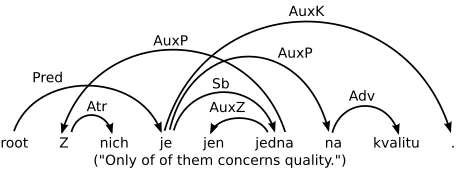
Syntactic dependency representations have a long history in descriptive and theoretical linguistics and many formal models have been advanced (Hudson, 1984; Mel’ˇcuk, 1988; Sgall et al., 1986; Maruyama, 1990). A dependency graph of a sentence repre-sents each word and its syntactic modifiers through labeled directed arcs, as shown in Figure 1, taken from the Prague Dependency Treebank (B¨ohmov´a et al., 2003). A primary advantage of dependency rep-resentations is that they have a natural mechanism for representing discontinuous constructions, aris-ing from long distance dependencies or free word order, throughnon-projectivedependency arcs, ex-emplified by the arc fromjednatoZin Figure 1.
[image:1.612.313.541.242.327.2]Syntactic dependency graphs have recently gained a wide interest in the computational lin-guistics community and have been successfully em-ployed for many problems ranging from machine translation (Ding and Palmer, 2004) to ontology
Figure 1: Example dependency graph.
construction (Snow et al., 2004). In this work we focus on a common parsing paradigm called data-driven dependency parsing. Unlike grammar-based parsing, data-driven approaches learn to produce de-pendency graphs for sentences solely from an anno-tated corpus. The advantage of such models is that they are easily ported to any domain or language in which annotated resources exist.
As evident from the CoNLL-X shared task on de-pendency parsing (Buchholz and Marsi, 2006), there are currently two dominant models for data-driven dependency parsing. The first is what Buchholz and Marsi (2006) call the “all-pairs” approach, where ev-ery possible arc is considered in the construction of the optimal parse. The second is the “stepwise” ap-proach, where the optimal parse is built stepwise and where the subset of possible arcs considered depend on previous decisions. Theoretically, these models are extremely different. The all-pairs models are globally trained, use exact (or near exact) inference algorithms, and define features over a limited history of parsing decisions. The stepwise models use local training and greedy inference algorithms, but define features over a rich history of parse decisions. How-ever, both models obtain similar parsing accuracies
McDonald Nivre
Arabic 66.91 66.71
Bulgarian 87.57 87.41
Chinese 85.90 86.92
Czech 80.18 78.42
Danish 84.79 84.77
Dutch 79.19 78.59
German 87.34 85.82
Japanese 90.71 91.65
Portuguese 86.82 87.60
Slovene 73.44 70.30
Spanish 82.25 81.29
Swedish 82.55 84.58
Turkish 63.19 65.68
[image:2.612.110.266.57.270.2]Overall 80.83 80.75
Table 1: Labeled parsing accuracy for top scoring systems at CoNLL-X (Buchholz and Marsi, 2006).
on a variety of languages, as seen in Table 1, which shows results for the two top performing systems in the CoNLL-X shared task, McDonald et al. (2006) (“all-pairs”) and Nivre et al. (2006) (“stepwise”).
Despite the similar performance in terms of over-all accuracy, there are indications that the two types of models exhibit different behaviour. For example, Sagae and Lavie (2006) displayed that combining the predictions of both parsing models can lead to significantly improved accuracies. In order to pave the way for new and better methods, a much more detailed error analysis is needed to understand the strengths and weaknesses of different approaches. In this work we set out to do just that, focusing on the two top performing systems from the CoNLL-X shared task as representatives of the two dominant models in data-driven dependency parsing.
2 Two Models for Dependency Parsing
2.1 Preliminaries
Let L = {l1, . . . , l|L|} be a set of permissible arc labels. Let x = w0, w1, . . . , wn be an input
sen-tence wherew0=root. Formally, a dependency graph
for an input sentence x is a labeled directed graph
G = (V, A) consisting of a set of nodes V and a set of labeled directed arcsA⊆V ×V ×L, i.e., if
(i, j, l)∈Afori, j ∈V andl∈L, then there is an
arc from nodeito nodejwith labellin the graph. A dependency graphGfor sentencexmust satisfy the following properties:
1. V ={0,1, . . . , n}
2. If(i, j, l)∈A, thenj6= 0.
3. If(i, j, l) ∈ A, then for all i0 ∈ V − {i}and
l0∈L,(i0, j, l0)∈/ A.
4. For allj∈V− {0}, there is a (possibly empty) sequence of nodes i1, . . . , im∈V and labels
l1, . . . , lm, l∈L such that (0, i1, l1),(i1, i2, l2),
. . . ,(im, j, l)∈A.
The constraints state that the dependency graph spans the entire input (1); that the node 0 is a root (2); that each node has at most one incoming arc in the graph (3); and that the graph is connected through directed paths from the node0to every other node in the graph (4). A dependency graph satisfy-ing these constraints is a directed tree originatsatisfy-ing out of the root node0. We say that an arc(i, j, l)is non-projectiveif not all wordskoccurring betweeniand
jin the linear order are dominated byi(where dom-inance is the transitive closure of the arc relation).
2.2 Global, Exhaustive, Graph-Based Parsing
For an input sentence,x=w0, w1, . . . , wnconsider
the dense graphGx = (Vx, Ax)where:
1. Vx ={0,1, . . . , n}
2. Ax={(i, j, l)| ∀i, j ∈Vxandl∈L}
Let D(Gx) represent the subgraphs of graph Gx
that are valid dependency graphs for the sentence
x. SinceGx contains all possible labeled arcs, the
setD(Gx)must necessarily contain all valid
depen-dency graphs forx.
Assume that there exists a dependency arc scoring function,s:V ×V ×L→R. Furthermore, define the score of a graph as the sum of its arc scores,
s(G= (V, A)) = X (i,j,l)∈A
s(i, j, l)
The score of a dependency arc, s(i, j, l) represents the likelihood of creating a dependency from word
wito wordwj with the labell. If the arc score
G= arg max
G∈D(Gx)
s(G) = arg max
G∈D(Gx) X
(i,j,l)∈A
s(i, j, l)
This problem is equivalent to finding the highest scoring directed spanning tree in the graphGx
origi-nating out of the root node0, which can be solved for both the labeled and unlabeled case inO(n2) time (McDonald et al., 2005b). In this approach, non-projective arcs are produced naturally through the inference algorithm that searches over all possible directed trees, whether projective or not.
The parsing models of McDonald work primarily in this framework. To learn arc scores, these mod-els use large-margin structured learning algorithms (McDonald et al., 2005a), which optimize the pa-rameters of the model to maximize the score mar-gin between the correct dependency graph and all incorrect dependency graphs for every sentence in a training set. The learning procedure is global since model parameters are set relative to the classification of the entire dependency graph, and not just over sin-gle arc attachment decisions. The primary disadvan-tage of these models is that the feature representa-tion is restricted to a limited number of graph arcs. This restriction is required so that both inference and learning are tractable.
The specific model studied in this work is that presented by McDonald et al. (2006), which factors scores over pairs of arcs (instead of just single arcs) and uses near exhaustive search for unlabeled pars-ing coupled with a separate classifier to label each arc. We call this system MSTParser, which is also the name of the freely available implementation.1
2.3 Local, Greedy, Transition-Based Parsing
Atransition systemfor dependency parsing defines
1. a setCofparser configurations, each of which defines a (partially built) dependency graphG
2. a setT oftransitions, each a functiont:C→C
3. for every sentencex=w0, w1, . . . , wn,
(a) a uniqueinitialconfigurationcx
(b) a setCxofterminalconfigurations
1
http://mstparser.sourceforge.net
Atransition sequenceCx,m = (cx, c1, . . . , cm)for a
sentencexis a sequence of configurations such that
cm ∈Cxand, for everyci (ci 6=cx), there is a
tran-sitiont∈Tsuch thatci =t(ci−1). The dependency
graph assigned toxbyCx,mis the graphGmdefined
by the terminal configurationcm.
Assume that there exists a transition scoring func-tion, s : C ×T → R. The score of a transition
tin a configuration c, s(c, t), represents the likeli-hood of taking transition t out of configuration c. The parsing problem consists in finding a terminal configuration cm ∈ Cx, starting from the initial
configuration cx and taking the optimal transition
t∗ = arg maxt∈T s(c, t) out of every configuration
c. This can be seen as a greedy search for the optimal dependency graph, based on a sequence of locally optimal decisions in terms of the transition system.
Many transition systems for data-driven depen-dency parsing are inspired by shift-reduce parsing, where configurations contain a stack for storing par-tially processed nodes. Transitions in such systems add arcs to the dependency graph and/or manipu-late the stack. One example is the transition system defined by Nivre (2003), which parses a sentence
x=w0, w1, . . . , wninO(n)time, producing a
pro-jective dependency graph satisfying conditions 1–4 in section 2.1, possibly after adding arcs (0, i, lr)
for every node i 6= 0 that is a root in the output graph (wherelris a special label for root modifiers).
Nivre and Nilsson (2005) showed how the restric-tion to projective dependency graphs could be lifted by using graph transformation techniques to pre-process training data and post-pre-process parser output, so-calledpseudo-projective parsing.
To learn transition scores, these systems use dis-criminative learning methods, e.g., memory-based learning or support vector machines. The learning procedure is local since only single transitions are scored, not entire transition sequences. The primary advantage of these models is that features are not re-stricted to a limited number of graph arcs but can take into account the entire dependency graph built so far. The main disadvantage is that the greedy parsing strategy may lead to error propagation.
the name of the freely available implementation.2
2.4 Comparison
These models differ primarily with respect to three important properties.
1. Inference: MaltParser uses a transition-based inference algorithm that greedily chooses the best parsing decision based on a trained clas-sifier and current parser history. MSTParser instead uses near exhaustive search over a dense graphical representation of the sentence to find the dependency graph that maximizes the score.
2. Training: MaltParser trains a model to make a single classification decision (choose the next transition). MSTParser trains a model to maxi-mize the global score of correct graphs.
3. Feature Representation: MaltParser can in-troduce a rich feature history based on previ-ous parser decisions. MSTParser is forced to restrict the score of features to a single or pair of nearby parsing decisions in order to make exhaustive inference tractable.
These differences highlight an inherent trade-off be-tween exhaustive inference algorithms plus global learning and expressiveness of feature representa-tions. MSTParser favors the former at the expense of the latter and MaltParser the opposite.
3 The CoNLL-X Shared Task
The CoNLL-X shared task (Buchholz and Marsi, 2006) was a large-scale evaluation of data-driven de-pendency parsers, with data from 13 different lan-guages and 19 participating systems. The official evaluation metric was thelabeled attachment score
(LAS), defined as the percentage of tokens, exclud-ing punctuation, that are assigned both the correct head and the correct dependency label.3
The output of all systems that participated in the shared task are available for download and consti-tute a rich resource for comparative error analysis.
2
http://w3.msi.vxu.se/users/nivre/research/MaltParser.html
3
In addition, results were reported forunlabeled attachment score(UAS) (tokens with the correct head) andlabel accuracy (LA) (tokens with the correct label).
The data used in the experiments below are the out-puts of MSTParser and MaltParser for all 13 lan-guages, together with the corresponding gold stan-dard graphs used in the evaluation. We constructed the data by simply concatenating a system’s output for every language. This resulted in a single out-put file for each system and a corresponding single gold standard file. This method is sound because the data sets for each language contain approximately the same number of tokens – 5,000. Thus, evalu-ating system performance over the aggregated files can be roughly viewed as measuring system perfor-mance through an equally weighted arithmetic mean over the languages.
It could be argued that a language by language comparison would be more appropriate than com-paring system performance across all languages. However, as table Table 1 shows, the difference in accuracy between the two systems is typically small for all languages, and only in a few cases is this difference significant. Furthermore, by aggregating over all languages we gain better statistical estimates of parser errors, since the data set for each individual language is very small.
4 Error Analysis
The primary purpose of this study is to characterize the errors made by standard data-driven dependency parsing models. To that end, we present a large set of experiments that relate parsing errors to a set of lin-guistic and structural properties of the input and pre-dicted/gold standard dependency graphs. We argue that the results can be correlated to specific theoreti-cal aspects of each model – in particular the trade-off highlighted in Section 2.4.
For simplicity, all experiments report labeled parsing accuracies. Identical experiments using un-labeled parsing accuracies did not reveal any addi-tional information. Furthermore, all experiments are based on the data from all 13 languages together, as explained in section 3.
4.1 Length Factors
10 20 30 40 50 50+
Sentence Length (bins of size 10)
0.7 0.72 0.74 0.76 0.78 0.8 0.82 0.84
Dependency
Accuracy
[image:5.612.78.296.61.168.2]MSTParser MaltParser
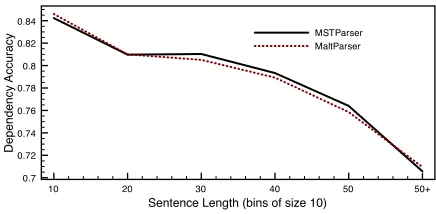
Figure 2: Accuracy relative to sentence length.
etc.). System performance is almost indistinguish-able. However, MaltParser tends to perform better on shorter sentences, which require the greedy in-ference algorithm to make less parsing decisions. As a result, the chance of error propagation is reduced significantly when parsing these sentences. The fact that MaltParser has a higher accuracy (rather than the same accuracy) when the likelihood of error propagation is reduced comes from its richer feature representation.
Another interesting property is accuracy relative to dependency length. The length of a dependency from wordwito wordwjis simply equal to|i−j|.
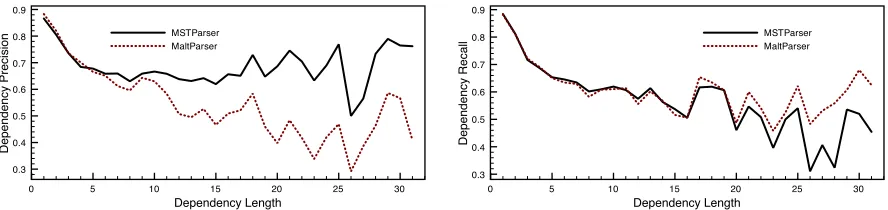
Longer dependencies typically represent modifiers of the root or the main verb in a sentence. Shorter dependencies are often modifiers of nouns such as determiners or adjectives or pronouns modifying their direct neighbours. Figure 3 measures the pre-cision and recall for each system relative to depen-dency lengths in the predicted and gold standard de-pendency graphs. Precision represents the percent-age of predicted arcs of lengthdthat were correct. Recall measures the percentage of gold standard arcs of lengthdthat were correctly predicted.
Here we begin to see separation between the two systems. MSTParser is far more precise for longer dependency arcs, whereas MaltParser does better for shorter dependency arcs. This behaviour can be explained using the same reasoning as above: shorter arcs are created before longer arcs in the greedy parsing procedure of MaltParser and are less prone to error propagation. Theoretically, MST-Parser should not perform better or worse for edges of any length, which appears to be the case. There is still a slight degradation, but this can be attributed to long dependencies occurring more frequently in constructions with possible ambiguity. Note that
even though the area under the curve is much larger for MSTParser, the number of dependency arcs with a length greater than ten is much smaller than the number with length less than ten, which is why the overall accuracy of each system is nearly identical. For all properties considered here, bin size generally shrinks in size as the value on the x-axis increases.
4.2 Graph Factors
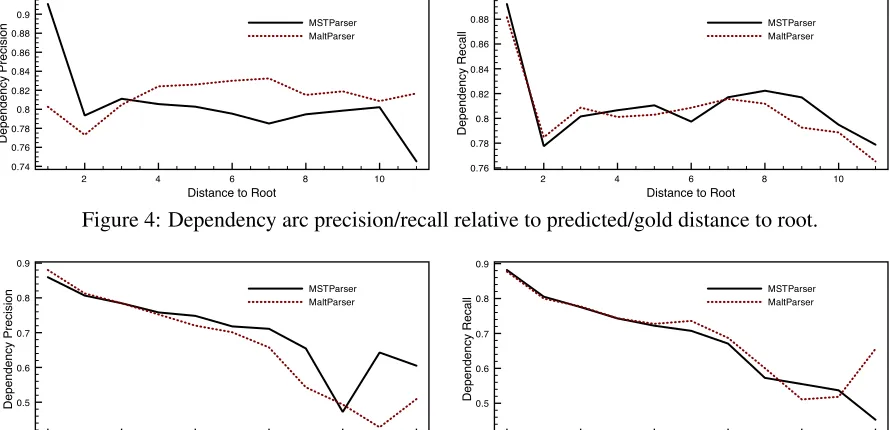
The structure of the predicted and gold standard de-pendency graphs can also provide insight into the differences between each model. For example, mea-suring accuracy for arcs relative to their distance to the artificial root node will detail errors at different levels of the dependency graph. For a given arc, we define this distance as the number of arcs in the re-verse path from the modifier of the arc to the root. Figure 4 plots the precision and recall of each sys-tem for arcs of varying distance to the root. Preci-sion is equal to the percentage of dependency arcs in the predicted graph that are at a distance ofdand are correct. Recall is the percentage of dependency arcs in the gold standard graph that are at a distance ofd
and were predicted.
0 5 10 15 20 25 30 Dependency Length
0.3 0.4 0.5 0.6 0.7 0.8 0.9
Dependency Precision
MSTParser MaltParser
0 5 10 15 20 25 30
Dependency Length 0.3
0.4 0.5 0.6 0.7 0.8 0.9
Dependency Recall
[image:6.612.83.527.61.166.2]MSTParser MaltParser
Figure 3: Dependency arc precision/recall relative to predicted/gold dependency length.
of the plot. The high performance for root modifica-tion (distance of 1) can be explained through the fact that this is typically a low entropy decision – usu-ally the parsing algorithm has to determine the main verb from a small set of possibilities. On the other end of the plot there is a sharp downwards spike for arcs of distance greater than 10. It turns out that MSTParser over-predicts arcs near the bottom of the graph. Whereas MaltParser pushes difficult parsing decisions higher in the graph, MSTParser appears to push these decisions lower.
The next graph property we will examine aims to quantify the local neighbourhood of an arc within a dependency graph. Two dependency arcs,(i, j, l)
and(i0, j0, l0)are classified as siblings if they repre-sent syntactic modifications of the same word, i.e.,
i = i0. Figure 5 measures the precision and recall of each system relative to the number of predicted and gold standard siblings of each arc. There is not much to distinguish between the parsers on this metric. MSTParser is slightly more precise for arcs that are predicted with more siblings, whereas Malt-Parser has slightly higher recall on arcs that have more siblings in the gold standard tree. Arcs closer to the root tend to have more siblings, which ties this result to the previous ones.
The final graph property we wish to look at is the degree of non-projectivity. The degree of a depen-dency arc from word w to word u is defined here as the number of words occurring betweenwandu
that are not descendants ofwand modify a word that does not occur betweenwandu (Nivre, 2006). In the example from Figure 1, the arc fromjedna toZ
has a degree of one, and all other arcs have a degree of zero. Figure 6 plots dependency arc precision and recall relative to arc degree in predicted and gold standard dependency graphs. MSTParser is more
precise when predicting arcs with high degree and MaltParser vice-versa. Again, this can be explained by the fact that there is a tight correlation between a high degree of non-projectivity, dependency length, distance to root and number of siblings.
4.3 Linguistic Factors
It is important to relate each system’s accuracy to a set of linguistic categories, such as parts of speech and dependency types. Therefore, we have made an attempt to distinguish a few broad categories that are cross-linguistically identifiable, based on the available documentation of the treebanks used in the shared task.
For parts of speech, we distinguishverbs (includ-ing both main verbs and auxiliaries),nouns (includ-ing proper names), pronouns (sometimes also in-cluding determiners), adjectives, adverbs, adposi-tions(prepositions, postpositions), andconjunctions
(both coordinating and subordinating). For depen-dency types, we distinguish a generalrootcategory (for labels used on arcs from the artificial root, in-cluding either a generic label or the label assigned to predicates of main clauses, which are normally verbs), a subject category, an object category (in-cluding both direct and indirect objects), and various categories related tocoordination.
2 4 6 8 10 Distance to Root
0.74 0.76 0.78 0.8 0.82 0.84 0.86 0.88 0.9
Dependency Precision
MSTParser MaltParser
2 4 6 8 10
Distance to Root 0.76
0.78 0.8 0.82 0.84 0.86 0.88
Dependency Recall
[image:7.612.73.529.62.165.2]MSTParser MaltParser
Figure 4: Dependency arc precision/recall relative to predicted/gold distance to root.
0 2 4 6 8 10+
Number of Modifier Siblings 0.5
0.6 0.7 0.8 0.9
Dependency Precision
MSTParser MaltParser
0 2 4 6 8 10+
Number of Modifier Siblings 0.5
0.6 0.7 0.8 0.9
Dependency Recall
[image:7.612.81.526.66.281.2]MSTParser MaltParser
Figure 5: Dependency arc precision/recall relative to number of predicted/gold siblings.
longer distances, while nouns and pronouns are typ-ically attached to verbs and therefore occur lower in the graph, with shorter distances. Empirically, ad-verbs resemble ad-verbs and conjunctions with respect to root distance but group with nouns and pronouns for dependency length, so the former appears to be more important. In addition, both conjunctions and adverbs tend to have a high number of siblings, mak-ing the results consistent with the graph in Figure 5.
Adpositions and especially adjectives constitute a puzzle, having both high average root distance and low average dependency length. Adpositions do tend to have a high number of siblings on average, which could explain MSTParser’s performance on that category. However, adjectives on average occur the furthest away from the root, have the shortest dependency length and the fewest siblings. As such, we do not have an explanation for this behaviour.
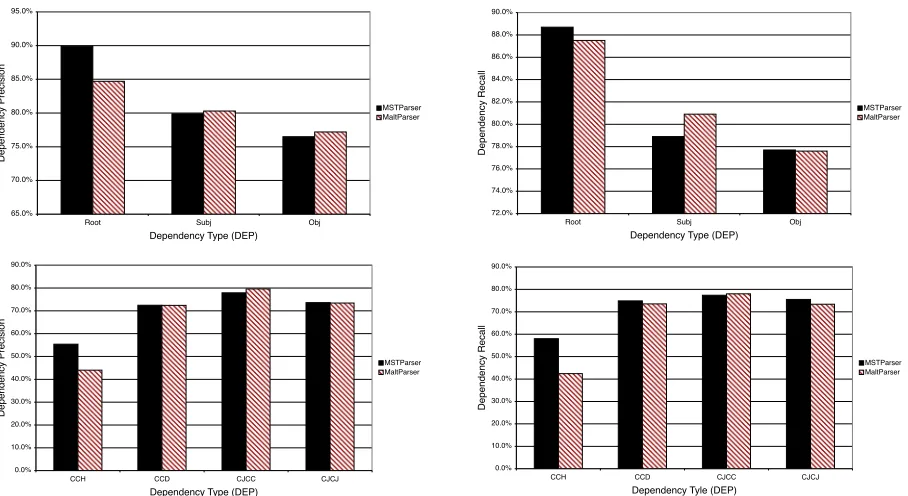
In the top half of Figure 8, we consider precision and recall for dependents of the root node (mostly verbal predicates), and for subjects and objects. As already noted, MSTParser has considerably better precision (and slightly better recall) for the root cat-egory, but MaltParser has an advantage for the nomi-nal categories, especially subjects. A possible expla-nation for the latter result, in addition to the length-based and graph-length-based factors invoked before, is that
60.0% 65.0% 70.0% 75.0% 80.0% 85.0% 90.0% 95.0%
Verb Noun Pron Adj Adv Adpos Conj
Part of Speech (POS)
Labeled
Attachment Score (LAS)
[image:7.612.321.538.340.467.2]MSTParser MaltParser
Figure 7: Accuracy for different parts of speech.
MaltParser integrates labeling into the parsing pro-cess, so that previously assigned dependency labels can be used as features, which may be important to disambiguate subjects and objects.
0 1 2 3 4 5 6 7+ Non-Projective Arc Degree
0.55 0.6 0.65 0.7 0.75 0.8 0.85
Dependency Precision
MSTParser MaltParser
0 1 2 3 4 5 6 7+
Non-Projective Arc Degree
0.6 0.65 0.7 0.75 0.8 0.85
Dependency Recall
[image:8.612.75.528.62.166.2]MSTParser MaltParser
Figure 6: Dependency arc precision/recall relative to predicted/gold degree of non-projectivity.
65.0% 70.0% 75.0% 80.0% 85.0% 90.0% 95.0%
Root Subj Obj
Dependency Type (DEP)
Dependency Precision
MSTParser MaltParser
72.0% 74.0% 76.0% 78.0% 80.0% 82.0% 84.0% 86.0% 88.0% 90.0%
Root Subj Obj
Dependency Type (DEP)
Dependency Recall
MSTParser MaltParser
0.0% 10.0% 20.0% 30.0% 40.0% 50.0% 60.0% 70.0% 80.0% 90.0%
CCH CCD CJCC CJCJ
Dependency Type (DEP)
Dependency Precision
MSTParser MaltParser
0.0% 10.0% 20.0% 30.0% 40.0% 50.0% 60.0% 70.0% 80.0% 90.0%
CCH CCD CJCC CJCJ
Dependency Tyle (DEP)
Dependency Recall
MSTParser MaltParser
Figure 8: Precision/recall for different dependency types.
and Slovene. The category CCD (coordinating con-junction as dependent) instead denotes concon-junctions that are attached as dependents of one of the con-juncts with a label that only marks them as conjunc-tions, a type of category found in the data sets for Bulgarian, Danish, German, Portuguese, Swedish and Turkish. The two remaining categories con-tain conjuncts that are assigned a dependency label that only marks them as conjuncts and that are at-tached either to the conjunction (CJCC) or to an-other conjunct (CJCJ). The former is found in Bul-garian, Danish, and German; the latter only in Por-tuguese and Swedish. For most of the coordination categories there is little or no difference between the two parsers, but for CCH there is a difference in both precision and recall of almost 20 percentage points to MSTParser’s advantage. This can be explained by
noting that, while the categories CCD, CJCC, and CJCJ denote relations that areinternalto the coor-dinate structure and therefore tend to be local, the CCH relations hold between the coordinate struc-ture and its head, which is often a relation that spans over a greater distance and is nearer the root of the dependency graph. It is likely that the difference in accuracy for this type of dependency accounts for a large part of the difference in accuracy noted earlier for conjunctions as a part of speech.
4.4 Discussion
[image:8.612.84.538.194.442.2]typi-cally performs worse on long sentences, long depen-dency arcs and arcs higher in the graphs. But this is offset by the rich feature representation available to these models that result in better decisions for fre-quently occurring arc types like short dependencies or subjects and objects. The errors for MSTParser are spread a little more evenly. This is expected, as the inference algorithm and feature representation should not prefer one type of arc over another.
What has been learned? It was already known that the two systems make different errors through the work of Sagae and Lavie (2006). However, in that work an arc-based voting scheme was used that took only limited account of the properties of the words connected by a dependency arc (more precisely, the overall accuracy of each parser for the part of speech of the dependent). The analysis in this work not only shows that the errors made by each system are dif-ferent, but that they are different in a way that can be predicted and quantified. This is an important step in parser development.
To get some upper bounds of the improvement that can be obtained by combining the strengths of each models, we have performed two oracle experi-ments. Given the output of the two systems, we can envision an oracle that can optimally choose which single parse or combination of sub-parses to predict as a final parse. For the first experiment the oracle is provided with the single best parse from each sys-tem, sayG= (V, A)andG0 = (V0, A0). The oracle chooses a parse that has the highest number of cor-rectly predicted labeled dependency attachments. In this situation, the oracle accuracy is84.5%. In the second experiment the oracle chooses the tree that maximizes the number of correctly predicted depen-dency attachments, subject to the restriction that the tree must only contain arcs from A∪A0. This can be computed by setting the weight of an arc to 1 if it is in the correct parse and in the set A∪A0. All other arc weights are set to negative infinity. One can then simply find the tree that has maximal sum of arc weights using directed spanning tree algorithms. This technique is similar to the parser voting meth-ods used by Sagae and Lavie (2006). In this situa-tion, the oracle accuracy is86.9%.
In both cases we see a clear increase in accuracy:
86.9%and84.5%relative to81%for the individual systems. This indicates that there is still potential
for improvement, just by combining the two existing models. More interestingly, however, we can use the analysis to get ideas for new models. Below we sketch some possible new directions:
1. Ensemble systems: The error analysis pre-sented in this paper could be used as inspiration for more refined weighting schemes for ensem-ble systems of the kind proposed by Sagae and Lavie (2006), making the weights depend on a range of linguistic and graph-based factors.
2. Hybrid systems: Rather than using an ensem-ble of several parsers, we may construct a sin-gle system integrating the strengths of each parser described here. This could defer to a greedy inference strategy during the early stages of the parse in order to benefit from a rich feature representation, but then default to a global exhaustive model as the likelihood for error propagation increases.
3. Novel approaches:The two approaches inves-tigated are each based on a particular combina-tion of training and inference methods. We may naturally ask what other combinations may prove fruitful. For example, what about glob-ally trained, greedy, transition-based models? This is essentially what Daum´e III et al. (2006) provide, in the form of a general search-based structured learning framework that can be di-rectly applied to dependency parsing. The ad-vantage of this method is that the learning can set model parameters relative to errors resulting directly from the search strategy – such as error propagation due to greedy search. When com-bined with MaltParser’s rich feature represen-tation, this could lead to significant improve-ments in performance.
5 Conclusion
References
A. B¨ohmov´a, J. Hajiˇc, E. Hajiˇcov´a, and B. Hladk´a. 2003. The PDT: A 3-level annotation scenario. In A. Abeill´e, editor, Treebanks: Building and Using Parsed Corpora, chapter 7. Kluwer Academic Publish-ers.
S. Buchholz and E. Marsi. 2006. CoNLL-X shared task on multilingual dependency parsing. InProc. CoNLL.
Hal Daum´e III, John Langford, and Daniel Marcu. 2006. Search-based structured prediction. In Submission.
Y. Ding and M. Palmer. 2004. Synchronous dependency insertion grammars: A grammar formalism for syntax based statistical MT. InWorkshop on Recent Advances in Dependency Grammars (COLING).
R. Hudson. 1984.Word Grammar. Blackwell.
H. Maruyama. 1990. Structural disambiguation with constraint propagation. InProc. ACL.
R. McDonald, K. Crammer, and F. Pereira. 2005a. On-line large-margin training of dependency parsers. In
Proc. ACL.
R. McDonald, F. Pereira, K. Ribarov, and J. Hajiˇc. 2005b. Non-projective dependency parsing using spanning tree algorithms. InProc. HLT/EMNLP.
R. McDonald, K. Lerman, and F. Pereira. 2006. Multi-lingual dependency analysis with a two-stage discrim-inative parser. InProc. CoNLL.
I.A. Mel’ˇcuk. 1988. Dependency Syntax: Theory and Practice. State University of New York Press.
J. Nivre and J. Nilsson. 2005. Pseudo-projective depen-dency parsing. InProc. ACL.
J. Nivre, J. Hall, J. Nilsson, G. Eryigit, and S. Marinov. 2006. Labeled pseudo-projective dependency parsing with support vector machines. InProc. CoNLL.
J. Nivre. 2003. An efficient algorithm for projective de-pendency parsing. InProc. IWPT.
J. Nivre. 2006. Constraints on non-projective depen-dency parsing. InProc. EACL.
K. Sagae and A. Lavie. 2006. Parser combination by reparsing. InProc. HLT/NAACL.
P. Sgall, E. Hajiˇcov´a, and J. Panevov´a. 1986. The Mean-ing of the Sentence in Its Pragmatic Aspects. Reidel.