BioNLP shared Task 2011 - Bacteria Biotope
Robert Bossy1, Julien Jourde1, Philippe Bessières1, Maarten van de Guchte2, Claire Nédellec1
1MIG UR1077 2Micalis UMR 1319 INRA, Domaine de Vilvert
78352 Jouy-en-Josas, France
Abstract
This paper presents the Bacteria Biotope task as part of the BioNLP Shared Tasks 2011. The Bacteria Biotope task aims at extracting the location of bacteria from scientific Web pages. Bacteria location is a crucial knowledge in biology for phenotype studies. The paper details the corpus specification, the evaluation metrics, summarizes and discusses the participant results.
1 Introduction
The Bacteria Biotope (BB) task is one of the five main tasks of the BioNLP Shared Tasks 2011. The BB task consists of extracting bacteria location events from Web pages, in other words, citations of places where a given species lives. Bacteria locations range from plant or animal hosts for pathogenic or symbiotic bacteria, to natural environments like soil or water. Challenges for Information Extraction (IE) of relations in Biology are mostly devoted to the identification of bio-molecular events in scientific papers where the events are described by relations between named entities, e.g. genic interactions (Nédellec, 2005), protein-protein interactions (Pyysalo et al., 2008), and more complex molecular events (Kim et al., 2011). However, this far from reflects the diversity of the potential applications of text mining to biology. The objective of previous challenges has mostly been focused on modeling biological functions and processes using the information on elementary molecular events extracted from text.
The BB task is the first step towards linking information on bacteria at the molecular level to ecological information. The information on bacterial habitats and properties of these habitats is very abundant in literature, in particular in Systematics literature (e.g. International Journal of Systematic and Evolutionary Microbiology), however it is rarely available in a structured way (Hirschman et al., 2008; Tamames and de Lorenzo, 2009). The NCBI GenBank nucleotide isolation source field (GenBank) and the JGI Genome OnLine Database (GOLD) isolation site field are incomplete with respect to the microbial diversity and are expressed in natural language. The two critical missing steps in terms of biotope knowledge modeling are (1) the automatic population of databases with organism/location pairs that are extracted from text, and (2) the normalization of the habitat name with respect to biotope ontologies. The BB task mainly aims at solving the first information extraction issue. The second classification issue is handled through the categorization of locations into eight types.
2 Context
According to NCBI statistics there are nearly 900 bacteria with complete genomes, which account for more than 87% of total complete genomes. Consequently, molecular studies in bacteriology are shifting from species-centered to full diversity investigation. The current trend in high-throughput experiments targets diversity related fields, typically phylogeny or ecology. In this context, adaptation properties, biotopes and biotope properties become critical information. Illustrative questions are:
• Is there a phylogenetic correlation between species that share the same biotope?
• What are common metabolic pathways of species that live in given conditions, especially species that survive in extreme conditions? • What are the molecular signaling patterns in
host relationships or population relationships (e.g. in biofilms)?
Recent metagenomic experiments produce molecular data associated with a habitat rather than a single species. This raises new challenges in computational biology and data integration, such as identifying known and new species that belong to a metagenome.
Not only will these studies require comprehensive databases that associate bacterial species to their habitat, but they also require a formal description of habitats for property inference. The bacteria biotope description is potentially very rich since any physical object, from a cell to a continent, can be a bacterial habitat. However these relations are much simpler to model than with general formal spatial ontologies. A given place is a bacterial habitat if the bacteria and the habitat are physically in contact, while the relative position of the bacteria and its dissemination are not part of the BB task model.
The BB Task requires the locations to be assigned different types (e.g. soil, water). We view location typing as a preliminary step of more fine-grained modeling in location ontologies. Some classifications for bacteria biotopes have been proposed by some groups (Floyd et al., 2005; Hirschman et al., 2008; Field et al., 2008; Pignatelli et al., 2009). The Environment Ontology project (EnvO) is developing an ambitious detailed environment ontology for supporting standard manual annotation of environments of all types of organisms and biological samples (Field et al., 2008). In a similar way, the GOLD group at JGI defined a standard classification for bacteria population metagenome projects. Developing methods for the association of such biotope classes to organisms remains an open question. EnvDB (Pignatelli et al., 2009) is an attempt to inventory isolation sources of bacteria as recorded in GenBank and to map them to a three level hierarchy of 71 biotope classes. The assignment of bacterial samples in one of the EnvDB classes is supported by a text-mining tool based on a Naïve
Bayes (NB) classifier applied to a bag of words representing the associated reference title and abstract. Unfortunately, the low number of paper references associated with the isolation source field (46 %) limits the scope of the method.
The BB task has a similar goal, but directly applies to natural language texts thus avoiding the issue of database incompleteness. As opposed to database-based approaches, biotope information density is higher but the task has to include bacteria and location identification, as well as information extraction to relate them.
The eight types of locations in the BB task capture high-level information for further ontology mappings. The location types are Host, HostPart, Geographical and Environmental. Environmental is broadly defined to qualify locations that are not associated to hosts, in a similar way to what was described by Floyd et al. (Floyd et al., 2005). In addition, the BB task types exclude artificially constructed biotopes (e.g. bacteria growing in labs on a specific medium) and laboratory mutant bacteria. The Environmental class is divided into Food, Medical, Soil and Water. Locations that are none of these subtypes are classified as Environmental.
The exact geographical location (e.g. latitude and longitude coordinates) has less importance here than in eukaryote ecology because most of the biotope properties vary along distances smaller than the precision of the current positioning technologies. Geographical names are only useful in bacteria biotope studies when the physico-chemical properties of the location can be inferred. For the sake of simplicity, the locations of bacteria host (e.g. the stall of the infected cow) are not taken into account despite their richness (Floyd et al., 2005).
with the help of specialized databases, which give the physico-chemical properties of locations, such as hosts (plant, animal, human organs), soils (see WebSoilSurvey, Corine Land Cover), water, or chemical pollutants.
From a linguistic point of view, the BB task differs from other IE molecular biology tasks while it raises some issues common to biomedicine and more general IE tasks. The documents are scientific Web pages intended for non-experts such as encyclopedia notices. The information is dense compared to scientific papers. Documents are structured as encyclopedia pages, with the main focus on a single species or a few species of the same genus or family. The frequency of anaphora and coreferences is unusually high. The location entities are denoted by complex expressions with semantic boundaries instead of rigid designators.
3 Task description
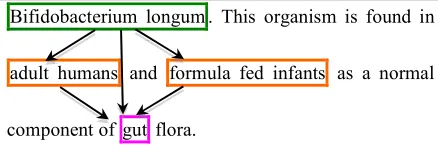
The goal of the BB task is illustrated in Figure 1.
[image:3.612.82.301.334.410.2]Bifidobacterium longum . This organism is found in adult humans and formula fed infants as a normal component of gut flora.
Figure 1. Example of information to be extracted in the BB Task.
The entities to be extracted are of two main types: bacteria and locations. They are text-bound and their position has to be predicted. Relations are of type Localization between bacteria and locations, and PartOf between hosts and host parts. In the example in Figure 1, Bifidobacterium longum is a bacterium. adult humans and formula fed infants denote host locations for the bacteria. gut is also a bacteria location, part of the two hosts and thus of type host part.
Coreference relations between entities denoting the same information represent valid alternatives for the relation arguments. For example, the three taxon names in Figure 2 are equivalent.
The green sulfur bacteria ( GSB ; Phylum Chlorobi ) are commonly found in aquatic environments .
Figure 2. Coreference example.
The coreference relation between pairs of entities is binary, symmetric and transitive. Coreference sets are equivalence sets defined as the transitive closure of the binary coreference relation. Their annotation is provided in the training and development sets, but it does not have to be predicted in the test set.
4 Corpus description
The corpus sources are the following bacteria sequencing project Web pages:
• Genome Projects referenced at NCBI; • Microbial Genomics Program at JGI; • Bacteria Genomes at EBI;
• Microorganisms sequenced at Genoscope; • Encyclopedia pages from MicrobeWiki.
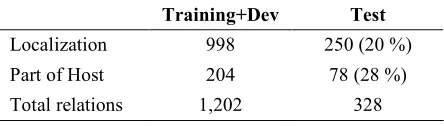
The documents are publicly available and quite easy to understand by non-experts compared to scientific papers on similar topics. From the 2,086 downloaded documents, 105 were randomly selected for the BB task. A quarter of the corpus was retained for test evaluation. The rest was split into train and development sets. Table 1 gives the distribution of the entities and relations per corpus. The distribution of the five document sources in the test corpus reflects the distribution of the training set and no other criteria. Food is therefore underrepresented.
Training+Dev Test
Document 78 (65 + 13) 27 (26 %) Bacteria 538 121 (18 %) Environment 62 16 (21 %)
Host 486 101 (17 %)
HostPart 217 84 (28 %) Geographical 111 25 (18 %)
Water 70 21 (23 %)
Food 46 0 (0 %)
Medical 24 2 (8 %)
Soil 26 20 (43 %)
[image:3.612.314.536.487.684.2]Training+Dev Test
[image:4.612.79.301.59.122.2]Localization 998 250 (20 %) Part of Host 204 78 (28 %) Total relations 1,202 328
Table 1. Corpus Figures.
5 Annotation methodology
HTML tags and irrelevant metadata were stripped from the corpus. The Alvis pipeline (Nédellec et al., 2009) pre-annotated the species names that are potential bacteria and host names. A team of 7 scientists manually annotated the entities, coreferences and relations using the Cadixe XML editor (Cadixe). Each document was processed by two independent annotators in a double-blind manner. Conflicts were automatically detected, resolved by annotator negotiation and irrelevant documents (e.g. without bacterial location) were removed. The remaining inconsistencies among documents were resolved by the two annotators assisted by a third person acting as an arbitrator.
The annotator group designed the detailed annotation guidelines in two phases. First, they annotated a set of 10 documents, discussed the options and wrote detailed guidelines with representative and illustrative examples. During the annotation of the rest of the documents, new cases were discussed by email and the guidelines amended accordingly.
Location types. The main issues under debate were the definition of location types, boundaries of annotations and coreferences. Additional annotation specifications concerned the exclusion of overly general locations (e.g. environment, zone), artificially constructed biotopes and indirect effects of bacteria on distant places. For instance, a disease symptom occurring in a given host part does not imply the presence of the bacteria in this place, whereas infection does. Boundaries of types were also an important point of discussion since the definite formalization of habitat categories was at stake. For instance we decided to exclude land environment citations (fields, deserts, savannah, etc.) from the type Soil, and thus enforced a strict definition of soil bacteria. The most controversial type was host parts. We decided to include fluids, secretions and excretions (which are not strictly organs). Therefore, the host parts category required specifications to determine at which point of
dissociation from the original host is a habitat not a host part anymore (e.g. mother’s milk vs. industrial milk, rhizosphere as host part instead of soil).
Boundaries. The bacteria name boundaries do not include any external modifiers (e.g. two A. baumannii strains). Irrelevant modifiers of locations are considered outside the annotation boundaries (e.g. responsible for a hospital epidemic). All annotations are contiguous and span on a single fragment in the same way as the other BioNLP Shared Tasks. This constraint led us to consider cases where several annotations occur side by side. The preferred approach was to have one distinct annotation for each different location (e.g. contact with infected animal products or through the air). In the case of head or modifier factorization, the annotation depends on the information conveyed by the factorized part. If the head is not relevant to determine the location type, then each term is annotated separately (e.g. tropical and temperate zones). Conversely, if the head is the most informative with regards to the location type, a single annotation spans the whole fragment (fresh and salt water).
Coreferences. Two expressions are considered as coreferential and thus valid solution alternatives, if they convey the same information. For instance, complete taxon names and non-ambiguous abbreviations are valid alternatives (e.g. Borrelia garinii vs. B. garinii), while ambiguous anaphora ellipses are not (e.g. as in “[..] infected with Borrelia duttonii. Borrelia then multiplies [..]”). The ellipsis of the omitted specific name (dutotonii) leaves the ambiguous generic name (Borrelia).
The full guidelines document is available for download on the BioNLP Shared Task Bacteria Biotope page1.
6 Evaluation procedure
6.1 Campaign organization
The training and development corpora with the reference annotations were made available to the participants by December 1st 2010 on the BioNLP Shared Tasks pages together with the evaluation software. The test corpus, which does not contain
1
https://sites.google.com/site/bionlpst/home/bacteria-biotopes/
any annotation, was made available by March, 1st 2011. The participants sent the predicted annotations to the BioNLP Shared Task organizers by March 10th. Each participant submitted a single final prediction set. The detailed evaluation results were computed, provided to the participants and published on the BioNLP website by March, 11th.
6.2 Evaluation metrics
The evaluation metrics are based on precision, recall and the F-measure. In the following section, the PartOf and Localization relations will both be referred to as events. The metrics measure the accuracy of the participant prediction of events with respect to the reference annotation of the test corpus. Predicted entities that are not event arguments are ignored and they do not penalize the score. Each event Er in the reference set is matched to the predicted event Epthat maximizes the event similarity function S. The recall is the sum of the S results divided by the number of events in the reference set. Each event Epin the predicted set is matched to the reference event Er that maximizes S. The precision is the sum of the S results divided by the number of events in the predicted set. Participants were ranked by the F-score defined as the harmonic mean between precision and recall. Eab, the event similarity between a reference Localization event a and a predicted Localization event b, is defined as:
Eab = Bab . Tab . Jab
• Bab is the bacteria boundary component defined as: if the Bacterium arguments of both the predicted and reference events have exactly the same boundaries, then Bab = 1, otherwise Bab = 0. Bacteria name boundary matching is strict since boundary mistakes usually yield a different taxon.
• Tab is the location type prediction component defined as: if the Location arguments of both the predicted and reference events are of the same type, then Tab = 1, otherwise Tab = 0.5. Thus type errors divide the score by two. • Jab is the location boundary component defined
as: if the Location arguments of the predicted and reference events overlap, then
1 − +
=
ab b a
ab
OV LEN LEN
J
where LENa and LENb are the length of the Localization arguments of predicted and reference events, and OVab is the length of the overlapping segment between the Localization arguments of the predicted and reference events. If the arguments do not overlap, then Jab is 0. This formula is a Jaccard index applied to overlapping segments. Location boundary matching is relaxed, though the Jaccard index rewards predictions that approach the reference. For PartOf events between Hosts and HostParts, the matching score Pab is defined as: if the Host arguments of the reference and predicted events overlap and the Part arguments of the reference and predicted events overlap, then Pab = 1, otherwise Pab = 0. Boundary matching of PartOf arguments is relaxed, since boundary mistakes are already penalized in Eab.
Arguments belonging to the same coreference set are strictly equivalent. In other words, the argument in the predicted event is correct if it is equal to the reference entity or to any item in the reference entity coreference set.
7 Results
7.1 Participating systems
Three teams submitted predictions to the BB task. The first team is from the University of Turku (UTurku); their system is generic and produced predictions for every BioNLP Shared Task. This system uses ML intensely, especially SVMs, for entity recognition, entity typing and event extraction. UTurku adapted their system for the BB task by using specific NER patterns and external resources (Björne and Salakoski, 2011).
The second team is from the Japan Advanced Institute of Science and Technology (JAIST); their system was specifically designed for this task. They used CRF for entity recognition and typing, and classifiers for coreference resolution and event extraction (Nguyen and Tsuruoka, 2011).
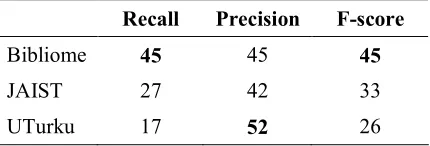
The results of the three submissions according to the official metrics are shown in Table 2. The scores are micro-averaged: Localization and PartOf relations have the same weight. Given the novelty and the complexity of the task, these first results are quite encouraging. Almost half of the relations are correctly predicted. The Bibliome team achieved the highest F-measure with a balanced recall and precision (45%).
Recall Precision F-score
Bibliome 45 45 45
JAIST 27 42 33
[image:6.612.78.293.176.249.2]UTurku 17 52 26
Table 2. Bacteria Biotope Task results.
7.2 Systems description and result analysis
All three systems perform the same distinct sub-tasks: bacteria name detection, detection and typing of locations, coreference resolution and event extraction. The following description of the approaches used by the three systems in each subtask will be supported by intermediate results.
Bacteria name detection. Interestingly the three participants used three different resources for the detection of bacteria names: the List of Prokaryotic Names with Standing in Nomenclature (LPNSN) by UTurku, names in the genomic BLAST page of NCBI by JAIST and the NCBI Taxonomy by Bibliome.
Bibliome 84
JAIST 55
UTurku 16
Table 3. Bacteria entity recall.
Table 3 shows a disparity in the bacteria entity recall of participants. The merits of each resource cannot be deduced directly from these figures since they have been exploited in different manners. UTurku and JAIST systems injected the resource as features in a ML algorithm, whereas Bibliome directly projected the resource on the corpus with additional rule-based abbreviation detection.
However there is some evidence that the resources have a major impact on the result. According to Sneath and Brenner (1992) LPNSN
is necessarily incomplete. NCBI BLAST only contains names of species for which a complete genome has been published. The NCBI Taxonomy used by INRA only contains names of taxa for which some sequence was published. It appears that all the lists are incomplete. However, the bacteria referenced by the sequencing projects, which are mentioned in the corpus should all be recorded by the NCBI Taxonomy.
Location detection and typing. As stated before, locations are not necessarily denoted by rigid designators. This was an interesting challenge that called for the use of external resources and linguistic analysis with a broad scope.
UTurku and JAIST both used WordNet, a sensible choice since it encompasses a wide vocabulary and is also structured with synsets and hyperonymy relations. The WordNet entries were injected as features in the participant ML-based entity recognition and typing subsystems.
It is worth noting that JAIST also used word clustering based on MEMM for entity detection. This method has things in common with distributional semantics. JAIST experiments demonstrated a slight improvement using word clustering, but further exploration of this idea may prove to be valuable.
Alternatively, the Bibliome system extracted terms from the corpus using linguistic criteria classified them as locations and predicted their type, by comparing them to classes in a habitat-specific ontology. This prediction uses both linguistic analysis of terms and the hierarchical structure of the ontology. Bibliome also used additional resources for specific types: the NCBI Taxonomy for type Host and Agrovoc countries for type Geographical.
Bibliome JAIST UTurku
Host 82 49 28
Host part 72 36 28
Geo. 29 60 53
Environment 53 10 11
Water 83 32 2
Soil 86 37 34
Table 4. Location entity recall by type. The number of entities of type Food and Medical in the
The location entity recall in Table 4 shows that Bibliome consistently outperformed the other groups for all types except for Geographical. This demonstrates the strength of exploiting a resource with strong semantics (ontology vs. lexicon) and with mixed semantic and linguistic rules.
In order to evaluate the impact of Location entity boundaries and types, we computed the final score by relaxing Tab and Jab measures. We re-defined Tab
as always equal to 1, in other words the type of the localization was not evaluated. We also re-defined Jab as: if the Location arguments overlap, then Jab =
1, otherwise Jab = 0. This means that boundaries
were relaxed. The relaxed scores are shown in Table 5. While the difference is not significant for JAIST and UTurku, the Bibliome results exhibit a 9 point increase. This demonstrates that the Bibliome system is efficient at predicting which entities are locations, while the other participants predict more accurately the boundaries and types.
Recall Prec. F-score Diff.
Bibliome 54 54 54 +9
JAIST 29 45 35 +2
UTurku 19 56 28 +2
Table 5. Participants score using relaxed location boundaries and types.
Coreference resolution. The corpus exhibits an unusual number of anaphora, especially bacteria coreferences since a single bacterium species is generally the central topic of a document. The Bibliome submission is the only one that performed bacteria coreference resolution. Their system is rule-based and dealt with referential “it”, bi-antecedent anaphora and more importantly sortal anaphora. The JAIST system has a bacteria coreference module based on ML. However the submission was done without coreference resolution since their experiments did not show any performance improvement.
Event extraction. Both UTurku and JAIST approached the event extraction as a classification task using ML (SVM). Bibliome exploited the co-occurrence of arguments and the presence of trigger words from a predefined list. Both UTurku and Bibliome generate events in the scope of a sentence, whereas JAIST generates events in the scope of a paragraph.
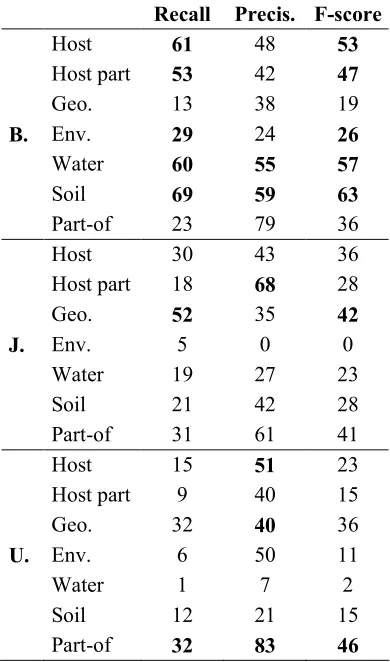
As shown in Table 6, UTurku achieved the best score for PartOf events. For all participants, the prediction is often correct (between 60 and 80%) while the recall is rather low (20 to 32%).
Recall Precis. F-score
Host 61 48 53
Host part 53 42 47
Geo. 13 38 19
B. Env. 29 24 26
Water 60 55 57
Soil 69 59 63
Part-of 23 79 36
Host 30 43 36
Host part 18 68 28
Geo. 52 35 42
J. Env. 5 0 0
Water 19 27 23
Soil 21 42 28
Part-of 31 61 41
Host 15 51 23
Host part 9 40 15
Geo. 32 40 36
U. Env. 6 50 11
Water 1 7 2
Soil 12 21 15
[image:7.612.326.521.121.452.2]Part-of 32 83 46
Table 6. Event extraction results per type.
Conversely, the score of the Localization relation by UTurku has been penalized by its low recognition of bacteria names (16%). This strongly affects the score of Localizations since the bacterium is the only expected agent argument. The good results of Bibliome are partly explained by its high bacteria name recall of 84%.
rather than the quality of event extraction. The paragraph scope chosen by JAIST probably compensates the lack of coreference resolution.
As opposed to Bibliome, the precision of the Localization relation prediction by JAIST and UTurku, is high compared to the recall, with a noticeable exception of geographical locations. The difference between participants seems to be caused by the geographical entity recognition step more than the relation itself. This is shown by the difference between the entity and the event recall (Table 4 and 6 respectively).. The worst predicted type is Environment, which includes diverse locations, such as agricultural, natural and industrial sites and residues. This reveals significant room for improvement for Water, Soil and Environment entity recognition.
8 Discussion
The participant papers describe complementary methods for tackling BB Task’s new goals. The novelty of the task prevents participants from deeply investing in all of the issues together. Depending on the participants, the effort was focused on different issues with various approaches: entity recognition and anaphora resolution based on extensive use of background knowledge, and relation prediction based on linguistic analysis of syntactic dependencies. Moreover, these different approaches revealed to be complementary with distinct strengths and limitations. In the future, one may expect that the integration of these promising approaches will improve the current score.
The corpus of BioNLP BB Task 2011 consists of a set of Web pages that were selected for their readability. However, some corpus traits make the IE task more difficult compared to scientific papers. For example, the relaxed style of some pages tolerates some typographic errors (e.g. morrow instead of marrow) and ambiguous anaphora. The genome sequencing project documents aim at justifying the sequencing of bacteria. This results in abundant descriptions of potential uses and locations that should not be predicted as actual locations. Their correct prediction requires complex analysis of modalities (possibility, probability, negation). Some pages describe the action of hosted bacteria at the molecular level, such as cellular infection. Terms
related to the cell are ambiguous locations because they may refer to either bacteria or host cells.
Scientific papers form a much richer source of bacterial location information that is exempt from such flaws. However, as opposed to Web pages, most of them are not publicly available and they are in PDF format.
The typology of locations was designed according to the BB Task corpus with a strong bias towards natural environments since bioremediation and plant growth factor are important motivations for bacteria sequencing. It could be necessary to revise it according to a broader view of bacterial studies where pathogenicity and more generally human and animal health are central issues.
9 Conclusion
The Bacteria Biotope Task corpus and objectives differ from molecular biology text-mining of scientific papers. The annotation strategy and the analysis of the participant results contributed to the construction of a preliminary review of the nature and the richness of its linguistic specificities. The participant results are encouraging for the future of the Bacteria Biotope issue. The degree of sophistication of participating systems shows that the community has technologies, which are mature enough to address this crucial biology question. However, the results leave a large room for improvement.
The Bacteria Biotope Task was an opportunity to extend molecular biology text-mining goals towards the support of bacteria biodiversity studies such as metagenomics, ecology and phylogeny. The prediction of bacterial location information is the very first step in this direction. The abundance of scientific papers dealing with this issue and describing location properties form a potentially rich source for further extensions.
Acknowledgments
References
Jari Björne and Taio Salakoski. 2011. Generalizing Biomedical Event Extraction. Proceedings of the BioNLP 2011 Workshop Companion Volume for Shared Task.
Cadixe. http://caderige.imag.fr/Articles/CADIXE-XML-Annotation.pdf
Corine Land Cover.
http://www.eea.europa.eu/themes/landuse/interactive/ clc-download
EnvDB database. http://metagenomics.uv.es/envDB/ EnvO Project.
http://gensc.org/gc_wiki/index.php/EnvO_Project Dawn Field [et al]. 2008. Towards a richer description
of our complete collection of genomes and metagenomes: the “Minimum Information about a Genome Sequence” (MIGS) specification. Nature Biotechnology. 26: 541-547.
Melissa M. Floyd, Jane Tang, Matthew Kane and David Emerson. 2005. Captured Diversity in a Culture Collection: Case Study of the Geographic and Habitat Distributions of Environmental Isolates Held at the American Type Culture Collection. Applied and Environmental Microbiology. 71(6):2813-23. GenBank. http://www.ncbi.nlm.nih.gov/
GOLD. http://www.genomesonline.org/cgi-bin/GOLD/bin/gold.cgi
Lynette Hirschman, Cheryl Clark, K. Bretonnel Cohen, Scott Mardis, Joanne Luciano, Renzo Kottmann, James Cole, Victor Markowitz, Nikos Kyrpides, Norman Morrison, Lynn M. Schriml, Dawn Field. 2008. Habitat-Lite: a GSC case study based on free text terms for environmental metadata. Omics. 12(2):129-136.
Jin-Dong Kim, Tomoko Ohta, Sampo Pyysalo, Yoshinobu Kano, Jun’ichi Tsujii. 2010. Extracting bio-molecular events from literature - the BioNLP’09 shared task. Special issue of the International Journal of Computational Intelligence.
MicrobeWiki.
http://microbewiki.kenyon.edu/index.php/MicrobeWi ki
Microbial Genomics Program at JGI. http://genome.jgi-psf.org/programs/bacteria-archaea/index.jsf
Microorganisms sequenced at Genoscope. http://www.genoscope.cns.fr/spip/Microorganisms-sequenced-at.html
Claire Nédellec. 2005. Learning Language in Logic - Genic Interaction Extraction Challenge" in Proceedings of the Learning Language in Logic (LLL05) workshop joint to ICML'05. Cussens J. and Nédellec C. (eds). Bonn.
Claire Nédellec, Adeline Nazarenko, Robert Bossy. 2008..Information Extraction. Ontology Handbook. S. Staab, R. Studer (eds.), Springer Verlag, 2008. Nhung T. H. Nguyen and Yoshimasa Tsuruoka. 2011.
Extracting Bacteria Biotopes with Semi-supervised Named Entity Recognition and Coreference Resolution. Proceedings of the BioNLP 2011 Workshop Companion Volume for Shared Task. Miguel Pignatelli, Andrés Moya, Javier Tamames.
(2009). EnvDB, a database for describing the environmental distribution of prokaryotic taxa. Environmental Microbiology Reports. 1:198-207. Prokaryote Genome Projects at NCBI.
http://www.ncbi.nlm.nih.gov/genomes/lproks.cgi Sampo Pyysalo, Antti Airola, Juho Heimonen, Jari
Björne, Filip Ginter and Tapio Salakoski. 2008. Comparative analysis of five protein-protein interaction corpora. BMC Bioinformatics. vol 9. Suppl 3. S6.
Zorana Ratkovic, Wiktoria Golik, Pierre Warnier, Philippe Veber, Claire Nédellec. 2011. BioNLP 2011 Task Bacteria Biotope – The Alvis System. Proceedings of the BioNLP 2011 Workshop Companion Volume for Shared Task.
Peter H. A. Sneath and Don J. Brenner. 1992. “Official” Nomenclature Lists. American Society for Microbioloy News. 58, 175.
Javier Tamames and Victor de Lorenzo. 2010. EnvMine: A text-mining system for the automatic extraction of contextual information. BMC Bioinformatics. 11:294.