Louisiana State University
LSU Digital Commons
LSU Doctoral Dissertations Graduate School
6-27-2019
Large-scale Data Analysis and Deep Learning
Using Distributed Cyberinfrastructures and High
Performance Computing
Richard Dodge Platania
Louisiana State University and Agricultural and Mechanical College, [email protected]
Follow this and additional works at:https://digitalcommons.lsu.edu/gradschool_dissertations Part of theOther Computer Engineering Commons
This Dissertation is brought to you for free and open access by the Graduate School at LSU Digital Commons. It has been accepted for inclusion in LSU Doctoral Dissertations by an authorized graduate school editor of LSU Digital Commons. For more information, please [email protected].
Recommended Citation
Platania, Richard Dodge, "Large-scale Data Analysis and Deep Learning Using Distributed Cyberinfrastructures and High Performance Computing" (2019).LSU Doctoral Dissertations. 5003.
LARGE-SCALE DATA ANALYSIS AND DEEP
LEARNING USING DISTRIBUTED
CYBERINFRASTRUCTURES AND HIGH
PERFORMANCE COMPUTING
A Dissertation
Submitted to the Graduate Faculty of the Louisiana State University and Agricultural and Mechanical College
in partial fulfillment of the requirements for the degree of
Doctor of Philosophy in
The Department of Computer Science
by
Richard Dodge Platania
B.S., Louisiana State University, 2013 August 2019
Acknowledgments
This dissertation and the work within it would not have been possible without the help and support of many people. I would like to thank my major advisor, Dr. Seung-Jong Park, for being a leader and mentor to me throughout my journey through graduate school. Also, many thanks to my committee members, Dr. Jian Zhang, Dr. Seungwon Yang, and Dr. Michal Brylinski for serving and providing guidance towards my research. Additional thanks to other faculty who have assisted me with research, including Dr. Kisung Lee, Dr. Joohyun Kim, and Dr. Nayong Kim. I’d also like to give a special thanks to my friends and fellow students, Shayan Shams, Sayan Goswami, Arghya Das, and Dipak Singh, whom I could not have made the journey without. I want to also thank my family for remaining extremely supportive throughout my graduate studies. Further appreciation is necessary for my animal companions, Harkness, GB, and Davros, for keeping me company and providing emotional support.
Lastly, I want to thank my loving and patient wife, Molly, for supporting me through the ups and downs of this adventure. Without her, it would not have been possible.
Table of Contents
ACKNOWLEDGMENTS . . . ii
LIST OF TABLES . . . v
LIST OF FIGURES . . . vii
ABSTRACT . . . ix CHAPTER 1. INTRODUCTION . . . 1 1.1. Data Analysis . . . 1 1.2. Deep Learning . . . 2 1.3. Large-scale Computing . . . 3 1.4. Goal . . . 4 1.5. Dissertation Outline . . . 4
2. HADOOP-BASED REPLICA EXCHANGE OVER HET-EROGENOUS DISTRIBUTED CYBERINFRASTRUCTURES . . . 6
2.1. Introduction . . . 6
2.2. Background . . . 8
2.3. HaRE: Hadoop-based Replica Exchange . . . 11
2.4. Performance Evaluation . . . 17
2.5. Discussion . . . 22
2.6. Concluding Remarks . . . 25
3. EVALUATION OF DEEP LEARNING FRAMEWORKS OVER DIFFERENT HPC ARCHITECTURES . . . 27
3.1. Introduction . . . 27
3.2. Deep Learning Frameworks . . . 29
3.3. HPC Architectures . . . 31
3.4. Evaluation . . . 32
3.5. Conclusion . . . 41
4. PREDICTING ADHD USING 3D CONVOLUTIONAL NEU-RAL NETWORKS AND FMRI DATA . . . 44
4.1. Introduction . . . 44
4.2. Related Work . . . 45
4.3. Methodology . . . 46
4.4. Experiment and Results . . . 52
4.5. Conclusion . . . 55
5. LARGE-SCALE DEEP LEARNING FRAMEWORK FOR REAL-TIME VEHICLE CLASSIFICATION OVER DIS-TRIBUTED CYBERINFRASTRUCTURE . . . 60
5.1. Introduction . . . 60 5.2. Background . . . 62 5.3. Related Works . . . 64 5.4. RT-VDC . . . 67 5.5. Vehicle Dataset . . . 71 5.6. Results . . . 73 5.7. Conclusion . . . 77 6. CONCLUSION . . . 78
APPENDIX. COPYRIGHT INFORMATION . . . 80
REFERENCES . . . 86
List of Tables
2.1. Summary of simulated biological systems. . . 12
2.2. Distributed computing resources experimented for HaRE . . . 14
2.3. Description of cluster hardware for single cluster scale-up and scale-out. . . 17
2.4. A comparison between the effect of a 16x increase of workload size on four node clusters at QB2, EC2, and CL:C (CloudLab Clemson). The number of mappers is fixed to 16, and the num-ber of replicas used is 16 and 1024. . . 19
2.5. Scale-across experiment with GENI. Benchmark results are shown from one cluster at one ExoGENI resource (Oakland, CA) and two clusters at two ExoGENI resources (Oakland, CA and Hous-ton, TX). The time taken for network-heavy phases (input prepa-ration and shuffle) are shown along with the remaining execution time. The total of the three gives the total execution time for one iteration of HaRE. Time is given in seconds. . . 23
3.1. Deep learning frameworks for evaluation. . . 29
3.2. Hardware for deep learning evaluation. . . 31
3.3. Deep learning models and datasets for experiments. . . 32
3.4. Benchmark for average time to train one batch with Caffe and AlexNet. The ILSVRC’12 dataset was used with a batch size of 256 . . . 35
3.5. Data transfer speeds using P100 with and without NVLink. . . 35
4.1. Testing set classification results for ADHD-200 dataset. . . 54
4.2. The number of parameters and memory requirements for convo-lution, pooling, and fully connected (FC) layers in the 2D and 3D CNN models. 3D requires approximately 5 times more param-eters for each layer and approximately 16 times more memory per training image. . . 55
5.1. Description of dataset. . . 73
5.2. Percentage of cars a that are above varying IOU thresholds t. . . 75
5.4. Frames per second of different GPUs. The classification compo-nent of RT-VDC used the AlexNet-based model. The resolution
List of Figures
2.1. Replica Exchange (RE) scheme with Statistical Temperature Molecular Dynamics (STMD). Each replica runs a single STMD during tEX with a given temperature range, and a swap is at-tempted for a pair of replicas at everytEX. This task is repeated
until the entire trajectory is simulated. . . 8 2.2. The schematic of HaRE presented (upper). Each round of MR
contains concurrent replica runs, which is implemented in the Map phase, and an exchange task in the Reduce phase. Also,
the iteration process of HaRE is described (lower). . . 12 2.3. Strong scaling out of HaRE from 16 to 1024 mappers (1 to 64
nodes) on the QB2 cluster. Each node has 16 mappers, and the
total number of replicas is fixed to 1024. . . 19 2.4. Weak scaling out of HaRE from 16 to 128 mappers (1 to 8 nodes)
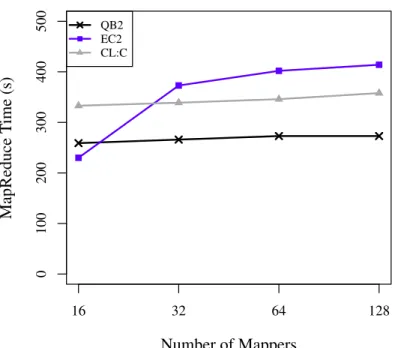
on QB2, EC2, and CL:C (CloudLab Clemson). Each node has
16 mappers and 16 replicas. . . 20 2.5. Weak scaling up of HaRE from 1 to 32 mappers and replicas
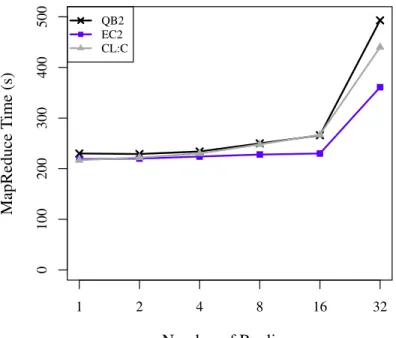
using a single node on QB2, EC2, and CL:W (CloudLab Wisconsin). . . 21 2.6. Scale-across experiment with CRON. CRON is configured
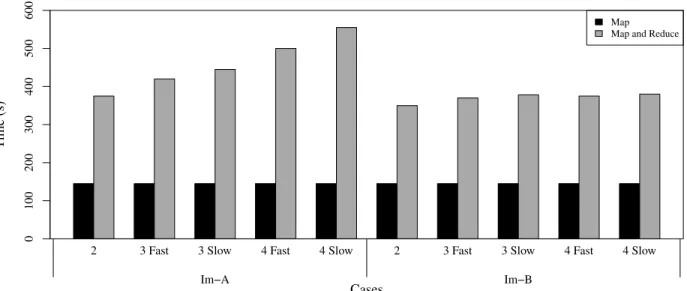
dif-ferently with 2, 3, and 4 nodes, for which a single cluster is built with up to 2 nodes. Two separate clusters (for configurations with 3 or 4 nodes) are connected with two different network con-nection conditions, fast and slow. These respective conditions are 10 Gbps with 60 ms latency and 100 Mbps with 30 ms la-tency. Two groups of experiments using IMA and IMB were conducted and compared. The time-to-solution for one round of MR is presented with a grey bar, and a black bar is the
time-to-solution of the Map phase. SA is used for this experiment. . . 22 3.1. Scaling up with Caffe using AlexNet for GPU (P100 with and
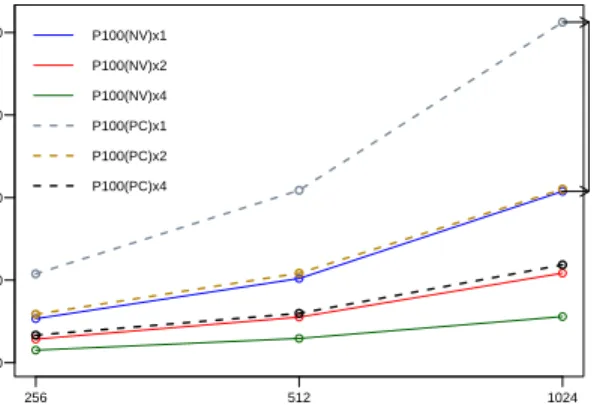
without NVLink) while increasing number of GPUs and batch size. . . 32 3.2. Scaling up with Caffe using GoogLeNet for CPU while increasing
the batch size. . . 33 3.3. Scaling up batch size on P100 with NVLink and KNL using
Alexnet with Caffe. . . 34 3.4. Scaling up batch size on P100 with NVLink using GoogLeNet
3.5. Scaling up batch size on P100 with NVLink using VGG-19 Net
with TensorFlow and Caffe.. . . 38
3.6. TensorFlow and SINGA scale out results. Each node has one P100 GPU worker and each worker has a mini-batch size of 64. . . 39
3.7. Caffe and TensorFlow scale out results. Each node is one KNL worker and each worker has a mini-batch size of 64. . . 40
3.8. Scale out result with Intel Caffe over P100 via InfiniBand and KNL via Omni-Path. For P100 results each node has one P100 GPU worker and for KNL result each node is one KNL worker and each worker has a mini-batch size of 64. . . 41
3.9. Scale out result with TensorFlow over P100 via InfiniBand and KNL via Omni-Path. For P100 results each node has one P100 GPU worker and for KNL result each node is one KNL worker and each worker has a mini-batch size of 64. . . 42
4.1. A visual representation of (a) 2D and (b) 3D convolutions. The blue squares/boxes represent the data and the red squares/boxes represent the receptive filter. In both examples, we see that the receptive filter maps data from three different channels, the only difference being the dimensions of the data and filter. . . 47
4.2. Example fMRI data from ADHD-200 dataset. . . 51
4.3. 3D CNN layer architecture . . . 57
4.4. Training loss of 2D and 3D convolutional neural networks. . . 58
4.5. Training accuracy of 2D and 3D convolutional neural networks. . . 58
4.6. Scalability of 3D CNN. There are 16 workers per node. . . 59
5.1. An overview of RT-VDC. . . 67
5.2. Distributed infrastracture of RT-VDC. . . 71
5.3. Visualizing the different IOU thresholds . . . 74
Abstract
Data in many research fields continues to grow in both size and complexity. For instance, recent technological advances have caused an increased throughput in data in various biological-related endeavors, such as DNA sequencing, molecular simulations, and medical imaging. In addition, the variance in the types of data (textual, signal, image, etc.) adds an additional complexity in analyzing the data. As such, there is a need for uniquely developed applications that cater towards the type of data. Several considerations must be made when attempting to create a tool for a particular dataset. First, we must consider the type of algorithm required for analyzing the data. Next, since the size and complexity of the data imposes high computation and memory requirements, it is important to select a proper hardware environment on which to build the application. By carefully both devel-oping the algorithm and selecting the hardware, we can provide an effective environment in which to analyze huge amounts of highly complex data in a large-scale manner. In this dissertation, I go into detail regarding my applications using big data and deep learning techniques to analyze complex and large data. I investigate how big data frameworks, such as Hadoop, can be applied to problems such as large-scale molecular dynamics simulations. Following this, many popular deep learning frameworks are evaluated and compared to find those that suit certain hardware setups and deep learning models. Then, we explore an application of deep learning to a biomedical problem, namely ADHD diagnosis from fMRI data. Lastly, I demonstrate a framework for real-time and fine-grained vehicle detection and classification. With each of these works in this dissertation, a unique large-scale anal-ysis algorithm or deep learning model is implemented that caters towards the problem and leverages specialized computing resources.
Chapter 1. Introduction
1.1. Data Analysis
Data has always driven research, and, with data sets reaching the terabyte scale, the strategies involved in storing and analysis of data have never been more important. For instance, genome sequencing technologies have advanced their throughput and capabilities to the point of producing terabyte-sized sequencing data for a single dataset. While the storing of this data is in itself a challenge, specifically with respect to hardware, the analysis requires both capable computing resources and algorithms. Because of these requirements, platforms have been developed that are capable of leveraging large-scale computing re-sources while abstracting the distributed computing practices from the user, thus keeping the algorithm development process as simple as possible. Platforms like this have made the data analysis process quicker and more accessible to researchers.
Since there are many different requirements for data analysis based on the type of data and task, many platforms have been developed with diverse focuses. For instance, large-scale batch processing of big data was first made widely popular by Hadoop MapRe-duce [1], which stems from the original MapReMapRe-duce [2]. This tool enabled researchers to write code using the well-defined Map-Reduce programming paradigm while automatically distributing the data and computation across a cluster. Big data analysis continued with the development of many other open source tools, each with their own data analysis goals (e.g., Apache Spark [3] for in-memory distributed computation), and many of which exist within the Hadoop ecosystem. With the growing popularity in deep learning for data anal-ysis, there was a demand for large-scale deep learning tools that could accommodate large data and models that can be trained in a reasonable amount of time. Out of this demand came tools like TensorFlow [4], which has enabled researchers to carry out deep learning research in a variety of computing environments with this flexible framework.
1.2. Deep Learning
Since its inception, deep learning has had the potential to be a powerful tool set for the analysis of data. Its birth occurred decades before it saw widespread use in research and industry. Ivakhnenko [5] was the first to propose and implement a deep network consisting of 8 layers. Initially, it proved difficult to apply deep learning methodology to more than small datasets on a small scale because of the computational requirements involved. Since then, the initial model proposed by Ivakhnenko has given rise to a large variation of models designed with different data and tasks in mind. Eventually, basic evolutions of this model were found to be capable of activities like handwritten digit recognition [6]. In the late 2000s and early 2010s, there was a surge in deep learning development due to the massive availability of powerful computational resources. In particular, the accessibility of deep-learning capable GPUs made this movement much more potent. Furthermore, the support of companies like NVIDIA to produce libraries dedicated towards deep learning on these high-performance GPUs helped further the deep learning movement.
Given this boom in deep learning research and development, many research fields have been advanced and sped up with respect to their data analysis capabilities due, in part, to the end-to-end nature of many of the deep learning models. In other words, the lack of requirement in hand-crafted features made the process easier and quicker for researchers to produce a turn around in their analysis. Researchers in a copious amount of fields have been either directly or indirectly influenced by deep learning. Within these fields, many tasks that have remained difficult for humans to perform are now possible through deep learning, often times with even higher accuracy (e.g., breast cancer detection and diagnosis). At this point, deep learning has extended its reach towards image recognition, natural language processing, drug discovery, bioinformatics, and many other domains.
In order to cater towards different datasets and tasks in these domains, many different deep learning models have been developed. Arguably, one of the most popular models is the Convolutional Neural Network due to its applicability towards image data. Its use
of filters that scan the input image make it possible to detect patterns across the entire image. Meanwhile, its use of weight sharing reduces the computational complexity, making the model easier to train. While its primary use is on image data, it has shown applicability to other types of data as well, such as DNA sequences [7]. Another model that has had a successful effect with respect to data analysis is the Recurrent Neural Network (RNN). Most notably, the Long Short-Term Memory (LSTM) model, a type of RNN, has shown great success in time-series and text analysis. Whereas CNNs consider the spatial relations very well in its inputs, LSTMs and RNNs specialize in considering the long-term dependencies or temporal relations in data. The number of new models or variations of existing models continues to grow along with a continuing demand for more deep learning applications in a variety of domains.
1.3. Large-scale Computing
The availability and improvement of computing resources and environments are what have supported the development and improvement of data analysis and deep learning re-search. Without developing algorithms catered towards these resources and their environ-ments (e.g., parallelize algorithm for a scaled-out computational resource), research would not have progressed as quickly as it has in recent years. It is important for the continued development of both of large-scale resources and algorithms to go hand-in-hand in order for researchers to be able to continue to improve the speed and quality of their research. In addition to the hardware and software development for single-node data analysis and deep learning, efforts continue to be made to enable distributed computing in a usable and efficient manner.
Distributed computing for large-scale data analysis has been well established with the development of the Hadoop ecosystem toolkit. There is database support in the form of HBase, batch processing from the MapReduce programming model, in-memory compu-tation from Spark, and many more, all behind an abstracted distributed computing and storage methodology. However, deep learning has not experienced a significant amount of
distributed computing support until recently. Initially, many deep learning frameworks, including TensorFlow [4], were not capable of distributed computing, essentially limit-ing models to that which could fit in a slimit-ingle compute node. Now, most of the popular frameworks offer options for scaling out or, at the very least, scaling up with multiple GPUs [4, 8, 9]. Beyond the software, certain hardwares were designed with throughput-heavy tasks, like training a neural network, in mind. The development of communication tools such as NVIDIA’s NVLink and Intel’s Omnipath were intended to alleviate the com-munication bottleneck exhibited by many of these large-scale data analysis and deep learn-ing tasks. With the continued support and development of distributed computlearn-ing resources and algorithms, large-scale analysis and deep learning will continue to grow and produce more impressive results in a timely manner.
1.4. Goal
The goal of this work is to develop algorithms capable of tackling barriers associated with using data analysis and deep learning for large-scale applications. This a challenging problem since the computational complexity and large memory overhead imposed by big datasets and models requires advanced deep learning techniques and hardware technologies to apply deep learning in an efficient manner. In addition, the hardware and software setup is very essential to deal with computational complexity and large memory overhead of big data and models. In this dissertation, I present works regarding large-scale data analysis and deep learning over distributed infrastructures. In more detail, the works focus on both evaluating the large-scale nature of applications in addition to evaluating the applications performance towards a scientific problem.
1.5. Dissertation Outline
The remainder of this proposal is as follows. Chapter 2 details the development and analysis of HaRE, a framework for Hadoop-based Replica Exchange simulations. The following chapter evaluates several deep learning frameworks in terms of scaling up and out in several computing environments with state-of-the-art hardware. Next, in Chapter 4, we
delve into a deep learning application using one of the frameworks evaluated in the previous chapter. This particular application aims to use 3D convolutional neural networks for diagnosing ADHD from fMRI data. The next chapter is about a large-scale framework for real-time and fine-grained vehicle detection and classification. Lastly, Chapter 6 concludes my dissertation and gives a brief description of future works.
Chapter 2. Hadoop-based Replica Exchange over Heterogenous
Distributed Cyberinfrastructures
2.1. Introduction
Large-scale sampling of biomolecules is a continuously growing, computationally in-tensive endeavour. In recent years, many extensions from traditional Molecular Dynamics (MD) have been developed in order to address computation time and simulation complexi-ties. The Replica Exchange (RE) scheme is a popular alternative which has been applied to many established MD packages. It imposes the simulation of several replicas of a system, each at a different temperature. At certain intervals, trajectory exchanges are attempted between pairings of replicas. Replica Exchange Statistical Temperature Molecular Dynam-ics (RESTMD) is a sampling algorithm recently introduced and is thought to be promising with many merits overcoming drawbacks of conventional sampling and enhanced sampling approaches [10, 11, 12, 13]. It combines the popular RE scheme with the recently developed Statistical Temperature Molecular Dynamics (STMD) algorithm.
As the complexity and size of simulations continues to increase, researchers need to look towards distributed cyberinfrastructures (DCI) in order to address the hardware limi-tations of single node execution. Simulation time is a key challenge that is often addressed through the use of MPI. However, this work is concerned with replica exchange, which involves infrequent, coarse-grained communication at set synchronization points (exchange attempts). MPI implementation in an application can be challenging, and the fine-grained communication is necessary for RE, which requires replica communication only at exchange attempts. In order to overcome this challenge, strategies aimed towards implementing task-level parallelism are required. In this work, the aim is to provide this parallelism to RE scheme.
In order to provide this task-level parallelism, this work makes use of the MapReduce
This chapter was previously published as R Platania, S Shams, CH Chui, N Kim, J Kim, SJ Park,
”Hadoop-based replica exchange over heterogeneous distributed cyberinfrastructures.” Concurrency and
(MR) paradigm. Note that MR is a programming model initially introduced for large-scale distributed data processing [14], but here the use of this model for compute-intensive, more specifically, loosely-coupled applications, is demonstrated. Hadoop [1] provides an open source implementation of MapReduce. As demonstrated in this chapter, Hadoop appears to also be an excellent framework over HPC resources and cloud-based environments, greatly benefiting those applications identified as pleasingly and loosely-coupled [15, 16, 17], as well as other complex applications often relying upon solely MPI to achieve scalability.
This chapter describes the performance of HaRE over DCI and investigate contributing factors towards performance. By doing this, it is shown that Hadoop MapReduce is a capable model for loosely-coupled applications. HaRE is executed in multiple scenarios and environments over various DCI in order to show potential performance in real environments that researchers would be expected to execute similar applications. These environmental set-ups range from physical computing nodes over high-speed networks to virtual machines over low-speed networks, and the DCI types range from traditional, homogeneous HPC clusters to fully distributed, heterogeneous clouds. Utilizing a large variety of environmental set-ups and DCI allows for successful analyzing of HaRE performance.
The chapter is organized as follows. In the following section, background of of RESTMD and Hadoop are given, followed by an introduction to related works. Next, HaRE is intro-duced along with its RESTMD integration. The following section describes the architecture and environmental configuration of the DCI experimented in this work. Then, experi-mental results for scalability performance are shown. Discussions are presented regarding contributing factors to performance in different DCI, Hadoop as a task-level parallelism framework, and future works. Lastly, there is an insight towards future work and a brief conclusion.
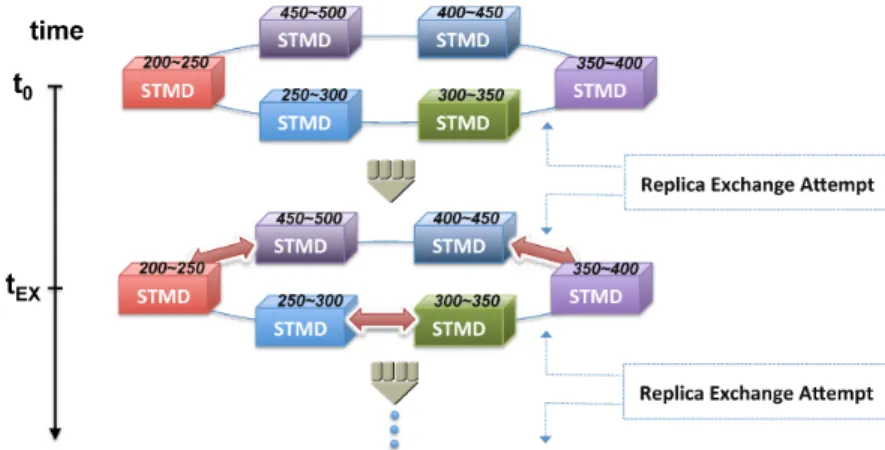
Figure 2.1. Replica Exchange (RE) scheme with Statistical Temperature Molecular Dy-namics (STMD). Each replica runs a single STMD during tEX with a given temperature range, and a swap is attempted for a pair of replicas at every tEX. This task is repeated until the entire trajectory is simulated.
2.2. Background
2.2.1. Statistical Temperature Molecular Dynamics (STMD) and RESTMD
STMD itself is an enhanced sampling method, partly inspired by the Wang-Landau method, but becoming a distinctively different novel method, in which the theoretical definition of statistical temperature is the key idea as the name suggests [18, 19]. This new method, STMD, can explore configurational space of a broad range of temperatures, and thus becomes a multicannonical approach. For HaRE, two popular simulation packages, CHARMM [20] and LAMMPS [21], were modified for allowing STMD simulations, resulting in the support of all-atom simulations. Particularly, LAMMPS-STMD is significant for the research community since the package is well known for its scalability performance with the excellent MPI support, and thus there is a great potential for its use.
RESTMD is a replica exchange method which follows a similar swapping protocol of the popular replica exchange MD. The difference is that RESTMD runs a STMD simula-tion instead of straightforward MD for each replica. The schematic of simulasimula-tion pipeline for replica exchange is shown in Fig. 2.1. RESTMD is not only a better sampling strat-egy but also has many advantages over REMD, currently a de-facto protocol. As one of its key merits, RESTMD requires fewer replicas to cover the same range of temperature
space, primarily because each replica simulation with STMD can explore a broad range of temperatures. Additionally, more efficient exchanges between replicas occur [19]. These aspects are particularly advantageous for sizeable biological molecules where conventional REMD suffers to scale as the size of a target system increases. On the other hand, they are also beneficial as a HPC application. In a given computational resources (i.e. the number of nodes), a less number of replicas means more nodes to individual replicas and thus can tackle a larger system. This, in addition to the better exchange rate, results in more effi-cient sampling, while saving computing time. Therefore, RESTMD is an attractive choice for most of current biomedical research topics aiming towards real biological processes in a living cell, since their typical system size is beyond what REMD is capable of.
2.2.2. Hadoop MapReduce
For the task-level parallelization of HaRE, the MapReduce (MR) programming model is used, which was initially introduced for large-scale distributed data processing [14]. Its popularity has been fuelled by Hadoop [1], a software framework comprising of the Hadoop Distributed File System (HDFS) and an open-source implementation of the MR program-ming model. Hadoop can be easily installed on most hardware, from commodity to high end, and has gained strong support from both the open source community and leading com-panies in the IT industry, resulting in numerous applications in various domains. Hadoop has already shown to be an attractive framework for large-scale data processing. It is demonstrated that it is also attractive for loosely-coupled applications, such as RESTMD, by executing HaRE in various scenarios.
Hadoop continues to have an extensive impact on scientific research, especially con-sidering the continuously growing and robust software stack complementing MapReduce. Pig [22], for instance, provides a high level language for performing large-scale data anal-ysis and has already been adopted for large-scale sequence data analanal-ysis as seen with BioPig [23]. Spark [3] provides an additional option for scientific data analysis with its robust data structures and iterative computation using scalable, in-memory machine
learn-ing, graph processlearn-ing, and more. There are already several Spark-based approaches for analyzing sequencing data [24, 25]. While Spark and similar frameworks are emerging as front-runners in Big Data, this application utilizes simulation packages that require writing to and reading from files between replica exchange iterations, essentially negating any benefit that Spark’s in-memory iterative processing provides. For this reason, Hadoop MR’s user-friendly programming model is selected. As the Hadoop community continues to grows, there will be more software built for the Hadoop ecosystem that are aimed towards developing large-scale scientific applications.
2.2.3. Related Work
Previously, there have been several modifications and demonstrations of the Hadoop framework for large-scale applications. Some of these works aimed to provide APIs de-signed for domain-specific scientific applications [26]. While useful, this does not focus on the improvement of performance but rather the ease-of-use. Many of the others focused on adding an iterative functionality to Hadoop [27, 28]. HaLoop, for instance, imple-ments loop-aware task scheduling for MR, but its development has not continued past the prototype [27]. Similarly, Twister provides iterative MR functionality but also allows for long-running Map and Reduce tasks that can can continue execution beyond the typical barriers exhibited in traditional MR. This sort of asynchronicity has many applications in the scientific domain, but it does not apply well to replica exchange which requires barrier synchronization for replica exchange. Other Hadoop extensions are aimed towards improv-ing streamimprov-ing performance [29, 30]. However, these improvements all have a commonality of design for data-intensive applications. Instead, this work highlights the use of Hadoop for a compute-intensive scientific application.
Other works have focused on data locality and task scheduling. Some of these con-sider data locality or compute capacity in order to efficiently assign Map tasks and avoid data transfer [31], and some even transparently implement MR in a multi-cluster environ-ment [32, 33, 34]. Alternatively, others work towards replication strategies for providing
improved data locality [35]. The motivation behind these works is based on the notion of avoiding transfer of large amounts of data across multiple clusters. This work shows that the compute-intensive application, HaRE, performs well without needing modifications to the Hadoop framework, even in multi-cluster environments.
In considering traditional Hadoop MR, there have been many scientific applications. CloudBurst [36], one of the earlier scientific applications of MapReduce, performs large-scale read-mapping of next-generation DNA sequence data, consequently demonstrating Hadoop’s applicability to data-intensive genome applications. While an extension of MR has been previously applied to MD simulation trajectory analysis [37], HaRE aims to utilize MR for performing simulations. In some previous works, an early implementa-tion of MR-based RESTMD was introduced with initial results of scalability performance, STMD performance, and the performance of STMD implemented in two different packages (CHARMM and LAMMPS) [38, 39]. Traditional MD implementations using MR are diffi-cult due to the fine-grained communication requirement imposed by MD. For this reason, it is uncommon to see MR-based MD simulations.
2.3. HaRE: Hadoop-based Replica Exchange 2.3.1. Architecture of HaRE
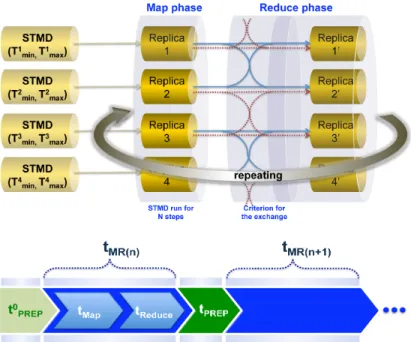
This replica exchange scheme for HaRE is implemented by using the MR model. In Figure 2.2 (upper), the execution for a single iteration of MR is shown. The Map phase is responsible for multiple, concurrently running STMD simulations. In particular, each mapper configures and executes LAMMPS-STMD. The following Reduce phase manages replica exchanges using outputs produced from prior STMD simulations in the Map phase. Figure 2.2 (lower) describes the iteration process of HaRE. The preparation step is needed before each round of MR to prepare inputs for STMD runs occurring in the next round.
Figure 2.2. The schematic of HaRE presented (upper). Each round of MR contains con-current replica runs, which is implemented in the Map phase, and an exchange task in the Reduce phase. Also, the iteration process of HaRE is described (lower).
Table 2.1. Summary of simulated biological systems.
Simulated System SA SB
Description Solvated GB1 Solvated
hairpin peptide mini protein (Crambin)
Protein structure (PDB ID) 1GB1 1CBN
Number of residues 16 46
Number of water molecules 1699 2781
Total number of atoms 5356 9002
2.3.1.1. Two biological systems for simulations:
Simulations in this work considered two biological systems of two small proteins, as summarized in Table 2.1, that differ in their sizes. The different system size requires dif-ferent computational workloads and affects the performance of each step along with the Hadoop-based workflow. In a previous conference paper [38], time-to-solutions were com-pared using these two molecular systems for two different implementations for RESTMD, in order to find a right decision on the implementation. Based on results, for HaRE, one implementation is used, called IMB, with the larger system,SB, unless specifically stated
otherwise.
A standard procedure for all-atom MD simulations is employed for building a molecular system in a simulation box [40]. In brief, the initial structures of the proteins were obtained from the PDB database and inserted into explicit water molecules. The CHARMM force field, CHARMM22/CMAP, was used for the two proteins, and the TIP3P explicit water model was used to solvate the proteins.
2.3.2. HaRE over Distributed Cyberinfrastructures
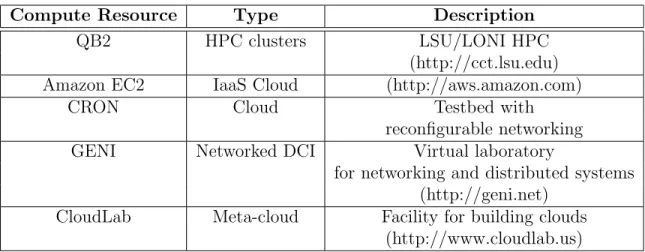
Heterogeneous computing environments are becoming increasingly common and useful as researchers look to leverage the benefits of combining different hardware in the same clus-ter. Furthermore, the federation of multiple clusters to complete some task is become more feasible and popular with the proliferation of nationwide high-speed network backbones. Because of this, heterogeneous DCI are incorporated into experiments in order to evaluate the performance of HaRE in these different environments. Five different types of computing environments are utilized for demonstration and are displayed in Table 2.2. Conventional HPC clusters generally provide a somewhat consistent and predictable performance with physical nodes and high-speed intra-cluster connections (e.g., InfiniBand). On the other hand, the four distributed infrastructures, Amazon EC2, CRON, GENI, and CloudLab are distinctly different. Amazon EC2 is a compute-on-demand IaaS cloud environment that is recently widely utilized for research and science gateways [41]. CRON [42, 43] is a testbed system that can be configured to emulate a distributed computing infrastructure connected by configurable networking conditions. The remaining two resouces, GENI and CloudLab, are both built on a nationwide infrastructure comprising of many locations. GENI (Global Environment for Network Innovations) is a virtual laboratory for networking, distributed systems, and security while also hosting applications [44]. CloudLab provides the ability to build cloud environments over baremetal resources [45]. Both of these infrastructures support the federation of rack resources using nationwide, high-speed networks.
Table 2.2. Distributed computing resources experimented for HaRE
Compute Resource Type Description
QB2 HPC clusters LSU/LONI HPC
(http://cct.lsu.edu)
Amazon EC2 IaaS Cloud (http://aws.amazon.com)
CRON Cloud Testbed with
reconfigurable networking
GENI Networked DCI Virtual laboratory
for networking and distributed systems (http://geni.net)
CloudLab Meta-cloud Facility for building clouds
(http://www.cloudlab.us)
2.3.2.1. HaRE over HPC:
HPC are the most well developed and supported of the DCI discussed in this chapter. Because of this, HPC setup for HaRE is the most straightforward. For these experiments, the new LONI QB2 cluster was used [46, 47]. QB2 has 504 compute nodes with a peak performance of 1.5 Petaflops. Each QB2 node contains two 10-core 2.8 GHz E5-2680v2 Xeon processors, 64 GB memory, and 500 GB HDD. The nodes are connected using 56 Gbps InfiniBand connections.
2.3.2.2. HaRE over Homogenous Cloud (EC2):
Amazon EC2 is easily accessible and continues to gain popularity for a wide variety of applications. Consequently, this work demonstrates execution and performance of HaRE over EC2. EC2 provides a variety of virtual machine instance types and configurations to cater to different cloud applications. However, because HaRE is a compute-intensive application, the C4 family of instance types that focus on providing computation perfor-mance is chosen. Specifically, the experiments used instances consisting of 36 vCPU cores and 60 GB memory over Amazon’s Elastic Block Storage (EBS) SSD volumes. Unlike the other DCI, EC2 VMs do not provide the inherent benefit of dedicated physical CPU cores. Because of this, performance can be unpredictable and requires more identical executions for verification.
2.3.2.3. HaRE over Heterogeneous and Virtually Distributed Cloud (CRON):
As previously explained in this section, it is crucial to demonstrate the capability and performance of HaRE over heterogeneous environments, especially with the increasing popularity of heterogeneous cloud-based environments. With the combination of computing nodes with varying hardware, it is possible leverage them by assigning tasks or applications to nodes which have more suitable specifications. So, this work makes use of the testbed system, CRON. While it was shown that HaRE setup for traditional HPC systems is straightforward, additional efforts for configuration and setup of HaRE over CRON are required in order to perform experiments in several different virtual environments. In brief, CRON is able to emulate a cloud computing environment, composed of two separate clusters connected by a configurable network. This environment is important for the purpose of this work since the scale-across scenario of HaRE over a heterogeneous multi-cluster Hadoop environment can be investigated.
The experimental set-up over CRON examined in this work consists of two clusters, interconnected by a reconfigurable network that emulates varying network conditions. One cluster is composed of up to two nodes, each having a 6-core Intel Xeon processor with 12 GB RAM and 10 Gbps NIC, and the other cluster is configured with up to two nodes, each equipped with a 4-core AMD Opteron processor with 8 GB RAM and 10 Gbps NIC. The two clusters are connected by two different network conditions: a fast 10 Gbps bandwidth with 60 ms latency configuration and a slow 100 Mbps bandwidth with 30 ms latency. Note that these configurations are intended to represent realistic conditions, a case with minimum bandwidth and a case with high bandwidth, respectively, commonly found in network conditions between production HPC systems.
2.3.2.4. HaRE over Homogeneous and Geo-Distributed Cloud (GENI):
GENI is a nationwide networking testbed connecting various universities and research institutions by making use of nationwide high-speed Layer 2 connectivity. It is new
com-pared to the previously discussed DCI but is quickly gaining popularity. For the purpose of this chapter, it is important to demonstrate HaRE over a physically distributed scale-across scenario, as virtually demonstrated with CRON. Two ExoGENI resource locations are used: Oakland, CA and Houston, TX.
Similar to CRON, the experimental set-up over GENI examined in this work consists of two clusters, interconnected by a high-speed, reconfigurable network. Each ExoGENI rack provisions virtual machines over IBM M4 servers. A total of four VMs were provisioned across two configurations. The first configuration consists of a single cluster located at an ExoGENI rack in Oakland, CA. More interestingly, the second configuration federates two geographically distant ExoGENI rack resources (Oakland, CA and Houston, TX) by creating a VLAN supported by a 10 Gbps connection. Due to a lack of network interfaces at ExoGENI and multihoming in MapReduce, the experiments are limited to a maximum of two clusters. Each VM consists of 4 CPU cores and 12 GB memory, which is comparable to the setup in CRON. For the two-cluster case, the two resource locations were chosen such that they were geographically distant and they supported the federation of rack re-sources over the previously mentioned 10 Gbps Layer 2 connection. By doing this, we will see how HaRE performs in an environment where both the computing resources and the network backbone is heavily shared. The network provides best-effort service, meaning that additional experiments are required for performance verification.
2.3.2.5. HaRE over Geo-Distributed HPC (CloudLab):
Adding HPC resources to a cluster is no longer limited by the locality of the additional resources. The increasing prevalence of high-speed network connections between research locations allows for a more seamless federation of external resources. CloudLab is used to investigate the performance of HaRE in an environment with hardware similar to that of the HPC investigation but with lower bandwidth and increased latency between the nodes. The effect of this network discrepancy on performance will be shown and demonstrate the overall viability of federating HPC resources for HaRE and similar applications. CloudLab
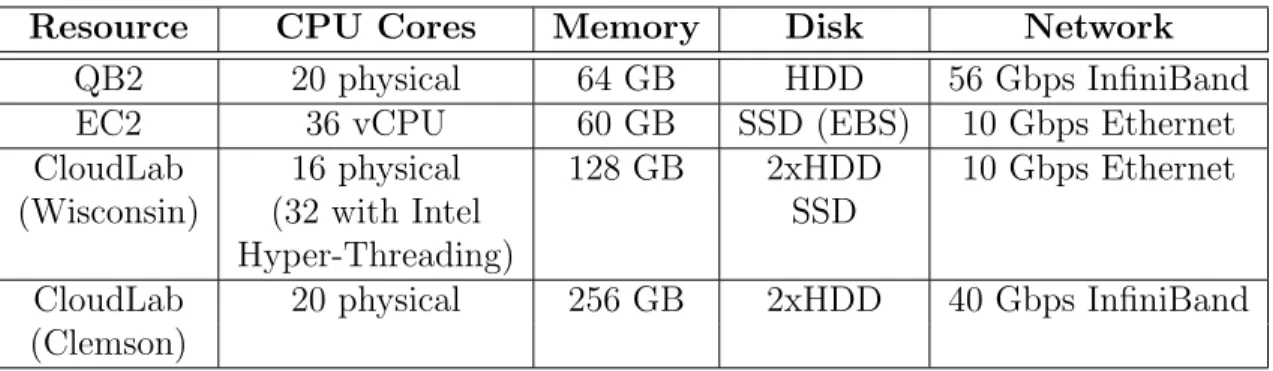
Table 2.3. Description of cluster hardware for single cluster scale-up and scale-out.
Resource CPU Cores Memory Disk Network
QB2 20 physical 64 GB HDD 56 Gbps InfiniBand
EC2 36 vCPU 60 GB SSD (EBS) 10 Gbps Ethernet
CloudLab 16 physical 128 GB 2xHDD 10 Gbps Ethernet
(Wisconsin) (32 with Intel SSD
Hyper-Threading)
CloudLab 20 physical 256 GB 2xHDD 40 Gbps InfiniBand
(Clemson)
is part of the GENI federation network, which allows federation with both GENI and CloudLab resources. For this work, the Wisconsin and Clemson locations of CloudLab are utilized. The Wisconsin nodes each have two 8-core Intel E5-2630v3 processors with Hyper-Threading, 128 GB memory, two 1.2 TB HDD, and one 480 GB SSD. Each node has 10 Gb NIC, but the actual rate is throttled to 100 Mbps in order to represent an HPC environment connected over an external network. The Clemson nodes each have two 10-core Intel E5-2660v2 processors, 256 GB memory, and two HDD at 1 TB each. Each node has 40 Gbs InfiniBand but, like the Wisconsin nodes, it is throttled. Like GENI, the network provides best-effort service, requiring additional experimentation for performance verification.
2.4. Performance Evaluation
2.4.1. Scalability performance of HaRE
For the following scalability experiments, the number of replicas and mappers at each node are varied. The results for scale-up and scale-out were produced from the QB2 cluster, EC2, and the CloudLab testbed. The results for scale-across are from the CRON, GENI, and CloudLab testbeds. Here, the scalability performance with respect to the scale-up, scale-out, and scale-across scenarios are presented.
2.4.1.1. Scale-up and scale-out in a single cluster with HPC and EC2:
In a single cluster environment, it is essential to know the scalability as additional nodes are utilized for the target computation. In addition to this scale-out scenario, an
understanding of scale-up performance, addressing how more computational loads can be added in a single node, is also important for potential scalability. The single cluster hard-ware configurations for these experiments are described in Table 2.3. In Fig. 2.3, the strong scale-out results over QB2 are presented. The configuration used for this is to allow 16 mappers per node while fixing the number of replicas to 1024. The number of mappers increases up to 1024. The results suggests a good linear scaling, indicating good scalable performance of HaRE as more nodes are utilized in a cluster. In addition to traditional HPC, it is crucial to understand the performance over both cloud-based clusters. For this reason, the scalability of QB2 against EC2 and CloudLab scale-out experiments are com-pared, as shown in Fig. 2.4. In this experiment, the number of replicas increases along with the number of mappers from 16 to 128. Interestingly, EC2 suffers a 1.6x increase in execution time from one to two nodes (16 to 32 mappers) while both QB2 and CloudLab experience good scaling. This result is reasonable considering that both QB2 and Cloud-Lab have direct access to physical hardware, there is lack of control over EC2 instance rack locality, and EC2 networks are less predictable.
On the other hand, in Fig. 2.5 and Table 2.4, results are presented relevant to scale-up performance. First, the workloads are increased within a single node by increasing the number of mappers and replicas from 1 to 32. Until the number of mappers and replicas reaches 16, good scalability is achieved. The number of concurrently executing mappers and the number CPU cores have a direct effect on performance. Increasing the number of concurrent mappers begins to exhibit a diminishing effect on the overall performance in HaRE. Recall that the number of available cores per node in the QB2 cluster is 20, CL:W is 16, and EC2 is 36 (vCPU), implying that the number of mappers exceeding the number of cores may have an effect on the scale-up threshold. Note that the number of physical cores used in EC2 is unknown, but we clearly see a drop in performance before reaching the vCPU threshold of 36. In addition to scaling up a single node, a four-node cluster is set up with each node scaled up individually. Considering a scenario like this is necessary
250 500 1000 2000 4000 8000 16000 16 32 64 128 256 512 1024 MapReduce T ime (s) Number of Mappers QB2
Figure 2.3. Strong scaling out of HaRE from 16 to 1024 mappers (1 to 64 nodes) on the QB2 cluster. Each node has 16 mappers, and the total number of replicas is fixed to 1024. Table 2.4. A comparison between the effect of a 16x increase of workload size on four node clusters at QB2, EC2, and CL:C (CloudLab Clemson). The number of mappers is fixed to 16, and the number of replicas used is 16 and 1024.
MapReduce Time (seconds)
Resource 64 Replica 1024 Replica Increase
QB2 273 3971 14.54x
EC2 402 5692 14.16x
CL:C 346 4951 14.31x
because the use of Hadoop in strictly single-node scenarios is uncommon. Table 2.4 shows the performance of increasing the number replicas of a four-node cluster from 64 to 1024, a 16x increase, with the number of concurrently executing mappers per node remaining at 16. As expected, the execution time varies between the three resources, but it appears that the time is increased by a similar factor in all three cases.
2.4.1.2. Scale-across with two network-connected clusters in CRON and GENI:
One of the important contributions for this work is the demonstration of the scale-across scenario with unmodified Hadoop, the core of HaRE. Note that Hadoop is generally
0 100 200 300 400 500 16 32 64 128 MapReduce T ime (s) Number of Mappers QB2 EC2 CL:C
Figure 2.4. Weak scaling out of HaRE from 16 to 128 mappers (1 to 8 nodes) on QB2, EC2, and CL:C (CloudLab Clemson). Each node has 16 mappers and 16 replicas.
considered as a framework for distributed, data-intensive computing in a single cluster, thus this work’s set-up and demonstration for a compute-intensive application over multiple distributed resources is an intriguing experiment. As described in the previous section, the CRON-based distributed system, emulating the network-connected two clusters, was built and used for scale-across experiments. Two different network configurations, designed to mirror realistic network conditions, are tested with varying number of nodes. Obtained results are presented in Fig. 2.6. The fast and slow configurations previously described are used as the number of nodes varies. The Map phase has virtually no change between the slow and fast network connections. Interestingly, the time-to-solution of a whole MR varies considerably depending upon the configuration of the two-cluster system and two implementations, IMA and IMB. These two implementations were described extensively in the conference paper [38], and in brief, represent two possible implementation strategies that differ in to what extent the local file system is utilized. Striking difference is observed between the two. A possible cause is likely to be associated with network speed and underlying file I/O tasks affecting the non-Map tasks. For this, one needs to remember
0 100 200 300 400 500 1 2 4 8 16 32 MapReduce T ime (s) Number of Replicas QB2 EC2 CL:C
Figure 2.5. Weak scaling up of HaRE from 1 to 32 mappers and replicas using a single node on QB2, EC2, and CL:W (CloudLab Wisconsin).
that in IMA, local file systems across the network should be accessed as required by its design, revealing its apparent connection to the increment in time-to-solution as the network speed becomes slower. Interestingly, the cases withIMB do not show such a pattern. IMB uses HDFS as a primary means to store information about simulations and exchanges, seemingly revealing its better scalability performance is less affected by the varying network connection. Additionally, this interpretation is further supported with the observation that an additional increase of the MR time is observed when the entire system goes from the 3-node configuration to 4 nodes, since the change suggests more file I/O operations in the case of IMA over the network connection.
It is important to see thatIMBalso performs well in an environment where two clusters are connected in a geo-distributed fashion. For this purpose, two configurations were set up over the GENI testbed. The first configuration consists of a single cluster of four nodes at a single resource location (ExoGENI at Oakland, CA). The second configuration creates a VLAN by adding a second cluster using a second, geographically distant resource (ExoGENI at Houston, TX). In this case, each cluster has two nodes. The execution time of
Map Map and Reduce
Cases
T
ime (s)
2 3 Fast 3 Slow Im−A
4 Fast 4 Slow 2 3 Fast 3 Slow Im−B 4 Fast 4 Slow 0 100 200 300 400 500 600
Figure 2.6. Scale-across experiment with CRON. CRON is configured differently with 2, 3, and 4 nodes, for which a single cluster is built with up to 2 nodes. Two separate clusters (for configurations with 3 or 4 nodes) are connected with two different network connection conditions, fast and slow. These respective conditions are 10 Gbps with 60 ms latency and 100 Mbps with 30 ms latency. Two groups of experiments using IMA and IMB were conducted and compared. The time-to-solution for one round of MR is presented with a grey bar, and a black bar is the time-to-solution of the Map phase. SA is used for this experiment.
the network-heavy MR phases are shown along with the total execution time. These results are presented in Table 2.5. The execution of the shuffle phase of MR, the phase in which data is transferred over network from mappers to reducers, is shown in blue. Typically, this is a huge bottleneck in MR applications. However, because HaRE is very compute-intensive and not very data-compute-intensive, this phase shows only a slight increase between the two configurations. The input preparation, shown in black, involves STMD input preparation on the HDFS between HaRE iterations. We see a more significant increase here, but the remaining time spent for other phases (Map, Reduce, etc.) dominates the overall execution time, making this time increase less significant.
2.5. Discussion
The main contributions in this chapter include i) the development of HaRE with Hadoop MapReduce as the basis for task-level parallelism of replica exchange, ii) the config-uration and execution of HaRE over several DCI of varying hardware and environment, iii)
Table 2.5. Scale-across experiment with GENI. Benchmark results are shown from one cluster at one ExoGENI resource (Oakland, CA) and two clusters at two ExoGENI re-sources (Oakland, CA and Houston, TX). The time taken for network-heavy phases (input preparation and shuffle) are shown along with the remaining execution time. The total of the three gives the total execution time for one iteration of HaRE. Time is given in seconds.
# of Clusters Preparation Shuffle Other Total
1 7 7 317.5 331.5
2 34.5 10 326.5 371
the demonstration of scalability via scale-out and scale up in a single cluster and scale-across in distributed clusters, and iv) the identification and discussion of factors contributing to performance behavior in different configurations. Additionally, several configurations of HaRE and environmental factors that effect performance are discussed below.
2.5.1. Contributing factors to HaRE performance over DCI
Hadoop configuration is perhaps the most vital component in achieving the best per-formance for HaRE. The most important factor is likely the number of concurrent mappers per node. Because of the compute-intensive nature of STMD simulations, it was important to consider the computational load of the simulation. From there, the correct number of concurrent mappers could be determined such that the CPU is maximally utilized without harming execution time. It is equally important to not under-utilize the CPU. The scale up results show performance gain from scaling up mappers to the number of CPU cores. In particular, we can consider the four-node scale-up experiment shown in Table 2.4. Even though there is a 16x increase in the number of replicas, the time taken at each DCI only increases by a factor of 14.16-14.51. Thus, utilizing both scale-up and scale-out techniques are required for maximizing the overall performance of HaRE.
The replica exchange scheme configuration, in particular the pairing of replicas for exchange attempts, was initially believed to have an impact on the shuffle phase of MR. Paired replicas always go to the same reducer, so the pairing scheme will ultimately deter-mine the number of connections between datanodes. However, in this case, different replica pairing strategies ultimately showed no significant gains for this computationally intensive
application. Because of this, replicas were paired based on neighboring temperature ranges, which is an approach that benefits the biological results of HaRE. However, more data in-tensive applications with a pairing dependency may see more significant changes to shuffle time. In these cases, it would be good to make use of some of the previously described related works that optimize data locality and scheduling [31, 32, 34, 33].
The EC2 scale-out results suggest a degradation of performance when transitioning from one to multiple instances. Although EC2 attempts to provide locality of instances, there is no guarantee that they will all be hosted in the same rack or even the same data center. So, spanning to multiple nodes can impose a large networking overhead. Furthermore, the default configuration for instances is shared tenancy, meaning that an unknown number of other users may be sharing the same hardware resources. This can further slow down inter-instance communication.
The GENI experiments revealed that network configurations had an increasing affect on input preparation and shuffle times. However, the shuffle time experienced an insignif-icant increase as shown in Table 2.5. Interestingly, the STMD input preparation required by HaRE at each iteration showed the most significant change. Even though the input preparation deals with extremely small files, HDFS I/O is dependent on the network and will ultimately experience a reduction in performance across clusters. Still, the scale-across results with CRON showed good scaling despite the additional preparation overhead.
2.5.2. Hadoop as a task-level parallelism framework for HaRE
Scientific HPC applications are commonly grouped as pleasingly parallel, loosely-coupled, and tightly coupled [15]. Coarse-grained parallelism strategies are effective for the former two, while fine-grain parallelism might be the right choice for the latter. A previous work showed the use of MR for a bioinformatics application, the alignment of short reads onto a reference genome, belonging to the pleasingly-parallel application and thus suitable for data parallelization [17]. In this work, applications of the replica exchange scheme, catego-rized as loosely-coupled ones, are focused and showed that MR is also a viable approach for
task-level parallelization. The result is a combination of the aforementioned coarse-grained parallelism for replica exchange along with fine-grained parallelism for STMD simulations through MPI. Indeed, a lower developmental cost and benefits of well-established Hadoop and MR are attractive for many HPC applications of similar algorithmic characteristics. As examined in the conference paper [38] and in this chapter, an understanding of under-lying mechanisms coupled with characteristics of computational environments is crucial for better-performing implementations of Hadoop-based applications.
2.5.3. Broader impact and future works
Many outcomes from this work and presented in the conference paper [38] for the development of HaRE can be unequivocally useful for other applications algorithmically employing the replica exchange scheme. In addition to REMD, those applications include other parallel tempering approaches such as Metropolis-Coupled Markov Chain Monte Carlo (M C3) in statistical learning and inference [48, 49]. Another example is a class of applications using massively parallel monte carlo methods which is increasingly gaining a lot of interests in in data analytics for Big Data. Most importantly though, HaRE’s task-level parallelism and scalability are demonstrated, implying that, for similar compute-intensive applications, the MR model, or other Hadoop-based programming models supported by software stacks, such as Spark, Hama, Tez, and others, fits well since it manages iterative tasks of parallel jobs with minimal inter-communications or global synchronization.
2.6. Concluding Remarks
Recently, methods for performing large-scale scientific applications have been gaining a lot of interest. Providing scalable solutions for researchers across widely available com-puting resources is of key importance. Hadoop remains a pivotol framework for creating scalable, data-intensive applications. This chapter describes HaRE, a Hadoop-based replica exchange implementation of RESTMD, and it is demonstrated that it provides good task-level parallelization and scalability with the use of the unmodified MapReduce programming model. Results with scale-up and scale-out, using multiple cluster and hardware
configu-rations over HPC, Amazon EC2, and CloudLab, imply that HaRE performs comparably in each DCI and even demonstrates linear scaling in many cases. Through the scale-across scenarios with CRON and GENI, the effect of network and geographical distribution on the network-heavy MapReduce phases of HaRE is investigated. Along with these results, fac-tors contributing to performance variation between DCI were uncovered and discussed. In summary, Hadoop MapReduce benefits RESTMD by implementing task-level parallelism that scales well over many resource types and configurations. With this knowledge, Hadoop can be applied to similar scientific applications, those exhibiting computationally-intensive, loosely-coupled tasks, with the flexibility to scale well independent of resource selection.
Chapter 3. Evaluation of Deep Learning Frameworks over
Different HPC Architectures
3.1. Introduction
Deep learning has continued to thrive as the availability of capable computing re-sources becomes more common. Many fields are now able to make use of deep learning for their particular applications. These applications include biomedical image analysis, social media analysis, and many more. New deep learning techniques and applications are con-stantly being developed as they continue to see success through many domains. With this spurring of development, many different software and hardware have been developed that cater towards deep learning workloads. There are a few existing works that focus on the comparison of deep learning hardware performance from speed and scaling perspectives. In order to more effectively compare the variety of software tools, they should be bench-marked with these metrics over various hardware environments. In this work, we aim to do this using three deep learning frameworks, several HPC environments, and state-of-the-art hardware technologies.
The trending development of deep learning tools is providing users with more options that can cater specifically to their needs. Typically, these needs stem from available hard-ware resources. For instance, a user with access to a large-scale commodity cluster may aim to utilize a different deep learning tool than a user with access to a single multi-GPU machine. This isn’t to say that one single tool isn’t suitable for multiple environments. Rather, the different tools were created to include features that benefit certain hardware setups. Caffe is a popular deep learning framework that excels at single- or multi-GPU training on a single machine, making it more accessible to the general user [9]. On the other hand, Apache SINGA strives to provide scalable deep learning in a distributed en-vironment [50, 51]. Combining multiple ideologies, TensorFlow looks to perform well on a
This chapter was previously published as S Shams*, R Platania*, K Lee, SJ Park, ”Evaluation of deep
learning frameworks over different HPC architectures,” Proceedings of the 37th International Conference
variety of platforms, including scaled-up CPU or GPU machines, scaled-out clusters, and mobile devices [4]. There are several works that benchmark the performance of these and other frameworks with respect to batch training time [52, 53]. Caffe in particular has been thoroughly evaluated. However, works concerning the evaluation and comparison of Ten-sorFlow, SINGA, or other distributed deep learning tools through scaling are limited. We aim to contribute to the already existing benchmarks with scaling results. The three afore-mentioned frameworks are used in this work. Many other tools have been developed with certain performance goals in mind, and we plan to explore these in future works [54, 55].
Since many of the recently developed software for deep learning were created with specific computing environments in mind, it is also important to consider the ongoing advancement of related hardware technologies and their impact on software performance. The spotlight tends to remain on the advancement of general purpose GPUs because of their high performance vector computation and deep learning’s reliance on such. However, it is still important to visualize CPU and other computing hardware capability with respect to deep learning. It is interesting to see if the recent and upcoming technologies, such as Intel’s Knight’s Landing Xeon Phi processor with Omni-Path interconnect, can compete with GPU in deep learning. On top of this, GPU memory is limited, and the size of data continues to grow. Hence, CPU or other technologies may see increased use in deep learning. GPU-related technologies are beginning to adapt to overcome this issue and the data transfer bottleneck it imposes on GPU-based training. Previous works have been done to evaluate hardware performance for deep learning, and we aim to add to these with the inclusion of new frameworks and hardware [56, 52, 53]. Notably, our work evaluates the impact of NVIDIA’s recently developed NVLink technology for deep learning, which is as an alternative to traditional PCIe Gen3 for CPU to GPU and GPU to GPU data transfer, and also Intel’s Knight Landings (KNL), which was very recently introduced to overcome the problem of limited memory on GPUs while having powerful and fast vector and tensor operations. This technology is unique in that it is Intel’s first Xeon Phi accelerator that
can replace a host processor, eliminating the need for PCIe transfer.
The remainder of the chapter is organized as follows. First, we describe the deep learning frameworks and hardware used in this work. Following this, we evaluate the different frameworks with various metrics on differing hardware setups. Before concluding, a brief discussion regarding challenges is given. After conclusion, we talk about future works to which we intend to extend this work.
3.2. Deep Learning Frameworks
Table 3.1. Deep learning frameworks for evaluation.
FRAMEWORK VERSION URL
Caffe v1.0 http://caffe.berkeleyvision.org/
TensorFlow v0.12 https://www.tensorflow.org/
Apache SINGA v0.30 https://singa.incubator.apache.org/
For this work, we selected three frameworks for evaluation: Caffe from Berkeley, Ten-sorFlow from Google, and Apache SINGA [9, 4, 51, 50]. These were selected based on a combination of popularity, performance, and distributed computing capability. Because of the difficulty in compiling the different frameworks over various hardware and developing similar models for benchmarking, we limited ourselves to only these. For example, ensuring correct compilation and execution of each framework over the P100 and Knight’s Landing took much effort. Furthermore, producing code for identical deep learning models and training for each framework is difficult. In a future work, we plan to diversify our selection of frameworks.
3.2.1. Caffe
Caffe was developed at the Berkeley Vision and Learning Center and is one of the most popular deep learning frameworks currently available. It is made popular in part by its fast benchmark training time and ease of use for programming novices. Because of its popularity, the large community of users and developers have released many different flavors
of Caffe, each attempting to add a new feature or improve an existing one. For instance, Intel released their own version with optimization for Xeon processors1. Additionally, there have been several releases that add MPI to the framework, consequently enabling scaled-out deep learning. In this work, we make use of the base version of Caffe from Berkeley for GPU comparisons and for evaluating Intel’s Knights Landing (KNL) we use the Intel version of Caffe.
3.2.2. TensorFlow
TensorFlow was originally developed by the Google Brain Team at Google’s Machine Intelligence research organization. It has since then become an open-source project. Deep learning models can be expressed with a data flow graph, where each vertex represents some computation, similar to a neuron in a neural network. Recently, distributed training was added to TensorFlow. This framework was selected for our work because of its fast community growth and distributed training capability. Furthermore, because it is still quite new, there is a lack of validated benchmarks available that measures the performance of TensorFlow over different hardware.
3.2.3. Apache SINGA
SINGA is a lesser known deep learning platform designed with distributed training in mind. The lack of popularity is likely due to the fact that it is an Apache project that is still in incubation. However, it offers desirable features in a deep learning tool. The deep learning model definition, which is done by defining layers, is similar to that of Caffe, allowing easy migration of model configurations from one framework to another. More importantly, it enables effortless scaling out and flexible client/server configuration for synchronous or asynchronous training. The authors have published promising results demonstrating the performance of scaling out and both synchronous and asynchronous training [51, 50]. In spite of its lack of popularity, we select SINGA in order to compare the scalability with other frameworks in multiple different distributed HPC environments.
3.3. HPC Architectures
Table 3.2. Hardware for deep learning evaluation.
HARDWARE CORES MEMORY
Intel E5-2680v2 Xeon Processor 20 64 GB
IBM Power8 Processor 20 256 GB
IBM Power8+ Processor with NVLink interface 20 256 GB
NVIDIA Tesla P100 with NVLink interface 3584 16 GB
Intel Phi 7230 processor(KNL) 64 96 GB
3.3.1. Deep learning with CPU
More often than not, training deep learning models with CPU is not ideal. It is well known that GPUs provide an extreme advantage in cases of vector computation, which makes up the majority of computation during training. In practice, the CPU typically acts as the parameter server, performing scalar updating of parameters received from GPUs and redistributing the updated values to the GPUs. However, it is still important to evaluate CPU-based training because not all users have access to GPUs with sufficient memory for training larger data. In Table 3.2, the CPUs used in this work are described. The main difference between the Power8 and Power8+ is that the Power8+ supports NVLink, which will be described in the following subsection. We investigate the Intel’s Knight’s Landing performance on various deep learning frameworks. Intel Knight’s Landing is interesting since they it can replace the host CPU, eliminating the need for data transfer over PCIe, while having acceptable number of cores and hyper threads to accommodate the needs of vector operations in deep learning. In addition, it can has access to a larger memory pool by using RAM, enabling training with a larger batch size and model and making faster convergence possible.
3.3.2. Deep learning with GPU
Training evaluation using GPU is arguably more important than the CPU evaluation. GPUs outperform CPUs in vector computation, which makes up the majority of
compu-256 512 1024 0 300 600 900 1200 Batch Size Time(ms) P100(NV)x1 P100(NV)x2 P100(NV)x4 P100(PC)x1 P100(PC)x2 P100(PC)x4 NVLink eff ect
Figure 3.1. Scaling up with Caffe using AlexNet for GPU (P100 with and without NVLink) while increasing number of GPUs and batch size.
tation in deep learning. The GPUs utilized for our experiments are listed in Table 3.2. Of particular interest is the Tesla P100 with NVLink. NVLink is a recently developed technology by NVIDIA that intends to provide faster data sharing between CPU to GPU and GPU to GPU. In the evaluation, we will go into detail on their performance over the P100 and in order to make a clear comparison and find out the effectiveness of the the new NVlink technology. We select and compare NVIDIA Tesla P100 GPUs, one with support of NVLink and the other with PCIe Gen3 connection to CPU.
Table 3.3. Deep learning models and datasets for experiments.
MODEL DATASET URL
AlexNet [57] ILSVRC’12 image-net.org/challenges/LSVRC/2012
VGG-19 [58] ILSVRC’12
GoogLeNet [59] ILSVRC’12
LeNet [60] MNIST yann. lecun. com/exdb/mnist
ConvNet CIFAR-10 www.cs.toronto.edu/ kriz/cifar.html
3.4. Evaluation
We divide the evaluation into three parts. First, we investigate the performance of different CPU, GPU, and Knight’s Landing models on training time. Second, we analyze
Batch Size T ime (s) 0 50 100 150 200 250 300 350 32 64 128 256 512
Figure 3.2. Scaling up with Caffe using GoogLeNet for CPU while increasing the batch size.
training performance on a single node while scaling up the number of CPU and GPU. The frameworks evaluated for this are Caffe (both Berkeley and Intel versions) and TensorFlow. Lastly, we look at scaling out with multiple nodes. For this, we focus on TensorFlow, SINGA, and the Intel version of Caffe, since they were designed with scaling in mind, and the base version of Caffe does not scale out. Several neural network models and datasets are used throughout these experiments and are described in Table 3.3. They are all commonly used in deep learning experiments and benchmarks. All timings were averaged over 1000 iterations and ignore the first 100 iterations which often exhibit some startup overhead. In other words, the timings from iterations 101 to 1100 are used.
3.4.1. CPU and GPU performance
Before considering scaling up or out, it is important to see the performance of a single compute resource. Our first experimental consideration is the affect of CPU and GPU model on the time taken to train a batch of images. In Table 3.4, we provide the training time per batch with various CPU and GPU configurations. These results were gathered using Caffe and the AlexNet model with the ImageNet Large Scale Visual Recognition