Course Concept Extraction in MOOCs via Embedding-Based Graph
Propagation
Liangming Pan, Xiaochen Wang, Chengjiang Li, Juanzi Li and Jie Tang Knowledge Engineering Laboratory
Department of Computer Science and Technology Tsinghua University, Beijing 100084, China
{panlm14, wangxc15, licj17}@mails.tsinghua.edu.cn {lijuanzi, tangjie}@tsinghua.edu.cn
Abstract
Massive Open Online Courses (MOOC-s), offering a new way to study online, are revolutionizing education. One chal-lenging issue in MOOCs is how to de-sign effective and fine-grained course con-cepts such that students with differen-t backgrounds can grasp differen-the essence of the course. In this paper, we conduc-t a sysconduc-temaconduc-tic invesconduc-tigaconduc-tion of conduc-the problem of course concept extraction for MOOC-s. We propose to learn latent repre-sentations for candidate concepts via an embedding-based method. Moreover, we develop a graph-based propagation algo-rithm to rank the candidate concepts based on the learned representations. We eval-uate the proposed method using different courses from XuetangX and Coursera. Ex-perimental results show that our method significantly outperforms all the alterna-tive methods (+0.013-0.318 in terms of R-precision;p0.01,t-test).
1 Introduction
In contrast with traditional courses that have lim-ited numbers of students, each online course in a MOOC platform may draw more than 100,000 registrants (Seaton et al.,2014). The students have very diverse backgrounds; and knowledge present-ed in MOOCs is well understood by certain stu-dents, but might be difficult to others. In MOOC-s, we use course concepts to refer to the knowl-edge concepts taught in the course videos, and re-lated topics that help students better understand course videos. Identifying course concepts at a fine level is very important, as students with dif-ferent backgrounds have totally difdif-ferent require-ments. Figure1shows an example to illustrate the
Figure 1: Example of a video clip and its course concepts
problem addressed in this work. It is a clip (about ten minutes long) of video captions from thedata structurecourse in XuetangX1, one of the largest
MOOCs in China. The related course concepts are marked in red and blue. We see that there are a dozen concepts mentioned in this clip. The ma-jor concept is “quick sort” (marked in red), but the content is related to many other prerequisite concepts such as “divide-and-conquer”, “bubble sort”, and “unstable sorting algorithm” (marked in blue). For students with a computer science back-ground, those concepts would be easy; however, for students from other discipline areas, the con-cepts may be completely new. With the identified course concepts, we can build an interactive learn-ing environment to help individual students better grasp the knowledge in a course. For example, for a non-science student, the system may display the definition of “unstable sorting” and “uniform dis-tribution”; while for a science student, the system could recommend advanced concepts or potential applications of “quick sort”.
Course concepts were previously provided by the teacher, but only at a coarse level—it is time-consuming and tedious to annotate all fine-grained concepts in all videos of a course. Our goal is to automatically identify all course concepts from each video clip. Despite quite a few studies on related research topics, including keyphrase ex-traction (Salton and Buckley,1988;Mihalcea and Tarau, 2004; Liu et al., 2010) and term
extrac-1http://www.xuetangx.com/
tion (Hisamitsu et al., 2000;Li et al., 2013), the problem of course concept extraction in MOOC-s iMOOC-s far from MOOC-solved. The moMOOC-st challenging iMOOC-sMOOC-sue in the MOOC context is thelow-frequency prob-lem. Course video captions often contain many course concepts with low frequency, primarily for three reasons: (1) course video captions are rela-tively short documents, containing small numbers of words; (2) many infrequent course concepts are from other prerequisite or related courses (e.g., “u-niform distribution” is from mathematical courses and “divide-and-conquer” is from courses about algorithms); (3) a disambiguated course concept tends to be expressed in various ways, which pro-duces many scattered infrequent terms. For exam-ple, “Q sort” is a colloquial expression referring to quick sort, and “partition exchange sort” is anoth-er name for quick sort. They both have infrequent presence in course videos.
Handling infrequency errors remains an open challenge for state-of-the-art keyphrase extrac-tors (Hasan and Ng,2014). In MOOCs, the low-frequency problem makes it difficult for video captions to provide reliable statistical informa-tion (e.g., tf-idf, c-value, and co-occurrence) for extracting and ranking terms, and results in the ignoring of many course-relevant yet infrequent concepts. For example, in Figure1, we can cor-rectly extract the frequent concept “quick sort” us-ing tf-idf, but fail to extract “partition exchange sort” due to its infrequent presence, even if these two concepts have the same meaning. The above problem can be addressed if we know the seman-tic relationship between “quick sort” and “parti-tion exchange sort”. Such an “understanding” can be facilitated by the incorporation of background knowledge from external data sources. There ex-ist quite a few attempts (Vivaldi and Rodr?uez,
2010; Rospocher et al., 2012) that utilize exter-nal knowledge sources such as Wikipedia cate-gories and WordNet to incorporate semantic rela-tions (e.g. synonymy, is-a) into keyphrase extrac-tion. However, these methods are not suitable in the MOOC context, because many highly techni-cal course concepts are not covered by generic se-mantic resources, including Wikipedia and Word-Net.
Recently, distributed representations of word-s, namely word embeddings (Mikolov et al.,
2013b,a), provides us with powerful tools to rep-resent semantic relations between words. In our
work, to address the low-frequency problem, we incorporate online encyclopedias to learn the la-tent representations for candidate course concepts. Moreover, we present a novel graph-based propa-gation algorithm to rank the candidates based on the learned representations. We evaluate the pro-posed method using real courses from XuetangX and Coursera 2 with different domains and
dif-ferent languages, and compare our method with state-of-the-art keyphrase extractors. In summa-ry, our contributions include: a) the first attemp-t, to the best of our knowledge, to systematically investigate the problem of course concept extrac-tion in MOOCs; b) proposal of an efficient model for course concept extraction via semantic repre-sentation learning, and ranking candidates through graph-based propagation; c) design of four novel datasets using real courses of different disciplines from XuetangX and Coursera to evaluate our pro-posed method.
2 Problem Formulation & Framework In this section, we first give some necessary defi-nitions and then formulate the problem of course concept extraction.
A course corpus is composed of n cours-es in the same subject area, denoted as D = {Cj}j=1,...,n, whereCj is one course. We assume
that course Cj = {vij}i=1,···,mj consists of mj
course videos, wherevij stands for thei-th video.
Each video vij is composed of its video title tij
and its video texts (video subtitles or speech script-s)dij.
Course concepts are subjects taught in the course. Formally, a course concept c can be de-fined as ak-gram inDwith the following proper-ties: a)phraseness:cshould be a semantically and syntactically correct phrase; b)informativeness:c should represent a scientific or technical concept related to courses inD.
Course concept extractionis formally defined as follows. Given the course corpusD, the objec-tive is to extract candidate course concepts from D, denoted asT = {c1, . . . , cM}, and output the
confidence scoresi for each candidateci ∈ T. si
indicates the likelihood ofci to be a course
con-cept inD.
The fundamental challenge for course concep-t exconcep-tracconcep-tion is how concep-to capconcep-ture concep-the phraseness and informativeness of course concepts. The general
architecture of our model consists of three parts: (1)candidate concepts extraction, (2)candidate concepts ranking, and (3)postprocessing.
Candidate concepts extraction pre-processes the input corpus and extracts candidate course concepts. Considering that most concepts are noun phrases consisting of nouns, adjectives and some variants of verbs, and end with a noun word (Liu et al.,2010;Hulth,2003;Li et al.,2013), we obtain candidate course concepts by extracting al-l noun phrases in the course corpus. The input text is first tokenized and annotated with part-of-speech (POS) tags. Next, we employ the linguistic pattern ((A|N)+|(A|N)∗(NP)?(A|N)∗)N,
in-troduced by Justeson and Katz (1995), to extract allk-gram noun phrases as our candidates, where A, N, and P denote the adjectives, nouns, and prepositions, respectively.
Candidate concepts ranking, which is the most important part of our method, involves ranking the extracted candidates based on their phraseness and informativeness. In our model, we utilize local mutual frequencies to measure the phraseness of the extracted candidates. The informativeness of a candidate is largely dependent on its semantic meaning. Due to the low-frequency problem, lo-cal statistilo-cal features do not provide sufficient in-formation for capturing the semantic meaning car-ried by each candidate concept. In our method, we propose an embedding-based method, which incorporates external knowledge from online en-cyclopedias, to provide semantic representation-s for candidate conceptrepresentation-s. Barepresentation-sed on the learned phraseness and informativeness information, we construct a weighted undirected graph, namely a
course concept graph (CCG), where each vertex represents a candidate course concept. We then rank the vertexes in the graph via a novel iter-ative graph-based propagation algorithm, namely
course concept propagation(CCP).
In the postprocessingstep, by choosing an ap-propriate cut-off value for the ranking list, we can easily annotate course concepts in video texts via string matching.
3 Course Concept Graph
We combine the phraseness and informativeness information of candidate course concepts syner-gistically to construct the course concept graph, formally defined as follows.
The course concept graph (CCG) of D is a
weighted undirected fully-connected graph denot-ed asG = (V, E), whereV is the vertex set of G andE is the edge set ofG. Each vertex inV rep-resents a candidate course conceptci ∈ T and is
associated with aphraseness scoreph(ci),
indicat-ing the phraseness ofci. For an edge(ci, cj)∈E,
its edge weight e(ci, cj) = SR(ci, cj), where
SR(ci, cj)indicates thesemantic relatedness(SR)
betweenciandcj, i.e., the likeness of their
mean-ing or semantic content.
A fully-connected CCG stores the SR between any candidate pair. But in practice, we introduce a parameter θ for pruning the graph. An edge (ci, cj) exists in a CCG only if SR(ci, cj) > θ.
The reason for pruning is: (1) the propagation on a fully connected CCG is computationally challeng-ing, and (2) low-SR candidate pairs may introduce noise during propagation. In the following subsec-tions, we introduce the essential building blocks of CCG, i.e., the calculation of phraseness and the representation of semantic relatedness.
3.1 Phraseness Measurement
Phraseness examines the likelihood of a multi-word term to be a semantically and syntactically correct phrase. There exists several mechanisms such as Log-likelihood (LL) (Dunning,1993) and Pointwise Mutual Information (PMI) (Church and Hanks,1990) to measure the phraseness of a ter-m. These methods are mostly based on the as-sumption that if the constituents of a multi-word candidate term form a collocation, rather than co-occurring by chance, it is more likely to be con-sidered as a phrase (Korkontzelos et al., 2008). In our paper, we propose a simple PMI-based ap-proach, which utilizes local mutual frequencies in the course corpus, to calculate the phraseness s-core for each candidate. Specifically, for a k -gram candidate c = {w1,· · ·, wk} ∈ T, where
k > 1, we split c into fi = {w1,· · · , wi}
(pre-fix) and bi = {wi+1,· · · , wk} (suffix), where
i= 1,· · ·, k−1. Then, the phraseness scoreph(c) is defined as follows.
ph(c) =max{pmi(fi, bi)|i= 1,· · ·, k−1} (1)
wherepmi(fi, bi)is the PMI of the prefix fi and
the suffixbi, defined as follows.
pmi(fi, bi) =freq2(f×freq(c)
i) +freq(bi) (2)
wherefreq(c),freq(fi),freq(bi)are the
cor-pus, respectively. Due to the low-frequency prob-lem in the MOOC corpus, the phraseness scores for infrequent candidates may be statistically un-reliable. Thus, the final phraseness of a candidate is estimated on both the MOOC corpus and the on-line encyclopedia corpus as follows.
ph(c) =α·F[phD(c)] + (1−α)·F[phE(c)] (3)
wherephD(c)andphE(c)are the phraseness
cal-culated on the course corpus and the encyclope-dia corpus, respectively. αranges between 0 and 1, controlling the phraseness contribution of each corpus. F[·] is a filter for the value of ph(c). If the frequency of c is lower than a pre-defined thresholdminc, orcis an unigram, the filter sim-ply assigns a priori value of0.5 to the term, i.e., F[ph(c)] = 0.5.
3.2 Semantic Relatedness Learning
As mentioned in Section 2, statistical informa-tion in the course corpus cannot adequately cap-ture the informativeness of concepts because of the low-frequency problem. In our method, we use word embeddings (Mikolov et al., 2013b,a) based on the online encyclopedia corpus to pro-vide semantic representations for candidate con-cepts. Word embeddings represents each word as a low-dimensional, real-valued vector, and the se-mantic similarity between two words can be re-flected by the cosine distance of their vectors. Our method for calculating semantic relatedness be-tween candidate concepts consists of three steps: (1) corpus annotation, (2) representation learning, and (3) relatedness calculation.
Corpus Annotation. An online encyclopedia corpus is a set of articles, and can be represented as a sequence of wordsW = hw1· · ·wi· · ·wmi,
where wi denotes a word and m is the length
of the word sequence. In W, we replace any adjacent words which literally matches a candi-date in T as an unique token. After this step, we obtain a concept-annotated corpus W0 =
hx1· · ·xi· · ·xm0i, where xi corresponds to a
word w ∈ W or a concept c ∈ T. Note that the length m0 ofW0 is less than the length m of
W because multiple adjacent words are labeled as one token.
Representation Learning. We then learn word embeddings on W0 to obtain vector
representa-tions for all annotated candidates and words inW0.
For any unannotated candidate concept inT, we
obtain its semantic representations via the vector addition of its individual word vectors.
Relatedness Calculation. When vector repre-sentations of candidate concepts are learned, we define thesemantic relatednessbetween two can-didates c1 andc2 as the cosine similarity of their
vectors, denoted asSR(c1, c2).
With this method, a candidate course concept has no corresponding vector only if any of its con-stituent word is absent in the whole encyclopedia corpus. This case is unusual because a large online encyclopedia corpus can easily cover almost all in-dividual words of the vocabulary. Our experimen-tal results verify that over 98% of the candidates have vector representations in this way.
4 Graph Propagation-Based Ranking After the construction of a course concept graph, we propose an algorithm to rank the candidate course concepts, based on the following assump-tion about CCG.In CCG, a course concept is like-ly to connect with other course concepts with high semantic relatedness. We make this assumption based on two reasons. First, course concepts are usually scientific concepts. Scientific concepts in the same domain usually have strong semantic re-lations. Second, the main ideas of a document can be captured by a group or groups of words with strong semantic relationships. Course concepts are strongly related to the course corpus, which makes them more likely to connect with each oth-er with high semantic relatedness.
For a vertexcin CCG, we denoteconf(c)as its
confk(c), and the initial confidence score ofcas
conf0(c). We set conf0(c) = 1 if c ∈ S and
conf0(c) = 0, otherwise. In the following
sub-sections, we first introduce the construction of a seed set, and then present the propagation process in detail.
4.1 Seed Set Construction
In our method, the seed set can be constructed ei-ther manually or automatically. For some cours-es, key course concepts may already be included in course materials; however, this is not the case for most MOOC courses. For those courses in which key course concepts are not explicitly pro-vided, we propose to extract them automatically from course outlines. A course in a MOOC usu-ally contains hundreds of videos, each of which is associated with a video title. These video ti-tles serve as an outline of a course and become a potential good resource for providing high-quality course concepts. Specifically, for each courseCi,
we first extract candidates from video titles ofCi,
following the same pattern-based procedure in the candidate extraction step. Then, candidates are ranked based on theirtf-idf inCi. Finally, we
se-lect the top-N ranked candidates to form the seed setS.
4.2 Propagation Process
To design the propagation process, we need to an-swer two crucial questions. First, a vertex should receive confidence scores from which vertexes in each iteration? Second, how much score should a vertex receives from another vertex in each it-eration? Based on the above questions, we de-fine two general functions as follows: a) voting scorevsk(c
j, ci): determines the confidence score
cj propagates toci in thek-th iteration; b)
voter-s A(ci): it specifies the vertex set from whichci
receives the voting scores in each iteration. There-fore, a general propagation process can be defined as follows.
whereZa the normalization factor. The main idea of Equation 4 can be explained as a voting pro-cess. During each iteration, each vertex inA(ci)
will vote forci. The score of ci in the next
iter-ation is dependent on the average voting score of vertexes inA(ci). We implement the voting score
function as follows.
vsk(c
j, ci) =ph(cj)·e(ci, cj)·confk(cj) (5)
whereph(cj)·e(ci, cj)determines the
“authorita-tiveness” of the vote fromcj toci. Ifcj has a
high-er phraseness (the vothigh-er is more credible) andcjis
more relevant toci (the voter knows more about
the candidate), thencj tends to propagate more of
its score toci (the vote from cj has a greater
im-pact on determining whetherciis a course concept
than the votes from other voters). As for the im-plemention of A(ci), a natural way would be to
set A(ci) as the neighbor vertexes of ci in CCG.
Because a course concept is likely to connect with other course concepts with high semantic related-ness, it tends to receive high voting scores from its course concept neighbors, compared with other vertexes, during propagation.
However, in practice, the propagation process is usually hampered by theoverlapping problem. If two termsci andcj contain one or more identical
words, we say thatciandcj areoverlapping. For
example, “merge sort” and “bubble sort” are over-lapping because they both have the word “sort.” Overlapping frequently occurs among course con-cepts because scientific terms often have back-ground words such as “function,” “algorithm,” and “culture”. We find thatvs(cj, ci)is less reliable if
cj andci overlap. For example, the term “same
algorithm” is not a course concept, but it contain-s the word “algorithm,” which makecontain-s it to have a high SR with the course concepts including word “algorithm,” as in “bfs algorithm” and “kmp al-gorithm”. Therefore, the score of the term “same algorithm” tends to be blindly increased by votes from these course concept neighbors. To solve this problem, we generalize the voting score by intro-ducing apenalty functionopf, which restricts the propagation of voting scores among overlapping terms. Thegeneralized voting score(gvs) is de-fined as follows.
Termination Condition. To determine when the iteration process stops, we introduce a termi-nation setF, includingScourse concepts. Let us denote the average ranking of concepts in F af-ter thek-th iteration asArk(F). The propagation
Dataset Domain Language #courses #videos #tokens #candidates #labeled correlation CSEN Computer Science English 8 690 1,242,156 59,050 4,096 0.734
EcoEN Economics English 5 381 401,192 27,571 3,652 0.696
CSZH Computer Science Chinese 18 2,849 2,291,258 79,009 5,309 0.721
EcoZH Economics Chinese 8 455 645,016 60,566 3,663 0.646
Table 1: Dataset Statistics
5 Experiments
5.1 Datasets
Because there is no publicly available dataset for course concept extraction in MOOCs, we con-struct four course corpuses with different domains and languages to evaluate our model. Specifical-ly, we collect Computer Science and Economic-s courEconomic-seEconomic-s from two famouEconomic-s MOOC platformEconomic-s — Coursera and XuetangX — to construct our evalu-ation datasets.
Coursera is one of the first MOOC platform-s in the world. We collect video captionplatform-s from 8 Computer Science courses to form the CSEN
dataset. Similarly, video captions from 5 Eco-nomics courses are picked to construct theEcoEN
dataset. All video captions in CSEN and EcoEN are in English. XuetangX is one of the most popu-lar MOOC websites in China. Video captions of 18 Computer Science courses and 8 Economics courses are collected to form the CSZH dataset andEcoZH dataset, respectively. All video cap-tions in CSZH and EcoZH are in Chinese.
The statistics of the four datasets are list-ed in Table 1, where #courses, #videos, and #tokensare the total number of courses, videos, and tokens in each dataset. For each dataset, the video captions are preprocessed following the pro-cedure of Candidate concepts extractionin Sec-tion 2. #candidates denotes the number of ex-tracted candidates for each dataset. To create a gold standard for evaluation, candidates for each dataset are sent to two human annotators majoring in the corresponding domain. For each candidate, the annotator is asked to make a judgement about whether it is a course concept based on the course contents. Thus, each dataset is doubly annotat-ed, and pearson correlation coefficient is applied to assess inter-annotator agreement. A candidate is labeled as a course concept only if the two an-notators are in agreement. The column#labeled presents the ground-truth number for each dataset. In each dataset, we use 10% of ground truth to form the termination set and others for evaluation.
The datasets will be publicly available later. As for the online encyclopedia corpus, we em-ploy the Baidu encyclopedia3, which is the largest
web-based encyclopedia in China, for Chinese language. Our training corpus includes 6,223,649 web pages crawled from the latest Baidu ency-clopedia. For the English language, we extract 9,834,664 articles from the latest publicly avail-able Wikipedia dump.4
5.2 Evaluation Metrics
For our experiments, we select two evaluation metrics. The first metric is R-precision (Rp)
(Zesch and Gurevych,2009), which is an IR met-ric that focuses on ranking. Given a ranking list withngold keyphrases, it computes the precision of a system over itsnhighest-ranked candidates. However, R-precision does not take the order of extracted keyphrases into account. To address the problem, we select theMean Average Precision
(MAP), which has been the preferred metric in in-formation retrieval for evaluating ranked lists.
5.3 Influence of Parameters
We first investigate the parameters that may influ-ence the performance including: (1)αin Equation
3, (2) the size of seed set N, and (3) the penalty factorλ.
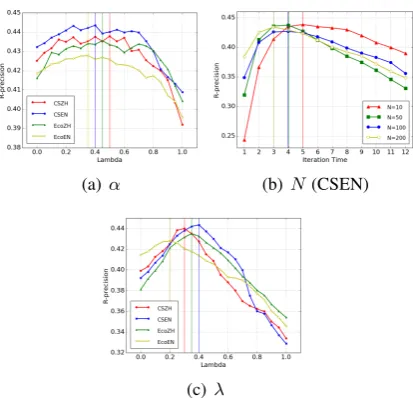
The phraseness parameter α. The parame-terα controls the contribution of a course corpus when calculating the phraseness score. Ifαis too large, the calculated phraseness may suffer from unreliable estimation; however, the calculated s-core may fail to reflect the real phraseness distri-bution in the course course when α is too small. We investigate the influence of α in Figure 2(a). This figure shows the R-precision of CCP when λ = 0.3, N = 100, and α ranges from 0 to 1. From this figure we find that, whenαis set from 0.2 to0.7, the performance is consistently good, and remains stable with the variations ofα. When αis larger than0.85, the R-precision drops in all
3http://baike.baidu.com/
evaluation datasets. The results demonstrate that the large-scale encyclopedia data is conducive to making reliable estimations of the phraseness. In our experiment,αis set as0.4for all four datasets.
The size of seed set N. As mentioned in Sec-tion4.1, we utilize the video titles to automatically construct the seed set for each dataset. We set the size of the seed setN = 10,50,100,200for each dataset and explore the influences of N on CCP. Figure2(b)shows the R-precision of CCP with d-ifferentN on CSEH (λ = 0.3, α = 0.4). From the figures, we observe that the CCP reaches its best performance through 3 to 5 iterations. When N becomes larger, the algorithm tends to achieve the best performance faster, i.e., it terminates with fewer iterations. However, different settings ofN all lead to a competitive best performance (around 0.43 on CSEN). We obtain similar observation-s on other dataobservation-setobservation-s. In our experimentobservation-s, we observation-set N = 100for all datasets.
The penalty factor λ. The parameter λ rec-onciles the influence of voting scores from over-lapping terms. We demonstrate the influence of λ in Figure 2(c). This figure shows that the C-CP achieves its best R-precision when λ ranges from 0.20 to 0.40 in all datasets. If we do not severely lower the voting scores from overlap-ping terms (λ > 0.5), or even have no penalty (λ = 1.0), the performance is consistently un-satisfactory. The experimental results verify that the voting score from a non-overlapping neighbor (e.g., “data mining” to “machine learning”) is rela-tively more reliable than an overlapping one (e.g., “difficult learning” to “machine learning”) in CCP. However, voting scores from overlapping terms still encode some useful semantics (e.g., “merge sort” to “quick sort”), ignoring them (λclose to 0.0) may cause a decline in performance. We set λ= 0.3for all datasets.
5.4 Comparison with Baselines
After we explore the influences of parameters, we employ four baseline methods to compare with our proposed method, i.e., course concept propagation (CCP).
5.4.1 Baseline Approaches
First, we select twostatistics-based methods, i.e., TF-IDF and PMI, as our baselines.TF-IDFranks the candidate course concepts based on theirtf-idf
in the course corpus. For a candidatec ∈ T, its tfidfR(c) =tfc×log(idfc), wheretfcis the
fre-(a) α (b)N(CSEN)
(c) λ
Figure 2: The Study of Parameter Influence on CCP
quency of cin D, andidfc is based on the
num-ber of videos in which c appears. In the PMI
method, we directly rank candidates based on their phraseness, using the method described in Section
3.1. We use the same parameter α with CCP for a fair comparison. Second, we also employ two
graph-based methods. TextRank (Mihalcea and Tarau,2004) andTopical PageRank (TPR) (Liu et al., 2010) are two state-of-the-art graph-based keyphrase extraction approaches. They all con-struct a graph based on word co-occurrences with-in the corpus, and apply the PageRank algorithm (Brin and Page,1998) to score the vertices. The s-core of a multi-word candidate is the average ss-core of all words within the candidate. Different from TextRank, TPR decomposes traditional PageRank into multiple PageRanks specific to various topics using LDA (Blei et al.,2003). Topics in TPR are learned from external data sources, and we use the same encyclopedia corpus as ours to make a fair comparison.
5.4.2 Implementation Details
For pruning the CCG, we set θ = 0.3 for al-l datasets. The minc is heuristically set as 5 in our experiments. The skip-gram model (Mikolov et al.,2013b) is applied to train word embeddings using the Python library gensim 5 with default
parameters. For TextRank and TPR, we use the THUTag6, a state-of-the-art keyphrase extraction
package, which provides the implementations of these methods.
Method CSEN EcoEN CSZH EcoZH TF-IDF MAPRp 0.1250.105 0.3030.232 0.1180.109 0.1980.145
PMI Rp 0.239 0.222 0.246 0.179
MAP 0.141 0.197 0.187 0.121 TextRankMAPRp 0.1510.137 0.2900.263 0.1420.131 0.1610.115
TPR Rp 0.284 0.414 0.305 0.303 MAP 0.255 0.387 0.267 0.288 CCP MAPRp 0.4430.432 0.4270.365 0.4340.416 0.4350.423
Table 2: Performance of Different Methods on Differen-t DaDifferen-taseDifferen-ts
5.4.3 Performance Comparison
In Table 2 we summarize the results of different methods across different datasets. From the table, we find that the proposed methods outperform all baselines on all datasets, which indicates the ro-bustness and effectiveness of CCP7. Specifically,
we have the following observations.
First, TF-IDF performs competitively with Tex-tRank, but they both perform worse than TPR and CCP. TF-IDF and TextRank only use statistical information within the course corpus and have a strong reliance on term frequency, which hamper-s their performancehamper-s. For example, both TF-IDF and TextRank correctly extract the concept “IP”, which appears 139 times in the Computer Net-work course, but failed to extract “Internet Pro-tocol”, the full name of “IP”, due to its infrequent presence. Moreover, they also highly ranked many irrelevant yet frequent terms, such as “English lan-guage”. These errors are significantly reduced in CCP with the incorporation of semantic relations. Second, TPR performs better than TextRank across all datasets (an average of +0.141 in terms of R-precision), but is worse than CCP. In MOOC-s, a course usually contain multiple topicMOOC-s, but TextRank often falls into a single topic, and fail-s to cover other fail-subfail-stantial topicfail-s of a courfail-se. For example, in the Data Structure course, TextRank highly ranked phrases with “tree”, but lower-ranked concepts related to “sort”. TPR alleviates this problem by incorporating topic information from online encyclopedias. However, TPR also favors frequent course concepts, because frequen-t words frequen-tend frequen-to have high connecfrequen-tivifrequen-ty in frequen-the co-occurrence graph, and thus receive high rankings using PageRank.
7The improvements are all statistically significant tested
with bootstrap re-sampling with 95% confidence.
6 Related Works
Our work is relevant to automatic keyphrase ex-traction, which concerns the automatic extrac-tion of important and topical phrases from the body of a document” (Turney, 2000). General-ly, keyphrase extraction techniques can be classi-fied into two groups: supervised approaches and unsupervised approaches. In supervised machine-learning approaches, the training phase usually in-cludes a classification task: each phrase in the doc-ument is either a keyphrase or not (You et al.,
2013). Different learning algorithms have been employed to train the classifier, including na¨ıve bayes (Frank et al.,1999;Witten et al.,1999), de-cision trees (Turney,2000), maximum entropy ( Y-ih et al., 2006; Kim and Kan, 2009) and sup-port vector machines (Lopez and Romary, 2010;
Kim and Kan, 2009). Unsupervised approach-es usually involve assigning a saliency score to each candidate phrase, by considering various fea-tures (Wan and Xiao, 2008). Generally speak-ing, the information such astf-idf, co-occurrence, or neighbor documents are frequently used in un-supervised keyphrase extraction. For example, TextRank (Mihalcea and Tarau, 2004) is a well-known method that ranks keywords based on the co-occurrence graph. Huang et al. (2006) utilize co-occurrence information to construct a semantic network for each document and derive the impor-tance of phrases by analyzing the network. The ExpandRank (Wan and Xiao,2008) model uses a set of neighborhood documents to enhance single-document keyphrase extraction. Recently, Liu et al., (2015) proposed a new framework that extract-s quality phraextract-seextract-s from text corpora integrated with phrasal segmentation. This model also rely on lo-cal statistilo-cal information and requires a relatively large corpus.
terms. For example, Rospocher et al. (2012) use the WordNet to detect synonym terms, and then rank a synonym term higher even if it is ranked lower by the statistical method. The work of Vival-di and Rodr´ıguez (2010) utilizes an ontology hier-archy extracted from Wikipedia categories to pro-vide background knowledge. Similarly, Berend and Farkas (2010) invent features concerning the Wikipedia level to achieve enhancements in per-formance. All these methods make use of on-ly the explicit semantic knowledge contained in the external source. Different from them, we use word embeddings to learn semantic representa-tions for candidate concepts and rank them via a novel graph-based propagation process.
7 Conclusion and Future Work
In this paper, we study the problem of course con-cept extraction in MOOCs. We precisely define the problem and propose a graph-based propaga-tion method to extract course concepts by incorpo-rating external knowledge from online encyclope-dias. Experimental results on evaluation datasets validate the effectiveness of the proposed method. Incorporating external knowledge of various kind to help extract course concepts is an intriguing di-rection for future research. A straightforward task is to incorporate structured information such as “is-a” relation into the proposed model.
References
G´abor Berend and Rich´ard Farkas. 2010. SZTERGAK : Feature engineering for keyphrase extraction. In Proceedings of the 5th International Workshop on Semantic Evaluation, SemEval@ACL 2010, Upp-sala University, UppUpp-sala, Sweden, July 15-16, 2010, pages 186–189.
David M. Blei, Andrew Y. Ng, and Michael I. Jor-dan. 2003. Latent dirichlet allocation.
Internation-al JournInternation-al of Machine Learning Research, 3:993–
1022.
Sergey Brin and Lawrence Page. 1998. The anato-my of a large-scale hypertextual web search engine.
International Journal of Computer Networks,
30(1-7):107–117.
Kenneth Ward Church and Patrick Hanks. 1990. Word association norms, mutual information, and lexicog-raphy. International Journal of Computational Lin-guistics, 16(1):22–29.
Ted Dunning. 1993. Accurate methods for the statistics of surprise and coincidence. International Journal of Computational Linguistics, 19(1):61–74.
Eibe Frank, Gordon W. Paynter, Ian H. Witten, Car-l Gutwin, and Craig G. NeviCar-lCar-l-Manning. 1999. Domain-specific keyphrase extraction. In Proceed-ings of IJCAI, pages 668–673.
Luit Gazendam, Christian Wartena, and Rogier Brussee. 2010. Thesaurus based term ranking for keyword extraction. In Database and Expert Sys-tems Applications, Dexa, International Workshops, Bilbao, Spain, August 30 - September, pages 49–53.
Kazi Saidul Hasan and Vincent Ng. 2014. Automatic keyphrase extraction: A survey of the state of the art.
InProceedings of ACL, pages 1262–1273.
Toru Hisamitsu, Yoshiki Niwa, and Jun’ichi Tsujii. 2000. A method of measuring term representative-ness - baseline method using co-occurrence distribu-tion. InProceedings of COLING, pages 320–326.
Chong Huang, YongHong Tian, Zhi Zhou, Charles X. Ling, and Tiejun Huang. 2006. Keyphrase extrac-tion using semantic networks structure analysis. In
Proceedings of ICDM, pages 275–284.
Anette Hulth. 2003. Improved automatic keyword ex-traction given more linguistic knowledge. In
Pro-ceedings of EMNLP, pages 216–223.
John S. Justeson and Slava M. Katz. 1995. Technical terminology: some linguistic properties and an al-gorithm for identification in text. Natural Language Engineering, 1(1):9–27.
Su Nam Kim and Min-Yen Kan. 2009. Re-examining automatic keyphrase extraction approaches in scien-tific articles. In Proceedings of the ACL-IJCNLP
Workshop on Multiword Expressions, pages 9–16.
Ioannis Korkontzelos, Ioannis P. Klapaftis, and Suresh Manandhar. 2008. Reviewing and evaluating auto-matic term recognition techniques. InProceedings
of GoTAL, pages 248–259.
Sujian Li, Jiwei Li, Tao Song, Wenjie Li, and Baobao Chang. 2013. A novel topic model for automatic ter-m extraction. InProceedings of SIGIR, pages 885– 888.
Jialu Liu, Jingbo Shang, Chi Wang, Xiang Ren, and Ji-awei Han. 2015. Mining quality phrases from mas-sive text corpora. InProceedings of ACM SIGMOD, pages 1729–1744.
Zhiyuan Liu, Wenyi Huang, Yabin Zheng, and Maosong Sun. 2010. Automatic keyphrase extrac-tion via topic decomposiextrac-tion. In Proceedings of
EMNLP, pages 366–376.
Patrice Lopez and Laurent Romary. 2010. Humb: Au-tomatic key term extraction from scientific articles in grobid. InProceedings of the 5th International
Workshop on Semantic Evaluation, pages 248–251.
Olena Medelyan and Ian H. Witten. 2006. Thesaurus based automatic keyphrase indexing. In
Proceed-ings of JCDL, pages 296–297.
Rada Mihalcea and Paul Tarau. 2004. Textrank: Bring-ing order into text. InProceedings of EMNLP, pages 404–411.
Tomas Mikolov, Kai Chen, Greg Corrado, and Jeffrey Dean. 2013a. Efficient estimation of word repre-sentations in vector space. International Journal of CoRR, abs/1301.3781.
Tomas Mikolov, Ilya Sutskever, Kai Chen, Gregory S. Corrado, and Jeffrey Dean. 2013b. Distributed rep-resentations of words and phrases and their compo-sitionality. In Proceedings of NIPS, pages 3111– 3119.
Marco Rospocher, Sara Tonelli, Luciano Serafini, and Emanuele Pianta. 2012. Corpus-based terminolog-ical evaluation of ontologies. Applied Ontology, 7(4):429–448.
Gerard Salton and Chris Buckley. 1988. Term-weighting approaches in automatic text retrieval. In-ternational Journal of Information Processing and
Management, 24(5):513–523.
Daniel T. Seaton, Yoav Bergner, Isaac L. Chuang, Piotr Mitros, and David E. Pritchard. 2014. Who does what in a massive open online course? Commun. ACM, 57(4):58–65.
Peter D. Turney. 2000. Learning algorithms for keyphrase extraction. International Journal of In-formation Retrieval, 2(4):303–336.
Jorge Vivaldi and Horacio Rodr?uez. 2010. Finding domain terms using wikipedia. InProceeding of
L-REC 2010.
Xiaojun Wan and Jianguo Xiao. 2008. Single doc-ument keyphrase extraction using neighborhood knowledge. In Proceedings of AAAI, pages 855– 860.
Ian H. Witten, Gordon W. Paynter, Eibe Frank, Carl Gutwin, and Craig G. Nevill-Manning. 1999. Kea: practical automatic keyphrase extraction. In ACM Conference on Digital Libraries, pages 254–255. Wen-tau Yih, Joshua Goodman, and Vitor R. Carvalho.
2006. Finding advertising keywords on web pages.
InProceedings of WWW, pages 213–222.
Wei You, Dominique Fontaine, and Jean-Paul A. Barth`es. 2013. An automatic keyphrase extraction system for scientific documents. Knowl. Inf. Syst., 34(3):691–724.
Torsten Zesch and Iryna Gurevych. 2009. Approxi-mate matching for evaluating keyphrase extraction.