University of South Carolina
Scholar Commons
Theses and Dissertations
1-1-2013
Care As the Essential Element in Teacher and
Student Interactions: Examining Dialogue as a
Vehicle for Building a Caring Environment
Crystal Plumley McSwain University of South Carolina
Follow this and additional works at:https://scholarcommons.sc.edu/etd Part of theEducational Administration and Supervision Commons
This Open Access Dissertation is brought to you by Scholar Commons. It has been accepted for inclusion in Theses and Dissertations by an authorized administrator of Scholar Commons. For more information, please [email protected].
Recommended Citation
CARE AS THE ESSENTIAL ELEMENT IN TEACHER AND STUDENT INTERACTIONS: EXAMINING DIALOGUE AS A VEHICLE FOR BUILDING A
CARING ENVIRONMENT
by
Crystal P. McSwain
Bachelor of Arts
University of South Carolina-Spartanburg, 1995
Master of Education, Elementary Converse College, 1998
Master of Education, Leadership Converse College, 2001
Education Specialist
University of South Carolina, 2008
____________________________________________
Submitted in Partial Fulfillment of the Requirements
For the Degree of Doctor of Philosophy in
Educational Administration
College of Education
University of South Carolina
2013
Accepted by:
Zach Kelehear, Major Professor
Lynn Harrill, Committee Member
Karen Heid, Committee Member
Cheryl Wissick, Committee Member
ii
iii ABSTRACT
This present study considers to what extent dialogue between teachers and
students can support a caring environment. Research investigating behavior and qualities
of effective teaching has been liked with caring relationships (Anfara & Schmid, 2007;
Marzano, 2007; Noddings, 2005). “Relationships and instruction are not an
either-or-proposition, but rather an incredible combination.” (Brown, 2010, p. 10) The present
study will examine to what extent dialogue, as one of the components of a proposed
model of caring, can build a caring environment in seventh grade classrooms at a local
middle school (Noddings, 2005, p.53). Specifically, dialogue skills such as intonation,
empathy, respect, and listening will be explored through classroom observations, as well
as interviews and surveys with students and teachers. Results suggest that the elements of
iv
TABLE OF CONTENTS
ABSTRACT ... iii
LIST OF TABLES ... vii
CHAPTER 1OUR STORY ...1
1.1INTRODUCTION ...6
1.2PURPOSE OF STUDY ...9
1.3 SIGNIFICANCE OF STUDY ...11
1.4 SUBJECTIVITIES ...14
1.5 RESEARCH QUESTIONS ...17
1.6DEFINITIONS ...18
1.7DELIMITATIONS ...20
1.8 ORGANIZATION OF STUDY ...21
CHAPTER 2REVIEW OF LITERATURE ...22
2.1 CARE IN SCHOOLS ...22
2.2 THE FACET OF TRUST IN A CARING ENVIRONMENT ...28
2.3 DIALOGUE SKILLS ...29
2.4 INTONATION ...30
2.5 RESPONDING WITH EMPATHY ...31
2.6 RESPECT ...32
2.7 LISTENING ...34
v
CHAPTER 3METHODOLOGY ...38
3.1 PURPOSE OF STUDY AND RESEARCH DESIGN ...38
3.2 SAMPLE ...39
3.3RESEARCH METHODS ...40
3.4 MEASURES ...41
3.5DATA ANALYSIS OF DOCUMENT CONTENT ...42
CHAPTER 4 RESULTS ...44
4.1 CLASSROOM OBSERVATIONS AND EVIDENCE OF DIALOGUE SKILLS ...44
4.2 TEACHER SURVEYS AND EVIDENCE OF DIALOGUE SKILLS...75
4.3STUDENT SURVEYS ...78
4.4 STUDENT INTERVIEWS ...80
4.5 INTONATION ...82
4.6 EMPATHY ...86
4.7 RESPECT ...88
4.8 LISTENING ...95
4.9 SUMMARY ...97
CHAPTER 5 DESCRIPTION, ANALYSIS, INTERPRETATION, JUDGMENT ...100
5.1 DESCRIPTION ...100
5.2 ANALYSIS ...101
5.3 INTERPRETATION ...102
5.4 JUDGMENT ...112
5.5 LINE ...112
vi
5.7 SHAPE ...113
5.8 FORM ...114
5.9 SPACE ...114
5.91 COLOR ...115
5.92 TEXTURE ...115
5.93 FUTURE RESEARCH ...116
5.94 CONCLUSION ...116
REFERENCES ...117
APPENDIX A: INSTRUMENT FOR SYNTHESIS OF TEACHER AND STUDENT STATEMENTS AND BEHAVIORS PARALLELED TO DIALOGUE ...121
APPENDIX B: TEACHER SURVEY ...124
APPENDIX C: STUDENT SURVEY ...127
APPENDIX D: PARENT CONSENT FOR STUDENT SURVEY...129
APPENDIX E: PARENT CONSENT FOR STUDENT INTERVIEWS ...131
APPENDIX F: DIALOGUE SKILLS ...132
APPENDIX G: ASSENT FORM FOR STUDENTS ...134
vii
L
IST OFT
ABLESTable 1.1 Intersection of the Elements of Art and Pedagogy. ...3
Table 1.2 Five Stages of Development. ...10
Table 2.1 Listening Techniques. ...35
Table 4.1 Synthesis of Teacher and Student Statements and Behaviors Paralled to
Dialogue Skills . ...45
Table 4.2 Teacher Survey Indicating How Often Dialogue Skills Are Demonstrated. ...76
Table 4.3 Student Survey Indicating How Often Teachers Demonstrate Dialogue
1 CHAPTER 1
OUR STORY
“Just as sunlight burns away the morning fog, the more light you shine on what
you stand for, what you believe in, and what you care about, the more clearly you’ll see
those roads signs pointing in the direction you want to go. (p. 35)” This quote from The
Truth About Leadership by Kouzes and Posner captured my attention as it catapulted me
back in time to the 2006-2007 school year, the first year I became principal of Landrum
Middle School. My memory serves me magical chunks of time as I become omniscient to
the past. Returning to my first year is a memory filled with a self critique of I should have
done this and why did we do it this way in juxtaposition with celebrating how far we have
come as a school as I now enter my eighth year as principal. Landrum Middle School’s
PASS scores ranked as one of the top three in Spartanburg County, and for Landrum
Middle School we ranked two out of three according to the overall weighted points total
of the Federal Accountability System among the middle schools across our district. In
addition, we just recently were awarded the Making Middle Grades Work Depth of
Implementation Award that is primarily based on having a continuous pattern of high test
scores and scoring “Met” on AYP for the past two years. For the first time in eight years,
I feel that there is a movement towards teachers feeling connected to their students and
2
than we have ever been, and it is imperative that we move forward the essence of this
connection that has enabled us to build relationships that are inextricably linked to
developing a caring environment for all who enter the doors of Landrum Middle School.
The process of moving forward has been a journey, and it began with coming to grips
with who we were as individuals and how this transferred into the classroom as
educators. Through staff development during approximately the first two years as I was
principal, we became critical thinkers as we examined ourselves in an artistic
metaphorical spectrum by creating a piece of art to represent how it related to the
elements in which we needed to grow professionally and/or personally. By utilizing a
metaphorical lens, we were allowed the opportunity to examine ourselves using the
Feldman Method, “a mechanism of critiquing art” to evaluate through judgment the
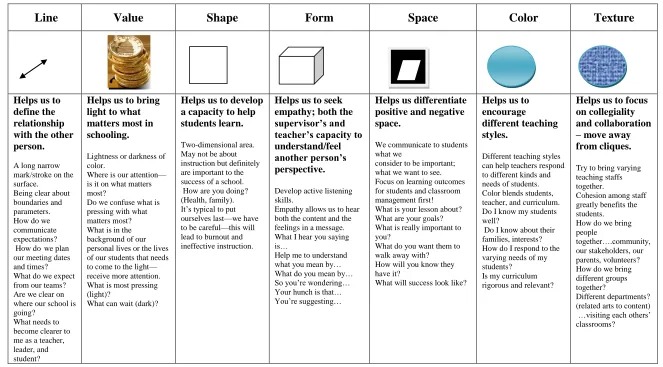
elements of art: line, value, shape, form, space, color and texture (Kelehear, 2006). Table
1.1 below describes the intersection of the elements of art and pedagogy to result in
creating a piece of art and a self-reflection to represent where personal and professional
3
Table 1.1 Intersection of the Elements of Art and Pedagogy
Line Value Shape Form Space Color Texture
Helps us to define the relationship with the other person.
A long narrow mark/stroke on the surface. Being clear about boundaries and parameters. How do we communicate expectations? How dowe plan our meeting dates and times? What do we expect from our teams? Are we clear on where our school is going?
What needs to become clearer to me as a teacher, leader, and student?
Helps us to bring light to what matters most in schooling.
Lightness or darkness of color.
Where is our attention— is it on what matters most?
Do we confuse what is pressing with what matters most? What is in the background of our personal lives or the lives of our students that needs to come to the light— receive more attention. What is most pressing (light)?
What can wait (dark)?
Helps us to develop a capacity to help students learn.
Two-dimensional area. May not be about instruction but definitely are important to the success of a school. How are you doing? (Health, family). It’s typical to put ourselves last—we have to be careful—this will lead to burnout and ineffective instruction.
Helps us to seek empathy; both the supervisor’s and teacher’s capacity to understand/feel another person’s perspective.
Develop active listening skills.
Empathy allows us to hear both the content and the feelings in a message. What I hear you saying is…
Help me to understand what you mean by… What do you mean by… So you’re wondering… Your hunch is that… You’re suggesting…
Helps us differentiate positive and negative space.
We communicate to students what we
consider to be important; what we want to see. Focus on learning outcomes for students and classroom management first! What is your lesson about? What are your goals? What is really important to you?
What do you want them to walk away with? How will you know they have it?
What will success look like?
Helps us to encourage different teaching styles.
Different teaching styles can help teachers respond to different kinds and needs of students. Color blends students, teacher, and curriculum. Do I know my students well?
Do I know about their families, interests? How do I respond to the varying needs of my students?
Is my curriculum rigorous and relevant?
Helps us to focus on collegiality and collaboration – move away from cliques.
Try to bring varying teaching staffs together.
Cohesion among staff greatly benefits the students. How do we bring people
together….community, our stakeholders, our parents, volunteers? How do we bring different groups together?
4
Fast forward a few years and the self reflection evolved from self to looking
outside of ourselves to what kind of school we would want for own personal children.
This was a slightly different lens to view a school but one that would epitomize our
expectations of what every parent would desire as a school for his/her own child. It would
also lead our school to establishing our beliefs and a vision. I took the descriptions of
what type of school each teacher would want for his/her child, and I added the stem LMS
is a…. The following represents a snapshot of what was collected from faculty members:
LMS is a school where students feel comfortable, safe, loved, and valued.
LMS has an environment that is inviting and inspiring to aid in the quest for
knowledge.
LMS is a place where students can build and expand on their dreams.
LMS is a place where a strong work ethic and an attitude of achievement prevail.
LMS is a place where we give pats on the back to every member to show support
and offer words of encouragement.
LMS is a place where all the adults in the building remain calm, confident, and
compassionate-knowing things will get done, knowing we can expect
encouragement and support from our colleagues, and knowing at the end of each
day that we gave 110% for our kids.
LMS expects the best from each student.
LMS is a school where education is something to be cherished.
LMS is a school where every child is given every opportunity to learn and is
challenged.
5
LMS is a school that does not give up on children.
LMS is a school where children succeed.
LMS is a school where it is important to have caring relationships.
LMS is a school where respect is understood, manners are used, and empathy is
applied.
LMS is school where colleagues trust colleagues and our public school system.
LMS is a school where all students develop a passion for reading and learning.
LMS has teachers who touch the lives of his/her students and influence them to
strive to do their best.
LMS is a school that looks at individual children and makes education plans that
meets each child’s abilities.
LMS is a school where parent relationships are valued and welcomed.
Soon thereafter, we were able to condense the statements into our belief
statements, and a mission was born as well. If you were to "google" our webpage this is
what you would find:
Beliefs
Landrum Middle School believes:
Students need to be challenged with rigorous academics
All students can learn when provided the opportunity to do so
Students need to be engaged in their learning
Students need to be surrounded by role models who are caring, respectful and
knowledgeable
6
Everyone who enters Landrum Middle School needs to feel welcomed
Home, school and community relationships can strengthen learning experiences
Mission
The mission of Landrum Middle School is to give each student every opportunity to
make the most of themselves.
Vision
-A school for the heart and mind-
We have published for the entire world to see; and, therefore, a commitment, no a
promise, has been made to the children of Landrum Middle School.
INTRODUCTION
Since the No Child Left Behind (2001) Federal legislation, the effectiveness of
teachers has been pushed to the forefront of educational policy discussions. Complicating
the discussion of effectiveness is the lack of clarity as to what successful teaching
actually looks like and how it might be evaluated. Consequently, in Middle School
Journal (May 2007), the article, “Defining the Effectiveness of Middle Grades
Teachers,” reported that there was a high degree of agreement with regards to the
behaviors or qualities associated with effective teaching: “content knowledge,
pedagogical skills, classroom management, and issues dealing with the relationships
between teachers and students” (p. 55-56). Specifically, “through strong interpersonal
skills, [teachers] have the ability to motivate students, set high expectations for student
learning, interact with students in positive and caring ways, encourage students,
communicate interest in students both verbally and nonverbally, and provide a classroom
7
education” (p. 56). Another specific study outlined in the article focused on two main
dimensions of effective teaching: intellectual excitement and interpersonal
concern/effective motivation. Intellectual excitement involves teacher qualities such as
enthusiasm and humor; whereas, interpersonal concern/effective motivation deals with
concern, caring, availability, friendliness, and accessibility. In a recent publication, The
Art and Science of Teaching, Marzano dedicates one entire chapter on “What Will I Do to
Establish and Maintain Effective Relationships with Students?” Marzano states that
teachers should think in terms of teacher behaviors as opposed to teachers’ thoughts and
feelings. With this assertion in mind, there are two critical components of effective
relationships. One component related to behaviors is to communicate an appropriate level
of concern and cooperation such as knowing something about each student; engaging in
behaviors that indicate affection for each student; bringing student interests into the
content and personalizing learning activities; engaging in physical behaviors that
communicate interest in students; and using humor when appropriate. The second
component involves behaviors that communicate an appropriate level of guidance and
control such as consistently enforcing positive and negative consequences; projecting a
sense of emotional objectivity by recognizing that emotions are natural and inevitable and
monitoring your thoughts and emotions; and maintaining a cool exterior (Marzano, 2007,
p.154-160). Marzano also includes research that supports the idea that “if the
relationship between the teacher and the students is good, then everything else that occurs
in the classroom seems to be enhanced” (p. 150). Marzano conveyed that many
behavioral problems are related to a breakdown in teacher-student relationships.
8
buoyancy, and patience (Marzano, 2007). In summary, upon review of previous research,
there is a reoccurring theme of positive relationships between teacher and student as one
of the factors associated with teacher effectiveness. Teacher effectiveness has been
linked to student achievement and has been described through the Middle School Journal
(May 2007), in the article, “Defining the Effectiveness of Middle Grades Teachers,” as
relating to the following behaviors or qualities associated with effective teaching:
“content knowledge, pedagogical skills, classroom management, and issues dealing with
the relationships between teachers and students.” Obviously, teacher effectiveness in the
realm of building relationships goes beyond teaching basic academic skills. As Noddings
(2005, p. xv) describes extensively, it is through moral education and the concept of
providing a climate of care that “caring relationships might flourish” and “to be credited
properly with the virtue of caring, one must regularly succeed in establishing caring
relations.” Noddings’ relational view of caring embodies two contributors in a caring
relation: the carer and cared for. There are many educators today who find themselves in
a situation where they try to establish caring relationships and students who want to
receive care yet we find many students who claim, “Nobody cares” (Noddings, p. xv,
2005)! Noddings (1988, p.215) encourages her readers to entertain not that the aim of
American schooling should be the education of a moral life but that “the conception of
morality needs revision.” Consequently, Noddings proposes a model of caring that
encompasses four components: modeling, dialogue, practice, and confirmation. By
putting this model and its components of care into schools, Noddings emphasizes that
9
established” (Noddings, p. 107, 2005). More specifically, to emphasize the need for
dialogue, Noddings conveys:
Dialogue is also essential in learning how to create and maintain caring
relations with intimate others. Unfortunately, there is little real dialogue in
classrooms. A typical pattern of talk can be described this way: Teacher
elicitation, student response, teacher evaluations. Then the teacher moves
on to someone else, and the student-his or her turn over for the hour-
breathes a sigh of relief and returns to other thoughts. If dialogue cannot
be introduced into formal lesson structures, it must be provided
somewhere. There must be time in every child’s day for sustained
conversation and mutual exploration with an adult. (2005, p. 53)
Therefore, given that care matters in building relationships, this study will
determine to what extent dialogue between students and teachers can support a caring
environment.
PURPOSE OF STUDY
The study is a qualitative inquiry that utilizes the research designs of an
ethnographic study. This type of research design allowed for the understanding as to what
extent dialogue between teachers and students can support a caring environment. More
specifically, Noddings suggests that by giving intentional effort to developing the skills
of dialogue that engender a positive relationship and a caring classroom environment
teachers might establish a caring setting for learning. The site chosen for the study will be
Landrum Middle School located with Spartanburg County School District One. Four,
10
as high and low achievers will be chosen as part of the research population sample. The
seventh grade population of 82 students consists of 44 females and 38 males. Of those 82
students, 66 are white, 11 are black, 3 are Hispanic, and 2 are Asian. In addition, 38
students receive free lunch and 3 students receive reduced lunch. The age range for
seventh graders is 12 to 13 years. Psychologist, Robert Selman, is known for his theory of
adolescent social cognition which is the ability to understand social relationships. He
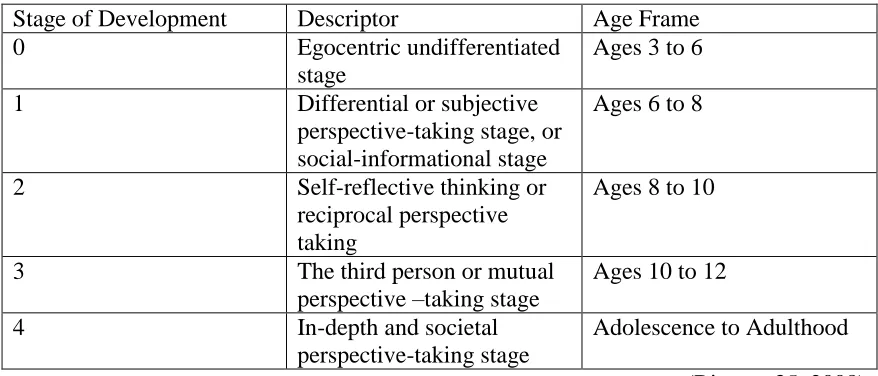
suggests that students move through five stages of development as indicated in Table 1.2.
Table 1.2 Five Stages of Development
Stage of Development Descriptor Age Frame
0 Egocentric undifferentiated
stage
Ages 3 to 6
1 Differential or subjective
perspective-taking stage, or social-informational stage
Ages 6 to 8
2 Self-reflective thinking or
reciprocal perspective taking
Ages 8 to 10
3 The third person or mutual
perspective –taking stage
Ages 10 to 12
4 In-depth and societal
perspective-taking stage
Adolescence to Adulthood
(Rice, p. 35, 2008)
The third stage known as “The Third Person or Mutual Perspective-Taking
Stage” usually occurs in children ages 10-12. At this stage, students can see their own
perspectives as well as a partner and a neutral third person. They have the ability to
understand a more generalized perspective of a group, and friendships are seen as a series
of interactions. In addition, seventh graders are usually in what Psychologist Jean Piaget
describes as the “Formal Operational Stage”. During this stage, adolescents transition
beyond concrete to more logical terms. They have acquired introspection, think about
11
(Rice, 2008). Therefore, as seventh graders, students have the cognitive ability to engage
in dialogue and to the extent in which dialogue can influence relationships.
In addition, four teachers that are representative of gender and who teach in
different content areas will be interviewed. I will choose only 4 because I would like for
my qualitative research to represent an equal voice of teachers and students. Data
collection methods will include interviews, surveys, classroom observations, and
recording the narratives of the participants involved. For this qualitative study, the
process of coding, to “put the data together in new ways by making connections between
a category and its subcategories to develop several main categories,” will be utilized
(Merriam, 2002, p. 149) Interviews will be used throughout this study with students to
gain knowledge on the topic of how teachers exhibit certain characteristics of care in the
classroom, specifically the importance of using dialogue skills.
SIGNIFICANCE OF STUDY
The significance of the study was supported by three factors: (1) teacher
characteristics affect student and teacher relationships, (2) student and teacher
relationships have an impact on student achievement, (3) care matters in building teacher
and student relationships, (4) dialogue is a component of a care model, (5) limited
research has been conducted on to what extent the role of dialogue supports a caring
classroom environment.
A study as to the extent to which dialogue between teachers and students supports
a caring environment is important for several reasons. First of all, there are limited
studies that focus specifically on how conversations support a caring environment.
12
behavior and/or qualities associated with effective teaching (Anfara & Schmid, 2007).
Effective teaching affects student achievement in the classroom and with the passage of
the South Carolina Educational Accountability Act in 1998 and the No Child Left Behind
(2001) legislation, student achievement has been one of the primary indicators that
measures accountability. Consequently, rapport has been defined as the ability to build
relationships. Given that care matters in building relationships, a study that explores the
degree that the characteristics of care supports the seventh grade classroom is crucial for
the impact of improving a caring environment in the middle school classroom. These
theories are important because a teacher’s knowledge of content and the way he/she
delivers it to the students is indicative of effective teaching. “There is a high degree of
what constitutes effective teaching. Basically the behaviors or qualities that are identified
focus on content knowledge, pedagogical skills, classroom management techniques, and
issues dealing with the relationship between teachers and students” (Anfara, 2007, p
55-56). However, if a teacher doesn’t have a positive relationship with his/her students or
they feel that he/she doesn’t care about them, students lose motivation; and, figuratively
speaking, build a wall that cannot be permeated with just teacher knowledge of content
and instructional strategies. “Relationships and instruction are not an either-or
proposition, but are rather an incredible combination. Research tells us this combination
will increase engagement, motivation, test scores, and grade point averages while
decreasing absenteeism, dropout rates, and discipline issues” (Brown, 2010, p. 10). The
relationship and rapport with a teacher’s students is an essential piece of the puzzle that
needs to be strategically placed so that the whole child can have his/her needs met
13
to explore through definitive research the facets that would complete the puzzle of what it
truly means to meet the needs of the whole child. It is within our educational ethic to give
our students the best of who we are when we enter the classroom so that our teaching is
effective. Some teachers are not aware that there may be something more out there that
could help them reach and better educate their children (Noddings, 1988). I would like to
utilize the findings from the audience of students and teachers to inform teachers what it
is beyond knowledge or instructional practice that could benefit them in becoming more
adept in educating our children. I want them to hear the voices of students and what it is
that they receive from teachers that drive them to perform well or at least try to excel. I
have always said there are some characteristics that I see in some teachers that I would
love to bottle and administer to other teachers. If we as educators truly identify ourselves
as lifelong learners, then the desire to improve any aspect of our teaching that could
improve the classroom environment should be evident, even if we have to change
something about ourselves or achieve a whole new paradigm about who we are and what
we exhibit when we close our classroom doors.
In my study, I think these theories will help me as an instructional leader to
establish my own personal expectations of what I would like to see for the educators in
our schools. Ultimately, we are all in education to do what is best for children, and I am
responsible for, as Jim Collins states in his book From Good to Great, to “get the right
people on the bus.” When I am I charged with the task to choose the right teachers for
our children, I need to find out as closely as is feasible what that individual “will look
14
receive this individual and is this individual “for real”? Do they have all the students’
best interests in mind when they take on the ultimate responsibility of educating them?
Currently, as I am in my eighteenth year in education and my seventh year as a
principal, I tend to notice relationships with students and their teachers as I observe
classroom instruction and deal with disciplinary issues. Specifically, what piques my
interest is when I see some of the same children who have been sent from the same
teacher repeatedly. I hear comments from students such as “She doesn’t like me”; she
calls me down for nothing”; “I can’t stand her and I don’t care what she does to me.” It
creates an interest because when I discussed this child that I have mentally ingrained in
my mind with his other teachers, I did not receive the same response that I received from
the teacher who sent the child to the office. Through my hindsight, I can’t help but
wonder if it is the teacher’s rapport with his/her students. I do see differences among
teachers; and, for this specific scenario, the teacher is not as nurturing and kind as the
other child’s teachers. I am curious as to what exactly would make this child say that the
teacher doesn’t like him and is there a possibility that we could change the whole
relationship between these two individuals, not to mention the child’s grades, which
plummeted from the second nine weeks to the end of school.
SUBJECTIVITIES
Through my research there are numerous subjectivities that I need to remain
cognizant of in order to determine clear and true “findings.” One of the most dominant
“subjective Is” that I need to remind myself of is the “Administrator I” versus who I use
to be when I was a classroom teacher. Not every teacher will teach like me or conduct a
15
teaching. Also, I must never “forget where I came from.” It tends to be easier to work
with some children for only one session versus 180 days. Even though I am in the
classroom as an administrator a few times out of the year, it is still not comparable to the
full 180 days a teacher fulfills in an academic calendar year. In addition, as an
administrator, students’ behavior, not to mention teachers’ behavior, tend to improve
when I enter the classroom. I must question am I truly seeing an accurate picture of what
occurs on a typical day in the classroom. An additional “subjective I” that may come into
play throughout my research is the “Empathetic I.” Due to not being with students as
much as teachers, I may tend to be a little more empathetic than their “Stressed-Out Is”
would allow. I have to be mindful of this “Empathetic I” when I am working with
disciplinary issues as well. It’s not easy when I have not been at the forefront of the
disciplinary issue. I have to play the middle and hear both sides and yet remain
supportive of teachers and what they are dealing with in the classroom. I may work with
one to three children at a time and they have between 20-25 in their classrooms—huge
difference! A third “subjective I” is my “Religious I.” A huge part of my actions relate to
my Christianity beliefs. The “golden rule” of “do unto others as you would have them do
unto you” is a constant struggle, yet is an undercurrent of what I hope and strive for in
my daily actions. A huge majority of my success with most students comes from lots of
prayer and simply treating them with kindness. However, I am not so sure that some
individuals are mindful of how they treat others-or at least is doesn’t appear to be when
working with students. Another “subjective I” is my “Pleasing I.” I like to please people,
and I want to make them happy. Students are not excluded. Sometimes I think I may be
16
addition, my “Experiences I” define somewhat of who I am at this time in my life. I am
not the same educator that I was 18 years ago. Through my experiences I have learned
what instructional practices, in my opinion, are deemed as necessary and important and
what may be considered as frivolous. However, I still consider my learning curve to be
pointed in an almost vertical direction; I have acquired new knowledge over the years
based on my experiences in dealing with students. I believe this has helped me to “save
face” for my students many times. One of the most important “subjective Is” that needs to
be written as a reminder at the top of my notepad before I conduct observations in
classrooms is my “Frustrated I.” As an administrator who has been exposed to several
types of teachers and classrooms, I have found lots of joy and approval in some
classrooms; and I have found some that I, ashamedly, admit that I would not want my
own children to be apart of. I am ashamed because I am at fault for letting these
individuals remain. Even though I have “inherited many faculty members, I have already
built a frustration for previous administrators who allowed teachers to switch schools or
classrooms because they felt the change would prove beneficial. What I am seeing is not
a need for change in location but attitude and the overall relationships that teachers have
established with their students. Students have a keen sense of when they are not wanted.
Therefore, with this frustration I must remind myself that this research is not for
retaliation, and I’m not looking for those individuals who have established or acquired
these negative characteristics, but I would like to provide or at least help educate how
dialogue is an important factor in supporting a caring classroom environment.
In essence, remaining cognizant of subjectivities and how they may interact with
17
articulating my own personal expectations of what I would like to see for the educators in
our schools. I have to subtract my limitations of thinking everyone comes to the table
with the same characteristics and beliefs of how we should treat children. I have to
utilize the motivation that may come from frustration and turn it into something positive
that will benefit children. Monitoring my subjectivities comes with first being aware of
my subjectivities. As I am collecting data, I will refer to my subjectivities when analyzing
anecdotal notes from interviews and observations so as not to skew conclusions and to
remain as objective as possible.
RESEARCH QUESTIONS
The purpose of this study is to determine if there is evidence in selected 7th grade
classrooms that the elements of dialogue between teachers and students engender a caring
environment. In order to understand, four skills of dialogue will be explored through the
following research questions:
1. To what extent is intonation present in the classroom?
2. To what extent is empathy present in the classroom?
3. To what extent is respect present in the classroom?
4. To what extent is listening present in the classroom?
The research question was supported with Noddings’ proposal for future purposeful
research: “to seek out situations in which educators are trying to establish settings more
conducive to moral growth and study these attempts at some length…” (Noddings, p.
18 DEFINITIONS
For the purpose of this study the following will be used as definitions for key terms:
Care (Caring) - as described by Noddings “is a way of being in relation, not a set
of specific behaviors” (Noddings, p, 17, 2005). Due to her definition being primarily
relational, Noddings uses the term caring relation interchangeably with the term care or
caring. Noddings states that a caring relation “is, in its most basic form, a connection or
encounter between two human beings-a carer and a recipient of care, or cared-for. In
order for the relation to be properly called caring, both parties must contribute to it in
characteristic ways” (Noddings, p. 15, 2005). In addition, Stronge conveys caring as a
broad term and that its characteristics include more than just knowing the students but
includes teacher attributes such as “listening, gentleness, understanding, knowledge of
students as individuals, warmth and encouragement, and overall love for children”
(Stronge, p.14, 2002).
Dialogue- “a conversation in which people think together in relationship.
Thinking together implies that you no longer take your own position as final. You relax
your grip in certainty and listen to the possibilities that result simply from being in a
relationship with others-possibilities that might not otherwise have occurred”
(Yankelovich, 1999, p. 19).
Rapport, as defined in this study, is building relationships between students and
teachers. There are “two critical components of effective relationships. One component
relates to behaviors that communicate an appropriate level of concern and cooperation
such as knowing something about each student; engaging in behaviors that indicate
19
learning activities; engaging in physical behaviors that communicate interest in students;
and using humor when appropriate. The second component involves behaviors that
communicate an appropriate level of guidance and control such as consistently enforcing
positive and negative consequences; projecting a sense of emotional objectivity by
recognizing that emotions are natural and inevitable and monitoring your thoughts and
emotions; and maintaining a cool exterior” (Marzano, 2007). For the purpose of this
study, building relationships between students and teachers will be referred to as rapport
(Catt & Miller, 2007).
Coding is “put[ting] data together in new ways by making connections between a
category and its subcategories to develop several main categories.” (Merriam, 2002, p.
149) “Weaving together the key categories” from observations, interviews, and surveys
conducted throughout this study will provide a way to “label categories with a term” and
for this research study the terms will be the teacher characteristics that affect teacher and
student rapport (Merriam, 2002, p.167 & Creswell, 2003, p. 192).
A “survey design provides a quantitative or numeric description of trends,
attitudes, or opinions of a population by studying a sample of that population. From the
results, the researcher generalizes or makes claims about the population” (Creswell, 2003,
p. 152). The survey will be conducted in a middle school located within Spartanburg
County School District One. A survey among four teacher participants who represent
varying genders and who teach in different content areas will be used to verify the
qualitative data collected through classroom observations. The additional participants of a
survey will include the four seventh grade middle school students who represent the ratio
20
the school and the remaining seventh grade population. Data on the survey will be
collected through the means of a questionnaire using Likert-like items based on a scale
from “never” to “sometimes” to “often.”
Likert scale “asks individuals to check their level of agreement (i.e., strongly
agree, agree, undecided, disagree, or strongly disagree) with various statements” (Gall,
2003, p. 214).
Teacher effectiveness has been described through the Middle School Journal
(May 2007), in the article, “Defining the Effectiveness of Middle Grades Teachers,” as
relating to the following behaviors or qualities associated with effective teaching:
“content knowledge, pedagogical skills, classroom management, and issues dealing with
the relationships between teachers and students.”
Student Achievement will be defined using the focus of achievement. The
American Heritage Dictionary defines achievement as “something accomplished
successfully, especially by means of exertion, skill, practice, or perseverance.” Evidence
of student achievement will be collected through data such as MAPS (Measures of
Academic Progress) and PASS (Palmetto Assessment of State Standards) results.
DELIMITATIONS
Initially, this study will confine itself to Landrum Middle School in Spartanburg
County School District One. The participants will include four seventh grade middle
school students who represent the ratio of percentages of the gender, varying ethnicities,
as well as high and low achievers within the school and the remaining seventh grade
population. In addition, four, seventh grade content area teachers who represent varying
21
generalizability to other situations may be limited. In addition, due to the study using a
qualitative design, empirical evidence will not be an analytical focus.
ORGANIZATION OF STUDY
This study will be organized into five chapters, a bibliography, and appendices.
As a result of Noddings and Feldman’s studies, I have embedded their work as my
theoretical lens to understand the art of caring as practice. Chapter two will present a
review of literature regarding building relationships, also referred to as rapport, among
teachers and students as part of teacher effectiveness. In addition, the role of dialogue
between teachers and students to create a caring environment will be included. Chapter
Three will describe the research design and methodology of the study. The instruments
used to gather the data, procedures followed, and the participants selected for the study
will also be included. An analysis of the data and a discussion of the findings will be
presented in Chapter Four. Chapter Five will use the Feldman Method as an approach to
provide a description, analysis, interpretation, and judgment with implications of how the
ethnographic research experience with the four dialogue skills of intonation, empathy,
respect, and listening relate and interact to add and create meaning, specifically a caring
environment (Kelehear, 2006). The study will conclude with a bibliography and
22
CHAPTER 2
REVIEW OF LITERATURE
The literature on dialogue as a component of caring may provide a new
perspective for how to provide an environment that supports student and teacher
relationships in the classroom. This chapter will explore the role of dialogue and the
skills associated with dialogue that can be extended into educational practice to influence
a caring environment that builds and sustains teacher and student relationships.
CARE IN SCHOOLS
In her second edition of The Challenge to Care in Schools: An Alternative
Approach to Education, Noddings (1995) continues her plea for a “central place for
caring in our schools” by putting the “human dimension back into an educational system
that has become dehumanized.” She advocates for a curriculum that “centers around care:
care for one’s self; for intimate others as well as strangers and distant others; for animals,
plants, the earth; and for human instruments and ideas” (Noddings, 1995, ix). In
Noddings’ book, An Ethic of Caring, she emphatically advocates for moral education and
describes a caring model consisting of four components: dialogue, modeling, practice and
confirmation. Specifically, to concentrate on dialogue is essential in order to provide a
vehicle for the teacher and student to know each other, for trust to develop, and for
23
Coincidentally, Isaacs articulates through the definition and the etymology of
dialogue the end result of what is accomplished in a learning environment where teacher
and student relationships are established:
The roots of the word dialogue come from the Greek words dia and
logos. Dia means “through”; logos translates to “word” or
“meaning,” In essence, a dialogue is a flow of meaning. But it is
more than this too. In the most ancient meaning of the word, logos
meant “to gather together,” and suggested an intimate awareness of
the relationships among things in the natural world. In that sense,
logos may be best rendered in English as “relationship.”
…dialogue is a conversation in which people think together in
relationship. Thinking together implies that you no longer take
your own position as final. You relax your grip in certainty and
listen to the possibilities that result simply from being in a
relationship with others-possibilities that may not otherwise have
occurred (Isaacs, 1999, p.19; Yankelovich, D., 1999).
People, in general, have an “unsatisfied hunger for community: a place where
people know about you, care about you, where you belong. In the conditions of the
twenty-first century, we cannot reproduce the communities of the nineteenth-century
small town America. But through dialogue we can penetrate the veneer that has been
created by too many interpersonal transactions” (Yankelovich, 1999, p. 151). “When
people engage one another, formally or informally, in dialogue, they are seeking truths to
24
1999, p. 216). Noddings’ argues her educational philosophy to be a marriage between
care, relationships, and academics:
A child’s place in our hearts and lives should not depend on his or
her academic prowess. Lots of young people see through today’s
educational slogans. We preach constantly that ‘all children can
learn’; we even suggest strongly that they all can learn anything
the school has to offer if they are taught well and they try. If they
don’t try, they are made to feel like traitors, even though they
might work very hard at tasks over which they have some control
and choice. Thus, despite our determined optimism and insistent
everyone-can-do-it, students complain, ‘They don’t care!’ They
suspect that we want their success for our own purposes, to
advance our own records, and too often they are right (p.13).
In essence, Noddings’ theory that schools cannot achieve their academic goals
without implementing a curriculum that includes care for students is the foundation for
her argument of how to allow the best ideas to flourish from both traditional and
progressive methods in education (Noddings, 1995). Good teachers make a difference
and “learning is about constructing relationships in which students connect with teachers
or subjects” (Ark, 2002, p.10). “Relationships and instruction are not an
either-or-proposition, but are rather an incredible combination. Research tells us this combination
will increase engagement, motivation, test scores, and grade point averages while
decreasing absenteeism, dropout rates, and discipline issues” (Brown, 2010, p. 10).
25
their teachers” and students must know their teachers in order for trust to develop (Ark,
2002, p.13; Noddings, 1988). Dialogue is essential to building the foundation of trust
between student and teacher. “True dialogue is open; that is, conclusions are not held by
one or more of the parties at the outset. The search for enlightenment, or responsible
choice, or perspective, or means to problem solution is mutual and marked by appropriate
signs of reciprocity” (Noddings, 1988, p. 223). Consequently, making personnel
connections through dialogue by teachers sharing themselves through personal stories
and “insights concerning who they are outside the classroom are taking a leap toward
establishing trust-and even credibility-with their students. Teachers who create
comfortable learning environments by revealing themselves are ultimately rewarded with
rich discussions” (Polochanin, 2007, p.40). Rapport as being described as “the ability to
build relationships based on mutual trust and harmony” is a crucial element for learning
effectiveness. Students are interested in the personal experiences of their teachers so they
can get to know them; and, therefore, they might feel more comfortable opening up to
them (Catt, et. al, 2007, p. 369). “The benefit of learning what is on students’ minds, and
including some of these issues in class discussions, is connecting with students, which
helps to build trust-a key element in effective communication” (Hedin, 2007, p. 62).
“Districts that attempt to increase academic pressure without improving personalization
are seeing even higher dropout rates, especially among disadvantaged groups” (Ark,
2002, p.14). If we do not know our students in terms of what they love, fear, or hope for
and we just expect them to do well, then we are more or less treating them like “an
26
In addition, with respect to care and as it relates to moral education in our schools,
Klonoski’s article, “Teaching as a Primordial Act of Friendship,” connects the activity of
teaching to many of the essential characteristics traditionally associated with friendship
such as “frankness, critical self-assessment and self-understanding, and the obligations to
perfect the soul, care for the world, and express love for humanity” (Klonoski, 2003, p.
140). On a side note, to address the claim that teacher and students should not be friends
is “premised on a misconception about what sort of friendship is appropriate between
teachers and students” (Klonoski, 2003, p.140). Interestingly, in regards to students and
teachers communicating for learning effectiveness, students conveyed teachers’
enthusiasm, higher-energy levels, positive attitudes, and passions for the subject matter
were important. The common denominator for teacher effectiveness revolved around the
theme of teachers who were good communicators with students. “For communication to
occur between two individuals, a sharing of meaning must exist between the sender and
the receiver” and it is incorrect to conclude that sharing of meaning has occurred “just
because the communication process of sending and receiving has been completed” (Catt,
et. al, 2007, p.370).
Consequently, conversation is the medium for which learning emerges and
influences whether or not experiences are transformed into learning (Baker, et. al, 1997).
Furthermore, in Dialogue and the Art of Thinking Together, the dialogue process is
described as follows:
A form of conversation that can be meaningful to people from a
large number of backgrounds: from every walk of life, from every
27
responsibility within organizations and communities. People come
to dialogue for many different reasons. Dialogue achieves this by
deepening the glue that links people together. This “glue” is the
genuine shared meaning and common understanding already
present in a group of people (Isaacs, 1999, 10).
Issacs also describes the dialogue as a practical tool and practice
that can assist individuals with producing successful results out of difficult
conversations while “integrat[ing] the good, the true, and the beautiful
within each of us and within the larger institutions in which we live”
(Isaacs, 1990, 3). Most problems can be traced directly to their inability to
think and talk together.
As an example to support Isaacs’ idea of dialogue being utilized as
a practical tool, dialogue played a role in reversing the nuclear arms race
that ended the Cold War:
Some years after the end of Ronald Reagan’s presidency, George
Schultz, who had been Reagan’s secretary of state, asked Mikhail
Gorbachev, former president of the Soviet Union, what the turning
point in the Cold War had been.
“Reykjavik,” Gorbachev answered unhesitatingly.
He explained that at their meeting in Reykjavik, Iceland, he and
Ronald Reagan had for the first time entered into genuine dialogue
with each other-a dialogue that extended far beyond their main
28
aspirations for their two nations. Gorbachev credited this dialogue
with establishing enough trust and mutual understanding to begin
to reverse the nuclear arms race (Yankelovich, 1999, p.9).
This snapshot into history also captures a representation of the art “of not just talking
together but of thinking together that seems to have been all but lost in our modern
culture” (Isaacs, 1999, p. 6).
Even though dialogue appears to challenge most hierarchical models, it supports a
method for sustaining partnerships between teachers and students and students with each
other. It provides a framework where students and teachers can learn from each other in a
setting where people listen, respect differences, and let go of the certainty in order to see
ideas from new perspectives (Isaacs, 1999).
THE FACET OF TRUST IN A CARING ENVIRONMENT
Dialogue has a place and promise in today’s education in which all participants
must be treated equally (Yankelovich, 1999). “Dialogue becomes possible only after trust
has been built and the higher-ranking people have, for the occasion, removed their badges
of authority and are participating as true equals. There must be mutual trust before
participants of unequal status can open up honestly with one another” (Yankelovich,
1999, p. 42). “Relationships of all kinds are built on and sustained by trust” (Covey,
2006, p. 12). Students want to trust that their teachers care and to guide them through the
learning process. “Effective instructors work quickly to help students feel comfortable in
trusting them with the important task of guiding their efforts to learn” (Catt, et. al, 2007,
29
In Trust Matters: Leadership for Successful Schools, Tschannen-Moran conveys
how five facets of trust are essential for establishing and maintaining trust within schools
in order to foster relationships among teachers and students: benevolence, extending
good will; honesty, telling the truth; openness, engaging in open communication;
reliability, being dependable; and competence, setting an example and working hard.
Tschannen-Moran, however, emphasizes the most commonly recognized facet of trust is
a sense of caring: “There is a sense of care, not just care about the immediate outcome
but also care about the relationship…Students who do not trust their teachers or fellow
students cannot learn efficiently because they invest their energy in calculating ways to
protect themselves instead of engaging in the learning process” (Tschannen-Moran, 2004,
p. 19). The nature and power of care and its inextricable link to trust is reiterated
frequently by Covey in The Speed of Trust: The One Thing That Changes Everything.
“The motive that inspires the greatest trust is genuine caring-caring about people, caring
about purposes, caring about the quality of what you do, caring about society as a whole”
(Covey, 2006, p. 78). Covey presents trust as one of the most powerful forms of
motivation and inspiration because people want to be trusted and they respond and thrive
on trust; therefore, it is worth the dedication to get “good at establishing, extending, and
restoring trust…as the most effective way of relating to and working with others, and the
most effective way of getting results” (Covey, 2006, p. 29).
DIALOGUE SKILLS
In general, people crave a sense of community and to feel “we are not alone in
the world” (Yankelovich, 1999, p.31). Unfortunately, “many of the social bonds that once
30
that our population is growing apart. Americans sense that civility and respect for one
another are losing ground” (Yankelovich, 1999, p.29). Dialogue is a process of
relationship building and “life itself is a form of meeting and dialogue is the ridge on
which we meet.” (Yankelovich, 1999, p.15) Unfortunately, “at the present stage of our
history, the ability to conduct dialogue is a marginal skill that only a tiny handful of
people do well”; therefore, the skills needed to master the art of dialogue are critical
(Yankelovich, 1999, p.19).
The craft of dialogue and the skills and principles needed to create it in order to
establish and sustain relationships have been explored; and the core of dialogue can
extend into the classroom as a method to build relationships, to create a caring
atmosphere, and as a teaching device to engage students in the learning process
(Yankelovich, 1999; Isaacs, 1999). In The Magic of Dialogue: Transforming Conflict
into Cooperation by Yankelovich, That’s Not What I Meant: How Conversational Style
Makes or Breaks Relationships by Tannen, School Leadership that Works: From
Research to Results by Marzano, and Dialogue and the Art of Thinking Together by
Isaacs, the combination of four skills and principles for developing dialogue are
presented: Intonation, Responding with Empathy, Respect, and Listening.
INTONATION
When we speak, signals are sent through the intonation of how we speak our
words to communicate “what we think we’re doing when we speak: teasing, flirting,
explaining, or chastising; whether we’re feeling friendly, angry, or quizzical; whether we
want to get closer to back off. In other words, how we say what we say communicates
31
mechanics of conversation and include pacing, pausing, loudness, and pitch. These
signals help form or change the metamessage which is “what is communicated about
relationships-attitudes toward each other, the occasion, and what we are saying” (Tannen,
1986, p.29). Body language, voice inflection, volume, and facial expressions should
“convey a sense of high energy, excitement, and relevance” (Brown, 2010, p. 9). In the
Art and Science of Teaching, Marzano outlines several behaviors teachers should practice
to communicate interest in students:
Smile at students at appropriate times.
In an appropriate manner and at appropriate times, place a hand on a student’s
shoulder as a form of encouragement.
When talking with students, look them in the eyes.
When talking with students, stand close enough to communicate a sense of
concern but not too close to violate personal space.
Look interested in what students have to say (Marzano, 2007, p. 157).
Therefore, making adjustments with intonation as we are engaged in dialogue
could make a difference in adding to the strength and success of the metamessage and, in
essence, the relationship. Connecting with students and presenting oneself should give
students a reason to get excited, sit up, and pay attention (Brown, 2010).
RESPONDING WITH EMPATHY
The ability to “think someone else’s thoughts and feel someone else’s feelings are
indispensable to dialogue” (Yankelovich, 1999, p. 43). Empathy can influence the
behaviors of individuals when responding in dialogue; consequently, the behaviors we
32
in regards to empathy. Even though human beings are not accountable for how they feel,
they are accountable for how they act. Therefore, teachers have the freedom and control
to monitor their thoughts and emotions and, consequently, to behave in a way that
communicates care to the students in the classroom (Marzano, 2007). Our reactions and
behavioral responses can either “make a deposit to or a withdrawal from our relationship
account” (Mendes, 2003, p.58). The “ability to read and identify emotions work together
with self-management and leads to the optimal timing of responses” (Mendes, 2003,
p.58). Some of the behaviors that communicate an appropriate level of concern, control
and guidance are the following:
Speaking directly to the student in a calm and respectful tone
Looking directly at the student, without glaring or staring
Maintaining an appropriate distance from the student
Having a facial expression that is either neutral or positive (Marzano, 2007, p.
160)
RESPECT
In Dialogue and the Art of Thinking Together, Isaacs views respect as a central
element when practicing dialogue. The author defends that “at its core, the act of respect
invites us to see others as legitimate” (Isaacs, 1999, p.111). Something as simple as
addressing students by their names is indicative of showing respect (Brown, 2010;
Marzano, 2007). In addition, respect also means honoring people’s boundaries to the
point of protecting them (Isaacs, 1999, p. 114). Consequently, a teacher who
incorporates good manners in the classroom and consistency in demeanor is showing
33
interaction (Brown, 2010). “If you respect someone, you do not intrude. At the same
time, if you respect someone, you do not withhold yourself or distance yourself from
them” (Isaacs, 1999, p. 114). “Students look for reasons to respect and follow you. You
must send the message from day one that you are in control and worthy of their respect.
This message, however, should not convey an overbearing, authoritarian, inflexible
approach. Striking the right distance between being approachable without being their
friend is the challenge and art of teaching” (Brown, 2010, p. 8). Covey summarizes how
to demonstrate respect in the book, The Speed of Trust: The One Thing That Changes
Everything: “Genuinely care for others. Show you care. Respect the dignity of every
person and every role. Treat everyone with respect, especially those who can’t do
anything for you. Show kindness in the little things. Don’t fake caring. Don’t attempt to
be ‘efficient’ with people (p.151). With a genuine respect comes a desire to know a
person more fully, understand him or her more deeply, and connect with that person.
Respecting individuals looks, sounds, or feels like the following:
Listening
Asking for input
Making time for the person
Using positive humor
Accentuating the positive
Accepting the person “as is,” while helping him or her grow
Learning and demonstrating an appreciation for each person’s culture and
34
Providing the best (respectful tasks-everyone’s work is equally important and
equally engaging)
Expecting the best-always “teaching up”- pushing the student beyond where
he or she believes achievement is possible
Holding the person to a high standard
Ensuring a positive environment for growth (Tomlinson, et. al, 2008, p.3)
LISTENING
“Listening may be the single most powerful creative act we perform; we listen
and create reality based on what we hear in each moment. Without listening, dialogue
cannot exist. In the absence of listening, the streams of meaning that move among a
group of people become disconnected and often invisible” (Ellinor & Gerard, 1998, p.
99). In Dialogue: Rediscover the Transforming Power of Conversation, the authors,
Ellinor and Gerard, identify three levels of listening that take place during dialogue: first,
one listens to others to sift for what is important and to expand one’s own understanding;
secondly, one listens for an internal conversation of one’s own voice as he/she speaks;
third, one listens for the shared meaning and collective themes that are emerging from the
group as a collective whole (Ellinor & Gerard, 1998). As individuals “listen together”
dialogue creates the opportunity for common understanding and communion. Sometimes
listening requires for individuals to simply be still. The stillness, along with the quietness
of our minds, helps to recognize how one is actually listening and to ensure that one is
present so that listening can take place through minds and hearts, not through the ears
(Isaacs, 1999). “Active listening is a system of techniques for focusing the listener,
35
(Frey, et. al, 2009, p. 74). Table 2.1 below outlines active listening techniques and how
to perform them:
Table 2.1 Listening Techniques
What to
Do Why Do It How to Do It
Examples of What to Say
Encourage To convey
interest in what the speaker is discussing
To keep the
person talking
Nod, smile,
and use other facial
expressions.
Don’t agree
or disagree. Use noncommittal words with positive tone of voice.
“I see …”
“Uh-huh …”
“OK …”
“Keep going
…”
Restate or clarify
To show that
you are listening and understand
To check
your
perception of the speaker’s message
Restate the
basic ideas, emphasizing the facts.
Clarify
points.
Don’t “fake
listen”!
“If I understand
correctly, your idea is …”
“I see what you
mean.”
“In other words,
this is …”
“What did you
mean when you said …”
Reflect or paraphrase
To show the
speaker that what he or she is saying is being heard
To show you
understand
Restate the
other’s basic feelings.
Respond to
the other’s main ideas.
“So you feel
that …”
“You must feel
angry that …”
“I think you’re
36 the speaker’s
feelings
Summarize To pull
important ideas, facts, and so on together
To establish
a basis for further discussion
To review
progress Restate, reflect, and summarize major ideas and feelings.
“So would you
say the key ideas are …”
“If I understand
you, you’re saying that …”
“Based on your
presentation, would it be accurate to say that …”
(Frey, et. al, 2009, p. 75)
SUMMARY
Good teachers make a difference in the lives of students every day (Ark, 2002,
p.10). In order for learning to take place, students must make a connection with teachers
and the subjects they are studying. The combination of student and teacher relationships
and instruction is instrumental in increasing engagement, motivation and student
achievement (Brown, 2010). Noddings (1995) has proposed through her model of caring
that schools cannot achieve their academic goals without implementing a curriculum that
includes care for students. Emphasizing dialogue in the classroom is a component of the
model of caring because it supports how teachers and students can spend more time
together in order for trust to be established (Noddings, 2005). Moreover, in order for
students to achieve at high levels, “they must be well known to their teachers” and
students must know their teachers in order for trust to develop (Ark, 2002, p.13;
37
and teacher; and, therefore, dialogue is a process of building relationships to create a
caring atmosphere (Yankelovich, 1999). Consequently, when implementing the skills
and principles of dialogue such as intonation, responding with empathy, respect, and
listening, dialogue becomes a teaching tool to engage students in the learning process
38
CHAPTER 3
METHODOLOGY
The theoretical foundation for the present study was outlined in Chapters One and
Two. Chapter Three presents the methodology for the dissertation research. As a result of
Noddings and Feldman’s studies, I have embedded their work as my theoretical lens to
understand the art of caring as practice.
This chapter is composed of 4 sections. The first section restates the purpose of
the dissertation study and the research design. Subsequent sections describe the research
sample, measures, procedures, and analysis.
PURPOSE OF STUDY AND RESEARCH DESIGN
The study is a qualitative inquiry that utilizes the research designs of an
ethnographic study, “a focus on human society with the goal of describing and
interpreting the culture of a group” (Merriam, 2002, p. 236). An ethnography will allow
for the understanding of to what extent dialogue between teachers and students can
support a caring environment through the skills of dialogue used by teachers that
engender a positive relationship (Figure 3.1). The purpose of this study is to determine if
there is evidence in selected 7th grade classrooms that the elements of dialogue skills
between teachers and students engender a positive relationship. In order to understand,
four skills of dialogue will be explored through the following research questions:
To what extent is intonation present in the classroom?