University of South Carolina
Scholar Commons
Theses and Dissertations
1-1-2013
Impact of the Child Development Program on
Reading Achievement of Kindergarten Through
Eighth Grade Students in an Urban School District
Tai Elizabeth Lynch
University of South Carolina
Follow this and additional works at:https://scholarcommons.sc.edu/etd
Part of theEducational Administration and Supervision Commons
This Open Access Dissertation is brought to you by Scholar Commons. It has been accepted for inclusion in Theses and Dissertations by an authorized
Recommended Citation
IMPACT OF THE CHILD DEVELOPMENT PROGRAM ON READING ACHIEVEMENT OF KINDERGARTEN THROUGH EIGHTH GRADE STUDENTS
IN AN URBAN SCHOOL DISTRICT
by
Tai E. Lynch
Bachelor of Science College of Charleston, 2000
Master of Arts in Psychology The Citadel, 2002
Specialist in School Psychology The Citadel, 2003
_____________________________________
Submitted in Partial Fulfillment of the Requirements
For the Degree of Doctor of Philosophy in
Educational Administration
College of Education
University of South Carolina
2013
Accepted by:
Diane Harwell, Major Professor
Zachary Kelehear, Committee Member
Doyle Stevick, Committee Member
Timothy Hanchon, Committee Member
DEDICATION
Thank you to all of my family and friends who have given me love and support
throughout the years. To my parents, Rivers and Teresa Lynch, thank you for your
unwavering encouragement, for the numerous life lessons and morals that you have
taught me, and for instilling in me the important value of education. To my fiancé, John
Fisher, thank you for your constant words of advice, for your drive to help me complete
this journey, and for your witty humor that helped me greatly in times of need. For these
reasons and as a token of gratitude, I dedicate this dissertation to my wonderful family
ACKNOWLEDGEMENTS
I would like to acknowledge numerous people to whom I am indebted for their
guidance, support, and feedback over the past few years. I could not have completed this
dissertation without the support of my dissertation committee chairperson, Dr. Diane
Harwell. Thank you for the feedback and guidance as we made our way through this
process. I would also like to thank Dr. Zach Kelehear, Dr. Doyle Stevick, and Dr. Tim
Hanchon, committee members, for their excellent instruction, advice, and support that
aided in my completion of this study. Additionally, I would like to thank Dr. Ken
Stevenson, former USC professor and dissertation committee chairperson, for his initial
interest and help in the creation of and framework for this study. Thank you all for
challenging me as researcher and for helping me grow in my knowledge and
understanding of educational leadership.
I would like to thank Charleston County School District for allowing me to
conduct research within the school district. I also cannot express enough words of
gratitude to David Gus Ruff for his expertise in statistics and data analysis.
Finally, I am sincerely grateful to Joanne Langfitt for her proficiency in
manuscript writing and editing. Thank you so much for your prompt feedback, eloquent
advice on wording, and the overall love and support that you have given me during this
ABSTRACT
Educational leaders are charged with making informed decisions regarding
various aspects of schooling that affect the overall achievement of students. Numerous
legislative ideas, funding initiatives, programming standards, and practicing guidelines
for early childhood education programs have been introduced (Buyssee & Wesley, 2006).
Early care and education have become significant components of social policy due to the
increase in the number of individuals in the workplace and the increasing roles of
government in education and reform, as well as the continued concern for school
readiness and achievement (Urban Institute, 2009). Americans often state that children
are “our most precious natural resource” (Grubb, 1989, p. 358). History, however, has
demonstrated that varying changes and restrictions in implementing early childhood
education have occurred despite this belief system within the general population.
The State of America’s Children (Children‟s Defense Fund, 2010) reported that
the early years are critical for child development and can be influenced by enrollment in
high quality early childhood programs. In the United States, however, a child is born into
poverty every 32 seconds, and decreased developmental progress often continues to
widen the learning gap between them and their higher income peers. Several research
studies have been conducted to measure the immediate and long-term effects of student
This study examined the impact of early childhood education on the reading
achievement of children, kindergarten through eighth grade, who participated in the Child
Development (CD) program within Charleston County School District (CCSD) during
the 2002-2003 school year. The participating students' achievement was determined by
analyzing their performance on the Measures of Academic Performance (MAP)
(Northwest Evaluation Association, 1997) assessment, which is conducted at pivotal
points within a child‟s educational career. The treatment students‟ test results were
compared to those of a matched group of students who did not participate in the CCSD
Child Development program. The results indicated that the overall program type was an
insignificant variable with regard to the MAP reading scores obtained for each sample set
at the second, fifth, and eighth grade levels. Additional secondary research questions
TABLE OF CONTENTS
DEDICATION ... iii
ACKNOWLEDGEMENTS ... iv
ABSTRACT ... v
LIST OF TABLES ... vi
CHAPTER ONE: INTRODUCTION ... 1
Statement of the Problem ... 3
The Leadership Connection ... 8
Research Questions ... 9
Definition of Terms ... 10
Delimitations of the Study ... 14
Duplication of the Study ... 14
Organization of the Study ... 15
CHAPTER TWO: LITERATURE REVIEW ... 16
Introduction ... 16
History of Reading in the United States ... 18
Big 5 Areas of Reading Instruction ... 21
Present Day Reading Instruction... 23
Students At-Risk for Reading Difficulties in the United States ... 24
History of Early Childhood Education Programs in the United States ... 25
Present Day Early Childhood Programs ... 29
Relevant Studies of Early Childhood Education ... 32
Relevant Studies within South Carolina ... 40
Summary ... 44
CHAPTER THREE: METHODOLOGY ... 46
Research Design ... 46
Participant Sample ... 48
Participant Sample Matching Process ... 50
Data Collection Procedures ... 55
Data Analysis Procedures ... 56
Limitations of the Study ... 57
Summary ... 57
CHAPTER FOUR: RESULTS ... 59
Demographic Information and Participant Sample ... 60
Second Grade Analysis... 61
Fifth Grade Analysis ... 65
Eighth Grade Analysis ... 68
Data Analysis Summary ... 72
Summary ... 74
CHAPTER FIVE: SUMMARY, CONCLUSION, AND RECOMMENDATIONS ... 75
Interpretation of the Findings ... 76
Findings Related to the Literature ... 82
Future Recommendations ... 88
Recommendations for Action ... 92
Concluding Statements ... 94
LIST OF TABLES
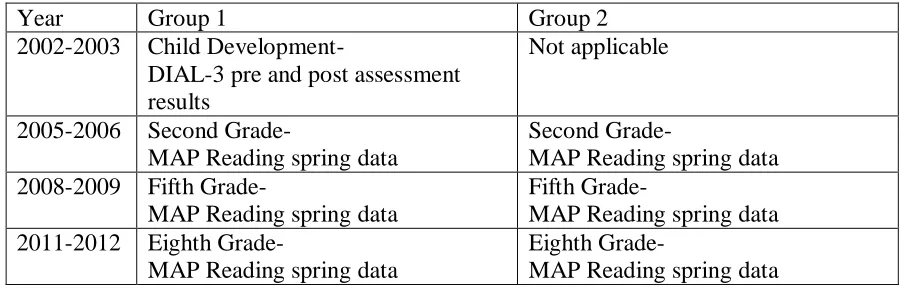
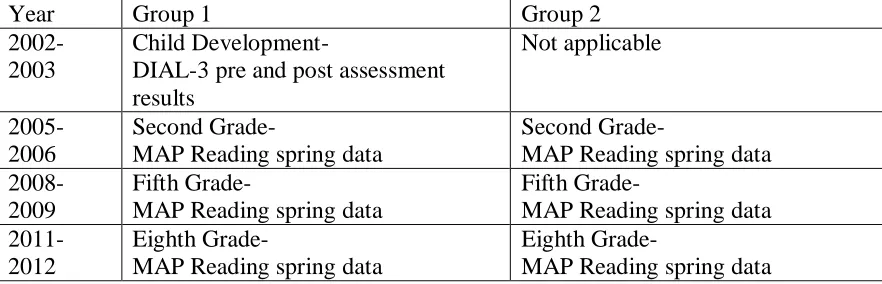
Table 3.1 Summary of the Research Design... 47
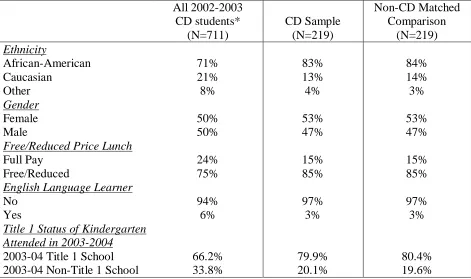
Table 3.2 Summary of the Demographics by Groups from the Original Study ... 51
Table 3.3 Summary of the Data Reviewed ... 55
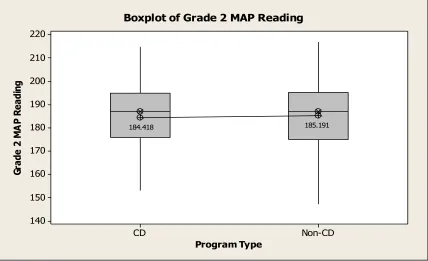
Table 4.1 Group Statistics for Grade Two Measures of Academic
Progress Scale Scores ... 60
Table 4.2 General Linear Model ANOVA of Grade Two Test Score ... 63
Table 4.3 Tukey Simultaneous Tests for Grade Two MAP Reading... 64
Table 4.4 Group Statistics for Grade Five Measures of Academic
Progress Scale Scores ... 65
Table 4.5 General Linear Model ANOVA of Grade Five Test Score ... 67
Table 4.6 Group Statistics for Grade Eight Measures of Academic
Progress Scale Scores ... 68
Table 4.7 General Linear Model ANOVA of Grade Eight Test Score ... 70
CHAPTER ONE
INTRODUCTION
This study proposed to examine the impact of early childhood education on the
reading achievement of children, kindergarten through eighth grade, who participated in
the Child Development (CD) program within Charleston County School District (CCSD)
during the 2002-2003 school year. The participating students' achievement was
determined by analyzing their performance on the Measures of Academic Performance
(MAP) (Northwest Evaluation Association, 1997) assessment at pivotal points within
their educational career. Their test results were compared to those of a matched group of
students who did not participate in the CCSD Child Development program.
The study included a review of the history of early childhood education,
longitudinal data related to participation in preschool education, and the significance of
reading. Finally, an examination and comparative study of the implementation of the
four-year-old Child Development program in Charleston County, South Carolina,
provided a more comprehensive evaluation of students‟ sustained achievement through
the primary, elementary, and secondary grades.
While contributing to the body of literature regarding longitudinal reading
achievement, this study may also assist school leaders and policy makers‟ efforts within
educators, and community members, would benefit from knowing how students who
participated in Child Development performed in the area of reading achievement within
Charleston County when compared to a cohort group of students. Finally, results of the
study could be used to assist in evaluating early childhood educational reform and to
maintain the programs regardless of growing economic concerns regarding investment in
early intervention programs.
Americans often state that children are “our most precious natural resource”
(Grubb, 1989, p. 358). History, however, has demonstrated that varying changes and
restrictions in implementing early childhood education and care have occurred despite
this belief system within the general population. The concept of extending school to
children under the age of six has been discussed within the federal government system in
the United States since the twentieth century (Hernandez, 1995). Numerous legislative
ideas, funding initiatives, programming standards, and practicing guidelines for early
childhood education programs have been introduced (Buyssee & Wesley, 2006). The
quality and effectiveness of these programs continue to be debated today.
Educational research in the area of early childhood programming has grown
significantly over the past 25 years. As American culture and society have changed, so
have the educational programs. Five general categories of preschool options are
available to parents and caregivers including: 1) the federally funded Head Start Program,
2) in-home care provided by a relative, 3) in-home care provided by a non-relative, 4) the
center-based program, and 5) a combination of two or more of these types of different
programs (Clark, 2009). Early care and education have become significant components
the increasing roles of federal and state government in child welfare and in education and
reform. Additionally, the continued concern for school readiness and academic
achievement also continues to impact social policy as well (Urban Institute, 2009).
In the United States, more than 80% of four-year-old children attend a
pre-kindergarten program (National Institute for Early Education Research, 2009). Research
has shown that the quality of early childhood care and the educational experiences
provided can support higher academic achievement and positive developmental outcomes
for students from low income families (Adams, Tout, & Zaslow, 2007). As reported in
Conway (2010), the National Institute for Early Education Research has indicated that
there is a measured 18-month achievement gap between students living in poverty
compared with those who are not living in poverty at their entry into kindergarten. Early
intervention and prevention are the keys to long-term developmental and academic
success. High quality and affordable child development programs that lay the
foundations for future learning are required and necessary in today‟s society.
Statement of the Problem
The State of America’s Children (Children‟s Defense Fund, 2010) reported that
the early years are critical for the development of key factors including cognitive, social,
and emotional growth for children aged birth to five (p. F-1). Adequate maturity during
this time frame can lead to healthy development as well as behavioral and academic
success. In the United States, however, a child is born into poverty every 32 seconds; and
decreased developmental progress often continues to widen the learning gap between
and wellness, emotional and intellectual development, and academic progress (Children‟s
Defense Fund, 2010). The Children‟s Defense Fund „Cradle to Prison Pipeline
Campaign‟ (2009) reported that the cost of poverty to the United States is half a trillion
dollars each year. This cost is attributed to the loss of productivity, decrease of health,
and increase in crime rates. These findings suggest that poverty, disproportionally based
on race, and lack of prevention/early intervention are the key contributors to the
continued „pipeline‟ downfall within the United States (Children‟s Defense Fund, 2009).
According to the Children's Defense Fund (2009), however, children enrolled in
high quality early childhood education programs are “more likely to complete higher
levels of education, have higher earnings, be in better health and be in stable
relationships, and are less likely to commit a crime or be incarcerated” (p. 1). Yet, recent
nationwide data collected by the Children‟s Defense Fund in 2010 found the following:
- More than 20 percent of children under the age five are poor; more than 40 percent of these children are Black and more than 33 percent are Hispanic children.
- More than 63 percent of mothers of young children are in the labor force. - In 20 states, a family must have an income that is below 75 percent of the
poverty level to receive a public child care subsidy.
- The annual cost of child care for a 4-year-old is more than the annual in-state tuition at a public four-year college in 36 states and the District of Columbia. In five of these states, it is at least twice the cost.
- In 2008, fewer than ten percent of all child care centers and less than one percent of all family child care homes were accredited.
- Thirty-eight states had state-funded pre-kindergarten programs in 2008-2009 but served only 25.4 percent of 4-year-olds and 3.7 percent of 3-year-olds. - Only eight states and the District of Columbia require 5-year-olds to be
enrolled in school. Two states do not require school attendance until the age of eight.
- The median salary for preschool teachers is only half that of kindergarten teachers.
Specifically in South Carolina, based on federal regulations and guidelines, one in
five children, or 21 percent, is poor. During the 2006-2007 school year, 19.9 percent of
three-year-olds and 54.3 percent of four-year-olds were enrolled in state-funded
preschool programs (Children‟s Defense Fund, 2009). South Carolina ranked within the
top 10 states serving 4-year-old children during the 2008-2009 school year; yet, the
overall percentage of students served in South Carolina state-led preschool programs
decreased to 38 percent (Barnett, Epstein, Friedman, Sansanelli, & Hustedt, 2009).
Barnett et al. noted that this trend of decreased enrollment of approximately one
percentage point compared to the 2007-2008 school year was also measured nationally
during the 2008-2009 school year when compared to the typical increase by
approximately two percentage points in previous years. The overall effect of the
recession on state funded pre-kindergarten programs has led to decreased access, lower
quality standards, and overall diminished resources.
Due to the recent societal trends, decreased funding in state budgets is inevitable
(Barnett et al., 2009). Funding issues, coupled with weak state standards and questions
regarding the effectiveness of programs, will only increase the large achievement gap that
is often measured between students of various racial and economic statures. The federal
government and individual states have responded to these issues through the
implementation of Good Start, Grow Smart (Bush, 2002) and No Child Left Behind
(2002) and, specifically in South Carolina, through the findings of the South Carolina
Educational Oversight Committee (Brown & Potter, 2003). Strong leadership decisions
effectiveness of student achievement (Barnett et al.). The foundation for long-term
school success has been linked to the implementation of effective preschool programs
(Barnett, Lamy, & Jung, 2005). State funded preschool programs may improve a child‟s
immediate and sustained success in school (Barnett, 2004).
The examination of the Child Development programs in Charleston, South
Carolina, provided a more comprehensive study of students‟ sustained achievement in the
area of literacy through the primary, elementary, and middle school grades. In 2008,
Charleston County School District created the Charleston Achieving Excellence (CAE)
Plan as an addition to the Charleston Plan for Excellence. The Charleston Plan for
Excellence was a district initiative that increased school choice options, provided facility
improvements, created innovative literacy, child health, and fine arts partnerships, and
focused on data-driven decision-making procedures including a coherent curriculum and
the “Excellence is our Standard” belief that all children can achieve. The Charleston
Achieving Excellence (CAE) Plan is a three-year vision that seeks to 1) elevate the
achievement of all students, 2) close the achievement gap, and 3) increase the graduation
rate. The district identified three core values [Results, Access, and Partnerships] that
provide the foundation for the CAE Plan. This research study will assist district leaders
in the evaluation of the CAE by specifically adding to the body of knowledge in
Charleston County School District related to the core values of Results: Rigor and
Relevance and of Access: Equity and Choice as well as to the Partnerships: Respect and
Relationships core values of the CAE.
In the core values area of Results, this study will provide the district with valuable
the CCSD Child Development Program through the specific analysis of student
performance on a nation-wide assessment at pivotal years within the child‟s educational
career. To address the Access core value, this study will seek to provide parents of
potential students and community stakeholders within Charleston County more
knowledge regarding the possible long-term educational benefits of participation in the
district-provided 4-year-old Child Development program. This may assist those parents
who are seeking choice options for their 4-year-old student between possible enrollment
in the CCSD Child Development program or in parentally placed private child
development centers. Finally, through the Partnership core value, this study will help
foster continued respect and relationships between the district and colleges/universities
within South Carolina who are seeking permission for data to assist with research
projects.
The results of the study closely align with the Charleston Achieving Excellence
Plan by evaluating the reading achievement of students who participated in the Child
Development program through the analysis of a selected group of students‟ performance
on a nationally administered assessment. Analysis of the achievement gap in CCSD
among socio-economic status, gender, and race was also conducted. Further, this
research study will add to the body of literature which continues to assess the benefits of
early childhood education and its impact on increasing the overall graduation rate by
specifically analyzing the performance of students within CCSD during the primary,
elementary, and middle school years. There is also the potential for future research
The Leadership Connection
Educational leaders are charged with making informed decisions regarding
various aspects that affect the overall achievement of students. These leaders attempt to
seek balance between the management and leadership sides of academia. Viewing the
issues through the structural, human resource, political, and symbolic frames can help
leaders decipher alternative approaches to the challenging decision making process that
often occurs in the educational setting (Bolman & Deal, 2003). Research by
Tryjankowski (2005) has shown that the developmental needs and learning styles of
preschool age children are unique and challenging for school administrators. And more
specifically, that little is known about the types of academic and professional
characteristics required of school administrators in early childhood education programs
(Tryjankowski, 2005). Despite good intentions, educators and administrators at times
make instructional decisions that may compromise the learning experiences required for
children to become engaged and successful readers (Allington & Gabriel, 2012).
The Balanced Leadership Framework is a resource for school leaders that was
created through a meta-analysis of research from Mid-continent Research for Education
Learning (McREL) (Waters & Cameron, 2007). The data that were analyzed identified
21 primary responsibilities that are necessary for educational leaders to implement in
school improvement initiatives. The McREL organization has completed various studies
that serve as a guide for “what” educators can do to increase student achievement.
Waters and Cameron stated “that simply knowing what to do is often not enough to
transform schools and classrooms. Leaders also must know why certain practices are
schools and classrooms (p. 1). Because of this, educational leaders are charged with
reviewing research on the effectiveness of their programs with regard to overall short
term and long term student achievement. Of the 21 primary responsibilities identified in
the meta-analysis, the following responsibilities closely align with this research study and
support the basis for how this research ties into the educational leadership connection:
involvement in curriculum, instruction, and assessment, focus, knowledge of curriculum,
instruction, and assessment, outreach, affirmation, change agent, and monitors/evaluates
Waters & Cameron, pp. 4-9).
Research Questions
(1) How do children who participated in the Charleston County School District
(CCSD) Child Development (CD) program during the 2002-2003 school year
compare to a matched sample of non-Child Development students at the end of
their second grade year as measured by the Measure of Academic Performance
(MAP) Reading assessment?
a. Do the results vary when data are disaggregated by socio-economic status
for the students who participated in the Child Development program?
b. Do the results vary when data are disaggregated by race for the students
who participated in the Child Development program?
c. Do the results vary when data are disaggregated by gender for the students
who participated in the Child Development program?
(2) How do these same CD students compare to the same matched sample of
a. Do the results vary when data are disaggregated by socio-economic status
for the students who participated in the Child Development program?
b. Do the results vary when data are disaggregated by race for the students
who participated in the Child Development program?
c. Do the results vary when data are disaggregated by gender for the students
who participated in the Child Development program?
(3) How do these same CD students compare to the same matched sample of
non-Child Development students at the end of their eighth grade year as measured by
the Measures of Academic Performance (MAP) Reading assessment?
a. Do the results vary when data are disaggregated by socio-economic status
for the students who participated in the Child Development program?
b. Do the results vary when data are disaggregated by race for the students
who participated in the Child Development program?
c. Do the results vary when data are disaggregated by gender for the students
who participated in the Child Development program?
Definition of Terms
Alphabetic Principle: the combination of alphabetic understanding and
phonological recoding skills through phonics instruction (Center for the
Improvement of Early Reading Achievement, 2000)
At-risk Students: for the purposes of this study, children who are in jeopardy
of not achieving academic standards due to poverty and cognitive delays
Big Five Areas of Reading: the findings of the National Reading Panel Report
(National Institute of Child Health and Human Development, 2000) that
resulted in the delineation of five specific areas (alphabetic principle, fluency,
phonemic awareness, phonics, and vocabulary) for beginning readers that are
necessary components for effective reading instruction
Center Based Program: the type of care provided in a public or private
building other than that of the Head Start program (Clark, 2009)
Cohort Reading Achievement Group: for the purposes of this study, the
matched sample of students from within Charleston County School District of
the same age as the selected target group who did not participate in the Child
Development Program
Developmental Indicators for Assessment of Learning, Third Edition
(DIAL-3): an individually administered screening developmental assessment that
evaluates concept, motor, and language skills through direct assessment and
self-help and social skills through parent interviews (Mardell-Czudnowski &
Goldenberg, 1998)
Economically Disadvantaged: students who are eligible for free or
reduced-price lunch according to guidelines that are derived from annual parent
income at or below the federally established poverty line (National Center for
Children in Poverty, 2007)
Fluency: the ability to read connected text with speed and accuracy (Center
Formal School: public or private school education for students in kindergarten
through twelfth grade (Clark, 2009)
Head Start: a federally funded program sponsored by the United States
Department of Health and Human Services for preschool aged children from
low-income families (Clark, 2009)
Measures of Academic Performance (MAP): a computer-based assessment
given to students typically three times per year in kindergarten through second
grade (MAP Primary) and second grade through eleventh grade (MAP) in the
areas of reading, mathematics, language, science, and/or social studies
(Northwest Evaluation Association, 1997)
National Institute of Early Education Research (NIEER): an independent
research and technical assistance organization that is committed to support
high quality, effective, early childhood education for children (National
Institute for Early Education Research, 2009)
Palmetto Achievement Challenge Test (PACT): the Palmetto Achievement
Challenge Test (PACT) is a standards-based accountability measurement of
student achievement in four core academic areas - English language arts
(ELA), mathematics, science, and social studies for students in third through
eighth grades. Students‟ performance in these areas are coded as: below basic,
basic, proficient, and advanced. The individual assessment items are aligned
with the South Carolina academic standards (South Carolina Department of
Phonemic Awareness: the ability to hear and manipulate the sounds in spoken
words (Center for the Improvement of Early Reading Achievement, 2000)
Phonics: the acquisition of letter-sound correspondences in reading and
spelling (Center for the Improvement of Early Reading Achievement, 2000)
Phonemes: the individual sounds of letters (Center for the Improvement of
Early Reading Achievement, 2000)
Pre-Kindergarten Program: a state funded four-year-old child development
program that is available to students who qualify based upon entry criteria
including developmental performance, income level of parent, primary
language, and the educational level of the mother (South Carolina Department
of Education, 2007)
Preschool Educational Experience: the education of students aged birth to
five in a structured environment either within the home, formal school, or a
center (Clark, 2009)
Reading: the ability to recognize printed or written symbols for the intent of
finding meaning and understanding (Clark, 2009)
School Readiness: generally refers to child development in the following five
domains: physical well-being and motor development, social and emotional
development, approaches to learning, language development, and cognition
and general knowledge (Child Care & Early Education Research Connections,
2013)
neighborhood of residence, or home ownership (Centers for Disease Control
and Prevention, 2010)
Title One Schools: individual schools that receive specific Title One federal
funding based on a total of 40% of the student enrollment who are classified
as low-income families. Title One schools were originally enacted in 1965
under the Elementary and Secondary Education Act which was created to
close the achievement gap between low-income students and other students
(U.S. Department of Education, 2009)
Delimitations of the Study
For the purposes of this study, a specific time frame was chosen to include
children who were enrolled in Charleston County School District during the 2002-2003
school year until completion of their eighth grade year during the 2011-2012 school year.
Participants in this study must have been 4 years old and enrolled in the Charleston
County School District Child Development program during the 2002-2003 school year or
enrolled in kindergarten during the 2003-2004 school year with sustained enrollment
through their eighth grade 2011-2012 school year. The location of the study was also
specific to Charleston County School District due to the availability of specific data of
various locations and programs within Charleston County School District.
Duplication of the Study
While this study specifically is designed for the students who were enrolled in
Charleston County School District during the 2002-2003 school year until completion of
their eighth grade year during the 2011-2012 school year, duplication of the nature of this
students enrolled in their Child Development program, including specific demographic
data of race, gender, and socio-economic status, could duplicate this study by creating a
matched sample of kindergarten students whose demographic data are similar to that of
the Child Development students‟ information. Achievement data analysis could occur
through the measurement of individual student performance on the duplicating school
district‟s nationally-normed chosen assessment and said specified grade levels. In
Charleston County, district leaders chose to administer the Measures of Academic
Performance (MAP) assessment at specific grade levels. Additional nationally-normed
assessments are available and could be analyzed using the same data analysis procedures
as this study to determine if there is a statistically significant difference in reading
performance between the students who participated in the CD program when compared to
the matched sample of students who did not participate in the CD program at the second,
fifth, and eighth grade levels.
Organization of the Study
The remainder of the study is organized into four additional chapters, references,
and appendices. Chapter Two presents a review of the history of early childhood
education, longitudinal data related to participation in preschool education, and the
significance of reading achievement. Chapter Three describes the research design and
methodology of the study. This chapter also explains the instrumentation materials,
procedures, and the sample for the study. Chapter Four provides a thorough analysis of
the data collected and includes discussions regarding those findings. Finally, Chapter
CHAPTER TWO
LITERATURE REVIEW
This study proposed to examine the impact of early childhood education on
reading achievement of children, kindergarten through eighth grade, who participated in
the Child Development (CD) program within Charleston County School District (CCSD)
during the 2002-2003 school year. The participating students' achievement was
determined by analyzing their performance on the Measures of Academic Performance
(MAP) (Northwest Evaluation Association, 1997) assessment at pivotal points within a
child‟s educational career. The treatment students‟ test results were compared to those of
a matched group of students who did not participate in the CCSD Child Development
program. An examination and comparative study of the implementation of the four-year
old Child Development program in Charleston County, South Carolina, provided a more
comprehensive evaluation of students‟ sustained reading achievement through the
primary grades.
Introduction
Reading achievement in the primary grades is possibly the most important
responsibility of educators in kindergarten through fourth grades (Mathes et al., 2005).
Snow, Burns, and Griffin (1998) have suggested that reading is the primary building
block for the greater part of all potential learning experiences. The instructional
components through which students acquire literacy are based on a complex set of
Allen, 1999). The achievement of successful reading skills is typically established in the
early grades and is influenced by the instructional practices that are used during this
critical learning period (Mathes et al., 2005). Hsin (2007) stressed the importance of
children learning to read in the primary grades as a necessary component in later reading
to learn skill development.
For some children, learning to read is easy to internalize because they have
experienced many literacy-related activities provided by appropriate modeling and
scaffolding of reading behaviors by adults around them. On the other hand, at-risk
students often experience significantly fewer opportunities for literacy-enriched activities
and are less likely to develop automatic and intrinsic reading skills (Leslie & Allen,
1999). Controversy over the definition of reading readiness and the factors that place a
student at-risk within the area of reading proficiency continues to exist despite numerous
research studies and instructional practices. Aspects such as cultural demographics,
language usage, and economic status are often considered as contributing to at-risk
development (Rodgers, Gomez-Bellenge, Wang, & Shulz, 2005).
Leslie and Allen (1999) indicated that “the downward spiraling of reading
achievement has been proposed as a major determinant of school failure” (p. 404). The
ability to read text is vital for independence in one‟s daily life; however, the number of
students with reading difficulties in the United States is disturbing. Continued concern
for the reading abilities of students in the United States has led to increased research
efforts and specific educational implications in the areas of early reading curriculum,
Individual student growth disaggregated by race continues to be well documented
in the research. Rodgers et al. (2005) indicated that the achievement gap between various
demographic groups can be observed as early as the kindergarten school year. Research,
as reported by Hsin (2007), indicated that more than 70% of poor readers have
difficulties in phonological awareness when in kindergarten. These deficits, as well as
continued reading difficulties, have predicted long-term reading failure into the fourth
grade. Juel (1988) indicated that 88% of children who scored in the lowest quartile in
reading comprehension at the end of first grade remained below the 50th percentile at the
end of fourth grade. Numerous studies conducted over the past 25 years have focused on
the prevention of developmental reading delays and early intervention for students at-risk
for reading problems. Results have suggested that early instruction during the primary
grades can be effective in preventing reading difficulties (Mathis et al., 2005). It is,
therefore, imperative that administrators and educators implement effective instructional
and procedural practices during the early childhood school years to address pre-reading
weaknesses in an effort to reduce the long term reading deficits that have been measured
in the past.
The History of Reading in the United States
Reading instruction has drastically changed since the printing of the first book,
The New England Primer, which was specifically designed for the American colonies to
teach alphabet verses with religious and moral meaning (Martinez & McGee, 2000).
Snow, Burns, and Griffin (1998) have suggested that reading is the primary building
which reading instruction is taught has changed throughout the history of academic
instruction in the educational system.
Martinez and McGee (2000) reviewed the past, present, and future instructional
practices of teaching reading in the United States. The authors indicated that the time
period from 1607 to 1776 was coined “The Period of Religious Emphasis in Reading
Instruction” by Nila Banton Smith, an educational researcher who studied the history of
reading (Martinez & McGee p. 156). During this time, instruction related to reading and
the understanding of biblical passages was taught. It was determined that only one
children‟s literature book was written during this time that included three fictional stories.
The next time period (1776-1840) was identified as the “Nationalistic-Moralistic
Emphasis” phase (Martinez & McGee p. 157). The focus of instructional material was
strongly influenced by the nationalistic aims of the country. The most widely used book,
The American Spelling Book, included very little literature- based material (Martinez &
McGee).
The “Period of Emphasis Upon Education for Intelligent Citizenship” from
1840-1890 followed the “Nationalistic-Moralistic Emphasis” period. Written information
during this time focused less on the patriotic and moralistic reading material and centered
on the expected duties of an American citizen (Martinez & McGee, 2000, p. 157).
Professional books on teaching, which first appeared during the 1890 to 1910 time period
called the “Period of Emphasis Upon Reading as a Culture Asset,” included a more
literature-enriched emphasis in reading. It was noted that during this time, teachers were
classic novels while younger students were given short stories to vary their instruction.
Nursery rhymes were also written down and added into books for younger students.
After 1910, instruction in the area of reading changed into the “Initial Period of
Emphasis Upon Scientific Investigation in Reading” (Martinez & McGee, 2000, p. 157).
The context in which reading instruction occurred reflected what researchers understood
about the scientific nature of reading text rather than the general educational goals of
society. During this period, two distinct fields of reading instruction emerged: instruction
that focused on the specific nature of reading versus the instruction that focused on the
emergence of literature. As time progressed, reading research increased within each
school of thought. Scientific research led to changes in the information presented in
reading materials. Selections in basal readers included pre-primer and readiness
materials, word lists for story vocabulary terms, a reduction in preprimer and primer
vocabulary, and the increase in repetitive vocabulary terms (Martinez & McGee).
During the 1950s, stories created for basal readers typically included white,
middle class suburban families who were specifically created by the publishing
companies. Critiques during the 1960s led to cultural changes in the stories and pictures
being printed; however, the content and context of the information presented remained
stable for the remainder of the 20th century. During the 1980s, research conducted on the
information contained within the basal revealed that literature-based stories were
infrequently included in the textbook. If works of literature were included, they were
gross adaptations or modifications of the original story (Martinez & McGee, 2000). This
led to dramatic changes in reading materials during the 1990s. Calls for literature-based
the material included in reading textbooks. In addition, five trends in children‟s literature
began in the 1990s and have continued to date. These five trends include books created
to support 1) beginning reading, 2) sustained and expanded beginning reading, 3) the
transition from picture books to more complex chapter books, 4) books with historical
and naturalistic themes, and 5) the diversity of children and experiences (Martinez &
McGee).
Big 5 Ideas of Reading Instruction
Research studies conducted over the past 25 years led to the creation of a specific
pedagogical framework in 2000 that is currently used to guide reading instruction (Mathis
et al., 2005). The report from the National Reading Panel (National Institute of Child
Health and Human Development, 2000) identified 5 Big Ideas for beginning readers that
are necessary components for effective reading instruction. These included phonemic
awareness, alphabetic principle, fluency with text, vocabulary, and reading
comprehension. In the context of improving student reading achievement, this theoretical
framework parallels the findings in research that addressed students‟ learning and the
integration of specific reading components (Mellard, Byrd, Johnson, Tollefson, &
Boseche, 2004).
Phonemic Awareness. Phonemic awareness is defined as the ability to hear and
manipulate the sounds in spoken words (Center for the Improvement of Early Reading
Achievement, 2000). It also includes the understanding that spoken words and syllables
are made up of meaningful sequences in speech sounds. Phonemes are the smallest parts
early literacy development in that it helps teach children to learn to spell words and
assists in improving a child‟s word reading and reading comprehension development.
Alphabetic Principle. The alphabetic principle is taught through phonics
instruction. Specific instruction in phonics helps children learn the systematic and
predictable relationships between the written letters and the sounds of language (Center
for the Improvement of Early Reading Achievement, 2000). Appropriate instruction in
phonics can significantly improve word recognition, spelling, and reading comprehension
skill development.
Text Fluency. Fluency, as defined by the Center for the Improvement of Early
Reading Achievement (2000), is the ability to read text accurately and quickly. Effortless
fluency in reading is believed to assist in the establishment of the connections between
word recognition and reading comprehension.
Vocabulary. Vocabulary is defined as the ability to communicate effectively
through words. Vocabulary can be segmented into two specific categories: oral
vocabulary that includes listening and speaking and reading vocabulary that refers to
reading and writing words in print form. Vocabulary is an important part of reading
development because beginning readers use their oral skills to make sense of words in
print. Readers also develop an understanding of words in print which then can translate
into adequate comprehension of the material read (Center for the Improvement of Early
Reading Achievement, 2000).
Comprehension. Finally, the Center for the Improvement of Early Reading
Achievement (2000) defines text comprehension as the main reason for reading. It is
understand, remember, and communicate with others what they have read. Effective
readers use metacognitive strategies while reading. Metacognition is defined as thinking
about thinking (Center for the Improvement of Early Reading Achievement, 2000). The
appropriate use of comprehension-monitoring techniques while reading can assist in the
metacognitive development of readers before, during, and after the act of reading.
Information from scientific research conducted by the National Institute of Child
Health and Human Development (2000) indicated that specific instructional practices
based on the principles outlined above can help build the foundation of effective reading
instruction. Mathis et al. (2005) reported that reading instruction should be explicit. The
authors defined explicit as the means of sharing new knowledge directly with the student
rather than requiring the student to infer new knowledge. Mathis et al. also indicated that
for some students, reading instruction must be intensive in order to assist in adequate
reading skill acquisition. Intensive instruction is defined as instruction in which the
“students are highly engaged in learning critical content and that the ratio of teacher to
students is relatively small” (p. 151). Present day instruction, which is reviewed in the
following section, has attempted to learn from the history of the past and has changed the
way in which reading is taught to children of all ages.
Present Day Reading Instruction
Specific changes in curriculum and instruction, special education laws and
regulations, and overall instructional practices have continued to build upon the
framework established in the latter part of the 20th century with regard to reading
specific awareness in the area of reading instruction and achievement (Wixson & Dutro,
1999). Standards-based reform and practices were initially implemented in the 1980s and
have continued to date. The goal of reform efforts has changed from teaching-based
instructional techniques to learning-based instructional techniques. Due to this change,
increased emphasis on competence levels of performance have been established in
relation to content standards (Wixson & Dutro, 1999).
The history of reading instruction within the United States has evolved over time
into a complex combination of literacy-enriched activities with a focus on specific
reading skill-based instruction. While the debate over explicit reading practices and
instructional techniques continues, the goal of reading achievement, as established
through standards-based competency levels, continues to be difficult for students to
attain. Mathes and Torgesen (1998) indicated that “average reading achievement has not
changed markedly over the last 20 years” thus suggesting that the reform efforts chosen
or enforced have not demonstrated an impact on actual student performance (p. 318).
The need for change in reading practices that include explicit and intensive instructional
techniques with measurable growth and goal achievement is required in order to increase
overall reading achievement in the United States. Specifically, the identification of those
students in need, before these deficits are practiced, is crucial for the early identification
and intervention of reading difficulties of students in the United States in order to address
the reading issues currently impacting society.
Students At-Risk for Reading Difficulties in the United States
The history of reading instruction within the United States has dramatically
the difficulty in teaching some children how to read with standard reading materials and
instructional practices. Mathes and Torgesen (1998) stated that “reading achievement has
not changed markedly over the last 20 years,” thus suggesting that the reading
restructuring procedures have done little to impact actual performance for those students
who are at-risk for reading failure (p. 318). Reading is a critical and necessary skill for
future success and independence; however, research has shown that young children
frequently struggle with the development of the essential components of reading as
outlined in the Big 5 Ideas of reading development (Center for the Improvement of Early
Reading Achievement, 2000). Campbell (2004) noted that this is an unfortunate trend
considering the documented research that suggests that reading deficits can be prevented.
While efforts have been made to address these issues, it is vital that researchers continue
to evaluate the successful development of reading skills through explicit and intensive
intervention programs and instructional practices that seek to prevent or remediate
reading skill difficulties before significant deficits are measured.
History of Early Childhood Education Programs in the United States
During the middle of the 20th century, most children lived in a two-parent family
in which the father worked and the mother cared for the children at home. Hernandez
(1995) reported that in 1940, 87% of young children under the age of six were cared for
by a non-employed parent in the home setting. By 1989, however, that statistic had
decreased to 48%. During that time, there was a growing prevalence of dual-earner
families within the work force, from 5% to 38%. At this same time, the number of
rose from 8% to 51% (Hernandez). This growing need for child care for preschool age
children was clearly evident in the new prevalence of dual-earner families and single
parent families who were employed.
Changes in the type of jobs offered which resulted in life pattern changes also
influenced the growing need for early childhood development programs. Agriculture and
the two-parent, farm family were the primary form of economic stability. In these
households, families worked together to support their way of living, and child care was
combined with living the farming way of life. With the introduction of the Industrial
Revolution, families moved into the city in order to obtain urban jobs, which in most
instances included higher pay. With this change to a more urban lifestyle, history has
also shown that the overall size of families decreased during this time period. The
introduction of child labor laws reduced the number of children eligible to obtain jobs
and thus also decreased the overall family income and ability to care for one another
(Hernandez, 1995).
As the general population changed from the agricultural way of living to the
industrial lifestyle, school enrollment rates also increased dramatically due partially to the
enforcement of compulsory school attendance and child labor laws (Hernandez, 1995).
The charity schools, which were first created by philanthropists, were started in an effort
to teach children political and moral education due to the belief that parents had overall
inadequate parenting skills. During the 1830s and 1840s, infant schools began by
removing poor children as young as 18 months old away from their „harmful parents‟
(Grubb, 1989). This idea shifted as the population changed its thoughts and became more
kindergarten was first initiated in the 1880s and also was formulated based on the
movement to teach poor children the “values of industriousness, cleanliness, discipline,
and cooperation” (Grubb, p. 361). Day nurseries, often established in settlement houses,
were also created during this time to assist working mothers. The negative connotation
of working mothers led to the decline in day nurseries, but the underlying idea behind
helping the poor persisted (Grubb). By 1920, nursery schools emerged with a different
philosophy intact. Instead of replacing the mother in the childcare environment, nursery
schools thrived on the idea that their services complemented mothering and catered to the
cognitive enrichment of middle-class students. These programs were half-day and were
considered a developmental model of early childhood programming rather than the
custodial programs of the past (Grubb).
During the Depression and World War II, numerous day-care centers were funded
through federally governed initiatives; however, the programs were closed after the war
ended. Kindergarten programs within the school setting remained, and the notion to
extend schooling to younger children began to impact governmental decisions at that
time. The Educational Policies Committee of the National Education Association
recommended in 1945 that programs be extended to children aged three and four years
old (Grubb, 1989); however, the idea of the mother providing the primary childcare
continued to influence policy makers. During the 1960s, a surge of public information
regarding developmental stimulation and the effects of early intervention led to increased
awareness and policies. The awareness of the impacts of poverty on child development
division in programming during this time period between the more developmentally
appropriate approaches versus the welfare custodial program point of view (Grubb).
Significant changes in the offering of early childhood programs occurred during
the 1970s. Legislative movements were introduced in 1971, 1975, 1976, and 1979. Most
of the proposals were defeated due to issues regarding federal funding and due to
conflicting views between early childhood providers and elementary certified teachers.
During the 1980s, continued political interest in child development programs led to
legislative movements in many states. South Carolina was among the first states to
provide additional funding for pre-kindergarten programs. The initiative, during that
time period, was spearheaded by both citizens and educators, which was not common
during the 1980s (Grubb, 1989). By 1989, approximately 40% of preschool-aged
children were under the care of an adult other than their parents (Hernandez, 1995).
The shift to providing adequate developmentally appropriate child care programs
occurred during the 1990s. The focus on school readiness transpired during 1991 when
the National Education Goals Panel established six educational goals for all students.
The first goal was specifically created for the early childhood field. It focused on the
establishment of an appropriate developmental spectrum of readiness prerequisite
standards that included physical and motor development, social and emotional
development, and creative approaches to learning, language, cognition, and general
knowledge (Buysse & Wesley, 2006). A secondary proposal passed in 1998 also called
for the need for the United States to have “ready schools” that could meet the
differentiated learning styles of all students. By 2000, the National Research Council
school readiness, and social/emotional development. While cognition has been assumed
to be one of the predictors of adult independence, Currie (2001) reported that the
variability and unstableness of intelligence have led to the increased focus on school
readiness. A study conducted by the Carnegie Foundation for Advancement of Teaching,
as reported by Currie, indicated that based on survey results from kindergarten teachers,
only 65% of students entering kindergarten were observed to be ready to learn by teacher
standard. Currie further explained that the teachers viewed readiness as based not solely
on cognition. Factors such as physical wellbeing, communication skills, curiosity for
learning, social skill development, and attention were rated as equal to overall
intelligence as important factors for school readiness.
Present Day Early Childhood Programs
Present day changes regarding early childhood programs can be observed in the
controversy surrounding the emphasis in early literacy and academic pre-readiness skills
prior to the transition into kindergarten (Buysee & Wesley, 2006). Typically, children
who are age five by a certain date within the fall semester are considered to be of
kindergarten age depending on each state‟s individually established criteria. Hatfield
(2007) argues that a child‟s developmental age should be taken into consideration despite
the chronological age when determining readiness level for kindergarten. As the early
learning standards for preschool children change, it is ever more increasingly important
that the preschool programs implemented within the school and early childhood
development settings learn to differentiate the standards related to literacy and additional
By 2001, the percentage of 4-year-old children enrolled in a center or
school-based program increased to 66% (Magnuson, Meyers, Ruhm, & Waldfogel, 2004). Of
this percentage and by 2003, only 14% were enrolled in a general education school-based
preschool program. Most programs at this time were half-day with few providing
comprehensive full-day services that included health screenings, transportation, and
meals. The criteria for entry into many public school pre-kindergarten programs were
oftentimes dependent on the student‟s ethnic and socio-economic status. Research,
however, reported by Magnuson et al. indicated that “being eligible does not guarantee
access to these programs, with most states serving less than half of their target
population” (p. 119). Evidence of the impact of early childhood development programs
for school readiness has been limited (Magnuson et al.).
The curriculum required to teach early childhood students continues to be
debated. Frede (1995) reviewed three dominant curricula that have been used in child
development programs. The didactic or direct instruction curriculum is structured within
a teacher-directed group lesson that addresses discrete skills in small incremental steps.
The open classroom, or traditional approach, is framed within the idea that the teacher
provides stimulating materials in which the students can freely explore their environment.
Finally, the interactive or cognitive-developmental curriculum involves active learning
between the child and his environment that is established by the teacher creating specific
reasoning and problem-solving activities (Frede). The overall result of the study
suggested that each of the curriculum procedures was more effective than no preschool
program at all. Frede also reviewed several additional studies to evaluate the long-term
factors of class size, teacher/student ratio, service intensity, teaching practices, and
curricula in order to provide quality preschool programs with long term effective results.
Frede noted that the knowledge of how to provide beneficial programs for children from
low-income families has been documented in the research, yet little influence has been
used in the decisions by policymakers and federally funded initiatives.
The reauthorization of the Individuals with Disabilities Act (IDEA) in 1986 and
again in 2004 has established key legislation that influenced the policies and procedures
for early intervention services. Through Part C -- the Infant and Toddler program --
states were required to develop a broad system for the early identification and services for
children from birth to three years old who met criteria for services as a student with a
developmental delay. States were given the option to offer early intervention services to
those students who fell within the at-risk range as well (Buysee & Wesley, 2006). The
IDEA Part B -- Section 619 Preschool Program -- was established to require states to
provide early intervention services through the school setting to students aged three to
five years old with developmental delays or disabilities. This subsection also allowed the
local education agencies the option to develop intervention services for students in
kindergarten through twelfth grade who fell within the at-risk range. Yet, Snow (2006)
found a widespread lack of consensus among early childhood education policy makers
regarding the definition of readiness. According to Snow, the lack of uniformity in the
definition “underscores the wide range of measures employed in the evaluation of
state-funded preschool programs and the lack of agreement on which measure to use” (p. 8).
identification and intervention for preschool children before they enter into kindergarten
(Buysse & Wesley). Many compensatory programs have failed to demonstrate the
measurable growth needed to indicate improvements in closing the achievement gap.
Educators have recently started to implement interventions that focus on a preventative
approach. These preventative approach style interventions are designed to identify
students who are lacking in specific skills at an earlier point in their education. Through
individualized interventions, specific instruction needed to develop affective learning and
readiness strategies is provided to the targeted student (D‟Agostino & Murphy, 2004).
The need for effective child development programs that use research validated
curriculum and have demonstrated long-term effectiveness is vital to the overall growth
and progress of society and to the needs of our educational population at this time.
Relevant Studies of Early Childhood Education
Several research-based studies have been conducted to measure the immediate
and long-term effects of student participation in child development programs. Most have
focused on the effects of specific program options on the developmental progress of
children from low-income families. It is perceived that early childhood education
generally improves the short-term cognitive performance of children, yet few studies
have specifically examined the long-term effects of child development on sustained
development (Barnett, 1998).
Barnett (1998) conducted a critical review of 38 studies to measure the long-term
effects of early childhood programming on children living in poverty. Barnett targeted
specific studies that measured the effects of early childhood education programs on
questions explored in the review focused on the study of the long-term effects on
cognitive development and academic achievement, the economic consequences of these
effects, and the impact on public policy and reform. Center-based programs, in-home
care programs, Head Start, and public school programs were included in the review as
well as those with half-day and full-day services. Barnett concluded that the effects on
cognition, as measured by intelligence tests, tended to subside after enrollment into
elementary school; and the effects on academic achievement, as measured by
standardized assessments, did not decrease over time. The author clarified that in many
studies the long-term achievement rates appear to decrease but attributed this to the
attrition of participants in the specific studies. He noted that in the true experimental and
quasi-experimental studies, lasting effects were measured. Overall school success, as
measured by rates of grade retention, special education, and high school graduation, was
also favorable for students who participated in early childhood education programs. In
conclusion, Barnett proposed that “every child living in poverty in the United States
ought to be provided with at least one year of quality education prior to school entry in a
part-day preschool education program or a full-day developmental child care program
rich in cognitive interactions between teachers and children” (p. 207).
One well known study that measured the long-term economic effects and that
conducted a benefits-cost analysis of early childhood education is the High Scope Perry
Preschool study (Barnett, 1998). In this longitudinal study, 128 student participants from
low income families were followed over a 40 year time period. The students, at age
was supplemented with weekly home visits by the teacher. An active learning style
curriculum was utilized to support cognitive and social-emotional development during
the preschool year. Follow-up interviews with the participants at the ages of 15, 19, 27,
and 40 years were conducted (Heckman, Moon, Pinto, Savelyev, &Yavitz, 2010).
Analysis of the long-term results were divided into seven categories including custodial
child care value, reduced cost of K-12 education, reduced cost of adult education,
increased costs of college education, increased earnings and fringe benefits, decreased
costs of crime, and decreased costs of welfare (Barnett). Results indicated that for every
one dollar spent on high-quality preschool, the taxpayers in the American society gained
seventeen dollars. While the monetary numbers alone are supportive of the benefits to
society that early childhood programs can provide, additional developmental gains were
also measured. The findings demonstrated that children who participated in the child
development program were less likely to be retained one or more school years during
their academic career, had higher high school graduation rates, made more money when
they obtained jobs in the workplace, and had fewer arrests (Charleston County School
District, 2008). This longitudinal study clearly demonstrates both the academic and
societal gains that have been acquired by children who have participated in high-quality
child development programs during their 4-year-old year.
In 2009, National Institute for Research on Early Education (Barnett et al., 2009)
reviewed the number of programs and funding allocations for child development
programs in the United States. At that time, South Carolina ranked 10th in terms of the
number of 4-year-old child development programs available for parents within the state.