An Improved Differential Evolution Algorithm for Economic Load Dispatch
Optimization of Power Systems
Lei Zhang, Cunlu Dang, Guangqing Bao
College of electrical and information Engineering, Lanzhou University of Technology Lanzhou 730050, China
Xiaohong Hao, Qun Qu
College of computer and communication Engineering, Lanzhou University of Technology Lanzhou 730050, China
Suoping Li
College of Science, Lanzhou University of Technology, Lanzhou 730050, China [email protected]
ABSTRACT: This paper proposed an improved differential evolution algorithm for solving economic load dispatch (ELD) problems of power systems. In the proposed algorithm, the double mutation operators are employed. One is used to maintain the diversity of the population; and the other is to accelerate the convergence speed. Meanwhile, an adaptive updating method of parameter and a chaotic local search is introduced to improve the performance of IDE. Finally, two types of ELD problems were used to test the efficiency of the proposed algorithm. Experimental results show that the proposed algorithm can effectively solve these problems.
Keywords: Differential Evolution Algorithm, Double Mutation Operator, Economic Load Dispatch, Power Systems
Received: 16 May, Revised 4 June 2017, Accepted 12 June 2017
© 2017 DLINE. All Rights Reserved
1. Introduction
For example, HS has good global exploration, but has low local exploitation. In this paper, we focus on exploiting differential evolution algorithm to achieve the better solution for the ELD problems.
Differential Evolution (DE) is a meta-heuristic algorithm for global optimization introduced by Price and Storn [10]. It is similar to other evolutionary algorithms (EAs) in that it employs a population and updates that population iteratively by using the mutation, crossover, and selection operation [11]. DE has demonstrated good convergence properties and is principally easy to understand. Therefore, the DE algorithm has gradually become more popular and has been applied in many practical applications, such as hydroelectric system scheduling [12], restoration in power distribution systems [13], image watermarking [14] and so on.
With above considerations, an improved differential evolution algorithm is proposed to solve economic load dispatch (ELD) problems of power systems in this paper. To ensure the diversity of the population and the convergence rate, two mutation operators are adopted, which are DE/rand/bin [10], DE/best/2/bin [10]. Meanwhile, an adaptive updating method of parameter and a chaotic local search is employed to improve the performance of IDE. To verify the proposed algorithm, computational experimental are conducted on the two types ELD problem, which are the basic ELD problem and ELD with valve point effect.
The remainder of this paper is arranged as follows. In Section 2, the economic load dispatch problems will be described. Section3 provides an introduction for differential evolution algorithm. Section 4 gives a detail description of the new proposed ELD algorithm. Section 5 discusses the experimental results. Finally, we end the paper with some conclusions in Section 6.
2. The economic load dispatch problems
Economic load dispatch (ELD) problem is an important issue about the power systems research and the practical application. The objective of it is to optimize the cost of the all generator sets and must ensure the total generated energy satisfy load demand. In general, the ELD can be stated as a minimization problem as follows [2, 15, 16]:
minimize C =
Subject to D = (1)
Pimin ≤Pi≤Pimax for i = 1, 2,...,n
C: the total generator cost
Pi: the electrical output of the generator i
fi: the cost function of i th generator
D: the total demand power
n: the total generators
Pimin; the minimum output of generator i
Pimax: the maximum output of generator i
In fact, the ELD problems can be defined as minimizing the total cost C subject to the power balance constraint D = Σ Pi, Pimin
≤ ≤ ≤ ≤
≤ Pi≤ ≤ ≤ ≤ ≤ Pimax... Under ideal conditions, the relationship between the cost and the generated energy can be described as follows:
fi(Pi) = ai + bPi + ciPi2 (2)
where ai, bi, ci are the coefficients of generator fuel cost.
In reality, due to valve point effect when the inlet valve of the generator is turn on, the costs of generators appear obvious nonlinearity. Therefore, with above considerations, sine function is added into Eq.(2) to show the exact relationship between the cost and the generated energy. The relationship can be defined as follows:
Σ
n fi(Pi)i =1
Σ
i =1
n
i =1
n
fi(Pi) = ai + bPi + ciPi2 + |ei• sin (fi• (Pimin - Pi))| (3)
where ei, fi are the coefficients for generator i, Pimin is the minimum output of generator i.
3. Differential evolution
Differential evolution (DE) algorithm is an effective global optimization algorithm in the field of evolutionary computation. It has the features of simple concept, high efficiency, easy to use. DE has been widely used to solve various optimization problems and practical applications. Like other evolutionary algorithms, DE algorithm adopts a population-based iterative statistical search process, and in each generation mutation, crossover, selection operators are used to move the current population toward the global optimal [11]. The classical DE algorithm includes 3 parameters: the population size NP, the scale factor F, the crossover
rate CR. The main process of DE algorithm is as follows [10]:
Step 1: Population initialization and related parameters.
Step 2: Mutate the population according to the mutation strategy. Step 3: Crossover.
Step 4: Selection.
Step 5: If the convergence criterion is satisfied, terminate the algorithm; otherwise, go back to step 1.
The components that affect the performance of DE include two main parts: the mutation strategy and the control of parameters. For the mutation strategy, the traditional mutation operation is to randomly select three individuals to construct the random vector to make the population mutate, but which has low efficiency. Thus, many researchers have proposed many different mutation operators [10] to get the high solving efficiency. However, there still lacks a mutation operator, which can adaptively maintain a reasonable balance between exploration and exploitation during the search process. The DE algorithm is very sensitive to the parameters. There is no parameter setting that is suitable for various problems. Moreover, the parameters setting also closely correlate with the choice of mutation strategy. So the traditional DE has the weakness of low convergence, weak convergence and the dependency for parameter. DE is not good at solving the complex optimal problems.
4. The improved DE algorithm for ELD
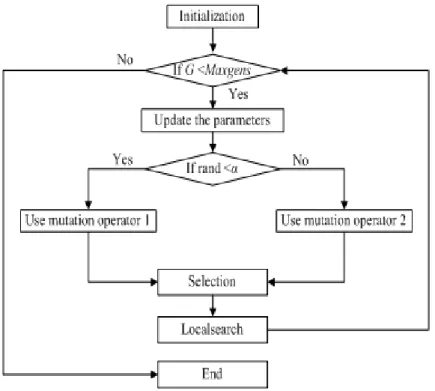
At present, most DE algorithms apply a single mutation strategy and combine the adjusting of parameters to mutate the population. Since DE uses a single mutation strategy, it leads to the shortage of the overall searching ability of the DE and does not sufficiently search for the large searching scope. DE uses only a part of features of population to evolve the population, which results in the too narrow solution space; especially the DE is easily trapped in local optimal, the diversity of the population loss, and the weak convergence during the evolutionary process. Therefore, an improved DE (IDE) is proposed in this paper. The two distinctive mutation operators are incorporated into DE to enhance the search ability of it. The updating way of parameters in reference [17] is adopted to further enrich the diversity of the population. Meanwhile, to improved the quality of the solution, a chaotic search algorithm [18] is introduced to further exploit the solution obtained by IDE. The procedure of IDE is described as follows, while the flow chart of it is displayed in Fig.1
Step 1: Initialization
Step 1.1: Population initialization. Initialize the population size NP and population based on ELD problems with Eq.(4).
where xij is the jth element of the ith individual, ximax, ximin is the maximum and minimum of, xij, respectively. i = 1,2,...,NP, j =
1,2,...,m, m is the number of generators.
Step 1.2: Parameter initialization. Initialize the scale factor F, the crossover rate CR, the selective factor α, the maximum iteration
Maxgens, the current evolution number G=1.
Step 2: Update the parameters. Update F and CR with Eq.(5) and Eq.(6).
1 2 1
, 1
, 0.1 0.9
i G
i G
rand if rand
F
F or
τ
+
+ × <
⎧ = ⎨
⎩ (5)
3 4 2
, 1 ,
i G
i G
rand if rand
CR CR or τ + < ⎧ = ⎨ ⎩ (6)
where τ1and τ2 are threshold value. rand1- rand4 are the random number between [0, 1].
Step 3: Mutation. Mutating the population based on the following method.
If rand <α, mutate the individual with Eq.(7); otherwise, use Eq.(8) to mutate.
vi = xr1,G + Fi • (xr2,G - xr3,G) (7)
vi = xbest, G+ Fi• (xr1, G - xr2, G + xr3, G - xr4, G) (8)
where xr1, G, xr2, G, xr3, G, xr4, G are the random individuals, xbest, Gis the best individual of the current population.
Step 4: Crossover.
ij i
ij ij
x if rand CR
u v or ⎧ < ⎪ = ⎨ ⎪⎩ (9)
where uij is the crossover individual, rand is a random number between [0, 1].
Step 5: Selection.
, , 1
,
( ) ( )
i i i G
i G
i G
u if f u f x
x x or + < ⎧ = ⎨ ⎩ (10)
where f(•) is the fitness function.
Step 6: Local search to the best solution by the chaotic search algorithm.
Step 7:G=G+1. If G>Maxgens, or find the optimization, then the search is over; otherwise, go back to step 2.
In above procedure, two mutation operators are employed, where Eq.(7) is DE/rand/bin [10] which has strong ergodicity, could sufficiently search the solution space and maintains the diversity of the population. So the proportion of it is large. Eq.(8) is DE/ best/2/bin [10] , which combines the four random individuals and the best individual in current population, could exploit the neighborhood of the best individual and speed up the convergence rate. The selective factor α decided the proportion of the two mutation operators, whose setting is important for the performance of the proposed algorithm. The updating method of parameter efficiently maintains the diversity of the population and gets rid of the dependency of the parameter setting. It improves the robustness of the proposed algorithm.
5. Experimental results and analysis
To evaluate the efficiency of the proposed IDE algorithm, several typical ELD problems are employed to as benchmark instances. These instances include two parts: basic ELD problem, the ELD with valve point effect. To fairly compare with other algorithms, we implement three classical algorithms; those are particle PSO [19], DE [20], jDE [17]. And other compared algorithms come from relevant literatures. The proposed algorithm was coded in Matlab2010a and run on a PC with an Intel Core i5-2450 CPU and 2G RAM under Windows 7.
The parameter is important for the performance of IDE, which includes the initial scale factor F and crossover rate CR and the selective factor α. F and CR are all set 0.5. α is set differently for different ELD problems, so it has displayed in each ELD problem.
Other parameters included the maximum iteration Maxgens, the population size NP are set according to different ELD problem.
In order to study the statistical properties of the proposed algorithm, every problem is executed by the proposed algorithm for 20 times. The parameters of above three compared algorithms come from relevant literatures.
5.2 Experimental results 5.2.1 The basic ELD problem
The dimension of the basic ELD problem is set 38. Other parameters can be seen from Table 1. The load demand is set 6000MW. In this problem, we will ignore the valve point effect and others constraints. Moreover, the consumption in during transmission is free. The population size NP is set 40, Maxgens=3000. The selective factor is set 0.6. Table 2 lists the results which include the
mean (Mean), the best value (Best), the worst value (Worst), the variance (Std). In this, the convergence rate of the proposed algorithm is compared with PSO, DE, jDE in Fig.1 Table 3 lists the best solution of the IDE, PSO, DE, jDE. In Table 4, we compare the best value of IDE with other reported algorithms for this ELD problem. These algorithms include LL [21], HHS [22], IPSO [23].
It is can be observed from Table 2 that the obtained results by IDE are better than other three algorithms. Meanwhile, regarding the mean cost and maximum cost, the performance of the proposed algorithm indicates that it is steady and robust, which demonstrated that the strong capability of handling the basic ELD problem. It also observed that the worst solution of IDE outperforms than the best solutions found by the other approaches. It can be seen from Table 4 that the best solution obtained by IDE is better than other reported algorithms found. In Fig.2, we can seen that the convergence rate of the proposed algorithm is superior to others. It illustrates that the mutation operator DE/best/2/bin have important effect on accelerating the convergence speed.
i Pimin P i
min a
i bi ci
1 220 550 0.3133 796.9 64782
2 220 550 0.3133 796.9 64782
3 200 500 0.3127 795.5 64670
4 200 500 0.3127 795.5 64670
5 200 500 0.3127 795.5 64670
6 200 500 0.3127 795.5 64670
7 200 500 0.3127 795.5 64670
8 200 500 0.3127 795.5 64670
9 114 500 0.7075 915.7 172832
10 114 500 0.7075 915.7 172832
11 114 500 0.7515 884.2 176003
12 114 500 0.7083 884.2 173028
13 114 500 0.4211 1250.1 91340
14 90 365 0.5145 1298.6 63440
15 82 365 0.5691 1298.6 65468
16 120 325 0.5691 1290.8 77282
17 65 315 2.5881 238.1 190928
18 65 315 3.8734 1149.5 285372 19 65 315 3.6842 1269.1 271676
20 120 272 0.4921 696.1 39197 21 120 272 0.5728 660.2 45576 22 110 260 0.3572 803.2 28770 23 80 190 0.9415 818.2 36902 24 10 150 52.123 33.5 105510 25 60 125 1.1421 805.4 22233
26 55 110 2.0275 77.1 30953
27 35 75 3.0744 833.6 17044 28 20 70 16.765 2188.7 81079 29 20 70 26.35 124.24 124757 30 20 70 30.575 8376.1 121915 31 20 70 25.098 1305.2 120780 32 20 60 33.722 710.6 104441 33 25 60 23.915 1633.9 8324
34 18 60 32.562 969.6 111281 35 8 60 18.362 2625.8 64142
36 25 60 23.915 1633.9 103519
37 20 38 8.482 694.7 13547
38 20 38 9.693 655.9 13518
Algorithm Best Mean Worst Std PSO[19] 9523431.38 9537029.10 9549653.64 1.31e+04 DE [20] 9407838.53 9408187.93 9408490.84 3.28e+02 jDE [17] 9406681.70 9406684.13 9.40668754 3.04e+00 IDE 9406671.36 9406671.36 9406671.36 6.65e-06
Table 2. Statistical results for PSO, DE, jDE, IDE
i PSO[19] DE[20] jDE[17] IDE
31 20.00 20.00 20.00 20.00 32 21.00 20.11 20.00 20.00 33 25.77 25.09 25.00 25.00 34 21.04 18.03 18.00 18.00 35 10.09 8.03 8.00 8.00 36 25.17 25.00 25.00 25.00 37 29.93 22.14 21.68 21.70 38 25.21 22.78 20.91 20.99
Table 3. The best solution with PSO, DE, jDE, IDE
Table 4. Comparison with other reported algorithms for the best value Algorithm Best
PSO [19] 9523431.38 DE [20] 9407838.53 jDE [17] 9406681.70 IDE 9406671.36 LL [21] 9447354 IPSO[23] 9500448 HHS[22] 9417325
5.2.2 The ELD problem with valve point effect
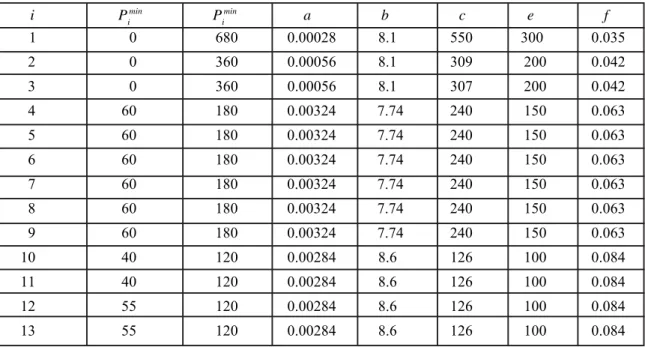
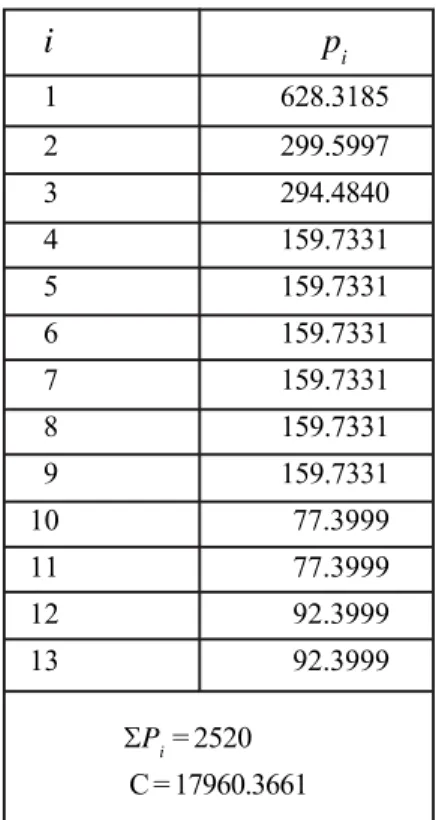
In this problem, 13 generators will be considered. This ELD problem takes into account the influence of the valve point effect. The load demand is set 1800MW and 2520MW. The relevant parameters can be seen from Table 5. The best known solution is lists in Table 6 and 7. Furthermore, the consumption in during transmission is also free. The population size NP is set 40,
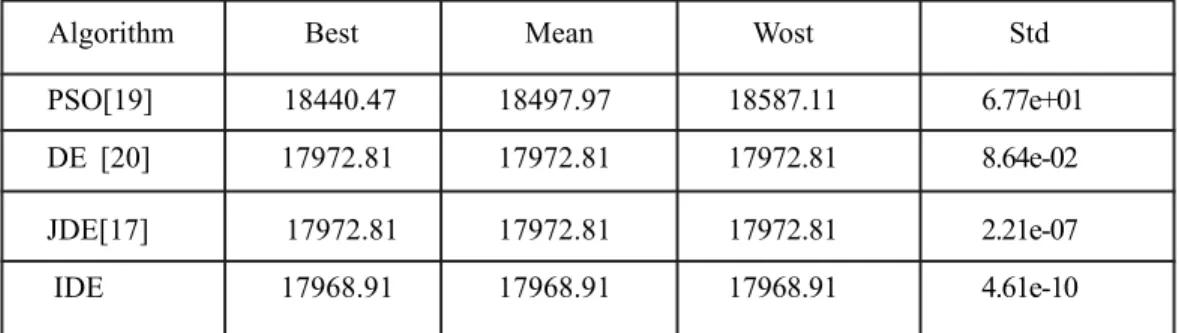
Maxgens=3000. The selective factor is set 0.7. Table 8 and Table 9 list the statistical results which include the mean (Mean), the
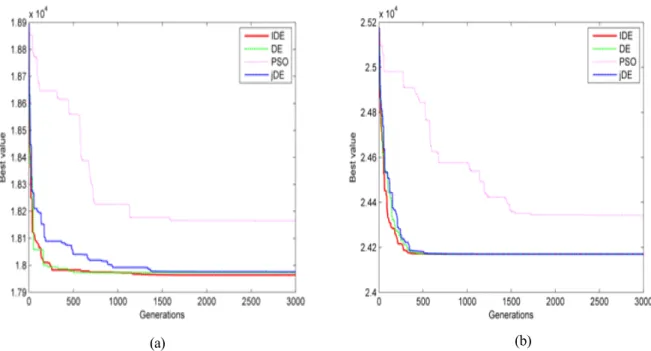
best value (Best), the worst value (Worst), the variance (Std). Table 10 lists the best value for PSO, DE, jDE, IDE and other reported algorithms, which include IFEP [24], CDE [25], DSPSO [26], HHS [22]. Meanwhile, the convergence rate of the proposed algorithm is compared with PSO, DE, jDE in Fig.3
1 0 680 0.00028 8.1 550 300 0.035 2 0 360 0.00056 8.1 309 200 0.042 3 0 360 0.00056 8.1 307 200 0.042 4 60 180 0.00324 7.74 240 150 0.063 5 60 180 0.00324 7.74 240 150 0.063 6 60 180 0.00324 7.74 240 150 0.063 7 60 180 0.00324 7.74 240 150 0.063 8 60 180 0.00324 7.74 240 150 0.063 9 60 180 0.00324 7.74 240 150 0.063 10 40 120 0.00284 8.6 126 100 0.084 11 40 120 0.00284 8.6 126 100 0.084 12 55 120 0.00284 8.6 126 100 0.084 13 55 120 0.00284 8.6 126 100 0.084
Table 5. The parameters of the ELD problem with valve point effect
i Pi
1 628.3185 2 149.5997 3 222.7419 4 109.8666 5 109.8666 6 109.8666 7 109.8666 8 60.0000 9 109.8666 10 40.000 11 40.000 12 55.000 13 55.000
ΣPi = 1800
C = 17960.3661
i
Table 6. The best known solution of the ELD problem with valve point effect (1800MW)
i
p
i1 628.3185
2 299.5997
3 294.4840
4 159.7331
5 159.7331
6 159.7331
7 159.7331
8 159.7331
9 159.7331
10 77.3999 11 77.3999 12 92.3999 13 92.3999
i pi
1 628.3185
2 299.5997
3 294.4840
4 159.7331
5 159.7331
6 159.7331
7 159.7331
8 159.7331
9 159.7331
10 77.3999 11 77.3999 12 92.3999 13 92.3999
ΣPi = 2520
C = 24164.0508
Table 8. The best known solution of the ELD problem with valve point effect (2520MW)
ΣPi = 2520
C = 17960.3661
PSO[19] 18440.47 18497.97 18587.11 6.77e+01
DE [20] 17972.81 17972.81 17972.81 8.64e-02
JDE[17] 17972.81 17972.81 17972.81 2.21e-07
IDE 17968.91 17968.91 17968.91 4.61e-10
Table 9. Statistical results with PSO, DE, jDE, IDE for the ELD problem with valve point effect (1800MW)
PSO[19] 24297.07 24394.08 24575.61 1.12e+02
DE [20] 24169.92 24169.92 24169.92 9.43e-03
JDE[17] 24169.91 24169.91 24169.91 2.51e-07
IDE 24167.92 24167.92 24167.92 4.81E-12
Table 10. Statistical results with PSO, DE, jDE, IDE for the ELD problem with valve point effect (2520MW)
ΣPi = 1800 ΣPi = 2520
Algorithm Best Algorithm Best
PSO [19] 18440.47 PSO[19] 24297.07
DE [20] 17972.81 DE[20] 24169.92
JDE [17] 17972.81 JDE[17] 24169.91
IFEP[24] 17994.07 IFEP[24] 24169.9
CDE[25] 17963.94 CDE[25] 24169.9
IDE 17968.91 IDE 24167.92 Algorithm Best Mean Wost Std
Table 11. Comparison with other reported algorithms for the best value Algorithm Best Mean Wost Std
Figure 3. The convergence curve of the ELD problem with valve point effect. (a) 1800MW (b) 2529MW
with the implementation of Classical DE and jDE, it is apparent that the double mutation is able to further improve the search of DE. Moreover, from Fig.2, we know that IDE again outperforms all other compared algorithms in terms of the convergence rate. It can be seen from Table 10 that the best solution obtained by IDE is better than other reported algorithms found. Therefore, it can be concluded that the proposed algorithm is suitable approach for such kinds of complex problems.
6. Conclusions
Economic load dispatch (ELD) is an important and difficult optimization problem in power system planning. So an improved differential evolution algorithm was proposed to solve it in this paper. The classical double mutation was introduced to maintain the diversity and speed up the convergence rate. To improve the quality of the solution, an adaptive updating method of parameter and a chaotic local search was employed. So the IDE can further stress the balance the global exploration and local exploitation. We use two types of ELD problems to test the efficiency of the proposed algorithm. The computational results were shown that IDE provides robust and good performance for ELD problems. In the further, the proposed IDE algorithms can be extended to solve other ELD problems, such as ELD with forbidden zone restrain, ELD with load variation and so on.
References
[1] Niu, Q., Wang, X., Zhoua, Z. (2011). An Efficient Cultural Particle Swarm Optimization for Economic Load Dispatch with Valve-point Effect. Procedia Engineering 23 (0) 828-34.
[2] Dejean, CB., Crespo, CM., Carnese, FR., Lanata, JL. (2014). An-cient DNA research, scope and limitations. First gene-tic analysis in museum samples from San Julian, Santa Cruz, Argentina. En: Kligmann D, Morales M, editores. Physical, chemical and biological markers in Argentine archaeology: theory, methods and applications. Oxford: British Archaeological Reports. Archaeopress. p. 53-62.
[3] Postillone, MB., Dejean, CB., Serna, A., Prates, L. (2015). Ances-tría genética de dos individuos inhumados en tiempos de la Campaña del Desierto (Sitio Chimpay, Río Negro). Actas XII Jornadas Nacionales de Antropología Biológica, Corrientes, Argentina.
[4] Hosseinnezhad, V., Rafiee, M., Ahmadian, M., Ameli, MT. (2014). Species-based Quantum Particle Swarm Optimization for economic load dispatch. International Journal of Electrical Power & Energy Systems 63 (0) 311-22.
[5] Lu, P., Zhou, J., Zhang, H., Zhang, R., Wang, C.(2014). Chaotic differential bee colony optimization algorithm for dynamic
economic dispatch problem with valve-point effects. International Journal of Electrical Power & Energy Systems. 62 (0)
130-43.
[6] Russo, M., Gheggi, M., Avena, S., Dejean, C., Cremonte, M. (2016). Linajes mitocondriales en muestras de esquina de Huajra (Jujuy, Argentina). Aportes al estudio de la ocupación incaica en la región y la procedencia de sus habitantes. Revista Argentina de Antropología Biológica, en este volumen.
[7] Coelho, LdS., Bora, TC., Mariani, VC. (2014). Differential evolution based on truncated Lévy-type flights and population diversity measure to solve economic load dispatch problems. International Journal of Electrical Power & Energy Systems. 57
(0) 178-88.
[8] Hota, PK., Barisal, AK., Chakrabarti, R. (2010). Economic emission load dispatch through fuzzy based bacterial foraging algorithm. International Journal of Electrical Power & Energy Systems. 32 (7) 794-803.
[9] Jeddi, B., Vahidinasab, V. (2014). A modified harmony search method for environmental/economic load dispatch of real-world power systems. Energy Conversion and Management. 78 (0) 661-75.
[10] Das, S., Suganthan, PN. (2011). Differential evolution: A survey of the state-of-the-art. IEEE Transactions on Evolutionary
Computation. 15 (1) 4-31.
[11] He, R., Yang, Z. (2012). Differential Evolution with Adaptive Mutation and Parameter Control Using Levy Probability Distribution. Journal of Computer Science and Technology. 27 (5) 1035-55.
[12] He, Y., Xu, Q., Yang, S., Han, A., Yang, L. (2014). A novel chaotic differential evolution algorithm for short-term cascaded hydroelectric system scheduling. International Journal of Electrical Power & Energy Systems. 61 (0) 455-62.
[13] Prado, R.S., Pedrosa Silva, RC., Neto, OM., Guimarães, FG., Sanches, DS., London, Jr, JBA, (2014). Differential evolution using ancestor tree for service restoration in power distribution systems. Applied Soft Computing. (0).
[14] Ali, M., Ahn, C.W., Siarry, P. (2014). Differential evolution algorithm for the selection of optimal scaling factors in image watermarking. Engineering Applications of Artificial Intelligence. 31 (0) 15-26.
[15] Roy, P., Roy, P., Chakrabarti, A. (2013). Modified shuffled frog leaping algorithm with genetic algorithm crossover for solving economic load dispatch problem with valve-point effect. Applied Soft Computing. 13 (11) 4244-52.
[16] El-Gallad A, El-Hawary M, Sallam A, Kalas A. Particle swarm optimizer for constrained economic dispatch with prohibited operating zones, In: Electrical and Computer Engineering, 2002 IEEE CCECE 2002 Canadian Conference on 2002. p. 78-81.
[17] Brest, J., Greiner, S., Boskovic, B., Mernik, M., Zumer, V (2006). Self-adapting control parameters in differential evolution: A comparative study on numerical benchmark problems. Evolutionary Computation, IEEE Transactions on. 10 (6) 646-57.
[18] Hui-juan, L., Huo-ming, Z., Long-hua, M. (2006). A new optimization algorithm based on chaos. Joural of Zhejiang University
Science A. 7 (4) 539-42.
[19] Lin, T-L., Horng, S-J., Kao, T-W., Chen, Y-H., Run, R-S, Chen, R-J, (2010). An efficient job-shop scheduling algorithm based on particle swarm optimization. Expert Systems with Applications. 37 (3) 2629-36.
[20] Postillone, MB., Flensborg, G., Dejean, CB., Martinez, G. (2016). Linajes maternos de los individuos del sitio arqueológico Paso Alsina I (Patagones, Buenos Aires).XIX Congreso Nacional de Arqueología Argentina, Tucumán, Argentina.
[21] Barberena, R., Prates, L., De Porras, M. (2015). The human occupation of North Western Patagonia (Argentina): paleoecological and chronological trends. Quatern Int 356. 111-126.
[22] Crespo, CM., Favier Dubois, C., Russo, MG., Lanata, JL., Dejean, CB. (2016). First analysis of ancient mtDNA and genetic diversity in northern Patagonia, Río Negro province, Argentina. Manuscrito presentado en la revista Journal of Archaeological Science.
[23] Chaturvedi, KT., Pandit, M., Srivastava, L. (2009). Particle swarm optimization with time varying acceleration coefficients for non-convex economic power dispatch. International Journal of Electrical Power & Energy Systems. 31 (6) 249-57.
[24] Sinha, N., Chakrabarti, R., Chattopadhyay, PK. (2003). Evolutionary programming techniques for economic load dispatch.
Evolutionary Computation, IEEE Transactions on. 7 (1) 83-94.
![Table 4. Comparison with other reported algorithms for the best value Algorithm Best PSO [19] 9523431.38 DE [20] 9407838.53 jDE [1](https://thumb-us.123doks.com/thumbv2/123dok_us/524180.2052209/8.918.208.696.109.312/table-comparison-reported-algorithms-best-value-algorithm-best.webp)