Energy Efficient Trust Node Based Routing Protocol
(EETRP) to Maximize the Lifetime of Wireless Sensor
Networks in Plateaus
https://doi.org/10.3991/ijoe.v15i06.10340Nandoori Srikanth(*), Muktyala Sivaganga Prasad
Koneru Lakshmiah Educational Foundation, Green fields, Vaddeswaram, India
Abstract—Wireless sensor networks (WSNs) can extant the individual prof-its and suppleness with regard to low-power and economical quick deployment for numerous applications. WSNs are widely utilized in medical health care, environmental monitoring, emergencies and remote control areas. Introducing of mobile nodes in clusters is a traditional approach, to assemble the data from sensor nodes and forward to the base station. Energy efficiency and lifetime improvements are key research areas from past few decades. In this research, to solve the energy limitation to upsurge the network lifetime, energy efficient trust node based routing protocol is proposed. An experimental validation of framework is focused on packet delivery ratio, network lifetime, throughput, energy consumption and network loss among all other challenges. This protocol assigns some high energy nodes as trusted nodes, and it decides the mobility of data collector. The energy of mobile nodes, and sensor nodes can save up to a great extent by collecting data from trusted nodes based on their trustworthiness and energy efficiency. The simulation outcome of our evaluation shows an im-provement in all these parameters than existing clustering and routing algo-rithms.
Keywords—WSN, EETRP, Mobile Node, Trust Node, Sub-Cluster (SC)
1
Introduction
competent routing protocol with well-planned data aggregation methods as well as very low energy consumption. These networks are drastically resource limited by their bound power supply. To figure out this issue hierarchical routing protocol based on clustering is taken into consideration [4].
Mahajan et al., (2014) [5] reported a rank based metric approach which is recom-mended to choose clusters from the set of sensors in view of network performance parameters that allocates load consistently in the cluster and consume least energy. Heterogeneous mobile sensor network environment wireless sensor network is a dis-persed network, which includes a set of independent and self-organized sensor nodes and one or more base station (BS). This sort of network can be designed and arranged to observe and track applications for instance smart environments like smart cities, smart grid, smart home; habitat monitoring and surveillance etc. [6]. In wireless sen-sor networks, trust model stipulates a significant role in recognizing misbehavior nodes and provided that co-operation amid trustworthy nodes. Trust node plays a most important role to sense a node which is not performing as expected (whichever defective or maliciously). Trust judges the quality of node and their services. It im-proves the lifetime of networks that motivate anticipations amid future interactions in WSNs [7].
1.1 Motivation of the paper
Clustering is a technique which is utilized to progress the lifetime of nodes and several clustering algorithms have been established to enhance the energy balance of the WSN's due to energy is the principal feature of WSN's during data transmission. These algorithms are mainly used for increasing the lifetime of sensor networks. The whole sensing field is distributed into sub clusters. In every sub cluster, few mobile nodes are introduced for various parameters, which include energy or distance from the base station. Introduced a mobile node (MN) in a sub cluster is the initial motiva-tion of this paper, because deployment of SN and collecmotiva-tion of data in plateaus and military areas is a major challenging issue, thus mobile node has to ingest more ener-gy to collect the data from those nodes. Enerener-gy efficient trust node based routing protocol was proposed to upsurge the lifetime of the network.
1.2 Contributions of the paper
In this research, an Energy efficient trust node based routing protocol (EETRP) was proposed in WSN. Nodes are structured into clusters, cluster is divided into the sub clusters, and we assign some sub-cluster nodes as trust nodes. However, EETRP algorithm is initially performed on all sub cluster nodes to form balanced sensor nodes, proper mobile node and trust node are designated. The main contributions of this research are as follows:
• EETRP protocol is utilized to optimize the sub clustering algorithm rules to up-surge the network lifetime, based on the applications like plateaus and military are-as.
• This protocol differs from the traditional clustering approaches due to uneven de-ployment and placement of sensor nodes in plateaus.
• EETRP utility system to concurrently ponder two elements: trustworthiness of nodes and energy efficiency.
2
Related Work
WSNs can extant the individual profits and suppleness as regards low-power and economical fast deployment for a number of applications. Sensor arrangement is an acute problem for some important objectives in WSNs like coverage, lifetime and connectivity. Deployment of tactic was depends on potential field theory to deploy the mobile sensor nodes in an unfamiliar environment to enhance the network coverage [8]. Numerous energy efficient schemes are well-defined as a cluster based routing is found to be a more energy efficient and ascendable way to form sensor nodes [9]. As shortest path spanning trees instinctively have short delay, it is extremely significant to find an energy-efficient shortest path tree for time-critical applications [10]. Hybrid energy efficient distributed clustering (HEED) was reported which is a multi-hop clustering algorithm for WSN. HEED contain distributing energy consumption to prolong network lifetime, reducing energy consumption during CH selection phase and reduce the control overhead of network [11].
Efficient sleep awake aware (EESAA) is an intelligent routing protocol for WSNs which presented a method of pairing amid nodes. Amid these pairs just a single mem-ber node awakes in a every single round to forward sensed data even though the other member node stays in sleep mode to save the energy resources [12]. Deployment of relay nodes results fault-tolerance in heterogeneous WSN with higher network con-nectivity. Heterogeneous WSN contain sensor nodes with unlike transmission radius. Further relay node proved more advantages when deployed in clustered sensor net-works [13]. Chuanhe et al., (2007) [14] was introduced a reputation-based trust man-agement scheme using a stimulus mechanism. Trust manman-agement scheme encourages packet forwarding and discourages selfish behaviors based on quantified objective measures and reputation propagation by a one-way hash chain based authentication. The performance of this scheme in the malicious nodes, as may be expected in a hos-tile environment has not been investigated. Trust and energy aware routing protocol was proposed for WSNs and it aims to report the energy limitations. By keeping re-source constrained distinctive of WSNs in mind, the design of Trust and energy aware routing protocol is centered on trustworthiness and energy efficiency. Routing Proto-col is proficient of energetically sensing and segregate misbehave nodes during trust assessment phase whereas energy awareness feature was amalgamated in route setup phase which aids in improved load balancing among trust nodes [15].
trust (performance at running time) and objective trust (node status) [16]. Higher energy consumption for the duration of data gathering and delivery process is de-creased utilizing a clustering method; hierarchical routing exploits upon these ad-vantages by the division of nodes into clusters. Clustering method generally selects the node with more energy as Cluster Head (CH), which collects the information and transmitted through lower-energy nodes by clustering method [17]. The Cluster based routing protocols (CBR-MOBILE) is proposed to face the challenges of packet loss and energy consumption in Hybrid networks like some sensor nodes are fixed, and other are mobile. It is traffic adaptive protocol that assigns timeslots of mobile nodes which are moves out of cluster can be reassign to the incoming mobile nodes into that cluster. Based on receiving signal strength, data is transmitted to the cluster head [26]. A secure mobile data collector is introduced in clusters to collect the data from cluster head, and forward to the base station. Authors proposed and analyzed three protocols for secure data collection, and it follows tree based connection management among sensor nodes [27]. Optimization of mobile data collector speed, and it’s mobil-ity is changed adaptively based on the requirements of network, are the objectives of paper, and this can be achieved by providing cooperation between sensing nodes, and mobile data collector nodes [28].
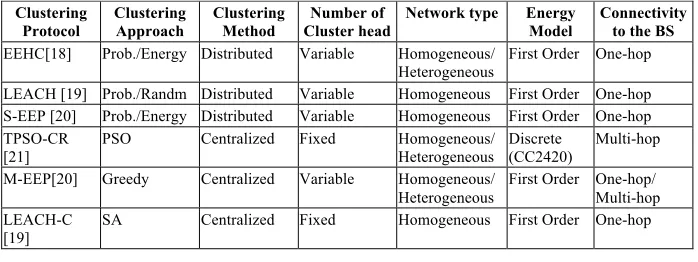
The comparison of clustering protocols regarding different attributes was repre-sented in Table 1. In this paper, trust based routing protocol, sub-clustering algorithm was proposed to decrease energy consumption, and leads to a rise in network lifetime, network throughput were assessed. In WSNs, trust stipulates the dependability or trustworthiness of sensor node. The trust value was calculated based on the actual sensed data of the sensors in WSNs is termed as data trust.
Table 1. Comparison of clustering protocols with clustering attributes
3
Methodology
In wireless sensor networks, there are a number of trust based routing protocols was proposed. To enhance the network lifetime, efficiency, throughput, various tech-niques are implemented based on trust values of nodes. In existing works, mobile nodes (MN) are introduced in fixed wireless sensor networks to gather the
infor-Clustering
Protocol Clustering Approach Clustering Method Cluster head Number of Network type Energy Model Connectivity to the BS EEHC[18] Prob./Energy Distributed Variable Homogeneous/
Heterogeneous First Order One-hop LEACH [19] Prob./Randm Distributed Variable Homogeneous First Order One-hop S-EEP [20] Prob./Energy Distributed Variable Homogeneous First Order One-hop TPSO-CR
[21] PSO Centralized Fixed Homogeneous/ Heterogeneous Discrete (CC2420) Multi-hop M-EEP[20] Greedy Centralized Variable Homogeneous/
Heterogeneous First Order One-hop/ Multi-hop LEACH-C
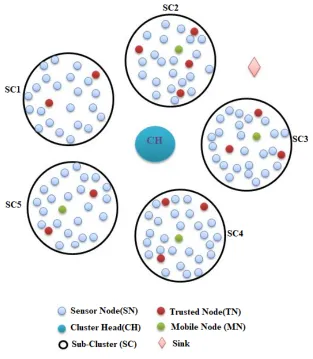
mation from sensor nodes and send it to CH. This type of implementations gives great results in military applications, plateaus, hill and valley places, etc. In this research, trust based routing protocol and sub-clustering algorithm was proposed in WSN. Fig. 1 displays the scenario of trust node in WSN. Cluster node is divided into the sub clusters and we assign some sub-cluster nodes as trust nodes. In sub cluster the mobile nodes are moving around the sensor node and MN comes near to the SN then node awake and sends data to MN. If the mobile node is stationary, the trust node will send the data to MN.
Fig. 1.Scenario of trusted node in WSN
3.1 Proposed energy efficient trust node based routing protocol
for-mation of the sub cluster region and energy harvesting was described by the below important steps.
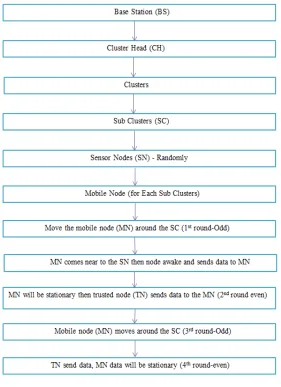
Step1: The BS monitors WSNs sensor nodes with cluster head and it forms cluster into sub cluster region separately.
Step2: Deployment of sensor nodes (SN) selected randomly. In the sensor net-work, all sensor nodes are arbitrarily deployed in a circular area with a radius of R. The network model can be clarified as an undirected connectivity graph G(S, E), where S is the set of all SN and E (i, j) is the set of wireless link amongst node i and node j .All the SN are homogeneous and stationary [22]. We divide the entire sub cluster region into several sectors named as fixed sensor nodes, one mobile node and two or three trust nodes.
Step3: Deployment of one mobile node (MN) for each sun-cluster.
Step4: Move the mobile node (MN) for first round (odd number of round) around the Sub-cluster (SC).
Step5: When the mobile node (MN) comes near to the sensor node then sensor node (SN) awake from sleep mode and sends the data to the mobile node (MN) (same procedure for every node).
In WSNs, the life cycle can be influenced by the residual energy of each node. Thus, energy plays an important role in the construction and operation of the network. All the sub cluster nodes have restricted energy, which will be consumed when the nodes send or receive data [15]. The first-order radio model is used as the energy consumption model. The quantity of energy consumption in transmitting 𝑙𝑙-bit packet from node 𝑖𝑖 to node 𝑗𝑗 can be represented by:
(1) Here
𝐸𝐸
%&%' is the energy necessary for driving and controlling electronic compo-nents.𝐸𝐸
()*Depends on the Radio Frequency (RF) amplifier’s consumed energy for free space 𝜀𝜀-. and multipath fading channel models 𝜀𝜀)* and𝑑𝑑01
represents theEu-clidean distance between node 𝑖𝑖 and node 𝑗𝑗. The threshold, 𝑑𝑑2 is calculated as follows
(2) The node consumes the following amount of energy in receiving 𝐸𝐸34𝑙𝑙-bit packet
(3)
A trust node of route will be calculated so as to ignore the encountering malicious nodes through the data-forwarding phase [23]. Trust nodes are initialized to 0 by de-fault but since the model is totally local, nodes are free to initiate some trust node. The evolution of the trust node on the node is given by the following formula
Fig. 2. Design flow of EETRP in WSN
(4)
iHere ∝ ∈ (0,1), (higher is∝, slower a direct trust goes from 0 to 1 with time, vice versa) and 𝑃𝑃=0,=1(𝑡𝑡)depends on the number of positive experiences 𝑃𝑃=0,=1? (𝑡𝑡) (the
number of good behaviors) and the number of negative experiences 𝑃𝑃=0,=1@ (𝑡𝑡) (the
number of bad behaviors) of 𝑛𝑛1observed by 𝑛𝑛0 until time t. The value of 𝑃𝑃=0,=1(𝑡𝑡)is
defined as
(5) Where 𝛽𝛽 (𝛽𝛽 > 1) is a parameter which allows the modulation of the importance of negative experiences (greater is 𝛽𝛽, larger is the influence of negative experiments),
𝛽𝛽 is introduced so that a definite number of faults may be tolerated. Both ∝and 𝛽𝛽
should be relatively high to keep the efficacy of the model. According to the above formula,
• If a node always behaves well, its trust value will rapidly increase to 1 • If a node is moderately malicious or failing, its trust node will be stable
• If the node is malicious or quite failing, then it will immediately become untrust.
Step7: For third round (odd number of round) again mobile node (MN) moves around the sub cluster (SC)
Step8: In fourth round (even number of round) again trust node (TN) send data and the MN will be stationary.
Pseudo code for EETRP with sub-clustering algorithm: Event detection can be possible by checking the sensed data of trusted node with neighbor nodes data, to decide the event occurrence. Trusted nodes will send data to mobile node to avoid malfunctions or malicious attacks.
Sub clustering algorithm
No. of nodes (n) =51
Divide the clusters (C) = node position Calculate residual energy for each node. For (i= 1 to n)
Dn ß calculate degree difference (n) N(n)ßidentify neighbors (n) Tcß calculate cumulative time (n) Cnßcalculate the character (n) Wnßcalculate the weight (n) Enßcalculate the energy (n)
Call the combined weight based energy calculation For (every n€N)
CMßcluster member (N)
End if End for
Clusterà division to SCH
SCH ßNode position
Each SCH ß1MN
No of MN = validate the no. of clusters
Energy Efficient Trust node based Routing Protocol
No of rounds=N N=[n+1/2],[2n+1/2]
N=DJ=K2[n + 1/2] for all odd rounds N=DJ=K2[2n + 1/2] for all even rounds When
N= odd round
MNßdata broadcast from SCH N= even round
MNßdata broadcast from trust nodes
4
Simulation Parameters
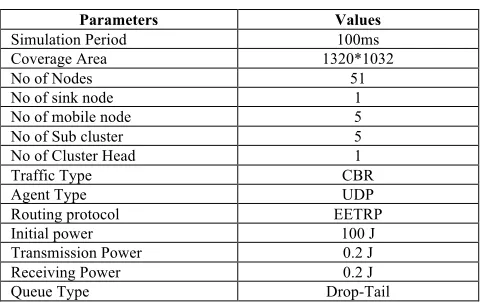
This paper assumes 51 (i.e. n = 51) mobile sensor nodes that are arbitrarily de-ployed inside the area of 1320*1032. The 3 kinds of nodes which include sink node, cluster node and trust nodes with the initial energy of 500 J respectively. The BS was located at any random place outdoor the sensing field. All the residual parameters are presented in Table 2. The SNs sense the data at a fixed rate and these SNs have al-ways some data to send.
Table 2. Simulation Parameters
Parameters Values
Simulation Period 100ms Coverage Area 1320*1032 No of Nodes 51 No of sink node 1 No of mobile node 5 No of Sub cluster 5 No of Cluster Head 1 Traffic Type CBR Agent Type UDP Routing protocol EETRP Initial power 100 J Transmission Power 0.2 J Receiving Power 0.2 J Queue Type Drop-Tail
5
Results and Discussion
Table 3. Comparison of existing algorithm with proposed TBRP Algorithm
Algorithm Aim Technique
used efficient Energy Goals achieved Trust and Energy aware
routing protocol Wireless Sensor Network
Best path to reach
destination Trust, energy Location calculation Yes Avoid suspicious node
Providing trust in wireless sensor network using a bio-inspired Technique.
Trust and reputation,
Reputable path Ant colony Optimization system No Avoid Misbe-having server A Direct Trust Dependent
Link State Routing Proto-col using Route Trust For WSNs(DTLSRP)
Trustworthy route Direct trust calculation No Routing attacks
Neighbor based malicious node discovery in wireless sensor networks
Precise malicious
node detection Data smoothing variation test and confidence level evaluation
No Low false alarm rates.
TARF: A trust aware routing framework for wireless sensor networks
Routing includes Trustworthiness of node
Trust manager, energy
watcher Yes Authentication, replay of routing information
Proposed: EETRP protocol Reducing Energy consumption and Prolong network life time
Trust based routing proto-col with sub clustering algorithm
Yes Avoid malicious node and trust-worthy
5.1 Network throughput
5.2 Network lifetime
From the beginning of the operation of the sensor network to the battery depletion of the last node is the network lifetime. In the simulation, the lifetime is assessed in terms of a cycle in WSN. Fig. 4 shows that EETRP protocol with sub clustering algo-rithm has higher stable lifetime than the other three hierarchical routing techniques. Due to maintaining large number of sensor nodes in sleep state until mobile data col-lector collects data from nodes individually, and by maintaining mobile data colcol-lector in idle condition in trust node based data collected rounds, the energy consumption is reduced greatly, and lifetime of the network also increases potentially than existing algorithms. The network lifetime of EETRP Protocol with sub clustering algorithm was found to be 68% which is greater than GLBD (56%), MLPA (35%) and SPT (20%) algorithm respectively. Fig. 4 clearly represents the EETRP protocol with sub clustering algorithm was far superior and more efficient in expressions of the number of active nodes and the network lifetime.
5.3 Network energy efficiency
Network Energy and Network Lifetime are Key parameters of WSN. Those two parameters are linear in Relation. The Performance of WSN depends on Network Energy Efficiency. Energy efficiency upsurge the performance of WSNs, and it can be expressed as the ratio of networks lifetime and sensor node’s energy. The Lifetime and Energy Efficiency of Network are enhanced when the sensor node’s Energy is stable. Total energy consumed by all the nodes in the network is expressed by
𝐸𝐸𝑛𝑛𝐸𝐸𝐸𝐸𝐸𝐸𝐸𝐸 𝐸𝐸𝐸𝐸𝐸𝐸𝑖𝑖𝐸𝐸𝑖𝑖𝐸𝐸𝑛𝑛𝐸𝐸𝐸𝐸 = T 𝐸𝐸0 J
0KU
𝐸𝐸0Signifies the energy consumed by the nodes in rounds. It decreases the energy
wastage and performs the number of rounds with limited energy. The network Energy efficiency of EETRP Protocol with sub clustering algorithm is 68% which is greater than GLBD, MLPA and SPT 56%, 35% and 20% [10] algorithm respectively.
5.4 Network packet delivery ratio
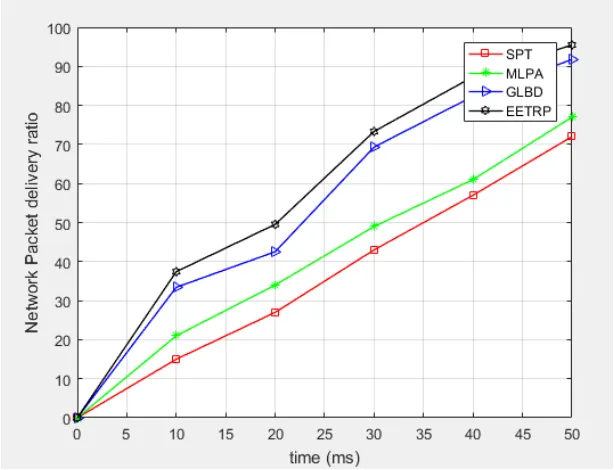
The packet delivery ratio lies in the loss-rate explanation observed by transport protocols and disturbs the entire network throughput. This metric accentuates the correctness and completeness of the routing protocol. Fig. 5 show that the comparison of packet delivery ratio between proposed EETRP Protocol with existing algorithm.
The EETRP protocol with sub clustering algorithm shows a considerable improve-ment in packet delivery ratio over GLBD, MLPA and SPT. As the integer of nodes upsurges the packet delivery ratio will increase in all other data aggregation and EETRP Protocol with sub clustering algorithm data aggregation provides maximum
Total number of packets that have been sent from the source node Packet Delivery Ratio
Total number of packet that had reached the destination
packet delivery ratio for 51 nodes was 97.77%, which is higher than 91.77%, 77% and 72% GLBD, MLPA [25] and SPT respectively.
5.5 Network energy consumption
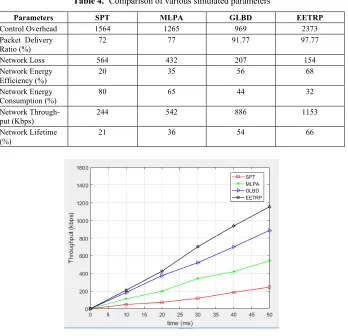
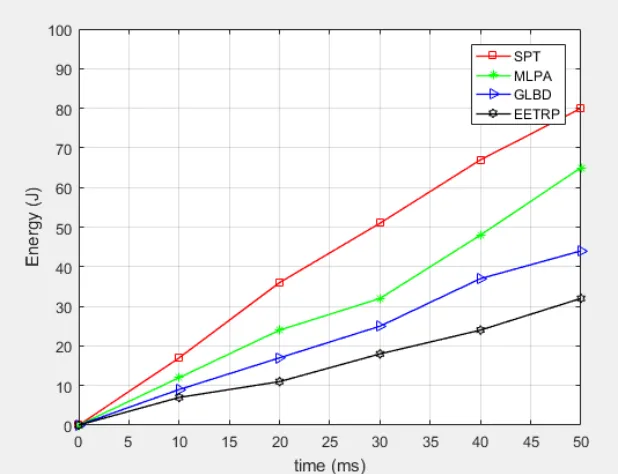
Energy used by the network is proportional to the diameter of the network. Table 4 shows comparison of various simulated parameters. Fig. 6 depicts the energy con-sumption amongst proposed EETRP Protocol with sub clustering algorithm. Due to deployment of trusted nodes per each sub cluster, remaining sensor nodes can spend more time in sleep state, until mobile collector gives wake-up notification. On other hand mobile data collector can be placed idle in even number of rounds, and it can collect data directly from trusted nodes. Due to these reasons, network consumes very less power compared with conventional protocols. Energy consumption of EETRP Protocol with sub clustering algorithm was found to be 32% which is lesser than GLBD (44%), MLPA (65%) [25] and SPT (80%) respectively.
Table 4. Comparison of various simulated parameters
Parameters SPT MLPA GLBD EETRP
Control Overhead 1564 1265 969 2373 Packet Delivery
Ratio (%) 72 77 91.77 97.77 Network Loss 564 432 207 154 Network Energy
Efficiency (%) 20 35 56 68 Network Energy
Consumption (%) 80 65 44 32 Network
Through-put (Kbps) 244 542 886 1153 Network Lifetime
(%) 21 36 54 66
Fig. 4. Comparison of network lifetime
Fig. 6. Comparison of network energy consumption
5.6 Parametric Analysis of Lifetime, Energy Consumption based on No of Trusted Routing iterations per Cycle.
Parametric analysis can be obtained by varying the trusted routing iteration number with respect to mobile routing iteration number. By increasing trusted round Iteration number, the lifetime of the network increases linearly. On the other hand the network energy consumption is keeps on decreasing. The problem arises in this type of analy-sis is TRUST Dependency. When trust iterations are more in a cycle, then QOS may decrease.
Parameter Alternative rounds (one trusted routing iteration per onemo-bile routing iteration)
Two trusted routing iterations
per one mobile routing iteration
Three trusted routing iterations per
one mobile routing iteration
Four trusted routing iterations per
one mobile routing iterations
Network energy
The graph shows variations of energy consumption and lifetime of the network for various trusted iterations.
6
Conclusion
The sensor nodes in WSNs have limited computation, storage and interaction abili-ties. In this paper, EETRP protocol with sub clustering algorithm in WSNs is present-ed to balance energy and prolong network lifetime. This algorithm divides the clusters into several sub clusters and assigned each sub cluster with a mobile node. Sensor nodes perform the data interaction by the sub clustering structure and trust nodes are depends on data collection, thus increasing the energy efficiency of network. There-fore, the proposed approach improves the energy efficiency and network lifetime at the same time. The simulation outcomes indicate that energy consumption of network is greatly reduced by our proposed energy efficient trust based routing algorithm while compared with other clustering algorithm.
7
References
[1] Baroudi, U., Al-Roubaiey, A., Mekid, S., Bouhraoua, A. (2014). Delay characterization and performance evaluation of cluster-based WSN with different deployment distribu-tions. Future Generation Computer Systems, 39, 100-110. https://doi.org/10.1 016/j.future.2014.02.011
[2] Younis, O., Krunz, M., Ramasubramanian, S. (2006). Node clustering in wireless sensor networks: recent developments and deployment challenges. IEEE network, 20, 3, 20-25. https://doi.org/10.1109/MNET.2006.1637928
[3] Amin, R., Islam, S. H., Biswas, G. P., Obaidat, M. S. (2018). A robust mutual authentica-tion protocol for WSN with multiple base-staauthentica-tions. Ad Hoc Networks, 75, 1-18. https://doi.org/10.1016/j.adhoc.2018.03.007
[4] Gambhir, A., Payal, A., Arya, R. (2018). Performance analysis of artificial bee colony op-timization based clustering protocol in various scenarios of WSN. Procedia Computer Sci-ence, 132, 183-188 https://doi.org/10.1016/j.procs.2018.05.184
[5] Mahajan, S., Malhotra, J., & Sharma, S. (2014). An energy balanced QoS based cluster head selection strategy for WSN. Egyptian Informatics Journal, 15, 3, 189-199. https://doi.org/10.1016/j.eij.2014.09.001
0 20 40 60 80 100
1/CYCLE 2/CYCLE 3/CYCLE 4/CYCLE
[6] Adnan, M. A., Razzaque, M. A., Abedin, M. A., Reza, S. S., Hussein, M. R. (2016). A novel cuckoo search based clustering algorithm for wireless sensor networks. In Advanced Computer and Communication Engineering Technology, 621-634. https://doi.org/10.1 007/978-3-319-24584-3_53
[7] Huaizhi Li and Mukesh Singhal, (2007). Trust Management in distributed Systems. IEEE Computer Society, 45-53. https://doi.org/10.1109/MC.2007.76
[8] Howard, A., Mataric, M. J., Sukhatme, G. S. (2002). An incremental self-deployment algo-rithm for mobile sensor networks. Autonomous Robots, 13, 2, 113-126. https://doi.org/10.1023/A:1019625207705
[9] Wei, D., Jin, Y., Vural, S., Moessner, K., Tafazolli, R. (2011). An energy-efficient cluster-ing solution for wireless sensor networks. IEEE transactions on wireless communica-tions, 10, 11, 3973-3983. https://doi.org/10.1109/TWC.2011.092011.110717
[10] Shan, M., Chen, G., Luo, D., Zhu, X., Wu, X. (2014). Building maximum lifetime shortest path data aggregation trees in wireless sensor networks. ACM Transactions on Sensor Networks(TOSN), 11, 1, 11. https://doi.org/10.1145/2629662
[11] Younis, O., Fahmy, S. (2004). HEED: a hybrid, energy-efficient, distributed clustering ap-proach for ad hoc sensor networks. IEEE Transactions on mobile computing, 3, 4, 366-379. https://doi.org/10.1109/TMC.2004.41
[12] Liu, Z., Zheng, Q., Xue, L., Guan, X. (2012). A distributed energy-efficient clustering al-gorithm with improved coverage in wireless sensor networks. Future Generation Comput-er Systems, 28, 5, 780-790. https://doi.org/10.1016/j.future.2011.04.019
[13] Han, X., Cao, X., Lloyd, E. L., Shen, C. C. (2010). Fault-tolerant relay node placement in heterogeneous wireless sensor networks. IEEE Transactions on Mobile Computing, 9,5, 643-656. https://doi.org/10.1109/TMC.2009.161
[14] Chuanhe, H., Yong, C., Wenming, S., Hao, Z. (2007). A trusted routing protocol for wire-less mobile ad hoc networks, IET Conference on Wireless, Mobile and Sen-sor Networks (CCWMSN 2007), 406 – 409.
[15] Ahmed, A., Bakar, K. A., Channa, M. I., Haseeb, K., Khan, A. W. (2016). A trust aware routing protocol for energy constrained wireless sensor network. Telecommunication Sys-tems, 61, 1, 123-140. https://doi.org/10.1007/s11235-015-0068-8
[16] Bao, F., Chen, R., Chang, M., Cho, J. H. (2012). Hierarchical trust management for wire-less sensor networks and its applications to trust-based routing and intrusion detec-tion. IEEE transactions on network and service management, 9, 2, 169-183. https://doi.org/10.1109/TCOMM.2012.031912.110179
[17] Muthukumaran, K., Chitra, K., & Selvakumar, C.(2017). An energy efficient clustering scheme using multilevel routing for wireless sensor network. Computers & Electrical En-gineering, 69, 642-652.
[18] Kumar, D., Aseri, T. C., Patel, R. B. (2009). EEHC: Energy efficient heterogeneous clus-tered scheme for wireless sensor networks. Computer communications, 32, 4, 662-667 https://doi.org/10.1016/j.comcom.2008.11.025
[19] Heinzelman, W. B., Chandrakasan, A. P., Balakrishnan, H. (2002). An application-specific protocol architecture for wireless microsensor networks. IEEE Transactions on wireless communications, 1(4): 660-670. https://doi.org/10.1109/TWC.2002.804190
[20] Kumar, D. (2013). Performance analysis of energy efficient clustering protocols for max-imising lifetime of wireless sensor networks. IET Wireless Sensor Systems, 4, 1, 9-16. https://doi.org/10.1049/iet-wss.2012.0150
[22] Wang, J., Cao, Y., Li, B., Kim, H. J., Lee, S. (2017). Particle swarm optimization based clustering algorithm with mobile sink for WSNs. Future Generation Computer Sys-tems, 76, 452-457. https://doi.org/10.1016/j.future.2016.08.004
[23] Xue, G. R., Lin, C., Yang, Q., Xi, W., Zeng, H. J., Yu, Y., Chen, Z. (2005). Scalable col-laborative filtering using cluster-based smoothing. In Proceedings of the 28th annual inter-national ACM SIGIR conference on Research and development in information retrieval, ACM. 114-121 https://doi.org/10.1145/1076034.1076056
[24] Tzung-Shi Chen, Hua-Wen Tsai and Chih-Ping Chu, "Gathering-Load-Balanced Tree Pro-tocol for Wireless Sensor Networks," IEEE International Conference on Sensor Networks, Ubiquitous, and Trustworthy Computing (SUTC'06), Taichung, 2006, 8-13. https://doi.org/10.1109/SUTC.2006.67
[25] Cheng, S. T., Wu, M. (2009). Optimization of multilevel power adjustment in wireless sensor networks. Telecommunication Systems, 42, 1, 109-121. https://doi.org/10.1 007/s11235-009-9173-x
[26] Awwad, Samer A. B. and Ng, Chee Kyun and Noordin, Nor Kamariah and A. Rasid, Mohd Fadlee (2011) Cluster based routing protocol for mobile nodes in wireless sensor network.Wireless Personal Communications, 61, 2, 251-281. https://doi.org/10.1007/s11277-010-0022-8
[27] Poornima, A.S. & Amberker, B.B. (2011). Secure data collection using mobile data collec-tor in clustered wireless sensor networks. IET Wireless Sensor Systems, 1, 85 – 95 https://doi.org/10.1049/iet-wss.2010.0086
[28] Sayyed, Ali & Buss Becker, Leandro. (2015). Optimizing speed of mobile data collector in Wireless Sensor Network. 1-6. International Conference on Emerging Technologies (ICET) https://doi.org/10.1109/ICET.2015.7389213
8
Authors
Nandoori Srikanth is one of the part time Ph.D. scholars in Koneru Lakshmiah Educational Foundation, from the department of Electronics & Communication Engi-neering. He published many research papers in various reputed journals and he is working as an Assistant professor in NRI Institute of Technology. His Research area is Wireless Sensor Networks. His research interests are wireless communications, signal processing.
Muktyala Sivaganga Prasad is one of the Professors in Koneru Lakshmiah Edu-cational Foundation, from the department of Electronics & Communication Engineer-ing. He published many research papers in various reputed International journals and he guided many more researchers in the fields of wireless communication, Antennas and wireless sensor networks. His research interests are wireless communications, Antennas and signal processing.