Multi-view Response Selection for Human-Computer Conversation
Xiangyang Zhou1∗, Daxiang Dong1∗, Hua Wu1, Shiqi Zhao1,
Dianhai Yu1,2, Hao Tian1,2, Xuan Liu1 and Rui Yan1
1Baidu Inc., Beijing, China
2School of Information Science and Technology,
University of Science and Technology of China
nzhouxiangyang, dongdaxiang, wu hua, zhaoshiqi,
yudianhai, tianhao, liuxuan, yanrui
o
@baidu.com
Abstract
In this paper, we study the task of response selection for multi-turn human-computer con-versation. Previous approaches take word as a unit and view context and response as se-quences of words. This kind of approaches do not explicitly take each utterance as a unit, therefore it is difficult to catch utterance-level discourse information and dependencies. In this paper, we propose a multi-view re-sponse selection model that integrates infor-mation from two different views, i.e., word sequence view and utterance sequence view. We jointly model the two views via deep neu-ral networks. Experimental results on a public corpus for context-sensitive response selection demonstrate the effectiveness of the proposed multi-view model, which significantly outper-forms other single-view baselines.
1 Introduction
Selecting a potential response from a set of can-didates is an important and challenging task for open-domain human-computer conversation, espe-cially for the retrieval-based human-computer con-versation. In general, a set of candidate responses from the indexed conversation corpus are retrieved, and then the best one is selected from the candidates as the system’s response (Ji et al., 2014).
Previous Deep Neural Network (DNN) based ap-proaches to response selection represent context and response as two embeddings. The response is se-lected based on the similarity of these two embed-dings (Lowe et al., 2015; Kadlec et al., 2015). In
∗These two authors contributed equally
these work, context and response are taken as two separate word sequences without considering the lationship among utterances in the context and re-sponse. The response selection in these models is largely influenced by word-level information. We called this kind of models asword sequence model in this paper. Besides word-level dependencies, utterance-level semantic and discourse information are also very important to catch the conversation top-ics to ensure coherence (Grosz and Sidner, 1986). For example an utterance can be an affirmation, negation or deduction to the previous utterances, or starts a new topic for discussion. This kind of utterance-level information is generally ignored in word sequence model, which may be helpful for se-lecting the next response. Therefore, it is necessary to take each utterance as a unit and model the context and response from the view of utterance sequence.
This paper proposes a multi-view response selec-tion model, which integrates informaselec-tion from both word sequence viewandutterance sequence view. Our assumption is that each view can represent rela-tionships between context and response from a par-ticular aspect, and features extracted from the word sequence and the utterance sequence provide com-plementary information for response selection. An effective integration of these two views is expected to improve the model performance. To the best of our knowledge, this is the first work to improve the response selection for multi-turn human-computer conversation in a multi-view manner.
We evaluate the performance of the multi-view re-sponse selection model on a public corpus contain-ing about one million context-response-label triples.
This corpus was extracted from an online chatting room for Ubuntu troubleshooting, which is called the Ubuntu Corpus in this paper (Lowe et al., 2015). Experimental results show that the proposed multi-view response selection model significantly outper-forms the current best single-view models for multi-turn human-computer conversation.
The rest of this paper is organized as follows. In Section 2, we briefly introduce related works. Then we move on to a detailed description of our model in Section 3. Experimental results are described in Section 4. Analysis of our models is shown in Sec-tion 5. We conclude the paper in SecSec-tion 6.
2 Related Work
2.1 Conversation System
Establishing a machine that can interact with hu-man beings via natural language is one of the most challenging problems in Artificial Intelligent (AI). Early studies of conversation models are generally designed for specific domain, like booking restau-rant, and require numerous domain knowledge as well as human efforts in model design and feature engineering (Walker et al., 2001). Hence it is too costly to adapt those models to other domains. Re-cently leveraging “big dialogs” for open domain conversation draws increasing research attentions. One critical issue for open domain conversation is to produce a reasonable response. Responding to this challenge, two promising solutions have been proposed: 1) retrieval-based model which selects a response from a large corpus (Ji et al., 2014; Yan et al., 2016; Yan et al., ). 2) generation-based model which directly generates the next utterance (Wen et al., 2015a; Wen et al., 2015b).
2.2 Response Selection
Research on response selection for human-computer conversation can be classified into two branches, i.e., single-turn and multi-turn response selection. Single-turn models only leverage the last utterance in the context for selecting resposne and most of them take the word sequence view. Lu and Li (2013) proposed a DNN-based matching model for response selection. Hu et al., (2014) improved the performance using Convolutional Neural Networks (CNN) (LeCun et al., 1989). In 2015, a further
study conducted by Wang et al. (2015a) achieved better results using tree structures as the input of a DNN model. Nevertheless, those models built for single-turn response selection ignore the whole con-text information, which makes it difficult to be im-plemented in the multi-turn response selection tasks. On the other hand, research on multi-turn re-sponse selection usually takes the whole context into consideration and views the context and response as word sequences. Lowe et al., (2015) proposed a Long Short-Term Memory (LSTM) (Hochreiter and Schmidhuber, 1997) based response selection model for multi-turn conversation, where words from con-text and response are modeled with LSTM. The se-lection of a response is based on the similarity of embeddings between the context and response. Sim-ilar to the work of Lowe et al., Kadlec et al., (2015) replaced LSTM with Temporal Convolutional Neu-ral Networks (TCNN) (Kim, 2014) and Bidirect-LSTM. Their experimental results show that mod-els with LSTM perform better than other neural net-works. However, the utterance-level discourse infor-mation and dependencies have been left out in these studies since they view the context and response as word sequences.
2.3 Response Generation
Another line of related research focuses on gener-ating responses for human-computer conversation. Ritter et al., (2011) trained a phrase-based statisti-cal machine translation model on a corpus of ut-terance pairs extracted from Twitter human-human conversation and used it as a response generator for single-turn conversation. Vinyals and Le (2015) re-garded single-turn conversation as a sequence-to-sequence problem and proposed an encoder-decoder based response generation model, where the post re-sponse is first encoded using LSTM and its embed-ding used as the initialization state of another LSTM to generate the response. Shang et al., (2015) im-proved the encoder-decoder based model using at-tention signals. Sordoni et al., (2015) proposed a context-sensitive response generation model, where the context is represented by bag-of-words and fed into a recurrent language model to generate the next response.
ℎ/
ℎ/
&
")
"01 02 0341 03 015 01 02 06 07 08
91 92 96 )
("
⨀ ⨀
;
!" < = 1 &, ) = $ (+"+ )
. . . .
A1 A2 A15 A1 A8
&
[image:3.612.81.535.66.309.2]ℎ341ℎ3
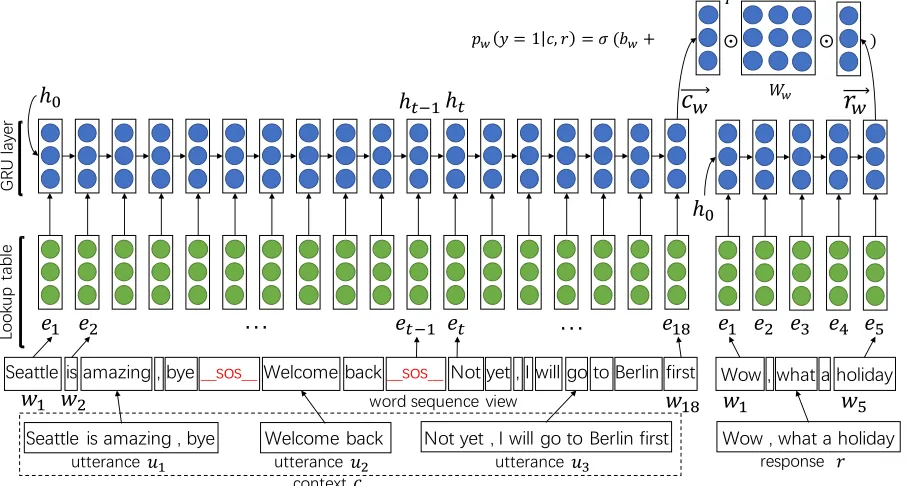
Figure 1: Word sequence model for response selection
3 Response Selection Model
In the task of response selection, a conventional DNN-based architecture represents the context and response as low dimensional embeddings with deep learning models. The response is selected based on the similarity of these two embeddings. We formu-late it as
p(y= 1|c, r) =σ(→−cTW−→r +b) (1)
where c and r denote the context and response,
−
→c and −→r are their embeddings constructed with
DNNs. σ(x) is a sigmoid function defined as σ(x) = 1+1e−x. p(y = 1|c, r) is the confidence of
selecting response r for context c. The matrix W and the scalarbare metric parameters to be learned to measure the similarity between the context and response.
We extend this architecture in a multi-view man-ner, which jointly models the context and response in two views. In this section, we first briefly describe the word sequence model. Then we introduce the utterance sequence model and multi-view response selection model in details.
3.1 Word Sequence Model
The word sequence model in this paper is similar to the LSTM-based model proposed in Lowe et al. (2015). As shown in Figure 1, three utterances of context c, written as u1, u2 andu3, are connected
as a sequence of words. A special word sos is inserted between every two adjacent utterances, denoting the boundary between utterances. Given the word sequences of context and response, words are mapped into word embeddings through a shared lookup table. A Gated Recurrent Unit neural net-work (GRU) (Chung et al., 2014) is employed to construct the context embedding and response em-bedding. It operates recurrently on the two word embedding sequences as Equation 2 to Equation 5, whereht−1is the hidden state of GRU when it reads
a word embeddinget−1 of word wt−1,h0 is a zero
vector as the initiation state,ztis anupdate gateand
rt is areset gate. The new hidden statehtfor
em-beddinget is a combination of the previous hidden
state ht−1 and the input embedding et, controlled
by the update gatezt and reset gatert. U,Uz, Ur,
W,Wz andWrare model parameters of GRU to be
s
s o
s
s o
temporal convolutional layer with padding size 1
max pooling layer word embedding layer word-level gated recurrent unit layer
utterance-level gated recurrent unit layer
word sequence view
utterance sequence view
𝑝" = 𝜎(𝑐"'𝑊"𝑟"+ 𝑏")
𝑝-= 𝜎(𝑐-'𝑊-𝑟-+ 𝑏-)
𝑐" 𝑟"
𝑐- 𝑟
-utterance 𝑢/ utterance 𝑢0 utterance 𝑢1 response 𝑟
Utterance
embedding 𝑢-/
𝑢-0 𝑢
-1
Response
embedding 𝑟
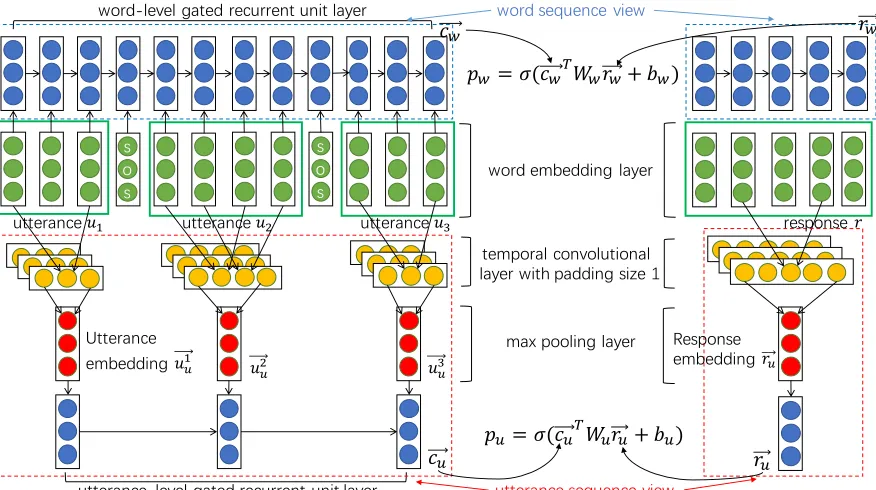
-Figure 2: Multi-view response selection model
ht= (1−zt)⊗ht−1+zt⊗ˆht (2)
zt=σ(Wzet+Uzht−1) (3)
ˆ
ht=tanh(W et+U(rt⊗ht−1)) (4)
rt=σ(Wret+Urht−1) (5)
After reading the whole word embedding sequence, word-level semantic and dependencies in the whole sequence are encoded in the hidden state of GRU, which represents the meaning of the whole sequence (Karpathy et al., 2015). Therefore we use the last hidden state of GRU as the context embedding and response embedding in word sequence model, named−c→w and−r→w respectively1. The confidence of
selecting response in word sequence model is then calculated as in Equation 6:
pw(y= 1|c, r) =σ(−c→wTWw−r→w+bw) (6)
where Ww and bw are metric parameters to be
trained in word sequence model.−c→wand−r→ware
con-structed by a same GRU in word sequence model.
1We use two subscripts, i.e.,wandu, to distinguish notation
in the two views.
3.2 Utterance Sequence Model
Utterance sequence model regards the context as a hierarchical structure, where the response and each utterance are first represented based on word embed-dings, then the context embedding is constructed for the confidence calculation of response selection. As the lower part of Figure 2 illustrates, the construc-tion of the utterance embedding and response em-bedding is in a convolutional manner, which con-tains the following layers:
Padding Layer: Given a word embedding sequence belonging to a certain utter-ance (response), namely [e1, ..., em], the
padding layer makes its outer border with
bn/2c zero vectors, the padded sequence is [01, ..,0bn/2c, e1, ..., em,01, ..,0bn/2c], where
n is the size of convolution window used in temporal convolutional layer.
[image:4.612.87.525.60.305.2]ei+n−1]∈Rn|e|, where⊕denotes the
concate-nation of embeddings, |e|is the size of word embedding. The temporal convolutional layer consists of k kernels, each of which implies a certain dimension and maps the region vec-tor to a value in its dimension by convolution operation. The convolution result of each ker-nel, termedconvi, is further activated with the
RELUnon-linear activation function (Xu et al., 2015), which is formulated as:
frelu(convi) =max(convi,0) (7)
Pooling Layer: Because utterance and response are naturally variable-sized, we put a max-over-time pooling layeron the top of temporal con-volutional layer (Kim, 2014), which extracts the max value for each kernel, and gets a fix-sized representation of length k for utterance and response.
In particular, representations constructed by CNN with max-pooling reflect the core meanings of ut-terance and response. The embeddings of utter-anceui and response r in utterance sequence view
are referred to as −u→iu and −→ru. Utterance
embed-dings are connected in the sequence and fed into a GRU, which captures utterance-level semantic and discourse information in the whole context and en-codes those information as context embedding, writ-ten as −→cu. The confidence of selecting response r
for context c in utterance sequence model, named pu(y= 1|c, r), is calculated using Equation 8:
pu(y= 1|c, r) =σ(−→cuTWu−→ru+bu) (8)
It is worth noticing that the TCNN used here is shared in constructing the utterance embedding and response embedding. The word embeddings are also shared for both the context and response. The sos tag in word sequence view is not used in the utterance sequence model.
3.3 Multi-view Model
Organic integration of different views has been proven to be very effective in the field of recommen-dation, representation learning and other research areas (Elkahky et al., 2015; Wang et al., 2015b).
Most existing multi-view models integrate differ-ent views via a linear/nonlinear combination. Re-searchers have demonstrated that jointly minimizing two factors, i.e., 1) thetraining errorof each view and 2) the disagreement between complementary views can significantly improve the performance of the combination of multi-views (Xu et al., 2013).
Our multi-view response selection model is de-signed as shown in Figure 2. As we can see, the context and response are jointly represented as se-mantic embeddings in these two views. The under-lying word embeddings are shared across the con-text and response in these two views. The com-plementary information of these two views is ex-changed via the shared word embeddings. The ut-terance embeddings are modeled through a TCNN in the utterance sequence view. Two independent Gated Recurrent Units are used to model the word embeddings and utterance embeddings separately on word sequence view and utterance sequence view, the former of which captures dependencies in word level and the latter captures utterance-level semantic and discourse information. Confidences for select-ing the response in these two views are calculated separately. We optimize the multi-view model by minimizing the following loss:
L=LD+LL+λ
2kθk (9)
LD=
X
i
(pw(li) ¯pu(li) +pu(li) ¯pw(li)) (10)
LL=
X
i
(1−pw(li)) +
X
i
(1−pu(li)) (11)
where the object function of the multi-view modelL
is comprised of thedisagreement lossLD, the
like-lihood lossLLand the regular term λ2kθk. pw(li) =
pw(y = li|c, r) andpu(li) = pu(y = li|c, r)
de-note the likelihood of thei-th instance with labelli
from training set in these two views. Only two la-bels, {0,1}, denote the correctness of the response during training. p¯w(li)andp¯u(li)denote the
proba-bilitypw(y 6= li)andpu(y 6= li)respectively. The
multi-view model is trained to jointly minimize the disagreement lossand thelikelihood loss. θdenotes all the parameters of the multi-view model.
Model/Metrics 1 in 10 R@1 1 in 10 R@2 1in 10 R@5 1 in 2 R@1
Random-guess 10% 20% 50% 50%
TF-IDF 41.0% 54.5% 70.8% 65.9%
Word-seq-LSTM (Lowe et al., 2015) 60.40% 74.50% 92.60% 87.80%
Word-seq-GRU 60.85% 75.71% 93.13% 88.55%
Utter-seq-GRU 62.19% 76.56% 93.42% 88.83%
[image:6.612.81.527.57.156.2]Multi-view 66.15% 80.12% 95.09% 90.80%
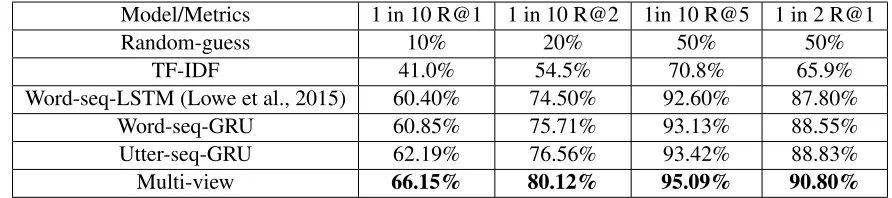
Table 1: Performance comparison between our models and baseline models. In the table,Word-seq-LSTMis the experiment result of the LSTM-based word sequence model reported by Lowe et at (2015).Word-seq GRUis the word sequence model that we implement with GRU.Utter-seq-GRUis the proposed utterance-sequence model. TheMulti-viewis our multi-view response selection model. In addition, we list the performance ofRandom-guessandTF-IDF
in Equation 12:
smtv(y= 1|c, r) =
pw(y= 1|c, r) +pu(y = 1|c, r)
(12)
The response with largersmtv(y = 1|c, r)is more
likely to be selected. We will investigate other com-bination models in our future work.
4 Experiment
4.1 Dataset
Our model is evaluated on the public Ubuntu Cor-pus (Lowe et al., 2015), designed for response selec-tion study of multi-turn human-computer conversa-tion (Serban et al., 2015). The dataset contains 0.93 million human-human dialogues crawled from an Internet chatting room for Ubuntu trouble shooting. Around 1 million context-response-labeled triples, namely < c, r, l >, are generated for training af-ter preprocessing2, where the original context and
the corresponding response are taken as the positive instances while the random utterances in the data set taken as the negative instances, and the number of positive instance and negative instance in train-ing set is balanced. The validation set and testtrain-ing set are constructed in a similar way to the training set, with one notable difference that for each context and the corresponding positive response, 9 negative responses are randomly selected for further evalua-tion.
4.2 Experiment Setup
Following the work of Lowe et al., (2015), the eval-uation metric is 1 inm Recall@k (denoted 1 inm 2Preprocessing includes tokenization, recognition of named
entity, urls and numbers.
R@k), where a response selection model is designed to select k most likely responses among m candi-dates, and it gets the score “1” if the correct response is in the k selected ones. This metric can be seen as an adaptation of the precision and recall metrics previously applied to dialogue datasets (Schatzmann et al., 2005). It is worth noticing that 1 in2 R@1 equals to precision and recall in binary classifica-tion.
4.3 Model Training and Hyper-parameters We initialize word embeddings with a pre-trained embedding matrix through GloVe (Pennington et al., 2014)3. We use Stochastic Gradient Descent (SGD)
for optimizing. Hidden size for a gated recurrent unit is set to 200 in both word sequence model and utterance sequence model. The number of convo-lutional kernels is set to 200. Our initial learning rate is0.01with mini-batch size of 32. Other hyper-parameters are set exactly the same as the baseline. We train our models with a single machine using 12 threads and each model will converge after 4-5 epochs of training data. The best model is selected with a holdout validation dataset.
4.4 Comparison Approaches
We consider the word sequence model implemented by Lowe et at., (2015) with LSTM as our base-line, the best model in context-sensitive response selection so far. Moreover, we also implement the word sequence model and the utterance sequence model with GRU for further analysis. Two simple approaches are also implemented, i.e., the
Random-3Initialization of word embedding can be obtained on
(a) 1 in 2 R@1 (b) 1 in 10 R@1
[image:7.612.76.538.63.336.2](c) 1 in 10 R@2 (d) 1 in 10 R@5
Figure 3:Performance comparison between word sequence model (with/without sos tags) and utterance sequence model. We choose the number of utterances in range of [2,6], since most samples in testset fall in this interval
guess and the TF-IDF, as the bottom line for perfor-mance comparison. The perforperfor-mance of Random-guess is calculated by mathematics with an assump-tion that each response in candidates has the equal probability to be selected. The TF-IDF is imple-mented in the same way in Lowe et al., (2015). TF for a word is calculated as the count of times it appears in a certain context or response. IDF for each word w is log(|d∈DN:w∈d|), where D denotes the whole training set, N is the size of D, d is a conversation inD. The context and the response in testset are represented as a bag-of-words according to TF-IDF. The selection confidence is estimated as the cosine score between context and response.
4.5 Experimental Result
We summarize the experiment result in Table 1. As shown in Table 1, all DNN-based models achieve significant improvements compared to Random-guess and TF-IDF, which implies the effectiveness of DNN models in the task of response selection. The word sequence models implemented with GRU and LSTM achieve similar performance. The ut-terance sequence model significantly outperforms
word sequence models for 1 in 10 R@1. Multi-view model significantly outperforms all the other models, especially for 1 in 10 R@1, which is more difficult and closer to the real world scenario than other metrics. The experimental result demonstrates the effectiveness of multi-view model and proves that word sequence view and utterance sequence view can bring complementary information for each other.
5 Analysis
We examine the complementarity between word se-quence model and utterance sese-quence model in two folds, i.e., via statistic analysis and case study.
5.1 Statistical Analysis
We compare the performance of word sequence model4 and utterance sequence model for different
number of utterances in the contexts. In addition, we also examine what the contribution sos tag makes in word sequence view. The performance
4The GRU-based word sequence model that we
User
(utterance) Word Sequence View Utterance Sequence View
Wildintell ect: (Utteranc e-1)
anyone know where to find a list of all
language codes a
locales with each ?
itaylor57: (Utteranc
e-2) __url__ __url__
Wildintell ect: (Utteranc e-3)
thanks but that list seems incomplete
thanks but that list seems incomplete
itaylor57: (Utteranc
e-4) __url__ __url__
Selected Respons e
i already looked at that one , also
incomplete , lacks the locales within a language group
does it work ?
User
(utterance) Word Sequence View Utterance Sequence View
astra-x: (Utteranc e-1)
alright so has anyone solved an error with __path__ ext4 leaking ?
alright so has anyone solved an error with __path__ ext4 leaking ?
sipior: (Utteranc
e-2) what sort of error ? what sort of error ?
astra-x: (Utteranc e-3)
my reported free disk space says full , yet last week it was 60g free on __path__ , and i cannot find anymore than 29g of files. yet __path__ and __path__ are reported correctly
my reported free disk
space says full , yet last
week it was 60g free on __path__ , and i cannot find anymore than 29g
of files. yet __path__ and __path__ are reported correctly
sipior: (Utteranc e-4)
how are you getting the disk space information ?
how are you getting the disk space information ?
Selected Respons e
__path__ should be 10g and __path__ should be 19g
want me to pastebin all my debugging ? anyone know where to
[image:8.612.81.530.57.356.2]find a list of all language codes a locales with each ?
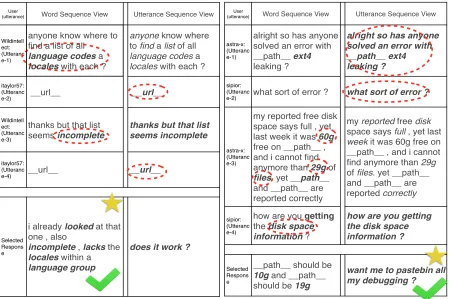
Figure 4:Case studies for analysis of word sequence model and utterance sequence model. The context and the selected responses are collected from testset. Response with a green checkmark means it is a correct one, otherwise it is incorrect. Words (Utterances) inboldare the important elements recognized by our importance analysis approach. The yellow start denotes the selection of multi-view model.
is shown in Figure 3. We can see that as the number of turns increases, the utterance sequence model outperforms word sequence model more sig-nificantly, which implies that utterance sequence model can provide complementary information to word sequence model for a long context. Further-more, word sequence model without sos tag has an obvious fall in performance compared with word sequence model with sos , which implies its cru-cial role in distinguishing utterances for modeling context.
5.2 Case Study
We analyze samples from testset to examine the complementarity between these two views. The key words for word sequence model and core utterances for utterance sequence model are extracted for anal-ysis. These important elements are recognized based on the work of Li et al. (2015), where the gradi-ents of their embeddings are used for importance
analysis. After studying the testset, we find that the word sequence model selects responses according to thematching of key wordswhile the utterance se-quence model selects responses based on the match-ing of core utterances. We list two cases in Figure 4 as examples.
re-sponse. However, for cases like example 1, where the core meaning of correct response is jointly com-bined with different words in different utterances, the utterance sequence model does not perform well. The multi-view model can successfully select the correct responses in both two examples, which im-plies its ability to jointly leverage information from these two views.
6 Conclusion
In this paper, we propose a multi-view response se-lection model for multi-turn human-computer con-versation. We integrate the existing word sequence view and a new view, i.e., utterance sequence view, into a unified multi-view model. In the view of utter-ance sequence, discourse information can be learnt through utterance-level recurrent neural network, different from word sequence view. The represen-tations learnt from the two views provide comple-mentary information for each other in the task of re-sponse selection. Experiments show that our multi-view model significantly outperforms the state-of-the-art word sequence view models. We will extend our framework to response generation approaches in our future work. We believe it will help construct a better representation of context in the encoding phrase of DNN-based generation model and thus im-prove the performance.
Acknowledgement
This paper is supported by National Basic Re-search Program of China (973 program No. 2014CB340505). We gratefully thank the anony-mous reviewers for their insightful comments.
References
Junyoung Chung, C¸aglar G¨ulc¸ehre, KyungHyun Cho, and Yoshua Bengio. 2014. Empirical evaluation of gated recurrent neural networks on sequence model-ing. CoRR, abs/1412.3555.
Ali Mamdouh Elkahky, Yang Song, and Xiaodong He. 2015. A multi-view deep learning approach for cross domain user modeling in recommendation systems. In
Proceedings of the 24th International Conference on World Wide Web, pages 278–288. International World Wide Web Conferences Steering Committee.
Barbara J Grosz and Candace L Sidner. 1986. Attention, intentions, and the structure of discourse. Computa-tional linguistics, 12(3):175–204.
Sepp Hochreiter and J¨urgen Schmidhuber. 1997. Long short-term memory. Neural computation, 9(8):1735– 1780.
Baotian Hu, Zhengdong Lu, Hang Li, and Qingcai Chen. 2014. Convolutional neural network architectures for matching natural language sentences. InAdvances in Neural Information Processing Systems, pages 2042– 2050.
Zongcheng Ji, Zhengdong Lu, and Hang Li. 2014. An information retrieval approach to short text conversa-tion. arXiv preprint arXiv:1408.6988.
Rudolf Kadlec, Martin Schmid, and Jan Kleindienst. 2015. Improved deep learning baselines for ubuntu corpus dialogs. arXiv preprint arXiv:1510.03753. Andrej Karpathy, Justin Johnson, and Fei-Fei Li. 2015.
Visualizing and understanding recurrent networks.
arXiv preprint arXiv:1506.02078.
Yoon Kim. 2014. Convolutional neural networks for sen-tence classification. arXiv preprint arXiv:1408.5882. Yann LeCun, Bernhard Boser, John S Denker, Donnie
Henderson, Richard E Howard, Wayne Hubbard, and Lawrence D Jackel. 1989. Backpropagation applied to handwritten zip code recognition.Neural computa-tion, 1(4):541–551.
Jiwei Li, Xinlei Chen, Eduard Hovy, and Dan Jurafsky. 2015. Visualizing and understanding neural models in nlp.arXiv preprint arXiv:1506.01066.
Ryan Lowe, Nissan Pow, Iulian Serban, and Joelle Pineau. 2015. The ubuntu dialogue corpus: A large dataset for research in unstructured multi-turn dia-logue systems. arXiv preprint arXiv:1506.08909. Zhengdong Lu and Hang Li. 2013. A deep architecture
for matching short texts. InAdvances in Neural Infor-mation Processing Systems, pages 1367–1375. Jeffrey Pennington, Richard Socher, and Christopher D.
Manning. 2014. Glove: Global vectors for word rep-resentation. InIn Proc. EMNLP, pages 1532–1543. Alan Ritter, Colin Cherry, and William B Dolan. 2011.
Data-driven response generation in social media. InIn Proc. EMNLP, pages 583–593. Association for Com-putational Linguistics.
Jost Schatzmann, Kallirroi Georgila, and Steve Young. 2005. Quantitative evaluation of user simulation tech-niques for spoken dialogue systems. In 6th SIGdial Workshop on DISCOURSE and DIALOGUE.
Lifeng Shang, Zhengdong Lu, and Hang Li. 2015. Neu-ral responding machine for short-text conversation.
arXiv preprint arXiv:1503.02364.
Alessandro Sordoni, Michel Galley, Michael Auli, Chris Brockett, Yangfeng Ji, Margaret Mitchell, Jian-Yun Nie, Jianfeng Gao, and Bill Dolan. 2015. A neural network approach to context-sensitive gener-ation of conversgener-ational responses. arXiv preprint arXiv:1506.06714.
Oriol Vinyals and Quoc Le. 2015. A neural conversa-tional model. arXiv preprint arXiv:1506.05869. Marilyn A Walker, Rebecca Passonneau, and Julie E
Boland. 2001. Quantitative and qualitative evalua-tion of darpa communicator spoken dialogue systems. InProceedings of the 39th Annual Meeting on Associ-ation for ComputAssoci-ational Linguistics, pages 515–522. Association for Computational Linguistics.
Mingxuan Wang, Zhengdong Lu, Hang Li, and Qun Liu. 2015a. Syntax-based deep matching of short texts.
arXiv preprint arXiv:1503.02427.
Weiran Wang, Raman Arora, Karen Livescu, and Jeff Bilmes. 2015b. On deep multi-view representation learning. In Proceedings of the 32nd International Conference on Machine Learning (ICML-15), pages 1083–1092.
Tsung-Hsien Wen, Milica Gaˇsi´c, Dongho Kim, Nikola Mrkˇsi´c, Pei-Hao Su, David Vandyke, and Steve Young. 2015a. Stochastic Language Generation in Dialogue using Recurrent Neural Networks with Con-volutional Sentence Reranking. InProceedings of the 16th Annual Meeting of the Special Interest Group on Discourse and Dialogue (SIGDIAL). Association for Computational Linguistics, September.
Tsung-Hsien Wen, Milica Gaˇsi´c, Nikola Mrkˇsi´c, Pei-Hao Su, David Vandyke, and Steve Young. 2015b. Seman-tically conditioned lstm-based natural language gen-eration for spoken dialogue systems. InProceedings of the 2015 Conference on Empirical Methods in Nat-ural Language Processing (EMNLP). Association for Computational Linguistics, September.
Jason D Williams and Steve Young. 2007. Partially ob-servable markov decision processes for spoken dialog systems. Computer Speech & Language, 21(2):393– 422.
Chang Xu, Dacheng Tao, and Chao Xu. 2013. A survey on multi-view learning. arXiv preprint arXiv:1304.5634.
Bing Xu, Naiyan Wang, Tianqi Chen, and Mu Li. 2015. Empirical evaluation of rectified activations in convo-lutional network. arXiv preprint arXiv:1505.00853. Zhao Yan, Nan Duan, Junwei Bao, Peng Chen, Ming
Zhou, Zhoujun Li, and Jianshe Zhou. Docchat: An information retrieval approach for chatbot engines us-ing unstructured documents.