ROBUST THERMAL FACE RECOGNITION USING REGION CLASSIFIERS
AYAN SEAL* , ‡, DEBOTOSH BHATTACHARJEE* , §, MITA NASIPURI*,¶ and CONSUELO GONZALO-MARTIN†,||
*Department of Computer Science and Engineering Jadavpur University, India
†Center for Biomedical Technology Universidad Politecnica de Madrid, Spain
§[email protected] •[email protected] [email protected]
This paper presents a robust approach for recognition of thermal face images based on decision level fusion of 34 di®erent region classi¯ers. The region classi¯ers concentrate on local varia-tions. They use singular value decomposition (SVD) for feature extraction. Fusion of decisions of the region classi¯er is done by using majority voting technique. The algorithm is tolerant against false exclusion of thermal information produced by the presence of inconsistent distri-bution of temperature statistics which generally make the identi¯cation process di±cult. The algorithm is extensively evaluated on UGC-JU thermal face database, and Terravic facial infrared database and the recognition performance are found to be 95.83% and 100%, respec-tively. A comparative study has also been made with the existing works in the literature.
1 . Introduction
Automatic face recognition has been comprehensively studied for more than four decades since face recognition of individuals has many applications, particularly in human–machine interaction and security domain. The nonintrusive nature makes the face recognition superior to other biometric-based recognition system is such as ¯ngerprints, iris, hand geometry, etc. Most of the available face recognition systems are based on visible face images. For more information regarding visible face
recognition m e t h o d s , readers are encouraged t o see Ref. 4. These are very good constrained environment. T h e primary problem in recognizing people in uncon-strained environments is t h e high variability of t h e visual aspect of t h e face pre-sented by di®erent sources. T h e appearance of t h e face image is changed due t o t h e changes in illumination, occlusions, t h e head pose and orientation of t h e subject, t h e facial expression, and aging. This high changeability makes t h e face recognition one of t h e toughest problems in t h e ¯elds of p a t t e r n recognition, computer vision and biometrics. Some of t h e researchers have been recommended illumination in-variant face recognition algorithm based on visible face images.2 4,3 5 B u t , still these
methods are not s u ± c i e n t for unconstrained environments. Face recognition using infrared images has m a d e m u c h progress during t h e last decade with t h e advent of
C C D technology.5 0 Face recognition system based on visual images has an edge
over other biometric t r a i t s due t o easy availability of low cost visible b a n d optical camera, b u t visual images-based face recognition alone has not been able t o achieve t h e required accuracy because of its sensitivity t o illumination, pose, and expres-sions. On t h e other h a n d , t h e r m a l infrared face recognition systems do not depend on illumination condition. This system can c a p t u r e t h e radiated energy from t h e face only. As t h e heat p a t t e r n is e m i t t e d from t h e face surface itself, without any source of external radiation, these systems can c a p t u r e images despite any external lighting and even in t h e dark. In this system, t h e tasks of face detection, locali-zation, and segmentation are relatively easier and more reliable t h a n those in visual images.2 5,3 2 A brief review of t h e signi¯cant works, as found in t h e literature, on
t h e r m a l face recognition, as well as infrared face recognition during t h e last decade, is presented here. In 1992, ¯rst t h e r m a l face recognition work was conducted in Mikos Corporation.2 8 Mikos Corporation ¯rst d e m o n s t r a t e d t h a t t h e facial
ther-mograms are di®erent for every individual. Wilder et al.49 have presented one of t h e
¯rst works on t h e r m a l face recognition. T h e y have compared t h e relative perfor-mances of three face recognition algorithms for visible and t h e r m a l IR images of 101 subjects and concluded t h a t t h e recognition results for one modality were not signi¯cantly b e t t e r t h a n those for t h e other. T h e y did not consider a signi¯cant a m o u n t of illumination changes for visible images and t e m p e r a t u r e changes for I R images. However, t h e illumination problem could be solved t o a great extent using Gabor transform.4 5 Illumination does not a®ect t h e t h e r m a l images since t h e r m a l
images are illumination independent. Cutler1 5 were one of t h e ¯rst researchers who
have used t h e eigenface3 4 m e t h o d in t h e infrared face recognition and applied t o a
d a t a b a s e of 288 hand-aligned low-resolution (160 x 120) images of 24 subjects t a k e n from three viewpoints (frontal, 45° and pro¯le). Recognition rates reported were 96% for frontal views, 96% for 45° views, and 100% for pro¯le views. A n o t h e r
face recognition system based on t h e r m a l face was introduced by Yoshitomi et al.52
in 1997. T h e y focused on t h e lighting problem in visual face recognition system and
recommended infrared face recognition as a solution. Socolinsky et al.44 presented
spectrum (LWIR). They have tested the eigenfaces34 and the ARENA48 algorithms
on a database of visible and infrared images of 91 distinct subjects taken under di®erent illumination conditions, with varying facial expressions, and with or without glasses. Selinger and Socolinsky52 evaluating the performance of the
rec-ognition system using the same database of 91 subjects and tested the performance on four di®erent face recognition algorithms (PCA, LDA, LFA and ICA). Their results showed that LWIR imagery of human faces is better to visible imagery in recognition. In Ref. 44, the researchers have used visible imagery and thermal infrared imagery for face recognition in operational scenarios of both indoor and outdoor. They have studied the performance of the face recognition system across multiple sessions. The visible imagery is a®ected by changes in outdoors illumi-nation; thermal imagery is a®ected by some challenging factors such as physical activity of subjects, weather conditions for both indoors and outdoors, etc. Their experimental results proved that, under controlled lighting conditions, visible im-agery has a better recognition rate for indoors. For all of the algorithms that they used, outdoor recognition rate was worse for both visible and thermal images, with a sharper degradation for visible one. They have concluded that face recognition performance with thermal infrared imagery is steady over many sessions. IR im-agery represents a feasible substitute to visible imaging in the search for a robust and practical face recognition system. Trujillo et al.42 proposed an unsupervised
local and global feature extraction paradigm to the problem of facial expression using thermal images. Chen et al.40 developed a face recognition method with
Principle Component Analysis (PCA). They used PCA to study the comparisons and combination of infrared and visible images to the e®ects of lighting, facial expression change and the time di®erence between gallery and probe images. They have paid attention to a very crucial factor in thermal infrared face recognition which is the time di®erence between training and test images in the galleries. First they did not consider elapse time for testing the system. They have stated that there is no regular di®erence between the recognition rate of visible and thermal IR Infrared. Later, they have concentrated on elapse time. They have concluded that visible image is better than thermal IR in time-lapsed recognition. But there is an important clue in their research: The sets of mismatched probes of the two clas-si¯ers for the two models did not overlap necessarily. This clue suggested that these two models may have complementary information about the probe. So, the researchers combined the results of the thermal IR and visible image-based face recognition systems using some combination rules using three di®erent strategies. Their experimental results indicated that when there was signi¯cant time elapse between the gallery and probe images, the visible face recognition outperforms the thermal IR one. Their experimental results also showed that the combination of the two models outperforms both the single models. Friedrich et al.43 have also
pro-posed an eigenface-based face recognition using thermal IR images. In their work, they found that the thermal IR images are less a®ected by changes of pose or facial
expression. They found that the thermal IR face recognition is quite better than a visible one when the probe images include highly varying pose and facial expres-sions. Prokoski et al.47 expected that it is possible to extract the vascular network
i.e. network of blood vessels from thermal facial images as a feature for face rec-ognition. Some of the researchers10–12,16,33 used this clue and presented an approach
for face recognition based on this physiological information extracted from the thermal face images. First, they segmented the human face from the background using a di®erent method which is mentioned in their papers. Then, they have used to extract blood vessels available on the segmented face. The extracted vascular network is unique for each person. It has been found that there exists an analogy between thermal imprints of human faces and ¯ngerprints of human beings. The thermal imprints of the blood vessels may be treated as the ridges in the ¯nger-prints and ¯nger¯nger-prints recognition techniques may be applied on thermal im¯nger-prints of the human faces for their recognition. The reliability of the ¯ngerprint recog-nition system has been signi¯cantly enhanced through the technique of minutiae extraction from ridges. Most common type of minutiae is: when a ridge either comes to an end, which is called a ridge-termination or when it splits into two ridges, which is called a ridge-bifurcation. So, the number and locations of the minutiae vary from face to face in any particular person. When a set of face images is obtained from an individual person, the number of minutiae is recorded for each face. The precise locations of the minutiae are also recorded, in the form of nu-merical coordinates, for each face and the feature sets thus obtained has been stored in a separate database. A computer can rapidly compare this feature sets with that of anyone else in the world whose face image has been scanned. This work had a drawback: The matching method could not overcome the nonlinearities in the deformation of the vascular network, due to variations in facial pose and expressions and the experimental results showed high false acceptance rates due to weaknesses of the proposed method in the feature extraction and matching algorithms.
Blood perfusion data can be used for face recognition since blood vessels trans-porting warm blood are re°ected in the thermal patterns. Wu et al.36 used this
suggestion to get better performance of the IR face recognition system under dif-ferent surrounding temperatures. First they have extracted the blood perfusion data from thermal patterns, since thermal images are dependent on surrounding tem-perature and blood perfusion data is more steady features. So, the extracted blood perfusion data (also called physiological data) is used for face recognition. After converting the thermal data into the blood perfusion data, the features are extracted by the PCA methods and RBF neural network is used for recognition. The experi-mental results have proved that the performance of the face recognition system using blood perfusion data is signi¯cantly better than the temperature data. Bhowmik et al.37 used Log-polar transform to achieve rotation and to scale invariant images.
¯nally, classi¯cation is done using multilayer perception. When only one-sided semi-pro¯le thermal images of an individual are available, a mosaicking technique can be applied to build an apparent 2D front pro¯le view of that person.39 In Ref. 13,
authors have used Log-Gabor wavelets for IR face recognition. In the ¯rst step of their used method, Log-Gabor has been used to form feature vector from IR face image. In the second step, PCA is used to reduce the dimensions of the feature vectors that are obtained from the ¯rst step. Then Independent Component Analysis (ICA) has been used to form a new feature vector, which fed into Top-match clas-si¯er for identifying class labels of the testing IR face images. They have used LWIR face database collected by Equinox Corporation. The available semi-pro¯le image is converted into a mirror image which is similar to the opposite half semi-pro¯le thermal image of that person. Human face is symmetric. So, simple concatenation of these two images (one is the original side view image, and another is the mirror or opposite side view image) produces an apparent 2D front face thermal mosaicked image of that person. This mosaic image can be used in any simple thermal face recognition system.
From the above paragraph, it is clear that most of the researchers have used PCA for extracting features from the face in thermal face recognition. PCA is known as reconstructive approach, which is considered to be robust for contaminated pixels.51
One of the main de¯ciencies of the PCA-based classi¯er is its limited capability to handle local variations in the faces, caused by expressions, motion, deformation,8 and
false exclusion of thermal information produced by the presence of inconsistent distribution of temperature statistics (missing data), etc.
In this work, decision level fusion27 of many region classi¯ers is used for the
identi¯cation of the class label and singular value decomposition (SVD) is used for feature extraction and classi¯cation purpose. Region classi¯er can handle local variations by dividing the face into a number of regions, performing recognition on each of these separate regions and then fusing the results. Due to occlusion or ex-pression change, some of the region classi¯ers may fail to identify the person. But, the aggregation of decisions of other region classi¯ers may recognize the person with high con¯dence. Thus this method is robust against local variations in the faces, caused by occlusions, expression changes, motion, deformation, and false exclusion of thermal information produced by the presence of inconsistent distribution of temperature statistics. Again most of the researchers have implemented their algorithms on few numbers of subjects. Here, we have developed our algorithm on UGC-JU thermal face database30 which contains 84 subjects and which is freely available on request
for research purpose. However, the pathological (like fever, headache, in°ammation, etc.) and psychological (like nervousness, blush, etc.) conditions of the person, which may a®ect his blood perfusion data, have not been considered in the present work. The rest of this paper is organized as follows. The proposed system is introduced in Sec. 2. Experimental results and discussion are presented in Sec. 3. Section 4
2. Proposed System
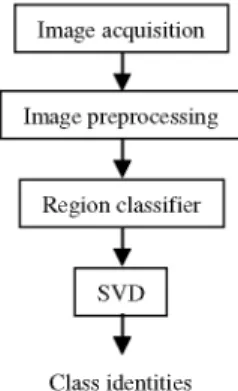
A schematic diagram of the proposed Robust Thermal Face Recognition System (RTFRS) is shown in Fig. 1. The system consists of four main modules, namely image acquisition, image preprocessing, region classi¯er and SVD. Each of these modules has been discussed, in detail, in subsequent subsections.
Face image acquisition: In the present work, thermal and visible face images are acquired simultaneously with variable expressions, poses and with/without glasses. Till now 84 individuals have volunteered for this photo shoots and each of 39 dif-ferent templates of RGB color images with di®erent expressions (happy, angry, sad, disgusted, neutral, fearful and surprised) and pose changes about x-, y- and z-axis are taken. Resolution of each image is 320 x 240, and the images are saved in JPEG format. FLIR 7 camera is used to capture this database. Our FLIR 7 camera can capture thermal infrared spectrum (wavelength of 8-14 /im). A typical thermal face image is shown in Fig. 2(a)). This thermal face image depicts interesting thermal information of a facial model.
Image acquisition
I
Image preprocessing Region classifierI
SVD Class identitiesFig. 1. Schematic block diagram of the proposed system.
(a) (b) (c) Fig. 2. Thermal face image and its various preprocessing stages. (a) Athermal face image, (b) corre-sponding grayscale image and (c) binary image.
2 . 1 . Image preprocessing
The stage involves binarization of the acquired thermal face image, extraction of the largest component as the face region, and cropping of the face region in elliptic shape. The image processing techniques which have been used here are discussed in detail as follows.
2.2. Binarization
Each of the captured 24-bits color images has been converted into its 8-bit grayscale image.41 The grayscale image of the sample image of Fig. 2(a) is shown
in Fig. 2(b). The grayscale images are then converted into corresponding binary images by setting pixels in the grayscale image with luminance greater than the mean intensity with the value 1 (white) and all other pixels with the value 0 (black). In a binary image, black pixels mean background and white pixels mean the face region. The binary image of the grayscale image given in Fig. 2(b) is shown in Fig. 2(c).
Extraction of the largest component41: The foreground of a binary image may
contain more than one object. Let us consider the image, in Fig. 2(c), it has six foreground objects or components. The largest one represents the face region. The others are at the left bottom corner and small dot on the top. Then largest com-ponent has been extracted from a binary image using \Connected Comcom-ponent Labeling" algorithm.9 This algorithm is based either on \4-connected" neighbors or
\8-connected" neighbor's method.7,17 In this study \8-connected" neighbor's method
is used. It is a binary image. Here, white means face skin region and black means background. Using the selected largest component as template face region from the grayscale image is then extracted. Figure 3(b) shows only the gray level face region (excluding background) of Fig. 3(a).
(a) (b) Fig. 3. (a) A largest component as a face skin region. (b) A largest component as a face skin region (grayscale image).
2.3. Cropping of the face region in elliptical shape
Normally human face is of an elliptical shape. For ¯tting an ellipse on the identi¯ed face region, the centroid29,41 of the face region needs to be evaluated. The coordinates
of the centroid are evaluated from the binarized face image using the following equations.
\ f(x,y)x \ f(x,y)y X = ^=^ , Y = ^=^ ,
y^f(x,y) y j f(x, y)
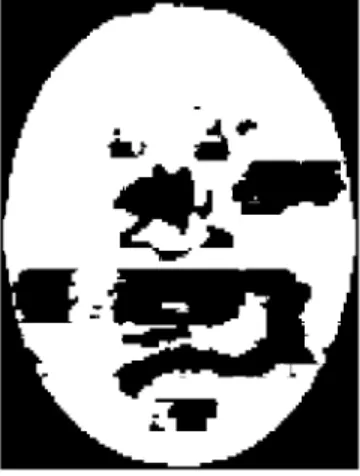
where x, y are the co-ordinates of the binary image and f(x, y) is the intensity value at x, y co-ordinates. Using this information, face region has been cropped in an elliptical shape using \Bresenham ellipse drawing"18 algorithm. Distance between
the centroid and the right ear is called the minor axis of the ellipse and distance between the centroid and the forehead is called the major axis of the ellipse. The cropped elliptical face image is shown in Fig. 4.
2.4. Region classifier
After cropping of the face region in elliptical shape, it has been seen that some thermal information within the facial area (especially nose and eye region) is ex-cluded during binarization, shown in Fig. 4. False exclusion of thermal information produced by the presence of inconsistent distribution of temperature statistics makes the process of identifying persons using their thermal facial images di±cult. So, in the classi¯cation stage, we propose to consider the thermal face surface as a combination of several local regions. If the facial area is partially excluded due to some reasons, information regarding the excluded regions will not be available. Therefore instead of globally evaluating a surface, it will be bene¯cial to analyze the images by separate local classi¯ers and then to fuse the regional classi¯cation results. Local analysis of
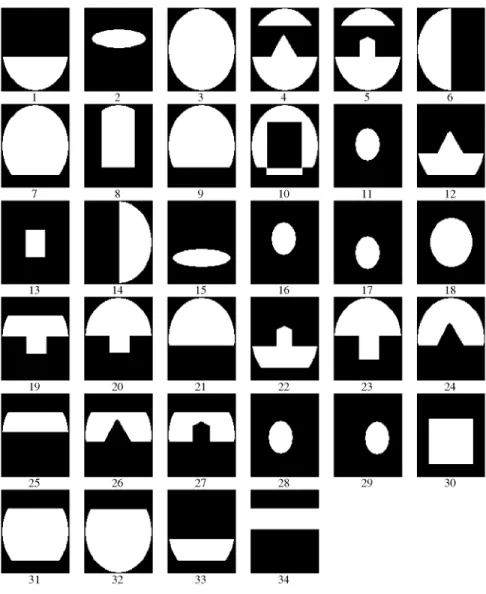
HHnHHd
1 2 3 4 5 6•UUEDD
7 8 9 10 11 12 13 14 15 16 17 18•QUQUH
19 20 21 22 23 24HHBDDD
25 26 27 28 29 30 31 32 33 34 Fig. 5. Local region templates.the facial surface was proposed in Ref. 1 to deal with facial occlusions on 3D images, which was utilized in Ref. 2 for facial expression variations. In this work, we utilized 34 overlapping local region templates of the face, as shown in Fig. 5, where the white area represents the selected local face region and the black area is the excluded face region. The regions were chosen in such a way that, for di®erent types of local variation, they would allow stable features for comparison. Examples of such regions are those that leave out the upper or the lower part of the face because of the di®erence in hair, caps, etc. or di®erence in expression of the mouth. Other examples are leaving out areas covered by glasses and the left or right side of the face, which are less visible for large rotations around the vertical y-axis.
All of these local regions are m a p p e d on t h e elliptical face, and t h e features are extracted from t h e white region only. All feature vectors can be represented as a 1 x n-dimensional vector. So, the size of the feature vector is less compared t o t h a t extracted from t h e whole face image. Still t h e size of t h e feature vector is not manageable. Since, any a t t e m p t at recognition in such high-dimensional space is vulnerable t o a variety of issues often referred t o as t h e curse of dimensionality. Therefore, at t h e feature extraction stage, images are transformed t o low-dimen-sional vectors in t h e face space. T h e main objective is t o ¯ n d such a basis function for this transformation which could distinguishably represent faces in t h e face space. A number of approaches have been reported in the face recognition literature, such as PCA,2 3,3 4 LDA,5,1 4 ICA,3,2 1 S V D6 a n d Wavelet transforms.2 9,3 1,4 6
P C A is known as reconstructive approach. Reconstructive approach is robust for
contaminated pixels5 1 which could serve our purpose. In this work, instead of solving
t h r o u g h covariance matrix, eigenvectors a n d the corresponding eigenvalue are found out through SVD because t h e covariance matrix-based method is computationally as well as memory requirement wise happens t o be very costly.
Singular Value Decomposition: SVD is considered as an i m p o r t a n t topic in linear algebra by m a n y renowned mathematicians. It is t h e widely used technique t o decompose a m a t r i x into several component matrices, exposing m a n y useful a n d interesting properties of t h e original matrix. T h e decomposition of a m a t r i x is often called a factorization. Let us say A be a rectangular m a t r i x with TO rows a n d n columns, with rank r and r < n < m. T h e n A can be broken down into t h e product of three matrices — an orthogonal m a t r i x U, a diagonal m a t r i x S, a n d t h e transpose of another orthogonal m a t r i x V:
where UTU = I, VTV = I; t h e m a t r i x U = [M1; U2, . . ., ur, wr+ 1 ,..., um] are
ortho-normal eigenvectors of ATA, a n d t h e column vector ut, for i = 1, 2,..., TO, form an
orthonormal set.
' / • — n • •
3 l3
1,. . . , i = j,
0,. . . , i =/= j.
Similarly, t h e m a t r i x V = [w1; v2,.. ., vr, wr +1 ,. .. ,vn] contains orthonormal
eigen-vectors of ATA, t h e column vector vi, for i = 1,2,... ,n, form an orthonormal set:
T (1,..., i = j, Vi Vj = 6ij = i 0 • -L •
\ , . . . , i j= j,
and S is a diagonal m a t r i x with singular values a1 <J2 ,..., an of A on t h e diagonal
which are t h e square roots of eigenvalues o b t a i n e d from U or V in descending order.
So, SVD allows us t o factoring a digital image in three matrices. T h e use of Snn, i.e. singular values allows us t o represent t h e image with a smaller set of values,
which can preserve useful features of the original image, b u t use less storage space in
t h e memory. P C A can be derived from the SVD.2 6 T h e covariance m a t r i x can be
written as
1 T 1 2T, T
C = — AA = — US V .
m m
F r o m the above equation, it is understood t h a t SVD order t h e singular values in decreasing order and t h e ¯rst m columns corresponds t o t h e sorted nonzero
eigen-values of C as m > n. So, P C A transformed d a t a can be written as
X = U A = U USVT,
where U is t h e m a t r i x of eigenvectors sorted according t o eigenvalues and U U is a simple m x n m a t r i x which is one on t h e diagonal and zero everywhere else. So, t h e transformed P C A d a t a can be described in terms of t h e SVD decomposition of A. SVD for face recognition: Here, a single face image in t h e training phase is known as baseface, and all such basefaces are grouped together t o create a face space which are known faces. W h e n , a new face image appears for identifying its class label by projecting it onto t h e face space, and t h e n matching this face by comparing its coordinates (position) in face space with t h e coordinates (positions) of known faces i.e. \face space". Let / be a baseface of size m rows and n columns. A row vector f of size 1 x M ( = m x n) has been created by appending each row one after another column wise. Each such baseface is appended row wise in order t o get t h e training set S with N number of face images of known individuals t o be represented in t h e form of an N x M matrix:
S = [ /1, / 2 , , / j v F
-T h e mean image /m e a n of training set S is found by /m e a n = jj^2i=1 fi which is shown
in Fig. 6.
Each of the training images must be centered. This centering is done by sub-tracting the mean image from each of the training images as shown below:
Xi = fi - /mean, i = 1,2,...,N.
This gives another M x N matrix X:
X= [X1,x2,...,xN]. Then SVD is applied on the matrix X as described below:
^-MN UMM *~>MN v NN'
Depending on the nonzero singular values {<J1<J2, • • •, crr}, {_u1, M2, • • •, ur} form an orthonormal basis for R(X), the range (row) subspace of matrix X where R(X) is called a face subspace in the `image space' of m x n pixels, and each ut, i = 1,2,... ,r, can be called a baseface.
The input image fmxn in the facespace is represented by the contribution of each
baseface which are treated as basis as follows: x=[U1,u2,...,ur]Tx(f-fmean).
The vector x will be used in recognition to ¯nd which prede¯ned face classes are the best matches of the face. The simplest method for determining which face class provides the best description of an input class xi is through the use of Euclidean
distance and trying to ¯nd which face class minimizes it.
di = \x- xt\ = ^/{x-XiYix-Xi),
where xt is the feature vector of ft, which is the scalar projection of (/, — /mean) onto
the \baseface":
Xt= [U1,U2,...,Ur] X ( / i Z m e a n )
-A face / is classi¯ed as ft when dt is found to be minimum.
So, the recognition process starts from projecting a region template onto the training images and extracting the pixel information from the mapped region (white area) of the training images, then storing these pixels' information as a row vector which is treated as a feature vector. Size of this feature vector depends on the white area of the region template. It has been seen that the size of the feature vector is very large. Combining these feature vectors as columns a matrix is formed. Application of SVD transforms this matrix into a product USVT, which is refactoring of a digital
image in three matrices. This refactoring can conserve useful features of the original image and represents the image with a smaller set of values instead of using less storage space in the memory. The singular values a1, a2,. . •, <rn are unique; however
the matrices U and V are not unique, so each image has its own singular values. After extracting SVD for the train and test sets, by using Euclidean distance, minimum distance will be found.
The recognition results coming from di®erent region classi¯ers are independent and may vary widely. Some of them may be very low. But fusion of the results of the region classi¯ers into a single score or decision might be better than the individual decisions.
In our work, decision level fusion being adopted is based on majority voting technique since majority voting technique will be more appropriate with the idea of using multiple region classi¯ers each representing more or less stable regions in the face area. Some of the region classi¯ers may give incorrect decision, but still many others will give the correct decision. So, majority voting technique takes decision when the majority of the classi¯ers agree.
3. Experimental Results and Discussion
Experiments have been performed on UGC-JU thermal face database,38 and one
benchmark database named as Terravic facial infrared database. The details of UGC-JU face database have been mentioned earlier. Twelve frontal images are taken for each person for our experiments from the two datasets i.e. our UGC-JU thermal face dataset and Terravic facial infrared dataset separately. All the images of size 112 x 92 have been made. Then these thermal face images are divided into two sets, namely training set and test set. Here two types of experiments have been performed. In the ¯rst set of experiments, the entire face image is used for classi¯cation. The pixel information from the cropped elliptic thermal face images of each (person) in the training set is fed to the SVD module, which de¯nes the basefaces and facespace for the training set. For testing, each face image in the test set is projected onto the face-subspace of the each training images, and its distance from the nearest base-face of the training set is computed. This is repeated for all the test images and the test image is assigned with the class label for which that distance measure is found minimum. A number of experiments have been performed, which are discussed in detail below: 3.1. 2-fold cross-validation
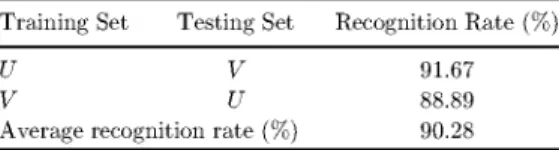
In the 2-fold cross-validation method, total image set is divided into two disjoint sets
U and V, respectively, and the U set is used for training and V set is used for testing purpose and the vice versa. Then the average percentage of recognition rate has been calculated on UGC-JU thermal face database, and the obtained result is shown in Table 1. The average recognition rate is found to be 100% for Terravic facial infrared database.
Table 1. Performance rate for simple approach using 2-fold cross-validation.
Training Set Testing Set Recognition Rate (%)
U V 91.67
V U 88.89
3.2. 3-fold cross-validation
In the 3-fold cross-validation method, total images are divided into three disjoint sets U, V and X, respectively. In the ¯rst part of this experimentation (Exp 1), one of these three sets is used for training purpose and rest two sets are used for testing purpose. The recognition rate on the test sets is calculated and shown in Table 2. The average percentage of recognition rate is found to be 100 for Terravic facial infrared database.
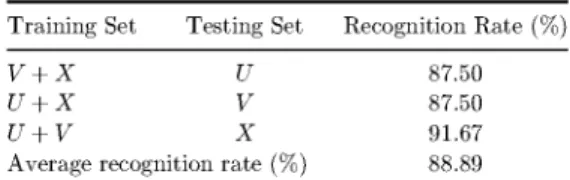
In the second part of experiment (Exp 2), two sets are used for training purpose and rest one set is used for testing purpose. The obtained recognition rates on the test set are calculated and reported in Table 3. The average recognition rate is found to be 100% for Terravic facial infrared database.
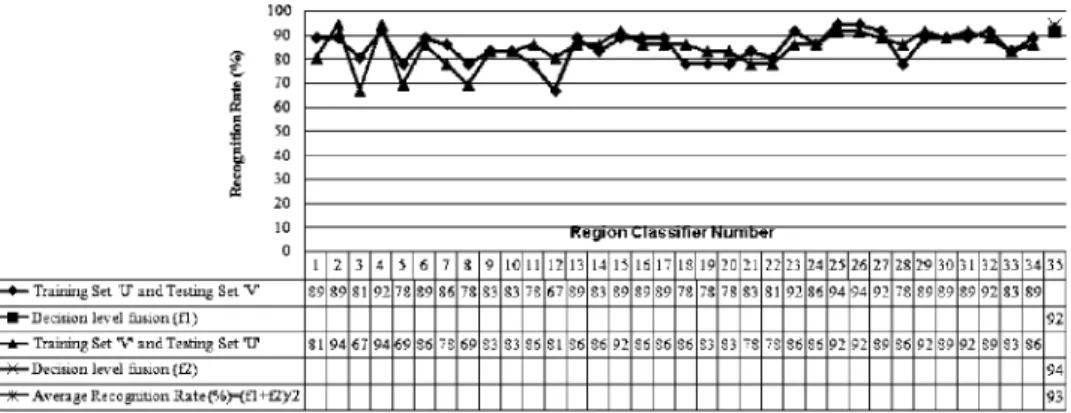
In the second set of experiments, region classi¯ers are used. Here, total images are also tested using both 2-fold and 3-fold cross-validation. For feature extraction, each region template is projected onto the training images, and pixel information is extracted from the mapped area (white area) from the training images. The pixel information is fed to the SVD module, and facesubspace and baseface are de¯ned. So, this process is repeated for all the region templates (34 di®erent regions). The per-formance of individual classi¯ers and the fused result for 2-fold cross-validation are shown in Fig. 7. `X'-axis of the following graphs represents the region classi¯er number and `Y '-axis represents the recognition rate in percentage. Here, the total classi¯er numbers are 34. So, in `X'-axis 34 di®erent marks are there. The 35th mark is used to represent the fused and average result. Five di®erent symbols (diamond, square, triangle, multiplication and asterisk) are used to represent the results of Training Set U and Testing Set V , Decision level fusion (f1), Training Set V and Testing Set U, Decision level fusion (f2) and Average recognition rate respectively
Table 2. Performance rate for simple approach using 3-fold cross-validation (Exp 1).
Training Set Testing Set
U V þ X V U þ X X U þ V
Average recognition rate (%)
Recognition Rate (%) 85.42 87.50 85.42 86.11
Table 3. Performance rate for simple approach using 3-fold cross-validation (Exp 2).
Training Set Testing Set
V þ X U U þ X V U þ V X
Average recognition rate (%)
Recognition Rate (%) 87.50 87.50 91.67 88.89
Fig. 7. Region classi¯er number versus recognition rate (%) for 2-fold cross-validation.
Fig. 8. Region classi¯er number versus recognition rate (%) for 3-fold cross-validation (Exp 1).
and the average Recognition rate is found to be 93.06%. The average recognition rate is found to be 100% for Terravic facial infrared database.
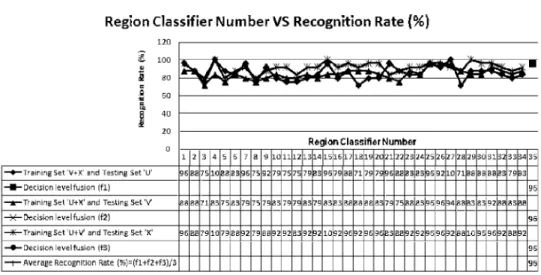
In the 3-fold cross-validation method, total image set is divided into three disjoint sets U, V and X, respectively. The 3-fold cross-validation method is also divided into two ways. In the ¯rst way, one set out of three sets is used for training and rest of the two sets is used for testing purpose, and the result is shown in Fig. 8. Average recognition result is 91.67%. In the second way, two sets are used for training and one set is used for testing purpose. Result is shown in Fig. 9. Average recognition result is 95.83%. The average recognition rate is found to be 100% for Terravic facial infrared database.
From the above tables, we have two little observations. First one is that, the region classi¯ers give a better result than a simple approach (without a region
Fig. 9. Region classi¯er number versus recognition rate (%) for 3-fold cross-validation (Exp 2).
classi¯er). Human can identify or distinguish a person by seeing his or her eye regions only since it is have a unique characteristic. The recognition results obtained from the Region classi¯er numbers 25, 26, and 27, which are concentrated on eye regions only, are better than that obtained from the other parts of the face.
4 . Comparison w i t h Other Methods
The present method has been compared with previous works of Seal et al.36,37,39 on
thermal face image recognition on the basis of their performances on the UGC-JU face database. In their previous work, three di®erent methods have been used to extract the blood perfusion image, namely bit-plane slicing and medial axis trans-form, morphological erosion and medial axis transtrans-form, `sobel' edge operators. Then two methods have been used to ¯nd the minutiae points from a blood perfusion image of a human face, which are unique for that face. After the extraction of minutiae points from a blood perfusion image, entire face image is divided into equal size square blocks, and the total number of minutiae points from each block is calculated and stored it in a vector to make ¯nal feature vector. Therefore, the size of the feature vectors is found to be same as the total number of blocks considered. A three layer feedforward back propagation neural network is used as a classi¯cation tool. The maximum recognition rate obtained on these methods is 95.24% which is quite satisfactory. But, these methods have several limitations. First, these minutiae-based techniques may be a®ected by occlusion, wear glass since these techniques are sensitive to proper localization of the minutiae points. Second, the success rate depends on the size of the block. Lastly, the exact localization of minutiae points are always a di±cult task. These limitations have been overcome using 34 di®erent Region-based classi¯ers, each was focusing on di®erent regions of the face. Here, the recognition performance depends on the aggregation of the decisions of the individual
region classi¯ers; failures of some of them are supplemented by the success of others. The present method has also been compared with one work, which is based on PCA, Wavelet, and SVM.19 In this work, the authors have used PCA and Haar level-4
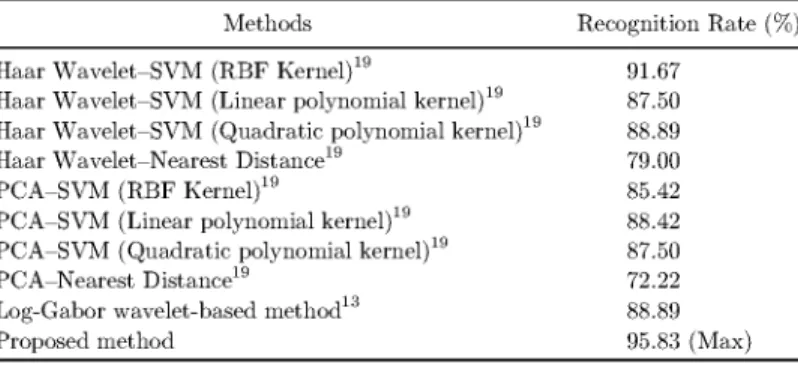
wavelet for extraction of features from the face images and fed these features into SVM with three types of kernels namely RBF kernel, Linear polynomial kernel and Quadratic polynomial kernel and Nearest Distance Classi¯er separately for classi¯-cation purpose. PCA and Haar level-4 wavelet are used in this work to extract the feature from the UGC-JU thermal face images for comparisons. The size of the low-frequency coe±cient array is 7 x 6 after level-4 decomposition. In this work, only LL4 coe±cients are used. The LL4 coe±cients of a face image are stored in the form of a row vector, and the size of the row vector is 1 x 42 (7 x 6 = 42). Here the face images are divided into two groups; one is used for training and the other for testing. All experiments are performed in MATLAB 2012 platform except SVM classi¯cation. For SVM, Weka 3.6.10 version is used. The obtained average recognition rate after 2-fold cross-validation is shown in Table 4.
In Ref. 19, authors have considered di®erent pose changes for their work, but in the present implementation only frontal face images with di®erent facial expressions are considered. The present work has also been compared with one of the existing work of Chen and Jing.13 The used algorithm consists of four steps. In the very ¯rst
step, Log-Gabor wavelets are used at four di®erent scales and six directions to form 24 images of the same size of the input face image. Some of the parameters need to be set for executing Log-Gabor wavelet transform. These parameters are wavelength of smallest scale ¯lter, scaling factor between successive ¯lters, ratio of the standard deviations of the radial Gaussian function to the ¯lter center frequency, and ratio of angular interval between ¯lter orientations and the standard deviation of the angular Gaussian function. In this experiment, the value of these parameters are set to be 3, 2, 0.65, and 1.5, respectively. Then all 24 transformed images are concatenated column wise to form feature vector. Then PCA has been used to reduce the size of the feature vector. ICA has been considered to get a new feature vector from the reduced feature vector. Top-match classi¯er is used for identifying the class label of the test
Table 4. Comparison of recognition performances of di®erent methods on UGC-JU thermal face image database.
Methods Recognition Rate (%)
Haar Wavelet–SVM (RBF Kernel)19 91.67
Haar Wavelet–SVM (Linear polynomial kernel)19 87.50
Haar Wavelet–SVM (Quadratic polynomial kernel)19 88.89
Haar Wavelet–Nearest Distance19 79.00
PCA–SVM (RBF Kernel)19 85.42
PCA–SVM (Linear polynomial kernel)19 88.42
PCA–SVM (Quadratic polynomial kernel)19 87.50
PCA–Nearest Distance19 72.22
Log-Gabor wavelet-based method13 88.89
face image. The same experiment has been done on UGC-JU thermal face database, and the obtained result is shown in Table 4. All the results support the conclusion that the face recognition performances based on region classi¯ers are better than all other above mentioned methods, and the proposed method also helps to remove the limitations of the above mentioned problems.
5. Conclusion
In this work, Region Classi¯er is used for the ¯rst time in the area of thermal face recognition. We have proposed a thermal face recognition system which is robust against the missing thermal information of the facial surface produced by the presence of inconsistent distribution of temperature statistics. Experiment is done on UGC-JU thermal face database and Terravic facial infrared database. Extensive experiments were carried out to illustrate the e±ciency of thermal face recognition using Region classi¯er and SVD. In terms of face classi¯cation, we have shown that dividing the facial surface into local regions and combining their individual views at the classi¯-cation level signi¯cantly improves the recognition rate. Furthermore, using SVD-based classi¯ers improves identi¯cation results: when local results are fused by ma-jority voting technique. The simple architecture of the proposed approach makes it computationally e±cient. Besides, no knowledge of geometry or speci¯c feature of the face is required. However, this system is applicable to front views and constant background only. It may fail in unconstrained environments like natural scenes. Acknowledgments
Authors are thankful to a major project entitled \Design and Development of Facial Thermogram Technology for Biometric Security System," funded by University Grants Commission (UGC), India and \DST-PURSE Programme" at Department of Computer Science and Engineering, Jadavpur University, India for providing the necessary infrastructure to conduct experiments relating to this work. Ayan Seal is grateful to Department of Science & Technology (DST), India for providing him Junior Research Fellowship-Professional (JRF-Professional) under DST-INSPIRE Fellowship programme [No: IF110591].
References
1. N. Alyuz, B . Gokberk and L. Akarun, 3D face recognition system for expression and occlusion invariance, 2nd IEEE Int. Conf. Biometrics: Theory, Applications and Systems (BTAS) (IEEE, 2008), pp. 1–7.
2. N. Alyuz, B . Gokberk and L. Akarun, Regional registration for expression resistant 3-D faces recognition, IEEE Trans. Inf. Forensics Security 5(3) (2010) 425–440.
3. M. Bartlett, H. Lades and T . Sejnowski, Independent component representations for face recognition, in Proc. SPIE Conf. Human Vision and Electronic Imaging III (1998), pp. 528–539.
4. M. P . Beham and S. M. M. Roomi, A review of face recognition methods, Int. J . Pattern Recogn. Artif. Intell. 27(4) (2013) 1356005.
5. P . N. Belhumeur, J . P . Hespanha and D. J . Kriegman, Eigenfaces vs. Fisherfaces: Rec-ognition using class speci¯c linear projection, IEEE Trans. Pattern Anal. Mach. Intell. 19(7) (1997) 711–720.
6. G. Beylkin, R. Coifman and V. Rokhlin, Fast wavelet transforms and numerical algorithms I, Commun. Pure App. Math. 44(2) (1991), 141–183.
7. D. Bhattacharjee, A. Seal, S. Ganguly, M. Nasipuri and D. K. Basu, A comparative study of human thermal face recognition based on Haar wavelet transform (HWT) and local binary pattern (LBP), Comput. Intell. Neurosci. (2012) doi: 10.1155/2012/261089. 8. M. K. Bhowmik, D. Bhattacharjee, M. Nasipuri, D. K. Basu and M. Kundu, Classi¯cation
of polar-thermal eigenfaces using multi-layer perceptron for human face, IEEE Region 10 Colloquium and the Third ICIIS, Kharagpur, India, 8–10 December (2008), pp. 1–6. 9. P . Buddharaju, I. Pavlidis and I. Kakadiaris, Face recognition in the thermal infrared
spectrum, in Proc. IEEE Computer Society Conf. Computer Vision and Pattern Recognition Workshops (CVPRW '04) (2004).
10. P . Buddharaju, I. Pavlidis and P . Tsiamyrtzis, Physiology-based face recognition using the vascular network extracted from thermal facial images: A novel approach, in Proc. IEEE Int. Conf. Advanced Video and Signal Based Surveillance, Como, Italy, 15–16 September, 2005, pp. 354–359.
11. P . Buddharaju, I. T . Pavlidis, P . Tsiamyrtzis and M. Bazakos, Physiology-based face recognition in the thermal infrared spectrum, IEEE Trans. Pattern Anal. Mach. Intell. 29(4) (2007) 613–626.
12. X. Chen, P . J . Flynn and K. W. Bowyer, PCA-based face recognition in infrared imagery: Baseline and comparative studies, in Proc. IEEE Int. Workshop on Analysis and Modeling of Faces and Gestures (AMFG '03) (2003), pp. 127–134.
13. X. Chen and Z. Jing, Infrared face recognition based on log-Gabor wavelets, Int. J . Pattern Recogn. Artif. Intell. 20(3) (2006) 351–360.
14. P . Comon, Independent component analysis — A new concept?, Signal Process. 36 (1994), 287–314.
15. R. Cutler, Face recognition using infrared images and eigenfaces (1996), Available at
http://citeseer.ist.psu.edu/cutler96face.html.
16. G. Friedrich and Y. Yeshurun, Seeing people in the dark: Face recognition in infrared images, in Second BMCV (2003), pp. 348–359.
17. S. Gong, S. J . Mckenna and A. Psarrou, Dynamic Vision: From Images to Face Recog-nition (ImperCooege Press, 2000).
18. R. C. Gonzalez and R. E . Woods, Digital Image Processing, 3rd edn. (Prentice Hall, 2002). 19. E. Gumus, N. Kilic, A. Sertbas and O. N. Ucan, Evaluation of face recognition techniques
using PCA, wavelets and SVM, Exp. Syst. Appl. 37 (2010) 6404–6408.
20. U. Halici, L. C. Jain and A. Erol, An introduction to ¯ngerprint recognition, in Intelligent Biometric Techniques in Fingerprint and Face Recognition eds. L. C. Jain, U. Halici, I. Hayashi, S. B . Lee and S. Tsutsui (CRC Press, Florida, 1999), pp. 3–34.
21. Z. Q. Hong, Algebraic feature extraction of image recognition, Pattern Recogn. 24(3) (1991) 211–219.
22. A. Jain, A. Ross and S. Prabhakar, An introduction to biometric recognition, IEEE Trans. Circuits Syst. Video Technol. 14(1) (2004) 4–20.
23. I. T . Joli®e, Principal Component Analysis (Springer, 1986).
24. G. A. Khuwaja and M. S. Laghari, Adaptive classi¯er integration for invariant face recognition (ACIIFR), Int. J . Pattern Recogn. Artif. Intell. 16(6) (2002) 749–772.
25. S. G. Kong, J. Heo, B . R. Abidi, J. P a i k a n d M. A. Abidi, Recent advances in visual a n d infrared face recognition—A review, Comput. Vis. Image Understand. 97 (2005) 103-135. 26. R. E. Madsen, L. K. Hansen a n d O. W i n t h e r , Singular value decomposition a n d principal component analysis, F e b r u a r y 2004, Available a t h t t p : / / w w w . l i b r a r y . c o r n e l l . e d u / n r / bookcpdf.html.
27. S. Majumder, G. Majumder a n d M. Bhowmik, H u m a n face mosaicing using t h e r m a l image, in Journal of the Tripura Mathematical Society, Special Vol. 13 ( T r i p u r a M a t h -ematical Society, 2011), p p . 145-153.
28. C. M a n o h a r , E x t r a c t i o n of super¯cial vasculature in t h e r m a l imaging, Master's thesis, Dept. Electrical Eng., Univ. of Houston, Houston, Texas (2004).
29. B . S. Morse, Lecture 2: Image Processing Review, Neighbors, Connected C o m p o n e n t s , a n d Distance (1998-2004), available at h t t p : / / h o m e p a g e s . i n f . e d u . a c . u k / r b f / C V o n l i n e / L O C A L . C O P I E S / M O R S E / c o n n e c t i v i t y . p d f .
30. I. Naseem, Linear regression for face recognition, IEEE Trans. Pattern Anal. Mach. Intell. 32(11) (2010) 2106-2112.
31. O T C B V S W S Series Bench; J. Davis a n d M. Keck, A t w o stage a p p r o a c h t o person detection in t h e r m a l imagery, in Proc. Workshop on Applications of Computer Vision, J a n u a r y 2005, p p . 364-369.
32. F . Prokoski, History, current s t a t u s , a n d future of infrared identi¯cation, in Proc. IEEE Workshop Computer Vision Beyond Visible Spectrum: Methods and Applications (2000), p p . 5-14.
33. F . J. Prokoski a n d R. Riedel, Infrared identi¯cation of faces a n d body p a r t s , in BIO-METRICS: Personal Identi¯cation in Networked Society, C h a p . 9 (Kluwer Academic Publishers, 1998), p p . 1-23.
34. F . J. Prokoski, R. B . Riedel a n d J. S. C o ± n , Identi¯cation of individuals by means of facial t h e r m o g r a p h y , in Proc. IEEE 1992 Int. Carnahan Conf. Security Technology:
Crime Countermeasures, A t l a n t a , G A , U S A , 14-16 October 1992 ( I E E E ) , p p . 120-125. 35. D. Rizo-Rodríguez, H. Mendez-Vazquez a n d E. García-Reyes, Illumination invariant face
recognition in quaternion domain, Int. J. Pattern Recogn. Artif. Intell. 27(3) (2013) 1360004. 36. A. Seal, D. Bhattacharjee, M. Nasipuri a n d D . K. Basu, Minutiae based t h e r m a l face
recognition using blood perfusion d a t a , in Proc. IEEE Int. Conf. Image Information Pro-cessing, J a y p e e University of Information Technology, India, 3-5 November, 2011, p p . 1-4. 37. A. Seal, D. B h a t t a c h a r j e e , M. Nasipuri a n d D . K. Basu, Minutiae from bit-plane sliced
t h e r m a l images for h u m a n face recognition, in Proc. Springer Int. Conf. Soft Computing for Problem Solving, Roorkee, India, 20-22 December, 2011, p p . 113-124.
38. A. Seal, D . Bhattacharjee, M. Nasipuri a n d D. K. Basu, U G C - J U face d a t a b a s e a n d its benchmarking using linear regression classi¯er, Multimedia Tools Appl. (2013), doi: 10.1007/s11042-013-1754-8.
39. A. Seal, S. Ganguly, D. B h a t t a c h a r j e e , M. Nasipuri a n d D. K. Basu, Minutiae based t h e r m a l h u m a n face recognition using label connected component algorithm, in Proc. International Conference on Computer, Communication, Control and Information Technology, India, 25-26 F e b r u a r y , 2012, p p . 604-611.
40. A. Selinger a n d D. A. Socolinsky, Appearance-based facial recognition using visible a n d t h e r m a l imagery: A comparative study, Equinox Corporation, Technical Report 02-01 (2002).
41. Y. Shinohara a n d N. Otsu, Facial expression recognition using ¯sher weight m a p s , Sixth IEEE Int. Conf. Automatic Face and Gesture Recognition, Vol. 100 (2004), p p . 499-504. 42. T . Sim, R. S u k t h a n k a r , M. Mullin a n d S. Baluja, Memory-based face recognition
for visitor identi¯cation, in Proc. IEEE Int. Conf. Automatic Face and Gesture Recog-nition (2000), p p . 214-220.
43. D. A. Socolinsky and A. Selinger, Thermal face recognition in an operational scenario, in Proc. CVPR 2004, Washington, DC (2004), pp. 1012–1019.
44. D. Socolinsky, L. Wol®, J . Neuheisel and C. Eveland, Illumination invariant face recog-nition using thermal infrared imagery, in IEEE Computer Society Int. Conf. Computer Vision and Pattern Recognition, Vol. 1. Kauai, HI, USA (2001), pp. 527–534.
45. L. J . Spreeuwers, Fast and accurate 3D face recognition using registration to an intrinsic coordinate system and fusion of multiple region classi¯ers, Int. J . Comput. Vis. 93(3) (2011) 389–414.
46. E. J . Stollnitz, T. D. DeRose and D. H. Salesin, Wavelets for computer graphics: A primer, part 1, IEEE Comput. Graphics Appl. 15(3) (1995) 76–84.
47. L. Trujillo, G. Olague, R. Hammoud and B. Hernandez, Automatic feature localization in thermal images for facial expression recognition, in Proc. CVPR '05 Proc. the 2005 IEEE Computer Society Conf. Computer Vision and Pattern Recognition (CVPR '05), Washington, DC, USA (2005), p14.
48. M. Turk and A. Pentland, Eigenfaces for recognition, J . Cognit. Neurosci. 3 (1991) 71–86. 49. J . Wilder, P . Phillips, C. Jiang and S. Wiener, Comparison of visible and infra-red
im-agery for face recognition, in Proc. IEEE Int. Conf. Automatic Face and Gesture Rec-ognition (AFGR '96), Killington, Vermont, October 1996, pp. 182–187.
50. S. Wu, Z. J . Fang, Z. H. Xie and W. Liang, Blood perfusion models for infrared face recognition, School of information technology, Jiangxi University of Finance and Eco-nomics, China, Vienna, Austria (2008), p . 236.
51. S. Wu, W. Song, L. J . Jiang, S. Xian, F . Pan, W. Y. You and S. Ranganath, Infrared face recognition by using blood perfusion data, in Proc. Int. Conf. Audio Video Based Bio-metric Person Authentication, New York, USA, 20–22 July, 2005, pp. 320–328.
52. Y. Yoshitomi, T . Miyaura, S. Tomita and S. Kimura, Face identi¯cation using thermal image processing, in Proc. IEEE Int. Workshop Robot Human. Communication (1997), pp. 374–379.