Window-Based Data Parallelization in
Complex Event Processing
Von der Fakultät Informatik, Elektrotechnik und
Informationstechnik der Universität Stuttgart zur Erlangung der
Würde eines Doktors der Naturwissenschaften (Dr. rer. nat.)
genehmigte Abhandlung
vorgelegt von
Ruben Daniel Mayer
aus Heilbronn-Neckargartach
Hauptberichter:
Prof. Dr. rer. nat. Dr. h. c. Kurt Rothermel
Mitberichter:
Prof. Dr. Umakishore Ramachandran
Tag der mündlichen Prüfung:
19.03.2018
Institut für Parallele und Verteilte Systeme (IPVS)
der Universität Stuttgart
Acknowledgements
Performing the research that has led to this thesis would not have been possible without the help of many people. First of all, I want to thank my doctoral advisor, Prof. Kurt Rothermel, for his support and guidance throughout the whole time. I also want to thank Prof. Umakishore Ramachandran, who gave me a lot of advice over the years and even came all the way from Atlanta to Stuttgart for my thesis defense.
Special thanks go to Boris Koldehofe, who was my post-doc in the first two years of my PhD. He introduced my into the topic of CEP, and also into the research community in that field. Moreover, I thank Adnan Tariq, my post-doc in the second half of my PhD, for his support and hard work. In the end, the work wouldn’t have been possible without such great supervisors. I learned a lot from both of you!
More thanks go to all the colleagues at IPVS who made the work in Stuttgart very pleasant. Namely, I thank Beate Ottenwälder, Christian Mayer, Christoph Dibak, Frank Dürr, and Ahmad Slo, who in one or the other way collaborated with me or gave valu-able feedback. Also, I thank Enrique Saurez and Harshit Gupta from EPL at Georgia Tech, who made my stay there a very interesting and enjoyable experience.
Last but not least, I would like to thank the Baden-Württemberg Stiftung and the DFG for their financial support through the projects that enabled the research work done in this thesis.
There is more to a PhD than only good scientific support, a pleasant work environment at university, and the necessary funding. In the course of the PhD, there are ups and downs, and both are better to handle when there is support at home, outside of the office hours. I thank you, An Jing, for your continuous support and encouragement throughout the whole time.
Contents
Abstract 15 Zusammenfassung 17 1 Introduction 19 1.1 Background . . . 22 1.1.1 Technological Trends . . . 221.1.2 Complex Event Processing (CEP) . . . 24
1.1.3 Operator Parallelization in CEP . . . 29
1.1.4 Project Background . . . 32
1.2 Research Scope and Goals . . . 34
1.3 Contributions . . . 35
1.4 Structure . . . 37
2 Fundamentals 39 2.1 CEP Model . . . 39
2.2 System Model . . . 44
2.3 Data Parallelization Architecture . . . 45
2.3.1 Overview . . . 45
2.3.2 Operator Latency . . . 47
2.3.3 Operator Configuration . . . 48
3 Stream Partitioning and Adaptation 49 3.1 System Model . . . 51
3.2 Problem Description . . . 52
3.3 Window-based Stream Partitioning . . . 54
3.3.1 Partitioning Model . . . 54
3.3.2 Runtime Environment . . . 55
3.3.3 Expressiveness . . . 56 5
6 CONTENTS
3.4 Adapting the Parallelization Degree . . . 57
3.4.1 Workload Monitoring and Prediction . . . 58
3.4.2 Operator Profiling . . . 60
3.4.3 Degree Calculation . . . 60
3.4.4 Adaptation . . . 62
3.5 Evaluation . . . 64
3.5.1 System Parameters . . . 64
3.5.2 Dynamic Degree Adaptation . . . 65
3.5.3 Approximating Distributions . . . 69 3.5.4 Splitter Throughput . . . 70 3.6 Related Work . . . 71 3.7 Conclusion . . . 73 4 Bandwidth-Efficient Scheduling 75 4.1 Problem Description . . . 76 4.2 Batch Scheduling . . . 78 4.2.1 Key Factors . . . 79 4.2.2 Reactive Controllers . . . 83 4.3 Model-based Controller . . . 86 4.3.1 Basic Approach . . . 86
4.3.2 Prediction of Model Parameters . . . 88
4.3.3 Scheduling Algorithm . . . 91
4.4 Evaluation . . . 93
4.4.1 Latency Model . . . 95
4.4.2 Overall Event Processing System . . . 100
4.5 Related Work . . . 103
4.6 Conclusion . . . 104
5 Supporting Consumption Policies 105 5.1 System Model and Problem Analysis . . . 106
5.1.1 Extensions of the System Model . . . 106
5.1.2 Challenges and Goal . . . 107
5.2 The SPECTRE System . . . 109
5.2.1 Speculation Approach . . . 109
5.2.2 Selecting and Scheduling the Top-k Window Versions . . . . 114
5.2.3 Parallel Processing of Window Versions . . . 119
CONTENTS 7
5.3.1 Experimental Setup . . . 122
5.3.2 Performance Evaluation . . . 124
5.4 Related Work . . . 130
5.5 Conclusion . . . 131
6 Efficient Rollback-Recovery with Savepoints 133 6.1 System Model . . . 134
6.2 Approach Overview . . . 135
6.3 Execution Model . . . 137
6.3.1 Properties . . . 139
6.3.2 Expressiveness . . . 140
6.4 Capturing and Replicating Savepoints . . . 142
6.4.1 Log and Savepoint Management . . . 142
6.4.2 Coordination of Savepoints . . . 143
6.5 Algorithms for Operator Recovery . . . 147
6.5.1 Recovery of the State of Failed Operators . . . 147
6.5.2 Control and Adjustment of the Operator Topology . . . 148
6.5.3 Correctness Analysis . . . 152
6.6 Evaluation . . . 153
6.6.1 Run-time Overhead . . . 154
6.6.2 Analytical Model of Recovery Overhead . . . 156
6.6.3 Conclusions on the Evaluation . . . 157
6.7 Extensions . . . 158
6.8 Related Work . . . 160
6.9 Conclusion . . . 162
7 Conclusion and Outlook 163 7.1 Summary . . . 163
7.2 Outlook . . . 165
List of Figures
1.1 Traffic monitoring: Surveillance of a no-passing zone. . . 25 1.2 Friend finder: Finding a person in a video stream. . . 25 1.3 Queries for the example operatorsωovertake from the traffic monitoring
scenario andωf_rec.from the friend finder scenario. . . 27 1.4 Conceptual architecture of a data parallelization framework. . . 31 2.1 Schematic of an exemplary operator graph. . . 39 2.2 QueryQE with different selection policies (SP) and consumption
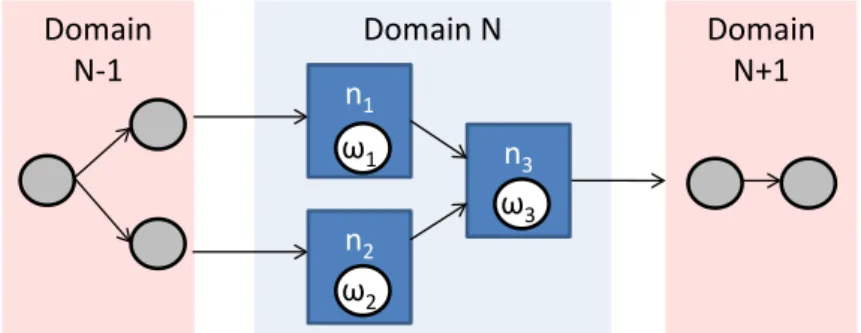
poli-cies (CP). . . 44 2.3 Administrative domains. The coarse-grained placement of operator
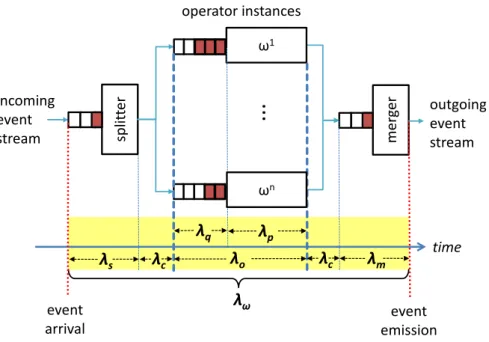
sub-graphs on the different domains is given. . . 45 2.4 Parallel operator model and composition of operator latency between
event arrival and (complex) event emission. . . 46 3.1 Predicates for the time sliding window operator. . . 55 3.2 Predicates for the sequence operator SEQ(A;B). . . 56 3.3 Support of consistent partitioning. ‘x’ denotes supported, ‘–’ denotes
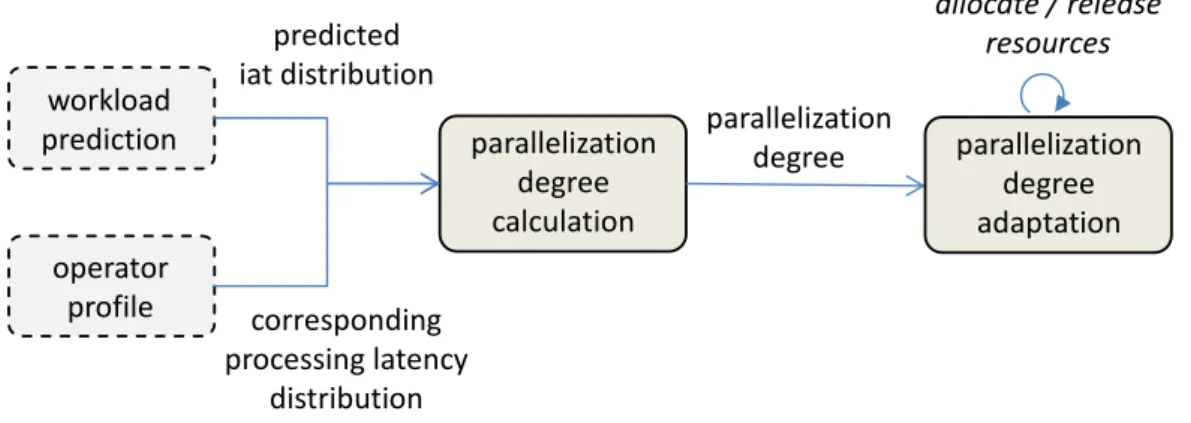
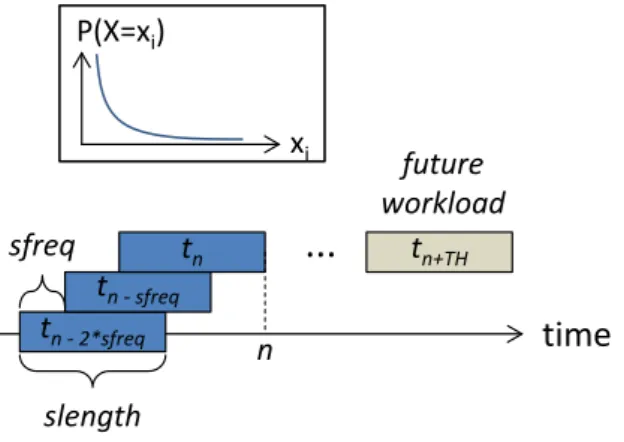
not supported. . . 57 3.4 Workflow of the adaptation of the parallelization degree. . . 58 3.5 Schematic: workload distribution at an operator in a time slice. . . . 59 3.6 Algorithm for calculating the optimal parallelization degree. . . 61 3.7 Algorithm for adapting the parallelization degree. . . 62 3.8 Processing measurements in time slices with the QT-DYN algorithm. . 64 3.9 Operator profile ofωovertake. . . 65 3.10 Evaluation results for different scenarios. . . 68 3.11 Parameters, corresponding approximations and calculated
paralleliza-tion degrees for the approximated distribuparalleliza-tions. . . 70 4.1 Splitting and scheduling. . . 78
10 LIST OF FIGURES
4.2 Evaluation of processing latency. . . 79
4.3 Max. operational latency, queue length and feedback delays. . . 81
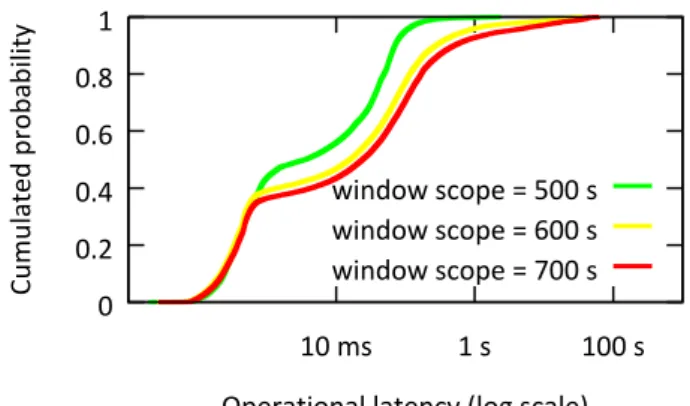
4.4 Traffic monitoring: Operational latency with reactive batch scheduling atTH=100msunder different window scopes. . . 85
4.5 Different sequences of negative and positive gains, in worst case (WC), best case (BC) and in a medium case (MC). . . 87
4.6 iatbins. . . 89
4.7 Overlap. . . 89
4.8 Predict negative and positive gains. . . 92
4.9 Batch scheduling algorithm. . . 92
4.10 Symbols used. . . 94
4.11 Face recognition operator atws=10s: prediction of negative and pos-itive gains. b=1. . . 96
4.12 Traffic monitoring operator atws=900s: prediction of negative and positive gains. b=1000. . . 97
4.13 Higher batch sizes. (a) Face recognition,b=4. (b) Traffic monitoring, b=2000. . . 98
4.14 Predictions of queuing latency peak. Face recognition operator,b=4, ws=10s. . . 99
4.15 Predictions of queuing latency peak. Traffic monitoring operator,b= 2000,ws=900s. . . 99
4.16 Traffic monitoring operator. (a) Operational latency. (b) Communica-tion cost. . . 101
4.17 Face recognition operator. (a) Operational latency. (b) Communication cost. . . 102
4.18 Latency of (a) scheduling and (b) updating statistics. . . 102
5.1 Data parallelization framework. . . 106
5.2 QE with selection policy “earliest A, each B” and consumption policy “selected B”. . . 107
5.3 Consumption Problem: (a) Structural View. (b) Processing View. (c) Man-agement View. . . 109
5.4 Algorithms for managing the dependency tree. . . 113
5.5 Calculation of completion probability of a consumption group. . . 116
5.6 Top-k window version selection algorithm. . . 118
5.7 Splitter: Scheduling algorithm. . . 118
LIST OF FIGURES 11
5.9 Queries. . . 123
5.10 Evaluations. (a)+(d): Scalability (Q1 on NYSE). (b)+(e): Scalability (Q2 on NYSE). (c)+(f): Overhead (Q1 on NYSE). . . 125
5.11 Evaluation of Markov Model. . . 129
6.1 Operator Model. . . 136
6.2 Example: Interface calls to the EE when shifting the window. . . 138
6.3 ACK flow and pruning ofQO. . . 143
6.4 Algorithm for log and savepoint maintenance at an operatorω. . . 145
6.5 Example: Event and ACK flow in an operator graph. . . 146
6.6 Algorithms for recovery of an operatorω. . . 147
6.7 Algorithm for monitoring and management of operator topology at the coordinator. . . 150
6.8 Recovery from an operator failure. . . 151
6.9 Run-time overhead comparison between rollback-recovery and active replication. . . 153
6.10 Lifetime of events in the sources against the number of sequential op-erators between sources and sinks. . . 155
6.11 Influence of the ACK frequency at the event sink on the overall com-munication overhead and the maximal size ofQOat the source. . . 156
List of Abbreviations
API Application Programming Interface CEP Complex Event Processing
DAG Directed Acyclic Graph FIFO First In First Out
IaaS Infrastructure as a Service iat Inter-arrival time
IoT Internet of Things LAN Local Area Network NYSE New York Stock Exchange
QoS Quality of Services QT Queuing Theory
SPECTRE SPECulaTive Runtime Environment TCP Transmission Control Protocol
VM Virtual Machine
Abstract
With the proliferation of streaming data from sources such as sensors in the Internet of Things (IoT), situational aware applications become possible. Such applications react to situations in the surrounding world that are signaled by complex event patterns that occur in the sensor streams. In order to detect the patterns that correspond to the situa-tions of interest, Complex Event Processing (CEP) is the paradigm of choice. In CEP, a distributed operator graph is spanned between the event sources and the applications. Each operator step-wise detects event patterns on subsequences, called windows, of its input stream and forwards output events that signal the detection to its successors. To cope with the ever-increasing workload at the operators, operator parallelization be-comes necessary. To this end, data parallelization is a powerful paradigm, building on an architecture that consists of a splitter, operator instances and a merger, to scale up and scale out CEP operators. In doing so, the operators need to provide consistent out-put streams, i.e., not produce false-negatives or false-positives, keep a latency bound on pattern detection, elastically adapt their resource reservations to the workload, and be fault-tolerant against node and network failures. Related work has proposed data parallelization techniques that build on splitting the input event streams of an operator either in a key-based, a batch-based or a pane-based way. These approaches, however, only support a limited range of CEP operators.
The goals of this thesis are (i) to support data parallelization for all window-based CEP operators, (ii) to develop adaptation methods such that CEP operators can keep a user-defined latency bound while minimizing costs for computing and networking resources, and (iii) to develop recovery methods that guarantee fault-tolerance at a low run-time overhead.
To this end, the following contributions are made. First, we propose a window-based data parallelization method that is based on the externalization of the operator’s win-dow policy to a data parallelization framework. Second, basing on Queuing Theory, we propose a method to adapt the operator parallelization degree at run-time to the workload such that probabilistic bounds on the event buffering in the operator can be
16 ABSTRACT met. Third, we propose a batch scheduling algorithm that is able to assign subsequent overlapping windows to the same operator instance, so that communication overhead is minimized, while a latency bound in the operator instances is still kept. Forth, we pro-pose a framework for parallel processing of inter-dependent windows that is based on the speculative processing of multiple versions of multiple windows in parallel. Fifth, we propose a lightweight rollback recovery method for CEP operator networks that exploits the externalization of the operator window policy to allow for the recovery of an arbitrary number of operators.
Zusammenfassung
Die zunehmende Verbreitung von Datenströmen aus Quellen wie Sensoren im Inter-net der Dinge macht situationsbewusste Anwendungen möglich. Solche Anwendun-gen reagieren auf Situationen in der Umgebung, die durch komplexe Ereignismuster in den Datenströmen signalisiert werden. Um Ereignismuster zu erkennen, die den in-teressanten Situationen entsprechen, wird heute komplexe Ereignisverarbeitung, oder Complex Event Processing (CEP), intensiv genutzt. In CEP wird ein verteilter Ope-ratorengraph zwischen den Ereignisquellen und den Anwendungen, die CEP nutzen, aufgespannt. Jeder Operator detektiert schrittweise Ereignismuster in Teilsequenzen seiner Eingangsströme, die Fenster genannt werden. Erkannte Ereignismuster werden den Nachfolgern im Operatorengraph durch Ausgangsereignisse angezeigt. Um mit den immer weiter zunehmenden Arbeitslasten der Operatoren umgehen zu können, ist deren Parallelisierung notwendig. Zu diesem Zweck ist die Datenparallelisierung ein mächtiges Werkzeug. Sie basiert darauf, anhand einer dreistufigen Architektur, beste-hend aus Splitter, Operatorinstanzen und Merger, die Operatoren zu skalieren. Dabei müssen die Operatoren einen konsistenten Ausgangsstrom erzeugen, der keine falsch-negativen und falsch-positiven Ereignisse enthält, eine Latenzschranke in der Ereigni-serkennung einhalten, ihre Ressourcenreservierungen elastisch an die Arbeitslast an-passen, und fehlertolerant gegenüber Knoten- und Netzwerkfehlern sein. Verwandte Arbeiten haben Techniken zur Datenparallelisierung vorgeschlagen, die darauf bau-en, eingehende Datenströme im Splitter entweder anhand eines Schlüsselwertes, einer Stapelgröße oder in Scheiben, sogenannten Panes, aufzuspalten. Diese Techniken un-terstützen jedoch nur eine begrenzte Auswahl von Operatoren.
Die Ziele dieser Dissertation bestehen darin, (i) Datenparallelisierung für alle fenster-basierten CEP-Operatoren zu ermöglichen, (ii) Adaptionsmechanismen zu entwickeln, sodass Operatoren eine nutzerdefinierte Latenzschranke einhalten können, während die Kosten für Rechen- und Netzwerkressourcen minimiert werden, und (iii) Wiederher-stellungsmethoden zu entwickeln, die Fehlertoleranz zu geringen Laufzeitkosten ga-rantieren.
18 ZUSAMMENFASSUNG Zu diesem Zweck werden die folgenden Beiträge geleistet. Erstens schlagen wir eine fensterbasierte Datenparallelisierungsmethode vor, die darauf basiert, dass die Fen-sterbewegungen eines Operators einem Datenparallelisierungsframework gegenüber offengelegt werden. Zweitens schlagen wir eine Methode zur Adaption des Operators vor, die auf Warteschlangentheorie beruht und zur Laufzeit den Parallelisierungsgrad des Operators so an die Arbeitslast anpasst, dass probabilistische Grenzen in Bezug auf die Pufferung von Ereignissen im Operator durchgesetzt werden. Drittens schlagen wir einen Schedulingalgorithmus vor, der aufeinander folgende und überlappende Fenster der gleichen Operatorinstanz zuweist, sodass der Kommunikationsaufwand minimiert wird, während eine Latenzschranke in den Operatorinstanzen eingehalten wird. Vier-tens schlagen wir ein Framework für die parallele Verarbeitung voneinander abhängi-ger Fenster vor, das auf der spekulativen, parallelen Verarbeitung mehrerer Versionen mehrerer Fenster basiert. Fünftens schlagen wir eine leichtgewichtige Wiederherstel-lungsmethode für CEP-Operatorennetzwerke vor, die die Offenlegung der Fensterbe-wegungen eines Operators ausnutzt, um die Wiederherstellung einer beliebigen Anzahl von Operatoren zu ermöglichen.
1
Introduction
In the recent years, we face an unseen boost ofstreaming databecoming available from sensors, social networks, stock markets, and various other sources. For instance, bil-lions of sensors andsmart objects, i.e., objects with embedded electronics that enable identification, sensing and actuation capabilities, are deployed throughout the globe, collecting data about the physical world. They grow in numbers [Int14] and have the power to enable new applications in the areas of smart homes, smart cities, environ-mental monitoring, health-care, smart business and security, paving the way towards theInternet of Things(IoT) [AIM10, MSPC12]. This bears a huge economical poten-tial: For instance, in the IoT, revenues of 267 billion USD have been predicted for the year 2020 by Forbes [For17] .
The data streams from sources like sensors contain valuable information about the situation in the surrounding world. For instance, sensor data in a traffic monitoring environment can contain information on the current traffic flow. However, the single data elements—also referred to asevents—like position updates of cars stemming from GPS sensor readings, contain only low level information. In order to gain higher level insights that are valuable for interested parties—such as other vehicles that adapt their route to a traffic jam or traffic operators that open additional lanes on a high-way—the low level source event streams have to be aggregated such that situations of interest can be detected. To this end, a middleware is needed between the event sources and sinks that enables theconsistent andtimelydetection of situations by integrating and continuously analyzing the low level source event streams. Consistency in situation detection means that neither false-positives nor false-negatives should occur, i.e., nei-ther should a situation be detected that is not signaled in the source event streams, nor
20 1. INTRODUCTION should a situation detection be missed when the source event streams actually signal it. Inconsistent situation detection can lead to wrong decisions, e.g., wrong routing de-cisions, that cost money and degrade customer satisfaction, or even can cause serious damage. Timeliness in situation detection refers to the time span between the point in time when the last source event that signals a situation of interest has been emitted and the point in time when the corresponding situation is actually detected and signaled to the interested party. Late detections of a situation are, in the worst case, useless for the end user; the acceptable delay between the occurrence of a situation and its detection is application-dependent and can be specified as alatency boundby a domain expert.
Complex Event Processing (CEP) [Luc01, BOO09, CM10, KKR10, CM12c] is a key paradigm that helps in realizing a middleware for situation detection. CEP allows for specifying a network of multiple dependent operators that step-wise transform low-level event streams into complex events that correspond to the situations of interest, e.g., critical power grid situations or traffic jams. Operators detect event patterns on their incoming event streams. Often, the pattern detection is window-based, i.e., pat-terns are detected on restricted event sequences—denoted as windows—of the incom-ing event streams. Windows can have arbitrary size and slide—i.e., move—dependincom-ing on thewindow policyand on the events occurring in the incoming streams. In partic-ular, subsequent windows can overlap, i.e., they have an event sequence in common. CEP systems further provide means to execute the operators in a distributed manner to ensure an efficient utilization of the available resources [PLS+06, RDR10, CGLPN16]. In doing so, applications often encompass a high and fluctuating number of events to be processed. This challenges CEP systems in several ways: First, high rates of incoming event streams make it necessary to run single operators in a parallel fashion, exploiting multi-core architectures (scale-up) as well as computing clusters that encompass mul-tiple machines (scale-out). This challenge is referred to as operator parallelization. Second, the fluctuation of data rates makes it necessary to elastically provide the com-putational resources that are necessary to process the current load, as providing for the worst-case event rates would lead to costly over-provisioning in times of lower pres-sure. This challenge is referred to asoperator elasticity. Furthermore, the CEP system needs to be able to cope with node and network failure, referred to asreliability.
Generally,data parallelizationis a promising method to scale up and scale out opera-tors in an elastic manner by employing a split–process–merge architecture. Asplitter
partitions the incoming event streams of an operator into independently processable parts which are processed in parallel by an elastic set of operator copies, denoted as
21
operator instances. The detected complex events are emitted by the operator instances to amerger that sorts them into a deterministic order. In this setting, the crucial ques-tion is how to split the event streams such that the partiques-tions can be processed inde-pendently by the operator instances in parallel. The existing splitting approaches, key-based [Hir12, FMKP13], batch-key-based [BDWT13] and pane-key-based [BT11, KWF+16] splitting, are insufficient in terms of expressiveness, i.e., they do not support window-based CEP operators.
Besides that, window-based operators challenge existing elasticity methods. When windows are large, assigning a window to an operator instances impacts the processing load on that instance for a long time. Moreover, the processing load that a single event in a window puts on the operator instance may depend on the event’s position in the window [MTR17]. While processing a window, processing state is gathered in the operator instance. This state may grow over the course of the window, such that later events in the window yield heavier processing load. Elasticity methods that just react on feedback parameters, e.g., CPU utilization in the operator instances [FMKP13], are not able to stabilize the system in such challenging conditions.
Furthermore, the scheduling of windows to operator instances influences the process-ing load and hence, the latency, induced in the operator instances. Assignprocess-ing differ-ent overlapping windows to differdiffer-ent operator instances implies that evdiffer-ents from the overlapping sequence of the event stream have to be replicated to both operator in-stances, leading to higher communication overhead. If the overlapping windows are all assigned to a single operator instance in one batch, events are not replicated and communication overhead is reduced, but the load on that operator instance is higher, so that the latency increases. In the literature, there is a lack of methods to control the trade-off between communication overhead and latency in operator instances.
Lastly, window-based operators lack efficient reliability-preserving mechanisms. Pro-viding active [Sch90, VKR11] or passive [BMST93] standby operators causes a lot of cost; to survive f operator failures, f+1 replicas of an operator need to be provisioned. To overcome the large overhead, roll-back recovery has been proposed, where check-points of the operator state are periodically taken; in case of a failure, the operator state is recovered from the checkpoint [EAWJ02, SM11]. Still, as window-based operators may gather a large internal state while processing large windows, checkpointing causes a lot of overhead even at failure-free run-time. A more lightweight roll-back recovery method that exploits the window policies in the operator to avoid costly checkpoints of the internal state is still lacking.
22 1. INTRODUCTION The goal of this thesis is to develop concepts and algorithms that support the scalability, elasticity, and reliability of window-based CEP operators. To this end, an expressive stream partitioning method is presented that allows for utilizing data parallelism in all window-based CEP operators. Further, a model-based elasticity method is presented that allows for taking into account workload fluctuations and processing latency fluc-tuations in operator instances by providing a problem formulation and adaptation algo-rithm that are based on Queuing Theory. To control the scheduling of windows to op-erator instances, a batch scheduling controller is proposed that tries to minimize com-munication overhead while keeping a latency bound in the operator instances. Lastly, a rollback recovery approach is developed that takes into account operator feedback about the window policies in order to avoid heavy-weight checkpointing of operator state, thus reducing run-time overhead.
1.1
Background
This section introduces the background of the thesis work. First, the technological trends that influence the thesis work are discussed in Section 1.1.1. Following that dis-cussion, in Section 1.1.2, the paradigm of CEP is introduced, providing an overview of current CEP systems and discussing requirements posed on the CEP systems in the context of the discussed technological trends and scenarios. High data rates can only be handled by employing parallelization on the CEP system; the current paralleliza-tion methods are, hence, discussed in Secparalleliza-tion 1.1.3 and shortcomings in supporting the requirements on CEP are highlighted. Overcoming those shortcomings for window-based CEP operators is the major goal of this thesis. The thesis has been carried out in the scope of two subsequent projects, funded by the Baden-Württemberg Stiftung gGmbH and the Deutsche Forschungsgesellschaft DFG. Section 1.1.4 provides back-ground information on those research projects.
1.1.1
Technological Trends
Two major technological trends that influence the field of CEP are regarded in this thesis: (1) The surge of streaming databeing available, and (2) the cloud computing
paradigm enabling the elastic provisioning of resources. In this section, these trends are discussed with focus on their impact on the design of CEP systems.
1.1. BACKGROUND 23
Streaming Data
There is an ongoing trend of increasing availability of all kinds of sensor data. In the course of the proliferation of the Internet of Things, “smart” things equipped with sensors are deployed in billions in the surrounding world [Int14], producing a huge amount of streaming data. Moreover, with the surge of social networks such as Face-book, Twitter, etc., the trend ofSocial Sensingis emerging [AA13, MGSR17a], where humans serve as sensor carriers or sensors themselves, emitting messages, posts and tweets. Such data streams contain valuable high-level information that can be ex-ploited by analyzing the low-level data “on the fly”. For instance, analyzing sensor streams of cars allows for live vehicle diagnosis [SZG10], analyzing smart meter data allows for load predictions and outlier detections [JZ14], analyzing smart factory data allows for detecting anomalies in the production process [GJK+17], and analyzing Twitter streams allows for performing sentiment analysis [AXV+11] and even predict-ing crowd behavior [Kal14].
Cloud Computing
Cloud computing [Hay08, BYV+09, AFG+10] is a paradigm that describes the advent of computing and storage as a utility. That means, that users get provisioned with resourceson demand, and get billed for those resources according to their usage ( pay-as-you-go). This view of cloud computing is also often referred to as “Infrastructure as a- Service” (IaaS). The on-demand resource provisioning in cloud computing en-ables anelasticstyle of scaling data analytics frameworks according to the fluctuating workload. The incentives of elasticity are clear: Instead of providing (and paying for) resources for the anticipated peak workload, the system rather adapts its resource reser-vations to the workload in such a way that always enough resources are available to keep the Quality of Services (QoS) goals, such as throughput and latency, but to avoid costly overprovisioning.
Besides the advantages of elastic resource provisioning, cloud computing also offers a high level of abstraction that eases the deployment and management of applica-tions [Hay08]. Instead of administrating and maintaining their own infrastructure, which is cumbersome and costly, users can buy that service as well from the cloud providers. Cloud providers offer a simple resource provisioning abstraction, i.e., pre-defined “flavors” of virtual machines (VMs). Problems such as load balancing and
24 1. INTRODUCTION placement of the VMs on the infrastructure [RLTB10], migration of VMs [VBVB09], etc., are handled by the cloud provider and are opaque to the user.
1.1.2
Complex Event Processing (CEP)
Complex Event Processing (CEP) [Luc01, BOO09, CM12c] has evolved as the para-digm of choice to detect and integrate events in situation-aware applications. In CEP, domain experts specify a query in aquery languagelike Snoop [CM94], Amit [AE04], SASE [WDR06] or TESLA [CM10]. Those languages involve constructs like event sequences, conjunctions, and negations, in order to define the event patterns to be detected. A query corresponds to an event pattern that marks a situation of inter-est occurring in the surrounding world. This overall pattern is broken down into multiple sub-patterns that are detected by a distributed operator graph [CBB+03, KMR+13, OMK14, JAA+06, SMMP09]. In the operator graph, each operator detects event patterns on its incoming event streams and produces outgoing events whenever an event pattern was detected. The operators are placed according to a placement strat-egy [PLS+06,RDR10,CGLPN16] on the available computing nodes between the event sources and sinks.
Examples
In the following, two example scenarios are introduced, where CEP systems are used in order to detect situations of interest from low-level sensor streams: a traffic monitoring system and a “friend finder” application.
(1) Traffic Monitoring. In smart cities, automated traffic monitoring systems are de-ployed, as depicted in Figure 1.1. On highways, it is often desirable to establish an overtaking ban, especially in danger zones like road construction sites. Given two cameras,Src1 andSrc2, deployed at two locations at the beginning and end of the no-passing zone (L1andL2), a CEP system can be used in order to detect when a vehicle overtakes another one. The operator graph consists of 3 operators: Each video stream from the camerasSrc1andSrc2is sent to anumber plate detectionoperatorωplatethat extracts the number plates of distinct cars from the video frames. The detected number plates are streamed to anovertaking detectionoperatorωovertake that detects when the ordering of number plates in the two incoming streams is different, which indicates overtaking.
1.1. BACKGROUND 25 L1 L2 ω overtake ω plate plate ω video video number plates number plates violations Src1: camera at location L1 Snk1: traffic monitoring system Src2: camera at location L2 Figure 1.1: Traffic monitoring: Surveillance of a no-passing zone.
video requests friend detections faces ω f_det. ω f_rec. Src1: camera Src2: FriendFinder application Snk1: FriendFinder application
Figure 1.2: Friend finder: Finding a person in a video stream.
(2) Friend Finder. A friend finder application offers the functionality to detect whether a person of interest (e.g., a participant of a marathon) is currently located in a specific area of interest (e.g, the goal of the marathon). To this end, a camera and an opera-tor graph consisting of two operaopera-tors are employed. The camera Src1 captures video frames from the area of interest. The video frames are streamed to a face detection
operatorωf_det.which detects all faces of distinct persons in the video stream. On the other hand, the friend finder application is a source Src2 of request events searching for specific persons of interest. Faces fromωf_det. as well as requests from Src2 are streamed to aface recognition operatorωf_rec.that detects whether a requested person is currently in the face stream.
Operator Execution
Based on the operator ωovertake from the traffic monitoring scenario and the operator
ωf_rec. from the friend finder scenario, some basic concepts of CEP operators are in-troduced in the following. First, both operators are window-based, i.e., they restrict the viable sets of events that can build a queried pattern by employing a sliding win-dow over the incoming event streams. Second, they may further restrict the events that
26 1. INTRODUCTION can build a pattern by employing a consumption policy. In order to detail those con-cepts,ωovertakeandωf_rec.are formalized in theMATCH-RECOGNIZEnotation [ZWC07], which is briefly explained in the following.
MATCH-RECOGNIZE expressions consist of three language clauses. The first language clause, PATTERN, describes the search pattern as a sequence of symbols that are fur-ther specified in the query’sDEFINEclause. TheWITHIN ... FROMclause specifies a window end condition (following WITHIN) and window start condition (following FROM); both can refer to symbols specified in theDEFINEclause. Optionally, aCONSUME clause can be used in order to specify consumption policies, as explained later. Note that we have added theWITHIN ... FROMclause to the originalMATCH-RECOGNIZE notation [ZWC07] to increase its expressiveness. It originally stems from the TESLA event specification language [CM10], which is more expressive, but also more verbose thanMATCH-RECOGNIZE.
The formalization of ωovertake andωf_rec. is listed in Figure 1.3. To detect violations of the overtaking ban, ωovertake employs windows: Whenever a vehicle A passes L1 (symbolAin the query), a new windowwis opened, and when the same vehicle passes
L2(symbolDin the query),wis closed. This window policy is describe in the pattern’s WITHIN ... FROMclause. Another vehicle B that appears in the L1 stream within window w (symbol B in the query) has passedL1 afterA. When B appears again in windowwin theL2stream (symbolCin the query), it has passedL2beforeA. If this is the case,Bhas overtakenAand thus violated the traffic rules. IfBappears in theL2
stream after windowwhas been closed, there is no traffic violation. Hence, the window creates acontextwithin which the processing of events is meaningful in detecting the queried pattern. In particular, all cars that pass bothL1andL2withinwhave overtaken vehicleAthat openedw. Similarly, windows are also employed inωf_rec.. Each request opens a new window that initiates the context for that request. The window is kept open for a given time span, denoted as thewindow scope (ws). Within that time span, all face events are compared to the request that opened the window. If a match is found, a “friend detection” event is produced. Please note that multiple windows can overlap. This means that events that are part of multiple different windows are evaluated in the context of each window individually. For instance, a face event that is in the window scope of multiple request event is evaluated for a match to each of those requests. Overlapping windows can lead to the case that the same event is used in multiple pattern detections. For instance, a face event could be matched to different requests. In some cases, this can lead to ambiguities and is not desired. For instance, in a video
1.1. BACKGROUND 27 [ωovertake] PATTERN(A B C) DEFINE AASA.type=L1 BASB.type=L1
CASC.plate=B.plateandC.type=L2
DASD.plate=A.plateandD.type=L2
WITHIND happensFROMA
[ωf_rec.]
PATTERN(A B)
DEFINE
AASA.type=request
BASB.type=faceandB.“face_match(A)00
WITHINwstime unitsFROMA.timestamp
Figure 1.3: Queries for the example operators ωovertake from the traffic monitoring scenario andωf_rec.from the friend finder scenario.
surveillance application that detects “tailgating” situations, i.e., when an unauthorized person directly follows an authorized person, there is a one-to-one relation between the unauthorized person’s detection and the tailgating situation—the unauthorized person can only directly tailgate one authorized person when it enters the door. After tailgating was detected for an unauthorized person once, no more tailgating events should be produced for that person. To enforce that an event is not used more than once in detecting a pattern, aconsumption policycan be specified in the query. Consumption policies specify under which conditions an event is consumed when being part of a pattern instance, i.e., the event is excluded from further pattern detections. We provide a more detailed discussion of windows and event consumptions in Chapter 2.
Requirements on CEP
Situation-aware applications pose a set of requirements on pattern detection in CEP. The following requirements are discussed in this section: consistency, timeliness, elas-ticity, and reliability.
Consistency. For CEP systems, it is important that detected events capture the status of the monitored surrounding world in a consistent way, i.e., no events of interest are disregarded (false-negatives) as well as no “wrong” events that did not really occur
28 1. INTRODUCTION are delivered to event sinks (false-positives). For instance, in the traffic monitoring scenario, all overtaking violations should be detected, as well as no overtaking should be reported that has not occurred. False-negatives and false-positives would under-mine the acceptance of an automated traffic control by issuing wrong tickets or leaving transgressors undetected. Similarly, the friend finder application would suffer from false-negatives and false-positives, leading to degraded customer satisfaction.
Timeliness. Besides consistency, timeliness plays an important role in event detection. That means that situations of interest are detected by the CEP system within an accept-able time span from the time of their occurrence until the situation is reported to the event sinks. For instance, in the traffic monitoring application, low latency of overtak-ing detection allows for direct feedback to drivers who have violated the traffic rules. In the friend finder application, late detection of a person of interest can mean that the relevant person has already left the scene. Depending on the specific needs of the application using the CEP system, latency bounds on situation detection are specified by a domain expert.
Elasticity. Workloads for the operators of a CEP system are often heavily fluctuat-ing as the event rates from the sources change over time. For instance, in the traffic monitoring scenario, the density of cars on the road determines the rate of distinct num-ber plates detected by theωplate operators, and hence, the incoming event rate of the
ωovertake operator. Official traffic statistics from the California Department of Trans-portation1show that in one single hour (“rush hour”) up to 25 % of the total daily traffic volume can occur on streets. Similarly, in the friend finder application, over time, a different number of distinct persons are in the detection range of the camera sensor
Src1. This means that the face detection operatorωf_det.emits a fluctuating number of face events to the face recognition operatorωf_rec., which leads to changing workload. Furthermore, in the course of time, different rates of friend finder requests fromSrc2 may be issued, adding to the workload variation ofωf_rec.. Resource provisioning for peak workloads would block resources even when workloads are low and hence, in-duce an unnecessarily high cost. With the advent of cloud computing, resources can be elastically provided and billed according to the needs of the user. However, in order to exploit this opportunity to save costs, a CEP system must be able to elastically adapt its resource reservations according to its needs, without compromising consistency or timeliness of event detection.
1.1. BACKGROUND 29
Fault-tolerance.CEP systems should be able to tolerate the failure of computing nodes. That means, that despite of the failure of a number of nodes, the consistency of event detection should not be compromised. At the same time, the recovery mechanism should not induce a lot of overhead at failure-free system run-time.
1.1.3
Operator Parallelization in CEP
High event rates demand that CEP operators are highly scalable. However, sequen-tial operator implementations cannot exploit the power of multi-core architectures and elastic cloud resources. To increase scalability of the CEP system, operator paral-lelizationis a necessity, i.e., enabling operators to detect multiple patterns in parallel using multiple cores and even multiple computing nodes. In the following, state-of-the-art operator parallelization methods are analyzed. In doing so, the focus on the analysis is on the scalability, i.e., how much parallelism can be achieved, and the ex-pressiveness, i.e., the range of supported CEP queries, of the parallelization methods. Two main methods are analyzed: Task parallelization and data parallelization.
Task Parallelization
In task parallelization, also known as pipelining or intra-operator parallelization, in-ternal processing steps that can be run in parallel are identified by deriving operator states and state transitions from the query [SGLN+11, BDWT13]. The operator logic is split accordingly, and the identified processing steps are executed in parallel on the incoming event streams. This approach offers only a limited achievable parallelization degree depending on the number of states in the query. For instance, operatorωovertake from the traffic monitoring scenario in Figure 1.1 only offers four states. Those states are: (1) vehicleA detected atL1, (2) vehicleBdetected at L1, (3) vehicleBdetected atL2, (4) vehicle A detected atL2. Hence, using task parallelization, ωovertake could only utilize four processing units (CPU cores or computing nodes); adding more re-sources to ωovertake would not increase the throughput further. This exemplifies that task parallelization only offers limited scalability, which in many cases yields only in-sufficient operator throughput (cf. [BDWT13]). The same limitations hold true for the face recognition operatorωf_rec.from the friend finder scenario. To increase the scala-bility of operators, a parallelization method that can scale the parallelismindependently
30 1. INTRODUCTION A common variant of task parallelization uses lazy evaluation techniques on event sequence patterns to increase the operator throughput [CM12b, KSS15]. Those tech-niques check the event stream for terminator events, i.e., the last event of the event sequence in a pattern, and only evaluate preceding events when such a terminator event is found. The underlying assumption is that a terminator event can be deter-mined independently of other events, e.g., solely based on its event type. However, often, sequence patterns depend on the comparison of the events’ payload, e.g., a stock quote increasing 3 times in a row; whether a quote is the third in a row that is increas-ing can only be determined when the two precedincreas-ing quotes are analyzed. Hence, such techniques are only addressing a subset of possible event patterns.
Data Parallelization
In data parallelization [MBF14, HSS+14, CCA+10, BMK+11, BEH+10, SHGW12, BAJR14, BDWT13, MKR15, MMTR16, MMA17, MTR17, DMM17b], instead of split-ting the operator logic into different states, the incoming event streams are split into partitions that can be processed by a number of identical instances of the operator. Figure 1.4 depicts the architecture of a data parallelization framework, consisting of a splitter, a number of operator instances and a merger. The splitter assigns events from the incoming event streams according to a partitioning model to different op-erator instances. The execution of an opop-erator instance is controlled by a runtime environment (RE). This comprises the management of partitions and communication with the splitter. The RE receives information about the assigned partitions and the corresponding events, and manages the operator execution so that the assigned parti-tions are processed. The merger ensures that an ordering between all produced events is established if such an ordering is required at subsequent operators or event sinks. In data parallelization, the crucial question is how to split the incoming event streams such that the operator instances consistently detect the event patterns according to the query. To this end, three different partitioning models have been proposed in the liter-ature: key-based, batch-based and pane-based.
Key-based partitioning proposes to split the event stream by a key that is encoded in the events [ZR11, Hir12, FMKP13, Ged14, MMTR16, MMA17], e.g., a stock symbol in algorithmic trading [Hir12] or a post ID in social network analysis [MMTR16]. Different key value ranges are assigned to different operator instances. However, the parallelism is restricted to the number of different key values; moreover, not all pat-tern definitions in CEP exhibit key-based data parallelism. In many cases, there is no
1.1. BACKGROUND 31 operator instance 1 incoming events
...
Sp
litte
r
M
er
ger
outgoing events operator instance nFigure 1.4: Conceptual architecture of a data parallelization framework.
common key available that would allow to group events to different operator instances. Instead, the membership of a distinct event to a certain pattern may depend on the ap-pearance of other events. This is, for instance, the case in the ωovertake operator from the traffic monitoring scenario. The overtaking situation is detected just when vehicle
Bis detected a second time before vehicleA. That means, that the appearance of both vehiclesAandBis put into a temporal relation. Sending all events of vehicleAto an operator instanceωAovertake and all events of vehicleB to a different operator instance ωBovertake would prohibit to detect the overtaking situation.
Batch-based partitioning, as proposed in the run-based parallelization approach in [BDWT13], splits the incoming event streams into batches that are large enough to fit any match to an instance of the queried pattern. Besides the problem that this can cause communication overhead when patterns fluctuate in their size, the approach is insufficient to support partitioning for operators that detect patterns of an unknown size. This is the case in the ωovertake operator from the traffic monitoring scenario, where a window closes only when the same vehicle that opened the window appears at the second sensorSrc2: How long a window is opened depends on the speed of the vehicle, which might heavily fluctuate over different windows. Also in many other CEP operators, the window size is unknown a-priori, e.g., in aperiodic, periodic and sequence operators as defined in the Snoop pattern definition language [CM94].
Pane-based partitioning has been proposed in stream processing systems [BT11, KWF+16]. For instance, when the maximum or median value of a window of 1 minute shall be computed, that window is split into 6 fragments of 10 seconds, the fragments’ maximum or median values are computed in parallel, and the global window’s value is aggregated from the fragments’ results. This parallel aggregation procedure is based on the idea of pane-based aggregations [LMT+05]. However, CEP patterns often im-pose a temporal dependency between the events of a window that prevents the vertical
32 1. INTRODUCTION splitting, e.g., when a sequence of events A and B is searched. Furthermore, addi-tional constraints on the events can be formulated, e.g., A andB have a parameterx, such that A:x>B:x (e.g., to detect chart patterns in stock markets [Hir12]). If the events are scattered among different panes, such dependencies and constraints cannot be analyzed.
Concluding from the observations we have made so far, there is currently no consis-tent operator parallelization method that allows for a high degree of parallelism for window-based CEP operators.
1.1.4
Project Background
This thesis has been carried out in the course of two subsequent projects: (1) “Complex Event Processing in the Large” (CEPiL), a research project funded by the research pro-gram “Internationale Spitzenforschung II” of theBaden-Württemberg Stiftung gGmbH, and (2) “Parallel Complex Event Processing to Meet Probabilistic Latency Bounds” (PRECEPT), a research project funded by the Deutsche Forschungsgemeinschaft DFG, research grant RO 1086/19-1. It is worth to mention that in both projects, a strong col-laboration of the IPVS with the research group of Prof. Umakishore Ramachandran from Georgia Institute of Technology, USA, was established. In this section, the back-ground of both projects is described briefly.
CEPiL
The goal of the CEPiL project, running from 2010 to 2013, was to develop concepts for highly scalable, reliable and secure CEP systems. The outcomes of the project were manifold. Among others, several research papers and 2 doctoral theses [Sch15, Ott16] were published. In particular, the author of this thesis developed a concept for roll-back recovery of CEP operators, which is part of this thesis and described in Chapter 6. Here, a short overview of the other results of the CEPiL project is provided.
To achieve high scalability, two research challenges have been addressed in the project. On the one hand, Schilling et al. [SKR11, Sch15] investigated operator placement strategies in heterogeneous and heavily constrained environments. They developed a decentralized placement algorithm that is able to minimize network usage while being adaptive to dynamic changes of processing nodes, rules, and load characteristics. On the other hand, Ottenwälder et al. [KORR12, OKRR13, OKR+14a, OKR+14b, Ott16]
1.1. BACKGROUND 33 investigated mobility-aware CEP systems. They developed methods to automatically adapt the processing of data streams to the changing location and range-of-interest of the user. In particular, the migration of operators and the sharing of similar query results among multiple users has been investigated.
For increasing the reliability of CEP systems, besides the roll-back recovery approach described in Chapter 6 of this thesis, an active-standby approach has been developed by Völz et al. [VKR11]. In particular, they proposed an algorithm for coordinating the operator replicas such that no false-positives, duplicates and false-negatives occur while the overhead of coordination is minimized.
In terms of security in CEP, Schilling et al. [SKRR13, Sch15] proposed an approach to prevent the inference of confidential input streams from legally received output streams of the CEP system. In their approach, access policies can be specified for each input stream based on a measure of obfuscation; those policies are then enforced by algo-rithms for access consolidation.
While working on the CEPiL project, it was found that despite of the improvements achieved by operator placement and support for user mobility, the parallelization of operators is a major challenge toward achieving high scalability. As a result of this, the PRECEPT project was devised.
PRECEPT
The goal of the PRECEPT project, started in 2015, is to develop methods for the con-figuration and dynamic adaptation of operators and operator networks, such that the overall CEP system can probabilistically meet a latency bound under varying and dy-namic workloads. To this end, three sub-goals are addressed in PRECEPT. First, ex-pressive data parallelization methods are developed that support window-based CEP operators. Second, methods for the configuration and dynamic adaptation of single CEP operators are developed, such that a single parallel operator can probabilistically meet a latency bound under dynamic workloads. Third, methods for the cost-minimal configurations of a network of operators are developed so that the entire network of operators can meet probabilistic end-to-end latency bounds. The first two goals, ex-pressive data parallelization and dynamic operator configuration, are addressed in this thesis. The third goal, optimization throughout the entire operator graph, is subject to current research in the PRECEPT project that is outside of the scope of this thesis.
34 1. INTRODUCTION
1.2
Research Scope and Goals
The overall research goal of this thesis is to support window-based CEP operators with methods for data parallelization, elasticity, and reliability, such that user-defined latency bounds can be met while the overall cost of computation and communication is minimized. This goal is broken down into several sub-goals, which are introduced and detailed in the following.
Expressive data parallelization. Previous work on parallel CEP has dealt with task parallelization or data parallelization that employs key-based, batch-based or pane-based stream partitioning. Those approaches do not support many of the window-based CEP operators that can be specified in expressive query languages such as Snoop [CM94] and Tesla [CM10]. Hence, the first goal of this thesis is to develop a suit-able data parallelization method for all window-based CEP operators. This requires concepts for consistent event stream splitting and the parallel execution of operator instances.
Adapting the parallelization degree. The rate of events streamed to a CEP operator can change tremendously over time. The second goal of this thesis is to develop meth-ods to adapt the number of operator instances at system run-time. The main challenge for window-based operators is that adaptations have to be planned ahead of time: When windows are large, the assignment of a window to an operator instance influences the processing load imposed on that instance for a long time.
Minimizing communication cost. When splitting the event streams into overlapping windows, the scheduling of those windows to the available operator instances poses a trade-off between load balancing and communication overhead. When overlapping windows are assigned to different operator instances, the events from the overlap are replicated. This means that those events can be processed in parallel, which reduces the processing latency and balances the load between the operator instances. However, replicating the events poses a higher communication overhead between the splitter and the operator instances. The third major goal of this thesis is to control the trade-off, such that a latency bound is kept in the operator instances while the communication overhead between splitter and operator instances is minimized.
1.3. CONTRIBUTIONS 35
Supporting event consumptions. Event consumptions prohibit an event to be part of multiple pattern instances. This poses challenges on data-parallel processing of overlapping windows, as event consumptions can induce inter-window dependencies. The forth goal, hence, is to resolve those dependencies such that inter-dependent win-dows can be processed in parallel.
Efficient operator recovery. When computing nodes fail, the processing state of operators is lost. The challenge is to allow for efficient state recovery without inducing too much run-time overhead, e.g., for taking checkpoints. The fifth goal in this thesis is to support efficient recovery schemes that work for non-parallelized as well as data-parallel CEP operators.
1.3
Contributions
In this thesis, work presented in [KMR+13], [MKR14], [MKR15], [MTR17] and [MST+17], is combined and extended toward a reliable parallel CEP system. In the course of the research projects CEPiL and PRECEPT, the work has been carried out jointly with colleagues from the IPVS, University of Stuttgart, Germany, and the Geor-gia Institute of Technology, USA. Hence, the technical contributions of the author of this thesis are highlighted in the following description.
The contributions of this thesis are:
1. An expressive stream partitioning model, referred to aspattern sensitive stream partitioning, together with an implementation in a data parallelization frame-work. The partitioning model allows to consistently parallelize a wide class of CEP operators and ensures a high degree of parallelism. In particular, it com-prises an interface to externalize the operator’s window policy. This work has been published in [MKR14] and [MKR15]. The main contributions of the author of this thesis are the window-based stream partitioning model, the expressive in-terface definition to the operator’s window policy and the implementation and evaluation of the overall data parallelization approach.
2. A model-based proactive controller, basing on Queuing Theory (QT), to adapt the operator parallelization degree to the workload fluctuations, such that a bound on the buffering induced in an operator can be enforced. This work has been
36 1. INTRODUCTION published in [MKR14] and [MKR15]. The main contributions of the author of this thesis are the development, implementation and evaluation of the QT-based parallelization degree adaptation model.
3. A scheduling algorithm and controller to minimize communication cost when assigning overlapping windows to operator instances. The controller is based on a model that predicts latency peaks in operator instances, such that the optimal amount of overlapping windows can be scheduled to each operator instance dy-namically at run-time. This work has been published in [MTR17]. The main contributions of the author of this thesis are the model-based batch scheduling controller, the predictive latency model and the implementation and extensive evaluation of the controller and of the latency model.
4. A framework, named SPECTRE, for parallel processing in the face of event consumptions. To overcome inter-dependencies between overlapping windows, the SPECTRE framework employs a speculative processing method that allows the execution of multiple versions of multiple windows using different event sets in parallel. This work has been published in [MST+17]. The main contributions of the author of this thesis are a probabilistic model that predicts the survival probability of window versions based on feedback about partial pattern matches from the operator instances and a scheduling algorithm that ensures that always those window versions are processed that have the highest survival probability.
5. A rollback recovery method for CEP operator networks, denoted as savepoint recovery. The proposed method avoids heavy-weight checkpointing of operator state. The basic idea is that in between the processing of two different windows, the processing state of the operator is empty, so that the overall operator state only depends on the positions of the next window in the incoming event streams. Savepoint recovery relies on the externalization of the window scopes from the operator to the recovery system, and the coordination of multiple such scopes on multiple adjacent operators in order to capture a consistent state of the whole operator graph. This work has been published in [KMR+13]. The main contri-butions of the author of this thesis are the savepoint updating and coordination algorithm in the operators, the failure recovery algorithm that restores operator states, and the implementation and evaluation of the approach in a simulation framework.
1.4. STRUCTURE 37
1.4
Structure
The structure of the thesis is organized as follows. Chapter 2 introduces the fundamen-tal assumptions in this thesis, describing an event processing and a system model as well as the basic architecture of a data parallelization framework for CEP operators. In Chapter 3, the data parallelization framework is detailed by describing its pattern sensitive stream partitioning model and the QT-based parallelization degree adaptation method. The batch scheduling controller and algorithm are introduced in Chapter 4, describing how the maximal amount of overlapping windows can be scheduled to a single operator instance while a latency bound in that instance can still be kept. The problem of inter-window dependencies that are caused by event consumptions is tack-led in Chapter 5, describing the SPECTRE system that resolves dependencies by means of speculative execution. Finally, the topic of fault tolerance is handled in Chapter 6, introducing the light-weight savepoint recovery algorithm that allows for the recov-ery of multiple failed operators. Finally, Chapter 7 closes this thesis by providing a summary and an outlook to new trends and open research questions in the field.
2
Fundamentals
This chapter introduces a general system and CEP model. Further, it introduces a generic data parallelization architecture for CEP operators. Parts of the system model and architecture description have already been published in [KMR+13], [MKR14], [MKR15], [MTR17] and [MST+17]. The notation and system model of those publi-cations is unified and refined here.
2.1
CEP Model
This section introduces the general models and notations of events, queries, and CEP operators used throughout this thesis.
Operator Graph. The operation of a CEP system is modeled by a directed, acyclic graph (DAG)—theoperator graph G(Src∪Ω∪Snk,L)—that interconnects sources in
Src, operators in Ω, and sinks inSnk in form of event streams in L⊂(Src ∪ Ω)×
ω1 ω2 ω3 Sources Operators Sinks Src1 Src2 Src3 Snk1 Snk2
Figure 2.1: Schematic of an exemplary operator graph. 39
40 2. FUNDAMENTALS
(Ω ∪ Snk). In this model, the sources act as producers of basic events (e.g., sensor
streams), operators perform correlations on their incoming event streams to produce new outgoing events, and sinks consume events emitted by the CEP system. The func-tionality of each operator is defined by a distinctquery. The query contains a set of patterns to be searched in the incoming event streams of an operator. There are many different CEP query languages that differ in their expressiveness, e.g, Snoop [CM94], Amit [AE04], SASE [WDR06] and TESLA [CM10]. Furthermore, user-defined func-tions can be embedded in a query, e.g., computer vision algorithms embedded in a face recognition operator.
Figure 2.1 depicts an examplary operator graph, comprising three sources, three op-erators and two sinks, all represented by vertices, and event streams represented by directed edges. In the following, models of the components of the operator graph, i.e., sources, operators, sinks and event streams, are described in more detail.
Event.Aneventis a data element that represents a change or a condition in the physical world that potentially is of interest to the applications using the CEP system, i.e., to the sinks in the operator graph. Events can be basic events stemming from event sources such as sensors that represent low-level information such as a position update of a car, or more complex events stemming from CEP operators that represent high-level information such as the detection of a traffic jam. Each event consists of contentand
meta data. There are no restrictions on the content of events; for instance, an event content can comprise numerical data from sensors, text from a posting in a social network, a video frame captured by a camera, or a notification about the occurrence of a situation of interest emitted by a CEP operator. The meta data of an event consists of the following fields: (1) the eventtype, and (2) atimestamp. The event type abstracts common properties of a similar set of events; as such, it is a basic building block of all CEP languages and systems [CM94, AE04, WDR06, CM10]. The timestamp reflects the physical time of occurrence of the situation that caused the event to happen. For instance, if the event reflects a detection of a person in a scene by a face recognition operator, the timestamp of the event signaling the detection may represent the time when the person was captured by the camera in the video frame that eventually led to the detection. An important assumption is that timestamps of events that are produced by the CEP system are computed solely based on the timestamps of the incoming events, but not based on the wall clock time of event production inside of the CEP system. On the other hand, events produced by event sources, such as sensors, may contain timestamps that reflect the wall clock time of the underlying observation (e.g., time of a temperature measurement).
2.1. CEP MODEL 41 Event Stream. Anevent stream (p,d)∈Lis directed from a producer pto a destina-tiond and ensures that events are delivered in the order they are produced. We call p
the predecessor ofdanddthe successor of p. Accordingly,(p,d)is called anoutgoing streamofpand anincoming streamofd. Events from different incoming streams have a well-defined, global ordering that is independent of the physical time of their arrival at the operator.
Event Source. Event sources emit events to the CEP operator graph via event streams that connect the sources to the ingress operators of the graph. Often, event sources are sensors; however, social networks, stock exchanges, and other arbitrary applications can be event sources as well.
Event Sink. Event sinks receive events that are produced by the operator graph via event streams that connect the egress operators to the sinks. Events emitted to sinks signal that a situation of interest has occurred. As such, requirements on the consis-tency and timeliness of the delivered events are imposed by the event sinks.
Operator. An operator ω ∈Ω performs processing of its incoming event streams
(in,ω)∈L, denoted byIω. During its execution,ωconceptually performs a sequence
ofcorrelation stepsonIω. In each correlation step, the operator determines awindoww
which is a finite subset of events in each stream ofIω. A correlation function fω:w→
(e1, . . . ,em)specifies a mapping from a window to a finite, possibly empty set of events produced by the operator. The produced events are written in order of occurrence to its outgoing event streams. For each outgoing stream a different set of events may be written.
To express the set of relevant events in a correlation step, the query of an operator imposes awindowof valid events on its incoming event streams. Such a window can depend on time or the number of events [WDR06, CM10, CM12a, KMR+13, MKR15, MTR17,DMM17b], but also on more complex predicates, e.g., on the content of events [GMM+16] or (combinations of) specific event occurrences that mark the beginning and end of a window [MKR15]. With the arrival of events in the stream, the window can capture new events, while old events fall out of the window scope. This concept is known as aslidingwindow [ABW06]. In this paper, we denote the valid window at a specific point in time aswi. When the window slides, the subsequent valid windows are denoted aswi+1,wi+2, etc.
How a window moves over event streams is defined in thewindow policy. If multiple events within a window match a queried pattern, this ambiguity is resolved by a se-lection policy. Furthermore, the ability to re-use events from a pattern detected in one
42 2. FUNDAMENTALS window in another pattern in a different window can be restricted by a consumption policy. In the following, those policies are defined in more detail.
Window Policy. According to the pattern definition, windows can have different sizes and a different number of events can occur between two start events of subsequent windows. We denote the period of time that a window spans, i.e., the time between the first event and the last event of a window, as thewindow scope,ws. Further, we denote the period of time between two start events of subsequent windows as thewindow shift,
∆. Both window scope and window shift can be fixed or flexible. Depending on the
window scope and shift, different subsequent windows canoverlap, i.e., events are part of multiple different windows.
Selection Policy. In detecting a pattern within the scope of a window, there can be ambiguities. This is the case when multiple events within the same window match a searched pattern. To resolve this issue, aselection policyspecifies which of the candi-date events to select for building the corresponding complex event. Common selection policies select the earliest or latest candidate events, but also more sophisticated poli-cies are possible.
Consumption Policy. A further ambiguity in pattern detection is whether an event is allowed to be used in multiple pattern instances or not. In some cases, multiple corre-lations of the same event are problematic. If there is a many-to-one relation between incoming events and detected situations, i.e., many events build a pattern instance but a single event can only be part of one pattern instance, contradicting complex events are produced when events are re-used.
Many-to-one or one-to-one relations are a common case in situation detections, e.g., in a video surveillance application that detects tailgating situations, i.e., when an unau-thorized person directly follows an auunau-thorized person. This is a one-to-one relation between the unauthorized person’s detection and the tailgating situation—the unau-thorized person can only directly tailgate one auunau-thorized person when she enters the door. After tailgating was detected for an unauthorized person once, no more tailgating events should be produced for that person. Another example is a query from a cam-era surveillance application that contains the pattern “PersonAisdirectlyfollowed by PersonBwithin 10 seconds”. A single PersonAcan only be directly followed by one other PersonB. After the “directly-followed-by” relation is detected for the first time and a complex event is emitted, the corresponding PersonAevent shall not be part of further “directly-followed-by” relations.
2.1. CEP MODEL 43 To resolve such issues, event specification languages allow for the specification of a
consumption policy [CM94, ZU99, AE04, CM10]. The consumption policy defines which selected events are consumed after they have participated in a complex event detection: It might benone,allorsomeof them—e.g., depending on the event type or other parameters.
Example An operator ω receives two event streams which contain events of type
A and B. The query implemented in ω detects when an event of type B follows
an event of type A within 1 minute. This query can be formalized in the extended MATCH-RECOGNIZEnotation [ZWC07] introduced in Section 1.1.2 as follows:
[QE]
PATTERN(A B)
DEFINE
AASA.type=A
BASB.type=B
WITHIN1 minuteFROMA.timestamp
This pattern can be detected by opening a window with a scope of 1 minute (window scope) whenever an A event occurs (window shift); when a B event is detected in a window opened by anAevent, a complex event can be created.
Suppose the eventsA1, A2,B1, B2 andB3 occur in the event stream in that order, i.e.,
Ai denotes the i-th occurrence of an event of type A in the stream (cf. Figure 2.2). Now, different combinations of selection and consumption policies results in different complex events being emitted. In the following, three examples are provided.
Let us assume that the first A in a window is correlated with every B in the same window—this can be defined in the selection policy as “Earliest A, each B”. As shown in Figure 2.2a, 5 complex events are detected:1 A1
B1, A1 B2, A2 B1, A2 B2, and A2
B3. Notice, that the
corresponding incoming events are correlated multiple times, i.e., they are not con-sumed after building a complex event. In the example in