2235
Unsupervised Rewriter for Multi-Sentence Compression
Yang Zhao1, Xiaoyu Shen2, Wei Bi3, Akiko Aizawa4,1
1The University of Tokyo, Tokyo, Japan [email protected]
2Max Planck Institute for Informatics, Saarland, Germany [email protected]
3Tencent AI Lab, Shenzhen, China [email protected]
4National Institute of Informatics, Tokyo, Japan [email protected]
Abstract
Multi-sentence compression (MSC) aims to generate a grammatical but reduced compres-sion from multiple input sentences while re-taining their key information. Previous dom-inating approach for MSC is the extraction-based word graph approach. A few vari-ants further leveraged lexical substitution to yield more abstractive compression. How-ever, two limitations exist. First, the word graph approach that simply concatenates frag-ments from multiple sentences may yield non-fluent or ungrammatical compression. Sec-ond, lexical substitution is often inappropri-ate without the consideration of context in-formation. To tackle the above-mentioned is-sues, we present a neural rewriter for multi-sentence compression that does not need any parallel corpus. Empirical studies have shown that our approach achieves comparable results upon automatic evaluation and improves the grammaticality of compression based on hu-man evaluation. A parallel corpus with more than 140,000 (sentence group, compression) pairs is also constructed as a by-product for fu-ture research.
1 Introduction
Multi-sentence compression (MSC) aims to gener-ate a single shorter and grammatical sentence that preserves important information from a group of related sentences. Over the past decade, multi-sentence compression has attracted considerable attention owing to its potential applications, such as compressing the content to be displayed on screens with limited size (e.g., mobile devices) and benefiting other natural language processing tasks, such as multi-document summarization (Banerjee et al.,2015), opinion summarization, and text sim-plification. Most existing works rely on the word graph approach initialized in (Filippova, 2010), which offers a simple solution that copies
frag-ments from different input sentences and concate-nates them to form the final compression. Later on, a bunch of subsequent research works (Boudin and Morin, 2013; Banerjee et al., 2015; Luong et al., 2015; ShafieiBavani et al., 2016; Pontes et al.,2018;Nayeem et al.,2018) attempted to im-prove the word graph approach using a variety of strategies, such as keyphrase re-ranking. However, such extraction-based approach may yield non-fluent or ungrammatical compression. A previous study (Nayeem and Chali, 2017) has shown that word graph approaches produce more than 30% of the ungrammatical sentences (evaluated by a chart parser), which is partly due to the non-usage of rewording by these extraction-based approaches. In fact, human annotators tend to compress a sen-tence through several rewriting operations, such as substitution and rewording (Cohn and Lapata,
2008). Despite some research works that attempt to do the lexical substitution, it is often inappro-priate without the consideration of context infor-mation.
in order to improve the grammaticality and en-courage more novel words in compression. Our contributions are two-folds:(i) we present a neu-ral rewriter for multi-sentence compression with-out any parallel data. This rewriter significantly improves the grammaticality and novel word rate, while maintaining the information coverage (in-formativeness) according to automatic evaluation and (ii) a large-scale multi-sentence compression corpus is introduced along with a manually cre-ated test set for future research. We release source code and data here1.
2 Dataset Construction
The largest existing English corpus for multi-sentence compression is the Cornell corpus ( McK-eown et al., 2010), which has only 300 in-stances. We introduce herein a large-scale dataset by compiling the English Gigaword2. After
pre-processing (e.g., filtering strange punctuations, etc.), 1.37 million news articles were yielded to group related sentences. The full procedure for the dataset construction is available here3.
2.1 Group Related Sentences
The prerequisite for multi-sentence compression is that all input sentences should be related to the same topic or event. Inspired by (McKeown et al.,
2010), if the sentences are too similar, one of the input sentences could be directly treated as a com-pression. In contrast, if the sentences are too dis-similar (no interaction), they may describe differ-ent evdiffer-ents or topics. Both cases should be avoided because sentence compression would not be nec-essary. Here we use bi-gram similarity, which ex-hibited the highest accuracy (90%)4. We
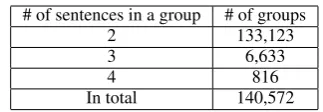
empiri-cally arrived at 0.2 of the lower threshold of the bi-gram similarity to avoid very dissimilar sentences and 0.7 of the upper threshold of the bigram sim-ilarity to avoid near-identical sentences. As pre-sented in Table 1, 140,572 sentence groups were finally yielded out of 1.37 million new articles. We refer to this as the Giga-MSC dataset.
1http://github.com/code4ai
2https://catalog.ldc.upenn.edu/LDC2011T07 English
Gi-gaword, a comprehensive archive of newswire text data con-taining seven distinct international sources.
3http://github.com/code4ai/data
4Human judges were asked to evaluate whether the
sen-tences in a group revolved around the same topic or event. A total of45out of 50 sentence groups were judged to be qualified.
# of sentences in a group # of groups
2 133,123
3 6,633
4 816
[image:2.595.334.496.60.116.2]In total 140,572
Table 1: Statistics of created Giga-MSC dataset.
2.2 Giga-MSC Dataset Annotation
We randomly selected 150 sentences for human annotation, which were used as reference com-pression in the automatic evaluation. Two anno-tators5 were asked to generate one single reduced
grammatical compression that satisfies two condi-tions:(1) conveys the important content of all the input sentences and (2) should be grammatically correct. We are interested in how the human an-notators will perform this task without vocabu-lary constraints; hence, we did not tell them to introduce as little new vocabulary as possible in their compression as several previous works did (Boudin and Morin, 2013; Luong et al., 2015). Inter-agreement score Fleiss’ Kappa (Artstein and Poesio,2008) was also computed. The score was 0.43, demonstrating that moderate agreement was reached.
3 Methodology
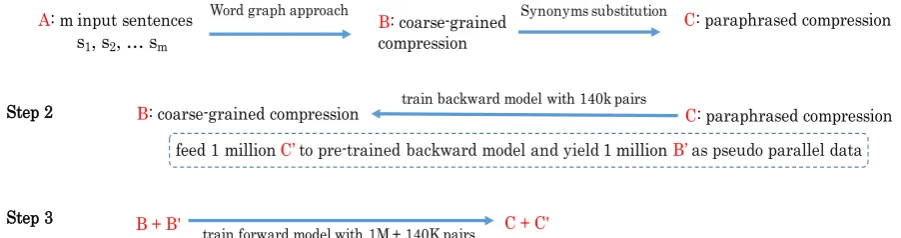
Figure 1 illustrates our rewriting approach consist-ing of three steps.
3.1 Step.1 (A→B)
Given m input sentences, s1, s2, ..., sm, called A, we use the keyphrase word graph approach (Boudin and Morin, 2013) to obtain coarse-grained compression, calledB.
3.2 Step.1 (B→C)
C is yielded by substituting words and phrases in B with synonyms. We first identified all the multiword expressions in a sentence and deter-mined all the synonyms in WordNet 3.06. Keep
in mind that our goal is to shorten the sentence as much as possible, we specifically substituted multiword expressions, such as police officer, united states of america, with their shorter syn-onyms policeman and u.s.. Because the size of synonyms in the WordNet dictionary is relatively limited, we also exploit PPDB 2.07 to replace
5Both annotators are native English speakers and not
au-thors of this paper.
A: m input sentences B: coarse-grained compression
Synonyms substitution
Step 1
C: paraphrased compression
s1, s2, … sm
Step 2
Step 3 B + B' C + C'
train forward model with 1M + 140K pairs
C: paraphrased compression
B: coarse-grained compression train backward model with 140k pairs
Word graph approach
[image:3.595.73.524.84.203.2]feed 1 millionC’to pre-trained backward model and yield 1 million B’as pseudo parallel data
Figure 1: Graphic illustration for the rewriter model. Arefers to multiple input sentences. B denotes a single
compressed sentence using the word graph approach. Cis the paraphrased sentence. C′ is a large-scale and
in-domain monolingual corpus, whileB′refers to the predicted compression by a pre-trained backward model given C′as input.B+B′andC+C′are the mixing datasets.
the nouns, verbs, and adjectives with their shorter counterparts. For example, the verbdemonstrating
is converted intoproved. By using the Giga-MSC dataset we created, 140,000 (A,B, C) tuples are yielded. Lexical substitution might lead to non-fluency C but significantly increases the number of novel words. Therefore, the next steps focus on creating pseudo parallel data to boost the fluency ofCwhile attempting to maintain the rate of novel words.
3.3 Step2 (C→B)
Because the yielded B and C are semantically equivalent, we train a backward model (C→B) us-ing 140,000 (C, B) pairs. The backward model consisted of a three-layer bi-directional LSTM en-coder and a uni-directional deen-coder with atten-tion mechanism. After the backward model was trained, one million grammatical in-domain sen-tencesC′were given as input to generate one mil-lion B′ The average length of C′ was similar to that of C (30.2 tokens). We also found that C′ maintained a novel rate of approximately 8.9, as compared toB′.
3.4 Step.3 (B+B’→C+C’)
We merge the training data (coarse-grained com-pressionB and non-fluent paraphrasing compres-sionC) and the pseudo parallel data (pseudo sen-tenceB′ and grammatical sentenceC′) to jointly learn a forward model that consisted of a three-layer LSTM encoder and decoder. The vocabulary and word embedding were shared between both backward and forward models. We expect that be-cause the grammaticalC′ accepts the majority of
training data, it will improve the fluency ofC.
4 Experiments
4.1 Datasets
We used two datasets to evaluate the model per-formance. First is the Giga-MSC dataset detailed in Section 2. A total of150annotated sentences were used as the ground truth for testing. Second is the Cornell dataset (McKeown et al.,2010).
4.2 Baseline Approaches
We considered (#1) the word graph approach (Filippova, 2010), and an advanced version (#2) keyphrase-based word graph model (Boudin and Morin, 2013) augmented with keyphrase iden-tification (Wan and Xiao, 2008), as our word graph baselines. Additionally, (#3) the hard paraphrasing (Hard-Para) approach directly sub-stituted words and phrases with their shorter syn-onyms by using WordNet and PPDB 2.0 (size M is chosen with 463,433 paraphrasing pairs). (#4) Seq2seq model was trained using (B, C) pairs. We considered both of them as comparison ap-proaches as well. The training details are pre-sented in Appendix 1. We release the source code here8.
4.3 Out-of-Vocabulary (OOV) Word Handling
Both datasets were from the news domain; hence, there are lots of organizations and names that are out of vocabulary. We tackled this problem by ex-ploiting the approach in (Fevry and Phang,2018).
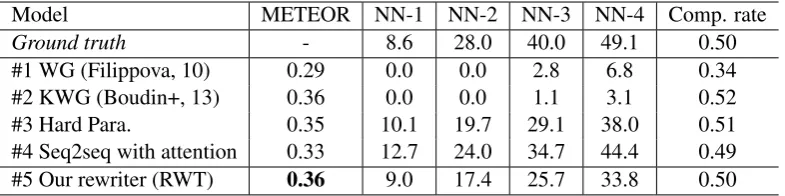
Model METEOR NN-1 NN-2 NN-3 NN-4 Comp. rate
Ground truth - 8.6 28.0 40.0 49.1 0.50
#1 WG (Filippova, 10) 0.29 0.0 0.0 2.8 6.8 0.34
#2 KWG (Boudin+, 13) 0.36 0.0 0.0 1.1 3.1 0.52
#3 Hard Para. 0.35 10.1 19.7 29.1 38.0 0.51
#4 Seq2seq with attention 0.33 12.7 24.0 34.7 44.4 0.49
#5 Our rewriter (RWT) 0.36 9.0 17.4 25.7 33.8 0.50
Table 2: Results for the Giga-MSC dataset.
Model METEOR NN-1 NN-2 NN-3 NN-4 Comp. rate
Ground truth - 5.2 15.8 23.2 29.6 0.49
#1 WG (Filippova, 10) 0.33 0.0 1.7 5.5 9.8 0.34
#2 KWG (Boudin+, 13) 0.45 0.0 1.8 4.6 8.0 0.52
#3 Hard Para. 0.38 9.2 19.0 28.7 37.7 0.50
#4 Seq2seq with attention 0.37 8.4 18.3 27.6 36.3 0.52
#5 Our rewriter (RWT) 0.40 8.1 17.0 26.0 34.3 0.50
Table 3: Results for the Cornell dataset.
Given an input sequence, we first identified all OOV tokens and numbered them in order. We stored the map from the numbered OOV tokens (e.g., OOV1 and OOV2) to words. The corre-sponding word embeddings were also assigned to each numbered OOV token. We then applied the same numbering system to the target. At the in-ference, we replaced any output OOV tokens with their corresponding words using the map that was stored beforehand, which allowed us to produce words that were not in the vocabulary.
5 Results and Analysis
METEOR metric (n-gram overlap with synonyms) was used for automatic evaluation. The novel n-gram rate9 (e.t., NN-1, NN-2, NN-3, and NN-4)
was also computed to investigate the number of novel words that could be introduced by the mod-els. Table 2 and Table 3 present the results and below are our observations: (i) keyphrase word graph approach (#2) is a strong baseline accord-ing to the METEOR metric. In comparison, the proposed rewriter (#5) yields comparable result on the METEOR metric for the Giga-MSC dataset but lower result for the Cornell dataset. We spec-ulate that it may be due to the difference in the ground-truth compression. 8.6% of novel uni-grams exist in the ground-truth compression of the
9Novel n-gram rate =1
−|S|∩CC|| where S refers to the set of words from all input sentences while C refers set of words from compression.
Giga-MSC dataset, while only 5.2% of novel uni-grams exist in that of the Cornell dataset, (ii) Hard Para.(#3), Seq2seq (#4), and our rewriter (#5) sig-nificantly increase the number of novel n-grams, and the proposed rewriter (#5) seemed to be a better trade-off between the information coverage (measured by METEOR) and the introduction of novel n-grams across all methods, (iii) on compar-ing with Seq2seq (#4) and our rewriter (#5), we found that adding pseudo data helps to decrease the novel words rate and increase the METEOR score on both datasets.
Method Informativeness Grammaticality
KWG 1.06 1.19
[image:4.595.104.497.62.160.2]RWT 1.02 1.40†
Table 4: Human evaluation for informativeness and grammaticality. †stands for significantly better than KWG with 0.95 confidence.
Human Evaluation As METEOR metric cannot measure the grammaticality of compression, we asked two human raters10to assess50compressed
sentences out of the Giga-MSC test dataset in terms of informativeness and grammaticality. We used 0-2 point scale (2 pts: excellent; 1 pts: good; 0 pts: poor), similar to previous work (we recom-mend readers to refer to Appendix 2 for the 0-2 scale point evaluation details). Table 4 shows the
10Both raters are native English speakers and not authors
Sentence1 Alleged Russian mobster Alimzhan Tokhtakhounov, accused of conspiring to fix skat-ing events at the 2002 Winter Olympics in salt lake city, has returned to Moscow, the Kommersant daily reported wednesday.
Sentence2 US prosecutors accused Tokhtakhounov of conspiring to fix the artistic skating events at the salt lake city games with the assistance of the French and Russian judges. KWG US prosecutors accused Tokhtakhounov, accused of conspiring to fix the artistic
skat-ing events at the salt lake city, has returned to Moscow, the Kommersant daily reported wednesday.
RWT Tokhtakhounov, accused ofconspiracyto fix the artistic skating events at the salt lake
town, has returned to Moscow, the Kommersant daily reported.
Table 5: Case study. The words in bold are paraphrase, while the underlined words are ungrammatical parts in the compression. KWG refers to word-graph baseline and RWT refers to our rewriter.
average ratings for informativeness and readabil-ity. From that, we found that our rewriter (RWT) significantly improved the grammaticality of com-pression in comparison with the keyphrase word graph approach, implying that the pseudo data may contribute to the language modeling of the decoder, thereby improving the grammaticality.
Context Awareness Evaluation Because several novel words were introduced in Hard Para. (#3), Seq2seq (#4), and our rewriter (#5), we were in-terested to determine whether the compressions generated by these models were context-aware. We herein considered an out-of-the-box context-aware encoder, BERT (Devlin et al., 2018). The evaluation proceeded as follows: As for a sen-tence with N words, S = [w1, w2, ..., wN], we sequentially masked each word at a time and cal-culated the average likelihood using this formula: CXT(S) = n1!i=1n −logp(wi|c)
wherec= [w1, ...wi−1, wi+1, ..., wn]. We used the implementation mentioned in11. The low
like-lihood CT X(S) may suggest a better context awareness. As presented in Table 6, the proposed rewriter achieves the lowest likelihood on both datasets, thereby indicating better context aware-ness in its generated compression.
Case StudyTo illustrate the pros and cons of the proposed rewriter, as listed in Table 5, we con-ducted a case study where two sentences were given as input and two compression outputs were produced by KWG and RWT. We observed that the RWT corrected the ungrammatical parts (e.t., underlined words,) generated by KWG. However, paraphrasing was not always accurate because
11https://github.com/xu-song/bert-as-language-model
Method BaseGiga-MSCLarge BaseCornellLarge Hard Para. 354.6 473.6 273.1 316.7 Seq2seq 249.1 219.1 326.1 388.3
Ours 148.5 158.4 203.9 277.4
Table 6: Context awareness scores for three models. Base and Large refer to the different model configura-tions of BERT.
phrases such as salt lake city are fixed colloca-tions. This may degrade the informativeness of the compression.
6 Conclusion
In this work, we propose a coarse-to-fine rewriter for multi-sentence compression with a specific focus on improving the quality of compression. The experimental results show that the proposed method produced more grammatical sentences, meanwhile introducing novel words in the com-pression. Furthermore, we presented an approach for the evaluation of context-awareness which may shed light on automatic evaluation for quality of sentence by virtue of pre-trained models. In the future, we will consider extending the current ap-proach to the single document or multiple docu-ment summarization.
Acknowledgments
References
Ron Artstein and Massimo Poesio. 2008. Inter-coder agreement for computational linguistics. Computa-tional Linguistics, 34(4):555–596.
Siddhartha Banerjee, Prasenjit Mitra, and Kazunari Sugiyama. 2015. Multi-document abstractive sum-marization using ilp based multi-sentence compres-sion. InIJCAI, pages 1208–1214.
Regina Barzilay and Kathleen R McKeown. 2005. Sentence fusion for multidocument news summa-rization. Computational Linguistics, 31(3):297– 328.
Florian Boudin and Emmanuel Morin. 2013. Keyphrase extraction for n-best reranking in multi-sentence compression. In North American Chapter of the Association for Computational Linguistics (NAACL).
Trevor Cohn and Mirella Lapata. 2008. Sentence com-pression beyond word deletion. In Proceedings of the 22nd International Conference on Computa-tional Linguistics-Volume 1, pages 137–144. Asso-ciation for Computational Linguistics.
Jacob Devlin, Ming-Wei Chang, Kenton Lee, and Kristina Toutanova. 2018. Bert: Pre-training of deep bidirectional transformers for language understand-ing. arXiv preprint arXiv:1810.04805.
Thibault Fevry and Jason Phang. 2018. Unsuper-vised sentence compression using denoising auto-encoders. arXiv preprint arXiv:1809.02669.
Katja Filippova. 2010. Multi-sentence compression: Finding shortest paths in word graphs. In Proceed-ings of the 23rd International Conference on Com-putational Linguistics, pages 322–330. Association for Computational Linguistics.
An-Vinh Luong, Nhi-Thao Tran, Van-Giau Ung, and Minh-Quoc Nghiem. 2015. Word graph-based multi-sentence compression: Re-ranking candidates using frequent words. In Knowledge and Sys-tems Engineering (KSE), 2015 Seventh International Conference on, pages 55–60. IEEE.
Kathleen McKeown, Sara Rosenthal, Kapil Thadani, and Coleman Moore. 2010. Time-efficient creation of an accurate sentence fusion corpus. In Human Language Technologies: The 2010 Annual Confer-ence of the North American Chapter of the Associa-tion for ComputaAssocia-tional Linguistics, pages 317–320. Association for Computational Linguistics.
Mir Tafseer Nayeem and Yllias Chali. 2017. Para-phrastic fusion for abstractive multi-sentence com-pression generation. In Proceedings of the 2017 ACM on Conference on Information and Knowledge Management, pages 2223–2226. ACM.
Mir Tafseer Nayeem, Tanvir Ahmed Fuad, and Yl-lias Chali. 2018. Abstractive unsupervised multi-document summarization using paraphrastic sen-tence fusion. In Proceedings of the 27th Inter-national Conference on Computational Linguistics, pages 1191–1204.
Elvys Linhares Pontes, St´ephane Huet, Thiago Gou-veia da Silva, Andr´ea carneiro Linhares, and Juan-Manuel Torres-Moreno. 2018. Multi-sentence com-pression with word vertex-labeled graphs and in-teger linear programming. In Proceedings of the Twelfth Workshop on Graph-Based Methods for Nat-ural Language Processing (TextGraphs-12), pages 18–27.
Rico Sennrich, Barry Haddow, and Alexandra Birch. 2015. Improving neural machine translation models with monolingual data. arXiv preprint arXiv:1511.06709.
Elaheh ShafieiBavani, Mohammad Ebrahimi, Ray-mond K Wong, and Fang Chen. 2016. An efficient approach for multi-sentence compression. InAsian Conference on Machine Learning, pages 414–429.