MOTIVATING TOMORROW’S ENGINEERS William Done, Peter Willmot
Loughborough University, Loughborough, Leicestershire, LE11 3TU, UK
Abstract
Engineering has higher drop-out rates from university than many other subjects. One widely agreed reason for non-completion is the lack of motivation to study while on course. Data from focus groups and two separate surveys compares the views of UK engineering students with those of their international counterparts, asking: why do students take up engineering and what motivates them to sustain their studies? The research suggests students choose engineering, not only as it matches their pre-existing academic strengths, but also because they have a long-existing passion for technology. Unsurprisingly, a very large proportion of those surveyed explicitly claim their single largest motivator is the prospect of a potentially rewarding career. Nevertheless, a combination of unengaging lecturers and a lack of overall support and feedback take their toll and many students rapidly become disengaged with their studies. The international views were closely aligned but strong themes emerged illustrating the importance of creative, real-world teaching and criticising lecturers who lack passion and communication skill.
Key words: motivations, engagement, engineering education
1. INTRODUCTION
A widely agreed reason for students not sustaining their efforts on degree courses is a lack of overall motivation. Engineering has higher drop-out rates than many other subjects and 23% of entrants in 2004/2005 enrolled on a full-time engineering course did not re-enrol for the second year of their programme (HESA, 2007). It is not likely that there is just one reason why students leave university (Yorke, 1999) and there are other determinants which affect non-continuation rates among engineering students. This report aims to answer three main questions: why do students take up engineering in the first place, what motivates them to sustain their effort on their engineering course and, are there any observable stand-out differences with UK students compared to other international students.
Qualitative and quantitative data were collected to assess the attitudes of students at Loughborough University in the UK. Separate survey data, gathered from university students in the USA, Denmark, Australia and Portugal in 2012 was analysed alongside this to gauge any geographical variances or peculiarities between students’ opinions. A third set of data from transcribed interviews of engineering students at Boise State University, USA and Central Queensland University, Australia is also used to reinforce the qualitative arguments.
Statistical and thematic/inferential analysis techniques are used to identify recurring themes throughout the varied data sets and the results are compared with existing published literature.
Further, the report outlines some best pedagogical practices that enhance student motivation – aiming to change the perceived motives of the majority of the engineering student population from extrinsic to intrinsic and ultimately deliver a more motivated, competent and employable graduate population.
2. BACKGROUND 2.1. Motivational theory
The concept of motivation is subject to much theoretical debate. The fundamentals were established several decades ago and arguably the most referenced and original fundamental theory in this field is Maslow’s Hierarchy of Needs.
Maslow (1943) says there are five main goals which humans eternally strive for and places them within a heirachy such than the one must be satisfied before progressing on to the next: physiological needs (e.g. food, shelter): safety and security (health, employment, social stability); belonging (friendship, sense of connection); self-esteem (confidence, achievement and the respect of others) and self-actualization (creativity, experience purpose and releasing the inner potential). Maslow believes the hierarchical goals are not mutually exclusive and the higher needs cannot continue unless previous needs have been met. Human behaviour is dependent on which need man is currently striving to fulfil since previously satisfied needs are no longer active. Maslow goes on to stress that while motivation determines behaviour to some degree, other determinants also include biological, cultural and situational factors.
Douglas McGregor’s Theory X and Theory Y address the ways in which people lead and manage. The theories observe effective and ineffective approaches to managing people and therefore define both desirable and undesirable approaches in order to motivate. While these theories were originally intended to examine employees in the workplace, there are clearly lessons here for educationalists. A Theory X approach to management assumes that those being managed are inherently lazy, avoid responsibility at all costs and therefore require controlling in the form of the carrot and stick approach (McGregor, 1960). He strongly believes controlling humans this way is extremely de-motivating. McGregor claims that a more forward-thinking, theory Y approach should be adopted by managers etc. in order to effectively manage and motivate groups of people and this is widely adopted within contemporary management learning. Theory Y management of the human resource identifies a person’s individual goals and, through collaborative effort, seeks to integrate these goals with those of the organisation.
Herzberg’s ‘two-factor theory’ (1968). Herzberg theorised that satisfaction and dissatisfaction within the workplace are not opposites and instead they act independently of each other. Therefore by eradicating job dissatisfaction you are not simultaneously stimulating satisfaction. His research showed that people’s satisfaction is derived by achievement, recognition, responsibility and, growth and advancement. Dissatisfaction is determined by factors such as bureaucracy, supervision, relationships with others, salary, working conditions, status and security (MindTools, accessed April 2015). The causes of satisfaction and dissatisfaction are referred to by Herbzberg as ‘hygiene factors’ and ‘motivators’, respectively. In summary. in order to maintain a long-term motivated workforce, hygiene factors need to be eliminated and conditions for task enrichment need to be created.
The degree to which Herzberg’s motivating factors are demanded by someone are what [Clark and] McClelland (1956) believes determines the motivating force within a person. A human’s need for achievement (nAch), power (nPow) and affiliation (nAffil) are all independent and are found in varying degrees in people. By identifying the degree to which an individual demands these needs, a leader can tailor his/her approach to managing that person and therefore effectively motivating them.
A student’s motivation for participating in higher education is likely to obey similar principles as we generally have a hierarchical structure where the lecturers set out the tasks in the form of coursework and provide rewards in the form of marks or grades. Clearly, to do this alone provides only extrinsic motivators, not dissimilar to the largely discredited theory X. So what can be done to elevate students to the higher level, intrinsic drivers that signify engagement and self-actualization?
Yorke and Longden (2008) – summarising the various works of Action on Access, 2003; Carey, 2005; Kuh et al., 2010; Long et al., 2006; Pascarella & Terenzini, 2005; Reason et al., 2006; The Pell Institute, 2007 – advised four main areas in which higher education institutions should focus in order to “enhance” student motivation:
• an institutional commitment to student learning, and hence to student engagement • proactive management of student transition
• treating the curriculum as an academic milieu, and also one in which social engagement is fostered • choosing curricular structures that increase the chances of student success
Three fundamental learning approaches are believed to exist: “deep”, “surface” and “strategic” (Marton & Säljö, 1976). As suggested, a “deep” approach to learning involves a student’s desire to obtain an in-depth understanding of a subject. Their thirst for knowledge means they are intrinsically motivated and have a desire to fully comprehend a topic to an extent where one can relate new ideas to previous knowledge (Rowe, 2001). Rowe argues that “surface” approaches to learning limit the student’s ability to be able to reflect on the learning and they are only learning in order to meet certain educational requirements. It’s these types of approaches that lead to an inability to distinguish principles from examples. A surface approach becomes more of a test of memory rather than a long-term comprehension of a topic. The third learning approach developed is the “strategic” approach. Rowe says that this approach refers to students who will learn how to pass exams and assessments rather than widen their long-term understanding of a topic. They are extrinsically motivated by the “esteem” associated with high grades and the potential for a better future career. Students who adopt a strategic approach to learning will stifle their own creativity by tailoring their work and working style to the “perceived preferences” of their various teachers (Rowe, 2001).
2.2. The transition to university
Surveys carried out by Yorke and Longden (2008) in the first year experience of higher education in the UK found that students started off their university careers with a generally very positive attitude and had a shared level of confidence that, upon completing their respective programmes, they would be able to gain graduate-level employment. However, some students showed concern and indicated various reasons as to why they might not be able to continue with their programme. These included inadequate prior information about their programme and/or institution and an overall concern over the financing of their studies.
Savage et al. (2011) discovered that first year engineering students were somewhat shocked to discover the steep increase in volume of work required from them when starting at university. This, they felt, “forced” them to adopt a surface approach to learning. Similarly, in a study conducted by Bailie and Fitzgerald (2000) about students who quit their courses at Imperial College London before graduating, the students stressed they were not adequately prepared for university learning styles. Savage et al. (2011) highlights the importance of an efficient, proactive facilitation of the school/college transition to higher education in order to effectively manage student expectations.
The ages which students spend in primary and secondary education in the USA are very similar to the UK though, in some cases they spend a total one year less at school, however this is compensated for by typically longer university courses. For engineering this usually means an additional preparatory year of general science and mathematics compared with the more specialised GCE Advanced level (A-Level) mathematics and physics entry requirement typical in the UK. The USA is home to 36.5% of the top 200 worldwide universities and 56% of the top 50 universities (Times Higher Education World University Rankings, 2014). Despite the quality of the universities in the USA, a study sampling 52% of the USA’s high school population in 2012 reports that more than 60% of 2012 high school graduates are not adequately prepared for college (ACT, 2012). During high school in the US, school guidance counsellors reportedly oversee a student’s entire high school career. Their role is essentially to ensure a student has the best chances available of getting in to college/university. The guidance counsellor does not directly prepare a student for what higher education has in store. There seems to be a larger focus on making sure a student’s grades are as high as possible – which leads to a high chance that students can “…achieve well, [while] learning very little” (excerpt from Winstone, 2014, pp.3). A number of commentators reported a similar effect in the UK since the introduction of the modular A-level in year 2000 when the course was segregated into a number of elemental parts and the award made on cumulative achievements.
The Local (an online German newspaper, 2013) illustrates a stark difference in the education system in Germany compared to the UK and USA. At the age of around ten or eleven, when transitioning from primary to secondary education, German children are put in to one of three tiers of school: “Gymnasium” (top performing students), “Realschule” (average students) or the Hauptschule (lower performing students). It is astonishing that at ten years old, the majority of students in Germany are branded on one year’s exam results, ignoring their potential for development and as a result have their futures defined for them. Gymnasium students tend to go on to study at universities whereas those who attend either Realschule or Hauptschule will progress to vocational studies or apprenticeships (The Local, 2013). This system strongly resembles the “11 plus/grammar school” system that used to dominate in the UK until the 1970s.
Throughout Australia’s six states and territories, the education system varies very little. Education is compulsory between the ages of six and sixteen. It is 13 years and divided into:
• Primary school – seven or eight years duration (compulsory) • Secondary school - three or four years duration (compulsory) • Senior secondary school – two years duration (voluntary)
(Australian Government, accessed December 2014)
It is fair to say the overall structure of the UK’s education system is not far removed from other international contexts; three layers, primary, secondary and tertiary education. Therefore understanding the reasons behind the non-continuation rates of UK engineering students from their first to second year in higher education is important. Solely comparing the various systems put in place worldwide to prepare students for university is not an adequate method of understanding engineering non-continuation rates for UK undergraduates. However, it is still important to understand and identify if there are any key differences in international educational systems that subsequently lead to low non-continuation rates of engineering students or various other successes.
3. RESEARCH METHODOLOGY
The report employs three methods of data collection:
i. Designing, piloting and distributing a survey to engineering students at Loughborough University (LU).
ii. Two focus group interviews with students at Boise State University (BSU) in the USA and Central Queensland University (CQU) in Australia.
iii. Surveys distributed to engineering students in universities in Australia, Denmark, Portugal, UK and USA.
3.1 Loughborough university engineering students’ survey
A mobile-friendly online survey was constructed consisting of a combination of open and closed questions totalling 42 in all and including 26 matrix questions that used a 5-point Likert scale. This was circulated to 1100 engineering students (84% male and 16% female) and a reminder email was sent two weeks later in order to attract a second wave of participants. The reminder effectively doubled the response rate and in total, 70 people participated in the local survey: 45 male (64.3%) and 25 female (35.7%). The split of year 1, year 2 and year 3 students was fairly even but there were only six responses, from year 4. 91% of respondents were UK nationals, the remaining participants were overseas students from India, Kenya, Netherlands, Pakistan, Spain and Thailand. 27.1% of the population were the first person in their immediate family to attend university. The questions were grouped in to three main themes in order to gauge student opinions:
i. Student preconceptions of university and the school/college to university transition.
ii. Student’s general attitudes towards work and their approaches to learning.
iii. Motivating/de-motivating characteristics of university studies.
Prior to its distribution, the survey was independently piloted by four year-3 engineering students and appropriate refinements were incorporated at this stage.
3.2 International engineering students’ survey
This survey was constructed in 2012 and was distributed by hand to students from the USA, Australia and three European countries resulting in 68 participants (50 males and 18 females).
The survey, was much like the Loughborough survey, and used 5-point Likert scale questions to obtain quantitative data for statistical analysis and also open-ended questions which are analysed using thematic and inferential analysis tools. This method was used as it helps objectify a subjective topic. The open-ended questions also provided scope for tailored responses and possible unanticipated answers. The analysis tools used were the same as those used in the Loughborough survey and were chosen for the same reasons: to make efficient use of the time available and also to maximise the accuracy and validity of results.
3.3 International focus group interviews
The foundation of the two focus groups, selected at random from a larger sample, was semi-structured around the questions distributed in the international survey and was focused around motivational constructs with aim to identify the extrinsic or intrinsic goal orientations of students and how these orientations are influenced. The focus groups consisted mainly of first year students; both groups consisted of four males and one female – a gender divide that was more even than was represented in each university. Attendance and participation was voluntary. The questions were designed to probe specific reasons why students become both motivated and de-motivated with the aim of identifying isolated instances where motivation has been influenced in some way and were the same for both groups.
4. RESULTS & DISCUSSION
The quantitative data was coded and exported in to Microsoft Excel as a tool to formulate charts in order to help visualise the principal messages. The mean scores for Likert style questions were calculated to gauge the average opinion of participants.
Open-ended questions were also integrated in to the survey as a method of accumulating unanticipated results and gauging attitudes/opinions in the language used. Students were allowed to write as much or as little as they wished in order to answer these types of questions. A qualitative data analysis method used to analyse text, looking at the language used, opinions expressed while acknowledging any possible socio-political and socio-economic factors, thematic analysis was used to analyse the qualitative data.
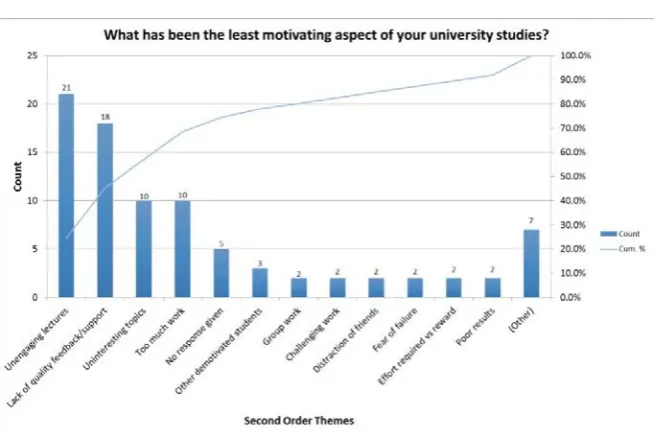
Based on further recommendations by Brown & Edmunds (2011), the answers to open-ended questions were read carefully and any themes shown were noted down (first order coding). Upon completing this task for all questions sets, the task was repeated and the smaller themes were then placed in to broader categories (second order coding). The frequency of second order themes was calculated and put in to a pareto chart for each open-ended question.
4.1. The Transition to University
53% of respondents to the questionnaire distributed to university students in the USA, Portugal, UK, Denmark and Australia agree that their previous education prepared them well for university.
However, when pressed in focus group questioning, students drew a distinction between academic preparation which was, on the whole good, and societal preparation which fared less well. Yorke & Longden (2008) had previously written that students must be able to both understand and cope with the academic demands of higher education in order to have a positive first year experience and therefore feel more motivated throughout the rest of their university studies. While a large number were neutral, just over one fifth of respondents disagreed and feel their previous education had not prepared them well enough for university. It is likely that there is no single reason why these students are not well prepared, however most literature suggests the reason for a poor transition and therefore lack of motivation is derived from a lack of student social integration (Harvey, et al., 2006). Perhaps more likely that it is a “series of interrelated processes” that hinders a student’s adaptation to higher education (Shobrook, 2004). The need for more effective college to university transition management is made evident in a survey conducted by Savage, et al. (2011) where eight out of eleven students in an interview commented on the stark style difference between the two tiers of education.
40% of respondents to the Loughborough University (LU) survey chose ‘neutral’ when asked to what degree they agree with the statement: “I underestimated how difficult my engineering programme would be,” implying it is just as difficult as they imagined but 44% feel that their programme is harder than they first imagined. It is likely that the absence of adequate preparation by schools and colleges, with regards to preparing students for the demands of studying at university, led to 31% of LU survey participants, at some point, considering withdrawing from their course. This is a further demonstration that it is imperative that the school to university transition is effectively managed by both schools and universities in tandem to ensure expectations are accurate and so that appropriate learning styles can be adopted quickly after enrolling at university (Savage, et al., 2011).
Focus group students at both Boise State University (BSU) in the USA and at Central Queensland University (CQU) expressed mixed opinions in terms of what they feel adequate preparation even is. One student at CQU compares the drastic increase in workload from high school to engineering; going from having little work to do, “cruising through high school”, to all of a sudden having a very demanding workload and how it felt like “getting hit by a big brick wall”. A similar theme is shown at LU where 61% of the sample population of the LU survey agree that they felt the volume of work given to them for their assignments is much greater than they anticipated.
However, even within the realms of the Australian educational system there is evidence of a difference in the university preparation techniques undertaken by high schools. Two students at CQU who attended private schools prior to university whole-heartedly disagree with the idea of high school being “cruisy” and that in fact they find university a lot easier in comparison. Perhaps this is what parents are paying private tuition fees for: ensuring adequate preparation for higher education. This suggests that the quality of student transition to higher education is not dependent on a nation but more on the individual institutions themselves and the educational professionals running them.
It isn’t just the underestimated increase in work volume that students appear to be concerned about either. Upon enrolling at university, two students at BSU agree that the speed at which the engineering material is being taught is something that is really challenging and requires adjusting to. As soon as the material gets on top of students, the fear of falling behind is something which both surveys show to have a negative impact on motivation. Inadequate academic preparation for high workloads can lead to undesirable approaches to learning being adopted: with work scheduled perceived so high and students being taught so fast, it is very difficult to sustain a deep approach to learning, where students “engage in a more active dialogue” (Marton, et al., 1984). It is absolutely crucial that all students are not only made well aware of the demands of university but are also well prepared prior to enrolment. In order to enable a fast, smooth transition into higher education, students need to have already been taught and have adopted:
i. Appropriate learning styles;
ii. Time management skills;
iii. People management skills (for group work) and;
iv. Workload management skills.
This is easier said than done.
4.2. The Importance of Engagement
Encouragingly, many responses to the LU engineering survey (69%) include comments on how an engaging lecture can draw a student in and inspire them to work. It is of no surprise that “engaging” lectures are the types of lectures that students believe will increase their motivation to study. Literature suggests the same thing: Vansteenkiste, et al. (2004) believe the way in which a teacher frames work and assessments have the greatest influences on student motivation. This is reinforced by comments made in the BSU focus group: knowing that more work is involved with one BSU module (unit) in particular; students still choose it, because it involves much more “hands-on” learning with frequent opportunities to put the engineering principles in to practice. They commented they actually look forward to this module and chose it for positive reasons rather than as a module they dislike the least from a list of options.
The most common criticism made by all students relates to the teaching staff. As mentioned, when asked to indicate the characteristics of lectures that “motivate you to work”, many responses referred to the importance of engaging lectures. One third of the local responses freely described motivating lecturer traits; “passionate”; “interactive”; “enthusiastic”; “knowledgeable”; “organised”; “tells a story”; “not patronising”; “clear communication”; “varied delivery methods”; “information explained in depth”; are all recurring phrases and themes mentioned not just in the LU survey, but in the international survey and commented on throughout the focus group interviews.
One thing that all universities share is that the major teaching (information giving) method used is lectures. It is the role of the lecturer to not only provide students with appropriate information, but deliver it in such a way that all students can understand to ensure that major lapses in student motivation are avoided throughout a programme’s duration. In short, students expect a ‘performance’. Elton (1988) refers to a foreword made by lord Ashby in Ilma Brewer’s book: learning more and teaching less – a decade of innovation in self-instruction and small group learning (1985). Elton regards Lord Ashby as “one of the wisest of [the 20th] century’s academics (Elton, 1988, pp220): “For many years I taught in universities. Like most academics I assumed that the only qualification I needed was expertise in the discipline I taught (which was biology). It did cross my mind that how to teach might be a discipline in its own right, but I never gave it much thought. I marked thousands of examination scripts without examining what the scripts could teach me about my capacity as a teacher and examiner.”
Figure 1: Positive characteristics of lectures.
The importance of knowing how to teach cannot be underestimated. Forward-thinking pedagogies need to be comprehensively taught to academics who are to go in to lecturing. Their primary focus should be to motivate students to learn. Without a strong motivational force, students are not only less likely to enjoy their time at university but they also tend to adopt unattractive learning styles. This in turn produces a less attractive graduate population, with non-transferrable skills, who are unable to apply their studies to the proverbial “real world”.
Engineering is a subject in which the theories being taught all have a practical application. Visualising and being part of this practical application of theory not only involves and engages students, it aids their learning. There are a wealth of examples available and lecturers need to make full use of them. As soon as this learning yields results, students claim their motivation improves as a result.
Students have been universally critical of the absence of hands-on learning and hands-on engineering. The majority of students want more of this type of learning as a way to further engage them and thus motivating them to learn. When asked if they could make one change to their course to make it more motivating, the joint second most frequently mentioned theme is the idea of having more practical work incorporated in to their courses. Fallows & Ahmet (1999) claim most teaching is out of context, without the use of “focused practicals” or other “direct involvement” of the students. This abstract method of teaching is proven unpopular amongst the LU survey sample population and the majority see it as a de-motivating characteristic of their studies yet it generally dominates in most institutions of higher learning. They go on to express that when students can see the relevance of the work they are doing and can begin to make connections between the theoretical work and its real-world relevance, they become “dramatically” more enthusiastic, engaged and motivated as a result. Once again, in an interview carried out by Savage, et al. (2011), all but one student comments on the need for tasks to be “practical” and have some sort of “real-world” relevance.
Students have commented on this and it ties in with the following section of the discussion – students want to be able to make direct links to the real-world and understand the relevance of what they are studying. The second most frequently mentioned theme in the LU survey, when asked what characteristics of lectures motivate you to study, revolves around when the work is related to the real world. If the same students could make one change to their engineering programme, among the top answers was having visits from experts in industry. Students show a burning desire to put into practice what they are learning in class and to be able to make connections with what they are studying to potential careers in engineering. The majority of the students surveyed, interviewed etc. all wish to apply their learning prior to graduating and working in industry as a way of keeping them motivated and also to improve their understanding.
4.3. Job Prospects
57.1% (including ‘other’ responses) of LU survey participants say their main reason for choosing an engineering degree course was because “it has good job prospects” and 34.3% of responses claim this to be the single most motivating aspect of their university studies. Similarly, all of the CQU focus group students say they have become much more career focused since coming to university. What is promising is that 92.8% of the LU sample population say that since enrolling on their course, they have developed a greater understanding of the engineering industry. However, less than a third of these students say they actively seek out and attend industry events on campus. This implies one of two things:
i. Not all students who claim they are at university to secure a ‘good’ job actually make the effort to utilise the available university resources to secure a promising job in engineering or;
ii. They initially intend to work in engineering but since developing a greater understanding of the industry, they are put off and perhaps feel an engineering career does not appeal to them.
The sample population of LU students claim they would be more motivated to work hard if they understood the relevance of the subjects they are being taught – clearly, understanding of an engineering career is sometimes incomplete; for example, “why am I studying Mechanical
Engineering but have a module in project management?” As previously indicated by the results from the international survey, students become de-motivated when being taught a subject in abstract. The most common theme expressed by the same students in the international survey in order to become more motivated, was if they understood a topic’s relevance. Lectures hosted by current industry experts will instil reasoning as to why the subject is being taught in the first place and is claimed to be able to greatly increase student motivation, provided, of course, students are motivated to attend in the first instance. Figures 2 and 3 give details of what students perceive as their motivators.
Figure 2: Motivators (LU survey)
Figure 3: De-motivators (LU survey)
It is important for teachers to understand the nature of their students’ long-term motivating forces and how best to tailor each student’s learning experience in order to connect with their respective motives. However, whether students are motivated by the prospect of a high salary or whether they feel an engineering career itself will be a rewarding, enriching and fulfilling one is arguably not the most important thing to learn here. The process involved while at university in order to reach their diverse
spectrum of goals remains the same – periodic, objective assessment. Elton (1988) believes that so long as the current assessment methods are in place, students will focus the majority of their energy in order to ensure they pass the assessments and it is only upon achieving their assessment goals that students will become intrinsically motivated. This is reinforced by data in the LU survey where 100% of students said their single largest motivation to study was to achieve the highest grade possible. Further, in an interview conducted by Savage, et al. (2011, pp.44) “all students reportedly commented on the need to get good grades” and one particularly observant student said: “I think it is in every student’s blood that they want to know how the mark is made up and what they should be getting into. I think it is bad because you are not thinking about doing the work because you want to; you are doing the work because you want to pass.”
Whether a student’s long-term goals are intrinsic or extrinsic, the higher education stepping stone can only be passed through objective assessment which, by their nature, force students to become extrinsically motivated. Students have shown to place more value on grades themselves versus the value associated with the process of learning or, indeed, what is being learnt. This can detach them from the reasons why they came to university in the first place and hence become de-motivated when their long-term goals appear distant and in some cases unachievable. The message here, is to constantly relate assessments to real-world values and career aspirations.
4.4. Fear of Failure
The results show students’ single largest motivation to study is to achieve the highest grade possible. The pressure of achieving is understandable as university is essentially a gateway to the future. Whether that future is a career in engineering, pursuing a doctorate or other motives – progression is governed by objective assessments and this is not always helpful in respect of creating an intrinsically motivating environment. Motivation is compromised when students begin to feel the pressures of assessment. It is not uncommon for the pressure and fear of failure to lead students becoming physically ill and in extreme cases, forced to withdraw from university. Engineering students frequently make adverse comments about excessive workloads, exam pressures being too high and the general fear of failure.
Graduates of a technically intensive degree such as engineering are generally paid and well-respected. To some extent therefore, neither the workload pressures on students, the effort required, nor the challenging nature of material being taught can be relieved as they are inescapable aspects of such a degree and of the profession. However, by shifting what a student values the most: from high grades to the actual process of learning, the fear of failure can be reduced at the same time as making the qualification more industrially relevant.
The international survey also quizzed students about their specific motivators and, unsurprisingly, good grades scored highly again but the results shown in figure 4 confirm the importance of coursework being practical, interesting and relevant.
Figure 4: International motivations.
The pedagogical paradigm is something where there has been great debate and many recent innovations. To motivate students beyond objective assessment, and compel them to input more effort in to their learning and work needs some degree of personal interest for students beyond the attraction of grades. The degree to which a student is personally interested in a subject is partly due to the subject nature itself and partly down to teaching method and style of the lecturer. Unfortunately, however, although methods such as the flipped classroom, problem based learning, team competitions, peer mentoring, virtual laboratories, multimedia reporting, industry and field visits are all known to be powerful educational methods, continual pressure to expand of higher education causes education managers to continue to build larger lecture theatres, claiming efficiency savings in class sizes of several hundred and the blossoming research imperative encourages academics to shift their energies away from time-intensive, normally small-scale pedagogies. It is ironic, however that scientists measure efficiency as the ratio of the input required to the output gained; but it is well-known that large-scale lectures can be ineffective experiences of ‘information giving’ and that to obtain good effective learning outputs takes much skill and experience, which is all too often lacking, So there are diminishing returns in learning quality from large lecture classes, and consequently, this suggests that only financial efficiency measures are in place.
4.5. Feedback and Support
Yorke and Longden (2008) state there are five teaching factors that influence the first year student experience:
i. Stimulating learning experience
ii. Supportive teaching
iii. Understanding academic demand
iv. Coping with demands of higher education
v. Feedback
More specifically, engineering and technology students value a learning experience that is both stimulating and supportive. It is fair to assume the same five factors influence their motivation throughout their university career.
The majority of students at Loughborough, when asked what one change could be made to their degree to make it more motivating gave answers regarding better quality support. One of the many duties which the University of Exeter (accessed April 2015) say a lecturer should fulfil is to identify the learning needs of students. The local survey results show a collective criticism of the lack of comprehensive support material available to them and express a need for various feedback/support channels. It is the role of the lecturer to ensure that practical and varied support and feedback channels are provided that tailor to each student’s needs. As expected, the universal theme of students placing high value on feedback and support from lecturers was also expressed internationally. An engineering student at Boise State University, USA comments on what de-motivates him about university studies: “it’s de-motivating when I don’t get any feedback from my professors. They only thing I get is a score marked down online – it’s really disconnected.”
Poor lecturer organisation and approachability are arguably the main reasons for a lack of support and feedback. Themes of approachability were mentioned frequently in the various surveys and also in the focus group interviews. One Loughborough student believes the most motivating aspects of his university studies is “when staff are approachable when you are having a problem or have an idea”. Of significance is that at Boise State University, an engineering professor lives with the engineering students in their dorms and if they have any questions, said professor can easily be found and approached. This uncommon approach to providing students with faster, more reliable support is something which BSU appear to greatly value. Some other institutions (e.g. Cambridge University) are known to offer different forms of one-on-one tutoring or subject-specific support centres (Loughborough University) and these are potentially something that the global student population would value.
4.6. The Desire to Learn
The results to the surveys show that 89% of Loughborough engineering students like doing work that stretches their abilities and 96% of participants to the international questionnaire agree with them. One interviewee at CQU claims to enjoy one of his current major projects as enjoyable specifically because it is a challenge. In a separate survey from a single event competitive team coursework challenge involving first year mechanical engineers at Loughborough University showed that 90% had enjoyed the task and only 2% had not (Willmot, 2015) and the overwhelming majority agreed it had also been an effective learning tool. While this demonstrates that, with a little ingenuity, learning can be both fun and efficient but is hard to imagine many conventional coursework assignments promote the same reaction.
Of interest however is that only 56% of LU students agree that they do the work because it interests them compared to the much larger 96% of students in the international survey who agree with this. This suggests that, while LU students do like their abilities to be stretched, much of the work they are given is either unchallenging and uninteresting or challenging and uninteresting. Other results to the LU survey suggest the answer is the latter and that the work is stretching a student’s abilities but is frequently framed in a way that fails to engage their interests.
Over a quarter of responses to the survey claim the biggest reason they chose to study engineering at university was simply because they wanted to deepen their understanding of the subject. Similarly, nearly a third of responses to the international survey chose engineering just because they were interested in it. University is the first time in a student’s life where he/she has the option to choose one discipline and one discipline only to focus their efforts and study something which motivates them. It is up to the staff to deliver this.
71% of LU engineers claim they work hard and study because of the intrinsic rewards they obtain from overcoming obstacles and solving problems. The sense of mastery can be a very large intrinsic motivator. The survey suggests, however, there is a huge variation in the actual amount of effort expended by students.
Figure 5: Claimed weekly out-of-class study hours.
One in five students who completed the international survey claim they become more motivated when they begin to see progression and development in their learning. This is similar to the local survey participants – just over one in five claim the most motivating aspect of their studies has been learning new things. The trick here though, is to pitch the work at the right level; not too hard, not too easy, because when students are truly beaten, they quickly become demotivated. The importance of comprehensive support is illustrated here again by a student at Boise State in the USA who claims a lack of detailed feedback indicating exactly where errors have been made is “frustrating” and limits his motivation.
Self-actualisation is the top tier motive identified in Maslow’s hierarchy of needs and it is essentially a person’s drive to reach what they define as their full potential (Maslow, 1943). Students have demonstrated this drive to achieve self-actualisation but appear to be somewhat restricted by the volume of work that typically accompanies an engineering degree.
The stress students experience surrounding grades and assessments has already been discussed; it leads to a fear of failure. If the value students place on grades can be reduced or if students are instead rewarded for illustrating a deep understanding of theoretical concepts (using any available mechanism) as opposed to rewarding their short-term memory, the fear of failure will fall as a result. Students can then begin to relax and place more value on the actual process of learning. Willmot (2014) writes about how the over-prescription of formulaic assessments can actually stifle student motivation. Learning by experimentation, making mistakes and learning from them helps students actively engage in engineering.
5. CONCLUSIONS
Non-continuation rates of engineering students are alarmingly high and it is widely agreed that lack of motivation is a major contributing factor.
The results, albeit a relatively small snapshot from random institutions, show no great differences peculiar to any region. The majority of students choose to study an engineering course as it matches their pre-existing academic strengths as well as their passion for problem solving and technology. Students are also motivated by a potentially rewarding career upon graduating – this motivation is shown to stay with them and causes most to sustain their efforts while studying. Anecdotally but unsurprisingly, we see this particular motivator becoming more powerful as graduation day is approached.
Students universally criticise unenthusiastic and unengaging lecturers, listing consistently similar characteristics of what they perceive to be poor quality lectures, irrespective of geography. Many students apparently vote with their feet, absenting themselves from these classes and rely on the written word to study. Institutions must not underestimate how critical a lecturer’s role is in terms of student motivation, progression and development and provide both appropriate training staff along with workable class sizes. Universities must strive to recruit candidates who demonstrate a clear passion and talent for teaching along with suitable career pathways to encourage motivational performance. Results show that detailed and reliable feedback and support motivates students so
lecturer enthusiasm should extend to the level of support and feedback offered to students which should not be restricted to an administrative add-on or, worse still, just absent.
Students have shown to be quick to assess the ‘relevance’ of their modules and become disengaged and subsequently become de-motivated when there is an absence of any real-world relevance of the work to be carried out or lacking in the opportunity to be creative. Equally, the presence of such work is shown to be highly valued and motivating. In terms of educational best practices, teaching in abstract should be avoided as much as possible and theoretical material needs to be taught while illustrating the material’s industrial use where appropriate at a pace which is comprehendible and practical. Lecturers should aim to stretch their students but avoid over-burdening them.
Currently, students too often do not have to demonstrate deep, transferrable knowledge in order to be rewarded with high marks. Formulaic assessment methods have regrettably caused students to value grades more than the learning itself. This, when coupled with perceivably high workloads, puts students under pressure to succeed but sometimes fails to deliver long term learning outcomes. As a result, the assessment methods used by universities has the power to both highly motivate and de-motivate students and staff should use a variety of methods, and some of the more unconventional styles appear to offer advantages in motivation.
Relieving some of the grade pressures would allow students to gain a greater sense of mastery upon completing tasks while working in a less stressful environment, leading in a more intrinsically motivated and autonomous student population.
By understanding what motivates and de-motivates students, perhaps the next question this research poses is: can universities effectively motivate students by finding ways of rewarding those better who demonstrate critical analysis, creativity, passion and a deep understand of material?
REFERENCES
ACT, 2012. The Condition of College & Career Readiness, Iowa City: ACT.
Australian Government, n.d. Australian education system. [Online] Available at: http://www.studyinaustralia.gov.au/global/australian-education/education-system [Accessed Dcemeber, 4, 2014]
Baillie, C. & Fitzgerald, G., 2000. Motivation and attrition in engineering students. European Journal of Education, 25(2), pp. 145-155.
Brown, G. & Edmunds, S., 2011. Doing Pedagogical Research in Engineering. Leicestershire: engCETL. Engineering Centre for Excellence in Teaching and Learning.
Clark, R. & McClelland, D., 1956. A factor analytic integration of imaginative and performance measures of the need for achievement.. Journal of General Psychology, Volume 55, p. 73.
Elton, L., 1988. Student motivation and achievement. Studies in Higher Education, 13(2), pp. 215-221.
Fallows, S. J. & Ahmet, K., 1999. Inspiring students : case studies in motivating the learner. London: Kogan Page.
Harvey, L., Drew, S. & Smith, M., 2006. The first-year experience: a review of literature for the Higher Education Academy, s.l.: Higher Education Academy.
Herzberg, F., 1968. One more time: How do you motivate employees?. Harvard Business Review, 46(1), pp. 53-62.
HESA, 2007. UKPIs: Non-continuation rates. [Online] Available at: https://www.hesa.ac.uk/dox/performanceIndicators/0506/sn3_0506.xls Accessed November 14, 2014.
Marton, F. & Säljö, R., 1976. On Qualitative Differences in Learning: I - Outcome and Process. British Journal of Educational Psychology, February, 46(1), pp. 4-11.
Marton, F., Hounsell, D. & Entwistle, N. J., 1984. The Experience of Learning. Edinburgh: Scottish Academic Press.
Maslow, A. H., 1943. A Theory of Human Motivation. Psychological Review, Volume 50, pp. 370-396.
McGregor, D., 1960. The human side of enterprise. New York: McGraw-Hill.
Rowe, J. W. K., 2001. Approaches to Study by First Year Engineering Students. Sheffield, Sheffield Hallam University.
Savage, N., Birch, R. & Noussi, E., 2011. Motivation of engineering students in higher education. Engineering Education, 6(2), pp. 39-46.
Shobrook, S., 2004. The Role of Pre Entry Practices and Induction Strategies in relation to Student Retention. In: PROGRESS Project Strategy Guide: Pre-entry and Induction Issues. Hull: The University of Hull.
The Local, 2013. Does Germany have the education edge?. The Local, 22 October.
Times Higher Education World University Rankings, 2014. Times Higher Education World University Rankings. [Online] Available at: http://www.timeshighereducation.co.uk/world-university-rankings/2014-15/world-ranking Accessed December 4, 2014.
University of Exeter, n.d. Lecturer Role Profile. [Online] Available at: http://www.exeter.ac.uk/staff/employment/academicroles/youteachandresearch/lecturer/roleprofile/ Accessed 14 April 2015.
Vansteenkiste, M. et al., 2004. Motivating Learning, Performance, and Persistence: The Synergistic Effects of Intrinsic Goal Contents and Autonomy-Supportive Contexts. Journal of Personality and Social Psychology, 87(2), pp. 246-260.
Vansteenkiste, M. et al., 2004. Motivating Learning, Performance, and Persistence: The Synergistic Effects of Intrinsic Goal Contents and Autonomy-Supportive Contexts. Journal of Personality and Social Psychology, 87(2), pp. 246-260.
Willmot, P., 2014. Why quality assured formulaic assessment can stifle student motivation. International Conference of Education, Research and Innovation. Seville, IATED.
Willmot, P., and Sutton, A., 2015. Engaged STEM learning with catapults, International Conference on Engineering Education. Zagreb, Croatia.
Winstone, N., 2014. Mirrored transitions: how a deeper understanding of the GCSE to A-Level transition can support the transition to STEM study at University. Edinburgh, HEA STEM Conference.
Yorke, M., 1999. Leaving Early: Undergraduate Non-completion in Higher Education. London: Falmer Press.
Yorke, M. & Longden, B., 2008. The first year experience of higher education in the UK. The International Journal of Interdisciplinary Social Sciences.