Unsupervised Word Class Induction for Under-resourced Languages: A
Case Study on Indonesian
Meladel Mistica
The Australian National University [email protected]
Jey Han Lau and Timothy Baldwin
The University of Melbourne [email protected]
Abstract
In this study we investigate how we can learn both: (a) syntactic classes that cap-ture the range of predicate argument struc-tures (PASs) of a word and the syntactic alternations it participates in, but ignore large semantic differences in the compo-nent words; and (b) syntactico-semantic classes that capture PAS and alternation properties, but are also semantically co-herent (a la Levin classes).
We focus on Indonesian as our case study, a language that is spoken by more than 165 million speakers, but is nonetheless rela-tively under-resourced in terms of NLP. In particular, we focus on the syntactic varia-tion that arises with the affixing of the In-donesian suffix-kan, which varies accord-ing to the kind of stem it attaches to.
1 Introduction
This research was motivated by the desire to semi-automatically develop a lexicon for a wide-coverage, precision grammar of Indonesian. Al-though these linguistically-motivated grammars are invaluable resources to the NLP community, the biggest drawback is the time required for the manual creation and curation of the lexicon. Our work aims to expedite this process by automati-cally assigning syntactic information to stems that make up the verbal elements, on the basis of pre-dicting syntactico-semantic clusters based on dis-tributional similarity.
However, one minor point becomes one ma-jor obstacle in this task: Indonesian is a rela-tively under-resourced language in terms of NLP. Therefore, many of the techniques that have been deemed successful in the inferring of syntactic in-formation or inducing syntactico-semantic classes
are not available to us. Even studies that are con-sidered lightweight minimally employ a part-of-speech (POS) tagger and chunker (Joanis et al., 2008), with many studies benefiting from the rich-ness of the features that a syntactic parser pro-vides (Schulte im Walde, 2006). In the case of Indonesian, there exist POS taggers (Pisceldo et al., 2009; Wicaksono and Purwarianti, 2010)1 but no chunker or syntactic parser, and the reliance on such pre-processing tools is unrealistic.
We adhere to the notion that semantic similar-ity begets syntactic similarsimilar-ity as per Levin (1989), and so employ a distributional similarity method to learn our syntactic classes, based on a non-parametric Bayesian model. We experiment with learning both: (a) syntactic classes that capture the range of predicate argument structures (PASs) of a word and the syntactic alternations it partic-ipates in, but ignore large semantic differences in the component words; and (b) syntactico-semantic classes that capture PAS and alternation proper-ties, but are also semantically coherent (a la Levin classes).
Here, we focus on the syntactic variation that arises with the affixing of the Indonesian suffix
-kan. The specific morpho-syntactic behaviour of thekan-affixed verb is very much determined by the type of stem it attaches to, and its result-ing behaviour varies from stem type to stem type (Kroeger, 2007; Vamarasi, 1999; Arka, 1993). The spectrum of variation induced by the affixing of-kanis not observed on all types of stems, and so being able to identify these superordinate types, representing the same morpho-syntactic variation, would assist greatly in accelerating lexicon devel-opment. It has been shown that Levin classes can be successfully induced employing unsupervised methods (Schulte im Walde, 2006; Kipper et al., 2006). We investigate the viability of
automati-1
Although no POS tagger has been released for public use.
cally inducing coarser-grained types that represent morpho-syntactic variation, and we test whether the method we define is suited to such a task. Specifically, we focus on a case study detailed in Section 2 on the syntactic and semantic variation that arises with the affixing of the Indonesian suf-fix-kan. In Section 3 we outline our criteria in cre-ating our gold standard data. Section 4 gives tech-nical details of our methodology, and our inter-pretation of distributional similarity expressed in soft clusters derived using the hierarchical Dirich-let process (HDP). We present our results compar-ing our method employcompar-ing HDP with a simpler benchmark system using hierarchical agglomera-tive clustering in Section 5, and also find that the method we employ in this study is better suited to discovering Levin-style classes rather than detect-ing morpho-syntactic variation, even though we had accommodated for syntactic structure in our model, by including functional words as structural indicators. We finally conclude with how we may extend this preliminary investigation.
Our contributions in this work are: (1) the demonstration that hierarchical Dirichlet pro-cesses are a highly effective way of modelling word similarity, outperforming simpler strate-gies; (2) the successful application of the syntax– semantics hypothesis of Levin to an under-resourced language based on distributional simi-larity analysis; (3) the finding that conflating se-mantic classes into superordinate types may be useful for annotating the lexicon, but when per-forming clustering tasks that employ distributional semantics, having a more semantically-oriented classification, such as Levin classes, are best suited for such methods, even when approxima-tions are made to account for syntactic informa-tion; and (4) the demonstration that clustering based on semantic properties is a relatively strong predictor of deep syntactic lexical properties, and can be of great assistance in semi-automatically constructing a deep lexical resource for an under-resourced language
2 Background
Indonesian is an Austronesian language spoken by more than 165 million speakers in Indonesia (where it is the national language) and around the world (Gordon, 2005). Even with this status it still is an under-resourced language when it comes to NLP. For our case study, we aim to discover
groups of like stems that, when used predicatively in the same morphological context, give rise to the same syntactic behaviour. That is, we aim to induce classes of stems that exhibit the same syntactico-semantic behaviour when they have the same morphological marking.
Predictions on syntactico-semantic properties of stems via morphological processes have also been explored for English (Grimshaw, 1990). Al-though Grimshaw’s account of nominalisation re-strictions with the English suffix -ing can be ex-plained with a more general theory of argument structure, she also shows that the nominalisation of certain predicates in this way exclude certain lexical classes, namely psychological predicates as shown in Example (1) .
(1) a. *The (movie’s) depressingof the audience.
b. *The worryingof the public.
The morpho-syntactic study presented in this paper is specific to Indonesian, but these lexical changes initiated by morphological processes can be a source of investigation into syntactico-semantic properties of lexemes for a variety of languages including English. For our case study we look into the Indonesian suffix -kan, which is generally described as a morpheme that triggers a lexical rule that increases valency. It can introduce a benefactive object, form a causative construction, or apply other semantic changes. Examples (2) and (3) show the benefactive, and causative uses, respectively: “(S)he bought a book for Mary.” b. Dia “(S)he bought Mary a book.”
(3) a. Orang-orang
person-person
mengungsi.
AV+take-refuge “The people took refuge.” b. PBB “The U.N. evacuated the people.”
In the second line of each of these glossed exam-ples, AVstands foractor voice, which means that the verb is active. This is marked by the prefix
asm, n(g|y)or∅. This verb behaves in a similar fashion to English verbs in an active sentence. We limit the examination of verbs in this study to those that exhibit the actor voice (AV) marking.
Linguists have tried to characterise stems ac-cording to their behaviour when affixed with -kan (Dardjowidjojo, 1971; Arka, 1993; Vama-rasi, 1999). In particular, Vamarasi (1999) claims that kan is a good diagnostic for separating un-accusative from unergative stems, which predicts their morphosynatic behaviour. However the facts of -kan seem more intricate than this characteri-sation. Even though the causative and benefac-tive constructions uses of kanare the most com-monly cited, its usage is much more varied and nuanced, as shown by Kroeger (2007), which is why we chose this morpho-syntactic construction as our case study.
Since the early ’90s, the tools and resources em-ployed in valency acquisition tasks have become increasingly sophisticated and lingusitically-rich. One of the earlier examples of this is by Brent (1993), who employs a system based on deter-ministic morphological cues to identify predefined syntactic patterns from the Brown Corpus. Man-ning (1993) employs a shallow parser or chun-ker in order to acquire subcategorisation frames from the New York Times. Schulte im Walde (2002) induces subcategorisation information for German with the use of a lexicalised probabilistic context free grammar (PCFG), and O’Donovan et al. (2005) employ the richly-annotated Penn Tree-bank in achieving this endeavour. In terms of re-sources, our work most closely resembles Brent (1993), in that we rely mainly on linguistic knowl-edge based on simple lexical features. However, the way linguistic knowledge is learned and ap-plied is quite different, as we will see in Section 3 In terms of the methodology, the studies that we look to are those systems that are built to disambiguate and/or discover syntactico-semantic Levin-style classes, rather than systems that aim to induce valency or syntactic frame information from corpora. These can be built in a supervised fashion as in Lapata and Brew (2004) or tackled as a clustering task as in Schulte im Walde (2006) or Bonial et al. (2011). Lapata and Brew (2004) de-velop a semi-supervised system that generates, for a given verb and its syntactic frame, a probabil-ity distribution over the Levin verb classes. They then use this system to disambiguate tokens using collocation information. Our system, like Schulte
im Walde (2006), uses an unsupervised clustering approach. In her approach, Schulte Im Walde em-ploys hierarchical agglomerative clustering over parse features to discover word classes in Ger-man, and evaluates using manually-created gold-standard data.
3 Evaluation Data
This section describes how we arrive at the two evaluation sets we use in our experiments.
3.1 Forming Levin Classes
We use VerbNet 3.22 as our guide for forming Levin classes for Indonesian, and rely on their translation to determine membership for the class, for a particular sense of that verb.
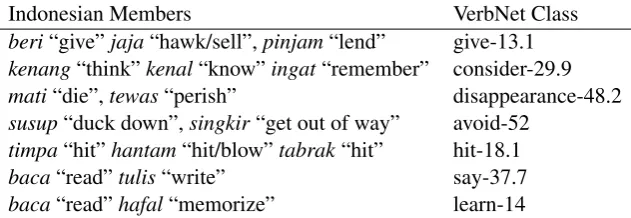
We have 30 stems that we group into 16 Levin classes. Unlike the types we form in Section 3.2, which have unique membership, a lexical item can appear in multiple classes as appropriate. For ex-amplebaca“read” has membership in both Verb-Net classes say-27.7 and learn-14. We show a subset of Indonesian Levin classes we develop based on VerbNet 2.3 in Table 1.
3.2 Forming Superordinate Levin Types
These superordinate types combine Levin classes to form groups of stems that behave in the same way syntactically, but may not all be synonyms of each other. In determining the coarse-grained su-perordinate types, we did not simply want to group stems according to intuition. Rather, we were af-ter an explicit description of the syntax and se-mantics of grouped stems that all behave in the same way when affixed with-kan. Stems that are grouped together should exhibit the same seman-tic shifts. That is, if affixing-kanto a stem gives rise to a causative meaning, then its correspond-ing group member will also produce a causative meaning when-kanis applied to the stem. Also, if adding a-kandoes not increase the valency for a stem in a particular group, then its corresponding group member will also exhibit the same syntatic behaviour.
In order to achieve this, we map out the different behaviour of verb stems when they occur in the morphological patterns (a) and (b):3
2
http://verbs.colorado.edu/˜mpalmer/ projects/verbnet/downloads.html
3
Indonesian Members VerbNet Class
beri“give”jaja“hawk/sell”,pinjam“lend” give-13.1
kenang“think”kenal“know”ingat“remember” consider-29.9
mati“die”,tewas“perish” disappearance-48.2
susup“duck down”,singkir“get out of way” avoid-52
timpa“hit”hantam“hit/blow”tabrak“hit” hit-18.1
baca“read”tulis“write” say-37.7
baca“read”hafal“memorize” learn-14
Table 1: Subset of the mapping of Levin classes into Indonesian
(a) MEN+stem (b) MEN+stem+KAN AV+stem AV+stem+KAN We map out the variation of arguments for pat-tern (a) with only theAV prefix, i.e.ME N+stem, and then note the changes when the stem has both the actorAVand-kanaffixes, i.e. pattern (b) ME N+stem+KAN. We also track the semantic changes relative to the stem for these two patterns and found that 25 verb stems found their way into 8 verb types.4 This formed one of our evaluation sets in our experiments (see Mistica (2013) for fur-ther details on forming these superordinate types). In the interests of space, we only present two out of the 8 manually-induced verb types in Ta-ble 2. Below each of the types, we show the syntactic and semantic changes that determine our verb types or subclasses.
4 Method
We define our features in terms of the context of occurrence of our target lexeme, and employ hier-achical agglomerative clustering (HAC) over these features in two ways: (1) directly over the raw word frequencies; and (2) over extracted seman-tic features learned via the contexts of occurrence, which are represented as topic probabilities.
We use Indonesian Wikipedia5 as our text col-lection, and remove mark-up with Wikiprep,6 then tokenise with the English-trained models of OpenNLP.7 The total word count of the text col-lection is approximately 26 million words. In the
4
We had also manually grouped stems from other word classes: 48 noun stems were grouped into 13 subclasses; and 27 adjective stems were grouped into 5, giving us a total of 100 stems with the 25 verbs, but we only report on the verb experiments.
5
http://dumps.wikimedia.org/idwiki/
6
http://www.cs.technion.ac.il/˜gabr/ resources/code/wikiprep
7http://opennlp.apache.org/Our experiments showed that OpenNLP’s English models performed better than a rule-based Malay sentence tokeniser (Baldwin and Awab, 2006).
next section we summarise the features we use in our experiments, in addition to outlining our clus-tering method.
4.1 Feature Engineering
Our features determine how we collect unigrams from the text collection. We collect these unigram features from 735 lexemes that we were able to identify as possible-kanhosts. These 735 lexemes had stems that belonged to any of the open class categories in Indonesian (noun, adjective or verb). In our preparation of the Wikipedia data, we in-clude function words as a means to infer structural information. Because we do not use a parser to explicitly obtain syntactic features, this is how we approximate this kind of information.
We use three main feature types in our task: (1)
morph∈‘k’, ‘mk’, ‘smk’; (2)win∈1 to 5; and (3)context∈‘+’ (forward), ‘−’ (backward).
Morphological features (morph): These are contextual features for different morphological forms of the target lexeme, where: ‘s’ stands for
stem, i.e. the unaffixed lexeme;‘m’stands for the AVvariant of the lexeme, based on pattern (a) from Section 3.2; and‘k’ stands for the KAN suffixed form of the AV variant of the lexeme, based on pattern (b) from Section 3.2. An example of the
‘s’, ‘m’ and ‘k’ variants of beli “buy” are beli,
membeli, and membelikan, respectively. These morphological features determine whether the un-igram features we collect for a lexeme are based on instances of ((s)m)k forms found in the text. We experiment with the context features based on these morphological variants in isolation and also in combination. For example, ‘mk’ would capture context features for themembeli andmembelikan
variants of the stembeli“buy”.
MORPHOLOGY VERBFRAME DECOMPOSITION
Example Type A:acuh“to heed”,terjemah“translate”,mandi“bathe”
MEN+V1 – –
MEN+V1+KAN <NPa, NPb> DOto([NPa],[V1 TO([NP])])
Example Type B:dengar“hear”,kenang“think of”
MEN+V3 <NPa, NPb> HAPPENto( [NPb],[V3TO([NPa])])
MEN+V3+KAN <NPa, NPb> DOto([NPa],[V3TO([NPb])])
Table 2: Manually generated verb Types (‘–’ = no attested word form in the text; ‘{. . .}’ = optional)
Context Features (context): We look at back-ward (‘−’) or forward (‘+’) context unigrams.
4.2 Clustering Stems
We employ hierarchical agglomerative clustering (HAC) in two ways: (1) over the raw frequencies of words based on the feature representations de-fined in Section 4.1; and (2) over the output of the distributional semantic modelling (HDP) dis-cussed in Section 4.3. The output of this step pro-duces topic models. In other words, we perform HAC over raw unigram frequencies and induced topic models from these raw frequencies to ascer-tain the usefulness of the HDP step.
To compute the distance between a pair of pat-terns, we use Squared Euclidean, and for the linkage criterion for merging clusters we use weighted linkage clustering (WPGMA). We com-pare the output of HAC with the flat-structured gold-standard classes. In order to induce flat clus-ters from the hierarchical output of HAC, we apply a similarity thresholdt= 0.825 to determine which instances should be grouped together.
4.3 Modelling Distributional Similarity
Distributional semantic models are commonly em-ployed in the induction and disambiguation of word senses (McCarthy and Carroll, 2003; La-pata and Brew, 2004; Brody and LaLa-pata, 2009; Lau et al., 2012), and to a lesser extent, in learn-ing syntactic classes and diathesis alternation be-haviour (Parisien and Stevenson, 2011; Bonial et al., 2011). We infer lexical similarity and soft word clusters using topic modelling, based on a hierarchical Dirichlet process (HDP: Teh et al. (2006)), a non-parametric extension of la-tent Dirichlet allocation (LDA: Blei et al. (2003)). LDA is a Bayesian generative topic model that learnslatent topics for a collection of documents
based on theobservablewords. Our definition of a document is a target lexeme and the observable words that surround the target lexeme (based on the window size in the parameter settings).
Formally, in LDA a topic is associated with a multinomial distribution of words, and each doc-ument (i.e. lexeme) in the collection is associated with a multinomial distribution of topics. HDP re-laxes the constraint in LDA where the number of topicsT is fixed, and learnsT based on the train-ing data ustrain-ing Dirichlet processes (DPs).
4.4 Evaluation
We develop two baseline systems to compare our results against: (1) majority class; and (2) random class assignment based on a uniform class distri-bution. The random scores reported are based on the median of 11 random assignments.
We use pairwise precision (pP), recall (pR), and F-score (pF1) to evaluate our generated
clus-ters, relative to the gold-standard word classes, as described by Schulte im Walde (2006).
5 Results
System Maj. Rand. ON-ALL ON-VERBS LEVIN-HDP
.114 .065 .174 .367
LEVIN-NOHDP .057 .111
TYPES-HDP
.271 .140 .281 .261
TYPES-NOHDP .026 .152
Table 3: pF1score comparing benchmark system NOHDP with our HDP system for Levin Classes (LEVIN) and our coarser-grained TYPES
A main“play”,nyanyi“sing”,gesek“scrape” B kirim“send”,hantar“place”
C dapat“get”,menang“win”,terima“receive”
Table 4: Induced groups with no known cate-gorised words
replacement) to ascertain the best parameters to apply to our 735 lexemes in terms of the unigram features we define in Section 4.1.
Given the discovered parameters, we report our results in Table 3. The labelON-ALLfor all HDP systems are sytems that have had topics induced from all 735 stems (made up of not only verbs, but also nouns and adjectives), whileON-VERBSonly induces topics from a subset of the 735 lexemes whose stems are also verbs, even though we only evaluate on verbs in these experiments.
We observe in Table 3 that HDP consistently outperforms NO-HDP systems. Furthermore, the LEVIN-HDP system outperforms the Random (“Rand.”) and the Majority Class (“Maj.”) base-lines, as well as the benchmark NOHDP system. The TYPES-HDPsystem, on the other hand, barely exceeds the Majority Class baseline with theON -ALL experiment, and fails to do so with the ON -VERBSexperiment.
6 Discussion
For our error analysis, we examine a sample of the resulting stem groups from the Levin Class exper-iments. Table 4 shows membership of all stems found in four separate clusters. The lexemes from these particular groups do not have membership into any of the gold standard Levin classes, unlike the groups formed in Table 5. In this table, the top half are groups that match our Levin classes, part of which is presented in Table 1, and the bottom half are groups that do not match Levin classes.
Group A from Table 4 has 3 verbs — main
D singkir“get out of way”,
susup“duck down”
E baca“read”hafal“memorise”
F terjemah“translate”tulis“write”,
muat“insert/contain”
G paksa“force”pinjam“lend”
hapus“wipe off/vanish/blot out”
Table 5: Induced groups with known categorised words
“play”, nyanyi “sing”, and gesek “scrape” — which may initially seem not to form a semanti-cally coherent group, however they all are associ-ated with producing music:main“play” is used to describe the playing of most musical instruments, and gesek “scrape/rub” is used for string instru-ments, such as violins or cellos. Group B has members that describe movement from one place to another, as does Group C.
Groups D and E in Table 5 faithfully replicate the Levin Classesavoid-52, adnlearn-14from Ta-ble 1. However, Groups F and G seem to not form coherent semantic groups.
7 Conclusion
References
I Wayan Arka. 1993. Morphological aspects of the -kan causative in indonesian. Master’s thesis, The University of Sydney, Sydney, Australia, November.
Timothy Baldwin and Su´ad Awab. 2006. Open source corpus analysis tools for Malay. InProceedings of the 5th International Conference on Language Re-sources and Evaluation (LREC2006), pages 2212–5, Genoa, Italy.
David Blei, Andrew Ng, and Michael Jordan. 2003. Latent Dirichlet allocation. Journal of Machine Learning Research, 3:993–1022.
Claire Bonial, Susan Windisch Brown, Jena D. Hwang, Christopher Parisien, Martha Palmer, and Suzanne Stevenson. 2011. Incorporating coercive construc-tions into a verb lexicon. InProceedings of the ACL 2011 Workshop on Relational Models of Semantics, pages 72–80, Portland, USA.
Michael R. Brent. 1993. From grammar to lexicon: Unsupervised learning of lexical syntax. Computa-tional Linguistics, 19(2):243–262.
Samuel Brody and Mirella Lapata. 2009. Bayesian word sense induction. In Proceedings of the 12th Conference of the EACL (EACL 2009), pages 103– 111, Athens, Greece.
Soenjono Dardjowidjojo. 1971. The meN-, meN-kan, and meN-i verbs in Indonesian. Philippine Journal of Linguistics, 2:71–84.
Raymond Gordon. 2005. Ethnologue: Languages of the World. SIL International, Dallas, USA.
Jane Grimshaw. 1990. Argument Structure. The MIT Press, Cambridge, USA.
Eric Joanis, Suzanne Stevenson, and David James. 2008. A general feature space for automatic verb classification. Natural Language Engineering, 14(3):337–367.
David Jurgens and Keith Stevens. 2010. HERMIT: Flexible clustering for the SemEval-2 WSI task. In Proceedings of the 5th International Workshop on Semantic Evaluation, pages 359–362, Uppsala, Sweden.
Karin Kipper, Anna Korhonen, Neville Ryant, and Martha Palmer. 2006. Extending VerbNet with novel verb classes. InProceedings of LREC 2006, pages 1027–1032, Genoa, Italy.
Paul R. Kroeger. 2007. Morphosyntactic vs. mor-phosemantic functions of indonesian ’-kan. In Joan Bresnan, Annie Zaenen, Jane Simpson, Tracy Hol-loway King, Jane Grimshaw, Joan Maling, and Christopher D. Manning, editors, Architectures, rules, and preferences: variations on themes, CSLI Lecture Notes, pages 229–251. CSLI Publications.
Mirella Lapata and Chris Brew. 2004. Verb class disambiguation using informative priors. Computa-tional Linguistics, 30(1):45–73.
Jey Han Lau, Paul Cook, Diana McCarthy, David New-man, and Timothy Baldwin. 2012. Word sense in-duction for novel sense detection. InProceedings of
the 13th Conference of the European Chapter of the Association for Computational Linguistics (EACL-2012), pages 591–601, Avignon, France.
Beth Levin. 1989. English Verb Classes and Alterna-tions: A preliminary investigation. The University of Chicago Press, Chicago, USA.
Christopher D. Manning. 1993. Automatic acquisition of a large subcategorization dictionary from corpora. InProceeding of the 31st Annual Meeting of the As-sociation for Computational Linguistics, pages 235– 242, Columbus, USA.
Diana McCarthy and John Carroll. 2003. Disam-biguating nouns, verbs, and adjectives using auto-matically acquired selectional preferences. Compu-tational Linguistics, 29(4):639–654.
Meladel Mistica. 2013. An Investigation into Deviant Morphology: Issues in the Implementation of a Deep Grammar for Indonesian. Ph.D. thesis, The Aus-tralian National University, Canberra, Australia.
Ruth O’Donovan, Michael Burke, Aoife Cahill, Josef van Genabith, and Andy Way. 2005. Large-scale induction and evaluation of lexical resources from the Penn-II and Penn-III treebanks. Computational Linguistics, 31(3):229–365.
Chris Parisien and Suzanne Stevenson. 2011. General-izing between form and meaning using learned verb classes. InProceedings of the 33rd Annual Confer-ence of the Cognitive SciConfer-ence Society, Boston, USA.
Femphy Pisceldo, Ruli Manurung, and Mirna Adriani. 2009. Probabilistic part-of-speech tagging for Ba-hasa Indonesia. In Proceedings of the Third Inter-national MALINDO Workshop, Singapore.
Sabine Schulte im Walde. 2002. A subcategorisa-tion lexicon for German verbs induced from a lex-icalised PCFG. In Proceedings of the 3rd Interna-tional Conference on Language Resources and Eval-uation, volume IV, pages 1351–1357, Las Palmas de Gran Canaria, Spain.
Sabine Schulte im Walde. 2006. Experiments on the automatic induction of german semantic verb classes. Computational Linguistics, 32(2):159–194.
Y. W. Teh, M. I. Jordan, M. J. Beal, and D. M. Blei. 2006. Hierarchical Dirichlet processes. Journal of the American Statistical Association, 101:1566– 1581.
Marit Kana Vamarasi. 1999.Grammatical relations in Bahasa Indonesia, volume 93 ofSeries D. Pacific Linguistics, Canberra, Australia.