SentiNLP at IJCNLP-2017 Task 4: Customer Feedback Analysis Using
a Bi-LSTM-CNN Model
Shuying Lin
1,3,4, Huosheng Xie
1Liang-Chih
Yu
2,3and K. Robert Lai
3,4 1College of Mathematics and Computer Science, Fuzhou University, Fuzhou, P.R. China2Department of Information Management, Yuan Ze University, Taiwan
3Innovation Center for Big Data and Digital Convergence, Yuan Ze University, Taiwan 4Department of Computer Science & Engineering, Yuan Ze University, Taiwan
Contact: [email protected]
Abstract
Analysis of customer feedback helps improve customer service. Much online customer feedback takes the form of online reviews, but the tremendous volume of such data makes manual classification impractical, raising the need for automatic classification to allow analysis systems to identify meanings or in-tentions expressed by customers. The aim of shared Task 4 of IJCNLP 2017 is to classify customer feedback into six tags. We present a system that uses word embeddings to express features of the sentence in the corpus, using the neural network as the classifier to
com-plete the shared task. The ensemble method is
then used to obtain a final predictive result. The proposed method ranked first among twelve submissions in terms of micro-averaged F1 and second for accuracy.
1
Introduction
Software companies receive tremendous amounts of online customer feedback every day, including product comments, bug reports, new feature re-quests, response complaints, capacity concerns and so on. The effective classification of this customer feedback can provide a foundation for improved customer service, but the huge amounts of data make manual classification impractical, raising the need for automatic classification to accurately identify customer meanings or intentions.
Sentence classification is a fundamental task for natural language processing (Collobert et al., 2011).
The goal of this shared task is to classify the cross language customer feedback into six categories (comment, request, bug, complaint, meaningless, and undetermined). Each sentence will be assigned at least one tag. It can be treated as a multi-label classification problem.
In recent years, deep neural network models such as convolutional neural networks (CNN) (Cun et al., 1990), recurrent neural networks (RNN) (Goller and Kuchler, 1996), long short-term memory (LSTM) (Hochreiter and Schmidhuber, 1997), and their combinations (Wang et al., 2016) have achieved remarkable results in many NLP tasks, including sentence classification (Kim, 2014; Kalchbrenner et al., 2014), sentiment analysis (Ir-soy and Cardie, 2014; Liu et al., 2015), sarcasm detection (Ghosh and Veale, 2016; Amir et al., 2016). The neural network models can automati-cally infer the features and can be used as a sen-tence classifier. The word embeddings (Mikolov et al., 2013a; 2013b; Pennington et al, 214; Yu et al., 2017) can provide word vector representation that captures semantic and syntactic information of words. The word vector is used to build the tence matrix and then inject information into tence classifier. The LSTM can provide the sen-tence sequence information in one direction. For-ward and backFor-ward networks respectively capture past and future information. Therefore, we used the bi-directional LSTM for our model.
sentence as input, and the neural network as the
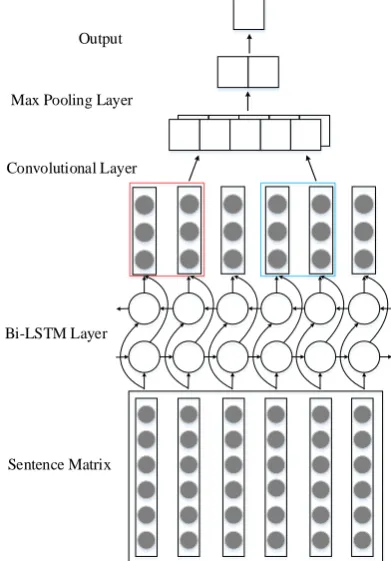
classifier. The neural network uses the sentence matrix as input to classify the sentence into six la-bels. For multi-label classification, we construct a binary classifier for each label. The proposed mod-el for sentence classification consists of two parts: a directional LSTM and CNN. The bi-directional LSTM is used to capture the context of a sentence through sequential modeling. The se-quence feature is used as the input for the CNN layer, which is then used to extract the most im-portant feature to form the sentence representation. The logistic regression layer on the top is used to output the sentence labels.
The rest of this paper is organized as follows. Section 2 describes the model for sentence classifi-cation. Section 3 briefly introduces the ensemble method used in this paper. Section 4 reports exper-imental results and analysis. Section 5 presents conclusions and suggests directions for future work.
2
Model for Sentence Classification
The model aims to classify a sentence into six la-bels according to its sentence texts. Figure 1shows the framework of the bi-directional LSTM-CNN model for sentence classification. In the input layer, the sentence is transformed into a sentence matrix based on the word vector. The word vectors of vo-cabulary words are trained from a large corpus us-ing the Glove (Pennus-ington et al., 2014) toolkit. The sentence matrix is fed into a forward LSTM network and a backward LSTM network. The rep-resentation sequence is then averaged over all timesteps and then concatenated to produce the fi-nal sequence representation. The sequence is the input of the CNN layer. The CNN extract the se-quence feature information followed by logistic re-gression layer whose target is the class label for given sentence.
For a given corpus, we store the word vector in a look up matrix M∈Rd V×| |
, where
|V|is the
vocabulary size of the given texts and d is the
dimensionality of the word vector. For the
sen-tence
S={ , , , }s s1 2 … sn, n is the length of the
sentence.
Let |V| denote the vocabulary of words, while d is the dimensionality of word vectors. The sentence matrix representation X={ ,x x1 2, ..., }xn ,i
x is the word vector of word si in accordance with the look up matrix M .
2.1
Recurrent Neural NetworkTo capture the relationship between the input se-quences, we can use the RNN layer to transform word vector into the sentence feature representa-tion.
Due to the vanishing gradients and exploding gradients problem (Pascanu et al., 2012), the LSTM (a certain type of RNN) is introduced for sequence modeling (Tang et al., 2015; Tai et al., 2015). The LSTM consists of three gates: input gate i, forget gate f and output gate o. The gate mechanisms work collaboratively to learn the long-term dependencies. At each time step t, the LSTM is calculated as follows:
Sentence Matrix Bi-LSTM Layer Convolutional Layer
[image:2.595.78.274.128.409.2]Max Pooling Layer Output
1
1
1
1
1
( )
( )
tanh( )
( )
tanh( )
i i i
f f f
g g g
o o o
t t t
t t t
t t t
t t t
t t t t t
t t t
i W x U h b
f W x U h b
g W x U h b
o W x U h b
c f c i g
h o c
σ σ
σ
−
−
−
−
−
= + +
= + +
= + +
= + +
= ∗ + ∗ = ∗
(1)
where xt is the input from lower layer. ht-1 is the hidden state at time step t-1. The it , ft ,ot are
re-spectively called the input, forget and output gates.
d
W∈Rω× and d
U∈Rω× are the weight matrices for different gates for input xt and hidden state ht-1. b
denotes bias vectors. Here * is the element-wise multiplication, and the ( )σ ⋅ and tanh( )⋅ are the el-ement-wise activation function. The d can be the dimension of the word vector or the size of the hidden state in the lower layer.
A forward network and a backward network can respectively capture the past and future infor-mation. For sentence classification, it is beneficial to combine the past and future information in se-quence modeling. Therefore, we use bi-directional LSTM to obtain the contextual information in sen-tence sequence modeling.
2.2
Convolutional Neural NetworkThe convolutional is used to extract n-gram fea-tures. We use a convolution filter F∈Rω×d to ob-tain the feature map Y∈Rn− +ω 1 , The j-th element
j
y is given by:
yj= f W x
(
j j: + -1ω +b)
(2)where f is the Relu activation function, W is the weight matrix of convolution filter, b is a bias, ω is the length of the filter, and d is the dimension of the word vector. The convolutional layer uses mul-tiple filters in parallel to obtain feature maps. It al-so can use convolutional filters of various length to extract different feature information.
The feature maps are fed into the max-pooling layer to obtain the most salient information to form the feature vector. The feature vector is useful for determining the output result.
3
Ensemble method
In statistics, ensemble methods use multiple learn-ing algorithms to obtain better predictive perfor-mance (Maclin and Opitz, 1999; Rokach, 2010). In this paper, the ensemble methods use multiple re-sults produced by the same NN-based method in different training times to obtain better predictive
performance. For multi-label classification, we make a variation of the voting rules in the ensem-ble method. The predictive outputs can be calculat-ed in two steps: For each label, we assign the sen-tence to label i if the proportion of positive results in more than half of the total predictive result. Af-ter that, we assign it to label j with the most com-ponent predictions if the sentence was unannotated.
4
Experiments and Evaluation
Dataset. For the shared task on customer feedback
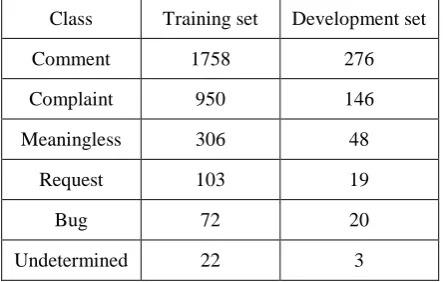
analysis, several sentences of annotated and unan-notated customer feedback in English were pre-pared, with a total of 3065 training texts, 500 de-velopment texts and 500 test texts. The training and development texts were annotated with six la-bels (comment, request, bug, complaint, meaning-less, and undetermined). We evaluated the pro-posed bidirectional LSTM-CNN model by submit-ting the results of the test set to the IJCNLP 2017 Task 4 Customer Feedback Analysis. The distribu-tion of the six labels shown in Table 1 indicates a data imbalance. Most of the data were assigned one of five class labels, and only a few were
anno-Class Training set Development set
Comment 1758 276
Complaint 950 146
Meaningless 306 48
Request 103 19
Bug 72 20
[image:3.595.307.529.210.351.2]Undetermined 22 3
tated as being undetermined. There are many pre-trained word vectors for English provided by word embeddings tool. We use the pre-trained word vec-tors trained on 840B tokens from common crawls and its dimensionality is 300 provided by Glove (Pennington et al., 2014 ) because of the high vol-ume of the vocabulary. Word vectors are randomly initialized with uniform distribution sample if the word is not in the vocabulary of the pre-trained
word vectors.
Let Y be the vector representation of the label of the sentence. The labels ls={ l1, l2, l3, l4, l5,
l6 }and the sentence has multiple labels {l1, l2}. For
each label, we use a binary classifier. Therefore, we can express the labels as: Y=(1, 1, 0, 0, 0, 0) to calculate the loss function through binary cross-entropy.
Experimental settings. The dataset containing the development set and training set is randomly shuf-fled and then re-divided for the 5-fold cross valida-tion. The hyper-parameters of the neural network are chosen based on the performance on the devel-opment data. We obtain the final hyper-parameters by averaging the ten evaluation results of the de-velopment set in the 5-fold cross validation.
The epoch time is 10 to minimize the loss func-tion. To avoid overfitting, we use the early stop mechanism and random dropout (rate of 0.25 or 0.5) (Srivastava et al., 2014). The nadam (Dozat, 2016) update rule is used to automatically tune the learning rate. The activation function in the top layer is a sigmoid function, which scales each label within a range 0 to 1. If the continuous result yi is
greater than 0.5, it is rounded up to 1, or set to 0 otherwise. The predicted result Y=(0, 0, 0, 0, 0, 0) for six labels is assigned to label i with the max-imum value yiof Y.
We first run experiments on CNN, LSTM and their combinations, including LSTM-CNN, CNN-LSTM, bi-LSTM and bi-LSTM-CNN. CNN1 and CNN2 have different hyper-parameters, a filter window of 3 with 256 feature maps in CNN1, and a filter window of 3 and 5 with 128 feature maps in CNN2.
We compare the results generated by the NN-based methods and select the best five results on
the development set data in micro-averaged F1 to produce the ensemble result.
Evaluation metrics. IJCNLP 2017 Task 4
pub-lished the results for all participants assessed based on both accuracy and micro-averaged F1 measure. Given a binary classification, there are four basic outcomes: true positive (tp), true negative (tn), false positives (fp) and false negative (fn). The ac-curacy and F1 score (Powers, 2011) are evaluation measures B(tp, tn, fp, fn) used to evaluate the per-formance of a binary classification problem. Accu-racy is the proportion of true results (both tp and tn) among the total test set. The micro-averaged F1 has a binary evaluation for its overall counts among all labels.
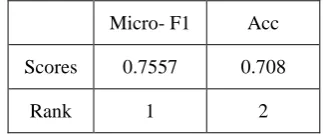
Results. A total of twelve teams participated in task 4. Table 2 shows the result of the ensemble
Micro- F1 Acc
Scores 0.7557 0.708
[image:4.595.92.256.230.297.2]Rank 1 2
Table 2: Results of ensemble method for the
best of the five results produced by the neural network model for IJCNLP-2017 Task 4.
NN-based Ensemble
Micro-
F1 Acc
Micro-
F1 Acc
CNN1 0.7223 0.668 0.7342 0.682
CNN2 0.7383 0.694 0.7495 0.702
LSTM 0.5947 0.57 0.6425 0.618
LSTM-CNN 0.6931 0.658 0.7181 0.68
CNN-LSTM 0.7155 0.68 0.7332 0.69
Bi-LSTM 0.7417 0.7 0.7455 0.704
[image:4.595.302.533.230.461.2]
Bi-LSTM-CNN 0.7309 0.69 0.7557 0.708
Table 3: Comparative results of ensemble
method with the best of the five results produced by the bi-directional LSTM-CNN model. We ob-tain the best result by sorting the micro-averaged F1 for all labels. The ensemble result ranked first for micro-averaged F1 and second for accuracy.
Table 3 shows the best experimental results of ten runs for the neural network model for both ac-curacy and micro-averaged F1, along with rive runs for the ensemble method. We found that the ensemble method shows better performance, indi-cating that it can improve on all NN-based meth-ods. The ensemble result in bi-LSTM-CNN achieves the best performance in all NN-based methods. The bi-LSTM yielded better performance without ensemble.
5
Conclusions
This study presents a neural network model to classify text-based customer feedback into six la-bels. We use the ensemble method to obtain the best of five results sorted by the micro-averaged F1. The use of the ensemble method can further im-prove performance in all NN-based methods. The bi-directional LSTM produces the sentence se-quence feature, and the convolutional layer ex-tracts the salient information from the sequence representation to classify the sentence into the mul-ti-labels. Experimental results show that the bi-directional LSTM-CNN achieves best performance.
Future work will focus on exploring customer feedback in multiple languages and high-order cor-relations between labels should be taken into ac-count to improve classification performance for both micro- and macro-averaged F1.
Acknowledgments
This work was supported by the Ministry of Sci-ence and Technology, Taiwan, ROC, under Grant No. MOST 105-2221-E-155-059-MY2 and MOST 105-2218-E-006-028.
References
Silvio Amir, Byron C. Wallace, Hao Lyu, Paula Car-valho, and Mario J. Silva. 2016. Modelling context with user embeddings for sarcasm detection in social
media. In Proc. of The 20th SIGNLL Conference on
Computational Natural Language Learning, pages
167–177.
Ronan Collobert, Jason Weston, Michael Karlen, Koray Kavukcuoglu, and Pavel Kuksa. 2011. Natural
lan-guage processing (almost) from scratch. Journal of
Machine Learning Research, 12(1):2493–2537.
Y. Le Cun, B. Boser, J. S. Denker, R. E. Howard, W. Habbard, L. D. Jackel, and D. Henderson. 1990. Handwritten digit recognition with a backpropagation
network. In Advances in Neural Information
Pro-cessing Systems, pages 396–404.
Timothy Dozat. 2016. Incorporating nesterov
momen-tum into adam. In ICLR 2016 workshop, page 107.
Aniruddha Ghosh and Tony Veale. 2016. Fracking
sar-casm using neural network. In Proc. of the 7th
Work-shop on Computational Approaches to Subjectivity,
Sentiment and Social Media Analysis (WASSA-16),
pages 161-169.
C. Goller and A. Kuchler. 1996. Learning task-dependent distributed representations by
backpropa-gation through structure. In Proc. of the IEEE
Inter-national Conference on Neural Networks (ICNN-96),
pages 347–352.
Sepp Hochreiter and J¨urgen Schmidhuber. 1997. Long
short-term memory. Neural computation, 9(8):1735–
1780.
Ozan Irsoy and Claire Cardie. 2014. Opinion mining
with deep recurrent neural networks. In Proc. of the
2014 Conference on Empirical Methods in Natural
Language Processing (EMNLP-14), pages 720–728.
Nal Kalchbrenner, Edward Grefenstette, and Phil Blun-som. 2014. A convolutional neural network for
mod-elling sentences. Eprint Arxiv, 1.
Yoon Kim. 2014. Convolutional neural networks for
sentence classification. Eprint Arxiv.
Pengfei Liu, Shafiq Joty, and Helen Meng. 2015. Fine-grained opinion mining with recurrent neural
net-works and word embeddings. In Proc. of the 2015
Conference on Empirical Methods in Natural
Lan-guage Processing (EMNLP-15), pages 1433–1443.
R. Maclin and D. Opitz. 1999. Popular ensemble
meth-ods: An empirical study. Journal of Artificial
Intelli-gence Research, 11:169–198.
Tomas Mikolov, Kai Chen, Greg Corrado, and Jeffrey Dean. 2013a. Efficient estimation of word
representa-tions in vector space. Computer Science.
Tomas Mikolov, Ilya Sutskever, Kai Chen, Greg Cor-rado, and Jeffrey Dean. 2013b. Distributed represen-tations of words and phrases and their
compositional-ity. Advances in Neural Information Processing
Razvan Pascanu, Tomas Mikolov, and Yoshua Bengio. 2012. On the difficulty of training recurrent neural
networks. Computer Science, 52(3):III–1310.
Jeffrey Pennington, Richard Socher, and Christopher Manning. 2014. Glove: Global vectors for word
rep-resentation. In Proc. of the 2014 Conference on
Em-pirical Methods in Natural Language Processing
(EMNLP-14), pages 1532– 1543.
David M W Powers. 2011. Evaluation: From precision, recall and f-factor to roc, informedness, markedness
& correlation. Journal of Machine Learning
Tech-nologies, 2:2229–3981.
Lior Rokach. 2010. Ensemble-based classifiers. Kluwer
cademic Publishers.
Nitish Srivastava, Geoffrey Hinton, Alex Krizhevsky, Ilya Sutskever, and Ruslan Salakhutdinov. 2014. Dropout: a simple way to prevent neural networks
from overfitting. Journal of Machine Learning
Re-search, 15(1):1929–1958.
Kai Sheng Tai, Richard Socher, and Christopher D. Manning. 2015. Improved semantic representations from tree-structured long short-term memory
net-works. In Proceedings of the 53rd Annual Meeting of
the Association for Computational Linguistics and the 7th International Joint Conference on Natural
Language Processing (ACL/IJCNLP-15), pages
1556–1566.
Duyu Tang, Bing Qin, and Ting Liu. 2015. Document modeling with gated recurrent neural network for
sentiment classification. In Proc. of the 2015
Confer-ence on Empirical Methods in Natural Language
Processing (EMNLP-15), pages 1422–1432.
Jin Wang, Liang-Chih Yu, K. Robert Lai, and Xuejie Zhang. 2016. Dimensional sentiment analysis using a
regional CNN-LSTM model. In Proc. of the 54th
Annual Meeting of the Association for Computational Linguistics (ACL-16), pages 225-230.
Liang-Chih Yu, Jin Wang, K. Robert Lai, and Xue-jie Zhang. 2017. Refining word embeddings for
senti-ment analysis. In Proc. of the 2017 Conference on
Empirical Methods in Natural Language Processing