University of South Carolina
Scholar Commons
Theses and Dissertations
1-1-2013
The Relationship of South Carolina Teachers'
Work-Related Stress With Years of Experience,
Feelings and Coping Strategy
Michelle Munnell University of South Carolina
Follow this and additional works at:https://scholarcommons.sc.edu/etd Part of theEducational Psychology Commons
This Open Access Dissertation is brought to you by Scholar Commons. It has been accepted for inclusion in Theses and Dissertations by an authorized administrator of Scholar Commons. For more information, please [email protected].
Recommended Citation
THE RELATIONSHIP OF SOUTH CAROLINA TEACHERS' WORK-RELATED STRESS WITH YEARS OF EXPERIENCE, FEELINGS AND COPING
STRATEGY
by
Michelle Collins Munnell
Bachelor of Science College of Charleston, 1989
Master of Arts
University of North Carolina at Charlotte, 1992 _______________________________________
Submitted in Partial Fulfillment of the Requirements
For the Degree of Doctor of Philosophy in
School Psychology
College of Arts and Sciences
University of South Carolina
2013
Accepted by:
Scott Huebner, Major Professor
Frederic J. Medway, Committee Member
Scott Decker, Committee Member
Amy Donnelly, Committee Member
Dedication
Dedicated to my mother, Sarah Blaney Collins, who taught elementary school for
thirty-nine years and who is the best teacher I have ever had! Thank you mom for your
unwavering support and encouragement.
Acknowledgements
Thank you to everyone who was so supportive and encouraging during my
doctoral work. Foremost, I want to thank God: “I can do all things through Christ which
strengtheneth me” (Philippians 4:13, King James Version). I would also like to thank: my
mentor, Fred Medway for all of his thoughtful assistance and continued encouragement;
my husband, Bak, who reviewed my rewrites each time and was consistently helpful,
especially with technical difficulties and deadlines, and was wonderfully supportive; my
parents, Sarah and David, for always listening and helping with whatever was needed;
and my children, Madison, Sydney, Mary Catherine and Alexander, for understanding
that mommies have homework too, and for all of their help and love. Many thanks also to
Abstract
Background. Stress has been found to affect workers in various occupations, and
teaching appears particularly stressful. Work-Related Stress (WRS) affects teachers and
people with whom they interact. Previous research suggests WRS may be related to
characteristics including teaching experience, feelings, and coping strategy. Objective.
The purpose of this study was to investigate further the relationship of teacher stress,
while expanding the investigation in several areas: utilizing a different geographic
population, broadening the focus to generic WRS, and including teachers with less
experience. Current model builds on Kyriacou and Sutcliffe’s (1978) and Tolbert’s
(2007) teacher stress models. This study examined relationships between Individual
Teacher Characteristics (Years of Teaching Experience, Hope, Locus of Control (LOC),
and Non-Teaching Stress) and teacher’s Perception/Appraisal of WRS and Experience of
Negative/Positive Feelings of Stress and selection of Coping Strategy. Coping Strategy
was examined in relation to outcome measures: Depression, Absences from Work, and
Commitment to Teaching. It was hypothesized that teachers with less experience, and
experiencing low levels of Hope, feelings of an external LOC, and more personal stress,
would be more stressed and choose Unconstructive Coping Strategies. Increased WRS
was hypothesized to predict Negative Feelings; while higher WRS and Negative Feelings
should predict Unconstructive Coping Strategies. Constructive Coping Strategy choice
Commitment. Less Depression and fewer Absences should predict increased
Commitment; less Depression predicts fewer Absences. Methods. Participants were 140
elementary-level teachers, from 25 South Carolina schools. Teachers anonymously
completed self-report questionnaires. Regression equations were calculated to analyze
relationships. Results. Results revealed significant relationships: WRS predicted Feelings
(R2=.26, p<.0001); Feelings predicted Coping Strategy (R2=.10, p<.001); Hope and
Non-Teaching Stress predicted Coping Strategy (R2=.12, p<.01); Coping Strategy
predicted Depression (R2=.21, p<.0001.); Depression predicted Absences (R2=.15,
p<.0001); Absences predicted Commitment (R2=.05, p<.05). Discussion. Findings
suggest teachers felt most stress is related to their occupation, not personal lives.
Interventions to increase teacher well-being include: lowering perceived occupational
stress, increasing positive feelings from stress, choosing positive coping strategies, and
encouraging characteristics such as Hope. These changes may positively impact
Table of Contents
Dedication ... iii
Acknowledgements ... iv
Abstract ... v
List of Tables ... ix
Chapter I. Introduction ... 1
1.1 Stress and the Workplace ... 2
1.2 Distress and Teachers – A Lengthy Relationship ... 3
1.3 Outcomes of Teacher Stress ... 4
1.4 Physical and Mental Health Problems ... 5
1.5 Types of Stress: Work-Related Stress and Personal Stress ... 9
1.6 Individual Teacher Characteristics Which May Affect Stress ... 11
1.7 Responses to Stress ... 15
1.8 Teacher Stress Models... 17
1.9 Current Study – Purpose and Predictions ... 23
1.10 Research Questions and Their Expected Relationships ... 26
Chapter II. Method ... 32
2.1 Introduction ... 32
2.2 Participants ... 33
2.3 Procedures ... 35
2.4 Measures ... 37
3.1 Overview of Results ... 56
3.2 Descriptive Statistics ... 57
3.3 Inferential Statistics ... 68
3.4 Correlation Relationships ... 68
3.5 Regression Equations ... 71
3.6 Research Questions ... 73
Chapter IV. Conclusion ... 79
4.1 Overview of Conclusion ... 79
4.2 Significant Relationships ... 79
4.3 Non-Significant Relationships ... 85
4.4 Limitations and Suggestions for Future Research ... 86
4.5 Implications ... 88
4.6 Summary ... 90
References ... 92
Appendix A ... 101
List of Tables
Table 2.1. Location of Participating Teachers ...34
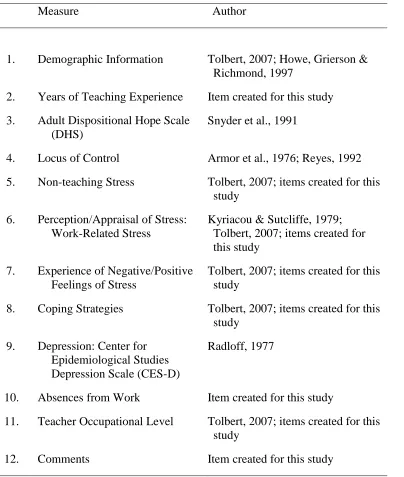
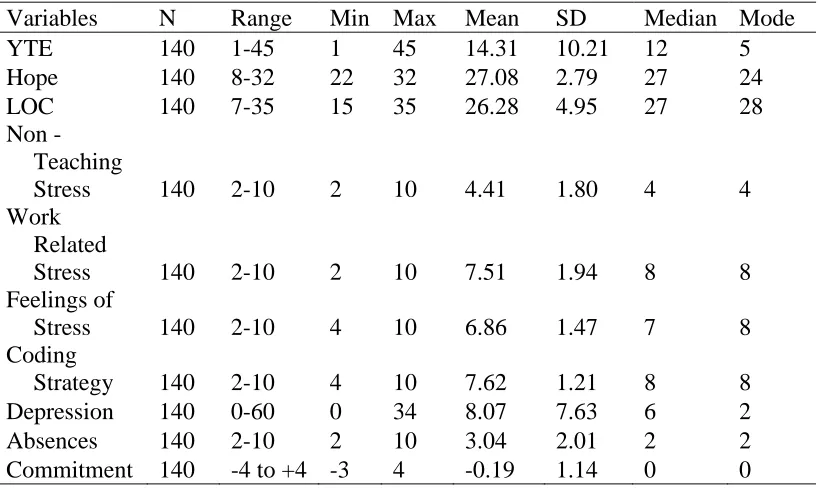
Table 2.2. Measures Contained in the Views of Educational Experiences Questionnaire 40 Table 3.1. Descriptive Statistics for All Variables ...57
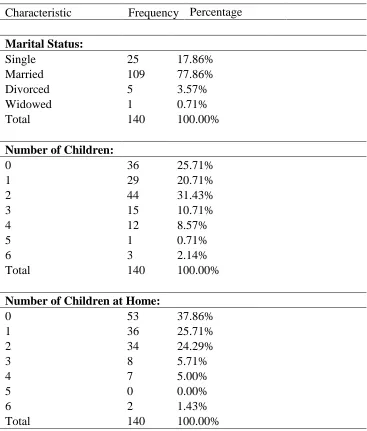
Table 3.2. Demographic Characteristics of Participating Teachers ...58
Table 3.3. Personal Characteristics of Participating Teachers ...59
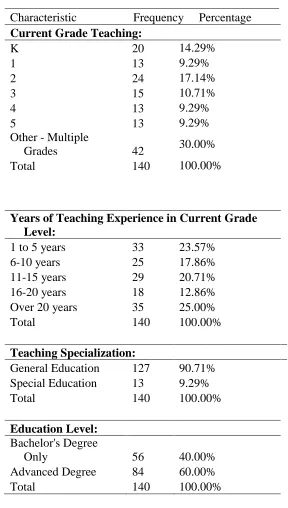
Table 3.4. Occupational Characteristics of Participating Teachers ...60
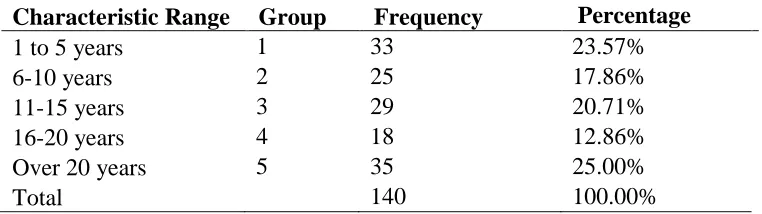
Table 3.5. Years of Teaching Experience ...61
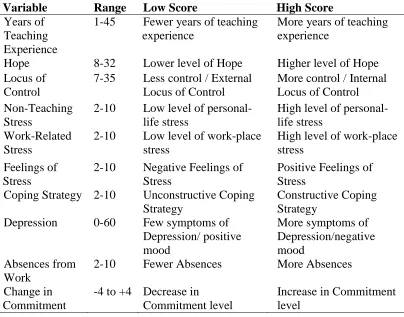
Table 3.6. Variables Value Interpretation ...63
Table 3.7. Coping Strategy Categories ...66
Chapter I
Introduction
Stress is a commonly used term to describe psychological feelings of time
pressure and work overload, resulting in a feeling of inadequacy in meeting the current
demands which a person is experiencing. Many researchers have examined the role of
stress in the lives of humans and animals. Hans Selye, for example, has studied stress
since the mid 1930’s, looking at both the physical and mental strain on the body, which in
turn produce stress (Gross, 1958). Selye determined that stress actually exists in all
living things and is inescapable. Stress is present regardless of the emotions being
experienced or the activity one is participating in; stress exists when people are sad or
laughing; angry or joyful; running or reading (Gross, 1958). Furthermore, stress is not
strictly a negative concept. There is a difference between negative stress or ‘distress’, and
positive stress or ‘eustress’. Selye (1974) stated that we are in reality focused on the
‘distress’ someone is experiencing, when we discuss someone being in a state of stress.
He suggested instead of focusing on the negative aspects of stress, that we look at stress
as a challenge for coping and “…enjoy it by learning more about its mechanism and
adjusting our philosophy of life accordingly.” (p. 33).
Richard Lazarus has also conducted research in the field of stress for many years.
He noted that stress began as an engineering term for systems, and then later became
“stress conveys the idea that the person or animal is beset by powerful pressures which
greatly tax the adaptive resources of the biological or psychological system.” (p. 10).
Lazarus, like Selye, focused on the way in which we view stress as important. According
to Lazarus, the situation alone does not define whether something is stressful, rather the
individual’s perceptions of the situation more often determine if a situation is viewed as
distressful for that person or someone with a similar personality (Lazarus, 1966). Thus,
personality characteristics specific to an individual are important in identifying potential
stressors for that particular person.
1.1 Stress and the Workplace
More recently, research work in the field of stress has examined the role of stress
or more accurately, ‘distress’, in the workplace. Many negative characteristics of the
current workplace environment, including the recent recession and poor economic
conditions, have increased the levels of work stress for a variety of occupations
(American Institute of Stress, 2012; Maslach & Leiter, 1997). This occupational stress
affects employees and their employers as well. The American Institute of Stress (2012)
stated that the estimated cost of stress for all employees in the United States workforce is
over $300 billion each year. This problem is not limited to the United States however, as
one newspaper reported in Scotland recently, last year the schools’ cost of stress included
thousands of days for teachers’ long-term absences (Thousands of Days, 2012).
Research in both the United States and in Great Britain, has shown that teaching
is one of the most stressful occupations. Kyriacou and Sutcliffe (1979) reported that
teaching is considered ‘very stressful’ or ‘extremely stressful’ for approximately 30% of
Cooper (1998) compared the stressfulness of the teaching occupation to nurses, doctors
and tax officers in the United Kingdom. Teachers were found to have a lower level of job
satisfaction and more mental health issues than the other professionals. Cox and
Brockley (1984) stated that “work appears as a major source of stress for working people,
with teachers appearing to experience more stress through work than
non-teachers,”(p.84).
The goal of the current study was to further examine the stressfulness of the
teaching occupation by examining individual characteristics which may impact a
teacher’s perception of stress, as well as their coping techniques. Additionally, this study
examined several teacher outcomes of the stress that is experienced.
1.2 Distress and Teachers- A Lengthy Relationship
Research groups such as the National Education Association began to study
teacher happiness in the 1930’s and other researchers continued to study teacher job
satisfaction and anxiety in the 1960’s (Adams, Heath-Camp & Camp, 1999). In the
1960’s and 1970’s the concept of teacher stress was identified and has become an
increasingly popular topic of study since that time (Kyriacou, 2001). Kyriacou defined
teacher stress as “…the experience by a teacher of unpleasant, negative emotions, such as
anger, anxiety, tension, frustration or depression, resulting from some aspect of their
work as a teacher.” (Kyriacou, 2001, p.28) He also developed a model of teacher stress
depicting stress as negative, or distress, and incorporating the perceptions of the teacher
in appraising the situation (Kyriacou & Sutcliffe, 1978). This is similar to the views of
situation and the person’s perception of the situation, in order to determine if it is
distressing to that person. Different people may interpret situations differently.
1.3 Outcomes of Teacher Stress
Outcomes for people interacting with highly-stressed teachers
As the research described above indicates, teachers are experiencing high levels
of stress in their professional lives. According to this research, they are also experiencing
more stress than other occupations. Not only is the high level of stress impacting the
individual teachers’ lives, but it is also negatively impacting the lives of the people
around them – their families, their coworkers and their students. Lazarus (1999)
described this overlap between a teacher’s stressful work life and personal life. Stress
from a teacher’s job can negatively impact his or her personal life, thus negatively
affecting his or her personal relationships with family and friends. Hart (1994) found that
a teacher suffering from distress may have poorer relationships with co-workers and
administrative staff. Similarly, other research has found that highly stressed teachers may
have substandard relationships with coworkers and distance themselves emotionally from
students, such as treating them in a disparaging manner (Moracco & McFadden, 1982).
This may negatively affect students emotionally and also affect the students’ current and
future academic achievement.
Outcomes for highly-stressed teachers
As a result of experiencing chronic, high levels of stress, some teachers may
experience physical and mental health problems, and burnout, leading to increased
absenteeism and a decrease in commitment. Hart (1994), in developing a model of
to a higher level of psychological distress. Moracco and McFadden’s (1982) research
further suggested highly stressed teachers may experience emotional problems such as
depression and relationship difficulties. If not corrected, these problems may continue to
escalate, even eventually forcing a teacher to leave the teaching profession entirely. This
increased exodus from teaching has serious consequences for school districts nationwide.
Hornick-Lockard (2008) and Guarino, Santibanez and Daley (2006) and others note an
urgent teacher shortage throughout much of the United States, especially in the areas of
science, math and special education. Thornton, Peltier and Medina (2007) noted that the
lack of special education teachers is at an ‘epidemic’ level. In addition, the current
recession economy increases the need for schools to retain qualified teachers, which will
contribute to saving dwindling funds and resources, as recruitment of new teachers is
very costly. Qualified teachers are also critical in order to encourage positive student
outcomes.
1.4 Physical and Mental Health Problems
There are numerous health problems that teachers may incur as a result of
experiencing occupational stress. These health problems range from mental health
problems, such as depression and anger, to physical ailments such as headaches and
illnesses. Milstein and Golaszwski (1985) stated that stress may result in emotional,
behavioral and /or physical difficulties. Teachers may display symptoms from one or
more of these types of problems, which include anxiety, overeating, and fatigue. Other
problems that appear, as a result of an inability to cope with too much stress, may be drug
Chronic unhealthy levels of stress, or distress, can eventually lead to burnout
(Iwanicki, 2001; Suh, 2008). Farber (1991, 2000) described the standard school teacher
with burnout as being tired and “worn-out”, incapable of working hard any longer.
Instead, he or she appears to have given up due to experiencing too much stress.
Similarly, in one study of high school and community college teachers, the researchers
found that teachers reported experiencing burnout symptoms in their seventh and tenth
years of teaching (Byrne, 1998.) The author notes that, consistent with other research,
the teachers he surveyed stated they feel hopeless, bored, depressed, anxious, frustrated,
and feel a lack of power or control.
Depression
Depression is a frequently cited mental health problem in the teacher stress
literature. Kyriacou and Sutcliffe (1978) stated that “Teacher stress is primarily
conceptualized as a response of negative affect, such as anger or depression, which is
usually accompanied by other phenomena which may be regarded as response correlates
of teacher stress,”(p.5). This mental health issue may also impact the individual’s
perception of stress and his or her selection of a coping strategy to handle this stress. For
example, Folkman & Lazarus (1986) found that depressed people have different
appraisals of daily event stressors, than do non-depressed people. In a more recent study,
Tolbert (2007) also discovered that more highly stressed teachers had more symptoms of
depression. Folkman and Lazarus (1986) noted that the individuals suffering from
depression, in their study, chose different coping methods. They found that individuals
coping techniques) rather than choosing problem solving techniques (direct-action coping
techniques).
Absenteeism
Absenteeism from work is another significant health problem associated with high
levels of teacher stress in the literature. Research, such as that by Milstein and
Golaszwski (1985), suggested that an inability to cope with increased stress levels may
lead teachers to experience increased absenteeism rates. Therefore, teachers who
experience higher levels of stress may subsequently have higher absenteeism from work.
While the high stress levels may not affect all individuals in this manner, the effects on a
few individuals can be significant.
In another study, Tolbert (2007) found that the majority of teachers surveyed
reported only a few absences due to personal illness. However, nine percent of the
teachers reported five or more absences and several participants reported between 10 and
35 absences. Moreover, Kyriacou and Sutcliffe (1978) found evidence of increased
absenteeism as one of the behavioral responses evidenced by teachers under high levels
of stress.
Other research suggests links between teachers with more symptoms of
depression and increased levels of absenteeism. Hurrell (2005) stated that absenteeism
and reduced productivity are typical indicators of depressive symptoms. Estimates of the
cost of these absences due to depression, for all United States employees are calculated to
be as much as $31 billion (Stewart, Ricci, Chee, Hahn, & Morganstein, 2003). There are
also additional costs comprised of decreased performance levels due to stressed
Teacher attrition and commitment
The retention of qualified teachers is an important concern to the school system,
the parents and the students (Darling-Hammond, 2003). In 1983, the problem of teacher
attrition was an important focus in the publication which reported on the status of
American schools, A Nation at Risk (Alliance for Excellent Education, 2004). High rates
of teacher attrition can result in tremendous costs for the school districts, both in the
funds required and the necessary time to recruit and train new teachers. The Alliance for
Excellent Education (2004), for example, determined that overall, school districts lost
207,370 teachers in the 1999-2000 school year. For that year, over $2.6 billion was the
total expense for the school district due to attrition alone, and which does not address
teachers that are retiring. This figure is computed with an estimated cost of $12,546 per
teacher that leaves his or her teaching position. Ingersoll (2003) noted that teacher
attrition, also known as teacher turnover, consists of teachers that leave the profession,
“leavers”. It does not include teachers that move between schools, which he denotes as
“movers”, and it does not include retirees. Ingersoll summarized data from the U.S.
Department of Education’s National Center for Education Statistics’ surveys, SASS (the
Schools and Staffing Survey) and TFS (Teacher Follow-up Survey). He found that in the
1999-2000 school year almost one-third of the 2.38 million teachers in the United States
were entering or leaving the schools. Of these, most new hires are to replace the
“leavers”, not the retirees.
Similarly, the students and parents are also impacted by the high rate of teacher
attrition. Not only is this problem causing a great deal of transition for the schools, but
student achievement because of the amount of teacher attrition in the schools. Dove
(2004) suggested that teacher attrition leaves vacancies which may not be able to be
readily filled with certified teachers in that particular curriculum area, thus disrupting
student learning.
As a result of the significant problems created by high levels of attrition, some
research has focused on the occupational commitment levels of teachers. Teachers with
high job satisfaction and commitment to their jobs should be less likely to leave their
jobs. In fact, teacher stress levels and occupational satisfaction or commitment are linked
in many studies. For example, Kyriacou and Sutcliffe (1978) found that teachers under
high levels of stress had accompanying psychological responses such as low occupational
satisfaction. Similarly, in a more recent study, Jepson and Forrest (2006) found that
occupational commitment to the teaching profession was the most significant indicator of
low levels of work-related stress for the teachers participating in their survey. Therefore,
the teachers in these studies who had lower stress levels were more satisfied and
committed to the teaching profession.
1.5 Types of Stress: Work-Related Stress and Personal Stress
Work-related stress
Work-Related Stress is that general stress which comes from the stressors in and
around the work-life of an individual. Researchers have identified multiple potential
sources of this work-related stress for teachers. Society is one source of work-related
stress, as Iwanicki (2001) explained that teaching has become more stressful due to
societal changes. There are demands for higher levels of productivity, while coping with
also coping with a decrease in the positive public attitudes towards the teaching
profession.
Other sources of work-related stress for teachers include role-related stresses such
as the attitudes and behaviors of troublesome or unmotivated students, working with
unsupportive parents, work overload and role ambiguity (Huston, 1989; Iwanicki, 2001;
Soh, 1986; van Dick & Wagner, 2001). Time pressures, pupil misbehavior and poor
working conditions were found to be sources of stress for both urban and rural teachers
(Abel & Sewell, 1999; Travers & Cooper, 1998), as well as poor working relationships
with coworkers, poor administrative support and low salary concerns (Brown & Ralph,
1998). Similarly, Kyriacou and Sutcliffe (1978) divided work-related stressors into those
that potentially arise from physical sources, such as time demands and poor working
conditions, and psychological sources, such as role-related stressors and poor working
relationships.
Furthermore, as mentioned previously, research by Selye (1974) and Lazarus
(1966) emphasized the importance of the appraisal of stress by each individual. Kyriacou
and Sutcliffe (1978) incorporated this aspect of the perception and appraisal of stress by
teachers into their research with work-related stressors. The researchers stated that only
those potential stressors which an individual teacher assesses as a threat then constitutes a
stressor. Therefore, a work-related stressor only becomes a stressor once an individual
perceives a situation, experience or an event in his or her work life as being stressful for
him or her.
Personal stress
In addition to work-related stressors, there are also personal or individual stressors
that teachers may experience. Personal stressors occur in the teacher’s life outside of the
classroom, and may include sickness or death of loved ones, and daily home life
demands, including financial struggles or personal relationship difficulties with a family
member such as his or her spouse, children, or the in-laws. Personal stressors may also
involve a teacher’s personal physical or mental health problems (Alschuler, 1984).
These personal stressors affect not only a teacher’s time away from work, but may
also impact a teacher’s work and the stress levels experienced on the job. Lazarus (1999)
emphasized the interaction of personal stressors with work-related stressors, which is also
reflected in Kyriacou and Sutcliffe’s (1978) work. In that study, the authors included
non-occupational stressors as well as work stressors in their examination of teacher
stress. Lazarus (1999) suggested that “work and family create the two most important
sources of daily stress in modern adult life,” (p. 132). He also described the interaction
between these two sources of stress as having “spillover” between one another. This
implies that high levels of stress in one’s personal life can negatively impact stress levels
in one’s work life, and vice-versa. A teacher experiencing a high level of personal stress,
for example, may subsequently experience a much higher level of stress at work, than
may be expected, based merely on his or her particular work situation.
1.6 Individual Teacher Characteristics Which May Affect Stress
Teaching experience
Some research has suggested that teachers with differing amounts of teaching
perceptions of stress and selection of coping techniques. For example, teachers with
fewer years of experience are more likely to leave the teaching profession (Alliance for
Excellent Education, 2004). Ingersoll (2003) reports that nearly 50% of school teachers
leave the teaching profession after the first five years they teach, over 33% leave after
the first three years of teaching, and 14% leave after the end of their first year in the
schools. Similarly, Guarino, Santibanez, and Daley (2006) in reviewing research, found
that the first few years and the years close to retirement age resulted in the highest levels
of teacher attrition. This trend, where attrition is compared with years of experience,
creates a U-shaped plot that is typically seen in the teacher attrition data.
This tendency where high attrition levels are observed for teachers with less
teaching experience may be due in part to higher levels of stress among the newer
teachers (Kyriacou, 2001; Tolbert, 2007). Kyriacou (2001) reported that teachers with
fewer years of experience may have higher levels of stress due to whether they perceive
the stress as a threat. This perception or appraisal of threat depends on the individual’s
personality characteristics.
The number of years of teaching experience may also play a role in a teacher’s
choice of coping techniques. In a study by Glickman and Tamashiro (1982), fifth-year
teachers scored higher in problem solving skills than did the newer teachers, with one or
two years of experience. Furthermore, the teachers who left teaching completely, scored
significantly lower in problem solving skills than any of the teachers who are still
employed in the teaching profession. Thus, years of experience in teaching may indicate
differences in problem solving abilities and subsequent selection of coping methods for
Hope
Hope is a personality characteristic which may affect how an individual teacher
perceives and appraises a stressor, and the particular coping strategies that the individual
teacher chooses. Nieto (2003) surveyed varied groups of school teachers with differing
school experiences, and determined some of the reasons why teachers continue to remain
in the teaching profession include the teachers’ belief in the power and importance of
education, love for the students and teaching, and hope, for their students, other teachers,
themselves and education. She states that “hope is the essence of teaching…” (p. 16).
McDermott & Snyder (1999) described multiple elements that comprise the stable
and enduring trait of hope: goals, willpower and waypower. Each of the elements is
necessary in order to become a “high-hope” person. First, a goal should be specific,
concrete, divided into achievable amounts, and important to the individual. Willpower,
another element, is defined as the “driving force in hopeful thinking… the sense of
mental energy that over time helps to propel the person (at point A) toward the goal
(Point B) “ (Snyder, 1994, p.6). Waypower, the final element, is reflected by the ability
to find multiple paths towards the goal that has been set.
An individual’s dispositional level of hope is a consistent feeling of hope across
various events and experiences, and throughout different life periods (Snyder et al.,
1996a). Snyder, et al. (1996b) stated that dispositional hope levels can provide insight
into an individual’s coping mechanisms. Other studies, such as Tolbert’s (2007) study,
have also examined the relationship between hope, as a personality characteristic, and the
Park, Peterson and Seligman (2004) defined hope, in their Values in Action (VIA)
Classification of Strengths, as one of twenty-four distinct character strengths. They
operationalized hope as: “Expecting the best in the future and working to achieve it;
believing that a good future is something that can be brought about.” (p. 606). In their
study, they found that hope was one of the top five character strengths. Thus, hope may
be seen as a measure of a person’s psychological strengths and it may indicate his or her
coping skills (Snyder, 2000). Snyder (2000) further suggested that hope may even
encourage the ability to cope with stress by those in the teaching profession. In addition,
Kumarakulasingam’s (2002) research suggested that high levels of hope co-exist with
low levels of teacher stress and feelings of burnout. These results are also confirmed by
Tolbert (2007) and Byrne (1998) that teachers with high hope levels were associated with
lower stress levels. However, Kumarakulasingam (2002) and Tolbert (2007) stated there
is a noticeable scarcity of research studying the potentially important relationship
between teacher stress and the characteristic of hope. Therefore, there appears to be a
need for additional research in the area of teacher stress and the teacher’s experience of
hope.
Locus of Control
A teacher’s Locus of Control may be indicative of his or her stress perceptions
and the coping strategies the teacher selects to manage this stress. For instance, an
individual’s perception of the control he or she exerts over his or her environment affects
the perception of what constitutes a stressor due to the relative importance to the
individual. Rotter’s Social Learning Theory of Personality is the basis for the concept of
she has in situations. Therefore, a person with an internal Locus of Control believes that
his or her own actions determine their circumstances, whereas a person with an external
Locus of Control believes that fate or chance, the environment or other outside forces
determines what transpires in their life (Armor et al., 1976; Mearns, 2012; Rotter, 1975).
Teachers with an external Locus of Control (that is, feelings of little control over the
environment) have been found to experience more stress, based on a more negative view
of their environment (Kyriacou & Sutcliffe, 1979). Similarly, Tolbert (2007) found that a
teacher with an external Locus of Control experienced more stress in a study of teacher
stress and No Child Left Behind Legislation. Byrne (1998) found there were associations
found between teachers’ high stress levels and feelings of a lack of control or power.
1.7 Responses to Stress
Feelings of Stress
Lazarus (1966) explained that the interpretation of a situation is determined by an
individual’s perception of a stressor. Therefore, for different people, stress may be
experienced through different types of feelings, depending on their appraisal of the
stressor. Stressful feelings may be positive, as in eustress, or negative, as in distress, as
described earlier in Selye’s (1976) work. Consequently, a teacher who experiences
positive feelings from a stressful teaching situation might have increased energy to solve
a problem, increased pride in contributing to the teaching profession, or an increase in
determination to learn a new skill. In contrast, a teacher who experiences negative
feelings from a stressful teaching situation might have increased symptoms of
Tolbert (2007) found that teachers experiencing stress had a decrease in positive
feelings and an increase in negative feelings, such that their feelings were predominantly
negative. This suggests that a teacher experiencing negative feelings of stress may
believe that the more stress they experience, the worse they feel, such as increased fear,
tension and strain. In contrast, a teacher experiencing positive feelings of stress may
believe that the more stress they experience, the better they feel; having more energy and
feeling challenged, for example. In addition, negative and positive feelings were found to
predict type of coping strategy (Tolbert, 2007).
Selection of a coping strategy
Some research supports the interaction of perceived stress and an individual’s
subsequent selection of a coping strategy (Monat and Lazarus, 1985). For example,
Kyriacou and Sutcliffe’s model of teacher stress demonstrated that the teacher’s
personality characteristics and the stressors interact to affect the coping mechanisms
utilized by a teacher to counteract stress (Kyriacou and Sutcliffe, 1978). Similarly,
Tolbert (2007) also found that the coping methodology the teachers chose was related to
experienced levels of stress and the experience of feelings of stress.
Folkman and Lazarus (1986) stated that “Coping refers to the thoughts and acts
that people use to manage the internal and /or external demands posed by a stressful
encounter,” (p. 108). In Lazarus and Folkman’s Transactional Model of coping,
individuals first appraise the stressful event’s importance to them, and then review the
coping strategies they will utilize: either direct-action or palliative coping techniques.
Lazarus (1998) further described these categories as “problem-focused coping”
help relieve stress due to general teaching stress, some teachers may use either
constructive or unconstructive coping strategies. These two types of coping strategies,
constructive and unconstructive, are commonly used to distinguish types of coping an
individual selects when experiencing stress. The constructive, or problem-focused
strategies, focus on direct action strategies whereby the individual takes action to change
either the environment or the problem. In contrast, the unconstructive, or
emotion-focused strategy, focus on palliative strategies whereby the individual changes his or her
emotional perspective of the stressor (Folkman & Lazarus, 1986; Lazarus, 1998).
Examples of constructive coping strategies include taking action to change the
situation by seeking support from other teachers, or other professionals; seeking support
from family and friends; or attending professional development activities. Examples of
unconstructive coping strategies include emotional responses such as denial or getting
angry or frustrated; displacing anger onto someone else; or increasing alcohol intake or
ignoring self-care. Tolbert (2007) found that of the teachers choosing palliative or
unconstructive coping strategies, almost half coped with stressors through anger and
nearly 40% coped by not taking proper care of themselves, such as poor health, exercise,
and diet. As stated earlier, the selection of a coping strategy may be related to years of
experience, feelings of hope, feelings of control, and levels of stress.
1.8 Teacher Stress Models
Kyriacou and Sutcliffe’s model
Kyriacou and Sutcliffe’s (1978) model of teacher stress, although one of several
models focusing on teacher occupational stressors, is one of the most frequently cited in
Kyriacou and Sutcliffe (1978) described teacher stress, “…as being directly related to the
degree to which the coping mechanisms are unable to deal with actual stressors, and the
degree to which the teacher appraises threat,” (p. 4). This teacher stress model examines
the relationships between characteristics of the individual teacher, stressors, the appraisal
of threat, coping mechanisms, and resulting negative affects to the teacher.
Much of the research in the area of teacher stress can be subsumed under Kyriacou
and Sutcliffe’s (1978) model. For example, the relationship between teacher personality
characteristics and teacher stress, is depicted in Kyriacou and Sutcliffe’s (1978) model as
well as Byrne’s work (1998). Byrne found associations between teachers’ high stress
levels and low-hope levels; and between lack of control or power, and stress. Another
example is Milstein and Golaszwski (1985), who reported the same categories of
difficulties which may result from teacher stress as Kyriacou and Sutcliffe. Both focus
on the results or outcomes of stress, which may be psychological, physiological or
behavioral. Milstein and Golaszwski (1985) suggested teachers may experience
symptoms from anxiety, overeating, fatigue and even increased absenteeism and drug
abuse. This research ties into Kyriacou and Sutcliffe’s model’s negative affect of teacher
stress and the resulting chronic symptoms. Hart’s (1994) research supports this model as
well, in the findings of stress leading to higher levels of psychological distress. Similarly,
chronic levels of stress may lead to burnout and teacher attrition, according to many
researchers (Farber, 1991, 2000; Iwanicki, 2001; Suh, 2008).
Components of Kyriacou and Sutcliffe’s model
Kyriacou and Sutcliffe’s (1978) model contained multiple components of the
threat, at which time this stressor would become an actual occupational stressors.
Occupational stressors may be categorized as either physical (e.g. classroom noise) or
psychological (e.g. time demands). These stressors are those experiences viewed by the
teacher as “exceeding his or her coping ability” (Kyriacou & Sutcliffe, 1978).
A second model component is the coping mechanism, which is utilized by a
teacher to reduce a stressor. The characteristics of the individual teacher affect both the
appraisal of threats or stressors, and the choice of coping mechanisms. The authors noted
that the teacher characteristics that are significant include biographical information, such
as teaching experience; personality traits, such as level of anxiety; perception of his or
her ability to cope with hassles or difficulties; and beliefs and values that the teacher
embraces (Kyriacou & Sutcliffe, 1978).
Another important component of Kyriacou and Sutcliffe’s model is the potential
non-occupational stressor, which consists of anything not directly connected with the
teaching occupation, such as illness or personal life activities. The non-occupational
stressors may impact the appraisal of threat, or the occupational stress level. This
suggests that there may be an impact from non-occupational or personal stressors on the
appraisal of occupational or work-related stressors which a teacher experiences.
Kyriacou and Sutcliffe (1978) further stated that “teacher stress is primarily
conceptualized as a response of negative affect, such as anger or depression, which is
usually accompanied by other phenomena which may be regarded as response correlates
of teacher stress,”(p.5). These responses to the stress are evidenced by, for example:
absenteeism (behavioral response), poor health (physiological responses), or low
Tolbert’s model
Numerous studies have conducted research utilizing similar components to
Kyriacou and Sutcliffe’s teacher stress model. Tolbert’s (2007) study was one of the
most recent adaptations of their research, and looked at many of the same components.
For example, both Tolbert (2007) and Kyriacou and Sutcliffe examined the relationship
of individual teacher characteristics with multiple variables: appraisal of threat or stressor
and choice of coping mechanism or strategy. The teacher characteristics identified for
both studies included demographic information, personality characteristics and beliefs or
attitudes. Both studies also examined the impact of appraisal of stress on the experience
of stress and subsequent choice of coping strategies. Finally, Tolbert’s study also
examines responses resulting from the stress the teacher experiences.
However, there are also important differences between Kyriacou and Sutcliffe’s
teacher stress model and Tolbert’s (2007) study. First, Tolbert (2007) investigated two
specific personality characteristics: hope and locus of control, within the larger category
of individual teacher characteristics. This is significant because only a few of the studies
have focused on hope, in order to specifically investigate the interaction of hope and
teacher stress (Kumarakulasingam, 2002; Snyder et al., 1991). A second difference
between the studies was that Tolbert specifically focused on attitudes and beliefs about
No Child Left Behind (NCLB) legislation and the stress felt by teachers due to this
legislation. Finally, Tolbert’s investigation differed from Kyriacou and Sutcliffe’s study
by focusing on four specific teacher stress outcome variables. This is important, as
Tolbert (2007) confirmed that prior to her study, there were no known research studies
effects of coping strategies were examined in regards to four stress outcome measures:
depression, absences due to illness, enjoyment with teaching, and occupational
commitment levels.
Findings of Tolbert’s investigation
Demographically, the population of Tolbert’s (2007) study consisted of 238
female elementary-level school teachers, first through fifth grades, from multiple schools
within a single Texas school district. The researcher excluded Kindergarten teacher
responses as these teachers did not participate in state-wide standardized achievement
testing. The mean age of the participants was 40 years, with a range of 23-63 years; 81%
were married; 95% were Caucasian, 1% African American and 4% were of other ethnic
background. Furthermore, most teachers in the sample (95%) had six or more years of
teaching experience, and only 5% had five or fewer years of teaching experience. The
survey response rate in this study was 33.8%.
Tolbert (2007) found several significant relationships while investigating teacher
stress.. The results indicate that among the teachers’ personality characteristics, hope and
years of experience did not predict perception of occupational stressors associated with
the No Child Left Behind (NCLB) Act. However, locus of control, agreement with
NCLB and non-occupational stressors did predict perception of NCLB stressors.
Interestingly, only hope, of all the teachers’ personality characteristics, was a significant
predictor of choice of coping strategies. These findings suggest higher hope teachers
select more productive coping strategies.
Furthermore, as stress levels increased, Tolbert found that the experience of
Experience of negative and positive feelings predicted coping strategies. In addition,
coping strategies were found to be predictive of two of the outcome measures, depression
and enjoyment with teaching. This suggests that teachers using more productive coping
strategies reported fewer depression indicators and a higher level of enjoyment with
teaching. There was also a significant relationship between depression and absences due
to illness. This indicates that teachers scoring higher in depression levels also had more
absences due to illness. Finally, enjoyment with teaching was significantly correlated to
commitment to teaching, suggesting that teachers who enjoy teaching are also more
committed to the teaching profession.
Limitations
Tolbert’s (2007) study significantly contributed to the body of teacher stress
research; however there are three areas which may be construed as limitations: the
sample population, a narrow focus on NCLB stressors, and a sample that included few
teachers with less teaching experience. Given that only teachers from a single district
within one state were included, it is important to expand the sample population to include
another region or state, thus increasing the generalizability of the results to a larger
population of elementary-level school teachers. Similarly, enlarging the surveyed sample,
by adding teachers from a different region or state, may increase the reliability of the
results, through decreasing sampling error.
Second, Tolbert’s study examined teacher characteristics as specifically impacting
the perception or appraisal of stressors associated with the No Child Left Behind Act
(NCLB Act). This is a limitation in that it is a narrow focus of the appraisal of
impact of teacher characteristics, such as years of teaching experience, on the perception
or appraisal of generic work-related stressors. These generic work-related stressors could
include time demands or pressures due to having too much work (high work load) and
insufficient time to accomplish all of the tasks that are necessary. Broadening the area of
focus to generic work-related stressors may affect the relationships with coping strategies
and outcome measures of depression level, absenteeism, and occupational commitment
levels.
Third, Tolbert noted that a limitation to the study was that most teachers in the
sample (95%) had six or more years of experience (Tolbert, 2007). Thus teachers with
less experience, that is five or fewer years of experience, were not well represented in the
study. These teachers may exhibit a differing level of stress and coping strategy, so
including additional teachers with fewer years of experience may affect these variables.
1.9 Current Study- Purpose and Predictions
The current study sought to add to the knowledge of teacher stress through
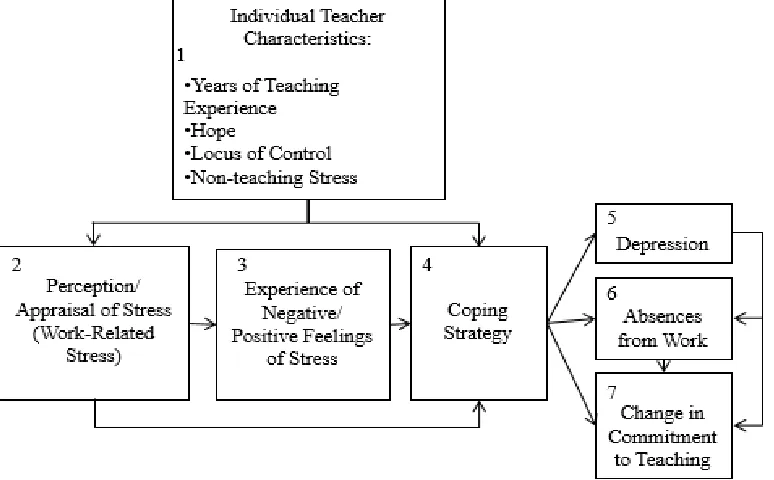
examining the variables of individual teacher characteristics, work-related stress levels,
feelings of stress, coping strategy and stress outcome variables. The model used was
based on Kyriacou and Sutcliffe’s (1978) model, and Tolbert’s (2007) model, with some
modifications and expansions (Figure 1.1). The purpose of this study was to investigate
further the relationship of teacher stress, while expanding the investigation in several
areas: utilizing a different geographic population, broadening the focus to generic
Figure 1.1. Current Study’s Investigation of Teacher Stress
24
First, the population for this study, in order to utilize a different geographic
population, consisted of a sample of elementary-level teachers from five school districts
within the South Carolina area. In this study, the South Carolina teacher responses were
predicted to replicate Tolbert’s (2007) findings in regards to teacher stress of the teachers
in Texas. Secondly, this study did not focus on the NCLB act and perceptions of stress
related to this legislation, rather, the work-related stressors were broadened to generic
stressors, including time demands and pressures. These stressors were predicted to be
highly correlated with levels of teacher locus of control and personal stressors, similar to
the results found by Tolbert (2007).
Finally, the current study included teachers with varying levels of years of
experience in teaching, including a larger proportion of teachers with fewer years of
experience. Within Tolbert’s study, most teachers in the sample (95%) had six or more
years of experience, and only 5% had five or fewer years of teaching experience. High
levels of teacher stress (or distress) were predicted to be positively related with fewer
years of school teaching experience. Thus, teachers with fewer years of teaching
experience were expected to experience more stress, similar to the results found by
Kyriacou (2001). Furthermore, it was predicted that teachers with fewer years of
experience would choose different coping strategies than teachers with more experience.
These results were also found by Glickman and Tamashiro (1982), in a study where fifth
year teachers scored higher in problem solving skills than did the teachers with only one
1.10 Research Questions and Their Expected Relationships
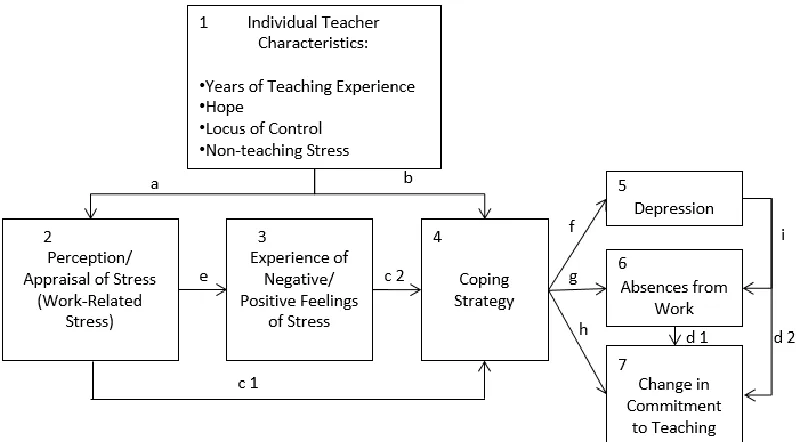
There are multiple research questions which were examined in this study. They
are described in the following section, along with the expected relationships between the
variables (Figure 1.2). The letters in the figure, a through i, correspond to the
relationships examined in this study, and described below.
Research question 1: Individual Teacher Characteristics and Work-Related
Stress
The first research question examined the effects of four Individual Teacher
Characteristics (Years of Teaching Experience, Hope, Locus of Control, and
Non-Teaching Stress), the independent variables, on the Perception /Appraisal of Stress
(Work-Related Stress, the dependent variable (Figure 1.2, a). Years of Teaching
Experience, which is an Individual Teacher Characteristic, was expected to be a predictor
variable for Work-Related Stress. The number of Years of Teaching Experience for a
teacher was predicted to be negatively related to teacher stress. Therefore, teachers with
less teaching experience were expected to experience more Work-Related Stress. Hope,
another Individual Teacher Characteristic which was examined as a predictor variable
was also expected to be negatively related to Work-Related Stress, in this study.
Therefore, teachers with higher levels of Hope were expected to have lower levels of
Work-Related Stress. Similarly, Locus of Control is a third Individual Teacher
Characteristic which was expected to have a negative relationship with Work-Related
Stress. Teachers who possess more feelings of control were expected to have lower
levels of Work-Related Stress. In contrast, Non-teaching Stressors, the final Individual
Teacher Characteristic, was expected to display a positive relationship with
Work-Related Stress. Teachers, who were experiencing higher levels of Non-Teaching Stress
or personal stress, were expected to also perceive that they were experiencing higher
Research question 2: Individual Teacher Characteristics and Coping
Strategy
This research question examined the effects of the four Individual Teacher
Characteristics (Years of Teaching Experience, Hope, Locus of Control, and
Non-Teaching Stress), the independent variables, on the selection of a Coping Strategy, the
dependent variable (Figure 1.2, b). The number of Years of Teaching Experience for a
teacher was predicted to be positively related to Coping Strategy. Therefore, teachers
with less teaching experience were expected to select unconstructive Coping Strategies,
whereas teachers with more experience were expected to select more constructive Coping
Strategies. The teacher’s level of Hope was also expected to be positively related to
Coping Strategy, in this study. Therefore, teachers with higher levels of Hope were
expected to select more positive or constructive Coping Strategies.
Similarly, Locus of Control is a third Individual Teacher Characteristic which was
expected to have a positive relationship with the selection of Coping Strategies. Teachers
who possessed more feelings of control over their environment were expected to utilize
more positive or constructive Coping Strategies. In contrast, Non-teaching Stressors, the
final Individual Teacher Characteristic, was expected to display a negative relationship
with Coping Strategies. Teachers, who were experiencing higher levels of Non-Teaching
Stress or personal stress, were expected to also utilize more negative or unconstructive
Research question 3: Work-Related Stress and Experience of Feelings of
Stress
The next research question examined the effects of the Perception /Appraisal of
Work-Related Stress, the independent variable, on the Experience of Negative/Positive
Feelings of Stress, the dependent variable (Figure 1.2, e). The Work-Related Stress for a
teacher was predicted to be negatively related to the Experience of Feelings of Stress.
Teachers who were experiencing higher levels of Work-Related Stress were expected to
experience more negative Feelings of Stress. Alternately, teachers who were experiencing
lower levels of Work-Related Stress were expected to experience more positive Feelings
of Stress.
Research question 4: Work-Related Stress and Coping Strategy
This next research question examined the effects of the Perception /Appraisal of
Work-Related Stress, the independent variable, on the selection of a Coping Strategy, the
dependent variable (Figure 1.2, c1). The Work-Related Stress for a teacher was predicted
to be negatively related to the selection of a Coping Strategy. Teachers who were
experiencing higher levels of Work-Related Stress were expected to utilize more negative
or unconstructive Coping Strategies, whereas teachers who were experiencing lower
levels of Work-Related Stress were expected to utilize more positive or constructive
Coping Strategies.
Research question 5: Experience of Feelings of Stress and Coping Strategy
This research question examined the effects of the Experience of
Negative/Positive Feelings of Stress, the independent variable, on the selection of a
Stress for a teacher was predicted to be positively related to the selection of a Coping
Strategy. Teachers who were experiencing higher or more positive Feelings of Stress
were expected to utilize more positive or constructive Coping Strategies, whereas
teachers experiencing more negative Feelings of Stress were expected to utilize more
negative or unconstructive Coping Strategies.
Research question 6: Coping Strategy and Depression, Absences, and
Commitment
This next research question examined the effects of Coping Strategy selection, the
independent variable, on three outcome or dependent variables: Depression, Absences
from Work, and Change in Commitment to Teaching (Figure 1.2: f, g, and h). The
selection of a Coping Strategy was expected to be negatively related to Depression levels.
Therefore, a teacher utilizing more positive or constructive Coping Strategies was
expected to have lower levels of Depression. Similarly, the selection of a Coping
Strategy was expected to be negatively related to the number of Absences from work.
Therefore, a teacher who was utilizing more positive or constructive Coping Strategies
was expected to have lower numbers of Absences. In contrast, a positive relationship
was expected between the selection of a Coping Strategy and Change in Commitment to
Teaching. Therefore, a teacher who was utilizing more positive or constructive Coping
Strategies was also expected to have higher levels of Commitment to being a teacher,
over time, and thus a positive change (or increase) in commitment levels.
Research question 7: Depression, Absences, and Commitment
The final research question examined the relationships between three outcome
(Figure 1.2: d1, d2, i). Depression levels were expected to be positively related to the
number of Absences from Work. A teacher who experienced lower levels of Depression
was expected to also have a low number of Absences (Figure 1.2, i). In contrast, a
negative relationship was expected between Depression levels and Change in
Commitment to Teaching. Therefore, a teacher who experienced lower levels of
Depression was expected to have higher levels of Commitment to continue teaching
(Figure 1.2, d2), and a positive change or increase in commitment levels over time.
Similarly, a negative relationship was expected between Absences from Work and
Change in Commitment to Teaching. A teacher who had a lower number of Absences
was expected to have higher levels of Commitment to continue teaching (Figure 1.2, d1),
Chapter II
Method
2.1 Introduction
The purpose of this study was to examine the relationships between Individual
Teacher Characteristics (Years of Teaching Experience, Hope, Locus of Control, and
Non-Teaching Stress) and a teacher’s Perception/Appraisal of Work-Related Stress and
subsequent Experience of Negative/Positive Feelings of Stress and the selection of a
Coping Strategy. The Coping Strategy selection was also examined in relation to several
outcome measures: Depression, Absences from Work, and Change in Commitment to
Teaching. The current level of generic work-related stress that a teacher is experiencing
was measured and how this stress is impacted by non-teaching related or personal
stressors (those that are not related to their job of teaching).
The research was expected to demonstrate that the teachers’ perception of
work-related stress is affected by Individual Teacher Characteristics, such as hope, locus of
control, and non-teaching stressors, which may also impact the selection of a coping
strategy. Teachers experiencing lower levels of hope, feelings of more of an external
locus of control, and experiencing more non-teaching stressors were expected to
experience more work-related stress and choose more unconstructive coping strategies.
In addition, years of experience in teaching were examined as an Individual Teacher
School teachers at multiple elementary schools within several school districts in
South Carolina were surveyed anonymously and the data compiled. Self-report
questionnaire data was gathered from teachers in these participating school districts.
Many of the school districts have a large proportion of certified teachers. There were 147
total participants who returned questionnaires; of these, 140 were completed, while 7
were incomplete and therefore not included in the results.
2.2 Participants
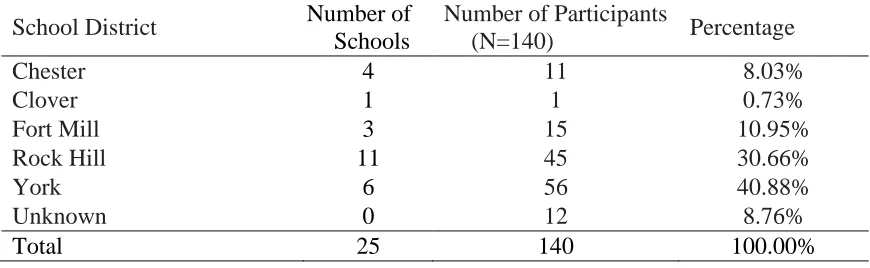
Teachers from 25 different schools within five South Carolina school districts
were asked to complete anonymous questionnaires (see Table 2.1). However, for this
study, participation was limited to school teachers at the elementary level. Jepson and
Forrest (2006) found that in a study of teachers experiencing work-related stress that the
stress levels of elementary school teachers were significantly higher than the stress levels
of secondary school teachers. Therefore, in this study the target teacher population
consisted of elementary level teachers who taught within the primary grades, which
ranges from Kindergarten through fifth grades. Teachers specializing in General
Table 2.1. Location of Participating Teachers
School District Number of
Schools
Number of Participants
(N=140) Percentage
Chester 4 11 8.03%
Clover 1 1 0.73%
Fort Mill 3 15 10.95%
Rock Hill 11 45 30.66%
York 6 56 40.88%
Unknown 0 12 8.76%
Total 25 140 100.00%
Demographic characteristics of the teachers who participated include: 91% (128)
are female and they ranged in age from 22 to 65. Teacher’s ages are well distributed over
10 year periods, with approximately 19% between 20-29 years of age, 30% are 30-39,
24% are 40-49, 21% are 50-59, and 6% are 60-65. The mean age of the participants is 41
years of age. The teachers’ reported ethnic background is: 86% Caucasian, 6.4% African
American, 1.4% Hispanic, 1.4% Asian, 0.7% Native American, and 3.6% indicated
“Other”- one of which specified they are of Middle Eastern background (0.7%); no-one
indicated “Bi-Racial”. Of the personal characteristics of the participating teachers, nearly
78% are married, 18% are single, 4% divorced, and less than 1% widowed. Teachers
reported that approximately 26% did not have any children, 21% have one child, 31%
have two children, 11% have three, 9% have four, and 3% have five or six children. The
mean number of children is 1.6, the median is 2 and the mode is 2. Teachers also
described the current number of children living at home with them: 38% have no children
living at home, 26% have one child living at home, 24% have two, 6% have 3, and over
6% have either four, five, or six children living at home. The mean number of children
In addition, this study also looked at the relationship between stress and teaching
experience. As mentioned earlier, there is a significant amount of research showing that
the attrition rates are very high for teachers in their first year through fifth year of
teaching (Alliance for Excellent Education, 2004; Guarino, Santibanez, & Daley, 2006;
Ingersoll, 2003). Therefore, teachers with varying amounts of teaching experience were
included in the proposed study. The range of years of teaching experience was very
diverse, with teachers reporting 1 year experience to 45 years of teaching experience. The
mean is 14.3 years, the median is 12 and the mode is 5 years. Nearly 24 % of the
participating teachers in this study have five or fewer years of experience in the teaching
profession. Overall, 76% of the teachers have six or more years of teaching experience:
17.9% have 6-10 years, 20.7% have 11-15, 13% have 16-20 and 25% have over 20 years
of teaching experience.
2.3 Procedures
Permission for conducting this research was first obtained through the University
of South Carolina Institutional Review Board (USC IRB). Next, appropriate school
district officials for the potential population of participating teachers were contacted to
obtain their consent as well. Once the necessary permissions were obtained, questionnaire
packages were distributed to elementary school teachers either at their school, or
distributed via an email invitation from the principal or a lead teacher. Each teacher
received a questionnaire package which included a cover letter and the questionnaire.
Teachers completing a hard copy of the questionnaire also received a sealable envelope
which could be used by the participants to return the completed questionnaire, to ensure
The cover letter (Appendix A) describes the nature of the study, benefits of the
study and requests the participant’s assistance by completing the questionnaire. Other
information includes informed consent details, advising the participant that questionnaire
participation is completely voluntary, with no negative consequences if someone chooses
to not participate or to stop participating at any time. Participants were advised of the
confidentiality of the data, and that all responses are anonymous. Finally, directions for
returning the questionnaires were given, and contact information for the researchers
involved in this study was provided to the participants to use if they had questions about
the questionnaire, their participation, or the results of the research. Participants could
keep a copy of this cover letter for their records. Similarly, teachers who completed the
questionnaire online read a description of the questionnaire, once they accessed the
web-based questionnaire site. This explanation could be printed out by the individual teacher
if they wanted to keep a copy.
The contents of the questionnaire package also included the questionnaire
(Appendix B) which is three pages (double-sided) in length, and takes approximately ten
to fifteen minutes to complete. The questionnaire consists of multiple choice and short
answer questions. Questionnaires were completed and submitted by participants utilizing
their choice of one of the following three methods. The first method was for the
participant to complete the questionnaire immediately and return it to the researcher. A
second method was for the participant to take the questionnaire packet with them and
complete it, then mail it or contact the researcher to collect the questionnaire. The third
method was to complete the questionnaire on-line, and send an email to the researcher to
most frequently, by 94 % of the sample (138 participants), four % (six participants)
returned their questionnaire to the researcher immediately, and two % of the sample
(three participants) mailed their questionnaire to the researcher. All seven of the
incomplete questionnaires were submitted on-line.
Once completed questionnaires were received, they were stored securely in a
locked file cabinet in the researcher’s office, so that only the researcher had access to the
information. The questionnaire data were compiled to ensure individual responses were
not identified and only group data are available to participating school administrators. As
an incentive, teachers were eligible for a $50 gift card drawing to a regional retail
superstore, to purchase school supplies for their classroom. The gift cards were awarded
to randomly selected teachers who returned completed questionnaires. Each teacher had a
one in thirty chance of winning a gift card, based on an estimated sample size of 120
participants. A total of four gift cards were awarded with a combined value of $200, and
were sent anonymously through the mail to maintain confidentiality.
2.4 Measures
Self-report questionnaires are one of the most common methods for gathering
data on teacher stress (Kyriacou, 2001). In a study similar to the current study, Tolbert
(2007) utilized questionnaires to compile data on elementary-level school teachers’ stress
levels and external stressors such as legislation for the No Child Left Behind Act.
Therefore, the questionnaire used in this study was a modified version of the
questionnaire used by Tolbert in order to compile data on school teachers and the stress