World Maritime University World Maritime University
The Maritime Commons: Digital Repository of the World Maritime
The Maritime Commons: Digital Repository of the World Maritime
University
University
World Maritime University Dissertations Dissertations
11-5-2017
An analysis on wreck related national laws of the Republic of
An analysis on wreck related national laws of the Republic of
Korea considering the Nairobi International Convention on the
Korea considering the Nairobi International Convention on the
Removal of Wrecks, 2007
Removal of Wrecks, 2007
Byoung-yun Lee
Follow this and additional works at: https://commons.wmu.se/all_dissertations
Part of the Environmental Policy Commons, and the International Law Commons
Recommended Citation Recommended Citation
Lee, Byoung-yun, "An analysis on wreck related national laws of the Republic of Korea considering the Nairobi International Convention on the Removal of Wrecks, 2007" (2017). World Maritime University Dissertations. 583.
https://commons.wmu.se/all_dissertations/583
non-WORLD MARITIME UNIVERSITY
Malmö, Sweden
AN ANALYSIS ON WRECK RELATED
NATIONAL LAWS OF THE REPUBLIC OF
KOREA CONSIDERING THE NAIROBI
INTERNATIONAL CONVENTION ON THE
REMOVAL OF WRECKS, 2007
By
BYOUNG-YUN LEE
The Republic of Korea
A dissertation submitted to the World Maritime University in partial Fulfillment of the requirements for the award of the degree of
MASTER OF SCIENCE
In
MARITIME AFFAIRS
(Maritime Law and Policy)
Class of 2017
ACKNOWLEDGMENTS
I would like to express my thanks to The Korea Shipowners’ Mutual Protection
and Indemnity Association for giving the valuable chance in World Maritime
University.
Among the people in WMU, I firstly want to express my appreciation to my
supervisor, Associate Professor Henning Jessen, who continuously guided me to be on
the right track. At the very initial stage of the study, Associate Professor Aref Fakhry,
Associate Professor María Carolina Romero Lares, and Professor Max Mejia provided
precious advice for developing rough ideas about the topic and Professor Emeritus
WMU Proshanto Mukherjee helped me to understand the issue in greater perspective.
Also, both Associate Academic Dean Daniel Seong-Hyeok Moon and Professor
Dong-Wook Song advised about essential academic matters, and Research Assistant Tafsir
Johansson and Jennie Larsson inspired me with confidence and enthusiasm. With
regard to the research matters, Christopher Hoebeke, Sara Hurst, Anna Volkova and
Ammar Jaber provided great support for developing my analysis.
Lastly, I wish to convey my sincere gratitude to my specialization classmates;
Aynur Maharramova, Brume-Eruagbere Omovigho, Emmanuel M. Redd, Sr., Eugenia
María Concepción Munguía Figueroa, Hassan Omary Muunguja, Isaac Marifem, Kais
Abdelhamid Hamoud Alsuhiemat, Kanhasut Pinsupa, Mam Pateh Dampha, May Flor
C. Carpio, Mohamed Shawki Mohamed Salem El Khadrawi, Namiraisir Endah Asmar,
Pham Thai Son, Roger Mengistu Teah, Ronnie Basco, Rubabatu Sumaila, Tran Thi
Minh Ngan and Yuki Morimasa who present a variety of viewpoints through
ABSTRACT
Title of Dissertation:
AN ANALYSIS ON WRECK RELATED NATIONAL
LAWS
OF
THE
REPUBLIC
OF
KOREA
CONSIDERING THE NAIROBI INTERNATIONAL
CONVENTION ON THE REMOVAL OF WRECKS,
2007
Degree:
MSc
This dissertation is a study of current domestic laws of the Republic of Korea,
considering the main features of the Nairobi International Convention of the Removal
of Wrecks (WRC), 2007 to identify possible gaps between the Convention and the
domestic laws and suggest how the national laws could be improved and enhanced
through further revisions.
From the public law viewpoint, the WRC 2007 mainly deals with reporting and
marking wrecks, hazard determination, and measures to facilitate the removal of
wrecks. In the Republic of Korea, four different domestic laws are related to the wreck
removal matter and all necessary requirements of the Convention are already in place
in the national laws. However, duplications of regulations among the laws need to be
reorganized and applications of the national laws in the Korean exclusive economic
zone are still controversial.
On the other hand, from the private law viewpoint, the WRC 2007 requires the
compulsory insurance and introduces the direct right of action against the liability
insurer. In Korea, such protective measures have not been in place although the
Commercial Act prohibit the limitation of liability in terms of wreck removal claims.
In order to ratify the Convention, several procedures in accordance with the
Constitution of the Republic of Korea need to be conducted and the Convention may
have the same effect of the national laws.
Although there have been some actions by the Ministry of Ocean and Fisheries to
respond the global trend, practical limitations have not solved yet and the ratification
of the Convention is unlikely to be implemented within a short period. Therefore, this
dissertation proposes several law revisions to narrow the gaps between the global trend
and the Korean regimes.
TABLE OF CONTENTS
DECLARATION
i
ACKNOWLEDGMENTS
ii
ABSTRACT
iii
TABLE OF CONTENTS
iv
LIST OF TABLES
vi
LIST OF FIGURES
vii
LIST OF ABBREVIATIONS
viii
1.
Introduction
1
1.1. Background
1
1.2. Objectives
2
1.3. Scope of study
2
2.
Public Law Aspects of WRC 2007 and Korean Laws
4
2.1. Definition of wreck
4
2.2. Scope of application
5
2.3. Reporting wrecks
6
2.4. Determination of hazard
8
2.5. Marking of wrecks
9
2.6. Measures to facilitate the removal of wrecks
9
3.
Private Law Related Analyses and Several Suggestions
13
3.1. Liability of shipowners
13
3.1.1. The international regime
13
3.1.2. Relevant Korean laws
14
3.1.3. A comparison with a Japanese law
16
3.2. Compulsory insurance or other financial security
17
3.2.1. The international convention
17
3.2.2. Shipowners’ Protection and Indemnity (P&I) Insurance
17
3.2.3. A comparison with Japanese laws
19
3.2.4. A possible revision of the Korean law
20
3.3. The direct right of action against the insurer
21
4.
Considerations on the Ratification of the WRC 2007
25
4.1. Legislative system of the Republic of Korea
25
4.2. Procedures of treaty ratification in Korea
26
4.3. Current responses and limitations
29
4.3.1. The five-year plan (2017~2021)
29
4.3.2. The yearly plan (2017) and potential risks
30
4.3.3. P&I Club’s blue card and government’s certificate
31
5.
Summary and Conclusions
33
LIST OF TABLES
Table 1. Reported wrecks in South Korea
7
LIST OF FIGURES
Figure 1. Headquarters chart of Ministry of Oceans and Fisheries
12
Figure 2. Hierarchy of Korean laws
25
LIST OF ABBREVIATIONS
CLC
International Convention on Civil Liability for Oil Pollution
Damage
COLREG
Convention on the International Regulations for Preventing
Collisions at Sea
EEZ
exclusive economic zone
GT
Gross tonnage
HNS
International Convention on Liability and Compensation for
Damage in Connection with the Carriage of Hazardous and
Noxious Substances by Sea
ICT
Information and Communication Technology
IMO
International Maritime Organization
ISL
Institute of Shipping Economics and Logistics
KOEM
Korea Marine Environment Management Corporation
LLMC
Convention on Limitation of Liability for Maritime Claims
MPA
Maritime and Port Authority of Singapore
P&I
Shipowners’ Protection and Indemnity Insurance
SDR
Special Drawing Right
UNCLOS
United Nations Convention of the Law of the Sea
1. Introduction
1.1. Background
After suffering severe damage due to a marine casualty such as collision or stranding, a ship may be partly or wholly sunken. The vessel’s hull insurer and owner
are likely to pronounce the damaged ship’s commercial death, in other words,
expected costs and expenses for rescuing and repairing the ship are likely to be more than the present value of the ship. Once the hull insurer and the shipowner express such decision, the ship in question legally becomes a ‘wreck’ (Baatz, 2011).
Then, the wreck starts to bring several key players into the picture. Firstly, from the hull insurer’s interest standpoint, the most cost-saving and simple solution is to pay the insurance money to the owner rather than involving any follow-up measures in relation to the wreck. Secondly, from the owner’s viewpoint, the aforementioned situation may be more complicated because it is almost impossible to escape from the wreck related liability in terms of both public and private law matters, although such costs and expenses may be compensated by the Shipowners’ Protection and Indemnity Association (P&I Club). The owner and the P&I Club may invite another player, a salvor, who actually conducts the wreck removal operation (Hazelwood & Semark, 2010). Lastly, the coastal State is likely to want the wreck to be immediately removed prior to be a navigational hazard or create pollution. If the wreck locates in the territorial sea of the State, there is nothing controversial to demand such wreck removal to the owner based on the State’s sovereignty as well as national laws. However, a wreck beyond the territorial sea may cause a dispute that the application of the national law accords with the United Nations Convention of the Law of the Sea (Brice & Reeder, 2003).
1.2. Objectives
Although the fastest way to be in the global trend is a prompt ratification of the WRC 2007, it is likely to be a time-consuming procedure due to other political concerns or arguments in the relevant industry. Therefore, the second best option may be narrowing gaps between the WRC 2007 and the Korean laws through further revisions. Form the aforementioned viewpoint, this dissertation aims to compare the WRC 2007 and national laws, analyse possible gaps between them, and then suggest several practical solutions to overcome the gaps prior to the ratification of the Convention.
1.3. Scope of study
In addition to the main contents of the WRC 2007, this dissertation studies and analyses several national and international laws and rules.
Firstly, in respect of the public law matters, the following Korean laws are mainly examined; the Maritime Safety Act and its Enforcement Rules, the Public Waters Management and Reclamation Act, the Marine Environment Management Act, and the Act on the Arrival, Departure, etc. of Ships. Also, regulations of the Territorial Sea and Contiguous Zone Act, the Exclusive Economic Zone Act, and the Act on the Establishment, Management, etc. of Spatial Data are studied.
Secondly, with regard to the private law issues, several Korean laws including the Commercial Act, the Civil Act, and the Compensation for Oil Pollution Damage Guarantee Act are mainly analysed and regulations of the Compensation for Oil Pollution Damage Guarantee Act are additionally referred. In addition, two Japanese laws, the Act on Liability for Oil Pollution Damage and the Act on Limitation of Shipowner Liability, are studied.
Finally, miscellaneous regulations of the United Nations Convention on the Law of the Sea, the Convention on Limitation of Liability for Maritime Claims, 1976, the Protocol of 1996 to amend the Convention on Limitation of Liability for Maritime Claims, 1976, the Protocol of 1992 to Amend the International Convention on Civil Liability for Oil Pollution Damage, 1969, and the International Convention on Civil Liability for Bunker Oil Pollution Damage, 2001 are referred and several rules of P&I insurance are additionally examined.
2. Public Law Aspects of WRC 2007 and Korean Laws
2.1. Definition of wreck
The WRC 2007 defines the term of ‘wreck’ as a sunken or stranded ship, or any parts or objects lost from such ship, or a ship that is expected to sink or strand, following upon a maritime casualty (Article 1.4).
In the Republic of Korea, Maritime Safety Act has introduced the latest legal
definition of ‘wreck’, although two different domestic laws already have their own definitions about wreck. Considering the contemporary development of maritime safety regimes including wreck removal matters, the Act was legislated in 2011 to
wholly amend its previous version (Sea Traffic Safety Act) which was initially
legislated in 1986 to adopt the whole contents of Convention on the International
Regulations for Preventing Collisions at Sea (COLREG), 1972 into the domestic legal
framework. However, instead of the term ‘wreck’ and relevant expressions, the Act
uses ‘obstruction to navigation’ and defines it as ‘a thing specified by Ordinance of the Ministry of Oceans and Fisheries as an obstruction to the navigation of vessels, such as a thing dropped down from a vessel and a vessel sunken or stranded, or a thing swept away from such vessel’ (Article 2). Although identical expressions do not exist between the international and national regulations, there is no significant
difference in terms of general meanings and intentions as if the Act paraphrases WRC
2007.
The other two Korean laws are Marine Environment Management Act, 2007
As mentioned above, three different national Acts presently define ‘wreck’ with different expressions. Such duplication may be a natural result because there had not
been an individual attention to wreck prior to the WRC 2007 and the Maritime Safety
Act, and the wreck removal matters have been a peripheral part of the other two Acts
which have been developed for their main purposes. However, it may be unnecessary any longer to maintain the three different definitions which have highly similar meanings. Therefore, from economic and efficient standpoints, it is required to
maintain the definition of the Maritime Safety Act as a mainly consolidated one and
other two Acts need to delete their own definitions and refer the Maritime Safety Act.
2.2. Scope of application
The WRC 2007 basically applies to the Convention area which is ‘the exclusive
economic zone of a State Party’ less than 200 nautical miles from the State’s
baselines (Article 1 and Article 3.1). However, in accordance with Article 3.2 of WRC
2007, Contracting States may ‘extend the application of this Convention to wrecks
located within its territory, including the territorial sea’. As of the 25th of August 2017 and among 37 Contracting States, 17 States including major European nations such Denmark, Finland, France, Netherlands and United Kingdom extend the application of the Convention to their territorial sea, whereas Germany applies the Convention only to its exclusive economic zone.
In South Korea, the Maritime Safety Act basically applies to vessels which are
‘within the territorial sea or inland waters of the Republic of Korea’ (Article 3.1.1). Further, the Act also applies to Korean flag vessels if they are in ‘any sea area other the territorial sea or inland waters’ (Article 3.1.2), and any ships that create ‘an obstruction to navigation in the exclusive economic zone of the Republic of Korea
(Article 3.1.3). Meanwhile, the Marine Environment Management Act applies in
‘territorial sea provided for in the Territorial Sea and Contiguous Zone Act’ which is
12 nautical mile areas from Korean base lines as well as ‘exclusive economic zones
defined in Article 2 of the Exclusive Economic Zone Act’ (Article 3) which are 200
nautical mile seas from the baseline. Lastly, the Public Waters Management and
Reclamation Act defines ‘public waters’ as ‘space from a coastline referred to in
is the approximate highest high water level to ‘the outer limit of the exclusive economic
zone under the Exclusive Economic Zone Act’ (Article 2.1).
As mentioned in the previous paragraph, the Korean laws related to wreck removal matters apply to not only Korean territorial seas but also 200 nautical mile exclusive economic zones. However, two arguments may arise with regard to the scope of application. Firstly, several laws concurrently exist with substantially the same regulations for wreck removal matters. For this matter, a similar consolidation among the national laws as mentioned in the previous section (2.1 Definition of wreck) may possible. The second argument is that any persons responsible for the wreck without pollution may insist that the domestic laws should not apply in the EEZ based on Article 56.1.(b).(iii) of the United Nations Convention on the Law of the Sea (UNCLOS). This may be more difficult and controversial issue because it is uncertain that which opinion between the claimant (the affected State) and the defendant is more legally robust. Therefore, it is necessary for Korea to ratify the WRC 2007 to eliminate such uncertainty and controversy.
2.3. Reporting wrecks
The WRC 2007 regulates that ‘[a] State Party shall require the master and the
operator of a ship flying its flag to report to the Affected State without delay when that ship has been involved in a maritime casualty resulting in a wreck’ (Article 5.1). Furthermore, such report is required to include the exact location of the wreck and its type, size, damage, condition, cargo and oil (Article 5.2).
Similarly, in Korea, the Maritime Safety Act stipulates that master, owner or
Furthermore, the Article 25.2 also rules that ‘[i]f a Korean vessel produces an obstruction to navigation in the exclusive economic zone of a foreign country, the person responsible for the removal of the obstruction to navigation shall report thereon to the government of the foreign country having jurisdiction over the sea area’. Thus, from the reporting standpoint, Article 25 of the Act includes all necessary requirements of the WRC 2007, although Korea has not ratified the Convention yet.
Statistics of reported wreck in Korea
In respect of statistics of reported wrecks in South Korea, ‘Sunken Ship
Management Plan 2017’ has been recently issued by Korea Marine Environment Management Corporation (KOEM) which has been established in accordance with
Marine Environment Management Act and consigned by Ministry of Ocean and
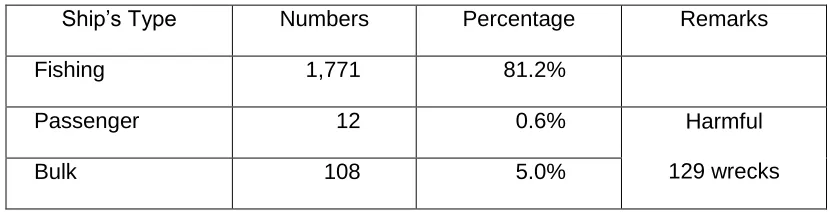
Fisheries to conduct such survey. According to the survey, from 1983 and as of the end of 2016, total 2,180 ships have sunken in Korean waters. In terms of specific locations of the wrecks, 923 wrecks (42%) have located in the South Coast of Korea. In addition, 806 wrecks (37%) and 451 wrecks (21%) have located in the West Coast and East Coast respectively. Meanwhile, in terms of ships’ size, almost a half of them (48%, 1,043 ships) are small ships under ten (10) gross tonnages, 39% (858 ships) are between ten (10) to 100 gross tonnages, and remaining 13% (279 ships) are bigger vessels more than 100 gross tonnages. Furthermore, in terms of ships’ type, whereas the vast majority (81.2%, 1,771 ships) of them are fishing vessels which may not significantly harm marine environment, and 6% (129 ships) of the sunken ships have been identified as highly risky wrecks which have significant amount of fuel oil, hazardous or noxious cargo.
Table 1. Reported wrecks in South Korea
Ship’s Type Numbers Percentage Remarks
Fishing 1,771 81.2%
Passenger 12 0.6% Harmful
129 wrecks
Tanker 5 0.2% (6%)
Gas Carrier 2 0.1%
Chemical Tanker 2 0.1%
Others * 280 12.8%
Total 2,180 100%
* Others: Towing vessel (74, 3.4%), Barge (56, 2.6%),
Miscellaneous (53, 2.4%), Unidentified (97, 4.5%)
Source: Korea Marine Environment Management Corporation (KOEM)
2.4. Determination of hazard
In respect of hazard determination, Article 6 of the WRC 2007 considers a lot of criteria such as condition of the wreck itself as well as its cargo and oil, hydrographical, meteorological, technical, marine environmental and maritime traffic elements.
The Maritime Safety Act rules that it needs to be considered ‘whether an
obstruction to navigation seriously affects the safety in navigation of vessels or the marine environment in determining hazards of the obstruction to navigation’ (Article 27.1). Although the details of such considerations do not be included in the Act, its
lower ordinance (Article 27 of Enforcement Rules of the Maritime Safety Act) contains
all aspects of the criteria included in the Convention. Furthermore, Article 6.2 of the
2.5. Marking of wrecks
The WRC 2007 rules that marking steps have to be conducted if ‘the Affected State determines that a wreck constitutes a hazard’ (Article 8.1). Also, the marking process should be in accordance with ‘internationally accepted system of buoyage’ (Article 8.2) and such marking needs to be promulgated by proper means such as ‘nautical publications’ (Article 8.3).
Article 26 of the Maritime Safety Act also deals with such marking procedures
that ‘[i]f an obstruction to navigation is likely to jeopardize the safety in navigation of other vessels, the person responsible for the removal of the obstruction to navigation shall put a sign indicating the hazard on the obstruction to navigation or take measures for informing other vessels of the obstruction without delay’ (Article 26.1). This is one of legal liabilities of owner or operator of the wreck. If they do not fulfil such obligation, ‘the Minister of Oceans and Fisheries may order the person responsible for the removal of the obstruction to navigation to put such sign or take the measure’
(Article 26.2) and furthermore, the Minister of Oceans and Fisheries ‘directly put a
sign indicating the obstruction to navigation’ if the person responsible does not follow such order (Article 26.3). Thus, in respect of the marking matters, a sufficient level of detail including vicarious execution is in place in the national regime.
2.6. Measures to facilitate the removal of wrecks
protection (Article 9.5). The Affected State is required to determine a reasonable period of such wreck removal operation and inform the period to the owner. Further, the owner needs to be informed that the wreck may be removed at ‘the registered owner’s expense’ if the owner misses the deadline of operation, and the States may conduct the immediate intervention if the wreck becomes a severe hazard (Article 9.6). The Affected State may remove the wreck by itself if it is impossible to contact the registered owner or the wreck removal operation is not completed within the period with a proper notification to the wreck’s flag State (Article 9.7 and 9.8).
In Korea, Article 28 of the Maritime Safety Act stipulates that ‘the person
responsible for the removal of an obstruction to navigation shall remove the obstruction to navigation’ (sub-article 1). If the person above does not conduct such measures, the Minister of Oceans and Fisheries can order the person for such measures based on Article 28.2 of the Act. Furthermore, the Minister of the authority also may remove the wreck if the person above does not conduct the order or the wreck is ‘determined as hazardous’ (Article 28.3). In addition, Article 29.1 of the Act deals with the collection of wreck removal costs. It rules that the Minister of Oceans and Fisheries may ‘demand the shipowner to submit a document guaranteeing the payment of such cost’ with regard to marking and removing the wreck. If the shipowner or operator does not obey such demand, in accordance with Article 30 of the Act, the Minister of the authority can ban the entry of the ship in question into Korean ports or mooring facilities, or the departure therefrom.
Meanwhile, three different domestic laws also deal with the wreck removal
measures. Firstly, in accordance with the Public Waters Management and
Reclamation Act, if a wreck is ‘deemed to impede the efficient utilization of public
port’ (Sub-article 1). If the owners or users in question do not comply with such order, the Authorities may ‘vicariously execute the ordered matter pursuant to Article 3.1 and
3.2 of the Administrative Vicarious Execution Act’ (Sub-article 2). However, this
procedure may be bypassed if the owners or users are unknown, or ‘water front
facilities’ are ‘illegally occupied and used repeatedly and habitually’, or obstacles need to be removed immediately due to navigation of ships (Sub-article 3). Lastly, the
Marine Environment Management Act rules that the Minister of Oceans and Fisheries conducts ‘systemic management of information on the sunken ship’, ‘risk assessment with respect to possible marine pollution accidents’ and ‘implementation of risk-mitigation measures’ to prevent further pollution damage by the wrecks (Article 83-2.1).
Thus, from the public law viewpoints including definition, reporting and marking of wrecks, and determination of hazard, any possible gaps between the WRC 2007 and the domestic laws have not been identified, except the controversy that whether the national laws may apply to wrecks without pollution in the Korean EEZ. The national regime has corresponded with the global trend through continuous revisions, and is likely to be more concise and explicit through the realignment of regulations.
Rearranged segregation of duties in the Ministry of Oceans and Fisheries
The following chart shows the headquarter organization of Ministry of Oceans and Fisheries, Republic of Korea. The headquarter consists of six major Offices and Bureaux as well as eight sub-Bureaux as below. In terms of wreck related domestic Acts, three different departments in the Ministry are concurrently related; firstly, the
Marine Policy Office is in charge of both the ‘Public Waters Management and
Reclamation Act’ (assigned to Marine Industry Policy Bureau) and the ‘Marine
Environment Management Act’ (assigned to Marine Environment Policy Bureau),
secondly, Shipping and Logistics Bureau is in charge of the ‘Act on the Arrival,
Departure, etc. of Ships’, and lastly, Maritime Affairs and Safety Policy Bureau is in
charge of the ‘Maritime Safety Act’. From both efficiency and management
Among the relevant departments, the last mentioned Maritime Affairs and Safety Policy Bureau is likely to be the most appropriate one for the wreck removal matters
because of two reasons; firstly, only the Maritime Safety Act has a separate chapter
of wreck related regulations with the most comprehensive considerations from the public law standpoint, secondly, the department is also in charge of the ship related
compensation Act, Compensation for Oil Pollution Damage Guarantee Act, which
adopts both the Protocol of 1992 to amend the International Convention on Civil
Liability for Oil Pollution Damage, 1969 (CLC PROT 1992) as well as the International
Convention on Civil Liability for Bunker Oil Pollution Damage, 2001 (BUNKERS
2001).
Figure 1. Headquarters chart of Ministry of Oceans and Fisheries
3. Private Law Related Analyses and Several Suggestions
3.1. Liability of shipowners
3.1.1. The international regime
The WRC 2007 regulates that the registered owner is basically liable to pay expenses of ‘locating, marking and removing the wreck’. However, such liabilities may be exempted if the owner proves that the wreck ‘resulted from an act of war, hostilities, civil war, insurrection, or a natural phenomenon of an exceptional, inevitable and irresistible character’, or ‘was wholly caused by an act or omission done with intent to cause damage by a third party’, or ‘was wholly caused by the negligence or other wrongful act of any Government or other authority responsible for the maintenance of lights or other navigational aids in the exercise of that function’ (Article 10.1). The
requirements of the liability exemption are identical with the requisites of the Protocol
of 1992 to amend the International Convention on Civil Liability for Oil Pollution
Damage, 1969 (CLC PROT 1992) as well as the International Convention on Civil
Liability for Bunker Oil Pollution Damage, 2001 (BUNKERS 2001). Such similarity
may be construed as the aforementioned three conventions locate under the same umbrella which imposes liabilities of costs and expenses due to any ship-sourced damage.
In addition, the Convention does not affect the owner’s rights about the limitation of liability in accordance with domestic laws or international liability conventions such
as the ‘Convention on Limitation of Liability for Maritime Claims, 1976, as amended’
(Article 10.2). Also, WRC 2007 rules that claims against the owner must be in accordance with the Convention and State’s sovereign rights in respect of its territorial seas are not affected by the Convention (Article 10.3). Furthermore, any third parties’ rights of recourse also do not be affected by the Convention (Article 10.4).
Meanwhile, in respect of exceptions to liability, WRC 2007 does not affect
shipowner’s liability in respect of costs and expenses related to the ‘International
Convention on Civil Liability for Oil Pollution Damage, 1969, (CLC 1969) as amended’
as well as the ‘International Convention on Civil Liability for Bunker Oil Pollution
Damage, 2001, (BUNKERS 2001) as amended. Although WRC 2007 also regulates
and Compensation for Damage in Connection with the Carriage of Hazardous and
Noxious Substances by Sea, 1996, (HNS 1996) as amended’, this is actually
ineffective because such exceptions are applied only if the relevant conventions are ‘applicable and in force’. Further, WRC 2007 also does not affect to nuclear related regimes (‘The Convention on Third Party Liability in the Field of Nuclear Energy, 1960, as amended’, or ‘The Vienna Convention on Civil Liability for Nuclear Damage, 1963, as amended’, or ‘national law governing or prohibiting limitation of liability for nuclear damage’).
3.1.2. Relevant Korean laws
In the Republic of Korea, the Maritime Safety Act stipulates that the registered
owner pays expenses in respect of marking and removing wrecks (Article 29.2). In
addition, Article 83-2.3 of the Marine Environment Management Act regulates that
the registered owner pays the expenses with respect to the ‘implementation of risk-mitigation measures’ to prevent further pollution damage by the wrecks.
In respect of shipowners’ limitation of liability, however, the aforementioned domestic laws do not have any relevant regulations. Therefore, it is necessary to
apply a more general law, Commercial Act as amended. Article 769 of the Act
basically rules that shipowners are entitled to limit their liabilities ‘whatever the cause for the claim may be’, unless the damage occurs because of ‘wilful misconduct or other reckless act or omission while recognizing the concern about the incurrence of such damage’. The liabilities of shipowners include claims of loss of life or injury and shipment damage or loss in relation to ship operation, claims of delay of shipment or passenger, claims of ‘infringement on another person's right, other than a contractual right’ with regard to the operation of ship, and claims of measures to ‘prevent or minimize’ aforementioned damage and their consequential loss. This Article is the
result of borrowing the contents of the Convention on Limitation of Liability for
Maritime Claims (LLMC), 1976. Although the Republic of Korea has not ratified the
LLMC 1976, the national law has derived its regulations from LLMC 1976’s Article
opt-out reservation rule (Article 18 of LLMC 1976) is applied. Such legal introduction results a similar legal effect of the ratification of the international convention, and may be a compromised or negotiated methodology to follow the international mainstreams in respect of liability and compensation issues.
With regard to the limitation amount of shipowner’s liability, Article 770.1 of the
Commercial Act rules that a claim of ‘a death of a passenger or a bodily injury’ is
calculated by multiplying the number of passengers by 175,000 SDR (Special Drawing Right) of the International Monetary Fund. This calculation has been derived
from Article 7 of the Protocol of 1996 to amend the Convention on Limitation of Liability
for Maritime Claims, 1976 (LLMC PROT 1996). Although the Republic of Korea has
not ratified LLMC 1976 as well as LLMC PROT 1996, both international regimes are selectively adopted into the Commercial Act. In other words, the Act has introduced the amount of LLMC PROT 1996 in respect of passenger claims, whereas the amount of LLMC 1976 is basically applied to other types of damage. For example, the Article 770.1 also regulates that the limitation amount of loss of life or injury other than a passenger is 167,000 SDR and 333,000 SDR for a ship of less than 300 tons and 500 tons respectively. Then, exceeding tonnages are multiplied by 500 SDR (up to 3,000 tons), 333 SDR (up to 30,000 tons), 250 SDR (up to 70,000 tons) and 167 SDR that are identical calculations with Article 6.1.(a) of LLMC 1976. Furthermore, the limitation amount of other claims is 83,000 SDR and 167,000 SDR for a ship of less than 300 tons and 500 tons respectively. Then, exceeding tonnages are multiplied by 167 SDR (up to 30,000 tons), 125 SDR (up to 70,000 tons) and 83 SDR that are also identical calculations with Article 6.1.(b) of LLMC 1976.
Meanwhile, the Article 773 of the Commercial Act stipulates five types of
exclusion of liability limitation. The relevant part among the five cases is that ‘[a] claim for a ship sunken, wrecked, stranded, abandoned, or involved with other marine accidents, and salvage, removal or scrapping of, or non-invasive measures for cargo and other goods which are or were in such ship’. This corresponds with the intention
of Article 769 of the Commercial Act (as if the Article 2.1.(d) and (f) of LLMC 1976 are
However, the aforementioned Article has been used by those who raise an objection to ratify the WRC 2007. They argue that exclusion of liability limitation in respect of wreck removal may be jeopardized because shipowners may limit their liabilities (the amount of LLMC 1976) in accordance with the Convention. Such argument is, however, a misunderstanding about the context of the Convention as well as its intentions. It should be reminded that Article 10.2 of the WRC 2007 explicitly mentions that ‘[n]othing in this Convention shall affect the right of the registered owner to limit liability under any applicable national or international regime, such as the Convention on Limitation of Liability for Maritime Claims, 1976, as amended’. This means that in terms of limitation of liability, existing national laws in Contracting States or relevant international conventions have priority over the WRC 2007. Thus, the Convention is not concerned or involved in deciding whether a shipowner is entitled to limit wreck-related liabilities, and entirely delegates or authorizes such power to the domestic laws or international regime which Contracting States have ratified. In fact, there is no provisions such as shipowners are ‘entitled to limit their liability’ under WRC 2007, or how to calculate limitation of liabilities using gross tonnages of ships, whereas CLC PROT 1992 does have such provisions in Article V. Therefore, it is a correct understanding that the amount in accordance with LLMC 1976 is the minimum figures of liability insurance as a legal safeguard against the huge amount of wreck removal costs, and not the maximum amount of liability which shipowners may enjoy.
3.1.3. A comparison with a Japanese law
with the 2012 amendment to the LLMC PROT 1996 which was accessed by Japan in 2006.
3.2. Compulsory insurance or other financial security
3.2.1. The international convention
From shipowners’ liability and compensation standpoints, Article 12 of the WRC 2007 contains the most important requirements to deal with the private law related issues. Basically, in accordance with Article 12. 1 of the Convention, if a ship’s gross tonnage is 300 or more, its registered owner needs to obtain and maintain an insurance certificate or other type of security which guarantees shipowner’s liability cover. The coverage of such insurance or security is required to be at least an amount
of the ‘Convention on Limitation of Liability for Maritime Claims, 1976, (LLMC 1976)
as amended’. Shipowners are required to submit the evidence of liability cover to the State’s competent authority, then the owners can obtain another document which is issued by the government and confirm the validity of compulsory liability coverage. The official document includes ship’s basic information such as name, identification number or letters, registry, tonnage, and information about the shipowner and insurer including name and place of business, and insurance coverage such as limit and period (Article 12.2). The following sub-articles (from Article 12.3 to Article 12. 9) deals with miscellaneous procedures in respect of certificate issuance, including delegation of authority to a recognized organization (Article 12.3), official language and its translation into English, French or Spanish (Article 12.4), requirement of keeping the certificate on board (Article 12.5), certificate’s valid period (Article 12.6), flag State’s determination of certificate issuance and validity (Article 12.7) and acceptance of certificates of foreign flag ships (Article 12.9).
3.2.2. Shipowners’ Protection and Indemnity (P&I) Insurance
In practice, the costs and expenses in respect of wreck marking and removal are
generally covered by Shipowners’ Protection and Indemnity (P&I) Insurance. In
wreck of an entered ship’ if such responsibilities are obligated by law (Section 15.A). Also, costs in respect of ‘raising, removal or destruction of any property being carried or having been carried on an entered ship’ are covered if such expenses are mandatory by law (Section 15.B). If secondary losses or expenses occur due to the activities in relation to wreck, such liabilities may be additionally compensated in accordance with Section 15.C of the P&I Rules. Finally, legal liabilities which imposed ‘as the result of the presence or involuntary shifting of the wreck’, or ‘shipowners’ failure to remove, destroy, light or mark such wreck’ are covered by P&I Insurance including costs and expenses due to ‘the discharge or escape from such wreck of oil or any other substance’ (Section 15.D). Thus, from the shipowners’ interest standpoint, all kinds of potential losses can be compensated by the liability insurance unless there is shipowner’s wilfulness to cause the wreck related losses.
In the Republic of Korea, two P&I insurers currently provide shipowners’ liability insurances with regard to wreck related costs and expenses. For instance, ‘The Korea Shipowners’ Mutual Protection and Indemnity Association’ (Korea P&I Club) covers such liabilities under its Rule 25 which is for ‘loss of or damage to property’. According to the Rule 25.3, the insurer compensates a shipowner’s payments for ‘raising, moving, removing, or destroying the Entered Ship, its fuel, cargo, or property therein, or installing lighting or marking on the ship’ if such measures are obligated by enforced laws.
Meanwhile, it should be noted that not every liability insurer can provide the proper insurance policy for shipowners because prior to the issuance of government certificates, the ‘appropriate authority’ of Contracting States is required to ascertain whether Article 12.1 (insurance coverage at least equal to LLMC 1976) is complied with. Practically, maritime authorities maintain lists of approved insurers in advance and update the lists by assessing the insurers’ performance including financial stability. In Singapore, for example, in accordance with Shipping Circular to Shipowners (No. 13 of 2017) announced by Maritime and Port Authority of Singapore (MPA), the agency has ‘the list of MPA recognised IG and non-IG clubs, including
fixed premium underwriters’ (Article 6). In the first page of the ‘List of Recognised
globally run the mutual P&I insurance are included. Further, the second page of the document lists fifteen ‘Non-international Group and Fixed Premium Underwriters by MPA’ for the same purpose. Whereas Korea P&I Club is included in the second page, the other Korean liability insurer, Korea Shipping Association, is not on the approved list. Thus, only 28 insurers are approved by Singapore government to provide the WRC blue card, although there are numerous non-life insurance companies in the global insurance market.
3.2.3. A comparison with Japanese laws
In Japan, with regard to pollution damage from ships as well as liability and
compensation matters, Act on Liability for Oil Pollution Damage (Act No. 95) is
applied which has a similar structure of the Korean law, Compensation for Oil
Pollution Damage Guarantee Act. In other words, the Japanese Act also domestically
3.2.4. A possible revision of the Korean law
In terms of the revision of domestic laws of the Republic of Korea, the most urgently necessary one is to require ships more than 100 gross tonnages to obtain and maintain the liability insurance or financial security for wreck related costs and expenses. Although in Japan the oil pollution related law includes such requirement,
it is more natural in the Republic of Korea that the Maritime Safety Act includes such
provision because only the Act has an individual chapter with regard to wreck issues and the most comprehensive regulations.
Meanwhile, the consequence of aforementioned revision may be predicted with several statistics. The following table shows ship-wrecks in the territorial sea of the Republic of Korea, as of December 2015. Among 2,158 wreck, almost a half (47.7%) of them are small ships under ten gross tonnage including coastal fishing vessels. The next biggest groups are ten to fifty gross tonnages (590 wrecks, 27.3%) and 50 to 100 gross tonnages (259 wrecks, 12.0%). In respect of the gross tonnages of compulsory insurance, if 100 GT is applied, 279 wrecks (12.9%) may be under the new regulation. If 300 GT is applied, only 146 wrecks (6.7%) may be under the compulsory insurance rule. Although the difference between the two case is not significant because the vast majority of wrecks are less than 100 GT, it is still necessary to introduce the stricter rule to protect coastal environment and ensure safe navigation of ships.
Table 2. Gross tonnages of ship wrecks (December 2015)
Gross tonnage Number of wrecks Percentage
Less than 10 1,030 47.7%
10 to 50 590 27.3%
50 to 100 259 12.0%
100 to 300 133 6.2%
300 to 500 32 1.5%
500 to 1,000 41 1.9%
3,000 to 10,000 15 0.7%
More than 10,000 3 0.1%
Total 2,158 100%
Source: Ministry of Oceans and Fisheries (www.mof.go.kr)
3.3. The direct right of action against the insurer
In the Republic of Korea, it is possible for claimants to directly sue against liability insurers if an oil spill occurs due to a wreck of tanker vessel or any other type of ship, based on CLC PROT 1992 and BUNKERS 2001 which South Korea has ratified in
1997 and 2009 respectively, as well as the national law, the Compensation for Oil
Pollution Damage Guarantee Act which domestically adopts CLC PROT 1992 and
BUNKERS 2001 into one single law. In accordance with Article 16 of the Korean Act, victims of oil pollution from oil tankers may directly claim against insurers that provide ‘indemnity contracts’ to the shipowners, unless the accident occurs due to ‘intentional misconduct’ of the owners (Sub-article 1). The liability insurers may have only defences that shipowners may argue against the claimants (Sub-article 2). Vessels other than tankers are also under the same rules based on Article 49 of the Act. The Article regulates that ‘[a]s for the indemnity contract for damage compensation and the compensation for damage against the insurers, etc. of general vessels and oil storage barges, Articles 16 through 19 shall apply mutatis mutandis’. However, with regard to a wreck itself, i.e. without oil spill, there is no such protective legal mean which allows direct claims against insurers under the current legal system in Korea. Thus, if a shipowner does not possess solvency for costs of wreck marking and removing in Korean waters, central or local government have to bear such expenses and they are ultimately tax payments by national people including victims, even though a robust liability insurer exists behind the bankrupt shipowner. Therefore, a new regulation of direct action for wreck itself is required to be supplemented through a further revision.
3.4. Time limits
In South Korea, with regard to the time limits of oil pollution from tankers or other type of ships, the exactly same rules are in place in accordance with the
Compensation for Oil Pollution Damage Guarantee Act which embraces both CLC
PROT 1992 and BUNKERS 2001. However, for the wreck removal matters without
oil spill, there is no such time limit regulation in the Act as well as in the Commercial
Act. Thus, a more general law, i.e. Civil Act, shall be applied. Form the private law
standpoint, the damage due to wrecks may be construed as an instance of tort. Article 750 of the Civil Act stipulates that ‘[a]ny person who causes losses to or inflicts injuries on another person by an unlawful act, intentionally or negligently, shall be bound to make compensation for damages arising therefrom’. Further, Article 766 of the Act regulates about legal prescriptions of rights to claim. Sub-article 1 rules that ‘[t]he right to claim for damages resulting from an unlawful act shall lapse by prescription if not exercised within three years commencing from the date on which the injured party or his/her legal representative becomes aware of such damage and of the identity of the person who caused it’. In addition, sub-article 2 rules that ‘[t]he provisions of paragraph 1 shall also apply if ten years have elapsed from the time when the unlawful act was committed’. Therefore, the period from the date of the maritime casualty that causes the wreck may be reduced from ten years (in accordance with the Civil Act) to six years if the Republic of Korea ratifies the Convention, in accordance with the
principle of lex specialis derogat legi generali.
Meanwhile, it should be noted that shipowners need to be careful in terms of time limit or time bar, because a gap between the WRC 2007 and the P&I Insurance may create an unprotected situation. For instance, although the WRC 2007 grants three years of time limit to bring an action and six years to extinguish any liabilities, Rule 5.O (Time bar) of the UK P&I Club limits the insurance cover that a shipowner’s indemnifying claim against the P&I Club is ‘discharged’ and the insurer is ‘under no further liability’ if the owner fails to inform the insurer about any accident, claims, costs or expenses ‘within one year’ after the owner’s awareness about them. In the worst case, a shipowner may fail to utilize the insurance cover due to the misunderstanding about the regulations and rules, and has to bear a huge amount of wreck related costs without insurance cover. Meanwhile, Korea P&I Club regulates that such recovery is
basically available only for two years from the accident ‘unless the Board of the
4. Considerations on the Ratification of the WRC 2007
4.1. Legislative system of the Republic of Korea
Prior to considering the ratification of the WRC 2007, it is highly necessary to
understand the Korean legislative system. According to Korea Legislation Research
Institute which is one of government-funded research institutes, the Korean legislative
system has five classes as shown in the below diagram.
Figure 2. Hierarchy of Korean laws
Source: Korea Legislation Research Institute (https://elaw.klri.re.kr)
or public welfare’, or ‘the purpose of safeguarding national security’. Occasionally, Emergency Executive Orders or Emergency Financial and Economic Executive Orders may have the same power in national emergency situations for the limited period of time. As mentioned in the previous chapters and sections, the vast majority of reviews in this dissertation are focused on analyses and revisions of Korean Acts (Class II). Meanwhile, it should be noted that treaties and international laws locates in the same level of domestic Acts, if such international regimes are ratified and promulgated in accordance with the Constitution. In addition, orders by administrative power collectively include Presidential Decrees (Class III) and Ordinances of the Prime Minister or head of each Ministry (Class IV). The lowest level (Class V) is for establishing and maintaining internal and practical rules of each Ministry or Agency.
4.2. Procedures of treaty ratification in Korea
The relationship between domestic laws and international laws as well as which one has priority over the other have been historically controversial issues. Generally, whereas so-called monism States such as France, Germany and Swiss grant the same power of national laws to international conventions after ratification, so-called dualism States such as United Kingdom require an independent legislative procedure to accept international conventions into their domestic legal system (Mukherjee & Brownrigg, 2013). The Republic of Korea has maintained the monism system, so an international convention may become effective once it is ratified by Korean government. Article 6.1 of the Constitution of the Republic of Korea rules that treaties concluded in accordance with the Constitution have “the same effect as the domestic laws of the Republic of Korea’. Further, in terms of conflicts or contradictions among
laws, the Korean legal system has accepted so-called lex posterior derogat legi priori.
Thus, after ratification of the WRC 2007, it may be clear that the Convention has priority over the Maritime Safety Act as well as any other relevant domestic laws in case of discordance. In addition, the Korean legal system has also introduced
so-called lex specialis derogat legi generali. Therefore, the WRC 2007 which deals with
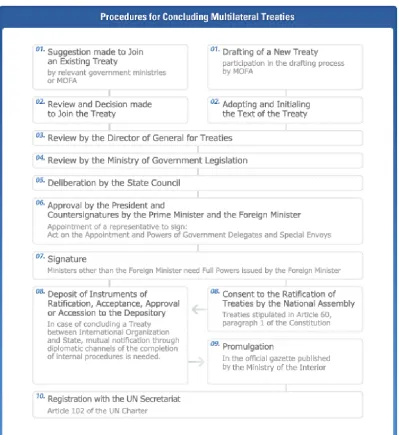
The following flow chart shows the detailed procedures of concluding international conventions in South Korea.
Figure 3. Procedures for concluding multilateral treaties
Source: Ministry of Foreign Affairs (www.mofa.go.kr)
In this case, the Ministry of Ocean and Fisheries is the responsible department to review and make the suggestion to join the regime of the WRC 2007. Then, the Director-General for Treaties of Ministry of Foreign Affairs reviews the suggestion made by the Ministry of Ocean and Fisheries (step 3). Then the suggestion of ratification may be reviewed by another central administrative agency, Ministry of Government Legislation, which is mainly in charge of law-making and revision
process in Korea (step 4). According to the Constitution of the Republic of Korea,
‘proposed treaties’ need to be deliberated by the State Council (Article 89.3) which may generally consist of the Ministers of each Ministry (step 5). Then, as step 6, the
President is entitled to ‘conclude and ratify treaties’ according to Article 73 of the
Constitution. In accordance with Article 3 of the Act on the Appointment and Powers
of Government Delegates and Special Envoys, the Minister of Foreign Affairs may
represent the Republic of Korea in ‘signing or initialling treaties’ (step 7). With regard to step 8 above, Article 60. (1) of the Constitution regulates that the National Assembly of Korea may have the right to ‘consent to the conclusion and ratification of treaties pertaining to mutual assistance or mutual security; treaties concerning important international organizations; treaties of friendship, trade and navigation; treaties pertaining to any restriction in sovereignty; peace treaties; treaties which will burden the State or people with an important financial obligation; or treaties related to legislative matters’.
Although it is uncertain that whether the consent of the National Assembly is required with regard to the ratification of the WRC 2007, the possibility of being required such consent is greater than the probability of being unnecessary, considering previous records of Treaty Information provided by the Ministry of Foreign
Affairs. For example, the International Convention on Civil Liability for Oil Pollution
Damage (CLC 1969) which was ratified in 1978 and denunciated in 1997 by Korean
government was consented by the National Assembly. In the same year, the Protocol
of 1992 to Amend the International Convention on Civil Liability for Oil Pollution
Damage, 1969 (CLC PROT 1992) was ratified with consent of the National Assembly.
Similarly, the International Convention on the Establishment of an International Fund
for Compensation for Oil Pollution Damage (FUND 1971) which was ratified in 1992
of an International Fund for Compensation for Oil Pollution Damage, 1971 (FUND PROT 1992) was ratified with consent of the National Assembly in the same year.
However, the International Convention on Civil Liability for Bunker Oil Pollution
Damage, 2001 (BUNKERS 2001) which has been ratified in 2009 did not require the
consent of the National Assembly.
4.3. Current responses and limitations
4.3.1. The five-year plan (2017~2021)
In March 2017, the Ministry of Ocean and Fisheries announced a document, ‘The
Second Maritime Safety Basic Plans (2017 ~ 2021)’ which includes an assessment
about ‘The First Maritime Safety Basic Plans (2012 ~ 2016)’, an analysis of recent
marine accidents, and visions in relation to the maritime safety in Korean waters as well as six main strategies and detailed implementation plans for the visions. Among the strategies, the review of ratification of the WRC 2007 is included under Strategy 5-2 (reliability enhancement of safety management with regard to major ship traffic lanes) which is a sub-part of Strategy No. 5, Cultivation of a state of the art system in respect of maritime traffic safety management based on ICT (Information and
Communication Technology). The relevant implementation plan points out the
necessity of effective counterplans in response to the entry into force of the WRC 2007 and for the purpose of preventing secondary accidents due to wrecks located in major ship routes. It also plans to assess social and economic benefits, cost-bearing matters in the Korean shipping industry, and the scope of application, i.e. whether the Convention needs to apply to the Korean territorial seas or not. Further, the plan summarizes the purposes and major contents of the WRC 2007 and appreciates that both the number of Contracting States and the percentage among world tonnages are rapidly increasing after its entry into force in April 2015.
WRC 2007 because the Republic of Korea is not currently a Contracting State of the Convention. The plan additionally mentions that Korea and China have accepted the major contents of the WRC 2007 into domestic laws rather than ratifying it, but this is a partly incorrect analysis because China already deposited the instrument of ratification on the 11th of November 2016 and the Convention entered into force three months later, i.e. from the 11th of February 2017 which was prior to the issuance of the five-year plan in March 2017. The plan finally explains that in Japan from 2005 it is compulsory for every ships larger than 100 tons to maintain the liability insurance for wreck removal prior to entering Japanese ports.
4.3.2. The yearly plan (2017) and potential risks
However, according to ‘2017 Maritime Safety Implementation Plan’ of the Ministry
of Ocean and Fisheries, there is no substantive working plan about the review or ratification of the WRC 2007 although some Regional Offices of Oceans and Fisheries plan to remove obstructions to navigation in accordance with the existing relevant domestic laws on a case by case basis. This may be a result of the authority’s recognition that it is not urgent matter as if an immediate response is required in 2017, although any kinds of response to the international regime for wreck removal may be necessary in the next five years. It is hard to assess whether such recognition is correct or wrong, but it may be so-called ‘a day after the fair’ unless a firm policy stance with comprehensive reviews is already in place, prior to a disastrous wreck
removal case such as Costa Concordia or Rena in 2012.
For instance, whereas the Republic of Korea deposited instruments of both the Protocol of 1992 to amend the International Convention on Civil Liability for Oil
Pollution Damage, 1969 (CLC PROT 1992) and the Protocol of 1992 to amend The
International Convention on the Establishment of an International Fund for
Compensation for Oil Pollution Damage (FUND PROT 1992) in the next year of the
entry into force in 1996, South Korea did not immediately respond to the Protocol of
2003 to the International Convention on the Establishment of an International Fund
for Compensation for Oil Pollution Damage, 1992 (FUND PROT 2003), which entered
occurred in the west coast of South Korea and it was impossible to utilize the highest level of compensation system because Korea was not a Contracting State at that time.
After the Hebei Spirit oil spill, public sentiment was significantly focused on the oil spill
related issues including limitation of liability as well as international compensation regimes. Politicians and policy makers were under criticism that Korean victims would have been more compensated using the FUND PROT 2003 if Korean government had corresponded to the global trend at the appropriate timing. Then, in 2010 Korea finally conducted accession of the FUND PROT 2003.
4.3.3. P&I Club’s blue card and government’s certificate
Korea P&I Club’s Rule 36.2. regulates that various certificates (so-called ‘blue cards’) may be issued in accordance with international conventions such as CLC PROT 1992, BUNKERS 2001, and the Athens Convention Relating to Carriage of
Passengers and Their Luggage by Sea 2002. The certificate ‘in accordance with
Article 12 of the Nairobi International Convention on the Removal of Wrecks, 2007’ is also one of them. There may be no problem for Korean or foreign shipowners to obtain such blue cards because they may be issued by any P&I Clubs once the vessels enter into contracts.
However, for Korean shipowners, a relatively complex and time-consuming
procedure is required when they want to obtain the government’s certificate in
Republic of Korea is not yet party to the Convention’ and ‘[n]evertheless, the State parties to the Convention is hereby kindly requested to accept the above mentioned Certificate of Compliance which meets the same legal and technical requirements as the Convention Certificate, taking into consideration that the Republic of Korea is in the process of acceding the Convention in due course’.
Although the above procedure was prepared for Korean shipowners in the situation that the WRC 2007 had not been ratified by South Korea, there was no shipowner who utilize such procedure which has a great extent of uncertainty. For example, a shipowner who obtains a wreck liability insurance provided by Korea P&I Club and then receives the government certificate issued by the Korean agency may suffer a delay prior to entering a port in India or any other Contracting States of the
WRC 2007, while the States access the validity of the Korean government’s
5. Summary and Conclusions
As an alternative way to narrow gaps between the global trend and the Korean regime with regard to the wreck removal matters, this dissertation studies how the national laws could be improved and enhanced through further revisions.
From the public law viewpoint, the WRC 2007 defines the ‘wreck’ as a sunken or stranded ship, or any parts or objects lost from such ship, or a ship that is expected to do so. Although the Convention basically applies to the EEZ of the Contracting States, the scope of application may be extended to the territorial seas of the States with an explicit declaration. The master and the operator of a ship are required to immediately report to the Affected State about the marine casualty including the location, size, damage, cargo and oil. The Affected State may consider conditions of the wreck from hydrographical, meteorological, technical, environmental and marine traffic viewpoints, then decide whether the wreck is required to be marked in accordance with the international buoyage system and promulgated by the nautical publications. In order to facilitate the removal of wreck, the Convention regulates that the registered owner is responsible for the costs of wreck removal which may be conducted by a salvor in a contract, and is required to present a certificate of wreck liability insurance. The Affected State may inform to and discuss with the wreck’s flag State, and is allowed to interfere the wreck removal operation in respect only to the matters of safety and protection of marine environment. Also, the Affected State may intervene only to the effectiveness of wreck removal operation, and is required to determine a reasonable period of the operation and inform it to the registered owner. An immediate intervention by the Affected States may be conducted if the owner fails to complete the removal by the deadline without a proper notification, or it impossible to contact the registered owner, or the wreck becomes a severe hazard.
In the Republic of Korea, four different domestic laws deal with the public law
matters in relation to wrecks. Firstly, the Maritime Safety Act which applies in the
territorial sea, inland waters, and the EEZ has introduced the latest legal definition of ‘obstruction to navigation’ which is used instead of ‘wreck’. The Act requires master, owner or operator of the wreck to immediately report the location and condition of it.
Further, it is necessary to assess the wreck’s influence on navigational safety and
WRC 2007. The Act also deals with marking procedures when the wreck is likely to jeopardize the safe navigation of ships. The registered owner is required to put a sign indicating the hazard, and the Minister of Oceans and Fisheries may directly conduct such measure if the owner fails to fulfil the obligation. In addition, the Act stipulates that the registered owner is obliged to remove the wreck. If the owner fails to conduct such order, the Minister of the authority may remove the wreck and ban the entry of the ship in question into Korean ports or mooring facilities, or the departure therefrom.
Secondly, the Public Waters Management and Reclamation Act which applies in the
territorial sea as well as EEZ regulates that the Minister of Oceans and Fisheries or local government may order the removal of sunken ship, derelict waste material, or other object if the wreck impedes the utilization of public waters or creates pollution. The central or local government may remove the wreck if the owner is unknown or fails to comply with the order. Further, the management agency of public waters needs to conduct ‘a prior investigation’ to ascertain whether a wreck may create
pollution or impediment of maritime utilization. Thirdly, the Marine Environment
Management Act express the wreck as ‘sunken ship’ which requires systemic
management, risk assessment, and risk-mitigation measures. The Act applies in the territorial sea as well as EEZ, likewise the aforementioned national laws. Finally, the
Act on the Arrival, Departure, etc. of Ships stipulates that the Minister of Oceans and
Fisheries may order owners or users of an object which obstructs the navigation of vessels in a trade port or in a place adjacent to the water zone of a trade port. If the owners or users do not comply with such order, the Authority may vicariously execute the ordered measure.
and efficient standpoints, it is unnecessary any longer to maintain the scattered and unorganized regulations for the exactly same matters. Thus, a consolidation of regulations among the Acts is highly required for a more concise and explicit legal regime. Similarly, an adjustment or rearrangement of work scope in the Ministry of Oceans and Fisheries is necessary because three different departments in the Ministry are concurrently related to the wreck removal matters. The second limitation is unlikely to be solved unless Korea ratifies the Convention. Although the Korean law-makers want to apply the national Acts in the EEZ, the registered owner of wreck may insist that Korea has no jurisdiction for the wreck without any environmental pollution. Thus, it is necessary to ratify the Convention to eliminate such uncertainty and controversy.
On the other hand, from the private law viewpoint, the WRC 2007 regulates that the registered owner is basically liable to pay wreck related expenses unless the owner proves an act of war or an exceptional and inevitable natural phenomenon, or third party’s whole liability, or any Government’s negligence in respect of navigational lights and aids, likewise with CLC PROT 1992 and BUNKERS 2001. In addition, the Convention does not affect the State’s national laws or application of existing compensation conventions. Any ships of 300 GT or more need to maintain the liability insurance cover at least an amount of LLMC 1976, and such security is examined and approved by the government’s certificate. Further, identically with CLC PROT 1992 and BUNKERS 2001, the WRC 2007 allows victims of the wreck to directly claim against the liability insurer who may defend with limitation of liability. Such claim is required to be brought within three years from the date of hazard determination, and the right to claim extinguishes after six years from the casualty.
In the Republic of Korea, although both the Maritime Safety Act and the Marine Environment Management Act simply stipulates that the registered owner pays expenses of marking and removing wrecks, there is no more specific regulation in the
two Act. Thus, a more general law, the Commercial Act shall apply for the liability
liability limitation from LLMC 1976 (personal and property c