IJIRT 148227
INTERNATIONAL JOURNAL OF INNOVATIVE RESEARCH IN TECHNOLOGY713
An Experimental Study on Bubble Deck Slab System
with HDPE Balls
Sunil Yadav
1, Mohd. Sharif Uddin
2, Vivek Kumar Pal
3, Zahid Ahmed
4, Prof. Ankur Gupta
51,2,3,4
Student, ABES Institute of Technology, Department of Civil Engineering, ABESIT, U.P, INDIA
5
Assistant Professor, ABES Institute of Technology, Department of Civil Engineering, ABESIT, U.P,
INDIA
Abstract-Concrete slab is an important two dimensional or planar element, used in all types of structures such as floors and roof covering. Bubble Deck slab is a futuristic method which can effectively eliminate all the concrete from middle of slab by replacing it with High Density Polyethylene Balls (HDPE) and provides thermal insulation. In this technique, the reinforcement mesh acquires, allocates and attached the balls at exact position and also stabilizes the lattice. By this technique structural weight can be reduced from 25% to 50.The main aim of this study to comparatively study of Bubble Deck slab and conventional slab under cost analysis, load bearing capacity .i.e. strength and efficiency too and also families and create awareness to all. The advantages of this technique are less energy consumption - both in production, transport and carrying out, less emission - exhaust gases from production and transport, especially CO2.
Index Terms- HDPE balls, bubble deck slab, conventional slab, comparison.
I. INTRODUCTION A. General
In any Building structure, Concrete slab is the most important component of any building structure for transmitting the load to other structural members. Slab helps in providing thermal comfort and achieving a effective lifestyle for People.
In general, Slabs are classified as one-way or two- way depending upon their longer to shorter span ratio. Slabs with longer to shorter span ratio is greater than 2 are termed as one way slab and those slab mainly deflect in one direction. Slabs with longer to shorter span ratio is smaller than 2 are termed as two way slab and those slabs are supported by columns arranged generally in rows so that the they can deflect in two directions.
Bubble deck slab technology firstly invented in Denmark. Bubble Deck Slab is a unique way of reinforced concrete which contains spherical hollow plastic balls as replacement of ineffective concrete from middle of the slab which reduces the dead load of the slab. This type of bubble deck slab has been
Implemented in various parts of the world using their design codes of practice in construction and has found to be successful.
In this project, one way bubble deck slab
(770mm*380mm*110mm) using the High
Density Polyethylene balls (70mm diameter) of size prepared which is made up of plastic waste. These balls are place in middle of the slab.
Generally the plastic waste is
Non-Biodegradable waste and harms the environment. By using this method, reduction of plastic waste and amount of concrete has been made and it makes the Green design
IJIRT 148227
INTERNATIONAL JOURNAL OF INNOVATIVE RESEARCH IN TECHNOLOGY714
A. Cement
Ordinary Portland Cement (OPC) 53-grade
confirming to IS: 8112-1989 is available in the market and it was used in the present studies.
PROPERTY VALUE
Specific Gravity 3.14
Fineness 328 (m^2/kg)
Consistency 34
Initial Setting time(Minutes) 52
Final setting time (Minutes) 258
Table 1: Properties of cement
B. Fine Aggregate
Locally available river sand is used in this project with specific gravity 2.95.
C. Coarse Aggregates
For this project, natural coarse aggregates are obtained from local supplier. The size of coarse aggregate is approx. 20 mm.
Fine aggregate
Specific Gravity 2.95
Sieve Analysis Zone 1
Coarse aggregate( Max size 20mm)
Sieve Analysis 2.91
Water Absorption 0.1%
Crushing Strength 28.58%
Table 2: Properties of Natural Coarse aggregates D. Steel
High grade steel of Fe 550 or Fe 500 is generally used. The same grade of steel is used in both in top and bottom steel reinforcement. Here 8 mm diameter steel bar is used for main reinforcement and 8mm diameter steel bar is used for distributor reinforcement. Reinforcement provided in both transverse and longitudinal direction in the form of welded mesh.
E. HDPE balls
The hollow spheres are made from recycled high-density polyethylene or HDPE.
Generally recycled plastic balls are used, because to reduce wastage of plastics instead of burning the plastics and also to reduce the environmental pollution. The cost of plastic ball is low when compared to the HDPE. The Bubble Deck slabs being entirely recyclable. The plastic ball don’t react chemically with the concrete or the reinforcement, it has no porosity and has enough rigidity and strength to take more loads while pouring of the concrete. The size of the plastic ball is about 70mm diameter. The
recycled polyethylene hollow spheres are shown in Figure below.
Figure 2: HDPE balls (Reference: Google images)
Name of Material
Parameter Value
Steel
Modulus of Elasticity(E) 200000 MPa
Density 7850 Kg/m^3
Poisson’s Ratio 0.3
Concrete
Modulus of Elasticity(E) 25000 MPa
Density 2460 Kg/m^3
Poisson’s Ratio 0.18
Plastic HDPE
Modulus of Elasticity(E) 1035 MPa
Density 970Kg/m^3
Poisson’s Ratio 0.4
Table 3: Properties of Materials
F. Water
Fresh and clean water is used for casting and curing of specimen. The water is relatively free from organic matters, silt, oil, sugar, chloride and acidic material as per requirements of Indian standard. Combining water with a cementitious material forms a cement paste by the process of hydration.
IJIRT 148227
INTERNATIONAL JOURNAL OF INNOVATIVE RESEARCH IN TECHNOLOGY715
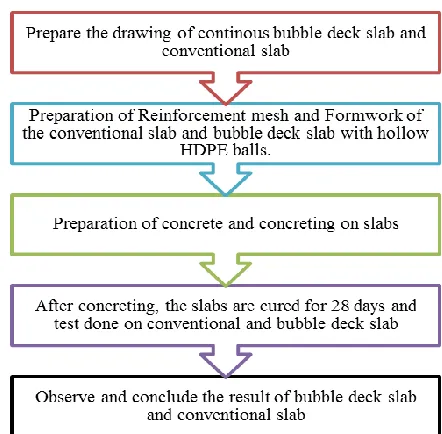
1. PREPARATION OF PLAN/DRAWING
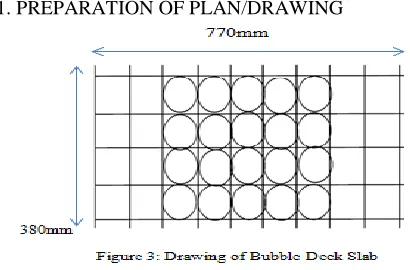
The drawing has prepared in AUTOCAD.
Size of slab= 770mm*380mm*110mm including
cover of 30 mm
8mm diameter Fe500 Steel Bar Longitudinal bars (710mm)
8mm diameter Fe500 Steel Bar Lateral bars (320mm)
70mm c/c spacing used in both direction 20 nos. 70 mm diameter balls used
2.Preparation of reinforcement mesh and Formwork of the slabs
High grade steel of Fe 500 used here. The same grade of steel is used in both in top and bottom steel reinforcement. Reinforcement shall be accurately placed and secured in position in a manner that will prevent its displacement during the placement of concrete.
The spacing of steel bar is 70 mm. The diameter of bar is 8mm.and the diameter of HDPE ball is 70mm. Timber used for shuttering for exposed concrete work should have smooth and even surface on all faces which come in contact with concrete.
The combination of bar and ball are show in fig. are given below:
Figure 4: Formwork of slabs
3.Concreting on Slabs and Curing
Mix design was done for M25 (1:1:2) grade concrete using IS 10262: 2009 with water cement ratio 0.45. Quantity of materials as per M25 mix design is given in table 2 for both slabs conventional and Bubble Deck slab. Curing of the slabs in this study is done for 28 days in Curing Tub.
IV. TESTING AND RESULTS A. Strength
The testing of both slabs done in Universal Testing Machine with deflection fixed at 0.5 mm interval to obtain suitable Loads. The specimen is placed in the Universal Testing machine with 110mm support width. Deflection is fixed about 0.5mm at various suitable loads applied by UTM. Once the machine is started it begins to apply an increasing load on specimen. Throughout the tests the control system and its associated software record the load and deflection at 0.5mm of the specimen.
Figure 6: Slab in universal Testing Machine
LOAD VS DEFLECTION
BUBBLE DECK SLAB CONVENTIONAL
IJIRT 148227
INTERNATIONAL JOURNAL OF INNOVATIVE RESEARCH IN TECHNOLOGY716
LOAD(N) DEFLECTION
(mm)
LOAD (N)
DEFLECTION (mm)
0 0 0 0
1400 0.5 1680 0.5
2550 1 3060 1
4950 1.5 5940 1.5
8800 2 10560 2
12050 2.5 14460 2.5
16050 3 19260 3
17750 3.5 21300 3.5
22300 4 26760 4
24750 4.5 29700 4.5
28400 5 34080 5
33200 5.5 39840 5.5
38750 6 46500 6
46200 6.5 55440 6.5
56700 7 68040 7
66850 7.5 80220 7.5
76100 8 91320 8
Table 4: Load vs. Deflection
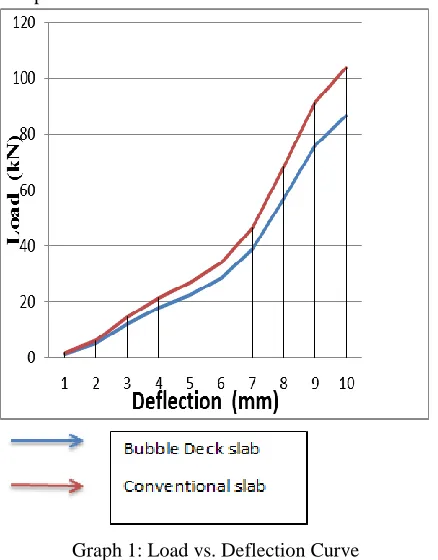
After knowing Loads at suitable interval of deflection plotting of load vs. deflection curve is obtained for comparison.
Graph 1: Load vs. Deflection Curve
The Result indicates that Strength of Bubble Deck slab is nearly 80% in comparison with conventional slab.
B. Comparison of slabs by weight
Weight of the slabs measured on weighing machine after curing of 28 days.
Weight Comparison
Weight of Conventional slab
Weight of Bubble deck slab
61.340 kg 47.050 kg
Table 5: weight comparison
Result indicates that approx. 25% of amount of concrete saved using Bubble deck Slab.
C. Cost Comparison
Only differences in materials concerning the slabs are considered. Bubble Deck reduces the amount of concrete with 25 %, and reduces the cost with 25 %.
Table 5: Quantity details
V. CONCLUSION
Dead load of the slab reduces by approximate 25% by weight using bubble deck slab.
The cost of Bubble Deck slab has been found to be 25% less in comparison with Conventional Slab.
Strength of Bubble Deck slab is nearly 80% in comparison with conventional slab and hence more suitable for less loaded structure like flat slab.
Use of Non-Biodegradable waste material HDPE ball used and hence making it very ecofriendly practice.
Reduces the amount of concrete in slab and hence reduces the pollution caused by cement
production allows reducing global CO2
emissions.
Cost and Time saving by using Bubbles in the slab, concrete volume indirectly load on the beam and walls also decrease/less so that building foundations can be designed for smaller dead loads.
BUBBLE DECK SLAB CONVENTIONAL SLAB
Materials Quantity
(Kg)
Materials Quantity
(Kg)
Cement 7 Cement 10
Fine Aggregate
8 Fine
Aggregate 13
Coarse Aggregate
13 Coarse
Aggregate 19
Water 4 Water 7
IJIRT 148227
INTERNATIONAL JOURNAL OF INNOVATIVE RESEARCH IN TECHNOLOGY717
REFERENCES
[1] Nagashree, Sachin Hokrane and Soumajit Saha (2017), “Comparative Studies of Conventional Slab and Bubble Deck Slab Based on Stiffness and Economy” IJSRD - International Journal for Scientific Research & Development| Vol. 5, Issue 03, 2017.
[2] Ritwik Bhowmik, Sourish Mukherjee and
Aparna Das, “Review on Bubble deck with spherical hollow balls” International Journal of Civil Engineering and Technology (IJCIET) Volume 8, Issue 8, August 2017.
[3] Shivani Mirajkar, Mitali Balapure1, and. Prof. Trupti kshirsagar “Study of Bubble Deck Slab” International Journal of Research In Science & Engineering e-ISSN: 2394-8299 Special Issue 7-ICEMTE March 2017.
[4] K.R.Dheepan, S.Saranya and S.Aswini,”
Experimental Study on Bubble Deck Slab using Polypropylene balls” © 2017 IJEDR | Volume 5, Issue 4 | ISSN: 2321-9939.
[5] Bhagyashri G. Bhade and S.M Barelikar,” An experimental study on two way bubble deck slab with spherical hollow balls” International Journal of Recent Scientific ResearchVol. 7, Issue, 6, June, 2016.
[6] Er. Immanuel Joseph Chacko and Er. Sneha M. Varghese, “Study on Structural Behavior of Bubble Deck Slab using Indian Standards”© September 2016 International Journal Of Innovative Research In Technology IJIRT | Volume 3 Issue 4 | ISSN: 2349-6002.
[7] Arati Shetkar and Nagesh Hanche,” An