
Research Online
Research Online
Theses: Doctorates and Masters Theses
2015
Intelligent network intrusion detection using an evolutionary
Intelligent network intrusion detection using an evolutionary
computation approach
computation approach
Samaneh RastegariEdith Cowan University
Follow this and additional works at: https://ro.ecu.edu.au/theses
Part of the Digital Communications and Networking Commons, and the Information Security Commons
Recommended Citation Recommended Citation
Rastegari, S. (2015). Intelligent network intrusion detection using an evolutionary computation approach. https://ro.ecu.edu.au/theses/1760
This Thesis is posted at Research Online. https://ro.ecu.edu.au/theses/1760
Theses: Doctorates and Masters Theses
2015
Intelligent network intrusion detection using an
evolutionary computation approach
Samaneh Rastegari
Edith Cowan University
This Thesis is posted at Research Online. http://ro.ecu.edu.au/theses/1760
Recommended Citation
Rastegari, S. (2015).Intelligent network intrusion detection using an evolutionary computation approach. Retrieved from http://ro.ecu.edu.au/theses/1760
Copyright
Warning
You
may
or
download
ONE
copy
of
this
document
for
the
purpose
of
your
own
research
or
study.
The
University
does
not
authorize
you
to
copy,
communicate
or
otherwise
make
available
electronically
to
any
other
person
any
copyright
material
contained
on
this
site.
You
are
reminded
of
the
following:
Copyright
owners
are
entitled
to
take
legal
action
against
persons
who
infringe
their
copyright.
A
reproduction
of
material
that
is
protected
by
copyright
may
be
a
copyright
infringement.
Where
the
reproduction
of
such
material
is
done
without
attribution
of
authorship,
with
false
attribution
of
authorship
or
the
authorship
is
treated
in
a
derogatory
manner,
this
may
be
a
breach
of
the
author’s
moral
rights
contained
in
Part
IX
of
the
Copyright
Act
1968
(Cth).
Courts
have
the
power
to
impose
a
wide
range
of
civil
and
criminal
sanctions
for
infringement
of
copyright,
infringement
of
moral
rights
and
other
offences
under
the
Copyright
Act
1968
(Cth).
Higher
penalties
may
apply,
and
higher
damages
may
be
awarded,
for
offences
and
infringements
involving
the
conversion
of
material
Doctoral Thesis
Intelligent Network Intrusion
Detection Using an Evolutionary
Computation Approach
Author:
Samaneh Rastegari
Supervisors:
Associate Professor Philip Hingston
Associate Professor C. Peng Lam
A thesis submitted in fulfilment of the requirements
for the degree of Doctor of Philosophy
in the
School of Computer and Security Science
Faculty of Health, Engineering and Science
I, Samaneh Rastegari, declare that this thesis titled, ’Intelligent Network Intrusion Detection Using an Evolutionary Computation Approach’ and the work presented in it are my own. I confirm that:
This work was done wholly or mainly while in candidature for a research degree
at this University.
Where any part of this thesis has previously been submitted for a degree or
any other qualification at this University or any other institution, this has been clearly stated.
Where I have consulted the published work of others, this is always clearly
attributed.
Where I have quoted from the work of others, the source is always given. With
the exception of such quotations, this thesis is entirely my own work.
I have acknowledged all main sources of help.
Where the thesis is based on work done by myself jointly with others, I have
made clear exactly what was done by others and what I have contributed my-self.
Signed:
Samaneh Rastegari
Date:
08/12/2015
Abstract
Faculty of Health, Engineering and Science School of Computer and Security Science
Doctor of Philosophy
Intelligent Network Intrusion Detection Using an Evolutionary Computation Approach
by Samaneh Rastegari
With the enormous growth of users’ reliance on the Internet, the need for secure and reliable computer networks also increases. Availability of effective automatic tools for carrying out different types of network attacks raises the need for effective intrusion detection systems.
Generally, a comprehensive defence mechanism consists of three phases, namely, preparation, detection and reaction. In the preparation phase, network administra-tors aim to find and fix security vulnerabilities (e.g., insecure protocol and vulnerable computer systems or firewalls), that can be exploited to launch attacks. Although the preparation phase increases the level of security in a network, this will never completely remove the threat of network attacks. A good security mechanism re-quires an Intrusion Detection System (IDS) in order to monitor security breaches when the prevention schemes in the preparation phase are bypassed. To be able to react to network attacks as fast as possible, an automatic detection system is of paramount importance. The later an attack is detected, the less time network administrators have to update their signatures and reconfigure their detection and remediation systems. An IDS is a tool for monitoring the system with the aim of detecting and alerting intrusive activities in networks. These tools are classified into two major categories of signature-based and anomaly-based. A signature-based IDS stores the signature of known attacks in a database and discovers occurrences of attacks by monitoring and comparing each communication in the network against the database of signatures. On the other hand, mechanisms that deploy anomaly detection have a model of normal behaviour of system and any significant deviation from this model is reported as anomaly.
This thesis aims at addressing the major issues in the process of developing signature based IDSs. These are: i) their dependency on experts to create signatures, ii) the complexity of their models, iii) the inflexibility of their models, and iv) their inability to adapt to the changes in the real environment and detect new attacks. To meet the requirements of a good IDS, computational intelligence methods have attracted considerable interest from the research community.
This thesis explores a solution to automatically generate compact rulesets for net-work intrusion detection utilising evolutionary computation techniques. The pro-posed framework is called ESR-NID (Evolving Statistical Rulesets for Network In-trusion Detection). Using an interval-based structure, this method can be deployed for any continuous-valued input data. Therefore, by choosing appropriate statistical measures (i.e. continuous-valued features) of network traffic as the input to ESR-NID, it can effectively detect varied types of attacks since it is not dependent on the signatures of network packets.
In ESR-NID, several innovations in the genetic algorithm were developed to keep the ruleset small. A two-stage evaluation component in the evolutionary process takes the cooperation of rules into consideration and results into very compact, easily understood rulesets. The effectiveness of this approach is evaluated against several sources of data for both detection of normal and abnormal behaviour. The results are found to be comparable to those achieved using other machine learning methods from both categories of GA-based and non-GA-based methods. One of the significant advantages of ESR-NIS is that it can be tailored to specific problem domains and the characteristics of the dataset by the use of different fitness and performance functions. This makes the system a more flexible model compared to other learning techniques. Additionally, an IDS must adapt itself to the changing environment with the least amount of configurations. ESR-NID uses an incremental learning approach as new flow of traffic become available. The incremental learning approach benefits from less required storage because it only keeps the generated rules in its database. This is in contrast to the infinitely growing size of repository of raw training data required for traditional learning.
Keywords: Network security, intrusion detection, evolutionary computation, classi-fication, genetic based machine learning, supervised learning, rule based algorithms.
Journal Paper:
Rastegari, S., Hingston, P., & Lam, C. P. (2015). Evolving statistical rulesets for network intrusion detection. Applied Soft Computing, 33, 348-359.
Conference Paper:
Rastegari, S., Lam, C. P., & Hingston, P., (recently accepted). A Statistical Rule Learning Approach to Network Intrusion Detection. InInternational Conference on IT Convergence and Security (ICITCS)., 2015. IEEE.
Related Paper:
Rastegari, S., Hingston, P., Lam, C. P., & Brand, M. (2013, April). Testing a distributed denial of service defence mechanism using red teaming. InComputational Intelligence for Security and Defense Applications (CISDA),2013 IEEE Symposium on (pp. 23-29). IEEE.
I am deeply thankful to my principal supervisor, Associate Professor Philip Hingston, for being a great inspiration throughout my candidature. His great advice and admirable patience helped me to get through the difficult stages of my thesis. My deep appreciation goes to my co-supervisor, Associate Professor C. Peng Lam, for her useful suggestions and close engagement throughout my research. Her constant support contributed a lot to completion of this thesis.
I am forever grateful to my loving parents, Reza and Shamsi, my kind brothers, Masoud and Yousef, and my lovely sister, Sima, for their unconditional love and support. My parents have given me the best of everything in this world by their endless sacrifices for my success. I would also like to thank my husband, Mohsen, who was extremely supportive and patient while I went through an important chapter of my life. He was always there to listen to every little worry I had and helped me deal with the challenges in my research with his love and sense of humour. I certainly cannot thank him enough.
I would also like to thank my PhD labmates in the School of Computer and Security Science and my friends in Australia for their encouragement, help and support. Special thanks go to Dr Majid Rad, Mahtab, Soheila, Samad, Zahra, Ali, Ghazaleh, Iman, Samira, Mousa, Arman, Hossein, Negar, and Amir for their warm support. Last but not least, I am also thankful to Edith Cowan University (ECU) for awarding me the postgraduate research scholarship during my PhD candidature.
Declaration of Authorship ii Abstract iii List of Publications v Acknowledgements vi Contents vii List of Figures xi
List of Tables xiii
Abbreviations xvii
1 Introduction 1
1.1 The Role of Intrusion Detection . . . 3
1.1.1 Essential Requirements of an IDS . . . 4
1.2 Research Motivation and Objectives . . . 5
1.3 Thesis Contributions . . . 7
1.4 Thesis Structure. . . 10
2 Background and Related Work 13 2.1 Introduction . . . 13
2.2 Overview of Network Intrusions . . . 13
2.3 Overview of Intrusion Detection Systems . . . 16
2.3.1 Selection Criteria for Intrusion Detection Systems . . . 19
2.4 Machine Learning . . . 22
2.4.1 Non-evolutionary Rule Learning Algorithms . . . 23
2.4.1.1 Repeated Incremental Pruning to Produce Error Re-duction (RIPPER) . . . 25
2.4.1.2 Decision Trees . . . 25
2.4.2 k-Nearest Neighbour (kNN) . . . 27
2.4.3 Evolutionary Rule Learning Algorithms . . . 28
2.4.3.1 XCS . . . 31
2.4.3.2 GASSIST . . . 33
2.4.3.3 MPLCS . . . 33
2.5 Rule-based nature-inspired approaches for IDSs . . . 36
2.5.1 Artificial Immune System . . . 36
2.5.2 GA-based Techniques . . . 40
2.5.2.1 Adapting to Environment Changes . . . 46
2.6 Summary of Challenges in GA-based IDSs . . . 47
2.7 Summary . . . 49
3 ESR-NID: A Framework for Evolving Statistical Rulesets for Net-work Intrusion Detection 51 3.1 Introduction . . . 51
3.1.1 Pre-processing Stage . . . 53
3.1.1.1 Input data . . . 54
3.1.1.2 Data Normalization . . . 54
3.1.2 Evolutionary Process . . . 54
3.1.2.1 Michigan Versus Pittsburgh Approach . . . 55
3.1.2.2 Individual Representation . . . 56
3.1.2.3 Seed Selection and Initializer . . . 58
3.1.2.4 Fitness Function and Performance Function . . . 60
3.1.2.5 Reproduction of A New Generation . . . 75
3.1.3 Post-processing . . . 77
3.2 Summary . . . 78
4 Performance Evaluation of ESR-NID on Synthetic Problems 81 4.1 Introduction . . . 81
4.2 Choice of Dataset . . . 82
4.2.1 A 3-Dimensional Medium Size Problem . . . 83
4.2.2 A 3-Dimensional Problem with More Clusters of Hits . . . 83
4.2.3 Problems With More Input Features . . . 85
4.3 Evaluation Strategy Against Synthetic Datasets . . . 87
4.4 Preliminary Experiments for Performance Evaluation . . . 87
4.4.1 Parameter Settings . . . 87
4.4.2 System Performance . . . 88
4.4.3 Adaptive Elitism Mechanism . . . 90
4.5 Algorithm Tuning . . . 94
4.6 Parameter Tuning for Other Classifiers . . . 98
4.7 Performance Comparison . . . 100
4.8 Performance Evaluation of ESR-NID against a 3-Dimensional Prob-lem with More Clusters of Hits . . . 103
4.9 Performance Evaluation of ESR-NID against a Problem with More
Input Features. . . 109
4.10 Using a Different Performance Function. . . 110
4.10.1 Imbalanced Dataset. . . 114
4.11 Summary . . . 116
5 Performance Evaluation of ESR-NID on Network Intrusion Detec-tion Problems 117 5.1 Introduction . . . 117
5.2 Choice of Dataset . . . 118
5.2.1 NSL-KDD dataset . . . 122
5.2.2 Combined DARPA/CAIDA dataset . . . 124
5.2.3 Features . . . 125
5.3 Experiments for Network Intrusion Detection. . . 128
5.3.1 Parameter Settings . . . 129
5.3.2 Experiments with NSL-KDD Dataset . . . 129
5.3.3 Experiments with DARPA/CAIDA Dataset . . . 134
5.4 ESR-NID for Detecting Normal Instances. . . 135
5.5 Summary . . . 138
6 Adaptation in a Dynamic Environment 141 6.1 Introduction . . . 141
6.2 Incremental Learning for ESR-NID . . . 142
6.3 Evaluation Strategy . . . 144
6.3.1 Experiments with Synthetic Datasets . . . 147
6.3.1.1 Parameter Settings . . . 148
6.3.1.2 Scenario 1 . . . 149
6.3.1.3 Scenario 2 . . . 151
6.3.1.4 Scenario 3 . . . 153
6.3.2 Experiments with NSL-KDD Dataset . . . 155
6.4 Summary . . . 157 7 Conclusions 163 7.1 Summary of Contributions . . . 164 7.2 Limitations . . . 166 7.3 Future Work . . . 167 Bibliography 169
1.1 Increases on the number of devices connected to the Internet over years. 1 1.2 Organization of a generalized intrusion detection system (Wu & Banzhaf,
2010). . . 3
2.1 Components of a comprehensive defence mechanism. . . 16
2.2 Layered AIS Framework (De Castro & Timmis, 2002). . . 37
2.3 Encoded Form of a Rule (Gong et al., 2005). . . 44
3.1 General view of supervised machine learning algorithms. . . 52
3.2 The architecture of the ESR-NID system.. . . 53
3.3 The structure of a chromosome in the proposed system. LBi, U Bi are real values between 0 and 1 and represent lower bound and upper bound of feature i and on/off component is a binary value used to activate or deactivate feature i in the chromosome. Thus, the system can produce variable length rules. . . 57
3.4 An example of a binary classification problem. One detection rule is covering a set of input instances. . . 61
3.5 A ruleset with three rules (corresponding to regions marked in green, yellow and purple respectively) for detection of abnormal instances. . 63
3.6 Weighting on the false positives in the proposed fitness functions (fit-ness function (2) and (3)) to take care of the problem of the class imbalance in a dataset. . . 65
3.7 A sample of sorted population based on the fitness value in generation0. 72 3.8 The breeding procedure (Luke et al., 2006). . . 76
3.9 Two point crossover. . . 77
3.10 Post-processing of final optimised ruleset. . . 79
4.1 A medium-size problem. Red (darker) data points represent “anoma-lous” records, and green (lighter) points are “normal”. . . 84
4.2 A problem to test the performance of ESR-NID in detection of more clusters of hits. This problem includes two “normal” clusters and five “anomalous” clusters. . . 84
4.3 Performance of ESR-NID on the problem shown in Figure 4.1 vs gen-erations for only one fold. . . 89
4.4 Fixed elitism approach (population-size=20 and elite=25%). . . 90
4.5 Performance of the enhanced ESR-NID on the problem shown in Fig-ure 4.1 vs generations for only one fold. . . 92
4.6 Adaptive elitism approach. Individuals are sorted in descending order of fitness values. Performance(Ind0, Ind2, Ind3, Ind4)>Performance(Ind0, Ind1, Ind2, Ind3, Ind4).. . . 93 4.7 Comparing the performance of ESR-NID using fixed elitism and
adap-tive elitism mechanisms (the results are for a total of 30 runs). . . . 94 4.8 Performance of ESR-NID using fitness function (1). Left y-axis shows
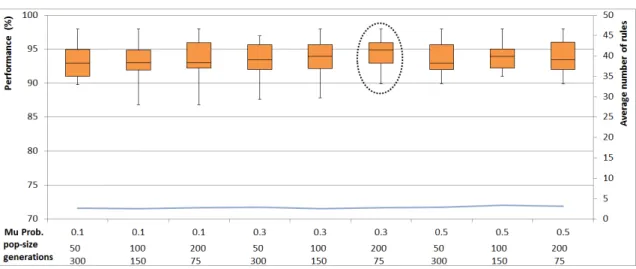
the performance value and right y-axis presents the number of rules used for classification. On x-axis, different combinations of muta-tion probabilities and populamuta-tion sizes for ESR-NID are depicted. As explained before, when the population size increases, the number of generations will be decreased to keep the total number of evaluations the same in all the experiments. . . 96 4.9 Performance of ESR-NID using fitness function (2) and different
com-binations of mutation probabilities and population sizes. . . 97 4.10 Performance of ESR-NID using fitness function (3) and different
com-binations of mutation probabilities and population sizes. . . 97 4.11 Performance of ESR-NID using different fitness functions. . . 98 4.12 Performance of ESR-NID using the best configuration found
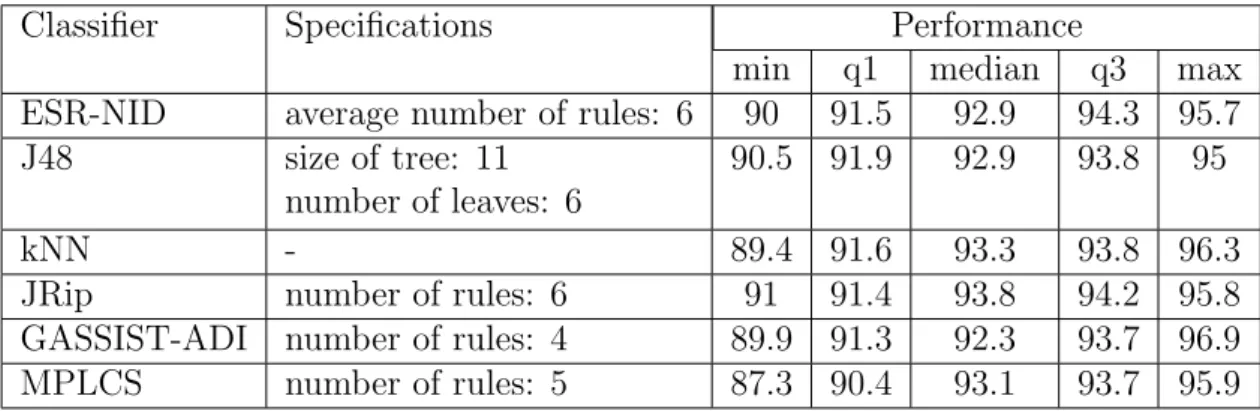
com-pared to J48, kNN, JRip, GASSIST-ADI and MPLCS approaches. . . 101 4.13 Performance of different techniques on the problem shown in Figure
4.2. Six rules are produced by ESR-NID, J48 and JRip for classifica-tion of anomalous records. . . 104 4.14 The final ruleset evolved by ESR-NID for classifying the anomalous
records in the problem shown in Figure 4.2. f1, f2 and f3 are the three features in the dataset generated by the rules in Section 4.2.1. . . 106 4.15 Comparing the output of J48 to the ruleset generated by ESR-NID. . 108 4.16 Performance of different techniques on a problem with 6 features. . . 110 4.17 Performance of different techniques on a problem with 12 features. . . 111 4.18 Performance of different techniques on a problem with 12 features. . . 113 4.19 Accuracy of different techniques on a problem with 12 features. . . . 113 5.1 Normal traffic scenario from MIT Lincoln Laboratory. . . 124 5.2 Low-rate DDoS attack scenario from CAIDA. . . 125 5.3 Entropy for a brief distributed denial of service attack (Feinstein et al.,
2003) . . . 126 6.1 Incremental learning used in ESR-NID. . . 143 6.2 Evaluation strategy used in the experiments in this chapter. . . 145 6.3 Performance of different learning approaches in the first scenario. . . 150 6.4 Performance of different learning approaches in the second scenario. . 153 6.5 Performance of different learning approaches in the third scenario. . . 155 6.6 Performance of different learning approaches against the NSL-KDD
2.1 Pros and cons of signature and anomaly based IDSs. . . 17 2.2 Factors affecting the selection process of defence mechanisms . . . 20 2.3 A summary of the reviewed GA-based rule learning techniques. . . . 35 3.1 A comparison of fitness functions for different scenarios.. . . 67 4.1 Parameters of the J48 machine learning algorithm used in optimization. 99 4.2 Parameters of the kNN machine learning algorithm used in optimization. 99 4.3 Parameters of the JRip machine learning algorithm used in
optimiza-tion. . . 100 4.4 Parameters of GASSIST-ADI and MPLCS used in optimization. . . . 100 4.5 Details of the results presented in Figure 4.12. . . 101 4.6 Comparing the final ruleset generated by ESR-NID, J48, JRip,
GASSIST-ADI and MPLCS. . . 102 4.7 The performance of different techniques on the problem shown in
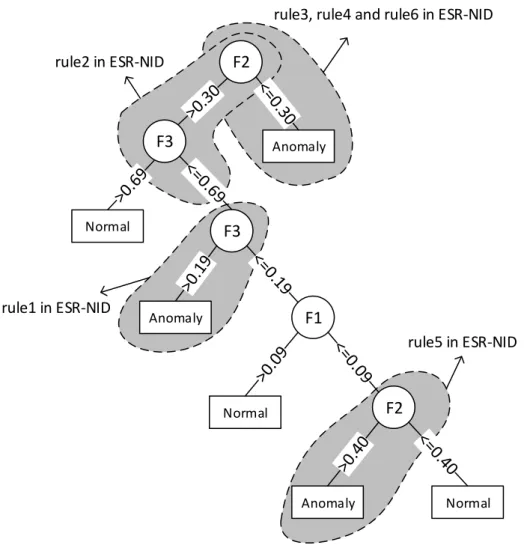
Figure 4.2. . . 104 4.8 Comparing the final ruleset generated by ESR-NID, J48, JRip,
GASSIST-ADI and MPLCS. . . 105 4.9 Performance of different techniques on a problem with 6 features. . . 110 4.10 Performance of different techniques on a problem with 12 features. . . 111 4.11 Confusion matrix for a two-class problem. . . 112 4.12 Performance of different techniques on a problem with 12 features. . . 112 4.13 Accuracy of different techniques on a problem with 12 features. . . . 114 4.14 Performance of two configurations of ESR-NID on an imbalanced
problem with 12 features. . . 115 4.15 Accuracy of two configurations of ESR-NID on an imbalanced
prob-lem with 12 features. . . 115 4.16 Average performance of ESR-NID against an imbalanced problem
with 12 input features. . . 115 4.17 Average performance of customised ESR-NID against an imbalanced
problem with 12 input features. . . 115 5.1 Attack types in KDD99 dataset and their categorisation. . . 120 5.2 Basic features in KDD99 dataset. . . 120 5.3 Traffic features using two-second time windows in KDD99 dataset. . . 121 5.4 Traffic features using windows of 100 connections in KDD99 dataset. 121
5.5 Connection-based content features based on domain knowledge in
KDD99 dataset. . . 122
5.6 Statistics of redundant records in the KDD99 training set (Tavallaee et al., 2009). . . 123
5.7 Statistics of redundant records in the KDD99 test set (Tavallaee et al., 2009). . . 123
5.8 Traffic features and details of CAIDA DDoS attack scenario (Moore et al., 2006; Xiang et al., 2011). . . 125
5.9 KDD99 continuous features. . . 127
5.10 Eight features extracted using CFS and BestFirst. . . 130
5.11 Fifteen features extracted using CSE and GreedyStepwise. . . 131
5.12 Comparing the performance of ESR-NID on the NSL-KDD dataset with 8 features with J48, kNN, JRip, GASSIST-ADI and MPLCS performances. . . 131
5.13 A ruleset generated by ESR-NID for the NSL-KDD dataset with 8 features. . . 132
5.14 A ruleset generated by GASSIST-ADI for the NSL-KDD dataset with 8 features. . . 132
5.15 A ruleset generated by MPLCS for the NSL-KDD dataset with 8 features. . . 132
5.16 Comparing the performance of ESR-NID on the NSL-KDD dataset with 15 features with J48, kNN, JRip, GASSIST-ADI and MPLCS performances. . . 133
5.17 Comparing the performance of ESR-NID on the NSL-KDD dataset with all 32 continuous features with J48, kNN, JRip, GASSIST-ADI and MPLCS performances. . . 133
5.18 Comparing the performance of ESR-NID on the combined DARPA/-CAIDA dataset with J48, kNN, JRip, GASSIST-ADI and MPLCS performances. . . 135
5.19 Comparing the final ruleset generated by ESR-NID, J48, JRip, GASSIST-ADI and MPLCS. . . 135
5.20 Performance of ESR-NID for detecting normal instances. . . 137
5.21 Performance of customised ESR-NID as an anomaly detection system.137 6.1 Average results for startup and update phases in the first scenario.. . 150
6.2 Comparing the final rulesets generated by ESR-NID during startup and update phases in the first scenario. . . 151
6.3 Average results for startup and update phases in the second scenario. 153 6.4 Comparing the final rulesets generated by ESR-NID during startup and update phases in the second scenario. . . 154
6.5 Average results for startup and update phases in the third scenario. . 155
6.6 Comparing the final rulesets generated by ESR-NID during startup and update phases in the third scenario. . . 156
6.7 Average results for startup and update phases against the NSL-KDD dataset. . . 157
6.8 Comparing the final rulesets generated by ESR-NID during startup and update phases for the NSL-KDD daraset. . . 158
AI Artificial Intelligence AISs Artificial Immune Systems ANNs Artificial Neural Networks
CAIDA Center for Applied Internet Data Analysis CFS Correlation-based Feature Selection
CSE Consistency Subset Evaluator
CVE CommonVulnerabilities andExposure
DARPA Defense Advanced Research Projects Agency
DDoS Distributed Denial of Service DMZ DeMilitarized Zone
EC Evolutionary Computation EC Evolutionary Algorithm
ESR-NID Evolving Statistical Rulesets for Network Intrusion Detection
FL Fuzzy Logic
GA Genetic Algorithms
GASSIST Genetic Algorithms based claSSIfier sySTem GBML Genetic-based Machine Learning
GP Genetic Programming
GR Gain Ratio
HIDS Host-based Intrusion Detection System ICMP Internet Control MessageProtocol IDS Intrusion Detection System
IP Internet Protocol
IG Information Gain
KDD Knowledge Discovery in Databases kNN k-Nearest Neighbors
LCS Learning ClassifierSystem
MPLCS Memetic Pittsburgh Classifier System
MOEA Multi-ObjectiveEvolutionary Algorithm NIDS Network-based Intrusion Detection System
RIPPER Repeated Incremental Pruning to Produce Error Reduction ROC Receiver Operating Characteristic
SI Swarm Intelligence
SIP Session Initiation Protocol TCP Transmission Control Protocol
TN True Negative
TN True Positive
UCP UserDatagram Protocol UCS SUpervised Classifier System
WEKA Waikato Environment for Knowledge Analysis XCS EXtended Classifier System
soulemate, Mohsen...
To my father, who did not live long enough to witness
this moment...
Introduction
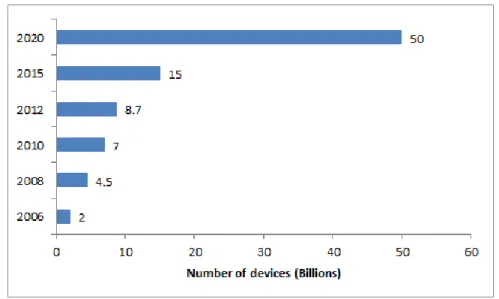
Computers and networks have been under threat from viruses, worms and attacks from hackers since they were first used. In 2008, the number of devices connected to the Internet exceeded the number of human beings and this increasing trend will see about 50 billion devices by 2020 (see Figure 1.1) (Evans, 2011). Securing these devices and the data passing between them is a challenging task because the number of intrusions is also increasing sharply year by year.
Figure 1.1: Increases on the number of devices connected to the Internet over years.
To address this issue, a large number of defences against network attacks have been proposed in the literature. Despite all the efforts made by researchers in the com-munity over the last two decades, the network security problem is not completely solved. One reason for that is the rapid growth in computational power and available resources to attackers, which enables them to launch complex attacks (Wu et al., 2010). This can be considered a two-player game, where an attacker attempts to find the most effective strategy to disrupt normal operations in a network and the de-fender’s challenge is to determine optimal defensive solutions and block illegitimate access to the network.
In general, defence against network attacks consists of preparation, detection and reaction phases. A risk analysis process is usually conducted by security engineers during the preparation phase to understand the environment and the assets they are trying to protect in that environment. This process is very crucial because it helps the engineers to understand how attacks can take place and how they affect the network (Santos,2007). The preparation phase also includes identification of infras-tructure vulnerabilities, development of security strategies and plans and installation of required security devices based upon analysis of the information gathered (Hamdi & Boudriga, 2005; M¨ols¨a, 2005). Another key element of network security is a de-tection system. An intrusion dede-tection system (IDS) usually complements a firewall to form an effective cyber security solution. One security motto is “Prevention is ideal but detection is a must” (Cole, 2011). Fast detection of attacks is required to be able to react rapidly. Thus, an automatic detection phase is of paramount importance. Finally, handling detected intrusions in a network is done during the reaction phase. A traffic blocking method is an example of a mitigation mechanism used in the reaction phase.
One of the main challenges in securing networks is the appropriate design and use of an intrusion detection system, that can monitor network traffic and effectively identify network intrusions. The role of this key element in an effective defence system will be explained in the next section.
1.1
The Role of Intrusion Detection
A large number of defence approaches have been proposed in the literature to provide different functions in various environments. The core element of a good defence sys-tem is an Intrusion Detection Syssys-tem (IDS), which provides proper attack detection before any reaction. An IDS aims to detect intrusions before they seriously damage the network. The term intrusion refers to any unauthorised attempt to access the elements of a network with the aim of making the system unreliable. Figure 1.2 depicts the organization of a generalized IDS. The solid lines show the data/control flow and the dashed lines indicate the responses to the intrusions.
Data Pre-processing Data
Collection
Intrusion Recognition Alarm Report Intrusion Models Security
Administrator Monitored System
Response to Intrusion
Response to Intrusion
Figure 1.2: Organization of a generalized intrusion detection system (Wu &
Banzhaf,2010).
Intrusion detection systems are generally categorised into signature based or anomaly based. Signature based IDSs use a database of rules or so calledsignatures to classify network connections, whereas anomaly based IDSs create a normal user profile and identify anything that does not match this profile as an attack. In the former, known intrusions can be detected efficiently with a low false alarm rate. Thus, in most of the commercial systems, this approach has been widely used.
One of the major challenges in the signature based intrusion detection is the de-tection of new intrusions. To address this issue, the database of rules should be regularly updated with a manual or automatic process. A manual process is usu-ally done by a network administrator by finding new signatures and adding them to the database of rules, while an automatic process can be done with the help of
supervised learning algorithms. Another way to address this problem is to switch to an anomaly detection system, which has the capability of detecting new types of attacks. However, the major problem in anomaly detection systems is discovering the boundaries between normal and anomalous behaviour. In addition to that, as the normal traffic pattern is also changing over time, an anomaly detection system needs to adapt itself to this changing behaviour.
Nowadays, due to the exponential growth of technologies and the increased number of available hacking tools, in both approaches, adaptability should be considered as a key requirement. To be able to react to network intrusions as fast as possible, an automatic or at least semi-automatic detection phase is required. This will decrease the amount of damage to legitimate users because an early detection system supplies more time for a proper reaction.
1.1.1
Essential Requirements of an IDS
The main features that an IDS should have are effectiveness, adaptability and exten-sibility (Lee,1999). Effectiveness refers to the ability of an IDS in detection of slight variations of known attacks and extensibility means that an IDS can be customised easily for different environments.
A majority of proposed IDSs in the past are based on signature detection (G´omez et al.,2013) because of their effectiveness in detection of known attacks. Two exam-ples of widely used open-source signature-based tools are Snort (Roesch, 1999) and ClamAV (Kojm,2004). Both have their own database of signatures (more than 4000 rules in Snort database and over 800,000 in ClamAV repository). However, these systems raise two important issues for further research: 1) a human is responsible for generation of signatures and updating the database and as a result the cost of developing and maintaining this database is an important issue. They also suffer from the time lag between facing new attacks and manually updating the signatures. and 2) they do not work against new and unknown attacks.
To automate the process of signature generation, the use of computational algo-rithms is a promising method with adaptation, fault tolerance, high computational speed and error resilience in the face of noisy information characteristics (Wu & Banzhaf, 2010). Additionally, to update the database of signatures for a dynamic environment, an incremental learning approach can be used to repeatedly learn new attacks.
To summarise, the laborious manual process of signature creation for IDSs, non-adaptability of them to a dynamically changing environment and considering exten-sibility as an important feature for the design of IDSs introduce a new direction of research and the motivation for this thesis.
1.2
Research Motivation and Objectives
As the number of malicious computer users and their intrusive behaviour increase, the task of designing comprehensive network protection systems become more and more difficult. This thesis focuses on the majority class of IDSs, which is based on signature detection and proposes a method for automatically generating signatures for network intrusion detection. The main disadvantage of signature-based detec-tion systems is the impossibility of detecting new intrusions because they only look for patterns that match the signatures (or rules) stored in their databases. These systems need frequent updates to keep the database of signatures current. Creation, test and distribution of these signatures are often carried out by human experts. This involves examining and analysing the malicious traffic for extracting informa-tion needed for signature-based detectors. After creainforma-tion of signatures, they should be tested against some captured network data and if they perform well, they will be added to the repository of signatures. To facilitate the signature creation process, a computational intelligence method can be used in a supervised learning mode in building an automatic rule-based IDS. More specifically in this thesis, a Genetic-based Machine Learning (GBML) technique is proposed and its application to IDS
problems is evaluated. The proposed approach uses a genetic algorithm (GA) to generate an optimal set of rules for intrusion detection.
Although the application of nature inspired rule based systems, such as genetic algo-rithms, for classification tasks is a promising line of work, there are some challenges that need to be addressed, such as scalability (how do they deal with datasets with a high number of attributes?), flexibility (can they deal with both balanced and imbalanced (i.e. a problem where the total number of a class of data is far less than the total number of another class of data) datasets?), understandability of the model (how complex is the final ruleset?), etc. These challenges are discussed below. One of the challenges in evolutionary rule learning techniques is dealing with datasets with a large number of attributes. Standard feature selection strategies are often used to find relevant attributes and reduce the search space. However, these meth-ods are only able to initially filter the dataset for the use of a classification method and thus the classifier is forced to use the same subset of features for every rule (signature) it generates. Therefore, the same subset of attributes are seen for the whole solution (i.e. ruleset). For example, if the feature selection method chose five of the 10 received features as the relevant attributes for the classifier, then the final ruleset generated by the classifier includes rules that are all the same size (each rule comprises five features). Recently, some other approaches have been pro-posed to integrate feature selection and learning in a concurrent manner (Bacardit & Krasnogor,2009a). These fine grained feature selection approaches are more flexible and produce rules with different sets of attributes. This also reduces complexity of the final ruleset generated for the classification task by giving the flexibility to learning system to only use and keep relevant attributes during the evolutionary course. Therefore, two advantages of an integrated feature selection and learning approach are 1) a more efficient learning process and 2) a more compact and hence understandable final solution.
In many real world situations (e.g., intrusion detection, risk management and med-ical applications), cases where one class (usually the positive class) represents only
a very small fraction of the entire dataset can often be seen. For example, in net-work intrusion detection, the number of intrusive instances is typically a very small fraction of the total network traffic records. Similarly, for classifying the cancerous pixels from normal ones in mammogram images, the cancerous instances represent only a very small fraction of the entire image (Chawla et al., 2003). Dealing with these cases is considered one of the emergent challenges in data mining (Yang & Wu, 2006). Since the minority class is considered the target class in the learning and prediction process, the cost associated with misclassification of even one exam-ple of that class should be higher than that of the other class. Therefore, a rule learning system’s design should be flexible enough to adapt to different types of problems and datasets.
Another important challenge for nature inspired rule based systems is the com-plexity of the final ruleset. In most domains, experts are interested in human-understandable models. A common metric used in the literature for measuring com-plexity is the number of rules. To avoid generating too many rules and to minimize overlapping regions covered by rules, cooperation between rules should be considered when evolving rules.
Therefore, this thesis aims at designing a genetic-based rule learning classifier, which can automatically generate a concise set of easy to understand rules for intrusion detection. This system decreases human effort in creating and maintaining rules for rule-based systems. Another goal of this thesis is to make the detection system adaptable to the changes in the real environment using an incremental learning approach. The contributions of the proposed approach to both the GBML and network intrusion detection fields are explained in the following section.
1.3
Thesis Contributions
• Automatic rule creation for intrusion detection:
The proposed nature inspired approach in this thesis is able to automatically generate signatures (rules) to detect anomalous traffic. This is accomplished by implementing a genetic algorithm with new features, which are explained later, to autonomously derive a set of rules from network data. This facilitates and speeds up the process of rule extraction from network audit data, which has been traditionally carried out by human experts for signature based IDSs.
• Use of statistical features for detector rules:
The types of rules generated in this thesis are statistical based as it is be-lieved that the generated packets by today’s attack tools with improved packet crafting characteristics will most likely distort statistical measurements of the composition of network traffic. For example, flooding attacks produce huge amount of normal packets to disrupt normal victim’s services. To be able to detect this kind of network intrusion, statistical methods can be used. Aiming for generation of statistical based rules, the input features to the proposed intrusion detection system are real-valued attributes. Accordingly, the sys-tem is named ESR-NID (Evolving Statistical Rulesets for Network Intrusion Detection). Examples of these statistical measures are number of data bytes from source to destination, number of data bytes from destination to source, Entropy of source IP address, Entropy of source port number, Entropy of des-tination port number, Entropy of packet type and Entropy of packet size. The rules generated by ESR-NID are not dependent on the categorical features extracted from packets and can be used for detection of a wide range of in-trusions. Most of the existing signature based IDSs lack the ability to detect slight variations of known attacks because they look for exact matches against network packets. Example of these features are source IP address, source port number, protocol and destination port number.
• Development and analysis of a flexible genetic-based rule learning technique: One of the main contributions of the thesis is the development of an effective genetic algorithm with new features to generate accurate and compact rulesets
for network intrusion detection. The proposed model, ESR-NID, has two main features:
1. An advanced two-stage evaluation approach:
ESR-NID uses two functions to find the best cooperating rules in each generation of an evolutionary run. These are a well-defined fitness func-tion, which considers the cooperation of rules to eliminate redundancy and minimize the overlap between the rules and a performance function, which decides on the best ruleset in a cooperative manner and provides flexibility in dealing with different problems, including imbalanced prob-lems. ESR-NID is also flexible enough to accommodate alternative fitness and performance functions based on the designer’s needs and preferences. To show this, a new problem is defined for exploring the use of ESR-NID for detecting normal instances instead of intrusions. The aim is to design a detection system that matches maximum number of normal instances. This can be achieved by changing the performance function in ESR-NID model. Accordingly, a set of experiments is conducted to show the flexi-bility aspect of ESR-NID.
2. An adaptive elitism mechanism:
To avoid the laborious task of finding the best elite value through a trial-and-error method and also losing good cooperative rules over the gen-erations, an adaptive approach is proposed for ESR-NID to adjust the number of elites copied into each new generation. This enhances the learning process by keeping the best performed rules from one generation to the next.
Analysis of the proposed method: The performance of ESR-NID is
eval-uated against three sources of data: synthetic datasets, NSL-KDD dataset (a new improved version of the KDD99) and a combined DARPA/CAIDA dataset. Preliminary evaluations of the method are carried out against the first set of data as the ground truth is known for synthetic problems. Four different scenarios are designed for generation of synthetic datasets. The other two sets of data are used for evaluating the ESR-NID within the context of a
real-world problem (network intrusion detection). The outcomes of ESR-NID are compared against five machine learning methods from two categories of GA-based and non-GA-based algorithms: J48, kNN and JRip (non-GA-based) and GASSIST-ADI and MPLCS (GA-based).
• Incremental learning:
Finally, a methodology is developed to make ESR-NID adaptable to environ-ment changes. Using this approach, ESR-NID is able to frequently update its database of rules to detect new attacks. The adaptability of ESR-NID is evaluated against synthetic datasets and NSL-KDD dataset.
1.4
Thesis Structure
The remainder of this thesis is structured as follows: In chapter 2, the context of this thesis is set by providing a brief introduction to the intrusion detection problem and the existing detection systems. After describing the important factors that should be considered in the design and implementation of intrusion detection systems, an overview of capabilities of machine learning techniques and their application to rule learning is provided. Additionally, a review of some of the recent and most related work to the proposed approach is provided.
In chapter 3, the design and implementation of the proposed approach, ESR-NID, for generating optimised rulesets for network intrusion detection is presented. The contributions of ESR-NID to the genetic based machine learning techniques are also explained in more detail.
Chapter 4 introduces the synthetic datasets generated for evaluation of ESR-NID. Through the first set of experiments, an adaptive elitism mechanism is proposed for enhancing the proposed algorithm. Additionally, an algorithm tuning process is conducted to find the best settings for ESR-NID for all the subsequent experiments. In chapter 5, ESR-NID is more extensively evaluated for network intrusion detec-tion. This is achieved through a series of experiments against NSL-KDD datasets.
Additionally, by combining the new attack traces in CAIDA DDoS 2007 data with the attack-free DARPA data, another dataset is created for testing the performance of ESR-NID. The flexibility in the use of ESR-NID on a different problem, where the aim is to detect normal instances instead of intrusions, is tested in this chapter as well.
In chapter 6, an incremental learning approach is proposed to make ESR-NID adapt-able to a dynamic environment. To evaluate the proposed model, an evaluation strategy is developed to carry out a series of experiments. Synthetic datasets and the NSL-KDD dataset are again used as the sources of data in this chapter.
Finally, chapter 7 summarizes the contributions of this thesis, points out the limita-tions of the work and discusses the future direclimita-tions for continuing further research in this area.
Background and Related Work
2.1
Introduction
This chapter first provides a brief introduction to the network intrusion problem and then an overview of intrusion detection systems (IDSs) and their selection cri-teria. Following the introductory concepts, a brief background on machine learning techniques with emphasis on rule learning approaches will be covered. The rule learning techniques are broadly categorised into evolutionary and non-evolutionary algorithms. Under each category, a set of selected machine learning techniques are reviewed. Finally, a survey of past research on the use of nature-inspired techniques for rule based intrusion detection systems, that is related to the work presented in this dissertation is provided.
2.2
Overview of Network Intrusions
Nowadays, many variations of network attacks are seen and they are increasingly becoming more varied and sophisticated. To improve computer and network security, knowing the existing attack types and categorising them based on their patterns is very useful. A standard taxonomy of attacks will decrease confusion between
organisations and researchers who are dealing with computer and network attacks on a regular basis to provide effective methods to combat them.
A comprehensive taxonomy of network and computer attacks that takes into account all parts of the attack (from the vulnerability to the target to the attack itself) can be found in Hansman & Hunt(2005). This taxonomy is designed using the concept of dimensions. There are four dimensions introduced for attack classification. The first dimension is based on the attack vector (i.e. the method by which an attack reaches its target). For example, the Melissa virus uses email as its main method of propagation. Therefore, it will be categorised in the category of mass-mailing worms. As defining the attack vector for some types of attacks is not easy, the cate-gory that best matches the following definitions are chosen in the taxonomy. These are virus (propagates through some form of infected files), Trojans (a benign looking program that serves some malicious purposes), buffer overflows (crashes a process by overflowing its buffer), denial of service attacks (makes services unavailable to legitimate users), network attacks (by manipulating network protocols), physical at-tacks (by damaging physical components of a network), password atat-tacks (aims at gaining a password) and information gathering attacks (aims at gaining important information). The second dimension covers the target(s) of attacks. There are two main categories in this dimension: hardware and software. Each category can be broken down into multiple sub-classes. Hardware targets include computer com-ponents (such as CPUs and hard-disks), network equipment (such as routers and switches) and peripheral devices (such as monitors). On the other hand, software targets are classified into operating systems and applications. The list of potential targets increases each year. The third dimension in this taxonomy covers the vulner-abilities that the attack uses. For this dimension, the CVE (Common Vulnervulner-abilities and Exposure) standard (CVE,2015) for vulnerabilities is used. For categorising an attack in this level, one should recognise the vulnerability or vulnerabilities that an attack exploits and assign CVE entries to it. Finally, the fourth dimension takes into account the possibility for an attack to have a payload or effects beyond itself. This dimension consists of five categories: first dimension attack payload, corruption of information, disclosure of information, theft of service and subversion.
There are some other methods in the literature, which are aimed at classifying secu-rity threats using various factors. For example, some are only focused on vulnerabil-ities (Abbott et al.,1976;Lough,2001) and some others categorise the attacks based on attacker motivation and objectives, for example, Howard & Longstaff (1998)’s taxonomy.
This research, however, is only concerned with distinguishing intrusive behaviour from legitimate behaviour. Therefore, any set of actions that attempt to compro-mise the integrity, confidentiality or availability of network resources is considered an attack or network intrusion (this definition of intrusion has been adopted from Heady et al.(1990)). Intrusions can be broadly categorised into two classes: anoma-lies and misuse intrusions. Anomaanoma-lies are deviations from normal behaviour while misuses are known patterns of attacks. As misuses are known patterns of attacks, detecting novel attacks is a challenging task for detection systems designed for this category of intrusions. On the other hand, because the behaviour of normal pat-terns varies in different environments and as a result the system profiles should be updated from time to time, detection of anomaly intrusions is computationally ex-pensive (Mukkamala et al., 2002). Some examples of intrusions are unauthorized modifications of system files to facilitate illegal access to the system, unauthorized modifications of router tables to deny use of the network and unauthorized use of computing resources (Bishop,2003).
As the number of devices connected to the Internet grows and the resources facil-itated by bandwidth-providers increase, the adversary-class has less concerns with the network bandwidth constraint and easily produces highly sophisticated network-based attacks (Baig et al., 2011). Therefore, there is still a need for highly efficient and intelligent defence mechanisms to stand against network threats. In the next section, an overview of intrusion detection systems as the key element of defence mechanisms against network attacks will be presented.
2.3
Overview of Intrusion Detection Systems
A complete security solution against network attacks has three main security com-ponents: attack prevention, attack detection, and attack reaction (Thomas, 2001; Yang et al., 2004). These components are presented in Figure 2.1.
Figure 2.1: Components of a comprehensive defence mechanism.
Prevention - The prevention phase aims to increase the overall security of the system by installation of required security devices, removing application bugs, up-dating protocol implementation, and improving the security of all computers linked to the Internet. In this stage, the network administrator tries to secure the system from illegitimate users by implementing preventive methods. Although it is not pos-sible to prevent all attacks, the goal is to raise the bar for attackers to launch DoS attacks (Glenn, 2003).
Detection - A good defence system should have a proper attack detection phase before any reaction. The goal of every attack detection mechanism is to detect intrusions before any serious damage. The term intrusion means any unauthorized attempt to access, falsify, change or destroy information in order to make a system unreliable (Spafford & Zamboni,2000). A good system can detect attacks in a short
period of time with a low proportion of false positives. Due to the growing number of intrusions, researchers are increasingly trying to develop Intrusion Detection Systems (IDSs). An IDS consists of three major components: sensor, analyser, and user interface (Allen et al., 2000). The key feature of such a system is its ability to provide a view of malicious activities and give out alerts, which inform the network administrators and facilitate the process of reaction.
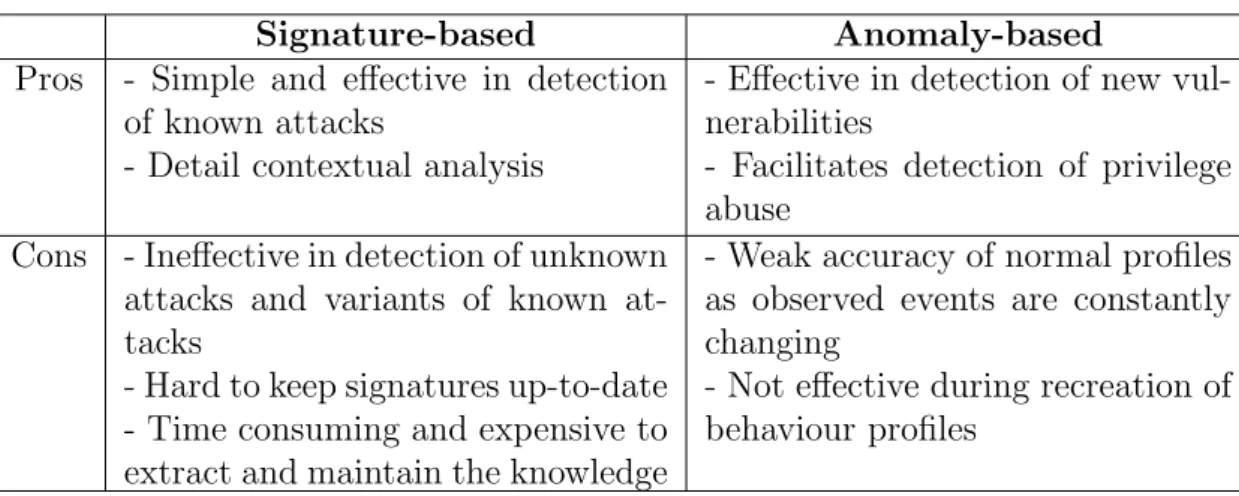
Based on the analysis methods used, there are two broad groups of IDSs: signature based detection and anomaly based detection. Mechanisms that combine anomaly based detection and signature based detection are known as hybrid detection sys-tems, which update an attack signature database using data about discovered attacks through an anomaly detection phase. Anomaly based detection systems explore in-trusions based on deviations from normal behaviours and thus they can detect some new or modified attacks. On the other hand, signature based detection systems can identify an attack if the monitored traffic matches the anomaly patterns (signatures) in their databases. Signature based mechanisms usually work faster and produce less false positives, but they need prior knowledge of intrusions and consequently, in the case of novel attacks, a network system is left vulnerable until the signature database is updated. Table 2.1 shows pros and cons of these detection methodologies (Liao et al., 2013). A hybrid system that can use the advantages of both signature based and anomaly based IDSs provides a more comprehensive protection against a wide range of attacks.
Table 2.1: Pros and cons of signature and anomaly based IDSs.
Signature-based Anomaly-based
Pros - Simple and effective in detection of known attacks
- Detail contextual analysis
- Effective in detection of new vul-nerabilities
- Facilitates detection of privilege abuse
Cons - Ineffective in detection of unknown attacks and variants of known at-tacks
- Hard to keep signatures up-to-date - Time consuming and expensive to extract and maintain the knowledge
- Weak accuracy of normal profiles as observed events are constantly changing
- Not effective during recreation of behaviour profiles
There are different methods and techniques involved in each category including threshold detection, statistical measurement, rule-based methods, and evolutionary computation methods (Haag et al., 2007). For example in a threshold detection approach, the user specifies threshold values for network traffic and any deviation from the values is considered an attack and the system produces an alarm. This approach is a very common technique used in sensor networks. The detection sys-tem recognises an event of interest, when the sensory readings exceed a predefined threshold value (Baqer & Khan, 2007). Similarly, a statistical technique determines a network’s normal traffic distributions and if these distributions change signifi-cantly, the system triggers an alarm. On the other hand, there are sets of predefined rules provided for rule-based systems. A rule-based classifier fires once a match is found between an input record and a rule in the system. Finally, the application of evolutionary computation techniques becomes a key technology in many research efforts in this area, but improvements are likely possible. These techniques with learning and adaptive capabilities have often been used together with rule-based methods to acquire knowledge of normal and abnormal behaviour (Wu & Banzhaf, 2010;Baig et al.,2011). Artificial neural networks (ANNs), fuzzy logic (FL), genetic algorithms (GAs), genetic programming (GP), swarm intelligence (SI) and artificial immune systems (AISs) are examples of computational intelligence approaches, that have been used (Wu & Banzhaf, 2010) for solving intrusion detection problems. Considering the source of data being used for intrusion detection, IDSs are classi-fied into two categories; Host-based IDS (HIDS) and Network-based IDS (NIDS) (Northcutt & Novak, 2002). A HIDS operates on a single host and monitors events occurring within an individual computer system. So, HIDS provide protection for critical computers that may house sensitive information. On the other hand, NIDSs are not restricted to packets going to a specific host since all the machines in the net-work are protected using this NIDS. A NIDS monitors traffic in a netnet-work segment and analyses the traffic in order to identify suspicious activities. In order to com-bine the advantages of both host-based and network-based IDSs and reduce human interaction, correlators are used to prioritize alerts from several different detection
systems. Correlators are able to weigh alerts, cluster related alerts, and assign pri-orities regarding the level of harm to a critical resource. This technique can help analysts by reducing the quantity of information they should analyse to recognise attacks (Haines et al.,2003).
Reaction - Finally, as the Internet is a resource-sharing architecture, a reaction mechanism should be employed when an attack is underway. The first advantage of having a good reaction technique is to save bandwidth that will be wasted by attack traffic and the second advantage is to separate the packets belonging to attack flow and normal flow of traffic. However, it needs to make sure that in the filtration phase, only attack traffic is filtered, and it has no impact on legitimate traffic (Peng et al., 2007). It is possible to combine any detection mechanism with one or more reaction techniques for achieving better results (M¨ols¨a, 2005). There are several reaction mechanisms proposed in the literature such as killing of active network connections, filtering, defining new policies and reconfiguring, and source traceback mechanism. Responses to attacks could either be in an active or passive mode. In an active scheme, the reaction mechanism reacts against attack traffic in real-time while in a passive mode, the attack traffic log will be analysed passively to find the sources of attacks, for example, see Chen et al. (2004).
As the focus of this thesis is on the intrusion detection problem, in the next section, some of the important features that an intrusion detection system should posses will be described.
2.3.1
Selection Criteria for Intrusion Detection Systems
Although there are many different IDSs available to secure networks, attackers on the other hand are evolving and coming up with new attack strategies against network infrastructure. There are several factors that should be considered when choosing a cost-effective defence. Several factors affecting the selection process are presented in Table 2.2 (M¨ols¨a, 2005; Chebrolu et al., 2005).
Table 2.2: Factors affecting the selection process of defence mechanisms
Factor Explanation
Effectiveness How capable is an IDS in detection of attacks? Is there a possibility of false positives?
Adaptability How capable is a defence mechanism in learning changes in the environment over time?
Misusability Can an attacker use a defence mechanism for achieving a DoS condition?
Collateral damage Does a defence mechanism cause any negative side ef-fects? Does it harm the legitimate traffic?
Proactivity Can a defence mechanism prevent attacks?
Completeness What kind of other defence mechanisms are required? Reaction time How fast does a defence mechanism react to attacks? Ease of implementation Is it feasible to implement a defence mechanism? Ease of use Is the interface easy to use? Is it configurable for
differ-ent environmdiffer-ents?
Installation place What is the optimal place to implement a defence mech-anism?
Effectiveness and adaptability are the two key characteristics of intrusion detection systems.
Effectiveness - An effective IDS should be general enough to detect different types of attacks and at the same time it should not misclassify legitimate activity as an attack (Chebrolu et al., 2005). The only way to evaluate the effectiveness of an intrusion detection system is to measure its ability to accurately detect intrusions (detection rate) without raising too many false alarms (false positives/negatives). These two metrics are the most common ones used in IDS evaluation studies (Eskin et al.,2002;Lee & Shields,2002;Lee & Stolfo,1998). The detection rate is generally defined as the percentage of attacks detected by the IDSs and the false positive rate is the percentage of normal traffic that has been mistakenly detected as malicious
traffic by IDSs. There is always a tradeoff between the detection rate and false alarm rate. The analysis of their trade-off can be represented as a receiver operating characteristic (ROC) curve. Some ROC curves of real IDSs can be seen in several research efforts (Durst et al., 1999; Lippmann et al., 2000). A ROC curve clearly presents the relationship between the number of false positives and true positives. An effective IDS can detect a high number of intrusions with an acceptable level of false alarms.
Adaptability - refers to an IDS’ ability in learning changes in the environment over time and adjusting to them (Bai & Kobayashi, 2003). For both signature and anomaly based detection systems, this is a major challenge and a highly de-sired characteristic. In signature based systems, the database of signatures should be regularly updated either manually, which is time-consuming and laborious, or automatically to be able to detect unknown intrusions. Although anomaly based detection systems are able to detect new types of intrusions, they also need to adapt to constantly changing normal behaviour (Wu & Banzhaf, 2010).
One solution to the problem of facing new attacks is considering the use of biologi-cally inspired approaches such as artificial immune systems (AISs). The principles of immunology have been adapted by the evolutionary computation community to de-velop AISs in the hope that these systems will adjust over time (Forrest & Hofmeyr, 1999; Dasgupta & Gonz´alez, 2002). Another research direction is the use of incre-mental learning techniques to provide the ability of repeatedly updating the system when new data becomes available (Nasr et al.,2014). The later is a broader solution as it will adapt the system to both changes in attack and normal behaviour.
In this dissertation, the main advantage of signature based IDSs, which is an effective detector of known attacks, will be used to provide high detection accuracy with few false positives. However, to overcome the problem of developing and maintaining the rules (signatures) for the signature based system, this thesis investigates the existing learning solutions and proposes an evolutionary computation based rule learning technique to automatically create IDS rulesets (signatures).
The following section demonstrates the promising capabilities of machine learning techniques in designing effective and adaptable intrusion detection systems. How-ever, more emphasis will be put on rule learning techniques as the proposed approach belongs to this category of machine learning techniques. Rule learning is a kind of machine learning technique, that uses rules for knowledge representation. The rule learning classification approaches can be broadly divided into two categories: evolutionary rule learners (GA-based) and non-evolutionary (non-GA-based) rule learners. One of the advantages of rule learning techniques is that they are very competitive in terms of interpretability since rules can often be understood easily by human experts (Fern´andez et al., 2010).
2.4
Machine Learning
Machine learning is a field of artificial intelligence (AI), that studies learning tech-niques that improve their behaviour based on past observations (Michalski et al., 2013). The goal of these techniques is to adapt to their environment and learn from their past experience, which has attracted researchers from different fields includ-ing computer science, engineerinclud-ing, mathematics, and cognitive science (Alpaydin, 2004). In general, a learning technique transforms information obtained from the environment into some new form for future use.
The three most common types of machine learning algorithms are supervised learn-ing, unsupervised learning and reinforcement learning. Every record in any dataset prepared for machine learning algorithms is usually represented using a set of fea-tures. The features might be continuous, categorical or binary. If the data is labelled, then the learning technique is referred to as supervised learning. In these techniques, a mapping will be found between the set of input values and their corresponding desired outputs. Support vector machines, neural networks, decision trees and k-nearest neighbour are examples of supervised learning techniques (Kotsiantis,2007). The proposed algorithm in this thesis works in a supervised environment and thus the learning algorithm is provided with the class of the input example. Another
kind of machine learning is unsupervised learning, where records in datasets are un-labelled. Finding regularities in the input data is the aim of unsupervised learning techniques, which will find unknown, but useful classes of items. This is done by finding structure in a collection of unlabelled data points. One common method in this category is clustering, which finds clusters of input data (Alpaydin, 2004). Finally, reinforcement learning will learn behaviour through trial-and-error interac-tions with a dynamic environment. In this approach, the learner is not told which actions to take. It will discover the best ones by trying each action in turn and being positively reinforced for good actions. (Kaelbling et al.,1996;Kotsiantis, 2007). Machine learning techniques can be applied to intrusion detection problems in dif-ferent ways. For example, automatically generating signatures or rules for signature based IDSs, extracting interesting features to improve the performance of IDS or learning the normal behaviour of a protected system for an anomaly based IDS (Shafi, 2008).
In the following sections, a set of selected machine learning techniques from the categories of non-evolutionary and instance-based approaches are explained. These are C4.5 (a decision tree learner), RIPPER (a propositional rule learner) and kNN (instance-based learning scheme). Additionally, a number of evolutionary algorithms are described to provide a sufficient background on the proposed technique in this dissertation.
2.4.1
Non-evolutionary Rule Learning Algorithms
Rule-based methods generally work as follows. A set of rules is manually defined or automatically learned by the system. Each rule uses a set of features and the input data points are also represented by those features. A rule-based classifier fires once a match is found between an input record and a rule in the system. A rule consists of a pattern and an action. When a pattern matches a sequence of values, the corresponding action will be fired (Aggarwal & Zhai, 2012). The goal of rule-based systems is to construct the smallest ruleset that is consistent with the
training data. If the number of rules learned by the system is large, the learning algorithm is only replicating the training data and will not generalise well. This is also called an overfitting problem which is a key problem for all learning algorithms (F¨urnkranz et al., 2012). Prepruning of rules during the learning and post-pruning after an overfitting ruleset has been learned are two standard techniques used to avoid this problem.
One example of a rule learning techniques is a separate-and-conquer or covering al-gorithm, which is presented in Algorithm 1. Basically, it searches for a rule that ex-plains a part of training dataset, separates these instances, and repeatedly conquers the remaining instances by learning more rules until no instance remains (F¨urnkranz, 1999). The final ruleset generated by this algorithm can be ordered in terms of rule accuracy so the most accurate rules are considered first when the system classifies a new instance.
Algorithm 1 A general pseudo-code for rule learners (Kotsiantis, 2007)
Initialize ruleset to a default (usually empty) or a rule assigning all objects to the most common class
Initialize instances to either all available instances in the training data or all instances not correctly handled by rule set
repeat
Find best, the best rule with respect to instances if such a rule can be foundthen
Add best to ruleset
Set instances to all instances not handled correctly by ruleset end if
untilno rule best can be found for instance, because no instances remain
Two dominant schemes for rule learning are RIPPER (for Repeated Incremental Pruning to Produce Error Reduction) (Cohen,1995) and C4.5 (a decision tree learner explained in Section 2.4.1.2) (Quinlan, 1993) algorithms. Both perform an optimi-sation process on the set of initial rules, which is a complex and heuristic process according toFrank & Witten(1998). In an intrusion detection context, a rule-based algorithm can be used to learn rules for the most interesting class, which is usually the attack class.
Figure



Outline
Related documents
1: Effect of competition on the number of leaves (A), dry matter accumulation (B), and dry matter partition (C) of guava plants (Psidium guajava) cultivated single or in
Select the menu command "SQL Server Enterprise Manager > SQL Server Group > Server entry > Management > Backup" to start the backup. For additional
Research tasks: - to find appropriate conservation methods of seed of the wild plants of Kazakhstan; - to test the available techniques in the conditions of the seed bank of
• The sourcing device must see the defined constant load current as the discovery voltage increases from 3 volts to 80% of the maximum output. • At the operating voltage minus 10%
This survey asks for your opinions about resident safety issues in your nursing home.. It will take about 15 minutes
Dickinson (1995) found that individuals with positive perceptions of classroom or school environment enhance their learning and motivation by adapting mastery
AMS standard cotton batts, and routine loose cotton samples, comparative evaluations were performed to establish the relationships between the HVI Rd and +b and
Figure 5.34 Temperature and species mole fraction distributions on two perpendicular vertical center-planes inside gasifier for concentric coal-oxidant injection case using
