A High-Performance Semi-Supervised Learning Method for Text Chunking
Rie Kubota Andoy Tong Zhangz
IBM T.J. Watson Research Center Yorktown Heights, NY 10598, U.S.A.
[email protected] [email protected]
Abstract
In machine learning, whether one can build a more accurate classifier by using unlabeled data (semi-supervised learning) is an important issue. Although a num-ber of semi-supervised methods have been proposed, their effectiveness on NLP tasks is not always clear. This paper presents a novel semi-supervised method that em-ploys a learning paradigm which we call structural learning. The idea is to find “what good classifiers are like” by learn-ing from thousands of automatically gen-erated auxiliary classification problems on unlabeled data. By doing so, the common predictive structure shared by the multiple classification problems can be discovered, which can then be used to improve perfor-mance on the target problem. The method produces performance higher than the pre-vious best results on CoNLL’00 syntac-tic chunking and CoNLL’03 named entity chunking (English and German).
1 Introduction
In supervised learning applications, one can often find a large amount of unlabeled data without diffi-culty, while labeled data are costly to obtain. There-fore, a natural question is whether we can use unla-beled data to build a more accurate classifier, given the same amount of labeled data. This problem is often referred to as semi-supervised learning.
Although a number of semi-supervised methods have been proposed, their effectiveness on NLP tasks is not always clear. For example, co-training
(Blum and Mitchell, 1998) automatically bootstraps labels, and such labels are not necessarily reliable
(Pierce and Cardie, 2001). A related idea is to
use Expectation Maximization (EM) to impute la-bels. Although useful under some circumstances, when a relatively large amount of labeled data is available, the procedure often degrades performance (e.g. Merialdo (1994)). A number of bootstrap-ping methods have been proposed for NLP tasks (e.g. Yarowsky (1995), Collins and Singer (1999), Riloff and Jones (1999)). But these typically assume a very small amount of labeled data and have not been shown to improve state-of-the-art performance when a large amount of labeled data is available.
Our goal has been to develop a general learning framework for reliably using unlabeled data to im-prove performance irrespective of the amount of la-beled data available. It is exactly this important and difficult problem that we tackle here.
This paper presents a novel semi-supervised method that employs a learning framework called structural learning (Ando and Zhang, 2004), which seeks to discover shared predictive structures (i.e. what good classifiers for the task are like) through jointly learning multiple classification problems on unlabeled data. That is, we systematically create thousands of problems (called auxiliary problems) relevant to the target task using unlabeled data, and train classifiers from the automatically generated ‘training data’. We learn the commonality (or struc-ture) of such many classifiers relevant to the task, and use it to improve performance on the target task. One example of such auxiliary problems for chunk-ing tasks is to ‘mask’ a word and predict whether it is “people” or not from the context, like language modeling. Another example is to predict the
diction of some classifier trained for the target task. These auxiliary classifiers can be adequately learned since we have very large amounts of ‘training data’ for them, which we automatically generate from a very large amount of unlabeled data.
The contributions of this paper are two-fold. First, we present a novel robust semi-supervised method based on a new learning model and its application to chunking tasks. Second, we report higher per-formance than the previous best results on syntactic chunking (the CoNLL’00 corpus) and named entity chunking (the CoNLL’03 English and German cor-pora). In particular, our results are obtained by us-ing unlabeled data as the only additional resource while many of the top systems rely on hand-crafted resources such as large name gazetteers or even rule-based post-processing.
2 A Model for Learning Structures
This work uses a linear formulation of structural learning. We first briefly review a standard linear prediction model and then extend it for structural learning. We sketch an optimization algorithm us-ing SVD and compare it to related methods.
2.1 Standard linear prediction model
In the standard formulation of supervised learning, we seek a predictor that maps an input vectorx2X
to the corresponding outputy 2 Y. Linear
predic-tion models are based on real-valued predictors of
the form f(x) =w
T
x, wherewis called a weight
vector. For binary problems, the sign of the linear prediction gives the class label. For k-way
classi-fication (with k > 2), a typical method is winner
takes all, where we train one predictor per class and choose the class with the highest output value.
A frequently used method for finding an accurate
predictor ^
f is regularized empirical risk
minimiza-tion (ERM), which minimizes an empirical loss of the predictor (with regularization) on thentraining
examplesf(X
i ;Y
i )g:
^
f =argmin
f n
X
i=1
L(f(X
i );Y
i
)+r(f) !
:
L() is a loss function to quantify the difference
between the prediction f(X
i
) and the true output
Y
i, and
r() is a regularization term to control the
model complexity. ERM-based methods for
dis-criminative learning are known to be effective for NLP tasks such as chunking (e.g. Kudoh and Mat-sumoto (2001), Zhang and Johnson (2003)).
2.2 Linear model for structural learning
We present a linear prediction model for structural learning, which extends the traditional model to
multiple problems. Specifically, we assume that
there exists a low-dimensional predictive structure shared by multiple prediction problems. We seek to discover this structure through joint empirical risk minimization over the multiple problems.
Considermproblems indexed by`2f1;:::;mg,
each with n
` samples
(X `
i ;Y
`
i
) indexed by i 2
f1;:::;n
`
g. In our joint linear model, a predictor
for problem`takes the following form
f
`
(;x)=w T
` x+v
T
`
x;
T
=I; (1)
where we useIto denote the identity matrix.
Ma-trix(whose rows are orthonormal) is the common
structure parameter shared by all the problems; w `
and v
` are weight vectors specific to each
predic-tion problem `. The idea of this model is to
dis-cover a common low-dimensional predictive
struc-ture (shared by the m problems) parameterized by
the projection matrix. In this setting, the goal of
structural learning may also be regarded as learning a good feature map x— a low-dimensional
fea-ture vector parameterized by.
In joint ERM, we seek(and weight vectors) that
minimizes the empirical risk summed over all the problems:
[ ^
;f ^
f`g℄=argmin
;ff
` g
m
X
`=1 n
`
X
i=1
L(f`(;X `
i );Y
`
i )
n`
+r(f`) !
:
(2) It can be shown that using joint ERM, we can reli-ably estimate the optimal joint parameteras long
asm is large (even when eachn
` is small). This is
the key reason why structural learning is effective. A formal PAC-style analysis can be found in (Ando and Zhang, 2004).
2.3 Alternating structure optimization (ASO)
r(f
`
) =kw
` k
2
2, where the regularization
parame-teris given. For clarity, letu
` be a weight vector
for problem `such that: u ` = w ` + T v ` :Then,
(2) becomes the minimization of the joint empirical risk written as:
m X `=1 n ` X i=1 L(u T ` X ` i ;Y ` i ) n ` +ku ` T v ` k 2 2 ! : (3)
This minimization can be approximately solved by the following alternating optimization procedure:
Fix(;fv `
g), and findmpredictorsfu `
gthat
minimizes the joint empirical risk (3).
Fixmpredictorsfu
`
g, and find(;fv `
g)that
minimizes the joint empirical risk (3).
Iterate until a convergence criterion is met.
In the first step, we trainmpredictors independently.
It is the second step that couples all the problems. Its solution is given by the SVD (singular value decom-position) of the predictor matrixU=[u
1 ;:::;u
m ℄:
the rows of the optimumare given by the most
sig-nificant left singular vectors1 ofU. Intuitively, the
optimum captures the maximal commonality of
them predictors (each derived fromu
`). These m
predictors are updated using the new structure ma-trixin the next iteration, and the process repeats.
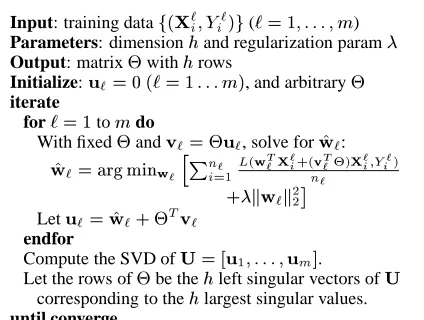
Figure 1 summarizes the algorithm sketched above, which we call the alternating structure op-timization (ASO) algorithm. The formal derivation can be found in (Ando and Zhang, 2004).
2.4 Comparison with existing techniques
It is important to note that this SVD-based ASO (SVD-ASO) procedure is fundamentally different from the usual principle component analysis (PCA), which can be regarded as dimension reduction in the data spaceX. By contrast, the dimension reduction
performed in the SVD-ASO algorithm is on the pre-dictor space (a set of prepre-dictors). This is possible because we observe multiple predictors from multi-ple learning tasks. If we regard the observed predic-tors as sample points of the predictor distribution in
1In other words,
is computed so that the best low-rank
approximation ofU in the least square sense is obtained by
projectingUonto the row space of; see e.g. Golub and Loan
(1996) for SVD.
Input: training dataf(X `
i ;Y
`
i
)g(`=1;:::;m)
Parameters: dimensionhand regularization param
Output: matrixwithhrows
Initialize:u`=0(`=1:::m), and arbitrary
iterate
for`=1tomdo
With fixedandv`=u`, solve for ^
w`: ^
w
`
=argmin
w ` h P n ` i=1 L(w T ` X ` i +(v T ` )X ` i ;Y ` i ) n ` +kw`k 2 2 Letu `
=w^
` + T v ` endfor
Compute the SVD ofU=[u1;:::;um℄.
Let the rows ofbe thehleft singular vectors ofU
corresponding to thehlargest singular values.
[image:3.612.322.534.58.218.2]until converge
Figure 1: SVD-based Alternating Structure Optimization (SVD-ASO) Algorithm
the predictor space (corrupted with estimation error, or noise), then SVD-ASO can be interpreted as find-ing the “principle components” (or commonality) of these predictors (i.e., “what good predictors are like”). Consequently the method directly looks for low-dimensional structures with the highest predic-tive power. By contrast, the principle components of input data in the data space (which PCA seeks) may not necessarily have the highest predictive power.
The above argument also applies to the fea-ture generation from unlabeled data using LSI (e.g. Ando (2004)). Similarly, Miller et al. (2004) used word-cluster memberships induced from an unanno-tated corpus as features for named entity chunking. Our work is related but more general, because we can explore additional information from unlabeled data using many different auxiliary problems. Since Miller et al. (2004)’s experiments used a proprietary corpus, direct performance comparison is not pos-sible. However, our preliminary implementation of the word clustering approach did not provide any improvement on our tasks. As we will see, our start-ing performance is already high. Therefore the addi-tional information discovered by SVD-ASO appears crucial to achieve appreciable improvements.
3 Semi-supervised Learning Method
shared structure (useful for the task) using the
ASO algorithm. In particular, we want to create aux-iliary problems with the following properties:
Automatic labeling: we need to automatically
generate various “labeled” data for the auxil-iary problems from unlabeled data.
Relevancy: auxiliary problems should be
re-lated to the target problem. That is, they should share a certain predictive structure.
The final classifier for the target task is in the form of (1), a linear predictor for structural learning. We
fix (learned from unlabeled data through
auxil-iary problems) and optimize weight vectorswandv
on the given labeled data. We summarize this semi-supervised learning procedure below.
1. Create training data e Z
` =f(
e
X
j ;
e
Y `
j
)gfor each
auxiliary problem`from unlabeled dataf e
X
j g.
2. Computefromf
e
Z
`
gthrough SVD-ASO.
3. Minimize the empirical risk on the labeled data:
^
f = argmin
f P
n
i=1
L(f(;X
i );Y
i )
n
+kw k 2
2
,
wheref(;x)=w
T
x+v T
xas in (1).
3.1 Auxiliary problem creation
The idea is to discover useful features (which do not necessarily appear in the labeled data) from the unlabeled data through learning auxiliary problems. Clearly, auxiliary problems more closely related to the target problem will be more beneficial. However, even if some problems are less relevant, they will not degrade performance severely since they merely re-sult in some irrelevant features (originated from
ir-relevant -components), which ERM learners can
cope with. On the other hand, potential gains from relevant auxiliary problems can be significant. In this sense, our method is robust.
We present two general strategies for generat-ing useful auxiliary problems: one in a completely unsupervised fashion, and the other in a partially-supervised fashion.
3.1.1 Unsupervised strategy
In the first strategy, we regard some observable substructures of the input data X as auxiliary class
labels, and try to predict these labels using other parts of the input data.
Ex 3.1 Predict words. Create auxiliary problems by regarding the word at each position as an auxil-iary label, which we want to predict from the context. For instance, predict whether a word is “Smith” or not from its context. This problem is relevant to, for instance, named entity chunking since knowing a word is “Smith” helps to predict whether it is part of a name. One binary classification problem can be created for each possible word value (e.g., “IBM”, “he”, “get”,). Hence, many auxiliary problems
can be obtained using this idea.
More generally, given a feature representation of the input data, we may mask some features as unobserved, and learn classifiers to predict these ‘masked’ features based on other features that are not masked. The automatic-labeling requirement is satisfied since the auxiliary labels are observable to us. To create relevant problems, we should choose to (mask and) predict features that have good cor-relation to the target classes, such as words on text tagging/chunking tasks.
3.1.2 Partially-supervised strategy
The second strategy is motivated by co-training.
We use two (or more) distinct feature maps:
1
and
2. First, we train a classifier F
1 for the
tar-get task, using the feature map
1 and the labeled
data. The auxiliary tasks are to predict the behavior of this classifierF
1(such as predicted labels) on the
unlabeled data, by using the other feature map
2.
Note that unlike co-training, we only use the classi-fier as a means of creating auxiliary problems that meet the relevancy requirement, instead of using it to bootstrap labels.
Ex 3.2 Predict the top-k choices of the classifier.
Predict the combination ofk(a few) classes to which
F
1 assigns the highest output (confidence) values.
For instance, predict whetherF
1assigns the highest
confidence values toCLASS1 andCLASS2 in this or-der. By settingk =1, the auxiliary task is simply to
predict the label prediction of classifierF
1. By
set-tingk > 1, fine-grained distinctions (related to
in-trinsic sub-classes of target classes) can be learned. From a-way classification problem,!=( k)!
4 Algorithms Used in Experiments
Using auxiliary problems introduced above, we study the performance of our semi-supervised learn-ing method on named entity chunklearn-ing and syntac-tic chunking. This section describes the algorithmic aspects of the experimental framework. The task-specific setup is described in Sections 5 and 6.
4.1 Extension of the basic SVD-ASO algorithm
In our experiments, we use an extension of SVD-ASO. In NLP applications, features have natural grouping according to their types/origins such as ‘current words’, ‘parts-of-speech on the right’, and so forth. It is desirable to perform a localized op-timization for each of such natural feature groups. Hence, we associate each feature group with a sub-matrix of structure sub-matrix. The optimization
al-gorithm for this extension is essentially the same as SVD-ASO in Figure 1, but with the SVD step per-formed separately for each group. See (Ando and Zhang, 2004) for the precise formulation. In
ad-dition, we regularize only those components of w
`
which correspond to the non-negative part of u
`.
The motivation is that positive weights are usually directly related to the target concept, while negative ones often yield much less specific information rep-resenting ‘the others’. The resulting extension, in
effect, only uses the positive components of U in
the SVD computation.
4.2 Chunking algorithm, loss function, training algorithm, and parameter settings
As is commonly done, we encode chunk informa-tion into word tags to cast the chunking problem to that of sequential word tagging. We perform Viterbi-style decoding to choose the word tag sequence that maximizes the sum of tagging confidence values.
In all settings (including baseline methods), the loss function is a modification of the Huber’s
ro-bust loss for regression: L(p;y) = max(0;1
py) 2
ifpy 1; and 4py otherwise; with square
regularization ( = 10
4
). One may select other loss functions such as SVM or logistic regression. The specific choice is not important for the purpose of this paper. The training algorithm is stochastic gradient descent, which is argued to perform well for regularized convex ERM learning formulations
(Zhang, 2004).
As we will show in Section 7.3, our formulation is relatively insensitive to the change in h
(row-dimension of the structure matrix). We fix h (for
each feature group) to 50, and use it in all settings. The most time-consuming process is the train-ing ofm auxiliary predictors on the unlabeled data
(computing U in Figure 1). Fixing the number of
iterations to a constant, it runs in linear to m and
the number of unlabeled instances and takes hours in our settings that use more than 20 million unla-beled instances.
4.3 Baseline algorithms
Supervised classifier For comparison, we train a classifier using the same features and algorithm, but without unlabeled data (=0in effect).
Co-training We test co-training since our idea of partially-supervised auxiliary problems is motivated
by co-training. Our implementation follows the
original work (Blum and Mitchell, 1998). The two (or more) classifiers (with distinct feature maps) are trained with labeled data. We maintain a pool ofq
unlabeled instances by random selection. The clas-sifier proposes labels for the instances in this pool. We choosesinstances for each classifier with high
confidence while preserving the class distribution observed in the initial labeled data, and add them to the labeled data. The process is then repeated.
We explore q=50K, 100K, s=50,100,500,1K, and
commonly-used feature splits: ‘current vs. context’ and ‘current+left-context vs. current+right-context’.
Self-training Single-view bootstrapping is some-times called training. We test the basic self-training2, which replaces multiple classifiers in the co-training procedure with a single classifier that employs all the features.
co/self-training oracle performance To avoid the issue of parameter selection for the co- and self-training, we report their best possible oracle perfor-mance, which is the best F-measure number among all the co- and self-training parameter settings in-cluding the choice of the number of iterations.
2We also tested “self-training with bagging”, which Ng and
words, parts-of-speech (POS), character types,
4 characters at the beginning/ending in a 5-word window.
words in a 3-syntactic chunk window. labels assigned to two words on the left.
bi-grams of the current word and the label on the left. labels assigned to previous occurrences of the current
[image:6.612.313.540.54.147.2]word.
Figure 2: Feature types for named entity chunking. POS and syntactic chunk information is provided by the organizer.
5 Named Entity Chunking Experiments
We report named entity chunking performance on
the CoNLL’03 shared-task3 corpora (English and
German). We choose this task because the original intention of this shared task was to test the effec-tiveness of semi-supervised learning methods. How-ever, it turned out that none of the top performing systems used unlabeled data. The likely reason is that the number of labeled data is relatively large (>200K), making it hard to benefit from unlabeled
data. We show that our ASO-based semi-supervised learning method (hereafter, ASO-semi) can produce results appreciably better than all of the top systems, by using unlabeled data as the only additional re-source. In particular, we do not use any gazetteer information, which was used in all other systems.
The CoNLL corpora are annotated with four types of named entities: persons, organizations, locations, and miscellaneous names (e.g., “World Cup”). We use the official training/development/test splits. Our unlabeled data sets consist of 27 million words (En-glish) and 35 million words (German), respectively. They were chosen from the same sources – Reuters and ECI Multilingual Text Corpus – as the provided corpora but disjoint from them.
5.1 Features
Our feature representation is a slight modification of a simpler configuration (without any gazetteer) in (Zhang and Johnson, 2003), as shown in Figure 2. We use POS and syntactic chunk information pro-vided by the organizer.
5.2 Auxiliary problems
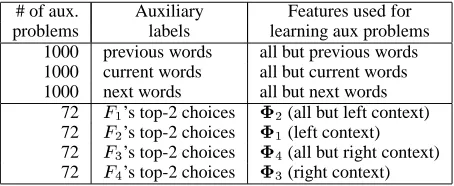
As shown in Figure 3, we experiment with auxiliary problems from Ex 3.1 and 3.2: “Predict current (or previous or next) words”; and “Predict top-2 choices
3http://cnts.uia.ac.be/conll2003/ner
# of aux. Auxiliary Features used for problems labels learning aux problems
1000 previous words all but previous words 1000 current words all but current words 1000 next words all but next words
72 F
1’s top-2 choices
2(all but left context)
72 F
2’s top-2 choices
1(left context)
72 F
3’s top-2 choices
4(all but right context)
72 F
4’s top-2 choices
3(right context)
Figure 3: Auxiliary problems used for named entity chunk-ing. 3000 problems ‘mask’ words and predict them from the other features on unlabeled data. 288 problems predict classi-fierF
i’s predictions on unlabeled data, where F
iis trained with
labeled data using feature map
i. There are 72 possible top-2
choices from 9 classes (beginning/inside of four types of name chunks and ‘outside’).
of the classifier” using feature splits ‘left context vs. the others’ and ‘right context vs. the others’. For word-prediction problems, we only consider the in-stances whose current words are either nouns or ad-jectives since named entities mostly consist of these types. Also, we leave out all but at most 1000 bi-nary prediction problems of each type that have the largest numbers of positive examples to ensure that auxiliary predictors can be adequately learned with a sufficiently large number of examples. The results we report are obtained by using all the problems in Figure 3 unless otherwise specified.
5.3 Named entity chunking results
methods test diff. from supervised
data F prec. recall F
English, small (10K examples) training set
ASO-semi dev. 81.25 +10.02 +7.00 +8.51
co/self oracle 73.10 +0.32 +0.39 +0.36
ASO-semi test 78.42 +9.39 +10.73 +10.10
co/self oracle 69.63 +0.60 +1.95 +1.31
English, all (204K) training examples
ASO-semi dev. 93.15 +2.25 +3.00 +2.62
co/self oracle 90.64 +0.04 +0.20 +0.11
ASO-semi test 89.31 +3.20 +4.51 +3.86
co/self oracle 85.40 0.04 0.05 0.05
German, all (207K) training examples
ASO-semi dev. 74.06 +7.04 +10.19 +9.22
co/self oracle 66.47 2.59 +4.39 +1.63
ASO-semi test 75.27 +4.64 +6.59 +5.88
co/self oracle 70.45 1.26 +2.59 +1.06
Figure 4: Named entity chunking results. No gazetteer. F-measure and performance improvements over the supervised baseline in precision, recall, and F. For co- and self-training (baseline), the oracle performance is shown.
with one of three sets of labeled training examples: a small English set (10K examples randomly chosen), the entire English training set (204K), and the entire German set (207K), tested on either the development set or test set. ASO-semi significantly improves both precision and recall in all the six configurations, re-sulting in improved F-measures over the supervised baseline by +2.62% to +10.10%.
Co- and self-training, at their oracle performance, improve recall but often degrade precision; con-sequently, their F-measure improvements are
rela-tively low: 0.05% to +1.63%.
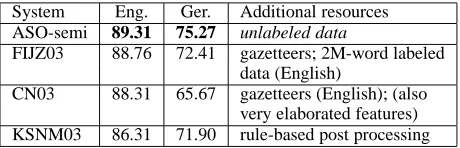
Comparison with top systems As shown in Fig-ure 5, ASO-semi achieves higher performance than the top systems on both English and German data. Most of the top systems boost performance by external hand-crafted resources such as: large gazetteers4; a large amount (2 million words) of labeled data manually annotated with finer-grained named entities (FIJZ03); and rule-based post pro-cessing (KSNM03). Hence, we feel that our results, obtained by using unlabeled data as the only addi-tional resource, are encouraging.
System Eng. Ger. Additional resources ASO-semi 89.31 75.27 unlabeled data
FIJZ03 88.76 72.41 gazetteers; 2M-word labeled data (English)
[image:7.612.333.522.151.193.2]CN03 88.31 65.67 gazetteers (English); (also very elaborated features) KSNM03 86.31 71.90 rule-based post processing
Figure 5: Named entity chunking. F-measure on the test sets. Previous best results: FIJZ03 (Florian et al., 2003), CN03 (Chieu and Ng, 2003), KSNM03 (Klein et al., 2003).
6 Syntactic Chunking Experiments
Next, we report syntactic chunking performance on
the CoNLL’00 shared-task5 corpus. The training
and test data sets consist of the Wall Street Journal corpus (WSJ) sections 15–18 (212K words) and sec-tion 20, respectively. They are annotated with eleven types of syntactic chunks such as noun phrases. We
4Whether or not gazetteers are useful depends on their
cov-erage. A number of top-performing systems used their own gazetteers in addition to the organizer’s gazetteers and reported significant performance improvements (e.g., FIJZ03, CN03, and ZJ03).
5http://cnts.uia.ac.be/conll2000/chunking
uni- and bi-grams of words and POS in a 5-token window. word-POS bi-grams in a 3-token window.
POS tri-grams on the left and right.
labels of the two words on the left and their bi-grams. bi-grams of the current word and two labels on the left.
Figure 6:Feature types for syntactic chunking. POS informa-tion is provided by the organizer.
prec. recall F
=1
supervised 93.83 93.37 93.60 ASO-semi 94.57 94.20 94.39 (+0.79)
co/self oracle 93.76 93.56 93.66 (+0.06)
Figure 7:Syntactic chunking results.
use the WSJ articles in 1991 (15 million words) from the TREC corpus as the unlabeled data.
6.1 Features and auxiliary problems
Our feature representation is a slight modification of a simpler configuration (without linguistic features) in (Zhang et al., 2002), as shown in Figure 6. We use the POS information provided by the organizer. The types of auxiliary problems are the same as in the named entity experiments. For word predictions, we exclude instances of punctuation symbols.
6.2 Syntactic chunking results
As shown in Figure 7, ASO-semi improves both pre-cision and recall over the supervised baseline. It
achieves 94:39%in F-measure, which outperforms
the supervised baseline by 0:79%. Co- and
self-training again slightly improve recall but slightly de-grade precision at their oracle performance, which demonstrates that it is not easy to benefit from unla-beled data on this task.
[image:7.612.72.302.388.462.2]all NP description ASO-semi 94.39 94.70 +unlabeled data
[image:8.612.318.535.53.197.2]KM01 93.91 94.39 SVM combination CM03 93.74 94.41 perceptron in two layers SP03 – 94.38 conditional random fields ZDJ02 93.57 93.89 generalized Winnow ZDJ02+ 94.17 94.38 +full parser output
Figure 8: Syntactic chunking F-measure. Comparison with previous best results: KM01 (Kudoh and Matsumoto, 2001), CM03 (Carreras and Marquez, 2003), SP03 (Sha and Pereira, 2003), ZDJ02 (Zhang et al., 2002).
(noun phrases) only. ASO-semi produces higher NP chunking performance than the others.
7 Empirical Analysis
7.1 Effectiveness of auxiliary problems
English named entity German named entity
68 70 72 74 76
1
F
-m
ea
su
re
(
%
)
85 86 87 88 89 90
dev set
F
-m
ea
su
re
(
%
)
supervised
w/ "Predict (previous, current, or next) words" w/ "Predict top-2 choices"
[image:8.612.73.296.62.139.2]w/ "Predict words" + "Predict top-2 choices"
[image:8.612.98.274.301.412.2]Figure 9:Named entity F-measure produced by using individ-ual types of auxiliary problems. Trained with the entire training sets and tested on the test sets.
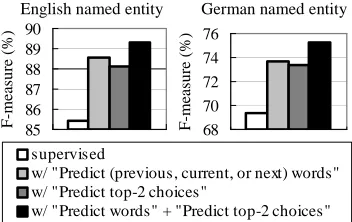
Figure 9 shows F-measure obtained by
comput-ing from individual types of auxiliary problems
on named entity chunking. Both types – “Predict words” and “Predict top-2 choices of the classifier” – are useful, producing significant performance im-provements over the supervised baseline. The best
performance is achieved when is produced from
all of the auxiliary problems.
7.2 Interpretation of
To gain insights into the information obtained from unlabeled data, we examine theentries associated
with the feature ‘current words’, computed for the English named entity task. Figure 10 shows the fea-tures associated with the entries ofwith the largest
values, computed from the 2000 unsupervised aux-iliary problems: “Predict previous words” and “Pre-dict next words”. For clarity, the figure only shows
row# Features corresponding to Interpretation significantentries
4 Ltd, Inc, Plc, International, organizations Ltd., Association, Group, Inc.
7 Co, Corp, Co., Company, organizations Authority, Corp., Services
9 PCT, N/A, Nil, Dec, BLN, no names Avg, Year-on-year, UNCH
11 New, France, European, San, locations North, Japan, Asian, India
15 Peter, Sir, Charles, Jose, Paul, persons Lee, Alan, Dan, John, James
26 June, May, July, Jan, March, months August, September, April
Figure 10: Interpretation of computed from
word-prediction (unsupervised) problems for named entity chunking.
words beginning with upper-case letters (i.e., likely to be names in English). Our method captures the spirit of predictive word-clustering but is more gen-eral and effective on our tasks.
It is possible to develop a general theory to show that the auxiliary problems we use are helpful under reasonable conditions. The intuition is as follows. Suppose we split the features into two parts
1and
2 and predict
1 based on
2. Suppose features
in
1are correlated to the class labels (but not
nec-essarily correlated among themselves). Then, the auxiliary prediction problems are related to the tar-get task, and thus can reveal useful structures of
2.
Under some conditions, it can be shown that features
in
2 with similar predictive performance tend to
map to similar low-dimensional vectors through.
This effect can be empirically observed in Figure 10 and will be formally shown elsewhere.
7.3 Effect of thedimension
85 87 89
20 40 60 80 100
dimension
F
-m
ea
su
re
(
%
)
ASO-semi supervised
Figure 11:F-measure in relation to the row-dimension of.
English named entity chunking, test set.
Recall that throughout the experiments, we fix the
row-dimension of(for each feature group) to 50.
Figure 11 plots F-measure in relation to the row-dimension of, which shows that the method is
[image:8.612.340.511.534.583.2]8 Conclusion
We presented a novel semi-supervised learn-ing method that learns the most predictive low-dimensional feature projection from unlabeled data using the structural learning algorithm SVD-ASO. On CoNLL’00 syntactic chunking and CoNLL’03 named entity chunking (English and German), the method exceeds the previous best systems (includ-ing those which rely on hand-crafted resources) by using unlabeled data as the only additional resource. The key idea is to create auxiliary problems au-tomatically from unlabeled data so that predictive structures can be learned from that data. In practice, it is desirable to create as many auxiliary problems as possible, as long as there is some reason to be-lieve in their relevancy to the task. This is because the risk is relatively minor while the potential gain from relevant problems is large. Moreover, the aux-iliary problems used in our experiments are merely possible examples. One advantage of our approach is that one may design a variety of auxiliary prob-lems to learn various aspects of the target problem from unlabeled data. Structural learning provides a framework for carrying out possible new ideas.
Acknowledgments
Part of the work was supported by ARDA under the NIMD program PNWD-SW-6059.
References
Rie Kubota Ando and Tong Zhang. 2004. A framework for learning predictive structures from multiple tasks and unlabeled data. Technical report, IBM. RC23462.
Rie Kubota Ando. 2004. Semantic lexicon construction: Learning from unlabeled data via spectral analysis. In
Proceedings of CoNLL-2004.
Avrim Blum and Tom Mitchell. 1998. Combining la-beled and unlala-beled data with co-training. In
proceed-ings of COLT-98.
Xavier Carreras and Lluis Marquez. 2003. Phrase recog-nition by filtering and ranking with perceptrons. In
Proceedings of RANLP-2003.
Hai Leong Chieu and Hwee Tou Ng. 2003. Named en-tity recognition with a maximum entropy approach. In
Proceedings CoNLL-2003, pages 160–163.
Michael Collins and Yoram Singer. 1999. Unsupervised models for named entity classification. In Proceedings
of EMNLP/VLC’99.
Radu Florian, Abe Ittycheriah, Hongyan Jing, and Tong
Zhang. 2003. Named entity recognition through
classifier combination. In Proceedings CoNLL-2003, pages 168–171.
Gene H. Golub and Charles F. Van Loan. 1996. Matrix computations third edition.
Dan Klein, Joseph Smarr, Huy Nguyen, and Christo-pher D. Manning. 2003. Named entity recognition with character-level models. In Proceedings
CoNLL-2003, pages 188–191.
Taku Kudoh and Yuji Matsumoto. 2001. Chunking with support vector machines. In Proceedings of NAACL
2001.
Bernard Merialdo. 1994. Tagging English text with
a probabilistic model. Computational Linguistics,
20(2):155–171.
Scott Miller, Jethran Guinness, and Alex Zamanian. 2004. Name tagging with word clusters and discrimi-native training. In Proceedings of HLT-NAACL-2004.
Vincent Ng and Claire Cardie. 2003. Weakly supervised natural language learning without redundant views. In
Proceedings of HLT-NAACL-2003.
David Pierce and Claire Cardie. 2001. Limitations of co-training for natural language learning from large datasets. In Proceedings of EMNLP-2001.
Ellen Riloff and Rosie Jones. 1999. Learning dictionar-ies for information extraction by multi-level bootstrap-ping. In Proceedings of AAAI-99.
Fei Sha and Fernando Pereira. 2003. Shallow
pars-ing with conditional random fields. In Proceedpars-ings of
HLT-NAACL’03.
David Yarowsky. 1995. Unsupervised word sense dis-ambiguation rivaling supervised methods. In
Proceed-ings of ACL-95.
Tong Zhang and David E. Johnson. 2003. A robust risk minimization based named entity recognition system. In Proceedings CoNLL-2003, pages 204–207.
Tong Zhang, Fred Damerau, and David E. Johnson. 2002. Text chunking based on a generalization of Win-now. Journal of Machine Learning Research, 2:615– 637.