University of South Carolina
Scholar Commons
Theses and Dissertations
1-1-2013
Deconstructing Books, Reconstructing Women
Summers Esther Morris University of South Carolina
Follow this and additional works at:https://scholarcommons.sc.edu/etd Part of theArt Practice Commons
This Open Access Thesis is brought to you by Scholar Commons. It has been accepted for inclusion in Theses and Dissertations by an authorized administrator of Scholar Commons. For more information, please [email protected].
Recommended Citation
DECONSTRUCTING BOOKS, RECONSTRUCTING WOMEN
by
Summers Morris
Bachelor of Fine Arts University of South Carolina, 2007
___________________________________________________________
Submitted in Partial Fulfillment of the Requirements
For the Degree of Master of Arts in
Art Studio
College of Arts and Sciences
University of South Carolina
2013
Accepted by:
Sara Schneckloth, Director of Thesis
Marius Valdes, Reader
Bradford Collins, Reader
ii
ABSTRACT
The goal of my thesis project is to examine the notion of choice encountered by
females with respect to gender roles. I intend to underscore the turmoil which often
comes from choices that leave many classic feminine roles left unattended by either sex. I
have created three altered books that address these struggles, as I have personally
experienced these, regarding marriage, motherhood, and domesticity. Each book analyzes
the conflicting nature of choice and, according to my own decisions as a modern feminist,
concludes accordingly. This in-depth look at the struggle for women to not only choose
gender roles to adopt, but to live with the consequences that lie in their wake, is best
communicated through the use of altered books. The altered books themselves function
conceptually as a metaphor, contain formal elements that enhance various concepts
within each book, and allow for appropriation which lends itself to humor which defines
my voice as the artist and narrator. Beyond the laughter, my hope is that those who
empathize with the desperation felt by the female characters in my books may also
understand the actual seriousness of the messages, acknowledging the humor and
hardships that accompany my characters as they work to find their way through each one
iii
TABLE OF CONTENTS
ABSTRACT………... ii
LIST OF FIGURES………...………….iv
CHAPTER 1-INTRODUCTION...……….…1
CHAPTER 2-PROJECT DESCRIPTION………..7
CHAPTER 3-JUSTIFICATION...…….………....11
CHAPTER 4-RESEARCH………...……….…20
CHAPTER 5-PROCESS..……...………...25
CHAPTER 6-CONCLUSION….………..27
WORKS CITED.………...31
APPENDIX A- ZOMBIE MOMMY………...………33
APPENDIX B- MECHANICAL MATRIMONY………....59
APPENDIX C- THE ESCAPE………...82
iv
LIST OF FIGURES
Figure A.1 Zombie Mommy Front Cover………...33
Figure A.2 Zombie Mommy Back Cover………...34
Figure A.3 Zombie Mommy Unaltered First Page……….35
Figure A.4 Zombie Mommy Unaltered Second Page……….36
Figure A.5 Zombie Mommy Beginning of Altered Pages………..……37
Figure A.6 Zombie Mommy………..….38
Figure A.7 Zombie Mommy………..…….39
Figure A.8 Zombie Mommy………..….40
Figure A.9 Zombie Mommy………...41
Figure A.10 Zombie Mommy……….42
Figure A.11 Zombie Mommy……….43
Figure A.12 Zombie Mommy……….44
Figure A.13 Zombie Mommy……….45
Figure A.14 Zombie Mommy……….46
Figure A.15 Zombie Mommy……….47
Figure A.16 Zombie Mommy……….48
Figure A.17 Zombie Mommy……….49
Figure A.18 Zombie Mommy……….50
Figure A.19 Zombie Mommy……….51
v
Figure A.21 Zombie Mommy……….53
Figure A.22 Zombie Mommy……….54
Figure A.23 Zombie Mommy……….55
Figure A.24 Zombie Mommy……….56
Figure A.25 Zombie Mommy……….57
Figure A.26 Zombie Mommy Unaltered Final Page……….….58
Figure B.1 Mechanical Matrimony Front Cover………...59
Figure B.2 Mechanical Matrimony Detail of Coptic stitch………...60
Figure B.3 Mechanical Matrimony ………..61
Figure B.4 Mechanical Matrimony Detail……….61
Figure B.5 Mechanical Matrimony ………...62
Figure B.6 Mechanical Matrimony Detail……….62
Figure B.7 Mechanical Matrimony ………...63
Figure B.8 Mechanical Matrimony Detail……….63
Figure B.9 Mechanical Matrimony ………...64
Figure B.10 Mechanical Matrimony Detail………..…….64
Figure B.11 Mechanical Matrimony ……….65
Figure B.12 Mechanical Matrimony Detail………..…….65
Figure B.13 Mechanical Matrimony Detail………..….65
Figure B.14 Mechanical Matrimony ……….66
Figure B.15 Mechanical Matrimony Detail………..……….66
Figure B.16 Mechanical Matrimony Detail………..…….66
vi
Figure B.18 Mechanical Matrimony Waterfall Card Details (1)………..…….68
Figure B.19 Mechanical Matrimony Waterfall Card Details (2)………..….69
Figure B.20 Mechanical Matrimony ……….70
Figure B.21 Mechanical Matrimony ……….70
Figure B.22 Mechanical Matrimony Detail………..……….71
Figure B.23 Mechanical Matrimony Detail………..………….71
Figure B.24 Mechanical Matrimony ……….72
Figure B.25 Mechanical Matrimony Detail………..……….72
Figure B.26 Mechanical Matrimony ……….73
Figure B.27 Mechanical Matrimony ……….74
Figure B.28 Mechanical Matrimony ……….74
Figure B.29 Mechanical Matrimony Detail………..……….75
Figure B.30 Mechanical Matrimony Detail………..………….75
Figure B.31 Mechanical Matrimony Detail………..……….75
Figure B.32 Mechanical Matrimony ……….76
Figure B.33 Mechanical Matrimony Detail………..……….76
Figure B.34 Mechanical Matrimony Detail………..……….77
Figure B.35 Mechanical Matrimony Detail………..………….77
Figure B.36 Mechanical Matrimony ……….78
Figure B.37 Mechanical Matrimony Detail………..………….78
Figure B.38 Mechanical Matrimony Detail………..………….78
Figure B.39 Mechanical Matrimony ……….79
vii
Figure B.41 Mechanical Matrimony Detail………..……….79
Figure B.42 Mechanical Matrimony Detail………..………….80
Figure B.43 Mechanical Matrimony ……….80
Figure B.44 Mechanical Matrimony (Wheel of Choice Detail)………...……….81
Figure C.1 The Escape Front Cover………..……82
Figure C.2 The Escape Back Cover………...…………83
Figure C.3 The Escape ………..………84
Figure C.4 The Escape ………..………85
Figure C.5 The Escape Detail………86
Figure C.6 The Escape ………..…………87
Figure C.7 The Escape Detail………88
Figure C.8 The Escape Detail………...…………88
Figure C.9 The Escape ………..…89
Figure C.10 The Escape ………90
Figure C.11 The Escape ………91
Figure D.1 Zombie Mommy Journal Excerpt………..…...92
Figure D.2. Zombie Mommy “Dear Mother-To-Be” Rewrite………93
Figure D.3. Zombie Mommy Unused Page Layout………...….94
Figure D.4 The Escape Ribbon Detail………...………95
Figure D.5 Work Table………..96
1
CHAPTER 1
INTRODUCTION
The primary intent for my thesis work is to craft three altered books which
address my goal of examining the notion of choice encountered by females with respect
to gender roles. The problems of craft and conceptualization are at the forefront of my
research, with my major questions being: how do I construct altered books and how do I
do so in a way that addresses my conceptual concerns? Regarding concept, my questions
are as follows: how do I convey the juxtaposition of opposing sex-typing that conflicts
many modern women and how do I create work that provokes women to question
whether their gender roles are self-imposed choices or are structures set in place by their
upbringing? My thesis work began with the analysis of the practice of altering books and
my own personal reflections.
The term “altered book” is not a term familiar to most people, in or out of the art
world. The questions I receive always lead me into a short speech on the definition and
history behind the art form. I find appropriation to be the best opening topic.
Appropriation, in the art world, is the act of an artist taking possession of a copy
of an original work of art by another artist, not with the intent of plagiarizing, but with
the intent to use his or her viewer's association of that image to bring added power to the
new context in which the artist plans for the work to function. This idea of deliberate
2
idea allows the artist to play off the original meaning behind the work of art and then
incorporate his or her own commentary or critical analysis (Gersh-Nesic).
Recontextualization has driven my work along with the work of other altered book artists
who make choices about which books they intend to alter based on the challenges
presented in creating unique works derived from the narratives of others.
The idea of altered art, though not a familiar term, is not a new process. The act of
transforming an ordinary object into a piece of artwork actually began with articles of
text. Eleventh-century monks often scraped ink off vellum manuscripts dating back as far
as the fourth century to be recycled. This reused manuscript was called palimpsest, from
the Greek word meaning “scraped again” (Maurer-Mathison 105). Centuries after the act
of using palimpsests was well established for conserving resources for documentation,
British artist Tom Philips became the first known artist to appropriate a book in our
current sense of the practice. In the 1960's he bought an old Victorian novel and began
taking out lines and adding new illustrations to construct his own story. The work he
coined a “treated” book, was published in 1973 and titled A Humument: A Treated
Victorian Novel (107). Philip’s book, along with establishment of The Center for Book
Arts in New York in 1974, met with the emergence of the Book Arts movement in the
1970s (Sparks). By the 1980s and 1990s there was a rise of book arts programs being
established at universities across the United States. In typical book arts programs, courses
on altered books are offered as well as courses on bookbinding and papermaking (“About
the Center for Book Arts”). As distinguished as the book arts soon became, altered books
seems to maintain a connection to “ scrapbooking”, a not so reputable cultural craft
3
cultural critic Johanna Drucker, “scrapbooking” supplements the lack of integration
among “craft values, fine print values, and conception values” (qtd. in Sparks) in altered
book making.
The altered book is an art book-scrapbook hybrid. The art book is defined as a
work of art in the form of a book. They are often published in small editions or as one,
known as a “unique” (Bury 3). What draws the line between a traditional art book and an
altered book is in the fact that art books are created solely by the artist, not appropriated
from a found text. “Scrapbooking”, on the other hand was born out of collecting and
preserving found objects. Comparatively, as well, “scrapbooking” is not considered an
art, but rather the hobby of conserving family history in a form of low-art collage
(Buckler 16, 17). The process includes the use of materials such as dye-cuts, glue dots,
stickers, stamps, ribbons, craft papers, etc. The one thing this hobby does share in
common with the book arts is the focus on the archival process using acid free, colorfast,
or waterproof materials. The artist and the “scrapbooker” may not want to consider
themselves related. I often wanted to pretend that non-academic “scrapbooking” had no
place near my altered books, but the more my construction research lead me to internet
tutorials, the more the female instructors with their Martha Stewart crafting scissors
proved their value. I am also sure that the book artists, much like myself, have enjoyed
the value of the scrapbooking aisles loaded with archival inks, adhesives, and card stock
in every color. Dr. Elisa Kay Sparks, Professor at Clemson University, echoes my theory
on the altered book as an art book-scrapbook hybrid: “The modern altered book has two
parents. The first is a leader in the Book Arts movement of the 1970’s… The other, less
4
contemporary craft interest in stamping and scrapbooking” (“Altered Books: A Brief
Introduction”). The altered book artists themselves decide where their art falls in this
spectrum. When searching for altered book art one may come across work ranging from
books having the aesthetic and conceptual depth of a “Baby's First Year!” scrapbook, to a
high-art museum quality mixed media masterpiece.Dr. Sparks also notes the opinions of
Johanna Drucker regarding the loss of concept in altered books:
“While she celebrates the widespread popularization of artist’s books
through the book arts centers that provide classes in how to make them as
objects, she also laments the lack of emphasis on thematic and conceptual
concerns. The situation with altered books seems even more extreme with
craft and how-to examples sometimes almost empty of content or filled
with greeting card quotations and hackneyed poetic sentiments that hardly
rise above the level of verbal clip art.” (“Altered Books: A Brief
Introduction”).
The choice to alter books did not arise until I decided to take an autobiographical
approach in developing the concept for my project. I had a considerable amount of
conceptual analysis to broach as a child brought up with two different views on what is
meant to be a woman, and how to approach adulthood with the infinite possibilities of
choice. This self analysis led to my quest to create works of art that provoke other women
to reanalyze their own imposed guides for what it means to be a woman in today's society
and to reconstruct a path that is best suited for who they are as individuals, not simply
5
I believe my concept sprang from my current time and situation in life. I became
enamored with conceptual art within my first year of undergraduate studies and from that
point, no matter how my work was formally constructed, concept became the driving
force. My work has always been autobiographical, due to the fact that the one area I
know I can conceptualize the best is that of my own personal experiences. When
beginning this project two years ago I was recently married and was without children.
According to my personal life plan, I assumed children and domesticity were on the
horizon, but, at 25 years of age, I felt unsure. My art became my therapeutic outlet for
dealing with this uncertainty, and this pull to be two different people. This pull, I
concluded, began from my well rounded upbringing.
Being a child of a feminist lesbian and the granddaughter of a 1960's housewife
left me with more than one idea of how to be a woman. During a normal week my mother
worked and I stayed with my grandparents, or they picked me up from school, so their
home was my second home. With all this time under their care, my grandmother’s
influence became just as strong as my mother's with an almost unseen battle for control
of my upbringing going on under my nose. I recently looked back on photos from
Christmas 1994. My house had presents from my mother ranging from puzzles, art
supplies, tech toys, and board games. My grandparents' house was altogether a different
color; awash with pink Barbie boxes and baby doll paraphernalia. Extracurricular
activities weren't much different. My mother coached my softball team and my
grandmother toted me to ballet class. I balanced these two opposing worlds without much
effort, with the occasional, “Stop prancing around the bases!” from my mother and,
6
recollection of hating any of them. I adored being the quintessential little girl who played
with dolls and who aspired to own every Barbie Mattel could produce. I envisioned my
Prince Charming sweeping me off my feet and how pleasant a life would be tending to
our children. On the other hand, I was a really good athlete; tough, determined, with
coordination. I was even given a great deal of “masculine” responsibility around the
house including yard work, home repairs, and even learning how to pay the bills. Here I
was a child who seemed to have few faults; I fit well into the tough gender neutral world
of the feminists, but also had the nurturing side and affinity for femininity connected with
my domestically driven grandmother. The big issue I faced now was the burden of
choice. I have always aimed to fully commit with whole-hearted passion to any and all
undertakings in life and reaped the benefits, be it captain of my soccer team, manager of
my first job, or being awarded teacher of the year. As a self-proclaimed perfectionist, the
idea of having it all and making it work was never feasible; when taking on too much I
found everything suffered. So in my dilemma on how to start my life as young woman,
domestic or professional, I began to realize that sacrifices would have to be made, but I
7
CHAPTER 2
PROJECT DESCRIPTION
As the physical, and primary, component of my thesis project, I created three
altered books over the course of two years, Zombie Mommy, Mechanical Matrimony, and
The Escape. Before delving into the justification, research, and process development
behind my work, a statement about each piece must be presented to provide a point of
reference.
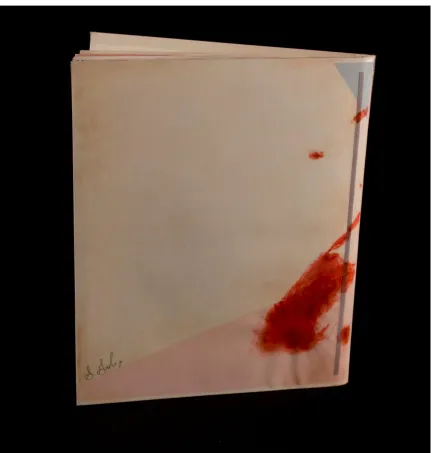
Zombie Mommy was originally a vintage self-help guide for new mothers from
1962 entitled Your Baby Book (see figures A.1-A.26). The book has a flexible cover and
its page count went from 42 to 24 after all alterations were finalized. The measurements
are 7.25 inches wide and 9 inches high. The main colors are pastel blues and pinks along
with yellow ochre. The book is outlined the same as an ordinary maternity guide book,
beginning with preparation and ending with plans for future care. The twist occurs with a
narrative I created based on a phantom umbilical cord that connects mother and child via
the mother's brainstem long after delivery (see figure A.7). It is the cord that begins to
drain the Madonna-like mother, turning her into a rotting, brainless drone (see figures
A.10 and A.11). Each page layout explores a new obstacle facing the transformed zombie
mommy as she navigates her way through typical tasks such as bathing, outings, and
feeding time (see figures A.13, A.19, and A.22). The narrative concludes with the family
pediatrician providing the mother with the one true antidote for any mother feeling dull
8
This idea grew from my own fears of being pressured into motherhood and losing
any and all intellectual stimulation. Wanting to be a mother that provides all the care my
children could need, but knowing how my personal independence and intellectual
development will inevitably suffer, raises the key issue regarding the burden of choice in
my thesis goal. The hopeful resolution in my narrative, along with my humorous parody,
also aims to provoke my female viewers toward self reflection rather than form a wedge
between opposing viewpoints on maternal roles.
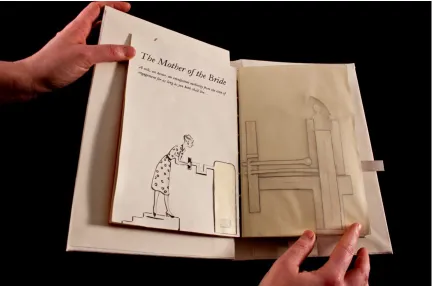
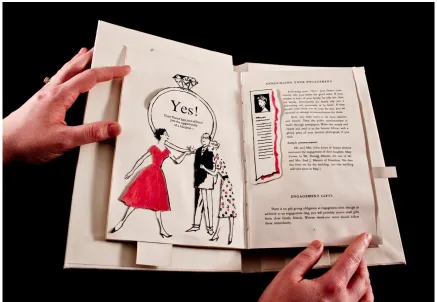
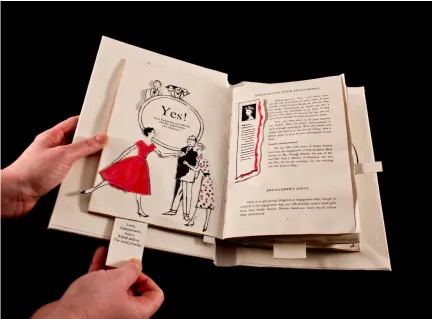
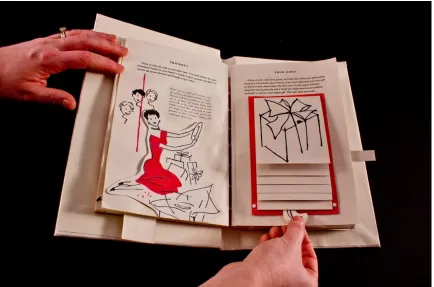
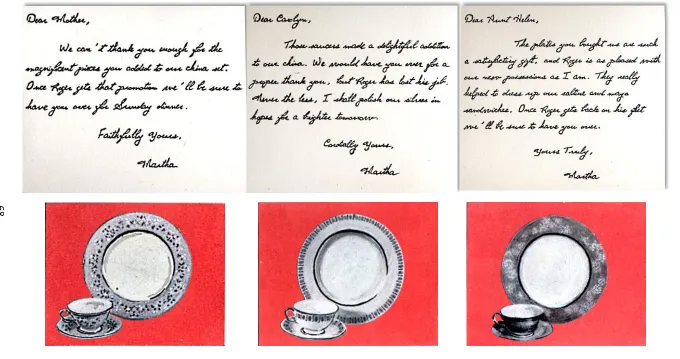
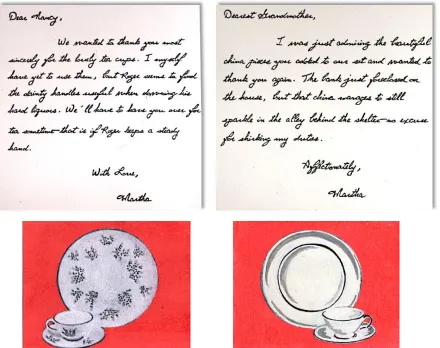
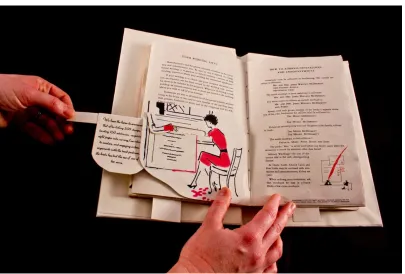
In 1959 Castleton China published a pamphlet entitled Wedding Etiquette. I took
this informative handbook and transformed it into a completely redesigned pop-up book I
renamed Mechanical Matrimony (see figures B.1-B.44). The book itself measures 7
inches wide and 10.5 inches high and is 20 pages in length. I unbound the original
pamphlet and rebound the pages using a Coptic stitch with a hardcover binding (see
figure B.2). The colors used throughout the book are black, cream, and a deep coral pink.
Text from the original copy of the work and text I incorporate are blended as seamlessly
as possible. The original outline defined within its pages was only altered slightly,
beginning with the engagement and ending with the future of wedded bliss on the
horizon. Within the narrative the young bride-to-be's body, words, and wedding
obligations are all at the mercy of the viewer's hands. As she is presented with such tasks
as addressing wedding invitations or organizing the processional, the viewer is able to
manipulate the pop-up mechanisms related to each event (see figures B.20-B.23 and
B.32-B.35).
This concept evolved from my own experiences as a young bride with my own
9
close family and their financial support. I made the connection to the pop-up features
because I felt they conceptually represented the feelings felt by a bride bound by the
opinions of every person involved in her wedding. I do still bring to light the burden of
choice in my closing pages; “... always remember freedom is never free...” (see figure
B.42). The financial cost and possible loss of a family bond over wedding decisions
causes many brides to feel what seems like a simple choice to do as they please, isn't
always so easy. With this work, again I ask the former, current, and future brides to
question their own choices regarding wedding traditions; what should stay, change, and
who guides those decisions?
The Escape was altered from a kitchen aide pamphlet entitled The Homemaker's
Helper: Kelvinator Wartime Idea Exchange for Home Economists: Project 11: Ideas for
Kitchen Improvement (see figures C.1-C.11). The pamphlet has no printed publishing
date but is clearly from the WWII era. The current measurements are 9 inches wide and
12.5 inches high with my restructuring taking away a clear page count. The book has
been altered to have a hard cover with acetate covered inlays of the original cover image
(see figure C.1). The color scheme is tan, black, and pine green with red accents. Its
construction is similar to a ring-binder with gingham ribbons for a tie closure. The book
has been altered into a covert escape plan disguised as a kitchen manual for a desperate
housewife seeking to abandon her kitchen captivity. The two initial pages viewed when
opening the book contain all the advice columns located in the original book (see figure
C.3). When each page is lifted, a piece of cream vellum can be unfolded over the columns
(see figure C.4). The vellum has sections cut out that uncover hidden messages which
10
scrolled section in the middle that unfolds to reveal a green and white blueprint-style
illustration of the kitchen. Within this scroll a layer of acetate unrolls over the illustration
to unveil red hand drawn markings that indicate places of interest and the location of
important items for the housewife (see figures C.6-C.8). The side panels are set in the
front and back covers of the book and can be pulled out with the gingham ribbon. These
panels disclose the step by step escape plan to be used by the housewife (see figures C.9
and C.10).
The concept for this book developed out of need for a third book in my altered
book series. Domesticity seemed the natural progression from wedding to motherhood,
and I have always had mixed feeling about kitchen work. After a planned weekend spent
in the kitchen preparing three square meals each day from scratch, I realized that having a
life outside of the kitchen was futile. My experiences from that weekend inspired every
aspect of the book. Though I make a clear statement regarding my opinion of kitchen
duties, I do again provide the option of choice. The inner scroll contains the survival
guide for those who plan to serve their full domestic life sentence; the escape plan is only
for the brave and desperate. In this piece I question the notion of insanity brought forth
by the cyclical nature of domestic chores. The kitchen, as I discovered, is one area where
those revolving chores can dominate an entire day. I pose the question of how our
grandmothers did this everyday and if women still are, what causes them to remain in
11
CHAPTER 3
JUSTIFICATION
Conceptually my work functions on a plane beyond my personal concerns. My
goal of examining the turmoil stimulated by opposing gender roles faced by modern
women has a place firmly held in current feminist ideology, and raises similar concerns
held in research concerning various but synonymous areas of women’s studies including
the critique of gender roles, marriage, maternity, and domesticity. The choice to utilize
the art form of altered books, as well, will be justified with an examination of its value as
a tool for communication. This section will explore the idea of the book as a metaphor,
formal qualities of the book acting as enhancements to the experience, and ways in which
appropriation and satire synergize to develop my artistic voice.
Feminism has gone through multiple paradigm shifts over the last two centuries. In
the mid to late 1800's women were fighting for the acknowledgment of intellectual
equality; by the 1960's and 70's the shift had changed to a struggle for women's equality
in regard to gender roles (Bernard 10-11); within the last 30 years, another shift has again
occurred. Feminism and other areas of social theory tend to follow similar trends.
Enlightenment led the way at the start of the 20th century with order and reason as the
guiding ideals. Universal truths and oppositional categories were drawing clear and
distinct lines in the sand between man and woman; culture and nature; emotion and
reason. Feminism emerged from this time of Enlightenment, but its followers also began
12
mother and bad mother. This opposition and rigid structuring would lead to the most
recent change in social theory and feminism. The new postmodern look towards a
multifaceted nature of identities and phenomena had a great impact on feminism and left
behind Enlightenment and its universal truths. By the 1990's feminism had shifted to
allow women to create their own identities (Williams 61-65). No longer did women have
to be viewed as man-haters, or “abandoning the cause” if they chose to stay home with
their children. Views on the sex industry even changed with this new feminist ideology,
with a turn from perceiving these women as victims. Despite many other shifts occurring
in the feminist movement, my work continues to focus on the ideas of gender roles. With
all the foundational work laid by women from the past which allows modern women to
be who they choose, what happens when there is no one there to fill the void being left in
the wake of their choices?
After the tireless works of feminists like Susan B. Anthony and Betty Friedan,
modern women now have every right to join men in practically every aspect of American
culture. According to author Jane Schulenburg, women have been seeking this equality
with men from the time of early medieval society; tales were told of female virgins being
praised for their spiritual virility, being seen as progressing toward perfect manhood with
some even going as far as killing themselves in attempts to preserve their chastity
(128,131). This equality has now been mostly secured in western culture, but there has
not been a commensurate change in men's domestic labor (Aspinwall 105). These
important roles once dominated by women are being abandoned without anyone turning
to fill the void. According to sociologist Alice Rossi, “If it were not for their wives in the
13
This is why so many professional women complain privately that what they most need in
life is a 'wife'!”(86). My work poses the question to modern women who have been given
a choice, unlike the our mothers' mothers who were expected to fill the role of the
housewife.
My altered book on marriage entitled Mechanical Matrimony is a wedding
planning book that addresses the concern of a bride acting as a pawn for manipulation,
rather than as an active player in the decision making process surrounding her own
wedding (see figures B.1-B.44). The specific notion of multiple choices comes down to a
wedding of the bride's choosing and a wedding that unites a community. The concept of
two individuals coming together and making a choice based on love and commitment to
be man and wife is a relativity new idea brought about by Christianity which did not
spread quickly (Baker 7). Initially brides were chosen by warriors who conquered
villages as a way to add to their own tribe's numbers (Urlin 24). This changed with time,
but only to allow the father to have some say in the transfer of his daughter to a new
“master” of his choosing (Lee 113). Marriages were seen as business arrangements that
joined families' fortunes and land holdings. This idea of the bride having little or no say is
naturally threatening to most modern women, but many of the customs symbolizing these
practices still remain. The act of the father walking the bride down the aisle and giving
her away is simply a representation of the old tradition when he really was relinquishing
her as property. Again, one would think women should flee from the notion of marriage
entirely based on this evidence, but according to sociologist Walter Gove, “ …it is
possible to interpret the single male's status as being a matter of choice while the single
14
as holding true within my own group of male and female friends. Obviously the
ceremonial act of the wedding holds a greater significance that encumbers the bride with
the problem of choice once again. According to author Ethel L. Urlin, “ There is a
tendency in modern life to diminish the ceremonial, but the marriage service, even where
it is not considered to be a sacrament, strengthens relationships and friendships, and
brings many to share in a joy which is essentially an unselfish joy, and its use is not likely
to die out” (20). Even though some traditions, such as bestowing gifts, symbolize the
anachronistic act of purchasing the bride, other customs such as eating and drinking
together remain as a welcome symbol of the new couple joining a new social group, with
cooperation and sharing as the main objective (Baker 110). My altered book does not
impose a choice on the women reading through my pages, but concludes with an option
of choice (see figures B 42- B.44). Urlin's statement is truly what causes most brides not
to flee to Vegas, but to put up with the hassle of their family's demands and to play their
role in the traditional ceremony. A wedding is an event that may star the happy couple,
but affects the whole community involved in their ceremonious occasion.
My book on maternity entitled Zombie Mommy, examines the problem women face
in wanting to maintain a sense of personal identity, especially professionally, while
fighting or embracing that urge, be it biological or social, to nurture those little chubby
faced angels that nature has endowed women with abilities to produce (see figures A.1-
A.26). Journalist Lisa Belkin's article “The Opting-Out Revolution,” focused on the idea
that “some of our nation's most educated and ambitious women were making the choice
to stay at home and leave their professions” (qtd. in Richards 3). This choice of the
15
be perceived as taking a step backwards in social progress. In the mid nineteen hundreds
feminist Simone de Beauvoir stated that our biological stereotypes would lead to the
“enslavement of the female to the species and the limitations of her various powers” (qtd.
in Blaffer Hrdy 24). In the 1960's and 70's feminist writings by Simone de Beauvoir and
Betty Friedan were calling women to abandon their homemaking lifestyles and start
careers, but this pull between career and motherhood started to really affect women when
psychologist John Bowlby introduced his ideas behind attachment theory (Blaffer Hrdy
xiii). This theory proposes that human infants have an innate need for a primary
attachment figure in the first years of life, and without it they suffer irreparable damage
(24). Professional mothers are now faced with a seemingly irreconcilable dilemma, which
is felt more strongly by those who choose to work, versus those who have to work to
support their families (491). Again the question arises of who takes on the role of
nurturer? Men often times do not volunteer because women tend to be better fit for the
role of caretaker. They are hormonally primed, sensitive to infants signals, and most
likely grew up in the company of other female caregivers learning how to care for small
infants (500). It is the woman who contains the hormone prolactin to produce milk on
command of a baby's cry (130), not a man. Anthropologist Sarah Blaffer Hrdy states it
best: “...evolutionists... appear[ed] to be imposing on women painful choices no man
need ever make: her aspirations versus her infant's well being; vocation or reproduction”
(490). My altered book acknowledges this painful choice and the struggle that occurs
along the way, but maintains a beacon of hope in conclusion (see figures A. 24 and A.25).
The last book in my series, entitled The Escape, examines the idea of the domestic
16
the modern family, domestic duties often become a shared burden, but according to
recent studies,” working women were estimated to do 1.6 times the amount of housework
as working men, on average, with wives averaging 1.7 times the housework of husbands,
and married mothers averaging 1.9 times the housework of married fathers” (Bianchi 56).
Women's roles have come a long way from the days of the “cult of domesticity,” but
much like the sentiments leading her back to the roles tied to motherhood and obedient
bride, therein lay internal callings that may lead women to continue to take on more of
the domestic duties. Married women of the Old South found their lives defined by their
duties (McMillen 1). According to author Margaret Bendroth, “anti-suffragette Catherine
Beecher argued that women who knew how to run a proper home had far more clout than
she could ever achieve through the ballot. 'There is a moral power given to woman in the
family state,' Beecher declared, 'much more controlling and abiding than the inferior,
physical power conferred on man'.” (qtd. in 43). This idea dominates the thinking of
those who still today value homemaking as a profession. Author Carolyn Graglia argues
against Betty Friedan's notion of the homemaker as a common “parasite” living off her
husband and lacking any real purpose; she found homemaking to afford her “a life of
unlimited freedom-the greatest freedom I had ever known-to create a design for living
myself and family and direct its performance” (2). Though Graglia argues for the greater
purpose in domestic work, sociologist Walter Gove still argues the fact that keeping
house is a boring, lowly, job that can often lead to depressive states due to its lack of
structure and allotment of far too much time for being self-consumed (282-283). Whether
you agree with Simone de Beauvoir in believing domestic work is “not directly useful to
17
picture and see domestic work as Julia McQullian sees it; as the work that “...women
have always done, that turns isolated individuals into families and communities, brick
and mortar into hearth and home, and gives meaning to our live” (qtd. in 29); the work
must be done. My final altered book is the only book where I give my strong reaction to
the choice at hand. I stand behind one of my childhood literary idols who too had to find
her way amid the choices of gender roles; in Anne of Green Gables, Anne Shirley sums
up my final work with her statement, “so little scope for imagination in cookery” (qtd. in
Hilder 216). The mere notion of spending countless hours in a kitchen or any of room of
a house cycling through chores day after day for the sheer purpose of maintenance causes
my head to spin. I find it very difficult to grasp the bigger picture behind domestic work
regarding its contributions to the greater good of a family. As a child, take-out food and
unfolded laundry have proved to have no effect on my accomplishments as an adult.
In terms of a metaphor, each book acts as a representation for the lives of women.
Each book was originally a guidebook. They were chosen to represent guides for life
which have been set in place for women by their upbringing. The idea behind their
altering acts as a metaphor for altering one's life structures to recreate new structures
based on gender roles that better fit the individual woman she has chosen to become. The
conclusion, and the structures being torn down in my books, are both aimed at my own
imposed structures I am working through, but I hope the symbolism of reconstructing her
own guide to femininity holds true for any woman viewing my books, no matter where
on the spectrum from dominant to dainty she may fall.
The use of the altered book allows for many formal elements that would have been
18
manipulate parts of my books served as a tool for communicating my conceptual
meanings. The use of paper engineering to create pop-up features in Mechanical
Matrimony helps to communicate the key idea of manipulation (see figures B.1- B.44).
Being able to pull, turn, and flip parts of the book enhances the visuals and the text,
because the viewer now becomes a participant in manipulating the bride's wedding day.
The Escape, based on domesticity, is set up like a secret escape plan from the kitchen (see
figures C.1- C.11). The ability for the viewers to read the hidden messages by flipping
certain pages, and pulling out secret compartments, allows them to actively engage in the
desperate housewife's escape act, not just read about her complaints. The empathy created
for the characters in my books was enhanced by the formal mechanics that were present
in the structures of altered books. Meg Campbell wrote while discussing the reasons
women are drawn to bookmaking: “...rather than passively looking at a painting or
sculpture, the individual enters into an intimate, intricate, and decidedly physical
relationship with the Artist's Book...” (qtd. in Bury 23). This act of physicality, though
risky at times, is again why I chose altered books.
The act of altering and deconstructing goes back to the concept of appropriation.
By recontextualizing the original meanings of each book, I am able to create satirical
parodies that act as a tool to communicate the messages behind each of my works. Artist
Russell Connor states it best when describing his own appropriated work: “I learned that
humor could be a ...Trojan horse, bearing truth that can't get in the gate on its own” (xi).
For example, my juxtapositions of photos of the polished 1960's housewife contained in
Zombie Mommy, against the drawings of her rapid physical decay marked by Baby's
19
my male and female viewers (see figures A.20 and A.21). I could have simply created a
work of art that visually depicted a woman in a state of depression reminiscent of the
migrant mother in the iconic Depression-era photograph by Dorothea Lange, but humor
allows for so much more approachability. My work is meant to be nonthreatening. The
absurdity of a wife planning an escape route out of her kitchen via trash collection day
doesn't set the tone for quiet contemplation, but shared laughter and stories of
commiseration (see figure C.10).
My thesis work is justified in its connection to issues surrounding current social
theory in contemporary feminism, specifically in detailing questions that still emerge
regarding gender roles in respect to marriage, maternity, and domesticity. Through an
explanation of the value placed on the art form of the altered book for my project,
regarding its metaphorical nature, the enhancements created by the formal mechanics
common to the altered book, and the satirical humor brought about by the use of
appropriation, I argue that this art form serves as a dynamic tool for communication.
20
CHAPTER 4
RESEARCH
My research efforts began with the development of my concepts through
observation and journaling, which then transitioned to research into a vast array of
construction techniques for creating each book, and finally led me to a conceptual study
of critical and philosophical literature to uncover the justification for my project beyond
its personal relevance.
Journaling and observation were my first research techniques. By taking what I
observed from new mothers, my own reflections on wedding planning, and by creating a
kitchen experience reminiscent of a day at Alcatraz, I was able to flesh out the concepts
for my three altered books. My work is essentially autobiographical, and my assumptions
were if I wrote enough on the concepts something was bound to arise from my written
word. In each case the visual metaphors worked their way to the surface one by one.
Some ideas were dismissed due to their inability to visually convey each concept (see
figure D.3). For example, in my initial journal entries on Zombie Mommy, I compared a
stay-at-home mother to a bear in hibernation, but the idea of the zombie with an antidote
seemed to make a better connection to the loss of mental function (see figure D.1).
Observation of others also inspired parts of my work; for example, in Zombie Mommy
there is a passage that states: “Besides, boring other mommies with your lactation
schedule is impossible; they're already dead” (see figure A.15). This developed after an
21
lactation it was the first time I was truly unable to join in the conversation and started to
take note of the “them vs. me” feeling. For Mechanical Matrimony, I took a great deal of
time for personal reflection and filled my journals with accounts of my emotions while
planning my wedding. The constant guilt I remember in wanting to go against the
etiquette, rituals, and structures of a classic wedding led me to the decision to alter the
1950's wedding etiquette book into a pop-up book. I found that the metaphor of the bride
being pushed and pulled to conform to her duties would be even more effective if the
viewers were able to physically push and pull her. Journaling for The Escape was very
important because I created an authentic experience to journal about. I spent a weekend
cooped up in my kitchen cooking all meals from scratch dressed as a 1940's housewife. I
wanted my meals to be as authentic to the era the original guide book was published, so I
enlisted the help of my grandmother and vintage cookbooks. I was up and in the kitchen
by 8:00 A.M. both Saturday and Sunday in a dress, apron, with curled hair and painted
lips. I skipped the heels; it was hard enough just to stand up for 12 hours. I calculated that
with my own meal and bathroom breaks I sat down for a total of 33 minutes each day. I
managed to cut myself by 10:30 the first morning and documented that I bled until 4:35
that afternoon. I didn’t want to eat anything I prepared except for Jell-O which I ate by
the ladle full. I continued to journal through my torturous experience and was able to
create an escape plan that best addressed the aches and frustrations felt during my time in
domestic hell. The frequent appearance of bacon in my illustrations emerged after the
third entry in two hours on how I was covered in grease and smelled like breakfast (see
figures C.7 and C.8). As a designer, I took note of its benefits as a fabulous lubricant; a
22
completed the journaling aspect to establish the concept of each book, I then directed my
research towards paper engineering and technical aspects of bookmaking.
Each book varied in its construction needs. Research on the construction of Zombie
Mommy focused on adhesives and the effects of moisture on the different types of papers
I was utilizing. Mechanical Matrimony was my first big challenge. The research was
heavily based in paper engineering and bookbinding, two areas I knew very little about.
The research for The Escape was almost entirely focused in bookbinding. I found that
with each new book I began, I continued part of the techniques I has mastered from the
previous book, and then pushed myself to take on new technical challenges.
In the series, Zombie Mommy, falls in the middle (i.e. marriage leads to maternity,
followed by domesticity), but in the creation process, this book came first. I found most
of my technical information on how to construct this first book on the website
altered-book.com. The site provided me with great insight on the best types of books for altering,
adhesives that are most forgiving, and how to work with vellum, a type of craft paper I
used to give this book its nursery-themed aesthetic. These skills became foundational for
the work I would continue to do with the next two books.
Mechanical Matrimony, my giant technical undertaking, began quite differently. I
knew I was planning to not only change the images in the book, but the entire structure. I
began my research with pop-ups and discovered the term “paper engineer”. It is a fancy
term for one who designs pop-ups but really does better encapsulate the degree of
mechanics, spacial visualization, and functional problem-solving, that goes into creating
the fun three-dimensional elements often found in children's books. I immediately
23
Marion Bataille's book ABC3D for dissection. I also checked out Joan Irvine's How to
Make Pop-Ups and spent hours watching countless YouTube tutorials by crafty
“scrapbookers” who never ceased to amaze with their tips and tricks on how to create
paper mechanisms that slid and flipped with ease. The waterfall mechanism utilized on
page eight of my book and the key feature in my large mechanical mash up on page four
were all thanks to YouTube tutorials on making birthday cards (see figures B.16 and B.6).
To complete the book, I had to begin researching bookbinding techniques, because,
unlike my former book, I had taken this one apart to add the pop-up elements. I sought
out help from Professor Eliot Dudik at the University of South Carolina who teaches a
class on bookmaking. He has a wealth of knowledge on materials, process steps, and the
best course of action for my work. He had not worked with altered books before, so this
was also a bit new for him. His advice and counsel led me again to more YouTube
tutorials and to find the book arts resources talasonline.com and hollanders.com for
supplies. This knowledge enabled me to bind my book and led me to explore grand
possibilities for my final endeavor.
The Escape, the final book in my three-part series, began in reverse. Unlike my
first two books where I deconstructed the pages within the book and considered the
binding and covers last, the structure of this book was going to be its key feature. I
planned to create secret compartments hidden within the structure of the book itself (see
figure C.11). I began with continued research on bookbinding. I stayed in contact with
Professor Dudik and I viewed more tutorials. By creating the book's structure, and then
adding in the elements from the kitchen guide I was altering, I felt I had the most control
24
choices from the first book, I knew my bookbinding materials well, and I simply knew
how to structure the procedural steps to create a well crafted book. By addressing the
structures of the book first, I eliminated the most difficult hurdle faced by altered book
artists; trying to maintain original binding. Zombie Mommy was altered while remaining
bound, so warping and the effects pages had on each other became a huge challenge. By
crafting my own structure for The Escape and creating space for the original illustrations
and text to be appropriated within, I essentially took almost complete control in
developing this book.
The final aspect of my research was based around justifying my work in a broader
scholarly and social context. I had spent so much time taking an autobiographical
approach to my work that I had not taken much time to see how it connected to a wider
critical audience. I consulted literature on the psychology of gender roles, the history and
ideology behind feminism, anti-feminist view points, motherhood, domesticity, marriage
rituals, appropriation, and book arts. I found that many of the topics covered in each piece
of literature I examined overlapped in some way to help me better tie together my
argument for justification. The research also offered another form of therapeutic respite
as I searched for answers plaguing my own personal agenda and helped me iron out a
25
CHAPTER 5
PROCESS
Each of my altered books was developed under a three part process: (1) “the
search”, (2) experimentation, and (3) construction. Though the details of each step varied
from book to book, the main three components of my process were unvarying.
“The search” began as I initially had to find suitable books that met the needs of
my concepts and were able to be altered. Thankfully I did not have to scour the shelves of
vintage bookshops. The vintage world was made accessible with Ebay.com and Etsy.com.
I was able to search for the genre and date of my books with friendly return policies. I
kept my eyes open for guidebooks with hand-stitched or stapled bindings and illustrations
with a female character I could appropriate. During this time I also performed a great deal
of research based on the techniques I was planning to explore in the construction of each
book. Once the books arrived I began to experiment.
Experimentation took on many forms from sketching, to 3-D maquettes, to
photographing design layouts. No matter how I needed to experiment with supplies and
materials, I began each part of this process at Kinko’s. I made dozens of copies of each
page in multiple sizes so that I could have the freedom of play without the horror of
destroying an irreplaceable vintage book. In Mechanical Matrimony experimentation
seemed to take up more of my time than the making of the book itself. I called this stage
in my work “maquette madness” (see figure D.6). In order to go from a paper engineer
26
deal. I came to the realization about half way through that I was not just making a work
of visual art, but a little machine filled with gears and cogs and levers that had to function
in order for my aesthetic and concept to properly come across. Page four is an example of
my lofty initial goal for the whole book, which took weeks of trial, error, research, and
tiny bits of paper all over my dining room table (see figures B.7 and D.5). Page 16 is an
example of how I learned to take a simple mechanism from a child's instruction manual
and, with strategic arrangement, make it seem more advanced (see figures B.32, B.34 and
B.35).
Construction of each book was slow and calculated. When working with an artifact
like a vintage book, any misstep can lead to an unusable book. Preparing the pages by
blocking out sections with gesso, planning detailed steps for when each page could be
worked, and allowing for drying time under heavy weights, took up most of the hours.
With a desire for the books to maintain the aesthetic of their original state, I painstakingly
worked to mimic qualities in the book such as font, page color, and brush strokes in the
illustrations. After leaving “maquette madness” this was my “by any means necessary”
stage of the process. Page 11 in Mechanical Matrimony shows an example of size 8.5
Times New Roman font which I transfer lightly onto the page and then went over by
hand with a size 0.5 black Micron pen (see figure B.26). When I was unable to find
ribbon for The Escape, I took the green ink I used in the book and carefully painted each
27
CHAPTER 6
CONCLUSION
An analysis of my thesis work over the last two years identifies the major hurdles I
worked to overcome, components I would change, and provides an evaluation of the
project’s success.
The major hurdles faced in my thesis project center around constructing my three
altered books. As a proponent of craftsmanship, I was never fully satisfied with the craft
of each of my books. This came at the expense of my constant experimentation. Once I
had mastered one technique, I would be inspired to create a new physical component and
I would begin again as a novice. I never merely utilized what I mastered, and once I came
to terms with this, I began to admire the little flaws in my books as marks of
advancements in my artistic evolution. This need to experiment also combated my issues
with structured planning. The constraints of rigid time structuring demanded in the
practice of crafting altered books leaves no flexibility for the spontaneous artist. With
pages being printed back to back, one side cannot be considered without an immediate
plan for its opposite. I often just wanted to start on a page that inspired me at that
moment, but if it was not already prepared with gesso or the page on its reverse was
drying, I had to be patient. After an evening frustrated by this barrier, I began to journal
reminding myself that the books were acting as my metaphorical life guides. All my life
planning, hard work, and patience were the processes used in reaching my goals, so what
28
books should become lasting symbols of my life as a planner. Likening myself to a
careful hunter stalking her prey, deciding if it’s worth the kill, determining the dangers in
its acquisition, and plotting how best to attack.
If I could change one aspect of my thesis work it would be how I set up the
timeline for my research of critical and philosophical literature. I used this research to
justify my project instead of enhancing the development of the concept. I learned so
much about how my work fit into a larger social and scholarly context after the fact and,
in hindsight, some of the knowledge I gained along the way could have altered my work.
I wanted to create truly authentic work devoid of others’ influences, but in truth, the
findings of others helped clarify so many vague areas in my own concept and inspired
other creative ventures. In her book Mother Nature: A History of Mothers, Infants, and
Natural Selection, anthropologist Sarah Blaffer Hrdy provided me with scientific and
psychological foundations that came strikingly close to the fictional narrative I created in
Zombie Mommy. “Pregnancy, labor, and delivery alter the brain…Long after a child is
grown and has left the nest, if she makes a single misstep, painful signals are triggered in
a maternal body far away, as if from a phantom limb” (Blaffer Hrdy 490). The book
Growing Up Protestant: Parents, Children, andMainline Churches by Margaret
Lamberts Bendroth, not only aided in my research on domesticity, but has inspired a
future altered book. I plan to create another book that addresses the interconnectedness
between religion and domesticity, especially in the American South. In her book
Bendroth states, “Within this enclave women assumed responsibility for the physical care
of the family and, even more important, for their moral and spiritual upkeep” (16). This
29
choice with regard to raising children. Again, this attends to personal concerns. Being
raised Southern Baptist and having a secular marriage will certainly raise issues in the
future on how I choose to set the moral and spiritual foundations for my own children.
With a plan to disperse my research on critical and philosophical literature throughout my
concept development, I anticipate the future developments of this book.
Overall, I found my thesis project to be a success. I set clear goals for myself in
creating three altered books which address my thesis goal of underscoring the turmoil
which comes from choices that leave many classic feminine roles left unattended by
either sex. I wanted my books to illustrate the juxtaposition of gender roles encountered
by modern women and to provoke questions in regards to how each individual female
viewer’s life structures were formed. Each book poses these questions based on the
choices my viewers made or will make in the future with respect to marriage, maternity,
and domestic responsibilities. My books acknowledge the hardships that consequently
must occur anytime females make choices to adopt one role over another, but are meant
to encourage my viewers to independently reflect upon what is worth the sacrifice instead
of merely following a prescribed guide. By utilizing the practice of altering books, I was
able to communicate this message in a more profound manner. The vintage guide books I
altered conceptually function as metaphors for the life guides I aim to provoke my female
viewers to individually reconstruct. The formal mixed media elements of collage, paper
engineering, and bookbinding, common to the practice of altering books, enhanced the
various concepts within each book. I also found that appropriating images and text
already contained within the pages of the books I altered, not only created artistic
30
My hope is that my books will continue to incite laughter and provoke discussion
on the often irreconcilable burden modern women face when it comes to selecting roles
to fill. If I learned anything at all personally through this process, it’s that in order to do
anything well choices must be made. The slogan printed on every Barbie doll box starting
in 1984, a year before my birth, through the mid 2000s read, “We girls can do anything”
(Rogers 95), but it needed a disclaimer: “Caution: Girls who can do everything must pace
themselves. Prepare yourselves for the seemingly liberating burden of choice often
31
WORKS CITED
“About The Center for Book Arts.” The Center for Book Arts. n.d. Web. 17 Mar. 2013.
Aspinwall, Lisa G., and Ursula M. Straudinger, eds. A Psychology of Human
Strengths Fundamental Questions and Future Directions for a Positive Psychology. Washington, DC: American Psychological Association, 2003. Print.
Baker, Margaret. Wedding Customs and Folklore. New Jersey: Rowman and
Littlefield, 1977. Print.
Bean, Joan P., and Alexandra G. Kaplan, eds. Beyond Sex-Role Stereotypes: Readings Toward a Psychology of Androgyny. Boston: Little, Brown, 1976. Print.
Bendroth, Margaret Lamberts. Growing Up Protestant: Parents, Children, and
Mainline Churches. New Jersey: Rutgers University Press, 2002. Print.
Bernard, Jessie. “Sex Differences: An Overview.” Bean and Kaplan 9-26.
Bianchi, Suzanne, et al. “Housework: Who Did, Does or Will Do It, and How
Much Does It Matter?” Social Forces. (2012) 91 (1): 55-63. Web. 31 Mar. 2013.
Blaffer Hrdy, Sarah. Mother Nature: A History of Mothers, Infants, and Natural Selection. New York: Pantheon Books, 1999. Print.
Buckler, Patricia P., Katherine Ott, and Susan Tucker, eds. The Scrapbook in American Life. Philadelphia, PA: Temple University Press, 2006. Print.
Bury, Stephen. Artists' Books: The Book As a Work of Art, 1963–1995. England: Scolar Press, 1995. Print.
Connor, Russell. Masters in Pieces: The Art of Russell Connor. Boston: Journey Eds., 1997. Print.
Gersh-Nesic, Beth. “Art History Definition: Appropriation / Appropriation Art.”
About.com. n.d. Web.17 Mar. 2013.
32
Graglia, Carolyn F. Domestic Tranquility: A Brief Against Feminism. Dallas, Texas: Spence, 1998. Print.
Hilder, Monika. “The Ethos of Nurture: Revisiting Domesticity in L.M. Montgomery's Anne of Green Gables.” 100 Years of Anne With an “e”: The Centennial Study of Anne of Green Gables. Ed. Holly Blackford. Virginia: University of Calgary Press, 2009. 211-223. Print.
Lange, Dorthea. Migrant Mother. 1936.
Lee, Vera. Something Old, Something New: What You Didn't Know About
Wedding Ceremonies, Celebrations, and Customs. Naperville, Illinois: Sourcebooks Inc., 1994. Print.
Maurer-Mathison, Diane. Collage, Assemblage, and Altered Art: Creating Unique
Images and Objects. New York: Watson- Guptill Publications, 2007. Print.
McMillen, Sally G. Motherhood in the Old South: Pregnancy, Childbirth, and
Infant Rearing. Baton Rouge: Louisiana State University Press, 1990. Print.
McQuillan, Julia and Julie Pfeiffer. “Why Anne Makes Us Dizzy: Reading Anne of Green Gables From a Gender Perspective.” Mosaic 34.2 (2001): 17-32. Print.
Richards, Amy. Opting In: Having a Child Without Losing Yourself. New York: Farrar, Straus, and Giroux, 2008. Print.
Rogers, Mary F. Barbie Culture. London: Sage Publications Inc., 1999. Print.
Rossi, Alice. “Sex Equality: The Beginnings of Ideology.”Bean and Kaplan 79- 88.
Schulenburg, Jane Tibbetts. Forgetful of Their Sex: Female Sanctity and Society, ca 500-1100. Chicago: University of Chicago Press, 1998. Print.
Sparks, Elisa Kay. “Altered Books: A Brief Introduction.” Brittomart.net. 19 Aug 2010. Web. 14 Apr 2013.
Urlin, Ethel L. A Short History of Marriage: Marriage Rites, Customs, and Folklore in Many Countries and All Ages. Detroit: Singing Tree Press, 1969. Print
Williams, Fiona.“Postmodernism, Feminism and the Question of Difference.”
33
APPENDIX A
ZOMBIE MOMMY
Figure A.1
Zombie Mommy
34
Figure A.2
Zombie Mommy
35
Figure A.3
Zombie Mommy
36
Figure A.4
Zombie Mommy
37
Figure A.5
Zombie Mommy
38
Figure A.6
39
Figure A.7
40
Figure A.8
41
Figure A.9
42
Figure A.10
43
Figure A.11
44
Figure A.12
45
Figure A.13
46
Figure A.14
47
Figure A.15
48
Figure A.16
49
Figure A.17
50
Figure A.18
51
Figure A.19
52
Figure A.20
53
Figure A.21
54
Figure A.22
55
Figure A.23
56
Figure A.24
57
Figure A.25
58
Figure A.26
Zombie Mommy
59
APPENDIX B
MECHANICAL MATRIMONY
Figure B.1
Mechanical Matrimony
60
Figure B.2
Mechanical Matrimony
61
Figure B.3 Mechanical Matrimony
Figure B.4
Mechanical Matrimony
62
Figure B.5
Mechanical Matrimony
Figure B.6
63
Figure B.7
Mechanical Matrimony
Figure B.8
Mechanical Matrimony
64
Figure B.9
Mechanical Matrimony
Figure B.10
Mechanical Matrimony
65
Figure B.11
Mechanical Matrimony
Figure B.12 Figure B.13
66
Figure B.14
Mechanical Matrimony
Figure B.15
Mechanical Matrimony
Detail
Figure B.16
Mechanical Matrimony
67
Figure B.17
Mechanical Matrimony
68
Figure B.18
Mechanical Matrimony
69
Figure B.19
Mechanical Matrimony
70
Figure B.20
Mechanical Matrimony
Figure B.21
71
Figure B.22
Mechanical Matrimony
Detail
Figure B.23
Mechanical Matrimony
72
Figure B.24
Mechanical Matrimony
Figure B.25
Mechanical Matrimony
73
Figure B.26