University of Windsor University of Windsor
Scholarship at UWindsor
Scholarship at UWindsor
Electronic Theses and Dissertations Theses, Dissertations, and Major Papers
2012
Modeling and Optimizing the Coverage of Multi-Camera Systems
Modeling and Optimizing the Coverage of Multi-Camera Systems
Aaron Mavrinac
University of Windsor
Follow this and additional works at: https://scholar.uwindsor.ca/etd
Recommended Citation Recommended Citation
Mavrinac, Aaron, "Modeling and Optimizing the Coverage of Multi-Camera Systems" (2012). Electronic Theses and Dissertations. 5372.
https://scholar.uwindsor.ca/etd/5372
C MC S
by
Aaron Mavrinac
A D S F G
S E C E
P F R D
D P U W
Windsor, Ontario, Canada 2012
M O C MC S
byAaron Mavrinac
A :
Dr. H. H. Liu, External Examiner
Institute for Aerospace Studies, University of Toronto
Dr. B. Boufama, Outside Department Reader School of Computer Science
Dr. J. Wu, 1ˢᵗ Departmental Reader
Department of Electrical and Computer Engineering
Dr. M. Ahmadi, 2ⁿᵈ Departmental Reader Department of Electrical and Computer Engineering
Dr. X. Chen, Advisor
Department of Electrical and Computer Engineering
Dr. J. P. Coyle, Chair of Defense School of Social Work
is thesis includes four original papers that have been previously published/submied for publication in peer reviewed journals, as follows:
esis Chapter Citation Status
Chapter 3 A. Mavrinac and X. Chen, “Modeling Coverage in Camera Networks: A Survey,” submied toInt. J. Computer Vision, manuscript no. VISI2069R2.
Accepted
Chapter 6 A. Mavrinac and X. Chen, “Coverage ality and Smoothness Criteria for Real-Time View Selection in a Multi-Camera Net-work,” submied toACM Trans. Sensor Networks, manuscript no. TOSN-2012-0157.
Submied
Chapter 7 A. Mavrinac and X. Chen, “Semi-Automatic Model-Based View Planning for Active Triangulation 3D Inspection Systems,” submied to IEEE/ASME Trans. Meatronics, manuscript no. TMECH-05-2012-2343.
Submied
Chapter 8 A. Mavrinac and X. Chen, “Optimizing Load Distribution in Camera Networks with a Hypergraph Model of Coverage Topology,” inProc. 5th ACM/IEEE Int. Conf. Distributed Smart Cameras, 2011. DOI:10.1109/ICDSC.2011.6042903
Published
I certify that I have obtained a wrien permission from the copyright owner(s) to include the above published material(s) in my thesis. I certify that the above material describes work completed during my registration as graduate student at the University of Windsor.
I declare that, to the best of my knowledge, my thesis does not infringe upon anyone’s copyright nor violate any proprietary rights and that any ideas, techniques, quotations, or any other material from the work of other people included in my thesis, published or otherwise, are fully acknowledged in accordance with the standard referencing practices. Furthermore, to the extent that I have included copyrighted material that surpasses the bounds of fair dealing within the meaning of the Canada Copyright Act, I certify that I have obtained a wrien permission from the copyright owner(s) to include such material(s) in my thesis.
Abstract
is thesis approaches the problem of modeling a multi-camera system’s performance from system and task parameters by describing the relationship in terms of coverage. is interface allows a sub-stantial separation of the two concerns: the ability of the system to obtain data from the space of possible stimuli, according to task requirements, and the description of the set of stimuli required for the task. e conjecture is that for any particular system, it is in principle possible to develop such a model with ideal prediction of performance. Accordingly, a generalized structure and tool set is built around the core mathematical definitions of task-oriented coverage, without tying it to any particular model.
A family of problems related to coverage in the context of multi-camera systems is identified and described. A comprehensive survey of the state of the art in approaching such problems concludes that by coupling the representation of coverage to narrow problem cases and applications, and by aempting to simplify the models to fit optimization techniques, both the generality and the fidelity of the models are reduced. It is noted that models exhibiting practical levels of fidelity are well beyond the point where only metaheuristic optimization techniques are applicable.
Armed with these observations and a promising set of ideas from surveyed sources, a new high-fidelity model for multi-camera vision based on the general coverage framework is presented. is model is intended to be more general in scope than previous work, and despite the complexity intro-duced by the multiple criteria required for fidelity, it conforms to the framework and is thus tractable for certain optimization approaches. Furthermore, it is readily extended to different types of vision systems.
To my Lady Crystal,
Duncan “Bugger” Idaho & Long John Silver, and all the cool cats who sailed the stream with me.
Acknowledgements
First and foremost, I thank Dr. Xiang Chen. In his capacity as my advisor and mentor over the past six years, his excellent training and unfailingly high standards have shaped me into the researcher I am today. In particular, his guidance throughout the work surrounding this thesis has been invaluable. I also thank the other members of my commiee, Dr. Majid Ahmadi, Dr. Jonathan Wu, and Dr. Boubakeur Boufama. In addition to important training and mentoring within and beyond coursework, all provided helpful insights toward my research, and generously spent their time reviewing my work. Numerous fellow students in the Advanced Control Systems Laboratory, both those preceding me and those following me, offered their own advice and assistance on occasion. In particular, Jose Luis Alarcon Herrera became the first other researcher to employ the results presented in this thesis in his own work, and has since contributed much to the development of Adolphus and collaborated with me on important experimental work.
I am indebted to the exceptional team at Vista Solutions for providing a great opportunity to root my work in industry for most of my doctoral studies. Mike Sirizzoi and Dean Scarle have been excellent mentors and highly accommodating managers, and I am very grateful for their having taken a genuine interest in my career. Keith deGroot, Peter Denzinger, and Aaron Bouchard, along with the rest of the technical team, are among the most knowledgeable and skilled engineers I have had the pleasure of collaborating with, and the work presented here owes much to their insights.
I thank Dr. Frank P. Ferrie and Andrew Phan for welcoming me for a brief but inspirational visit to McGill University’s Centre for Intelligent Machines. Many other fellow researchers worldwide have provided valuable feedback on various aspects of this work, in the form of email exchanges, discussions at conferences, and paper review comments.
A special nod to my late friend Clayton Brewer, with whom I spent much of my childhood building things and taking things apart, a big part of what inspired me to go into engineering.
My deepest gratitude goes out to the friends and family who supported me in more ways than I can possibly enumerate. ree people in particular stand out. My father, Robert, who inspired my passion for science and technology from an early age, and taught me to do things the right way, whether big or small. My mother, Joan, who taught me that life is best lived with integrity and honesty, and believed in me even when I didn’t believe in myself. My wife, Crystal, who has been my best friend and companion through my entire academic career, and understands my ideas beer than anyone else in the world.
Declaration of Previous Publication iii
Abstract iv
Anowledgements vi
List of Figures x
List of Tables xii
List of Algorithms xiii
1 Introduction 2
1.1 Origins: Multi-Camera Systems . . . 2
1.2 Motivations: Problems of Coverage . . . 3
1.3 Approach: Modeling Task-Oriented Coverage . . . 6
1.4 esis Outline . . . 7
Part I Representing Coverage 2 Sensor System Coverage 10 2.1 Overview . . . 10
2.2 e Coverage Model . . . 10
2.3 Coverage Topology . . . 15
3 State of the Art 18 3.1 Overview . . . 18
3.2 Geometric Models of Visual Coverage . . . 18
3.3 Topological Models of Visual Overlap . . . 30
3.4 Topological Models of Visual Transition . . . 36
4 A Visual Coverage Model 42 4.1 Overview . . . 42
4.3 Model Specification . . . 43
4.4 Monocular Visual Coverage Function . . . 48
4.5 Multi-Camera Coverage . . . 51
4.6 Task-Oriented Coverage Evaluation . . . 51
4.7 Tractability and Computational Complexity . . . 52
5 Experimental Validation 54 5.1 Overview . . . 54
5.2 Validation of Monocular Criteria . . . 54
5.3 Comparison with Other Models . . . 57
Part II Optimization on Coverage 6 Robust Real-Time View Selection 64 6.1 Overview . . . 64
6.2 Introduction . . . 64
6.3 Optimal View Sequence Selection . . . 66
6.4 Real-Time View Selection Algorithm . . . 68
6.5 Experimental Results . . . 70
6.6 Conclusions . . . 76
7 View Planning for 3D Inspection 77 7.1 Overview . . . 77
7.2 Introduction . . . 77
7.3 Coverage Model for Active 3D Vision . . . 81
7.4 View Planning . . . 85
7.5 Automatic Refinement Algorithm . . . 87
7.6 Experimental Results . . . 90
7.7 Conclusions . . . 93
8 Camera Network Load Distribution 97 8.1 Overview . . . 97
8.2 Introduction . . . 97
8.3 Task Processing Distribution . . . 98
8.4 Experimental Results . . . 99
8.5 Conclusions . . . 103
9 Conclusions 105 9.1 Summary of Contributions . . . 105
A Mathematical Baground 109
A.1 Motion of Rigid Bodies . . . 109
A.2 Hypergraphs . . . 112
A.3 Miscellaneous . . . 112
B Geometry of Computer Vision 113 B.1 Image Formation . . . 113
B.2 Optical Effects . . . 116
B.3 Camera Calibration . . . 116
B.4 Active 3D Triangulation . . . 118
C Adolphus Simulation Environment 120 C.1 Introduction . . . 120
C.2 Architecture . . . 121
C.3 Obtaining the Soware . . . 123
D Equipment Specifications 124 D.1 Digital Cameras . . . 124
D.2 Camera Lenses . . . 126
D.3 Miscellaneous . . . 127
Glossary of Terms 129 eorems and Definitions 134 List of eorems . . . 134
List of Definitions . . . 134
Bibliography 135
List of Figures
1.1 Task-Oriented Coverage . . . 7
3.1 Basic Visual Criteria . . . 19
3.2 View Angle . . . 27
3.3 Vision Graph Example . . . 30
3.4 Vertex Granularity in the𝐶𝑁-Complex . . . 34
3.5 General Transition Graph Example . . . 37
3.6 Possible Cases of Transition . . . 41
4.1 Coordinate Convention of𝔻 . . . 43
5.1 HALCON Calibration Plate . . . 55
5.2 Validation of Field of View Criterion . . . 56
5.3 Validation of Resolution and Focus Criteria . . . 56
5.4 Validation of View Angle Criterion . . . 57
5.5 Ground Truth Face Pose . . . 59
5.6 Layout of Comparison Surveillance Network . . . 60
5.7 Adolphus Simulation of Comparison Surveillance Network . . . 61
5.8 Vision Graph for Comparison Surveillance Network . . . 61
5.9 Comparison of Coverage Model Fidelity . . . 62
6.1 Jier in View Selection . . . 70
6.2 Layout of Simulated Surveillance Network . . . 71
6.3 Visualization of Simulation Environment . . . 72
6.4 Agent Paths for Simulation Experiments . . . 72
6.5 Varying𝐽and𝜏with Ground Truth𝐶 and𝑅 . . . 73
6.6 Vision Graph for Simulation Experiments . . . 75
6.7 Controlled Camera Data Experiment . . . 76
7.1 Coordinate Frames in Active Vision . . . 80
7.2 Design Variables for Automatic Refinement . . . 86
7.3 Simulated Validation Configuration . . . 91
7.4 Structured Target Scan . . . 91
7.8 Robustness to Positioning Error . . . 94
8.1 Camera Network Layout and Relevance Function . . . 101
8.2 Load Statistics for Task 1 . . . 102
8.3 Load Statistics for Task 2 . . . 102
B.1 Pinhole Camera Model . . . 114
B.2 Field of View . . . 115
B.3 Pixel Coordinates . . . 115
B.4 Blur Circle . . . 117
B.5 Calibration Graph Example . . . 118
B.6 Scanning by Active Triangulation . . . 119
C.1 Adolphus User Interface . . . 121
C.2 Core Class Hierarchy (UML) . . . 122
D.1 Prosilica EC-1350 . . . 124
D.2 NET iCube NS4133BU . . . 125
D.3 SICK IVP Ranger E/D . . . 125
D.4 Computar M3Z1228C-MP . . . 126
D.5 Computar H10Z1218-MP . . . 126
D.6 Mitsubishi RV-1A . . . 127
List of Tables
3.1 Comparison of Selected Visual Coverage Models . . . 23
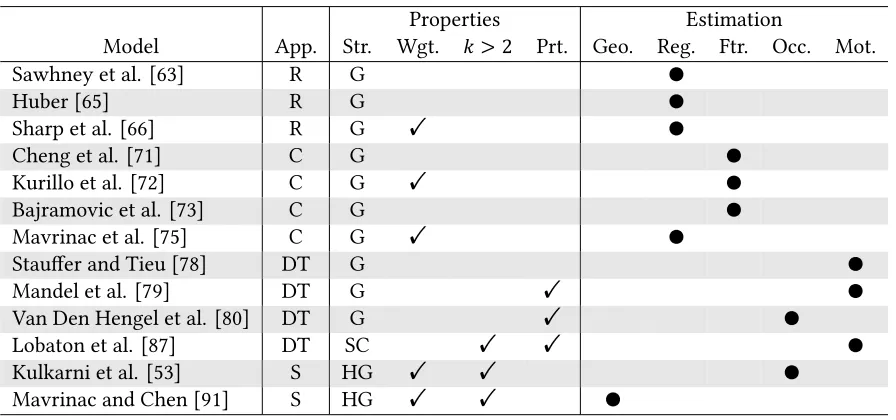
3.2 Comparison of Selected Topological Coverage Overlap Models . . . 32
3.3 Comparison of Selected Topological Transition Models . . . 39
4.1 Sensor Model Parameters for Visual Coverage . . . 44
4.2 Task Requirement Parameters for Visual Coverage . . . 47
5.1 Requirements for Target Pose Estimation Task . . . 55
5.2 Requirements for Face Detection Task . . . 60
6.1 Requirements for Simulated Surveillance Task . . . 70
6.2 Effects of Calibration Error (Path 1,𝐽 = 10) . . . 74
6.3 Effects of Calibration Error (Path 2,𝐽 = 20) . . . 74
6.4 Effects of Target Tracking Error (Path 1,𝐽 = 10) . . . 74
6.5 Using Robot Position Data . . . 76
7.1 Task Requirement Parameters for Active 3D Vision . . . 82
7.2 Laser Parameters . . . 83
7.3 Design Impact Matrix for Automatic Refinement . . . 87
7.4 Bounds on Design Variables . . . 88
7.5 Experimental Tasks and Results . . . 93
8.1 Hyperedges inℋ . . . 99
C.1 External Dependencies for Adolphus . . . 123
D.1 Prosilica EC-1350 Specifications . . . 124
D.2 NET iCube NS4133BU Specifications . . . 125
D.3 SICK IVP Ranger D50 Specifications . . . 125
D.4 Computar M3Z1228C-MP Specifications . . . 126
D.5 Computar H10Z1218-MP Specifications . . . 127
D.6 NET SV-0813V Specifications . . . 127
“at would be the highest thing for me”—so saith your lying spirit unto itself—“to gaze upon life without desire, and not like the dog, with hanging-out tongue: to be happy in gazing: with dead will, free from the grip and greed of selfishness—cold and ashy—grey all over, but with intoxicated moon-eyes! at would be the dearest thing to me”—thus doth the seduced one seduce himself,—“to love the earth as the moon loveth it, and with the eye only to feel its beauty. And this do I call immaculate perception of all things: to want nothing else from them, but to be allowed to lie before them as a mirror with a hundred facets.”
CHAPTER
1
Introduction
If you have built castles in the air, your work need not be lost; that is where they should be. Now put the foun-dations under them.
Henry David oreau (1817–1862),Walden
1.1 Origins: Multi-Camera Systems
Computer vision is the science and technology of artificial systems that see. Cameras, like all sensors, engage in the acquisition ofdata; it is the endeavour of computer vision to convert this data into useful
information. According to Marr [1], a vision system, as an information processing system, must be understood on three levels: the computational level, which identifies the task to which the system is set, and its purpose; the algorithmic/representational level, which describes how the system represents and acts on information to achieve the task; and the physical level, which describes the “hardware” implementing the system.
Nearly half a century ago, the field of computer vision emerged as distinct from earlier work in digital image processing in that it sought to recover information about the three-dimensional world from the raw data of images. Motivations for this research included new possibilities for automated control and metrology (cf. photogrammetry), and the obvious richness of visual information toward a human-like artificial understanding of the world.
In recent years, the cost of digital camera devices has dropped precipitously. Meanwhile, advances in embedded computing have spurred a trend toward increased in-network processing in sensor net-works [2]. e convergence of these developments, together with progress in computer vision, have led to the emergence of distributed networks of smart cameras [3, 4] as an important new field with numerous applications. Systems tasked with establishing situation awareness [5] based on multiple sources of visual information, previously the domain of human operators, are becoming increasingly automated under this paradigm.
While the communication and processing paradigms of camera networks introduce a variety of problems not previously seen in either computer vision or sensor networks, research in this field has also exposed a class of problems arising more broadly from the multi-camera paradigm, for which there has not previously existed a need for general (multi-camera) solutions. At the most fundamen-tal level, characterization of the performance of multi-camera systems with respect to a task is an open problem [6]; lacking a unified theoretical framework, the aforementioned problems have been addressed rather haphazardly and in isolation from one another. It is the ambition of this thesis to propose such a framework, solve the issue of performance evaluation, and provide a common basis for approaching a large class of multi-camera coverage problems.
1.2 Motivations: Problems of Coverage
In order to successfully accomplish a task using a particular set of representations of visual infor-mation and algorithms which manipulate these representations, it is tautological that the available visual data, along with any ancillary knowledge (geometric information about the imaging system, shape models, etc.), must meet some set of requirements. Identifying these requirements and estab-lishing their interaction with the system has clear value to design, enabling quantitative evaluation and optimization.
e fundamental approach of this thesis is to describe this relationship between task and system in terms ofcoverage. In this model, the physical level consists of a set of stimulus, which are intrinsic to the world and ostensibly encode the information needed by the task, and the sensor system, which transforms some of the stimuli into data. e question then becomes whether the data acquired is sufficient, given the representations, algorithms, and applicable constraints from ancillary knowledge, to achieve the task.
A model predicting, to some degree of fidelity, a sensor system’s performance with respect to a task, given a priori information about both, is valuable in and of itself. For example, it may be used to evaluate a design in simulation, closing the loop without the need for costly physical implementation. However, it also provides a quantitative characterization of the objective in a family of important problems of sensor systems, which are connected in that they all involve optimization over some aspect of coverage.
1.2. Motivations: Problems of Coverage
clarifies the high-level identity of these problems. It is important to note, however, that as a posteriori information is inherently incomplete and noisy, and especially since its behaviour in that respect is itself a function of coverage, the extent to which it can be integrated into a given a priori model varies. In actuality, Marr’s tri-level hypothesis generalizes to any information processing system. Sim-ilarly, the basic theoretical framework of coverage, as presented in Chapter 2, applies to any sensor system, irrespective of the sensing modality. However, as the main scope of this thesis is limited to multi-camera systems, a set of distinct and relatively concrete coverage problems which have been identified in that context are described here.
1.2.1 View Planning
e view planning problem—also variously known as sensor planning, camera planning, and optimal camera placement in the literature—is concerned with finding an adequate or optimal view of a scene for a given task. A view, in this context, is a set of one or more camera viewpoints. Generally, the space of views is continuous, although in practice a discrete approximation may be used to fit certain optimization methods. Specific problem formulations vary depending on what is constrained; typi-cally, the objective is either to find the camera parameters (including pose) which maximize coverage given a fixed set of cameras or maximum cost, or else to minimize the cost of the system while meeting some minimum coverage requirement.
e single-camera case is, by definition, an offline, open-loop subproblem, as the camera must be placed at a single viewpoint based on the available a priori knowledge. Consequently, this problem engendered the early model-based work, such as that of Cowan and Kovesi [7] and Tarabanis et al. [8]. e general approach is to derive, from an analysis of image formation and quantitative task require-ments on predetermined scene features, an indicator function over the space of viewpoints encoding adequacy.
Cases requiring multiple viewpoints to obtain the necessary information for the task give rise to the multi-camera case. However, early work on such problems tended, partly for reasons discussed in Section 1.1, to be limited to single cameras, the objective thus becoming to find an adequate or optimal sequence of viewpoints for the camera. Since the information obtained from each viewpoint is thus available in planning subsequent viewpoints, this is naturally an online, closed-loop subproblem, commonly known as the next best view problem. e approaches of Connolly [9], Hutchinson and Kak [10], and Maver and Bajcsy [11] exemplify the information-based approach to this problem, which ultimately influenced work on autonomous exploration based on the same principles, such as that of Whaite and Ferrie [12].
representations of multi-camera coverage, and eventually by Zhao et al. [16, 17, 18] and others into three dimensions.
With coverage modeled over the stimulus space rather than the viewpoint space, there is no longer an immediate analytic solution to the problem of planning the viewpoints. Instead, view planning is formulated as an optimization problem, whose difficulty depends on the tractability of the mathemat-ical model. As multi-camera vision is a complex phenomenon, there is a tradeoff between the fidelity and tractability of the model: simple models may allow the use of powerful, efficient optimization methods, but may not yield very good solutions, while complex models can accurately identify good solutions, but may be quite difficult to optimize. Approaches to multi-camera view planning span the gamut, from convex programming on extremely simple models to metaheuristics on highly complex models.
1.2.2 View Reconfiguration
e view reconfiguration problem is a limited, online derivative of the view planning problem intro-duced in the previous section. Again, the objective is to find an adequate or optimal view for a given task. e two major differences are temporal considerations, including processing time and delays in realizing views, and generally tighter restrictions on the parameters which can be controlled. ere is some overlap with next best view problems. In the literature, the most common target systems are networks of pan-tilt-zoom cameras, eye-in-hand robotic manipulators, and mobile robots with vision. In most specific problem formulations, the coverage objective is relatively localized (typically one or more targets, such as people) and dynamic.
e very fact that the cameras are capable of online reconfiguration is a hint that this is a closed-loop problem. Such applications as surveillance are the typical arena in which the problem arises: as new information about the dynamic scene is obtained—frequently from the cameras themselves—the optimal configuration changes accordingly.
Piciarelli et al. [19, 20] illustrate the architecture of a pan-tilt-zoom camera network which updates its model of task relevance based on activity information from the cameras. is kind of representation supports the notion that the underlying phenomenon of interest is coverage: as with the next best view problem, it is simply a maer of how closely the information can be mapped to a purely a priori model of the system.
1.2.3 View Selection
e view selection problem is a distinct coverage problem in the online domain. Here, there is no control over the cameras themselves; rather, the number of cameras from which information may be transmied, processed, or viewed simultaneously is constrained. e instantaneous subproblem involves the selection of an adequate or optimal view of a scene for a given task from a discrete set of possible views; the overall problem is to find an adequate or optimal view sequence. As with view reconfiguration, there is some overlap with next best view problems, and the coverage objective is typically one or more localized, dynamic targets.
1.3. Approach: Modeling Task-Oriented Coverage
as that addressed by Chen and Li [21], who minimize the length of the robot path required to reach a discrete set of views. e usual motivation for seeking a view sequence in multi-camera systems is for tracking the best view of dynamic agents in the scene over time. While the desirable property of a view at any particular instant is, of course, its quality of coverage, the desirable property of the overall sequence is its smoothness, which is in general a competing objective. is is quantified to some extent in the work of Jiang et al. [22] and Daniyal et al. [23].
Since the agent dynamics constitute online information, and since the most common means of obtaining this information is from the cameras themselves, most approaches to view selection are heavily information-based. Some information models depart radically from the intuitive concept of coverage, particularly those based on abstract image entropy, but coverage remains the underlying phenomenon. Others aempt to glean more familiar structure, such as object poses and occlusions, from the scene, which map more readily to an a priori model of the system. A few approaches to view selection are explicitly based on such models, assuming (and, in some cases, supplying) a means for the system to obtain information in an appropriate form.
1.2.4 Resource Distribution
Issues of load and storage distribution arise in smart camera networks, and turn out to be strongly related to coverage. e problem is one of allocating consumption of some resource—usually process-ing or storage, but also possibly communication, energy, etc.—efficiently among the nodes in a camera network, given some information about the task.
e volume of activity, of the sort that consumes resources, at any given node in a camera network tends to be directly proportional to the intersection of coverage and task relevance. As these concepts are made more concrete in the chapters to follow, this will become almost self-evident: in some of the aforementioned cases, such as Piciarelli et al. [19, 20], this is true by definition. Where a set of nodes are suitable candidates for carrying out some activity which need only be performed by some subset thereof, an opportunity for optimal assignment of the activity, guided by coverage information, exists. As with the previous two problems, the task relevance information is likely to be unknown or uncertain a priori, and this is thus oen a closed-loop problem.
1.3 Approach: Modeling Task-Oriented Coverage
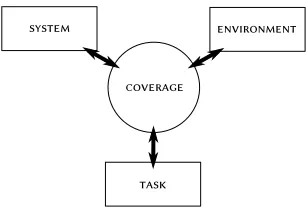
At the core of all of the problems presented in the previous section, and arguably quite central to the design and operation of multi-camera systems overall, is one fundamental question: how can the expected performance of a multi-camera system be quantified in terms of the parameters of the system, the environment it inhabits, and the task to which it is set?
system
task coverage
environment
Figure 1.1: Task-Oriented Coverage – e task-oriented coverage paradigm models the relationship between the sensor system, the external environment, and the task in terms of coverage.
e framework presented by this thesis owes its success to the methodology behind its develop-ment. From the outset, the common issue, viz. coverage, relating several problems was identified. Without initially concentrating on any particular problem, two weaknesses of existing approaches, underlying their lack of both generality and fidelity, became clear. First, the representation of cov-erage tend to be strongly coupled to the prevalent applications giving rise to the specific problem; without a clear separation between the system and task, models are incompatible across problems, and even ill-fit to many applicationswithin the same problem class. Second, the models tend to be streamlined to fit certain optimization techniques; the assumptions implied lead to further restriction of application scope and loss of fidelity.
ose efforts which do apply to a reasonable subset of problems, while retaining anything ap-proaching a practical level of fidelity, are already beyond the point where effectively only “black-box” metaheuristic optimization techniques are applicable. At that point, additional complexity in the model only impacts the performance of optimization insofar as the time taken to evaluate the objec-tive function increases. erefore, this thesis assumes optimization techniques allowing an objecobjec-tive function of arbitrary complexity, with the exception of a bounding requirement. Under this relaxed requirement of tractability, the development of a general, high-fidelity model of coverage is possible. e concept of a coverage model for sensor systems is presented in a highly general form—simply a bounded function over an arbitrary stimulus space—and thus any optimization approach developed for such a model generalizes trivially to any other model of the same basic form. is yields a powerful framework for approaching coverage problems, as the nature and complexity of the model may vary according to the particular application and the necessary level of fidelity. In particular, a flexible model specification for the modality of vision is presented and validated.
An important and novel feature of this framework is the explicit separation of the system and task specifications. e identification of the stimulus space for a particular sensing modality provides the interface between the two: it is possible to quantify whichhypotheticalstimuli in the space are covered by the system sufficiently to meet task requirements, then to specify a concrete set of relevant stimuli for the task itself, and finally identify the proportion of the laer covered by the former. is allows the same coverage model to apply to a diversity of applications and problems.
1.4 Thesis Outline
1.4. esis Outline
coverage model. Although actually developed by generalizing from material presented subsequently in the thesis, imparting an understanding of the core framework first allows the remainder of the thesis to be framed in its terms, which is valuable in exposing the strengths and shortcomings of existing work, and in developing the more concrete model for multi-camera networks.
Chapter 3 reviews the state of the art in approaches to the coverage problems described in Sec-tion 1.2, with a strong focus on the forms and features of the various coverage models. Along with geometric models, work on two types of topological model is surveyed.
Drawing from this prior work, a general, high-fidelity model of visual coverage is presented in Chapter 4. is model incorporates most of the identified criteria for monocular vision, and issues relating to multi-camera coverage specific to vision are discussed. While the model as presented does, of course, have some restrictions in its scope of applicability—for example, it does not character-ize random occlusion or illumination, and does not address stereo vision—it covers the majority of multi-camera applications, and provides a good foundation for extension to cases outside its scope (as demonstrated in Section 7.3).
Chapter 5 provides empirical evidence of the soundness and generality of this model formulation. e individual criteria for monocular vision are validated in terms of performance prediction for a task with general properties. en, the overall performance prediction of the model is compared to two of the more promising models from the literature, with favorable results.
Part II of the thesis demonstrates three applications to coverage problems using metaheuristic optimization techniques. In Chapter 6, a relatively simple greedy algorithm with hysteresis addresses the problem of real-time view selection. In Chapter 7, an instance of the view planning problem—in this case, for active triangulation inspection systems, requiring a modification of the base coverage model of Chapter 4—is approached with a particle swarm optimization technique. Finally, in Chapter 8, a heuristic drawn from the field of scheduling is adapted to hypergraphs, and leveraged, by way of a topological coverage model, against the general camera network load distribution problem.
Concluding remarks are presented in Chapter 9. ese include a review of the contributions pre-sented in this thesis, descriptions of a number of potential future research directions, and some final reflections on the work.
CHAPTER
2
Sensor System Coverage
Our intelligence cannot wall itself up alive, like a pupa in a chrysalis. It must at any cost keep on speaking terms with the universe that engendered it.
William James (1842–1910),A Pluralistic Universe
2.1 Overview
In this chapter, the fundamental framework within which this thesis treats the coverage of a sensor system is described. e general form does not prescribe any particular representation for stimuli, nor any means of valuation of coverage; it is ignorant of sensing modality and model thereof. In essence, it should be seen as an abstract base class for representing the coverage of multi-sensor systems. e primary aim is to introduce the vocabulary of concepts and its interrelationships, so that they may be used with some formality in subsequent chapters.
Although this framework has been derived, in part, by generalizing from the large volume of sensor system coverage models in the literature, specific reference to these models is deferred to Chapter 3. is order of presentation not only allows for a clean, direct exposition of the framework, but also provides a common language with which to describe the surveyed works.
2.2 The Coverage Model
A sensor system is an entity which detects stimuli for the purpose of executing a task. In general, this system may physically comprise a single sensor, multiple sensors, or part of one or more sensors’ ranges, with one or more sensing modalities. Here, the termsensor refers to an atomic unit, one or more of which comprise the sensor system.
Stimuli are uniquely defined in a stimulus space𝒮; in some cases, stimuli are simply 2D or 3D
geometric position may affect coverage as well. It may also be necessary to consider complex phenom-ena not localized at a single point in space. While the nature of𝒮may therefore become quite abstract,
it may be helpful to imagine simple spatial stimuli for the purpose of intuitively understanding the concept of the coverage function.
A stimulus 𝐩 ∈ 𝒮 is considered covered by a sensor system if it yields a response sufficient to
achieve the given task. An ideal coverage function, therefore, is a bivalent mapping𝐶 ∶ 𝒮 → {0, 1},
where𝐶(𝐩) = 1indicates that a point in𝒮is covered. Equivalently, one may speak of the set𝐶 ⊂ 𝒮of
covered stimuli. A more general definition𝐶 ∶ 𝒮 → ℝ encompasses models which handle uncertainty and/or grade coverage quality. In any particular case, this may be bounded as𝐶 ∶ 𝒮 → [0, 1]without
loss of generality.
1 Definition (Coverage Function)
Given a stimulus space𝒮, a coverage function is a mapping𝐶 ∶ 𝒮 → [0, 1], for whi𝐶(𝐩), for any𝐩 ∈ 𝒮,
is the grade of coverage at𝐩, according to some definition of coverage.
Extension of the subset notion is possible if one considers𝐶a fuzzy subset [24] of𝒮; that is,𝐶 is
the (fuzzy) set of stimuli which are covered. For convenience, the same symbol will be used to denote the coverage function and the fuzzy subset of which it constitutes the membership function. is also allows the use of the standard fuzzy union and intersection operators, which are defined, respectively, as
𝐶 ∪ 𝐶 (𝐩) = max(𝐶 (𝐩), 𝐶 (𝐩)) (2.1)
and
𝐶 ∩ 𝐶 (𝐩) = min(𝐶 (𝐩), 𝐶 (𝐩)). (2.2)
Another useful set construct is the coverage hull, the set of all points in𝒮for which𝐶is nonzero
(in the fuzzy set characterization, the support of𝐶).
2 Definition (Coverage Hull)
e set⟨𝐶⟩ = {𝐩 ∈ 𝒮|𝐶(𝐩) > 0}is the coverage hull of a coverage function𝐶.
Definition 2, along with (2.1) and (2.2), implies that⟨𝐶 ∪ 𝐶 ⟩ = ⟨𝐶 ⟩ ∪ ⟨𝐶 ⟩and⟨𝐶 ∩ 𝐶 ⟩ = ⟨𝐶 ⟩ ∩ ⟨𝐶 ⟩. A coverage model describes the valuation of 𝐶 over 𝒮 in the context of information about the
complete closed system in question. A fundamental conjecture of this thesis is that for any specific sensor system, environment, and task, it is in principle possible to formulate a coverage model for
𝐶which reflects perfectly the desired information for the given application.¹ As with any model of
a physical phenomenon, one may trade fidelity for simplicity and generality, which have their own benefits. Accordingly, the objective is to formulate a model whose nature makes it tractable for some optimization approach for a given application class, of sufficient generality to encompass the desired application scope, yet exhibiting sufficient fidelity to effectively solve problem instances.
2.2. e Coverage Model
2.2.1 Generalized Model Structure
Although model formulations, even within the same sensing modality, vary widely in practice, it is possible to derive a generalized fundamental structure beyond Definition 1. It is beyond the scope of this work to demonstrate, by way of a comprehensive literature survey, that all existing coverage models for all sensing modalities are subsumed by this structure; the survey presented in Chapter 3 does, however, make this case specifically for vision.
e phenomenon of sensor coverage is, in general, dependent upon the intrinsic and spatial char-acteristics of the sensors themselves, the structure and properties of the environment they inhabit, and the task requirements. us, formally, 𝐶(𝐩) is a shorthand for𝐶(𝐩, 𝑆, 𝐸, 𝑇), where𝑆,𝐸, and 𝑇
are contextual parameter vectors describing the sensor system, environment, and task, respectively, which collectively define the coverage grade of𝐩 ∈ 𝒮according to a specific model. For a given
ge-ometric global coordinate frame and sensing modality (with a corresponding definition of𝒮), 𝑆, 𝐸, and𝑇are, in principle, independent of one another. Proper decoupling of this information in a model
formulation yields important benefits.
Sensor Model
e sensor model encapsulates the characteristics of the sensing modality and the capabilities of the individual sensors. In many cases, the sensor model is homogeneous within a sensor system (with parameters varying between sensors), but as individual sensor-level coverage functions may be com-bined arbitrarily, this is not necessarily so, especially for systems with heterogeneous modalities.
Simplified models are defined for many sensing modalities, such that each individual sensor can be described in terms of a set of generic parameters; these are termed intrinsic parameters, and are normally either specified by the manufacturer or recovered experimentally. As the qualifierintrinsic
suggests, this information is strictly endemic to the sensor.
e position and orientation of a sensor inℝ (its pose) are described by another set of parameters,
termed extrinsic parameters. In general, the formulation of a coverage function for an individual sensor is simplified by operating on stimuli within the sensor’s local coordinate frame; the pose defines a mapping for stimuli localized in the global frame to the sensor frame. In the simplest case, this is a rigid transformation in𝑆𝐸(𝑛)applied to any dimensions ofℝ which are also dimensions of𝒮(it is
oen sensible, though by no means necessary, forℝ to be a subspace of𝒮). In cases where one or
more non-Euclidean dimensions of𝒮are also dependent upon the reference frame, it is necessary to
define a generalization of𝑆𝐸(𝑛)including these dimensions.
Typically, a sensor will define a coverage function over𝒮within its own local coordinate frame,
based on a set of coverage criteria which define their own simpler functions over𝒮. e framework makes no prescription as to the nature of these component functions or how they are combined to obtain the sensor coverage function, but in many cases each criterion𝑟can be expressed in the form 𝐶 ∶ 𝒮 → [0, 1]—in essence, a partial coverage function—and the sensor coverage function might be constructed from these functions by taking their product or minimum value,
𝐶(𝐩) = min 𝐶 (𝐩) (2.4)
respectively, depending on the effects of the criteria on task performance.² e objective is to define a function for the sensor which correlates strongly to the actual performance, so that the relative and absolute values of coverage are meaningful; as will be seen, it is possible to do so for complex sensing modalities with such a relatively simple scheme.
Environment Model
A description of the structure and contents of the environment is also typically necessary for an ac-curate expression of coverage. e use of this information in formulating𝐶is dependent on its effect
on the particular sensing modality being modeled, so the inclusion and representation of information will normally be tailored accordingly. Examples of physical phenomena which might be modeled in the environment model include:
• static objects (e.g. walls),
• deterministic dynamic objects (e.g. robots with closed control loops),
• probabilistic dynamic objects (e.g. people, vehicles),
• sources of non-task stimuli which affect sensing (e.g. ambient noise), and
• properties of the stimulus medium (e.g. temperature, density, reflectivity).
Geometric information in the environment model is described in the global coordinate frame, so as with stimuli, this information is mapped to the local frame of the individual sensor to simplify the formulation of the coverage function.
Task Model
Finally, a model of the task to be performed is required. is consists of two major components: a rele-vance function over the stimulus space, and a set of task requirements. e implicit task specifications found in many sources can be explicitly described in these general terms.
e relevance function indicates the relevance of the coverage of points in the stimulus space to the task. is information may be related to the environment insofar as the stimuli are associated with physical entities, but is nonetheless independent in principle. As a bivalent mapping𝑅 ∶ 𝒮 → {0, 1},
this specifies a subset of𝒮which may be continuous or discrete; in the very simplest case, this may
consist of a single point, implied by the context. It may also be useful to prioritize the set according to each point’s relevance to the task; in this case,𝑅maps𝒮toℝ which, as with the coverage function,
may be bounded to[0, 1]without loss of generality.
2.2. e Coverage Model
3 Definition (Relevance Function)
Given a stimulus space𝒮, a relevance function is a mapping𝑅 ∶ 𝒮 → [0, 1], for whi𝑅(𝐩), for any𝐩 ∈ 𝒮, is the relevance of the coverage of𝐩to the task with whi it is associated.
It is convenient (and trivial) to extend to relevance functions the fuzzy set conceptualization, the union and intersection operations of (2.1) and (2.2), and the notion of the coverage hull from Definition 2. For the last, a more context-appropriate term for⟨𝑅⟩is the task point set.
While there is no formal difference between them, two distinct conceptual interpretations of the relevance function exist, depending on the nature of the application:
• Concrete relevance function: e objective is to cover a particular stimulus or set thereof, usually associated with one or more actual target objects; relatively localized in the stimulus space.
• Abstract relevance function: e objective is to cover a field of potential stimuli over a range; relatively dispersed in the stimulus space.
e task requirements are a set of prescriptions on the data to be obtained by the sensor system from the stimuli in𝑅. ese need not berequirementsin the strict sense; they are arbitrary,
sensor-independent desirable properties of the data, which the coverage function will treat according to the sensing model, generally affecting the valuation of coverage in terms of whether (and to what extent) the data, as modeled, exhibit these properties.
2.2.2 Multi-Sensor Coverage
It is oen helpful to construct a coverage function by mathematically relating a set of “lower-level” coverage functions. e obvious case is the coverage function for a sensor system being composed of coverage functions for the individual sensors, though there could conceivably be an arbitrary number of levels in such a hierarchy. e definition of sensor system and sensor are general enough to state that𝐶(𝐩)for a sensor system is some arbitrary function of𝐶 (𝐩)for each sensor𝑖mapping to[0, 1],
and that a sensor system at the 𝑛th level of the hierarchy is a sensor at the(𝑛 + 1)th level. e
coverage model defines𝐶 for the topmost level entirely, recursively including all lower levels. e
levels referred to assensor systemandsensor will normally be clear from the context.
Although the sensor system’s coverage function is arbitrary in terms of the sensor’s functions, a useful definition of the coverage of the sensor system is oen simply the combined coverage of the individual sensors, as given by
𝐶 (𝐩) = max
∈ 𝐶 (𝑃 (𝐩)). (2.5)
where𝑁is the set of sensors in the sensor system, and𝑃 is the transformation from the local sensor
coordinate system in which𝐶 is expressed to the global coordinate frame (normally equivalent to the
pose of sensor𝑖). If the𝐶 functions are bivalent,𝐶 indicates which stimuli in𝒮are covered by at least one sensor; in other words,𝐶 defines the union of𝐶 for all𝑖 ∈ 𝑁. As is clear from (2.5), this
e above form defines1-coverage, and is a special case of the more general𝑘-coverage, for𝑘 ≥ 1,
which indicates whether a stimulus in𝒮is covered by at least𝑘sensors. With real-valued𝐶, there is
no single valid expression of the coverage of a point by a group of𝑘sensors, but the standard form
follows from the standard fuzzy intersection [24] as
𝐶 (𝐩) = min
∈ 𝐶 (𝑃 (𝐩)) (2.6)
where|𝑀| = 𝑘. e 𝑘-coverage function for the sensor system, then, is the union of (2.6) for all 𝑘-combinations in𝑁, expressed as
𝐶 (𝐩) = max
∈ 𝐶 (𝐩) (2.7)
for which𝐶 clearly reduces to the form stated in (2.5).
2.2.3 Task-Oriented Coverage Evaluation
A coverage function for the sensor system as a whole quantifies the coverage of a single point in𝒮,
according to the task requirements. As discussed in Section 2.2.1, the task also specifies a relevance function, which induces a task point set⟨𝑅⟩that, in general, contains multiple points. e final
com-ponent of the coverage model is the specification of a bounded scalar coverage metric for the entire task.
Given a sensor system coverage function𝐶for a task with relevance function𝑅inducing a finite,
discrete task point set⟨𝑅⟩, the coverage performance of the sensor system with respect to the task is
𝐹(𝐶, 𝑅) = ∑𝐩∈⟨ ⟩𝐶(𝐩)𝑅(𝐩)
∑𝐩∈⟨ ⟩𝑅(𝐩) . (2.8)
It is not generally feasible to compute𝐹(𝐶, 𝑅)as an integral for continuous⟨𝑅⟩, due to the arbitrary
complexity of𝐶and𝑅. In this case, (2.8) may be evaluated to any precision by sampling𝒮as a grid of
discrete points, and thereby obtaining a discrete⟨𝑅⟩.
2.3 Coverage Topology
With the division of a sensor system into sensors, various topological relationships among the sensors related to their coverage can be represented. In this abstracted form, combinatorial analysis can be applied for certain purposes. ese topological models are essentially derivative of the information encapsulated by the coverage model and task, but may involve additional related considerations.
2.3. Coverage Topology
2.3.1 The Coverage Overlap Hypergraph
An overlap model describes the topology of a sensor system in terms of mutual coverage of some subset of𝒮by the sensors, with respect to a relevance function (whether implicit or explicit). It is
oen desirable to capture not only the fact, but also the degree, of overlap.
e general form is a weighted undirected hypergraph³ℋ = (𝑁, 𝐸, 𝑤), where the vertex set𝑁is the
set of sensors in the sensor system,𝐸 ⊆ 𝒫(𝑁)(where𝒫denotes the power set) is a set of hyperedges,
and𝑤 ∶ 𝐸 → ℝ is a weight function over𝐸. e existence of a hyperedge𝑒 ∈ 𝐸 indicates that
the sensors in𝑒 share mutual coverage of the stimulus space, with a𝑘-hyperedge corresponding to 𝑘-coverage. e hyperedge weight𝑤(𝑒)quantifies the degree of shared coverage among the sensors
in𝑒.
e definition of mutual coverage and the characterization of edges can vary widely depending on the available and desired information in a particular application. However, it is possible to define an explicit general form derived from the coverage function, which all related models approximate in whole or in part; this form is an ideal model of coverage overlap with respect to a task to the extent that the coverage function and relevance function ideally quantify coverage.
e coverage hypergraph of a sensor system comprising a set of sensors 𝑁 is the hypergraph ℋ = (𝑁, 𝐸 , 𝑤). Its hyperedge set is defined as
𝐸 = {𝑀 ∈ 𝒫(𝑁)|⟨𝐶 ∩ 𝑅⟩ ≠ ∅} (2.9)
where𝐶 is computed by (2.6) for a given task,𝑅is the relevance function of the task, and𝒫denotes
the power set. Intuitively,𝑀 ∈ 𝐸 indicates that sensors𝑀have mutual coverage of some part of𝒮
with respect to𝑅.
1 eorem (𝐸 is an Abstract Simplicial Complex)
e hyperedge set𝐸 of a coverage hypergraph is an abstract simplicial complex; that is, for every𝑀 ∈ 𝐸 ,
and every𝐿 ⊆ 𝑀,𝐿 ∈ 𝐸 .
P If𝑛 ∈ 𝑀, then by (2.6),𝐶 = 𝐶 \ ∩ 𝑛. From (2.2), for all𝐩 ∈ 𝕊,𝐶 (𝐩) ≤ 𝐶 \ (𝐩). en, from Definition 2, clearly⟨𝐶 ⟩ ⊆ ⟨𝐶 \ ⟩, and⟨𝐶 ∩ 𝑅⟩ ⊆ ⟨𝐶 \ ∩ 𝑅⟩. us, for every𝑀 ∈ 𝐸 , and every
𝑀\𝑛 ⊂ 𝑀,𝑀\𝑛 ∈ 𝐸 . ■
In practice, pairwise overlap is by far the most commonly sought topological information. e 2-uniform subgraph ofℋ —by analogy with the𝑘-coverage notation in (2.7), denotedℋ —is a (weighted)
graph encapsulating pairwise overlap. Since, by eorem 1,𝐸 is an abstract simplicial complex,ℋ
is isomorphic to the primal graph of𝐻 .
2.3.2 The Transition Graph
A transition model describes the topology of a sensor system in terms of the probability and/or timing of dynamic agents transitioning from one region of coverage to another. While an overlap model
captures a physical topology, a transition model captures a more abstract functional topology of agent activity.
In the most general form, such a model is a weighted directed graph𝒢 = (𝑁, 𝐴, 𝑤), where𝑁is the
set of sensors in the sensor system (noting that it may be advantageous, in this case, for “sensors” to represent subdvisions of the actual physical sensors),𝐴is a set of arcs, and𝑤 ∶ 𝐴 → ℝ is a weight
function over𝐴.𝑁may also include a special source/sink node to collectively represent the uncovered
portions of the stimulus space. e existence of an arc𝑎 ∈ 𝐴indicates that agents may transition from
CHAPTER
3
State of the Art
What there was always more of had been congealed into permanence long ago, as if the automatic factory that cranked out these objects had jammed in theonposition.
Philip K. Dick (1928–1982),A Scanner Darkly
3.1 Overview
A comprehensive literature survey of geometric and topological coverage models for multi-camera systems is presented. e models are analyzed and compared in the context of their intended ap-plications. e general model form presented in Chapter 2, as well as the visual coverage model of Chapter 4, derive, in part, from the various properties and features of these models.
It is assumed that the reader is familiar with the fundamentals of computer vision, including per-spective projection, basic optics, and camera calibration. Appendix B reviews these topics, and estab-lishes the associated terminology, notation, and conventions employed in this and following chapters.
3.2 Geometric Models of Visual Coverage
e first type of coverage model surveyed is that which aempts to provide a coverage function valu-ation over physical visual stimuli—hence the “geometric” appellvalu-ation—which corresponds to the form presented in Section 2.2.
3.2.1 Anatomy of a Visual Coverage Model
Visual stimuli considered in the work reviewed herein can be reduced to point features [7, 8], which have a single point of origin in Euclidean space and possibly other characteristics. Vision is an in-herently three-dimensional sensing modality, though it is frequently modeled in two dimensions for simplicity. us, in all cases, the stimulus space is (or is a superset o)ℝ orℝ , lending a relatively
A clear distinction between the environment and task models, as described in Section 2.2.1, is not always made in the cited sources, as there is oen strong interaction between the two sets of information. For example, the relevance function is implied by a bounded environment structure in several of the sources reviewed here. Nevertheless, they will be treated indepedently for the sake of consistency.
Sensor Model: Coverage Criteria for Vision
Based on well-studied geometric imaging models (as described in Appendix B), a number of criteria for monocular visual coverage have been identified in the literature, and some or all are incorporated into various coverage models.
e first three criteria [25] depend only upon the viewpoint and a point feature in ℝ
(two-dimensional coverage models can be thought of as projecting these criteria onto the plane).
• Field of view: e bounds on the infinite subspace ofℝ which can theoretically be imaged by
the camera: a quadrilateral pyramid determined by the horizontal and vertical apex angles (in turn, by the optics and physical image sensor size) and the pose of the camera.
• Resolution: An upper and/or (less commonly) lower bound on the length projecting onto a single pixel in the image; translates directly into upper and lower limits on depth along the optical axis.
• Focus: A constraint on the acceptable sharpness of the image; given a maximum blur circle diameter, imposes upper and lower limits on depth along the optical axis about the subject distance (the depth of field).
Combining these criteria—i.e., truncating the field of view by the depth constraints of resolution and/or focus—produces a frustum, termed the viewing frustum aer the analogous concept in computer graphics.
α α
β
zn zn
zf
zr zf
zr
Figure 3.1:Basic Visual Criteria – e three basic visual criteria (field of view, resolution, and focus) are entirely defined by the location of the stimulus in space, and collectively define the viewing frustum.
3.2. Geometric Models of Visual Coverage
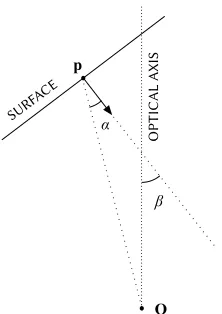
• View angle: A constraint on the maximum angle of the surface normal with respect to either the optical axis or the ray joining the optical center with the point.
A point feature may also be occluded, and thus not covered, if the ray from the feature to the optical center of the camera is interrupted by an opaque physical object. Occlusion is modeled in two distinct ways, depending on the type of information about the scene available.
• Deterministic occlusion: A bivalent criterion depending on whether the ray is interrupted by static objects or objects with known dynamics (e.g. walls).
• Random occlusion: A criterion depending on the probability that the ray to the point is inter-rupted by stochastic objects (e.g. humans).
In theory, deterministic occlusion could be treated as a special case of random occlusion with oc-cupancy probabilities in{0, 1}, but in practice the information is modeled sufficiently differently to
warrant the distinction; in fact, all surveyed models with a random occlusion criterion also consider deterministic occlusion separately. Self-occlusion is typically handled by a combination of the above and an upper bound of𝜋/2on the maximum view angle.
Environment Model
A nearly universal feature of environment models for visual coverage is some respresentation of static occluding structures, especially walls. Originating with the classic art gallery problem [26], the two-dimensional representation is oen in the form of one or more polygons; this generalizes to polyhe-drons in three-dimensions. Naturally, these are used in computing the deterministic occlusion crite-rion.
In some cases, a probabilistic model of occupancy and/or agent dynamics is also provided, allowing for the computation of the random occlusion criterion. is model may be informed in part by the static scene model, if one is available, in e.g. the imposition of constraints on agent motion.
Task Model
e relevance function𝑅takes the general form of Definition 3. As𝒮 ⊇ ℝ , task points in⟨𝑅⟩ are
located at physical points in the environment. Most commonly,𝑅represents a relatively large volume
of the environment to be observed, or some localized feature or object to be inspected or tracked. Frequently,𝑅is not specified explicitly: rather, it is implied by the structure of the static environment
model and/or the probability distributions of agent dynamics.
3.2.2 Geometric Coverage Models by Application
View Planning
e single-camera view planning problem received a significant amount of aention in the late 1980s and 1990s, prior to the advent of multi-camera networks. With the problem so posed, the objective is to find a viewpoint which adequately covers the target feature or features—which, in general, may be defined by a relevance function—according to a set of task requirements. e output of such methods is in the form of a (possibly empty) set of suitable viewpoints. It is generally straightforward to invert the criteria to obtain the coverage function over𝒮for any particular viewpoint. Tarabanis et al. [27]
present an excellent survey of the earlier work on this topic. Typically, the target systems employ a single camera observing a relatively well-controlled scene, and both require and can afford high-fidelity coverage models. e work of Cowan and Kovesi [7] and Tarabanis et al. [8] are quintessential examples from this period.
is exact approach does not scale well to systems with more than a few cameras at most, and the multi-camera context introduces additional design variables, including, of course, the number of cam-eras (possibly with a competing cost objective). Nonlinear optimization techniques and metaheuristics are the tools of choice, encouraging the use of much simpler coverage models. Typically, the objective is to search for either the solution with maximum coverage given a fixed cost or number of cameras, or the solution with minimum cost or number of cameras yielding some minimum coverage.
A basic formulation is equivalent to the classic art gallery problem [26]; González-Banos and Latombe [28] frame it so, with their model assuming omnidirectional visibility and infinite range. Significantly higher fidelity can be achieved simply by limiting visibility and range, but this funda-mentally changes the problem. Drawing on the sensor network literature, Ma and Liu [29, 30] propose a so-called boolean sector coverage model (derived from the common 2D disc model [31]), enabling them to treat view planning as a set cover problem [32, 33]. Qian and Qi [34], Wang et al. [35], and Jiang et al. [36] further develop this direction. Erdem and Sclaroff [37, 13] approach the problem with a more realistic two-dimensional model; subsequent results using different coverage model and opti-mization techniques but an overall similar method have been reported by Hörster and Lienhart [14, 15], Angella et al. [38], and Zhao et al. [16, 17, 18]. Malik and Bajcsy [39] address view planning for stereo camera nodes similarly. Yao et al. [40] adapt this type of approach to surveillance networks with tracking and handoff tasks, adding a “safety margin” to their coverage model to enforce the necessary coverage overlap. e work of Mial and Davis [41, 42, 43] extends the set of constraints to include random occlusion, important in a significant subset of applications involving relatively high densities of dynamic agents.
View Reconfiguration
3.2. Geometric Models of Visual Coverage
criterion in optimizing the configuration of rotating (panning) cameras.
View Selection
With a smaller solution space and usually more loosely defined task requirements, coverage model used in view selection focus on high-fidelity, usually graded quantization of coverage. Reed and Allen [49] and Chen and Li [21] approach the related next best view problem using coverage model similar to those used in view planning. Park et al. [50] use a relatively simplistic three-dimensional coverage model for view selection, acknowledging that a more sophisticated model could be substi-tuted. e approach of Shen et al. [51] is notable for assigning a scalar coverage metric to the stimulus space and for allowing task-specific weighting of the individual criteria; they also touch on a ver-sion of the view planning problem. Soro and Heinzelman [52] approach a slightly different problem: given a desired viewpoint directly—as opposed to a coverage objective in the form of a relevance function—their algorithm aempts to find the closest actual available viewpoint, subject to energy costs.
Load and Storage Distribution
For completeness, it is worth mentioning the geometric component of the topological coverage overlap model of Kulkarni et al. [53], which differs from other models surveyed here in that it is not analyt-ically derived from a camera model. Instead, it is purely empirical: through a Monte Carlo process whereby a structured target is placed at an arbitrary number of random points in the scene, each cam-era with a view to the target at a given position estimates its pose, and each Voronoi cell [54] around a target position forms a part of the geometric coverage of each camera that observed that position. In combination with the topological model, it is applied to load scheduling problems.
3.2.3 Analysis and Comparison of Models
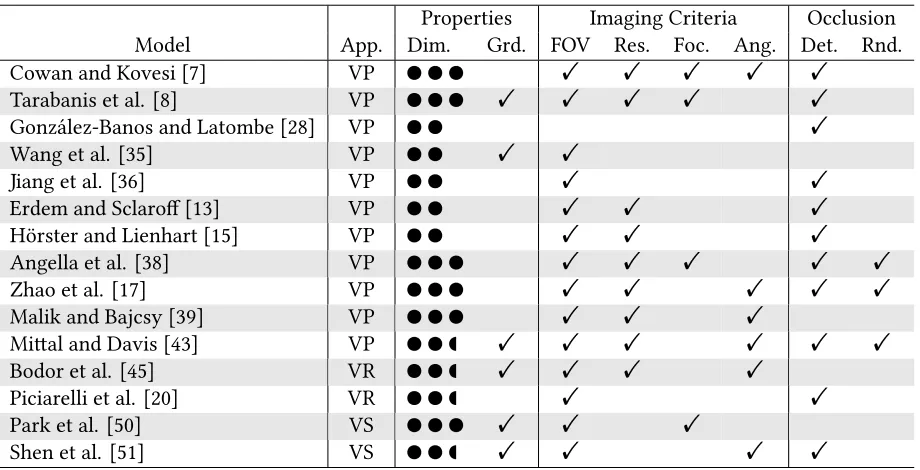
Table 3.1:Comparison of Selected Visual Coverage Models
Properties Imaging Criteria Occlusion
Model App. Dim. Grd. FOV Res. Foc. Ang. Det. Rnd.
Cowan and Kovesi [7] VP a a a ! ! ! ! !
Tarabanis et al. [8] VP a a a ! ! ! ! !
González-Banos and Latombe [28] VP a a !
Wang et al. [35] VP a a ! !
Jiang et al. [36] VP a a ! !
Erdem and Sclaroff [13] VP a a ! ! !
Hörster and Lienhart [15] VP a a ! ! !
Angella et al. [38] VP a a a ! ! ! ! !
Zhao et al. [17] VP a a a ! ! ! ! !
Malik and Bajcsy [39] VP a a a ! ! !
Mial and Davis [43] VP a a s ! ! ! ! ! !
Bodor et al. [45] VR a a s ! ! ! !
Piciarelli et al. [20] VR a a s ! !
Park et al. [50] VS a a a ! ! !
Shen et al. [51] VS a a s ! ! ! !
Dimensionality of the Stimulus Space
Although vision is an inherently three-dimensional phenomenon, many coverage models in the lit-erature are two-dimensional. In such cases, to simplify the problem at hand, it is assumed (either implicitly or explicitly) that
• all cameras are positioned in a common plane,
• all targets are constrained to a common plane, and
• the scene consists of occluding vertical “high walls.”
In models derived from the art gallery problem formulation, e.g. González-Banos and Latombe [28], the choice reflects the fact that three-dimensional generalization of the problem is NP-hard [55]. e vast majority of work on sensor network coverage problems [56] has employed two-dimensional disc models [31] (although the three-dimensional case has been studied [57]), assuming a roughly pla-nar environment. Some camera network models, including those of Ma and Liu [29, 30, 33], Wang et al. [35], and Jiang et al. [36], follow directly from this tradition, simply restricting the disc to a sector [31] for directionality. Erdem and Sclaroff [13] and Hörster and Lienhart [15] do not appear to share this lineage, and explicitly cite the complexity of their respective optimization methods as motivating their restriction to two dimensions. e model of Yao et al. [40] appears to be heavily influenced by that of Erdem and Sclaroff. In all of the preceding cases, the domain of camera coverage is explicitly planar.
respec-3.2. Geometric Models of Visual Coverage
tive constraints, but subsequent assumptions about the scene and viewpoint restrictions effectively reduce their models to the plane without loss of information. Shen et al. [51] present a similar treat-ment of view angle—in particular, including the inclination angle between the sensor and a human subject’s head with respect to the ground plane—in an otherwise two-dimensional model. Piciarelli et al. [20] account for a three-dimensional field of view criterion by projecting the elliptical cross-section of their conical visible region onto the plane.
Early coverage models used in single-camera view planning, such as those of Cowan and Kovesi [7] and Tarabanis et al. [8], are fully three-dimensional: the gains in generality and fidelity clearly out-weigh the added complexity in the single-camera case. ese advantages have induced a number of multi-camera coverage models across the application spectrum to follow suit. Cerfontaine et al. [58] describe a multi-camera method employing a three-dimensional coverage model presumably derived from the pinhole camera model, but give no details on the criteria. Park et al. [50] fully describe their model with a three-dimensional viewing frustum; the multi-camera complexity is handled by dividing the covered volume into discrete parts and generating look-up tables for the graded coverage func-tion. Angella et al. [38] employ a three-dimensional model drawing heavily on the single-camera view planning literature. e model of Malik and Bajcsy [39] is also fully three-dimensional. While Zhao et al. [17] use a three-dimensional model and do not restrict camera pose, targets—and therefore, the relevance function—are constrained to lie in a plane.
Coverage Function Valuation
View planning applications typically have well-defined task requirements, and the objective is simply to find any viewpoint which satisfies these requirements. Accordingly, models such as that of Cowan and Kovesi [7] are bivalent: either the viewpoint is adequate or it is not. Tarabanis et al. [8] discuss not only the adequacy of a viewpoint, but also its optimality, proposing an overall coverage quality metric based on the robustness (e.g. with respect to positioning error) in individual criteria.
In solving the view selection problem, one is interested in finding thebest view of a relevance function, to which a real-valued coverage function clearly lends itself. In Park et al. [50], the quality of coverage of a point𝐩 ∈ ℝ from a camera is considered to vary inversely with the distance from𝐩
to the center of the viewing frustum. e authors point out that developing a high fidelity coverage metric is not their focus, and allow that a more sophisticated definition could be substituted for their own. Shen et al. [51] explicitly set out to define such a metric for the restricted problem case of human surveillance; theirs takes the form of a real-valued coverage function.
Soro and Heinzelman [52] study several coverage-based valuations of viewpoints for view selec-tion, but as previously mentioned, their formulation is notably different than others discussed here. Roughly speaking, each valuation can be thought of as a distance metric on the space of admissible viewpoints. Were one to assign an ideal viewpoint to every𝐩 ∈ 𝒮, these metrics would effectively
constitute a coverage function per Definition 1.