ISSN(Online): 2320-9801
ISSN (Print): 2320-9798
I
nternational
J
ournal of
I
nnovative
R
esearch in
C
omputer
and
C
ommunication
E
ngineering
(An ISO 3297: 2007 Certified Organization)
Vol. 3, Issue 4, April 2015
Routing Method to Extend Network Lifetime
in Wireless Sensor Network
Sanghamitra
1, R.Suganya
2II year M.Tech Scholar (CNE), Dept of ISE, The Oxford College of Engineering, VTU, Bangalore, India Asst. Professor, Dept of ISE, The Oxford College of Engineering, VTU, Bangalore, India
ABSTRACT: The application of wireless sensor network consists of a wide variety of circumstances such as environmental observation, intrusion detection, and battlefield surveillance. The network is composed of a significant number of nodes distributed in a different area in which not all nodes are directly connected. These nodes are equipped with limited with battery power and capable of wireless communication. Resource limitation has to be taken care while designing wireless sensor network infrastructure. In wireless sensor network how to conserve the limited power source to extend the network lifetime.In this paper we proposed a EASR(energy aware sink relocation) to extend the network life time which deals with the residual battery energy of each sensor nodes to adjust the transmission range and relocate the sink.
KEYWORDS: wireless sensor network, energy aware routing, sink relocation, network lifetime.
I. INTRODUCTION
Due to recent technological advances and the fact that many comprehensive wireless device usages are proposed in diverse scopes, there is an impulse to increase the speed of the development of wireless communication technology. One of the new growing fields of wireless computer networks in recent years is Wireless Sensor Networks (WSNs) [1,2]. A WSN consists of hundreds or thousands of sensor nodes that are usually scattered over a certain area to perform monitoring tasks. The sensor nodes are low-cost, are equipped with limited battery power, and are small sized devices. Besides, they can monitor specific measurement data (e.g. temperature, humidity, and pressure) to detect abnormal events (e.g. a forest fire). Initially the sensor nodes are deployed manually or randomly in the sensing field to form a WSN. The end user may connect to a data concentration center called the sink node (or base station) via Internet or Satellite to send a request for querying a specific event or phenomenon on this sensing field.
Once a sensor node detects an unusual situation as designated by the sink node, it has to quickly propagate such an event occurred message to notify the end user. The WSN may also have fault-tolerance capability, that is, if the sensing data is lost, sensor nodes may recover the lost data from their inner caches. The end user will then eventually receive the reported information correctly from the sink node. The WSNs are usually deployed for use in harsh environments, the sensor nodes are not easily to be replaced or recharged when they run out of battery power. Thus, the most important research issue in the area of WSNs is how to conserve the limited battery energy to maximize the network lifetime.
ISSN(Online): 2320-9801
ISSN (Print): 2320-9798
I
nternational
J
ournal of
I
nnovative
R
esearch in
C
omputer
and
C
ommunication
E
ngineering
(An ISO 3297: 2007 Certified Organization)
Vol. 3, Issue 4, April 2015
II. RELATED WORK
Chu-Fu Wang et al.,[3] proposes a network lifetime enhancement method for sink relocation and its analysis in Wireless Sensor Networks. He describes the method to conserve network lifetime while performing the sensing and reporting task. He proposed energy-aware sink relocation (EASR) methods for mobile sink in WSNs. This method of sink relocation was an efficient one in increasing the network lifetime by avoiding the battery energy consumption. This sink relocation method requires mathematical analyses and efficient routing protocols. Özgür B. Akan et al., [4] proposes Event-to Sink Reliable Transport in Wireless Sensor Networks. He designed reliable event detection using minimum energy usage. This Event-to-Sink Reliable Transport (ESRT) protocol works by controlling the congestion of the network. Multiple event occurrences is accommodated in Wireless Sensor Networks. Here, the main function is run on sink and minimum functionality is shown at the source end.
Hui Wang et al., [5] describes Network Lifetime Optimization in Wireless Sensor Networks. In this protocol, design of physical, medium access control and routing layers are done in such a way that their network lifetime can be increased. An iterative algorithm is also proposed for large planar networks. Here, to address the problem of network lifetime Time Division Multiple Access technique is adopted. AnkitThakkar et al ., [6] elaborates on Cluster Head Election for Energy and Delay Constraint Applications of Wireless Sensor Network and proposes cluster formation that results in good performance with respect to energy and delay constraints of the network. In this cluster formation, cluster head collects and aggregates the data from member nodes and send it to the other cluster head or the base station, thus achieving good scalability.
III.ROUTING MECHANISMS
Efficient routing protocol should control the energy consumption of the network and they should reduce the complexity of the network. During communication between sensor nodes, these protocols should minimize the transfer delay occurring at the nodes. In this paper, we have compared various energy efficient routing protocols by maintaining better QoS[6].So these routing protocols should also concentrate on all these parameters to select the shortest path such that it should increase the network lifetime.The following routing scheme is as follows:
1)MCP
2) Stationary routing 3)One step routing 4)EASR
1) MAXIMUM CAPACITY PATH (MCP):
ISSN(Online): 2320-9801
ISSN (Print): 2320-9798
I
nternational
J
ournal of
I
nnovative
R
esearch in
C
omputer
and
C
ommunication
E
ngineering
(An ISO 3297: 2007 Certified Organization)
Vol. 3, Issue 4, April 2015
However, the available energy of node b is very low and the node b will run out of its energy rapidly.In order to avoid this fault, we proposed a path selection scheme, called as maximum capacity path scheme, for each sensor node to select a routing path with maximum capacityto sink. Let c(v)≥0 denote the available energy ofnode u in v and assume that c(s)=∞. Define the capacityofa routingpath P= vu, v1,…..vk, s as minimum node energy in P. The maximum
capacity path scheme is to determine a maximum capacity path from a specified sensornode to sink in the layered network.
For example, asshown in Fig. 1, the capacities of pathsare : e-c-a-s, e-c-d-s and e-d-b-s. 50, 5, and 5, respectively. Thus, the maximum capacity path schemewill select path as forwarding path e-c-a-s for node e. That is, node e sends data packets along pathe-c-a-s. In general, suppose that sensor node vhas k in-boundlinks (v,u1),(v,u2),……,(v,uk). Let
p(w)denote the maximum capacity value of maximum capacitypath P from node w to sink s. Thus, sensor node v selects node u* as forwarder to forward its data such thatp(u*)=max{p(u1), ………, p(uk)}.Then, node v updates its
p(v) by p(v)=min {c(v),p(u*)}[7].
2) STATIONARY ALGORITHM
The Stationary communication Algorithm is used to find the route from the source Node to destination Node.
Fig.2: stationary Routing Protocol
Fig2 shows the flowchart for the stationary routing protocol. As shown the fig the input is source Node, destination Node and coverage area is the inputs.
1. The Routing table for the source Node is retrieved.
2. The set of Nodes are found which have the distance within the coverage area.
3. If the set of neighbors has the destination Node then routing process is stopped otherwise go to step 4.
ISSN(Online): 2320-9801
ISSN (Print): 2320-9798
I
nternational
J
ournal of
I
nnovative
R
esearch in
C
omputer
and
C
ommunication
E
ngineering
(An ISO 3297: 2007 Certified Organization)
Vol. 3, Issue 4, April 2015
5. The process is repeated until the destination Node is reached.
It will discover a route.it first find neighbour node. if neighbour has destination it will stop the process. If it does not contain destination it will select he node who reply first. Disadvantages: Back and forth propagation
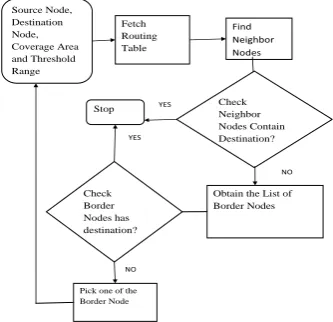
3) One Step Routing Algorithm
The One Step Routing Algorithm is used to find the route from the source Node to destination Node.
Fig.3:One Step Algorithm
Fig.3 shows the flowchart for the One Step Algorithm. As shown the fig the input is source Node, destination Node, coverage area and Threshold Range are the inputs. The Routing table for the source Node is retrieved.
1. The set of Nodes are found which have the distance within the coverage area are called In Nodes or IN Nodes
2. If the In Node Nodes have the destination Node then route discovered is stopped.
3. If the In Node Nodes does not have destination Node then go to step5.
4. The set of Nodes are found which have the distance between coverage area and the threshold are called border Nodes or border Node
5. If the border Nodes have the destination Node then route discovered is stopped.
6. If the border Nodes does not have the destination Node then next forward Node is picked as one among border Node.
7.The process is repeated until the destination Node is reached.
It will find a route whether it is efficient with respect to number of hops.no back and froth.
Disadvantage is energy consumption is more
Source Node, Destination Node, Coverage Area and Threshold Range
Fetch Routing Table
Find Neighbor Nodes
Check Neighbor Nodes Contain Destination?
Stop YES
NO
Obtain the List of Border Nodes Check
Border Nodes has destination?
YES
NO
ISSN(Online): 2320-9801
ISSN (Print): 2320-9798
I
nternational
J
ournal of
I
nnovative
R
esearch in
C
omputer
and
C
ommunication
E
ngineering
(An ISO 3297: 2007 Certified Organization)
Vol. 3, Issue 4, April 2015
4) EASR Routing Algorithm Transmission Range Adjustment
In general, a larger transmission range set for a sensor node will increase the number of neighbours and consequently enhance the quality of the energy-aware routing. However, it also bring the drawback of longer distance message relaying, which will consume more battery energy of a sensor node. On the contrary, for a shorter range of communication, although it does not help too much for routing, it can conserve the usage of the residual battery energy. In the proposed method, the transmission range adjusting will depend on the residual battery energy of a sensor nodes.
The nodes are classified into 3 types 1. Type 1 Nodes
2. Type2 Nodes 3. Super Healthy Nodes
1.Type1 Nodes
These are the nodes whose battery power is in the range of 0≤r(u) ≤B/3
r(u) is residual battery power of node u
B is initial maximum battery power of the node when network was initialized
2.Type2 Nodes
These are the nodes whose battery power is in the range of B/3≤ r(u) ≤B/2
r(u) is residual battery power of node u
B is initial maximum battery power of the node when network was initialized
3.Super Healthy Nodes
These are the nodes whose battery power in the range of
B/2≤ r(u) ≤B
r(u) is residual battery power of node u
B is initial maximum battery power of the node when network was initialized The Transmission range can be described as follows
SL No Battery Power Transmission Range
1
0
r
(
u
)
B
/
3
4
2
B
/
3
r
(
u
)
B
/
2
2
3
B
/
2
r
(
u
)
B
Sink Relocation:
ISSN(Online): 2320-9801
ISSN (Print): 2320-9798
I
nternational
J
ournal of
I
nnovative
R
esearch in
C
omputer
and
C
ommunication
E
ngineering
(An ISO 3297: 2007 Certified Organization)
Vol. 3, Issue 4, April 2015
The EASR algorithm can be described as follows
Fig.4 ESAR routing
1. Source Node, Destination Node, Transmission Range acts as an input.
2. The set of nodes which are within the transmission range are neighbor nodes.
3. If the neighbor nodes have the destination node then stop the process.
4. If the neighbor nodes does not have destination then we consider the residual battery power of the nodes.
5. The maximum residual battery is found and if it falls under the category of healthy nodes then one among them is chosen as the next forward node.
6. If the maximum residual battery of all nodes is under type1 then sink relocation process in initiated.
7. The above process is repeated until the destination is reached.
This routing will overcome the above disadvantages.
IV.SIMULATION RESULTS
The simulation studies involve the deterministic small network topology with 5 iteration of node as shown in Fig5. The proposed energy efficient algorithm is implemented with Ellipse. We transmitted same size of data through source node to destination node. Proposed algorithm is compared between two metrics Total Transmission Energyand Maximum Number of Hops on the basis of network lifetime and energy consumed by each node. We considered the simulation time as a network lifetime and network lifetime is a time. Our results shows that the metric total transmission energy performs better than the maximum number of hops in terms of network lifetime, energy consumption and total number of packets transmitted through the network.
It compares with all three algorithms with respect to two parameter number of hop and energy consumption so Energy aware sink relocation is most efficient to extend network lifetime.
Source Node Destination Node and Transmission Range
Find the
neighbor Nodes Check neighbor Nodes has destination node?
Stop
Find the residual battery of neighbor nodes Find the maximum residual battery power At least one
neighbor node is healthy?
Pick the node as the next forward node one among them
All Nodes are Type1
Perform Sink Relocation & Move Forward
YES
NO
YES NO
YES
ISSN(Online): 2320-9801
ISSN (Print): 2320-9798
I
nternational
J
ournal of
I
nnovative
R
esearch in
C
omputer
and
C
ommunication
E
ngineering
(An ISO 3297: 2007 Certified Organization)
Vol. 3, Issue 4, April 2015
Fig 5 graph with respect to number of hops Fig Graph with respect to energy consum
V.CONCLUSION AND FUTURE WORK
.
In this paper, we have analysed and compared various sink deployment techniques in wireless sensor networks. From this survey, we come to the conclusion that existing works not concentrate on the sink deployment technique and only very few works consider all the major objectives like threshold, area coverage and connectivity. A relocatable sink is approach for prolonging network lifetime by avoiding staying at a certain location for too long which may harm the lifetime of nearby sensor nodes.
REFERENCES
[1] P. Ferrari, A. Flammini, D.Marioli, A.Taroni, IEEE802.11 sensor networking IEEE Transactions on Instrumentation and Measurement 55 (2) (2006) 615–619.
[2]N. Jain and D. P. Agrawal, “Current trends in wireless sensor network design,” Int. J. Distrib. Sensor Netw., vol. 1, no. 1, pp. 101–122, 2005. [3] Chu-Fu Wang et al., a network lifetime enhancement method for sink relocation and its analysis in Wireless Sensor Networks. IEEE sensors journal, vol. 14, no. 6, june 2014
[4].Özgür B Akan, and Ian F Akyildiz, IEEE “ Event-to-Sink Reliable Transport in Wireless Sensor Networks” in IEEE/ACM Transactions on Networking , vol. 13, no. 5, pp. 1033-1066, October2005.
[5]Hui Wang, NazimAgoulmine, Maode Ma, and Yanliang Jin “Network Lifetime Optimization in Wireless Sensor Networks” IEEE Journal on Selected Areas in Communication, vol. 28, no. 7, pp.1127-1137,September2010.
[6]M. Marta and M. Cardei, “Improved sensor network lifetime with multiple mobile sinks,” J. Pervas. Mobile Computing, vol. 5, no. 5, pp. 542– 555,Oct.2009
[7]S. C. Huang and R. H. Jan, “Energy-aware, load balanced routing schemes for sensor networks,” in Proc. 10th Int. Conf. Parallel Distrib. Syst., Jul. 2004,pp.419–425. [8]R.C.ShahandJ.M.Rabaey,”Energy aware routing for low energy adhoc sensor networks” ,Proc. Of wireless communications and networking conference, pp.350355,2002.
BIOGRAPHY
R.Suganya is a Assistant professor in the Information Science Department, The Oxford College of Engineering Bangalore. She has three years of experience in the oxford college Engineering. She has presented two papers in national conference etc.