48
Review Paper on Unit Commitment Problem
and generation scheduling
Rajni
1, Ms. Kajal
21,2
Department of Electrical Engineering, R N College of Engg., Rohtak, Haryana
ABSTRACT
The topic of unit commitment has been and continues to be of interest to many researchers and for many utilities. Much of the past research has utilized integer programming, dynamic programming, linear programming, gradient directed search, and heuristic techniques. This paper gives a comprehensive review to solve the unit commitment problem as a decision analysis problem. The review provides most of the advantages of linear programming and dynamic programming with less stringent requirements on the pre-solution information needed for unit transition sequences.
Keywords: Electrical power system, single area, unit commitment.
I. INTRODUCTION
Electrical power plays a pivotal role in the modern world to satisfy various needs. It is therefore very important that the electrical power generated is transmitted and distributed efficiently in order to satisfy the power requirement. The Economic Load Dispatch (ELD) problem is the most significant problem of optimization in forecasting the generation amongst thermal generating units in power system. The ELD problem is to plan the output power for each devoted generating unit such that the cost of operation is minimized along with matching power operating limits, load demand and fulfilling diverse system limitations. The ELD problem is a significant problem in the operation of thermal/hydro generating station. It is considered an optimization problem, and is defined for minimized total generation cost, subject to various non-linear and linear constraints, in order to meet the power demand.
The ELD problem is classified in two different ways, as convex ELD problem and non-convex ELD problem. The convex ELD problem is modeled by considering the objective function as minimizing the generator cost functions considering linear limitations/constraints. In the nonconvex ELD problem the non-linear limitations/constraints are considered beside linear limitations while reducing cost function. The linear constraints, that is the generation capacity and power balance leads the ELD problem as approximate, simplified problem and the characteristics curve is assumed to be piecewise linear. A more precise and accurate problem is modeled by having the non-linear constraints such as prohibited operating zones, valve point effects and ramp rate limits.
The problem of ELD is usually multimodal, discontinuous and highly nonlinear. Although the cost curve of thermal generating units are generally modeled as a smooth curve, the input output characteristics are nonlinear by nature because of valve-point loading effects, Prohibited Operating Zones (POZ), ramp rate limits and so on. Large steam turbine generators normally have multiple valves in steam turbines. These valves are opened and closed to keep the real power balance. However, this effect produces the ripples in the cost function. This effect is known as valve-point loading effect. Ignoring of valve-point effects leads to inaccurate generation dispatch. Besides this, the generating units may have definite range where operation is abandoned due to the physical limitations of mechanical components. Such restricted regions of loading are commonly known as POZ.
When a generating unit has POZ, its operating region breaks into remote sub-regions, thus forming a non-convex decision space. Furthermore, the operating range for online units is restricted by their ramp rate limits. To keep thermal changes in the turbine inside safe limits and to avoid shortening of life, the rate of increase or decrease of power output of generating units is limited within a range. Such ramp rate constraint makes the conventional ED problem as a Dynamic Economic Dispatch (DED) problem. The presence of these nonlinearities in practical generator operation makes solving the ED problem more challenging.
49 coal based power stations. The generation of electricity from coal releases several contaminants, like Sulphur Oxide (SOx), Nitrogen Oxide (NOx) and Carbon Oxide (COx) in atmosphere. This causes negative effects to human health and the quality of life. It also causes damage to vegetation, acid rain, reducing visibility and global warming. The detrimental influence to environment by discharge of gases from coal based power plants can be diminished by scheduling of appropriate load to each generator. But this may cause rise in the operating cost of generators. So, it is vital to discover out a solution which gives neutral result between emission and cost. This can be attained by Combined Economic Emission Dispatch problem.
Generator Operating Cost
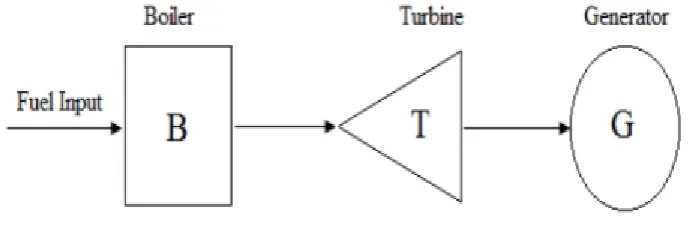
The overall operation‟s cost consists of the cost of labor, fuel cost, maintenance and supplies. Normally maintenance, supplies and costs of labor are set fractions of arriving coal costs. The power yield of fossil plants is raised in sequence by unlocking a set of valves to its steam turbine at the inlet. To control every generators output power, the power plant employs several valves. The valve point loading effect occurs when each steam inlet valve in the turbine start to open & throttling losses occur. The simplified model of thermal/fossil plant is shown in figure 1. The plant‟s operating cost has the form as shown in figure 2. For dispatch purposes, this cost is generally estimated by one or more quadratic segments. So, in the active power generation, the curve of fuel cost takes up a quadratic form, given as:
Figure 1. Simplified model of a thermal plant
Fuel Cost
Power Output (MW)
Figure 2. Classic fuel cost curve of thermal generating unit
The fuel cost curve may have a lot of irregularities. The irregularities happen when the output power is raised by means of supplementary steam condensers, boilers or extra equipment‟s. The incremental fuel cost can be conveyed by a number of piece-wise linearization inside the continuous range.
II. LITERATURE REVIEW
50 used to meet the total consumer demand. Economic load dispatch problem can be defined as allocating loads to plants or generators for minimum cost while satisfying various operational constraints.
The generators are to be scheduled in such a way that generators with minimum cost are used as much as possible. In addition the growing public consciousness of environmental protection has enforced the utilities to adapt their operational policies to decrease the pollution and atmospheric emissions. In India, two third of the electrical power generated is from coal based power stations. The generation of electricity from coal releases several contaminants, like Sulphur Oxide (SOx), Nitrogen Oxide (NOx) and Carbon Oxide (COx) in atmosphere.
This causes negative effects to human health and the quality of life. It also causes damage to vegetation, acid rain, reducing visibility and global warming. The detrimental influence to environment by discharge of gases from coal based power plants can be diminished by scheduling of appropriate load to each generator. But this may cause rise in the operating cost of generators. So, it is vital to discover out a solution which gives neutral result between emission and cost. This can be attained by Combined Economic Emission Dispatch problem.
From the year 1959 to so far, appreciable research work is done in the area of unit commitment problem. The brief overview of some important research papers according to various methodologies is listed below:
Sisworahardjo N. S. and El-Keib A. A. presented the Ant Colony Search Algorithm (ACSA)-based technique for solving the unit commitment problem using a 10-unit system.
Chusanapiputt S. et al. proposed a new methodology called hybrid ant system/priority list method (HASP) to solve unit commitment problem with operating constraints for a test system 100 generating units. Yu D. et al projected a hybrid algorithm composed of ant colony optimization (ACO) algorithm and Lambda-iteration named as HACO effective for finding solution to UCP in the range of 10 to 60 generating units.
Chitra N. et al. focused on power quality improvement in autonomous microgrid considering voltage frequency (Vf) regulation and harmonic analysis as the main parameters.
Senjyu T. et al. presented a solution to the thermal UCP using Genetic Algorithm (GA) for minimum up or minimum down time constraints. Damousis I.G. et al. developed a new Genetic Algorithm based solution for UCP. The integer coding used in new genetic algorithm differentiates it from previous binary GA and the test performed on 100- unit system showed better results compared to the LR method.
Ouiddir R. et al. [9] used the genetic algorithm to find the solution of an economic dispatch problem in the Western Part of the Algerian power network. Babu A.S. et al. described a Hybrid Genetic Algorithm for constructing a departmental class timetable. Kushwaha N. et al. proposed a genetic algorithm (GA) based bacterial foraging (BF) algorithm for optimization of a function. The proposed method gives an emphasis on mutation, crossover, step sizes and the lifetime of bacteria.
Bilolikar V.S. et al. presented a hybridized approach using simulated annealing (SA) and genetic algorithm (GA) to solve multi mode resource constrained project scheduling problem.
Valenzuela J. and Smith A. E. demonstrated that a memetic algorithm (MA) combined with Lagrangian relaxation (LR) can be very efficiently used for solving large unit commitment problems. Mafteiu L. O. and Mafteiu-Scai E. J. developed a memetic algorithm (MA) for the solution of linear system of equations by converting into an optimization problem.
Mafteiu-Scai L. O. proposed a technique using memetic algorithm (MA) for the improvement of convergence of iterative methods to solve linear or nonlinear systems of equations. Sanusi H. A. et al. investigated the performance of GA and MA for a constrained optimization and found that MA converges quicker than GA and produces more optimal results but the time taken by iteration in GA is less than that in MA.
51 Hardiansyah et al. investigated the features of artificial bee colony algorithm (ABC), differential evolution (DE) algorithm and particle swarm optimization (PSO) for 3 and 6-unit systems and found that differential evolution algorithm converges faster than artificial bee colony algorithm and particle swarm optimization. Ravi C.N. and Rajan C. C. A. used differential evolution (DE) optimization algorithm to solve optimal power flow (OPF) problem considering IEEE 30 bus standard power system.
Lee K. S. and Geem Z. W. developed a new Harmony search (HS) algorithm for global optimization. Coelho L.S. and Mariani V.C. improved the established harmony search (HS) algorithm using exponential distribution for a 13- unit system. Coelho L.S. et al. proposed a customized harmony search algorithm with differential evolution (DE) and chaotic sequences, CHSDE algorithm, for solving the ELD problem for a 10- unit system.
Tuo S. and Yong L. presented an enhanced harmony search with chaos (HSCH). The test results show that the HSCH algorithm is a convincing algorithm and it is much better than the classical HS technique and harmony search algorithm with differential evolution (HSDE). Shukla S. and Anand A. applied harmony search technique for the multi-objective optimization of a styrene reactor.
Arul R. et al. applied harmony search algorithm to solve ELD problem with transmission losses under the changing patterns of consumer load for standard 6-bus system, standard IEEE-14 bus system, and the standard IEEE-30 bus system.
Xue-hui L. et al. adopted a meta-heuristic algorithm, the shuffled frog-leaping algorithm (SFLA) and applied to solve travelling salesman problem. Reddy A. S. and Vaisakh K. customized the shuffled frog-leaping algorithm into a modified shuffled frog- leaping algorithm (MSFLA) for solving the economic emission load dispatch problem for IEEE- 30 bus system.
Pourmahmood M. et al. also proposed a modified shuffled frog- leaping (MSFL) algorithm. Jebaraj L. et al. applied SFLA to optimize the location and the size of the two FACTS devices, TCSC and SVC, for IEEE 30- bus system under certain considered conditions. Anita J. M. and Raglend I. J. presented the application of SFLA optimization algorithm to find the solution of UCP to a 10- unit thermal system.
Fang H., et al. presented a new snake algorithm which is demonstrated to overcome the drawbacks of traditional snake/ contour algorithms for contour tracking of multiple objects more effectively and efficiently. The experimental results of the tests carried out have proved that the proposed method is robust, effective and accurate in terms of finding the boundary solutions of multiple objects.
Simon D. developed biogeography- based optimization (BBO) algorithm and tested for 14 benchmark functions using BBO and compared the results with GA, PSO, DE, ES, stud genetic algorithm (SGA), PBIL and ACO. Du D. demonstrated the BBO technique after being modified using evolutionary strategy (ES) techniques. Secondly, the modified BBO technique had been applied to the travelling salesman problem and compared the results with GA and found that BBO is better in operation than GA.
Kundra H. et al. proposed a new optimization method combining the features of BBO and PSO to improve the reliability of underground water penetration. Khokhar B. et al. used BBO algorithm to solve the economic dispatch problem of optimal scheduling taking certain cases over 24-hour time.
Scheidegger C. et al. extended the standard BBO technique to a new algorithm which had been named as distributed BBO (DBBO). Du D. et al. incorporated features of ES for modifying BBO and a refusal approach is also included in BBO. The modified BBO had been tested for 14 benchmarks. Rarick R. et al. applied BBO algorithm and GA to the same power flow problem on IEEE 30-bus system to make a comparison between the two heuristic techniques.
Simon D. et al. showed that BBO is generalized form of GA with global uniform recombination often known as GA/GUR. BBO had been compared with GA/GUR taking certain benchmark problems/ cases and analysis has been obtained from the Markov models of the two techniques.
III. SINGLE AREA UNIT COMMITMENT PROBLEM FORMULATION
52 heat rate & fuel price information which is normally a quadratic equation of power output of each generator at each hour determined by Economic Dispatch(ED).
where, Ai, Bi, Ci are the cost coefficients. The total fuel cost over the given time period „T‟ is
where, Xi (t) is the position or status of ith unit at tth hour. Start up cost is that cost which occurs while bringing the thermal generating unit online. It is expressed in terms of the time (in hours) for which the units have been shut down. On the other hand, shut down cost is a fixed amount for each unit which is shut down. A start up cost can be expressed as :
(3) where,
DTi- Shut down time
MDTi- Minimum down time
HSCi- Hot start up cost
CSCi- Cold start up cost
CSHi- Cold start hour of ith unit.
CONCLUSION
The Unit Commitment is the essential and vital step in power system operational planning. In addition to the ED objective, environmental concern that arises from the emission produced by fossil fuel electric power plants becomes a major problem to be addressed. The emission and unit commitment are conflicting in nature and they have to be considered together to find optimal dispatch. The problem is formulated as single area unit commitment problem in which both the objectives (emission and economy) have to be minimized. This paper gives a comprehensive review to solve the unit commitment problem as a decision analysis problem. The review provides most of the advantages of various modern soft computing techniques with less stringent requirements on the pre-solution information needed for unit transition sequences.
REFERENCES
[1]. Gaing, Zwe-Lee. "Particle swarm optimization to solving the economic dispatch considering the generator constraints." IEEE Transactions on Power Systems,vol. 18 , no. 3, pp: 1187-1195, 2003. [5].R. T. F. Ah King and H. C. S. Rughooputh, “Elitist Multi-objective Evolutionary Algorithm for Environmental/Economic Dispatch,” Congress on Evolutionary computation, vol. 2, pp. 1108-14, 8-12 Dec.2003.
[2]. T. Aruldoss Albert Victoire and A. Ebenezer Jeyakumar ,“Hybrid PSO-SQP for economic dispatch with valve-point effect” Electric Power Systems Research; 71,pp: 51-9, 2004.
[3]. M. Sudhakaran, S.M.R Slochanal, R. Sreeram and N Chandrasekhar, “Application of Refined genetic Algorithm to Combined Economic and Emission Dispatch” J. Institute Of Engg. (India) ,vol. 85, pp: 115-119, Sep. 2004.
[4]. M. Sudhakaran and S.M.R Slochanal, “Integrating Genetic Algorithm and Tabu Search for Emission and Economic Dispatch Problem” J. Institute of Engg. (India) ,vol. 86, pp: 22- 27, June.2005.
[5]. Chiang, Chao-Lung. "Improved genetic algorithm for power economic dispatch of units with valve-point effects and multiple fuels." IEEE Transactions on Power Systems, vol. 20, no. 4, pp: 1690-1699, 2005.
[6]. Bhardwaj A., Tung N. S., Shukla V. K. and Kamboj V. K., “ The Important Impacts of Unit Commitment Constraints in Power System Planning”, International Journal of Emerging Trends in Engineering and Development, Vol. 5, No. 2, July 2012, pp. 301- 306.
[7]. Yu D., Wang Y. and Guo R., “A hybrid ant colony optimization algorithm based Lambda-iteration method for unit commitment problem”, Proc. 2nd WRI Global Congress on Intelligent Systems, Wuhan, China, 16- 17 Dec. 2010, pp. 19-22.
53 [9]. Senjyu T., Yamashiro H., Shimabukuro K., Uezato K. and Funabashi T., “Fast solution technique for large-scale unit commitment problem using genetic algorithm”, IEEE Proc. Generation, Transmission and Distribution, Vol. 180, No. 6, Nov. 2003, pp. 753- 760.
[10]. Damousis I.G., Bakirtzis A.G. and Dokopoulos P.S., “A Solution to the Unit-Commitment Problem Using Integer-Coded Genetic Algorithm”, IEEE Transactions on Power Systems, Vol. 19, No. 2, May 2004, pp. 1165- 1172. [11]. Ouiddir R., Rahli M. and Abdelhakem-Koridak L., “Economic Dispatch using a Genetic Algorithm: Application to