Authenticated Interleaved Encryption
and its Application to Wireless Sensor Networks
Claude Castelluccia, INRIA
[email protected]
Abstract—
We present AIE (Authenticated Interleaved Encryption), a new scheme that allows nodes of a network to exchange messages securely (i.e. encrypted and authenticated) with-out sharing a common key or using public key cryptogra-phy.
Our scheme is well adapted to networks, such as ad hoc, overlay or sensor networks, where nodes have limited ca-pabilities and can share only a small number of symmet-ric keys. It provides privacy and integrity. An eavesdrop-per listening to a communication is unable to decrypt it and modify it without being detected. We show that our proposal can be used in wireless sensor networks to send encrypted packets to very dynamic sets of nodes without having to establish and maintain group keys. These sets of nodes can be explicitly specified by the source or can be specified by the network according to some criteria, such as their location, proximity to an object, tempera-ture range. As a result, a node can, for example, send encrypted data to all the nodes within a given geograph-ical area, without having to identify the destination nodes in advance.
Finally we show that our proposal can be used to imple-ment a secure and scalable aggregation scheme for wire-less sensor networks.
I. INTRODUCTION
Wireless sensor networks are often deployed in public and unattended environments. As a result, any malicious node can easily eavesdrop on communications and retrieve sensitive information. It is therefore essential to encrypt communications.
However encryption in wireless sensor networks is problematic since nodes have limited CPU and memory capabilities. Public key encryption is too CPU expensive and only symmetric cryptography algorithms can possibly be used. Symmetric cryptography requires the communi-cating nodes to share a common secret. Since wireless sen-sor networks are often very large and dynamic, it cannot be expected that each node be configured with a pairwise key with all the nodes the network. Furthermore public key exchange protocols, such as Diffie-Hellman key exchange, require too much resource and are excluded. Some prob-abilistic key exchange protocols have been proposed [1], but they still require few protocol exchanges and are there-fore not practical if the communication is short-lived (i.e. a node only wants to send one or two packets).
One common feature to many sensor networks is the need to communicate secretly with arbitrary sub-groups of sensors. Such communication may be short-lived and consist of only few messages. Furthermore the members of these groups might be very dynamic and unknown to the source. The group members might actually be defined on the basis of some criteria, such as location, proximity to an object, temperature range or any other environmental property. Existing group keying solutions [2] are not appli-cable to small and dynamic groups. Most of them assume that the group is rather stable, revocation is a rare event, and that the size of the group is quite close to the entire nodes population.
The only two possible approaches today are either to encrypt a message as many times as there are receivers (as-suming the source shares a key with each of the receivers) or to enumerate all possible sensor subsets. Both solutions are clearly unpractical, highly inefficient and unworkable in any realistic sensor network. Novel methods are needed.
Our Contributions: We propose a new scheme that allows two nodes of a network to exchange messages securely (i.e. encrypted and authenticated) without sharing a com-mon key or using public key cryptography. Our scheme also solves the short-lived group encryption problem de-scribed previously. It allows a node to send encrypted packets to very dynamic sets of nodes without having to establish or update group keys. These sets of nodes can be explicitly specified by the source or can be specified by the network according to some criteria, such as their location. As a result, a node can, for example, send encrypted data to all the nodes within a given geographical area, without having to identify the destination nodes in advance. Fi-nally we show that our proposal can be used to securely aggregate encrypted data.
Our proposed scheme is based on stream ciphers and does not rely on any public key cryptography algorithms. It is therefore very efficient and well adapted to wireless sensor networks. It provides privacy and integrity pro-tection. It is secure against passive eavesdroppers, and secure against active attackers as long as no more than consecutive nodes get compromised, where is a system parameter.
Encryp-tion scheme, that provides authenticaEncryp-tion in addiEncryp-tion to pri-vacy protection. Section III shows how the AIE proposal can be used to solve the short-lived secure group commu-nication problem. It also explains how our proposal can be useful to implement a secure and scalable aggregation scheme for wireless sensor networks. The related work is presented in Section IV. Section V concludes our work.
II. INTERLEAVEDENCRYPTION
A. Assumptions/Security Model
We describe the assumptions regarding the network be-fore we present our schemes in detail.
1) Key distribution Model: We assume the Leap-frog key distribution model [3]. In this model, each node shares a secret key, with each of its direct neighbors
. Furthermore node shares a key, with each of node
’s direct neighbors. These keys are not known to node
(see Figure 1).
These keys can be configured in a setup phase, when the nodes are first deployed, by a network administrator or using some kind of probabilistic key pre-distribution pro-tocols [1]. We also assume that a node can check whether its neighbors have been revoked from the network. The details of the key establishment and revocation are out of the scope of this paper.
1 2
3
9
5 6
7 10
4
8 k_{1,2}
kn_{1,2}
Fig. 1. Key Distribution Model. Node shares a secret key, with node . It also shares a key, with ’s direct neighbors, i.e.
, , and . This key is not known to .
2) Commutative Encryption: Our interleaved encryp-tion proposal relies on a commutative encrypencryp-tion scheme i.e. an encryption scheme, denoted as
! #"%$ , that satisfies the following property:
'&( )
+*+ #"%$#$,
+*- .
!&( )"/$.
Most block ciphers are not commutative. However stream ciphers are commutative. Stream cipher encryption and decryption operations are defined as follows:
10+
"%$2,3"546+7 and8:9 10;
"%$<,3"=4>?7 , where+7 is a stream key generated from a pseudo-random generator keyed with the secret key . Since the @ACB (exclusive
OR, 4 ) operation is commutative, stream ciphers are commutative. More specifically,:
0D
0FE
"%$#$ ,
" 4 ?7
E
$G4
D
,
"=4H+7
D
$I4H?7
E
,J 10KEL
101D( "%$#$.
Some public key encryption schemes, such as the Pohlig Hellman encryption scheme, are also commutative. For simplicity, we assume a stream cipher in the description of our scheme.
3) Security Model: Our goal is to design a scheme that allows a nodeM to send a message" privately to a node8 without having to establish a secret key. Our scheme must be secure against passive and active attackers. A passive attacker should not be able to decrypt and recover the mes-sage. An active attacker should not be able to modify the message without being detected and should not be able to recover the message" .
4) Terminology: The following notations appear in the rest of this paper.
N
: is the secret key shared between node O and nodeOP .
N
: is the secret key shared between nodeOQ and
OP ’s neighbors. This key is unknown toOR .
N
TS
: is the Initialization Vector -IV- used by node
OU to encrypt a message for nodeOR . Note that TS
must be unique for each message. It could, for exam-ple, be implemented as a counter.
N
S
.! )"/$ is a stream cipher encryption algorithm that encrypts message" using the key and the IV
S
. For example the stream cipher RC4 can be used in our scheme. In the case,
0
S
V! #"%$ = RC4(v,k) xor m.
N
8W9 (
S
.!
$ is the decryption algorithm that decrypts the cipher
into the plaintext " using the key and the IV S
. If RC4 is used, 8W9 (
S
.!
$= c xor RC4(v,k).
N6X :,5
S
.L( #"%$.
X
is the result of the en-cryption of message" with the key; and the IV
S
.
N6X
%,Y (
S
. ( #"%$.
X
is the result of the encryption of message" with the key and the IVS
.
N6X A
XZ [ ,\
S
. )
S
Z
.
Z
[ #"%$. Note that since we use a commutative steam cipher,
X
A XZ
[ , XZ
[ A
X
.
B. The Basic Interleaved Encryption Protocol
This section describes the basic interleaved encryption protocol. It is assumed that nodeM wants to privately send a message" to node8 . All the nodes along the path from
M to8 are denotedO], whereO_^ is the source,O
D
the first node on the path,..., andOQ` the final destination.
It is also assumed that each node only knows the next hop on the path to the destination node8 and that each nodeO_ on the route shares a pairwise key, ba
D
, with
O_ca
D
. It is also assumed thatO] shares a key, ca
D
with
O_ca
D
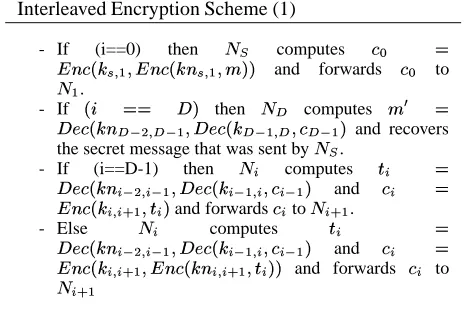
1) Protocol Description: The protocol executed by each node O , on the path from M to8 , is described in Table I:
Interleaved Encryption Scheme (1)
- If (i==0) then computes
and forwards to .
- If then computes
"! )"! #! #! and recovers
the secret message that was sent by$ .
- If (i==D-1) then % computes &%
%! )%! %! % %! and % %%(' &% and forwards% to%(' .
- Else % computes &%
%! )%! %! % %! and % % %(' % %)' &% and forwards % to %(' TABLE I
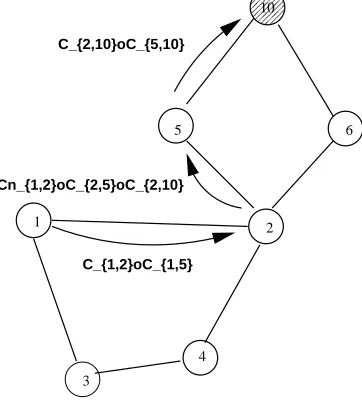
2) An example: This section gives an example of the previous algorithm using the network displayed on Fig. 2. - The source node,M , selects two random Initialization
Vectors,TS+* D andTS+* E , computes * , TS+* E . * D ) TS+* D . * D
)"/$)$, and sends the message, 8% VM
TS-* D S+* E */.
to nodeO
D
(i.e. the first node on the path toward D). - NodeO
D computes0 D ,J8:9 S+* D . * D *
$ and re-trieves ( TS+* E V * D
)"/$ (note that sinceO
D does not know * D
, it cannot recover" ). It then selects two random values,TS
D
E
andTS
D
1 , computes D , TS D
1 .
D E . S D E V D E 20 D
$)$ and sends the message : ,C8% .M
TS * E S D E TS D 1 D .
to nodeO
E . - O E computes 0 E , 8W9 ( TS D E . D E )8:9 TS * E . *
D D
$#$ and
re-trieves S E 1( . D E
)"/$ (since O
E does not know D E
, it cannot recover " ). It then selects two random values, TS
D
E
and TS
D
1 , computes 1E , TS E 3( . E 1( ) TS E 1( . E 1( 20 E $)$ and sends the message: , 8% VM
TS D 1 TS E 1 S E 3( KE . to nodeO1 .
- ...
- Node O_ receives message
,C8% .M TS 4 E TS 54 D S 54 D ca D 4 D .
from O 54
D
, computes
0 , 8:9 S 54 D . 4 D )8:9 TS 4 E . 54 E 4 D 54 D $)$ and retrieves S 54 D ba D . 4 D
#"%$ (since O does not know 4
D
, it cannot recover" ). It then selects two random values, TS
ca D and S ca E . If nodeO_ca D
is node8 , i.e. the destination node, node
OU computes , TS ca D V(ca D
60$ and sends the message: , 8% VM
TS 4 D ca D TS ca D . to node OUba D
. If nodeO_ca
D
is not the destination, it computes
, ( TS ca E
. ca
D . TS ba D V(ba D
60 $)$
and sends the message:
,C8% .M TS 4 D ca D TS ca D TS ba E .
to nodeO_ca
D
.
- Node D (destination) computes
8W9 ( TS+7 4 D 7 V 7 4 D 7 )8:9 TS+7 4 E 7 V 7 4 E 7 4 D 7 $#$ and retrieves the original message" .
89898 89898 :9: :9: 1 2 3 5 6 10 4 C_{1,2}oCn_{1,2} Cn_{2,5}oC_{5,10} Cn_{1,2}oC_{2,5}oCn_{2,5}
Fig. 2. Interleaved Encryption: Node; sends a message,< , securely to node;2= . Node; encrypts< with and and sends the results to node> . Node> decrypts the message with( and encrypts it with
) and -) . The results is sent to node?. Node? decrypts the message with ) and , and encrypts it with ) . The result is sent to node;2=. Node;2= decrypts the message withC)
and -) , and retrieves the initial message< .
C. Security Analysis
1) Privacy protection analysis: This section analyzes the security of the privacy/confidentiality of the Inter-leaved encryption scheme in presence of passive and ac-tives attackers. The goal of an attacker is to decrypt and retrieve the message" .
a) Passive attacks: The encryption scheme de-scribed in the previous section is secure against pas-sive attackers. A node O], on the path, can retrieve
54
D
#"%$. However since it does not know 54
D
and since
(A@
$ is semantically secure, it cannot retrieve
" . Furthermore an eavesdropper, that is not on the path, see, the message" encrypted three times with three dif-ferent keys and cannot retrieve it.
b) Active attacks: As explained above, the pro-tocol is secure against isolated compromised nodes. As in [3], the message " can only be retrieved if two adjacent nodes, one of them being on the path, collude. In fact, an attacker that compromises nodes OU and O_54
D
obtains the keys 4
D , L4 D , Lca D
and ca
D
. When it receives the cipher
54 D , 54 D # . L54 D # . 4 E 54 D #"%$#$#$ from node OU54
E
Furthermore, an active attacker (a compromised node) can modify the destination field of the message.The message will then be delivered to the wrong destina-tion and recovered. This attack is possible because an intermediate node cannot authenticate the message and verify its integrity. In particular it cannot verify whether the node, it received the packet from, did not modify it (its destination address for example). The solution is to authenticate/sign the destination address such that intermediate nodes can reject packets whose destination address has been modified. However since the message changes at each intermediate node, mes-sage authentication code (MAC) can not be used (even interleaved-authentication cannot be used [4], [5]). The proposed solution is to link the encryption key and the destination address, 8 . For example, instead of using the key L ,the key
, 7
(8 A
9C $ could be used, where A
9 is a unique random value or a counter sent together with the encrypted message. If IV-based mode of operation is used, as in RC4, another so-lution is to derive the IV from a nonce and the destination address, for example 5,
7 A
9 )8W$. As a result if nodeOU54
D
changes the destination address8 with8 [ , NodeOU will receive a message
54 D fromO_54 D equal to TS [ 4 D .L4 D ) S 54 E
) . 54
E 4 D TS [ 4 D 54 E . 4 D ca D
#"%$#$)$#$ , where TS [ . Z , 7 A 9 . Z
)8 [ $ and TS ) Z , 7 A 9 . Z )8W$. NodeO then computes0
[ , 8W9 ( TS [ 4 D . 54 D , 8:9 S [ 54 E . 54 E 4 D
$)$. Since node O 4
E
used S
instead of TS
[
, O will not retrieve
0 , TS 54 D ba D V 4 D
) #"%$ but
0 [ ,J8:9 TS [ 54 E V 4 E 54 D ) TS 54 E .L54 E # TS 4 D ca D .L4 D ca D
#"%$#$#$)$. Since TS [ 4 E and TS 54 E are different, 0
[
will differ from
0#. This error will then propagate until the destination node8:[ and will scramble the ciphertext.. As a result,8 [ won’t be able to correctly decrypt the message and retrieve the correct plaintext" . The previous attack will fail.
As a result, this modified interleaved encryption scheme is secure against active attackers as long as no more than two adjacent nodes are not compromised.
2) Integrity Protection Analysis: This section analyzes the security of our proposal in term of integrity. The goal of an attacker is not, as in the previous section, to retrieve
" but to modify" without the destination8 noticing it. Since message authentication is not provided, an active attacker can modify the message (and therefore the cor-responding plaintext) in transit by modifying some bits. Since our scheme is based on a stream cipher, the desti-nation has no way of detecting it. This is an attack on the integrity. This problem can be solved by having the source encrypting the message
"%$" instead of " , where
2@
$ is a redundancy function. An attacker would then be able to modify" but not
"%$. Modification of the message could then be detected by the destination node [6].
It is believed that this combination of encryption and
re-dundancy functions provide plaintext integrity (see remark 5.3 of [7]) if a stream cipher and a redundancy function such as AXU are used. Furthermore if the authentication tag is positioned before the message, instead of at the end, the AXU property is sufficient to provide cipher unforge-ability (CUF-CPA).
An encryption scheme is ciphertext unforgeable if it is infeasible for an attacker that has access to an en-cryption oracle with the key to produce a valid ciphertext under not generated by as response to one of the queries by [7]. Using the message length as an input of the redundancy function might also be a good design practice to avoid the attack described in [8].
D. Authenticated Interleaved Encryption
The section describes an extension of the basic protocol that provides integrity and privacy security against active attacks.
- The source node selects two nonces
A 9 * E and A 9 * D and computes TS * E , A 9 * E
8M$ and
TS * D , A 9 * D
8M$. It then generates
* , TS+* E V * D . S+* D . * D )"
" 9 $#$)$, where
2@
$ is a redundancy function and 9 is the length of message " . The message
,C8% .M A 9 * D A 9 * E * .
is sent to node
O
D
(i.e. the first node on the path toward D). - Node O
D computes TS+* D , A 9 * D
8M$,
0 D , 8:9 TS+* D V * D *
$ and retrieves:
TS * E V * D
)"/$ . It then selects two nonces
A 9 D E and A 9 D
1 and computes
S D E , A 9 D E
8M$ and
S D 1 , A 9 D
1 8M$.
It generates D
,
TS
D
1 .
D E . S D E V D E 60 D
$)$ and sends the message: ,C8% .M A
9 ^ E A 9 D E A 9 D 1 D .
to nodeO
E . - O E computes 0 E , 8W9 ( TS D E . D E )8:9 TS+* E . *
D D
$#$ and
re-trieves S D 1( . D E
#"%$. It then selects two nonces, A
9
E
1 and A
9
E
3 , and computes 1E , TS E 3( . E
1 . S E 1 V E 1 60 E
$)$. It sends the message,C8% .M A
9 D 1 A 9 E
1 A 9 E 3( KE . to nodeO1 .
- ...
- Node O receives message
,C8% .M A 9 54 E A 9 54 D A 9 4 D ca D 54 D .
fromO 54
D
, computes TS 4 D , A 9 4 D 8W$, TS 54 E , A 9 4 E
8W$ and 0 ,
8W9 ( TS 4 D # .L4 D ) )8W9 ( TS 4 E
) . 4
E 54 D 54 D $#$. It then retrieves
TS 4 D ca D . 54 D $.
OU selects two nonces, A
9 ba
D and A 9Cca E , computes , TS ba E
. ca
D . S ca D V(ca D
60 $)$
and sends the message:
,C8% .M A 9C54 D ba D A 9Cba D A 9 ca
Note that if nodeO ca
D
is the final destination D, node
O computes
,
TS ca
D
. ca
D
20 $.
- Node 8 (destination) computes
8W9 (
TS 7
4
D
7
V
7
4
D
7
)8W9 (
TS 7
4
E
7
V
7
4
E
7
4
D
7
$#$ and retrieves the plaintext@ " . It accepts the mes-sage" if@ ,
" 9 $ . Otherwise the message" is rejected.
III. APPLICATIONS
The proposed AIE scheme is well adapted to devices, such as wireless sensors, with very limited computing and storage capabilities since it does not rely on public key cryptography and does not require a lot of storage. If is the network’s degree, i.e. the average number of neigh-bors each node has,
E
$ keys are required per node. AIE can be used for many different applications. It can, for example, be used by a sensor to send secret data to nodes it does not share a security association with or that are defined by the network according to some criteria (lo-cation, functionality).
Another important application of AIE is short-lived broadcast encryption. With AIE, a node can send en-crypted messages to very dynamic groups without having to establish and maintain group keys.
Finally, our scheme can be used together with the se-cure homomorphic stream cipher proposed in [9] to pro-vide scalable secure aggregation of encrypted data in wire-less sensor networks.
These applications are detailed in the rest of this section.
A. Securing Unicast Communication
AIE can be used by a sensor to send secret data to nodes it does not share a security association with. If the net-work uses a link state based routing scheme, a node only knows the newt hop to its final destination. In the case, the protocol described in Section II-B.1 can be used.
If the network uses a distance vector based routing scheme, the source actually knows all the nodes along the path to the destination. In this case, a more elaborate and more secure scheme can be used. This scheme is described in the rest of this section.
1) Key distribution model: In this scheme, we assume that each node do not only share a pairwise key with its di-rect neighbors but also with its
A neighbors. Fig. 3 illustrates this key model. On this example, is set to 2. Each node shares a pairwise key with each of its direct neighbors and each of its 2-hop neighbors. For example, node 1 shares a pairwise key with each of its direct neigh-bors, i.e. nodes* , and , and with its 2-hop neighbors, i.e. nodes , and . These keys can be configured using a protocol such as the one described in [1].
2) Protocol description: The protocol, executed by each nodeOU, is described by Table II. It is assumed that nodeO_^ wants to send a secret message to nodeO]` , and that O
D
is the first node on the path fromOU^ toOU` ,O
E
1 2
3
9
5 6
7 10
4
8 k_{1,2}
k_{1,7} k_{1,4}
k_{1,3}
k_{1,6} k_{1,5}
Fig. 3. Key model. Each node shares a pairwise key with each of its
n-hop neighbors (n=2). This figures shows the keys that the node 1 shares with its direct neighbors and two-hop neighbors.
Interleaved Encryption Scheme (2)
- If then computes
and
forwards to .
- If then computes
#! #! ' #! "! 2
and recovers the secret message that was sent by$ .
- Else % computes &%
%!
%
%!
'
%
%!
%
%!
and % %
%)'
%
%('
%
%)'
&%
and forwards% to%('
TABLE II
the second node,...andO]` the destination node. It is also assumed thatL , if
& or
.
This protocol is illustrated by the example of Fig. 4. In this example, node & sends a secret message " to node
& using Interleaved Encryption (n=2). Node & encrypts
" with
D
E
and
D
and forwards the result D
to node* . Node* decrypts
D with
E
D
. It then encrypts the result with
E
and
E
D
^ and gets 1E
. Upon reception of 1E , Node decrypts it with
E
and
D
. It then encrypts the result with1
D
^ and gets
. Upon reception
, Node& decrypts it with
E
and1
D
^ and retrieve" .
3) Security Analysis: Since the message " is en-crypted several times on each link, this protocol is secure against passive attacks.
It is also secure against active attacks as long as less than consecutive nodes on the path do not get compromised. It is therefore more secure than the scheme described in Section II-B.1. However it requires each node on the path to know its next nodes on the path to the destination. This information is not always available.
1 2
3
5 6
10
4
C_{1,2}oC_{1,5} C_{2,10}oC_{5,10}
Cn_{1,2}oC_{2,5}oC_{2,10}
Fig. 4. Secure Unicast using Interleaved Encryption.
B. Dynamic Short-lived Multicast
One important service common to many sensor net-works is the need to privatly communicate with arbitrary subsets of the network’s sensors. These groups might actually be very dynamic and short-lived. In fact they might only consist of one command or one reply and, thus, a single message. Furthermore the members of group might be defined by the source or actually defined by the network on the basis of some arbitrary characteristic such as location, remaining battery power, and proximity to objects, temperature range or any other environmental property (see example2 described below). Existing group keying solutions [2] are not applicable to small and dynamic groups. Most of them assume that the group is rather stable, revocation is a rare event, and that the size of the group is quite close to the entire nodes population. These protocols require several rounds and are therefore not practical for short-lived groups. The only two possible approaches today are either to encrypt a message as many times as there are receivers (assuming the source shares a key with each of the receivers) or to enumerate all possible sensor subsets. Both solutions are clearly unpractical, highly inefficient and unworkable in any realistic sensor network. The first solution drastically increases the source load and the transmission bandwidth. The second one is highly non-scalable since all possible sensor subsets need to be pre-defined in advance. This is very difficult for large networks. Novel methods are definetly needed.
Protocol description: Our AIE scheme can be used to design a solution to the short-lived multicast encryption problem. We assume that a random nodeM wants to send a message" securely to a subset,8 , of nodes of the net-work. The nodes contained in this subset can be explicitly defined by the source, i.e. 8 , , O
D
.O E @(@)@
O
.
or can be implicitly defined by a criteria, i.e. “8 =all the nodes
that satisfy criteria C” (for example “C=all the nodes that are in the geographical area R”). In the later case, the deci-sion is made locally by the forwarding nodes, as illustrated later by example 2. We also assume that the leap-frog key model, described in Section II-A.1 is used.
The protocol is described as follows:
- M sends to each of its neighborsO] a packet that is composed of a header that specifies8 , the destina-tions nodes or the criteria, and the message " en-crypted with the keys
*
and
*
as described in Section . Note that ifO is part of the destination group, the message " is only encrypted once, with
*
.
- Upon reception of a packet, a node O] verifies whether it is on the destination list or if it satisfies the reception criteria (i.e. it is within the area ). If this is the case, it decrypts the message once (with the key it shares with the forwarding node) and retrieves the message plaintext," . ItO] is not on the destination list, it decrypts the message once or twice depending on whether it is only one-hop or several hops away from the source. It then encrypts twice for each of the neighbors that are on the multicast tree: with the keys it shares with its direct neighbor and two-hop neighbors. Note that if one of the neighbors is on the destination list or satisfies the reception criteria, it only encrypts the message once (with the key it shares with this neighbor, as explained in the previous section).
If node OU has
neighbors, it has to perform *
& $
E
encryptions. We assume for simplicity thatM sends the messages to all its neighbors, i.e. broadcast is used. However if a tree-based multicast scheme is used, the message is only sent to the neighbors that are on the delivery tree. Note that the messages sent to each neighbor are different since they are en-crypted using different keys.
- The message then propagates along the delivery tree until it reaches all destination nodes.
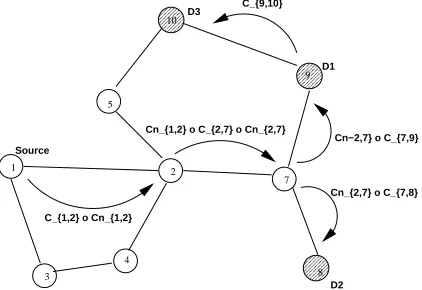
Example1: Figure 5 illustrates how our scheme can be used to securely multicast a message" to a set of nodes. In this example, nodeO
D
sends a message to the list of nodes85, , O .O .O
D
^
.
.
O
D
encrypts " with
D
E
and
D
E
. It then sends the result, X
D
E
A
X
D
E
to O
E
together with the list of destination nodes, 8 , to O
E
. Upon reception of this message,O
E
identifies, using its routing protocol, the next node(s) towards the destination. In this case, the next node toward8 isO . It then decrypts the message with
D
E
, and retrievesX
D
E
and encrypts result with
E
and
E
. The resulting message, 1E
,
X
D
E
A
X
E
A
X
E , is forwarded toO together with8 . O finds out that8
E
and8 are its direct neighbors and that8 is reachable via 8 . It decrypts
1E with
D
E
and
E
, and sends the result,X
E
encrypted with toO . SinceO is on the destination list, it decrypts the message it received, i.e. X
E
A
X
1 with 1 and
E
to retrieve" . Identically sinceO is on the destination list, it decrypts the message it received, i.e. X
E A
X
K , with 1 and E
to retrieve " . O finally encrypts " with
D
^ and forwards the result to
O
D
^ that can then retrieve" .
1 2
3 8
9
5
7 10
Source
D3
D1
D2
4
Cn_{1,2} o C_{2,7} o Cn_{2,7}
C_{1,2} o Cn_{1,2}
Cn−2,7} o C_{7,9} C_{9,10}
Cn_{2,7} o C_{7,8}
Fig. 5. Short-lived Multicast. Node multicasts a secret message to nodes , and = .
Example2: Figure 6 illustrates the protocol when the source does not specify the list of destination nodes but instead a reception criteria. In this example, the reception criteria is “all the nodes within the geographical area R”. Both nodes O andO
D
^ satisfy this criteria. We assume that each node is able to verify whether its direct neigh-bors and itself satisfy the reception criteria.
The source,O
D
encrypts" with
D
E
and
D
E
. It then sends the result, X
D
E
A
X
D
E
toO
E
together with the cri-teria, 8 , toO
E
. It also sends the message " , encrypted with
D
1 and
D
1 , toO 1 . However for simplicity sake, we only consider the messages that are on the path to the destination nodes. Upon reception of this message, O
E
finds out that its neighborO satisfies the criteria. It there-fore decrypts the message with
D
E
(and retrieveX
D
E
) and encrypts the result with
E
. The resulting message, KE
,
X
D
E
A
X
E
, is forwarded to O together with 8 .
O
E
also, possibly, encryptsX
D
E
with
E
and E
and forwards the results to O . Upon reception of the mes-sage, O finds out that it satisfies the reception criteria. It therefore decrypts the message with
D
E
and
E
to retrieve the message" . Since its neighbors8
D
^ also sat-isfies the reception criteria, it forwards the message" en-crypted with 1
D
^ to it. 8
D
^ can then retrieve the message
" .
C. Aggregation of Interleaved Encrypted Data
1) background and problem statement: Wireless sen-sor networks (WSNs) are ad-hoc networks composed of tiny devices with limited computation and energy capaci-ties. For such devices, data transmission is a very energy-consuming operation. It thus becomes essential to the
1 2
3
9
7 Source
4
7 5
10
Area R
C_{1,2} o Cn_{1,2}
Cn_{1,2}oC_{2,5} C_{5,10}
Fig. 6. Location-Based Short-lived Multicast. Node multicasts a secret message to all nodes with area , i.e. nodes and
time of a WSN to minimize the number of bits sent by each device. One well-known approach is to aggregate sensor data (e.g., by adding) along the path from sensors to the sink. Aggregation becomes especially challenging if end-to-end privacy between sensors and the sink is required, i.e. when the communication between each sensor and the sink is encrypted using a key that is not known to the ag-gregators.
[9] proposes a simple and provably secure additively ho-momorphic stream cipher that allows efficient aggregation of encrypted data. This new cipher only uses modular ad-ditions (with very small moduli) and is therefore very well suited for CPU-constrained devices.
The main idea of the scheme presented in [9] is to re-place the@ ACB (Exclusive-OR) operation typically found in stream ciphers with modular addition ( ), as described by Table III.
Additively Homomorphic Encryption Scheme
Encryption:
1) Represent message as integer
where is large integer.
2) Let be a randomly generated keystream, where
3) Compute
! #"%$'& Decryption:
1)
(9
#"%$'& 9 Addition of Ciphertexts:
1) Let (9 and
(9
2) For ) , * +
TABLE III
It is assumed that -, "
addi-tively homomorphic. In fact, if D ,
(
"
D
.
D
$ and E
,J
"
E
.
E
$ then D
E ,J
"
D
U"
E
.
D
E
$.
Note that if different ciphers
are added, then must be larger than
D
" , otherwise
ACBCB 9
0 9 7 7 is not provided. In fact if
D
" is larger than , decryp-tion will results in a value" that is smaller than . In practice, if>,G"
@
" $ then should be selected as
, *
Z
.
The keystream can be generated by using a stream cipher, such as RC4, keyed with a node’s secret key7 and a unique message id. This secret key pre-computed and shared between the node and the sink, while the message id can either be included in the query from the sink or derived from the time period in which the node is sending its values in (assuming some form of synchronization).
It is shown that aggregation based on this cipher can be used to efficiently compute statistical values such as mean, variance and standard deviation of sensed data, while achieving significant bandwidth gain. In fact, a proba-bilistic encryption scheme, denoted
0-$, is additively-homomorphic if for any instance
$ of the encryption scheme, given D
, 01D
"
D
$ and 1E
, 10FE
"
E
$, there exists a key such that
D
4
KE ,
10-"
D
4 "
E
$
In other words, the result of the application of function
4 on plaintext values may be obtained by decrypting the result of4 applied to the corresponding encrypted values. Additive aggregation can also be used to compute the variance, standard deviation and any other moments on the measured data. For example, in case of variance, each aggregator not only computes the sum, M ,
0
D
@ , of the individual values sent by its children, but also the sum of their squares: ,
0
D
@
E
. Eventually, the sink obtains two values: the sum of the actual samples which it can use to compute the mean and the sum of the squares which it can use to compute the variance.
One limitation of this proposal is that the identi-ties of the non-responding nodes (or responding nodes, whichever is expected to be smaller) need to be sent along with the aggregate to the sink. If the network is unreliable, this can represent an important overhead and scalability problem. It is therefore important to devise methods for reducing this cost.
We show in the following section that Interleaved Encryption can be used to solve this problem.
2) Our solution: Aggregation of Interleaved Encrypted Data : This section explains how the previous scheme can be used in an interleaved encryption mode to solve the identity transmission and scalability problems described in the previous section.
We assume for simplicity and without loss of generality that the network is structured as a tree. The sink is a top,
the aggregators are the intermediate nodes and the sensors are the leaves. Sensors encrypt their sensed data and send the result to their local aggregator. Each aggregator se-curely aggregates the data it receives from its children and forwards the results to the next aggregator (i.e. its parent in the tree) toward the sink.
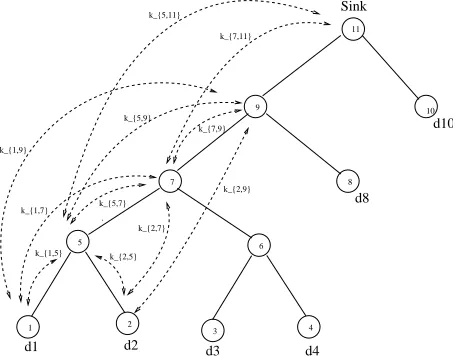
We also assume that each node shares a pairwise key with its direct parent, its 2-hop parent, 3-hop parent,...and n-hop parent, where is a system parameter. Fig. 7 illus-trates this key model. In this example, is set to 3. Each node shares a pairwise key with its parent, 2-hop parent (grand-parent) and 3-hop parent. For example, Node & shares a key with nodes , and . These keys can be establishment using a scheme such as [1].
When a sensor,O], sends a message, its encrypts it -time using the additively homomorphic scheme described in [9]. The first time with the key it shares with its direct parent, the second time with the key it shares with its 2-hop parent,..., the time with the key its shares with its
-hop parent. The sensor sends the result
to its parent along with its identifier.
An aggregator! adds up all the ciphers
Z
it receives from all of its direct children. It then decrypts the results using the sum of the pairwise keys it shares with each of its direct children,*
A children,...,
A children. The result is then encrypted times with the keys it shares with its parent, 2-hop parent,..., and "
. The result is forwarded to! ’s parent along with the identifiers of the children that have contributed to the resulting cipher. The messages get then securely aggregated hop-by-hop until the sink.
1 2 5
d2 d1
7
Sink
d3
d8
8
3 4 6
9 10 11
d10
d4
k_{2,5}
k_{7,9}
k_{1,7} k_{1,9}
k_{1,5} k_{5,7}
k_{5,11}
k_{5,9}
k_{2,7}
k_{2,9} k_{7,11}
Fig. 7. Aggregation of Interleaved Encrypted Data: Key model.
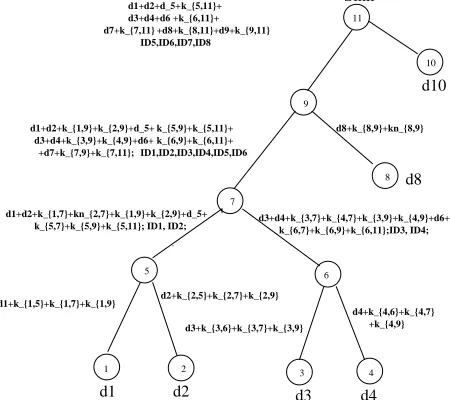
Figure 8 illustrates secure aggregation with our inter-leaved encrypted data scheme. In this example, is set to 3. The sensorsO
D
, O
E
,O 1 ,O 3 , O andO
D
^ send their data, respectively
D
,
E
, 1 ,
3 ,
and
D
^ , to the sink (O
D.D
$. The nodesO ,O$# ,O ,O are aggregators. NodeO
D
encrypts its data
D
3 times: with
D
,
D
and
D
, and sends the result D
5
3
d1+d2+k_{1,7}+kn_{2,7}+k_{1,9}+k_{2,9}+d_5+ k_{5,7}+k_{5,9}+k_{5,11}; ID1, ID2;
d1+k_{1,5}+k_{1,7}+k_{1,9}
d1+d2+k_{1,9}+k_{2,9}+d_5+ k_{5,9}+k_{5,11}+ d3+d4+k_{3,9}+k_{4,9}+d6+ k_{6,9}+k_{6,11}+ +d7+k_{7,9}+k_{7,11}; ID1,ID2,ID3,ID4,ID5,ID6
k_{5,11}+ d1+d2+d_5+ d3+d4+d6 +k_{6,11}+ d7+k_{7,11} +d8+k_{8,11}+d9+k_{9,11}
ID5,ID6,ID7,ID8
9
d8+k_{8,9}+kn_{8,9}
8 d8 10
d10 Sink
11
6
1 2 4
d4+k_{4,6}+k_{4,7}
7
k_{6,7}+k_{6,9}+k_{6,11};ID3, ID4; d3+d4+k_{3,7}+k_{4,7}+k_{3,9}+k_{4,9}+d6+
d3 d4 d2
d1
d3+k_{3,6}+k_{3,7}+k_{3,9} d2+k_{2,5}+k_{2,7}+k_{2,9}
+k_{4,9}
Fig. 8. Aggregation of Interleaved Encrypted Data. Data,1, ,
K and
are securely aggregated by the aggregators , and , on their way to the sink.
identifier. SimilarlyO
E
encrypts its data
E
with
E
,
E
and
E
, and sends the result 1E
to O together with its identifier. O decrypts
D with
D
and 1E
with
E
and adds the results. It then encrypts the sum with 1 ,1 and1
D)D
and sends the result,
together with the identi-fiers ofO
D
andO
E
toO . Similarly, nodeO1 encrypts its data
1 with-1K# ,-11 and-1K , and sends the result
1 to
O$# together with its identifier.O 3 encrypts its data
3 with
31# , 3 and 31 , and sends the result
3 toO$# . O # de-crypts
1 with 11# and
3 with 3# and adds the results. It then encrypts the sum with # , # and #
D)D
and sends the result,
# together with the identifiers ofO
E
andO 1 toO . As a result,O receives
fromO and
# from
O # . It decrypts
withK ,
D
and
E
and obtains the value@ . It then decrypts
# with # ,-1K and 3 and obtains the value . It encrypts the sum of@ and with
K and
K D.D
, and sends the results toO
together with the identifiers ofO , O
# ,
O
D
, O
E
, O 1 andO 3 . O en-crypts its data
with , D.D
and sends the result to
O . O adds
and
and decrypts the results with K ,
, # , 1 , 3 , 1K ,
E
and
D
. It then encrypts the results with
D)D
and obtains .
is then sent toO D.D together with the identifier ofO ,O ,O # andO . Note that the identifiers ofO
D
,O
E
,O 1 andO 3 do not need to be forwarded anymore.
The sink O D.D
decrypts the message it re-ceived with
D)D ,
D)D , K
D.D ,
#
D.D
and 1 D.D and retrieves the sum of the plaintext values i.e
D
E
1
3
#
.
3) Security vs Bandwith tradeoff: With the previous scheme, each aggregator has to forward at most
4
D
D
identities, where
is the degree of the tree, i.e. number of children per node. This is much less than the original scheme. In the original scheme, the number of identities
to be forwarded increases as the aggregated message gets closer to the root. At the level
of the tree (
, being the leaves),
$ identities has to be forwarded by each aggregator. If the aggregator tree has many levels, this can become problematic. In contract, with AIE, the number of identities to be forwarded is bounded and only depends on the parameters and
, where
is smaller than . With the example of Fig.8, each node has to forward at most 6 identities if AIE is used. With the original scheme, this number can go up to 12.
However the AIE based scheme is less secure than the original scheme. An attacker that corrupts consecutive nodes can actually retrieve the aggregated value at the low-est corrupted aggregator in the tree. For example, in Fig. 8 if an attacker corrupts node 5, 7, and 9, it is able to re-trieve the aggregated value available at node 5, i.e.
D
+
E
. With the original scheme, corrupting aggregators does not reveal any information about the aggregated value.
There is a clear tradeoff between the number of identi-ties to be forwarded (i.e. bandwidth cost) and security. By decreasing , the bandwith cost decreases but so does the security. By increasing , the bandwith cost and security increase. If , & , our scheme is similar to hop-by-hop encryption. This configuration is optimal in term of bandwith but very weak security-wise. On the other hand, if ,
(where
is the number of level in the tree), our scheme is similar to the original aggregation scheme of [9]. Its bandwith cost is high but its security is maximum.
4) Data Integrity Protection: The authenticated scheme proposed in Section II-D cannot be used with ag-gregation. In fact, since the plaintext is changing as the data are being aggregated (i.e. added) and the aggregators do not have access to the plaintext data, the redundancy check will fail. Furthermore, by definition, the redundancy function cannot be homomorphically additive. Therefore only the basic scheme, as defined in Section II-B is appli-cable.
require end-to-end authentication.
Hop-by-hop authentication is therefore sufficient and is probably the best level of integrity protection that can be provided with secure aggregation.
IV. RELATEDWORK
There have been several new key establishment propos-als for wireless sensor networks recently. Most of them are based on the random key pre-distribution that was pro-posed by Eschenauer and Gligor [1]. In this scheme, each sensor is configured with a random subset of a large pool of keys. These keys are used for point-to-point security by having a sender use a key known to be shared by the receiver. Chan et al. [11] improves and analyzes this scheme. Du et al. [12] extends the Eschenauer-Gligor scheme with a Blom pairwise key-generation scheme. Liu and Ning [13] proposes a polynomial-based key distribu-tion scheme. All of these schemes are pretty effective for point-to-point communications. However most of them require some message exchanges and are therefore not adapted to short-lived communications. Furthermore none of them are applicable to group communications.
Current group keying schemes either rely on some Diffie-Hellman group extensions [14], [15], and are there-fore not adapted to sensor networks, or requires assume that the groups are pretty stable [2]. These later schemes, referred to as “broadcast encryption”, are not applicable when the receiver subset is much smaller than the entire sensor population.
Vogt [4] and Zha et al. [5] have proposed data integrity protection schemes for secure node-to-node communica-tions based on interleaved authentication. Goodrich [3] ex-tended this work to broadcast and group integrity. These schemes are very related to our proposal but do not pro-vide privacy protection. AIE builds on these approaches to provide authenticated and encrypted group security.
V. CONCLUSION ANDFUTUREWORK
This paper presents a new scheme that allows CPU and storage constrained nodes of a network to securely ex-change messages (i.e. encrypted and authenticated) with-out sharing a common key or using public key cryptogra-phy. Our scheme can, for example, be used by a sensor to send secret data to a node it does not share a security asso-ciation with or that are defined by the network according to some criteria (location, functionality). It can also be used to solve the so-called “short-lived broadcast encryption” problem. It allows a node to send encrypted packets to very dynamic sets of nodes without having to establish or maintain group keys. These sets of nodes can be explicitly specified by the source or can be specified by the network according to some criteria, such as their location, proxim-ity to an object or functionalproxim-ity (i.e. aggregators/sinks). As a result, a node can, for example, send encrypted data to all the nodes within a given geographical area, without having to identify the destination nodes in advance.
We also show that our proposal can be used to imple-ment a secure and scalable aggregation scheme for wire-less sensor networks.
Authentication Interleaved Encryption can optionally provide source anonymity, since the destination does not need to know the source to decrypt the message. This might be a useful feature for some applications.
Our scheme is secure against passive attackers and iso-lated active attackers. An attacker that compromises two adjacent nodes (or adjacent nodes, according to the ap-plications) on the path can recover the encrypted messages. However, a node, even compromised, that is listening to communications is unable to decrypt them. As a result, the security provided by our solution is better than the se-curity of schemes based on global group keys (all the net-work nodes share a common group key) or on hop-by-hop encryption (the messages are decrypted/encrypted hop-by-hop until they reach the destination). With these schemes, any curious or compromised node can listen to the com-munications. On the other hand, our scheme is less secure than schemes that use end-to-end encryption. However, as argued earlier in this paper, it is not always feasible and practical to establish secret keys between communicating nodes in constrained environments, such as wireless sensor networks, especially for short-lived communications. Fur-thermore, current secure group communication solutions are not adapted to very dynamic and short-lived groups since they assume that group members are stable and re-vocations are rare events. To our knowledge, the AIE pro-posal is the first scheme to provide a solution to the chal-lenging short-lived secure broadcast problem.
REFERENCES
[1] L. Eschenauer and V. D. Gligor, “A Key Management Scheme for Distributed Sensor Networks,” ACM CCS, pp. 41–47, 2000. [2] Sandro Rafaeli and David Hutchison, “A survey of key
manage-ment for secure group communication,” ACM Computing Surveys, vol. 35, pp. 309–329, 2003.
[3] M. Goodrich, “Leap-frog packet linking and diverse key distribu-tions for improved integrity in network broadcasts,” in IEEE
Secu-rity and Privacy, May 2005.
[4] Harald Vogt, “Integrity preservation for communication in sensor networks,” Tech. Rep. 434, ETH Zurich, Institute for Pervasive Computing, Feb. 2004.
[5] Sencun Zhu, Sanjeev Setia, Sushil Jajodia, and Peng Ning, “An Interleaved Hop-by-Hop Authentication Scheme for Filtering False Data in Sensor Networks,” Security and Privacy, 2004.
[6] Jee An and Mihir Bellare, “Does encryption with redundancy pro-vide authenticity?,” in EUROCRYPT, 2001.
[7] Hugo Krawczyk, “The order of encryption and authentication for protecting communications (or: how secure is SSL?),” in CRYPTO, 2001.
[8] David Wagner, “Attacks on the hash-then-encrypt (for stream ci-pher),” http://www.cs.berkeley.edu/ daw/my-posts/mdc-broken2. [9] Claude Castelluccia, Einar Mykletun, and Gene Tsudik, “Efficient
aggregation of encryption data in wireless sensor networks,” in
IEEE Mobiquitous, 2005.
[10] David Wagner, “Resilient Aggregation in Sensor Networks,”
Work-shop on Security of Ad Hoc and Sensor Networks, 2004.
[11] H. Chan, A. Perrig, and D. Song, “Random key predistribution schemes for sensor networks,” in IEEE Security and Privacy
Sym-posium, 2003.
[12] W. Du, J.Deng, Y. Han, and P. Varshney, “A pairwise pre-distribution scheme for wireless sensor networks,” in ACM Conf.
[13] D. Liu and P. Ning, “Establishing pairwise keys in distributed sen-sor networks,” in ACM Conf. Computer and Communication
Secu-rity, 2003.
[14] Michael Steiner, Gene Tsudik, and Michael Waidner, “Key agree-ment in dynamic peer groups,” in IEEE Transactions on Parallel
and Distributed Systems, July 2000.
[15] Yongdae Kim, Adrian Perring, and Gene Tsudik, “Simple and fault-tolerant key agreement for dynamic collaborative groups,” in ACM
Conference on Computer and Communications Security, November