ISSN (Print) : 2320 – 3765 ISSN (Online): 2278 – 8875
I
nternational
J
ournal of
A
dvanced
R
esearch in
E
lectrical,
E
lectronics and
I
nstrumentation
E
ngineering
(An ISO 3297: 2007 Certified Organization)
Vol. 5, Issue 4, April 2016
PV Based Multiple-Input Bidirectional
DC–DC Power Converter for
HEV/FCV Application with PID Controller
R.Kuppuraj1, P.Narendran2, R.Praveen3, D.Surendar4, Y.Rehka5
U.G. Student, Department of Electrical and Electronics Engineering, New Prince Shri Bhavani College of Engineering
and Technology, Gowrivakkam, Chennai, India1,2,3,4
Assistant Professor, Department of Electrical and Electronics Engineering, New Prince Shri Bhavani College of
Engineering and Technology, Gowrivakkam, Chennai, India5
ABSTRACT: This paper proposes PV (Photo-Voltaic) based multiple-input bidirectional dc–dc power converter to interface more than two dc sources of different voltage levels. This finds applications in hybrid electric cell vehicles, where different dc sources of unequal voltage levels need to be connected with bidirectional power flow capability. The converter can be used to operate in both the buck and boost modes with bidirectional power control. It is also possible to independently control power flow between any two sources when more than two sources are actively transferring power in either direction. Interleaved boost converter is used to step-up the PV voltage with low output current ripple. The proportional-integral-derivative (PID) controller provide required gate pulses to the transistor switches used in the bidirectional dc to dc converter.
KEYWORDS: DC–DC power converter, fuel cell vehicle (FCV), hybrid electric vehicle (HEV), multiple-input converter.
I. INTRODUCTION
In PV (Photo-Voltaic) systems, a dc–dc converter issued at the output of the PV to obtain the required dc-link voltage to the inverter providing the power to the propulsion motor. To start the operation of the PV system and also to share the load, a battery unit that can supply power to the same dc link is used. The battery unit also helps to overcome the slower response time of the PV array by providing peak power during the acceleration of the vehicle. In addition, the peak power transients during acceleration and regenerative braking can be avoided by the inclusion of a higher power density element such as an ultra-capacitor. This can be used to store regenerative energy during deceleration to provide the supplemental power during acceleration.
The ability of the ultra-capacitor to handle higher power for higher number of charge/discharge cycles not only increases the life span of both the FC and battery but also improves the overall system efficiency. Based on the characteristics and dynamics of FC, the battery and ultra-capacitor are optimally sized, to achieve the required performance. A power electronic interface unit is required to match the voltage levels of the battery and the ultra-capacitor units with the dc-link voltage Vdc of the inverter. The function of this multiple-input power converter is to
interface these various sources with the dc link of the inverter and to regulate the power flow between the sources. A number of topologies are proposed in the literature to transfer the power from one source to another in hybrid electric vehicle (HEV) and micro grid applications.
II. EXISTINGSYSTEM
ISSN (Print) : 2320 – 3765 ISSN (Online): 2278 – 8875
I
nternational
J
ournal of
A
dvanced
R
esearch in
E
lectrical,
E
lectronics and
I
nstrumentation
E
ngineering
(An ISO 3297: 2007 Certified Organization)
Vol. 5, Issue 4, April 2016
hydrogen ions with oxygen or another oxidizing agent. The boost converter is a voltage up and current
step-down converter. Here it boosts the dc voltage obtained from fuel cell and it gives necessary voltage to the dc link. Battery and ultra-capacitors are bidirectional devices because both devices have charging and discharging characteristics. Multi-input bidirectional dc to dc converter acts as buck converter during battery and ultra-capacitor charging, it acts as boost converter during battery and ultra-capacitor discharging. This converter maintains the power flow between dc link and battery, ultra-capacitor.
III. PROPOSEDSYSTEM
In this proposed system PV array converts light energy into dc electrical energy using photo-voltaic effect. The interleaved boost converter is a voltage step-up and current step-down converter. Here it boosts the dc voltage obtained from fuel cell and it gives necessary voltage to the dc link. Interleaved boost converter is designed by connecting two boost converters in parallel so it reduces ripples in the output current. Battery and Ultra-capacitors are bidirectional devices because both devices have charging and discharging characteristics.Multi-input bidirectional dc to dc converter acts as buck converter during battery and capacitor charging, it acts as boost converter during battery and ultra-capacitor discharging. This converter maintains the power flow between dc link and battery, ultra-ultra-capacitor. Proportional-Integral-Derivative (PID) controller provide gate pulses to the transistor switch used in multi-input bidirectional dc to dc converter via driver circuit to maintain the desired value at the output.
IV.SCOPEANDOBJECTIVE
Multiple input bidirectional dc to dc converters with PID controller is designed to achieve, to interface more than two dc sources and can extended to any level. To transfer power in both directions. To control the power flow between any two sources independently and to improve system efficiency.
V. BLOCK DIAGRAM
Fig 1. Block Diagram
ISSN (Print) : 2320 – 3765 ISSN (Online): 2278 – 8875
I
nternational
J
ournal of
A
dvanced
R
esearch in
E
lectrical,
E
lectronics and
I
nstrumentation
E
ngineering
(An ISO 3297: 2007 Certified Organization)
Vol. 5, Issue 4, April 2016
Battery and Ultra-capacitors are bidirectional devices because both devices have charging and discharging characteristics.Multi-input bidirectional dc to dc converter acts as buck converter during battery and ultra-capacitor charging,it acts as boost converter during battery and ultra-capacitor discharging. This converter maintains the power flow between dc link and battery, ultra-capacitor. Proportional-Integral-Derivative (PID) controller provide gate pulses to the transistor switch used in multi-input bidirectional dc to dc converter via driver circuit to maintain the desired value at the output.
VI. SIMULATION
MATLAB is a high-performance language for technical computing. It integrates computation, visualization, and programming in an easy-to-use environment where problems and solutions are expressed in familiar mathematical notation. Typical uses include
Math and computation.
Algorithm development.
Data acquisition.
Modeling, simulation, and prototyping.
Data analysis, exploration, and visualization.
Scientific and engineering graphics.
Application development, including graphical user interface building.
MATLAB is an interactive system whose basic data element is an array that does not require dimensioning. This allows you to solve many technical computing problems, especially those with matrix and vector formulations, in a fraction of the time it would take to write a program in a scalar non interactive language such as C or FORTRAN.
PROPOSED SYSTEM
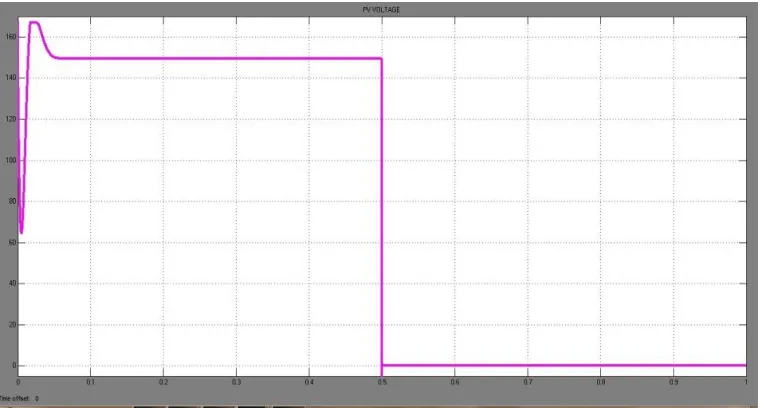
SOLAR PANEL OUTPUT VOLTAGE
ISSN (Print) : 2320 – 3765 ISSN (Online): 2278 – 8875
I
nternational
J
ournal of
A
dvanced
R
esearch in
E
lectrical,
E
lectronics and
I
nstrumentation
E
ngineering
(An ISO 3297: 2007 Certified Organization)
Vol. 5, Issue 4, April 2016
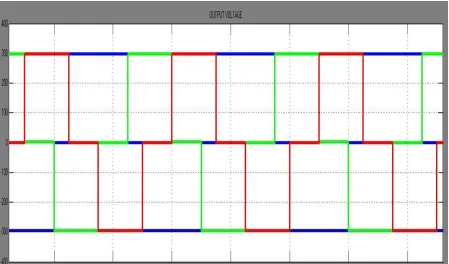
OUTPUT CURRENT
ISSN (Print) : 2320 – 3765 ISSN (Online): 2278 – 8875
I
nternational
J
ournal of
A
dvanced
R
esearch in
E
lectrical,
E
lectronics and
I
nstrumentation
E
ngineering
(An ISO 3297: 2007 Certified Organization)
Vol. 5, Issue 4, April 2016
INPUT V-I INTRELEAVED BOOST CONVERTER
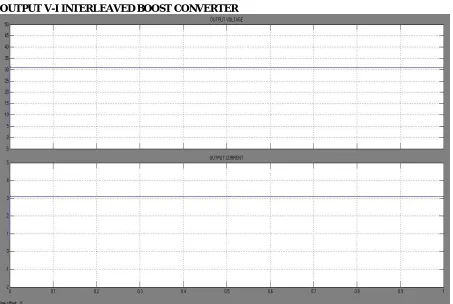
Fig 5. Input V-I Interleaved Boost Converter OUTPUT V-I INTERLEAVED BOOST CONVERTER
ISSN (Print) : 2320 – 3765 ISSN (Online): 2278 – 8875
I
nternational
J
ournal of
A
dvanced
R
esearch in
E
lectrical,
E
lectronics and
I
nstrumentation
E
ngineering
(An ISO 3297: 2007 Certified Organization)
Vol. 5, Issue 4, April 2016
VII.CONCLUSION
This paper has proposed a multiple-input bidirectional dc–dc converter to interface more than two sources of power/energy operating at different voltage levels. The converter can be operated either in buck mode or boost mode in either directions of power flow. It is possible to control the power flow between each pair of sources independently when more than two sources are active This paper gives detailed analysis, modulation, and operation of the converter for various modes. In each mode, the relationship between the sources is derived which assists in the implementation of the controller.
REFERENCES
1. Khaligh and Z. Li, “Battery, ultracapacitor, fuel cell, hybrid energy storage systems for electric, hybrid electric, fuel cell, plug-in hybrid electric vehicles: State of the art,” IEEE Trans. Veh. Technol., vol. 59, no. 6, pp. 2806–2814, Jul. 2010.
2. J. M. Miller, “Power electronics in hybrid electric vehicle applications,” in Proc. IEEE Appl. Power Electron. Conf., Miami Beach, FL, USA, Feb. 2003, vol. 1, pp. 23–29.
3. H. Matsuo, W. Lin, F. Kurokawa, T. Shigemizu, and N. Watanabe, “Characteristics of the multiple-input dc-dc converter,” IEEE Trans. Ind. Electron., vol. 51, no. 3, pp. 625–631, Jun. 2004.
4. W.-S. Liu, J.-F. Chen, T.-J. Liang, R.-L. Lin, and C.-H. Liu, “Analysis, design, control of bidirectional cascoded configuration for a fuel cell hybrid power system,” IEEE Trans. Power Electron., vol. 25, no. 6, pp. 1565– 1575, Jun. 2010.
5. Khaligh, J. Cao, and Y.-J. Lee, “A multiple-input dc-dc converter topology,” IEEE Trans. Power Electron., vol. 24, no. 3, pp. 862–868 , Mar. 2009.
6. W. Jiang and B. Fahimi, “Multiport power electronic interface-Concept, modeling, design,” IEEE Trans. Power Electron., vol. 26, no. 7, pp. 1890– 1900, Jul. 2011.
7. L. Solero, A. Lidozzi, and J. A. Pomilio, “Design of multiple-input power converter for hybrid vehicles,” in Proc. IEEE APEC, 2004, vol. 2, pp. 1145–1151.
8. Hintz, U. R. Prasanna, and K. Rajashekara, “Novel modular multipleinput bidirectional dc-dc power converter (MIPC),” in Proc. IEEE ECCE Asia, May 2014, pp. 2343–2350.
9. K. Rajashekara, “Present status and future trends in electric vehicle propulsion technologies,” IEEE Trans. Emerging Sel. Topics Power Electron., vol. 1, no. 1, pp. 3–10, Mar. 2013.