R E S E A R C H
Open Access
Fast implementation for modified
adaptive multi-pulse compression
Xianxiang Yu
1, Guolong Cui
1*, Meifang Luo
2, Lingjiang Kong
1and Dan Ran
3Abstract
This paper deals with the estimation of range-Doppler plane in pulse Doppler radar system, accounting both for clutter-free scenario and clutter scenario. A modified adaptive multi-pulse compression (MAMPC) algorithm including the estimation stages of range dimension and Doppler dimension is proposed for clutter-free scenario, where each stage is implemented based on the gain constraint adaptive pulse compression (GCAPC) algorithm. Additionally, the combination of whitening method removing the correlation of clutter component and MAMPC algorithm is
presented for the considered clutter scenario. Numerical simulations are provided to validate the effectiveness of MAMPC in terms of estimation of range-Doppler plane and computation burden.
Keywords: Range-Doppler plane, Modified adaptive multi-pulse compression, Range dimension, Doppler dimension, Gain constraint adaptive pulse compression
1 Introduction
Traditionally, the pulse Doppler radar systems repeat the same waveform to allow efficient pulse compression and Doppler processing technique to be used [1]. The tra-ditional pulse compression method is matched filtering, in which the high range sidelobe of strong targets may interfere or even mask nearby weak targets. The Doppler processing technique, such as the moving target detec-tion (MTD), also obtains Doppler sidelobe that results in the masking problem [2]. Consequently, suppress-ing the range-Doppler sidelobe is meansuppress-ingful for target detection.
Suppressing range or Doppler sidelobe has been received considerable attention. Summarizing, these works can be classified into three categories. The first category deals with the problem of adaptive range side-lobe suppression. In [3], iterative reweighted least squares (IRLS) algorithm was used to suppress range sidelobe. In [4], several binary pulse compression codes were designed to greatly reduce sidelobe meanwhile suffering only a small S/N loss. In [5], the adaptive pulse com-pression (APC) was proposed, which was shown to suc-cessfully suppress the range sidelobes over a variety of
*Correspondence: [email protected]
1University of Electronic Science and Technology of China, 2006 Xi Yuan Ave, West Hi-tech Zone, Chengdu, China
Full list of author information is available at the end of the article
stressing scenarios. Li et al. [6] has demonstrated that gain-constraint-APC (GCAPC) [7] has better estimating performance especially for weak targets compared to orig-inal APC algorithm [5].
The second category focuses on addressing the prob-lem of Doppler sidelobe suppression. As the mathematical model of the Doppler estimation for coherent multi-pulses is similar to direction of arrival (DOA) estima-tion, the studies related to DOA estimation can also be used in Doppler sidelobe suppression. For instance, the most well-known methods for DOA estimation are MUSIC [8], root-MUSIC [9] and ESPRIT [10]. Re-iterative super resolution (RISR) was studied in [11, 12], which was used to estimate DOA in array signal processing firstly.
The third category studies the sidelobe suppression problem by jointly suppressing range-Doppler sidelobe [13, 14]. In [15], two-dimensional reiterative minimum mean square error (MMSE) and 2-D least square (LS) solutions that mitigate the sidelobe of both pulse com-pression processing and antenna radiation patterns are derived. In [16], a RISR algorithm was used in conjunc-tion with Golay waveforms for range-Doppler estimaconjunc-tion. In [17], a recursive MMSE-based time-range adaptive processing was proposed for the purpose of jointly sup-pressing the range-Doppler sidelobe. However, clutter
scenario was not considered. In [18], the adaptive multi-pulse compression (AMPC) was presented to success-fully suppress the range-Doppler sidelobe over a variety of stressing scenarios. Unfortunately, the high computa-tional cost of this method limits its usage in real-time systems. It is worth noting that these approaches based dimensionality reduction are well known in open lit-erature as a means to facilitate practical solutions to computation problems. In [19], the fast adaptive pulse compression (FAPC) was proposed. In [20], the fast adap-tive multi-pulse compression (FAMPC) was proposed based on fast adaptive pulse compression (FAPC) by segmenting the MMSE cost function into blocks. Of course, some inherent loss in performance can generally be expected by reducing dimensionality, though the atten-dant reduction in computation often easily justifies the trade-off.
In this paper, we propose a modified adaptive multi-pulse compression (MAMPC) algorithm to obtain both good estimation performance and small amount of cal-culations. Unlike [21], we also consider clutter scenario assuming that some knowledge of clutter statistics is avail-able. For clutter-free scenario, we implement MAMPC with two estimating stages by utilizing GCAPC algo-rithm. Specially, we obtain estimation in the range dimension using GCAPC. Then, based on the obtained results, we achieve the estimation of range-Doppler plan in the Doppler dimension by exploiting GCAPC. In particular, for clutter scenario, the combination of whitening method removing the correlation of clutter component and MAMPC algorithm is proposed. Sim-ulation results highlight that MAMPC is capable of achieving a close estimation performance with that of AMPC, while shares much less computational time than AMPC.
The rest of the paper is organized as follows. In Section 2, we give the signal model of range-Doppler dimension. In Section 3 and Section 4, we present MAMPC algorithm for clutter free scenario and the combination of whitening method and MAMPC algo-rithm for clutter scenario, respectively. In Section 5, we evaluate the capabilities of MAMPC via numerical results. Finally, in Section 6, we provide some concluding remarks.
Notation: Vectors (matrices) are denoted by boldface lower (upper) case letters. Superscripts(·)T,(·)∗, and(·)H denote transpose, complex conjugate, and complex con-jugate transpose, respectively. | · | denotes the modulus of a complex number. E(·) is the statistical expectation.
(·) denotes the summation operation. IN is the iden-tity matrix with N × N demension. diag(.) is an oper-ation that creates a diagonal matrix by using the input vector as its diagonal. Finally, ⊗denotes the Kronecker product.
2 Signal model
Consider a stationary monostatic radar system which transmitsMcoherent pulses of train. Lets(t)be the base-band complex probing waveform. Assume that there areQ point-like targets andPclutter scatterers in different range cells and with different radial velocities. The received signalym(t)of themth pulse can be represented as parameters accounting for the target radar cross section (RCS), channel propagation effects, and other terms involved into the radar range equation. Assume thatσT,mq=σT,qfor allm=1, 2,· · ·,M, which are distributed as circular zero-mean complex Gaussian random variables. In other words, the pdf of the amplitudeAq= |σT,q|is Rayleigh distributed, i.e.,
pAq(x)= frequency of theqth target whilevqis the radial velocity andλis the carrier wavelength.
• τT,qandτc,mqdenote, respectively, the two-way time delays for theqth target and pth clutter scatterer for themth pulse.
• σc,mpis the complex scattering parameter of thepth clutter scatterer at themth pulse form=1,· · ·,M andp=1,· · ·,P.
• bm(t)denotes the zero-mean circular complex Gaussian random process.
Let s = [s1,s2, ...,sN]T be the discrete version of the baseband waveform s(t), then, after sampling with the same rate, the discrete versions of the received signalym(t) and the noise termbm(t)can be expressed respectively by
ym=ym[1] ,ym[2] ,· · ·,ym[L] T,
bm=[bm[1] ,bm[2] ,· · ·,bm[L]]T,
(2)
Y=y1,y2,· · ·,yM . (3)
In addition, let us divide uniformly the normalized frequency with K points, e.g., fk = (k − 1)/K, k = 1,· · ·,K, and denote by f = f1,f2,· · ·,fK the K-points Doppler frequency vector. Hence, theL ×K -dimensional range-Doppler plane X accounting for the scattering coefficients of the targets of interest can be expressed as
In this paper, we employ the adaptive pulse compres-sion algorithm to estimate the components of the range-Doppler planeX. To this end, we formulate the sub-vector
ym[l]= ym[l] ,· · ·,ym[l+N−1] T for the mth pulse the(2N−1)×1-dimensional sub-vector accounting the scattering coefficients at thek th Doppler frequency in the range-Doppler plane and
X[l]=[x¯l[ 1] ,· · ·,x¯l[K] ]is the
(2N−1)×K-dimensional sub-matrix ofX. • Fis the discrete Fourier transform matrix, given by
F=
(2N−1)×1-dimensional sub-vector accounting the clutter scattering coefficients.
• bm[l]=[bm[l] ,· · ·,bm[l+N−1] ]Tis theN×1 -dimensional sub-vector ofbm, which is distributed as the complex circular zero-mean Gaussian random vector with identity covariance matrixσn2IN.
Let us rewrite all the M sub-vectors ym[l], for m =
3 Fast implementation of MAMPC for clutter-free scenario
In this section, we focus on the estimation of the compo-nents of range-Doppler planeXin the presence of white noise using the fast implementation of MAMPC. To this end, the signal model without considering clutter in Eq. (8) can be simplified as
Y[l]=GX[l]FT+B[l] ,l=1,· · ·,L. (9)
3.1 The process in range dimension
In this subsection, we are devoted to the process in range dimension by exploiting the proposed fast algorithm. Specifically, Eq. (8) can be further recast as
Y[l]=GA[l]+B[l] , (10)
Since observation ym[l] is the linear combination of
am[l] ,αm[l] can be obtained by designing a filter forlth range cell employing GCAPC algorithm. In the follow-ing, we focus on the discussion of three cases of different scopes of range cell for the estimation of αm[l]. Specif-ically, for l = N,· · ·,L − (N − 1), we minimize the output power oflth range cell by devising GCAPC fil-ter coefficientswm[l] accounting for{wm[l]}Hs=1, with corresponding to optimization problem formulated as
Using lagrangian multiplier method, the filterwm[l] for
We further assume the independence between scatter-ing coefficients. As a consequence, the covariance matrix of observationym[l] can be written as
Eym[l]ym[l]H =G[l]GH +σn2I, (15)
whereσn2denotes the noise power and
[l]=diag| ˜αm[l−(N−1)]|2, , ...,| ˜αm[l+(N−1)]|2
(16)
with α˜m[l] the prior information of αm[l], where we assume the target range profiles located different range cells are independent. Submitting Eq. (15) in Eq. (27),
wm[l] can be rewritten as
Similarly, the optimization problem can be given by,
arg min
whereglis thelth column ofG. Consequently, the opti-mized filterwm[l] oflth range cell is derived as
Hence, the optimized filter coefficientwm[l] is given by
wm[l]=
Based on the above discussion, the estimation value
ˆ
am = αˆm[l] , ...,αˆm[L)] T,m = 1,· · ·,M can be obtained. Hence, the estimation of Aˆ ∈ CL×M can be expressed as
ˆ
A=[aˆ1, ...,aˆM] . (27)
3.2 The process in Doppler dimension
In this subsection, we focus on the process of doppler dimension in order to estimate the elements of range-Doppler planeX. Specifically, using the linear function in Eq. (8) andA[l]=X[l]FT, we have
ˆ
A=XFT+E. (28)
where E is noise vector with covariation matrix I/sHs. After transposition operation, Eq. (28) can be recast as,
ˆ
AT =FXT+ET. (29)
Letβˆ[l] ,x[l] ande[l] denote thelth columns ofAˆT,XT
ˆ coefficientswkfor the estimation ofxˆk[l] are expressed as
wk= (
Finally, we conduct the same procedure for each range cell and can achieve the estimation ofXˆ.
3.3 The joint procedure of MAMPC algorithm
In this subsection, the proposed procedure of MAMPC for the estimation of range-Doppler planeXis summa-rized in Algorithm 1.
Finally, it is worth highlighting that in each itera-tion, Algorithm 1 shares the computational complex-ity of O(LMN3 + LKM3). Additionally, we note that original AMPC [18] requires to conduct NM × NM matrix inversion for each individual range-Doppler cell with corresponding toO((MN)3)computation complex-ity. However, FAMPC [20] needs to implementKlKp× KlKp sub-matrix inversion for each range-Doppler cell, which is order of O(RpRl(KlKp)3), where full-dimension model is divided into theRlsegments in fast time domain andRp segments in slow time domain withKl = N/Rl and Kp = M/Rp. Compared with AMPC, the com-putation load of FAMPC algorithm reduces a factor of (RpRl)2. In particular, MAMPC algorithm includes com-putational burden connected with M matrix inversions with size ofN ×N and one matrix inversion with size of M× M for each range-Doppler cell, which is order ofO(MN3+M3). We note that MAMPC algorithm has the same order of computation load with FAMPC when Rp=M,Rl =1. Consequently, we conclude that FAMPC and MAMPC can significantly reduce the computational complexity in comparison with full-dimension AMPC algorithm.
Algorithm 1: MAMPC Algorithm for the estimation of range-Doppler planeX.
Input: Y,Q,K,M,L,s,σ2 n,ε; Output: An estimation matrixXˆ;
1: Initializeq=0,m=0,l=0and range-Doppler plane X(0)using traditional matched filter method;
2: Construct matrixGandFby (6) and (7); tional complexity involved in this step is in the order ofO(N3).
which has computational complexity ofO(M3).
18: Ifk≥K,k=0and return to step 19; otherwise, go to
4 The application of MAMPC algorithm in the presence of clutter
In this section, we focus on the estimation of range-Doppler plane X in the presence of clutter employing MAMPC algorithm. According to the received signal model in Eq. (8), we here adopt whitening method to remove correlation of clutter. Specifically, let c[l]= [c1[l] ,c2[l] ,· · ·,cM[l] ]T denote the range profile of the lth cell forMpulses; hence, we have
C[l]=
In particular, we further assume that cm[j] and cn[i]∀(m,n) ∈ {1, 2,. . .,M}2,∀(i,j) ∈ {1, 2,· · ·,L}2,i = j, are zero-mean uncorrelated random variables, and cm[j] ,cn[i] with i = j are correlative random variables obeying zero-mean Gaussian distribution with covariance matrix
Ec[l]cH[l] =σ0H=(σi,j)M×M,∀(i,j)∈ {1, 2,. . .,M}2, (36)
where nonnegative numberσ0is the power of clutter,His the positive semidefinite Hermitian-Toeplitz matrix with sizeM×M, whose main diagonal elements 1.
Our purpose is to remove correlation of clutter. In other words, the interference term including clutter and noise in Eq. (8) should show the same statistics feature as the noise term in Eq. (8) after whitening operation. In partic-ular, we stack all the column ofY[l] with only considering the interference term in Eq. (8), denoted asY˜[l], i.e.,Y˜[l]=
whereR = GGH is the correlation matrix for the range dimension, computed as
Assuming that s possesses good autocorrelation prop-erty, i.e.,rs[n]rs[ 0] ,n= −(N−1), ...,N−1,n =0, we have
R≈rs[0]IN. (40)
Submitting Eq. (40) into Eq. (38), we have
EY˜[l]Y˜H[l]−
where we suppose that the energy of s equals to 1. Based on the aforementioned discussion, the whitening resultY˜W[l] ofY˜[l] can be expressed as follows
˜
YW[l]=(σ0(H⊗IN)+σn2INM)−1/2Y˜[l] . (42)
According to Eq. (42), we can obtain the whitening result of Y[l] through some mathematical operations, given by
YW[l]=Y[l](σ0HT+σn2IM)−1/2. (43)
It is worth noting that decorrelation of observation matrix can be achieved by right-multiplying the whiten-ing matrix=(σ0HT+σn2IM)−1/2, which decreases the computation load.
Finally, exploiting Eq. (43), Eq. (8) can be expressed as
Y1[l]=GX[l]FT1 +B1[l] , (44)
where Y[l] = Y1[l] ,FT = FT1,GC[l]+ B[l] =
B1[l] with the same statistical characteristics asB[l]. Finally, we can estimate X[l] based on Y1[l] using MAMPC Algorithm which is reported in 3.
5 Numerical results
Table 1Target parameters
Range cell index Velocity (m/s) Normalized Doppler SNR (dB) frequency
40 30 0.2 5
30 35 0.233 –5
45 –35 –0.233 10
47 –40 –0.267 0
60 35 0.233 –8
55 30 0.2 5
70 –30 –0.2 5
25 –30 –0.2 –5
20 22 0.147 –8
30 62 0.413 –5
lengthN =32, bandwidthB= 4 MHz, pulse widthT = 4μs, center frequencyf0=GHz, and PRTTPRT = 1 ms. In partiuclar, we set the pulse numberM = 32. Finally, we consider the exit conditionε=10−6for Algorithm 1. Besides, the running computation time is analyzed using Matlab 2010a version, running on a standard PC (with a 3.3 GHz Core i5 CPU and 8 GB RAM).
5.1 Clutter-free scenario
In this subsection, we focus on the discussion of MAMPC in terms of achieved estimation of range-Doppler plane
Xand computational burden accounting for clutter-free scenario. In particular, for comparison purpose, matched filter and MTD (MF-MTD), AMPC, and FAMPC are also evaluated.
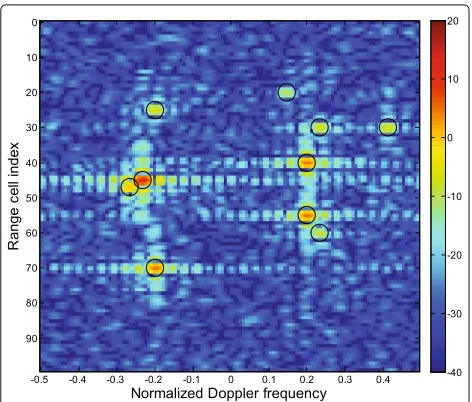
Figure 1 exhibits the estimation of range-Doppler plane X using traditional MF-MTD. In particular, the
Fig. 1The estimation (in dB) of range-Doppler plane X using traditional matched filter and MTD method for clutter-free scenario
locations of true targets are marked with circles. The results indicate that weak targets are possibly masked by the range-Doppler sidelobes of strong targets. For example, the high sidelobe of target at the 45th range cell has a significant impact on parameter esti-mating (i.e., range profile) of nearby target located at the 47th range cell. It could be treated as a weak tar-get leading to false alarm. Additionally, the mainlobes of the targets are expanded over the range-Doppler plane.
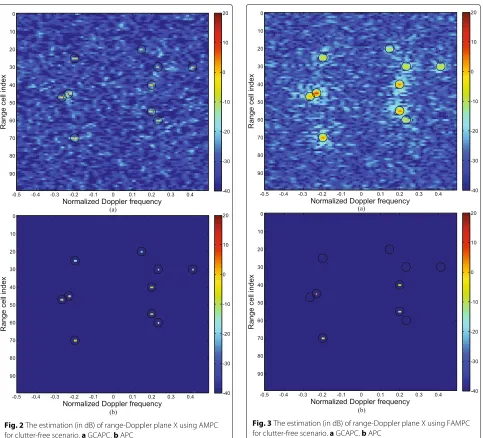
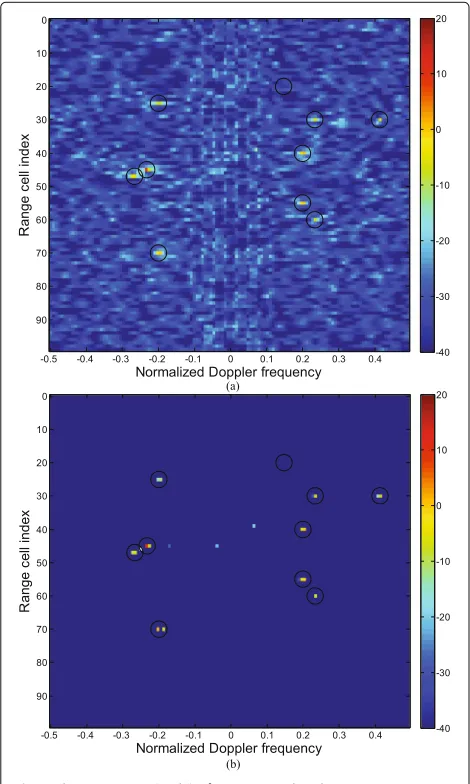
Based on the APC and GCAPC, Figs. 2, 3, and 4 depict the estimations of range-Doppler plane X uti-lizing AMPC, FAMPC, and MAMPC, respectively. In particular, we observe that, in Figs. 2a, 3a, and 4a, the targets can be accurately estimated by exploiting AMPC, FAMPC, and MAMPC based on the accom-plishment of GCAPC. However, the obtained results using FAMPC also exhibit the mainlobe energy of the targets can easily spread nearby-range Doppler cells, as well as possess high-range Doppler sidelobes, low range, and Doppler resolutions in comparison with those optimized by AMPC and MAMPC. Additionally, in Figs. 2b, 3b, and 4b, we assess the obtained estimation of range-Doppler planeXexploiting AMPC, FAMPC, and MAMPC accomplished by APC. Interestingly, AMPC, FAMPC, and MAMPC achieve lower range-Doppler side-lobe and narrower mainside-lobe in terms of estimation results of range-Doppler plane X compared with MF-MTD, whereas a portion of weak targets are missing for FAMPC.
In the following, we analyze the mean square error (MSE) performance of the estimation using MF-MTD, AMPC, FAMPC, and MAMPC. In particular, the MSE is defined as
MSE= 1
LK ˆX−X
2. (45)
In Fig. 5, we plot the MSE curves of the X esti-mation versus iteration number exploiting MF-MTD, AMPC, FAMPC, and MAMPC based on GCAPC for clutter-free scenario. Interestingly, AMPC and MAMPC both share the near performance and outperform MF-MTD and FAMPC. This is a reasonable behav-ior since the optimized results by MF-MTD and FAMPC show high range-Doppler sidelobes (Figs. 1 and 3a).
In Table 2, we report the iteration number and com-putation time of AMPC, FAMPC, and MAMPC for the implementation of estimation of range-Doppler plane
Fig. 2The estimation (in dB) of range-Doppler plane X using AMPC for clutter-free scenario.aGCAPC.bAPC
respectively. Finally, it is worth highlighting that MAMPC achieves the significant reduce of computational bur-den in comparison with AMPC and obtains more accu-rate estimation of range-Doppler planeXin contrast to FAMPC.
5.2 Clutter scenario
In this subsection, we consider the estimation of range-Doppler planeXin presence of clutter, where we suppose that colored Gaussian clutter is adopted with assuming internal motion of the clutter scatters due to, for example, wind affecting a forest or grassland. Thus, the temporal correlation of such clutter can be described by its power spectral density (PSD),
Fig. 3The estimation (in dB) of range-Doppler plane X using FAMPC for clutter-free scenario.aGCAPC.bAPC
Sc
f= σ
2 cλ √
2π2σv exp
−f2λ2
8σ2 v
, (46)
where σv is the root of mean square(rms) of clutter velocity and λ is the length of waveform. Furthermore, the autocorrelation function of clutter is expressed as
rc(τ)=σc2exp
−π2τ2
8σv2 λ2
. (47)
Hence, the(i,j)th element of the covariance matrixσ0H isσi,j = rc(|i−j|TPRT)/σc2fori,j = 1,. . .,M. Here, we assume the rms of clutterσv = 5 m/s and the power of clutter P = σ2
Fig. 4The estimation (in dB) of range-Doppler plane X using MAMPC for clutter-free scenario.aGCAPC.bAPC
Fig. 5The MSE (dB) versus iteration number using MF-MTD, AMPC, FAMPC, and MAMPC based on GCAPC for clutter-free scenario
Table 2Iteration number and computation time (in seconds) of AMPC, FAMPC, and MAMPC for clutter-free scenario
Algorithm AMPC FAMPC MAMPC
n 6 4 7
Time(s) 1014.7 91.6 7.7
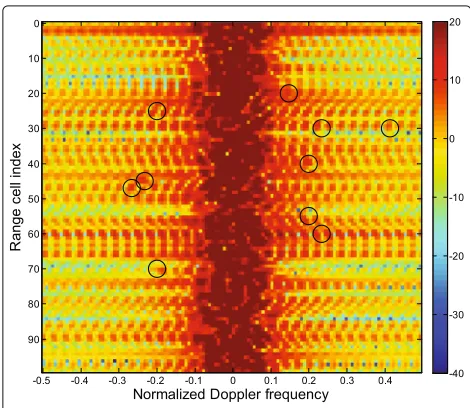
In Fig. 6, the obtained range-Doppler planeXby tradi-tional MF-MTD for clutter scenario is plotted. In particu-lar, we observe that the targets completely are masked by strong clutter, showing that the adopted method fails to the considered clutter scenario.
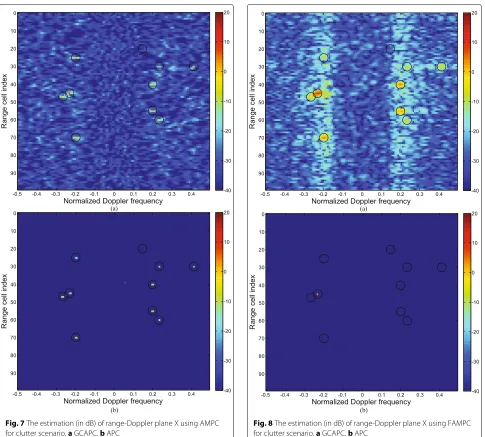
In Figs.7a, 8a, and 9a, we plot the estimation results of range-Doppler planeXobtained by AMPC, FAMPC, and MAMPC utilizing GCAPC, respectively. Interestingly, it can be seen that the weak target located at 20th range cell, cannot be found by AMPC, FAMPC, and MAMPC. Again, a wide mainlobe behavior can be observed for FAMPC. Based on the accomplishment of APC, we give the estimation results of range-Doppler planeXobtained by AMPC, FAMPC, and MAMPC in Figs. 7b, 8b, and 9b. Results again show that FAMPC is noneffective to a part of weak targets. In particular, by contrasting to MF-MTD, AMPC, and MAMPC can attain to a much better estimation and significantly alleviate the impact of clutter.
In Fig. 10, the MSE curves of theXestimation versus iteration number exploiting MF-MTD, AMPC, FAMPC, and MAMPC based on GCAPC for clutter scenario, are plotted. As expected, MAMPC exhibits a slightly
Fig. 7The estimation (in dB) of range-Doppler plane X using AMPC for clutter scenario.aGCAPC.bAPC
better performance than AMPC, and outperform MF-MTD and FAMPC due to low range-Doppler sidelobes in Fig. 9(a).
Table 3 summarizes the behavior of computational time of AMPC, FAMPC, and MAMPC for clutter scenario. Again, MAMPC exhibits a lower computation burden than AMPC and FAMPC. Precisely, MAMPC spends 7.1s to implement the estimation, whereas AMPC and FAMPC need 1400.5 and 105.8 s, respectively. Finally, it is worth pointing out that the performance behaviors in Fig. 10 and in Table 2 reflect the capability of the proposed MAMPC that not only estimates range-Doppler planeX
accurately, but also can reduce significantly computation load.
Fig. 8The estimation (in dB) of range-Doppler plane X using FAMPC for clutter scenario.aGCAPC.bAPC
6 Conclusions
Fig. 9The estimation (in dB) of range-Doppler plane X using MAMPC for clutter scenario.aGCAPC.bAPC
Fig. 10The MSE (dB) versus iteration number using MF-MTD, AMPC, FAMPC, and MAMPC based on GCAPC for clutter scenario
Table 3Iteration number and computation time (in seconds) of AMPC, FAMPC, and MAMPC for clutter scenario
Algorithm AMPC FAMPC MAMPC
n 8 4 6
Time(s) 1400.5 105.8 7.1
planeXwith that of AMPC, whereas FAMPC is likely to lose weak targets. Results have also impled that MAMPC shares much less computational time in comparision with AMPC. Possible future research tracks might concern the extension of the proposed framework to account for electronic jamming and nonhomogeneous characteristics clutter.
Endnote
1We notice that the waveform with good autocorrela-tion has better estimaautocorrela-tion performance for range-Doppler plane. Since the limitation on paper length, we here do not show the simulation results for the selection of waveform in simulation.
Acknowledgements
This work was supported by the National Natural Science Foundation of China under Grants 61201276 and 61301266, the Fundamental Research Funds of Central Universities under Grants ZYGX2014J013 and ZYGX2014Z005.
Competing interests
The authors declare that they have no competing interests.
Author details
1University of Electronic Science and Technology of China, 2006 Xi Yuan Ave,
West Hi-tech Zone, Chengdu, China.2AVIC Leihua Electronic Technology
Research Institute, Wuxi, China.37306 Research Institute of CASC, Chengdu,
China.
Received: 25 June 2016 Accepted: 9 November 2016
References
1. MI Skolnik,Introduction to Radar Systems, 3rd edn. (McGraw-Hill, New York, 2001), pp. 1010–1014
2. S Nagand, M Barnes, inProceedings of the 2003 IEEE Radar Conference. A moving target detection filter for an ultrawideband radar (Radar Conference, Huntsville, 2003), pp. 147–153
3. B Zrnic, A Zejak, A Petrovic, I Simic, Range sidelobe suppression for pulse compression radars utilizing modified RLS algorithm. 5th IEEE Int. Symp. Spread Spectrum Tech. Appl.3, 1008–1011 (1998)
4. R Sato, M Shinrhu, Simple mismatched filter for binary pulse compression code with small PSL and small S/N loss. IEEE Trans. Aerosp. Electron. Syst.
39(2), 711–718 (2003)
5. SD Blunt, K Gerlach, Adaptive pulse compression via MMSE estimation. IEEE Trans. Aerosp. Electron. Syst.42(2), 572–584 (2006)
6. L Li, W Yi, LJ Kong, XB Yang, inProceedings of 2014. Range limited adaptive pulse compression via linear bayes estimation (IEEE Radar Conference, Cincinnati, 2014), pp. 1010–1014
7. T Higgins, SD Blunt, K Gerlach, inProceedings of 2009. Gain-constrained adaptive pulse compression via an MVDR framework (IEEE Radar Conference, Pasadena, 2009), pp. 1–6
8. RO Schmidt, Multiple emitter location and signal parameter estimation. IEEE Trans. Ant. Pro.34(3), 276–280 (1986)
eigenstructure-based direction-finding algorithms, vol. 8 (ICASSP, Boston, 1983), pp. 336–339
10. A Paulraj, R Roy, T Kailath, A subspace rotation approach to signal parameter estimation. Proc. IEEE.74(7), 1044–1046 (1986) 11. SD Blunt, T Chan, K G, inProceedings of the IEEE Sensor Array and
Multichannel Signal Processing Workshop. SAM 2008. 5th IEEE. A new framework for direction of-arrival estimation (SAM, Darmstadt, 2008), pp. 81–85
12. SD Blunt, T Chan, K Gerlach, Robust doa estimation: the reiterative superresolution (RISR) algorithm. IEEE Trans. Aerosp. Electron. Syst.47(1), 332–346 (2011)
13. JM Baden, MN Cohen, inProceedings of Record of the IEEE 1990 International Radar Conference. Optimal peak sidelobe filters for biphase pulse compression (IEEE Radar Conference, 1990), pp. 249–252 14. JM Baden, MN Cohen, inProceedings of the National Telesystems
Conference. Optimal sidelobe suppression for biphase codes, vol. 1 (NTC, Georgia World Congress Center, Atlanta, 1991), pp. 127–131 15. S Wang, Z Li, Y Zhang, Application of optimized filters to two-dimensional
sidelobe mitigation in meteorological radar sensing. IEEE Geosci. Remote Sens. Lett.9(4), 778–782 (2012)
16. RC Chen, T Higgins, inProceedings of 2010 International Waveform Diversity and Design Conference (WDD). Golay waveforms and adaptive estimation, (WDD, Niagara Falls, 2010), pp. 257–261
17. T Higgins, SD Blunt, AK Shackelford, inProceedings of 2010 International Waveform Diversity and Design Conference (WDD). Time-range adaptive processing for pulse agile radar, (WDD, Niagara Falls, 2010), pp. 115–120 18. B Zhao, LJ Kong, M Yang, GL Cui, inProceedings of 2011 IEEE CIE
International Conference on Radar. Range-Doppler sidelobe and clutter suppression via time range adaptive processing (IEEE Radar (Radar), Chengdu, 2011)
19. SD Blunt, T Higgins, inProceedings of 2007 IEEE Radar Conference. Achieving real-time efficiency for adaptive radar pulse compression (IEEE Radar Conference, Boston, 2007), pp. 116–121
20. L Kong, M Yang, B Zhao, inProceedings of 2012 IEEE Radar Conference. Fast implementation of adaptive multi-pulse compression via dimensionality reduction technique (IEEE Radar Conference (RADAR), Atlanta, 2012), pp. 0435–0440
21. Y Yang, L Li, G Cui, W Yi, L Kong, X Yang, in2015 IEEE Radar Conference. A modified adaptive multi-pulse compression algorithm for fast implementation (IEEE Radar Conference (RadarCon), Arlington, 2015), pp. 0390–0394
22. SM Kay,Fundamentals of Statistical Precessing, 2nd edn. (Publishing House of Electronics Industry, Bei Jing, 2011)
Submit your manuscript to a
journal and benefi t from:
7 Convenient online submission 7 Rigorous peer review
7 Immediate publication on acceptance 7 Open access: articles freely available online 7 High visibility within the fi eld
7 Retaining the copyright to your article