Loudspeaker Equalization with Post-Processing
Wee Ser
Center for Signal Processing, School of Electrical & Electronic Engineering, Nanyang Technological University, Singapore 639798, Singapore
Email: [email protected]
Peng Wang
Center for Signal Processing, School of Electrical & Electronic Engineering, Nanyang Technological University, Singapore 639798, Singapore
Email: [email protected]
Ming Zhang
Center for Signal Processing, School of Electrical & Electronic Engineering, Nanyang Technological University, Singapore 639798, Singapore
Email: [email protected]
Received 1 November 2001 and in revised form 23 June 2002
Loudspeaker equalization is an essential technique in audio system design. A well-known equalization scheme is based on the deconvolution of the desired equalized response with the measured impulse response of the loudspeaker. In this paper, a post-processing scheme is combined with the deconvolution-based algorithm to provide a better equalization effect. Computer simu-lation results are given to demonstrate the significant improvement that can be achieved using this method.
Keywords and phrases:loudspeaker equalizer, post-processing.
1. INTRODUCTION
A loudspeaker is a device that converts a signal from its electric form to audible sound wave. Noticeable distortions may be introduced in this conversion leading to a significant loss of sound quality. The technique of loudspeaker equal-ization has thus been developed to deal with this problem. Among all the equalization schemes presented in the litera-ture [1, 2, 3, 4, 5, 6, 7, 8, 9, 10, 11, 12, 13], the deconvolution-based scheme [1] has the simplest filter structure and is widely used. However, this scheme does not work effectively at low and middle frequencies. Multiband approach over-comes this shortcoming and is able to provide satisfactory equalization for the entire frequency band of interest [2, 3], but its complex structure prevents it from being used in low-cost systems. In our previous work reported in [4, 5], a warped filter has been incorporated into the multiband equalizer design to reduce the structural complexity. In this paper, a different design approach is investigated. By suitably combining the deconvolution-based equalizer with a post-processing technique, a better equalization effect can be ob-tained with a marginal increase in the structural complexity. This paper is organized as follows. In Section 2, the deconvolution-based equalization scheme is briefly de-scribed and the principle of the proposed equalization
scheme with post-processing is introduced. In Section 3, the optimization process for the proposed scheme is discussed. Computer simulations have been conducted to demonstrate the effectiveness of the proposed scheme, and the results are given in Section 4. The paper ends with the concluding re-marks of Section 5.
2. PRINCIPLE OF THE PROPOSED SCHEME
Loudspeaker equalization involves the inverse filtering of the signal that is distorted by the loudspeaker. In the simplest case, it can be depicted as a convolution process, that is,
g(n)∗h(n)=z(n−τ) +e(n), (1)
whereh(n) andg(n) are the impulse responses of the loud-speaker and the equalizer, respectively, z(n) is the desired equalized response,e(n) is the residue error, andτis the time delay incurred due to the mixed-phase nature of the loud-speaker [1, 6, 14].
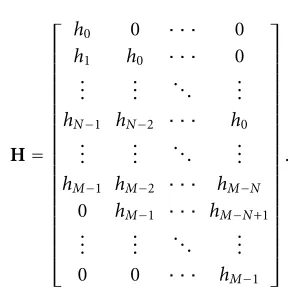
able to minimize the mean square error of the system equation can be derived
g=H#z, (3) where
g=g(0) g(1) g(2) · · · g(N−1)T (4)
is the coefficient vector of the equalizer filter,
z=0 · · · 0 z(0) z(1) z(2) · · · z(P−1) 0 · · · 0T (5) is an (N+M−1)×1 vector,Pis the length of the desired impulse responsez(n), # denotes pseudo inverse operation and
As can be seen from Figure 2b, noticeable distortions can still be observed in the equalized frequency response using this deconvolution-based scheme, especially at low and mid-dle frequencies. In this study, a new equalization method incorporating a post-processing technique is proposed to partially solve this problem. The principle of this method is to modify the desired equalized response according to the residue error observed from the previous equalization process.
Supposing z(n) is the modified desired-equalized-response and g(n) is the corresponding new equalizer de-sign, g(n) can be derived by replacing z with z in (3). The equalization process can be written accordingly as
g0(n)
h(n) Deconvolution g(n) Qualifier
Figure1: Flow chart of the iterative process.
follows
g(n)∗h(n)=z(n−τ) +e(n), (8) wheree(n) is the new residue error. The modified desired-equalized-response,z(n), is obtained by filteringz(n) with an adjustment functiont(n), that is,
z(n)=z(n)∗t(n). (9) In order to obtain maximum suppression of the residue er-ror, the adjustment function, t(n), must be designed very carefully. In this study, it is determined as follows:
LetY(l) be the Fourier transformation of the equalized impulse response, that is,
Y(l)=Ᏺg(n)∗h(n), (10) whereᏲdenotes Fourier transform. The smoothened func-tion ofY(l) is defined as
whereK is a positive integer. The adjustment function can now be obtained as follows,
t(n)=Ᏺ−1a/Y˜(l)c, (12) where Ᏺ−1 denotes the inverse Fourier transform,a is the
mean value of ˜Y(l), andcis a positive adjustment parame-ter. It can be observed that the adjustment function has been designed such that the strong components of Y(l) are sup-pressed while its weak components are enhanced.
3. OPTIMIZATION OF THE PROPOSED SCHEME
The effect of the proposed equalization method is domi-nantly determined by the value of the adjustment parameter
cin (12). An iterative process has been developed to search for the optimum value for this adjustment parameter.
The flow chart of the iterative process is shown in Figure 1, whereg0(n) is the resultant optimum equalizer, and
105
104
103
102
101
Frequency (Hz) −40
−20 0 20 40 60 80 100 120
M
ag
nitude
(dB)
(a)
(b)
(c)
Figure2: Magnitude frequency responses. (a) Measured response of the loudspeaker. (b) Equalized response using the deconvolution-based scheme. (c) Equalized response using the proposed scheme.
of the magnitude distortion is used to maximize the flatness of the equalized response within the passband, that is,
Ce=1L L−1
k=0
E(k)−E
/E2
, (13)
where E(k) is the magnitude distortion function, that is,
E(k) = Ᏺ[e(n)],Lis the passband width in taps, and Eis the mean value ofE(k) within the passband. A simple op-timization scheme using this qualification is summarized as follows:
Step1. Set the initial value ofcto zero, corresponding to the case where there is no adjustment made to the desired equal-ized response.
Step2. Design a deconvolution-based equalizer using (3).
Step3. CalculateCeusing (13), which is to be minimized in the subsequent process.
Step4. Increase the value ofcby a certain step size, and cal-culatez(n) using (9), (10), (11), and (12).
Step5. Calculateg(n) and the correspondingCe.
Step6. Repeat Steps 4 and 5 untilCeis greater than its previ-ous value.
The proposed optimum equalizer has a similar structure to that of the deconvolution-based method, and as such the latter has been used at the initial stage of the iteration to ac-celerate the iterative process.
4. COMPUTER SIMULATIONS
Computer simulations have been conducted to test the ef-fectiveness of the proposed scheme. The results of a
simula-tion carried out on a low-cost desktop loudspeaker are shown in Figure 2, where (a) is the measured frequency response of the loudspeaker, (b) is the equalized frequency response us-ing the deconvolution-based scheme, and (c) is that obtained using the proposed scheme. The desired equalized response,
z(n), has been modeled as one having a linear phase and a flat magnitude property within the passband (0∼20 kHz). The optimization method described in Section 3 has been em-ployed in the equalizer design to minimizeCe. In this simula-tion, the length of all the equalizer filters has been set to 100. It should be noted that the purpose of the proposed scheme is to redistribute the limited resources that can be used to construct the equalizer so as to achieve a better equalization effect. If the filter length is sufficiently large (e.g., 1000 for the loudspeaker used in this simulation), the deconvolution-based method alone is able to provide a good equalization effect on the entire frequency band, and the improvement contributed by the post-processing scheme may not be obvi-ous.
As can be observed from the figure, the magnitude fre-quency response of the loudspeaker contains noticeable dis-tortion. The deconvolution-based equalization helps to duce the distortion greatly, but the resultant equalized re-sponse is still poor at low and middle frequencies. Using the proposed scheme, an overall better equalization effect is ob-tained. In Table 1, the values ofCe (equation (13)) for the two equalized responses are compared to further illustrate the improvement.
Table1: Comparison of normalized variance of the magnitude dis-tortion.
Deconvolution-based Equalization with equalization post-processing
Ce(dB) −14.9394 −19.1804
Table2: Comparison of equalization effects using different qualifi-cations.
UsingCeas qualification UsingCeLas qualification
Ce(dB) −19.1804 −18.4319 CeL(dB) −18.3299 −19.7102
Qualifications other thanCecan be adopted in the opti-mization process to realize different equalization effects. An example is given in Table 2, where the normalized variance of the magnitude distortion at low frequencies,CeL, is used to further improve the equalization effect at low frequencies.
CeLcan be expressed as
CeL=1I I−1
k=0
E(k)−E
/E2,
(14)
in this paper) is further suppressed, but the overall equaliza-tion effect is deteriorated compared with that usingCeas the qualifier in the optimization.
It should be noted that in the definition of the adjust-ment function given in (12), all frequency components of the equalized response are enhanced or suppressed at the same exponential rate ofc. A reasonable conjecture is that, by al-lowing these frequency components to vary more freely, the resultant equalization effect could be improved further. This conjecture has been substantiated with a simple test, where the entire frequency band is divided into two sub-bands and the steepest decent algorithm is applied to search for the op-timum two-element adjustment parameter vector that min-imizesCe. For the loudspeaker used in Figure 2, the magni-tude fluctuation of the equalized response within the pass-band is reduced further by about 0.8 dB, compared with that using a uniform adjustment parameter (from−19.1804 dB to−20.0347 dB).
5. CONCLUSIONS AND REMARKS
In this paper, a new loudspeaker equalization method is pro-posed. By using the proposed post-processing technique to refine the result of the classical deconvolution-based design, the magnitude fluctuation of the equalized response within the passband can be further reduced. The effectiveness has been illustrated through computer simulations. Unlike other methods such as the multiband or warped filter equalization, the proposed scheme has a relatively simple implementa-tion design, which makes it very attractive for low-cost loud-speaker design. This method can also be incorporated into the multiband or warped filter solutions to provide better equalization effect.
REFERENCES
[1] J. Mourjopoulos, “Digital equalization methods for audio sys-tems,” presented at the 84th Convention of the Audio Engi-neering Society, Paris, France, preprint 2598,Journal of the Audio Engineering Society (abstract), vol. 36, pp. 384, May, 1988.
[2] J. A. Henriquez, T. E. Riemer, and R. E. Trahan Jr., “A phase-linear audio equalizer: design and implementation,” Journal of the Audio Engineering Society, vol. 38, no. 9, pp. 653–666, 1990.
[3] J. A. Jensen, “A new principle for an all-digital preamplifier and equalizer,”Journal of the Audio Engineering Society (Engi-neering Reports), vol. 35, no. 12, pp. 994–1003, 1987. [4] P. Wang, W. Ser, and M. Zhang, “A novel dual-band equalizer
design for loudspeaker systems,” Journal of the Audio Engi-neering Society, vol. 48, no. 10, pp. 917–921, 2000.
[5] P. Wang, W. Ser, and M. Zhang, “Multiband warped fil-ter equalizer design for loudspeaker systems,” inProc. IEEE Int. Conf. Acoustics, Speech, Signal Processing, pp. 913–916, Is-tanbul, Turkey, June 2000.
[6] R. Greenfield and M. O. Hawksford, “Efficient filter design for loudspeaker equalization,” Journal of the Audio Engineering Society, vol. 39, no. 10, pp. 739–751, November 1991. [7] W. Ser, M. Zhang, and K. C. Tan, “Practical loudspeaker
equalization using digital filter,” inProc. ISSPR ’98, Hong Kong, China, September 1998.
[8] G. Karachalios, D. Tsoukalas, and J. Mourjopoulos, “Multi-band analysis and equalization of loudspeaker responses,” presented at the 98th Convention of the Audio Engineering Society, Paris, France, February, 1995, preprint 3975. [9] K. Steiglitz, “A note on variable recursive digital filters,”IEEE
Trans. Acoustics, Speech, and Signal Processing, vol. 28, no. 1, pp. 111–112, 1980.
[10] H. W. Strube, “Linear prediction on a warped frequency scale,”Journal of the Acoustical Society of America, vol. 68, no. 4, pp. 1071–1076, 1980.
[11] M. Karjalainen, E. Piiril¨a, and A. J¨arvinen, “Loudspeaker response equalization using warped digital filters,” inProc. NorSig-96, pp. 367–370, Espoo, Finland, September 1996. [12] M. Karjalainen, E. Piiril¨a, A. J¨arvinen, and J. Huopaniemi,
“Comparison of loudspeaker equalization methods based on DSP techniques,”Journal of the Audio Engineering Society, vol. 47, no. 1, pp. 14–31, January–February 1999.
[13] M. Karjalainen, A. H¨arm¨a, U. K. Laine, and J. Huopaniemi, “Warped filters and their audio applications,” inProc. IEEE Workshop on Applications of Signal Processing to Audio and Acoustics, New Paltz, NY, USA, October 1997.
[14] D. Preis, “Phase distortion and phase equalization in audio signal processing—a tutorial review,”Journal of the Audio En-gineering Society, vol. 30, no. 11, pp. 774–794, 1982.
Wee Ser received his B.Sc. (Hons) degree and Ph.D. degree, both in electrical and electronic engineering from the Loughbor-ough University, UK in 1978 and 1982, re-spectively. He joined the Defence Science Organization (DSO), Singapore, as an en-gineer in 1982 and became the Head of the Communications Laboratory and later the Head of the Communications Research Di-vision in 1988 and 1993, respectively. From
1995 to 1997, he was an adjunct associate professor at the School of Electrical and Electronic Engineering (EEE) in NTU (Nanyang Technological University). In 1997, he joined NTU as an asso-ciate professor and was appointed as the Director of the Centre for Signal Processing. Wee Ser was a recipient of the Colomb Plan and PSC postgraduate scholarships. He was awarded the IEE Prize during his undergraduate studies. While in DSO, he was the re-cipient of the prestigious Defence Technology (Individual) Prize in 1991 and an Excellence Award for a research project in 1992. He is a senior member of IEEE. He has published more than 40 papers in international journals and conferences, and has seven patents filed under his name. His research interests include chan-nel equalization, space-time processing, microphone array process-ing, multiuser detection, noise control, and fingerprint verification techniques.
Ming Zhang received the B.Eng. and M.Eng. degrees from the National Univer-sity of Defense Technology, China, in 1985 and 1988, respectively, and the Ph.D. de-gree from the University of Electronic Sci-ence and Technology of China in 1991, all in electrical engineering. He was a Lecturer in 1991 and then Associate Professor in 1992 with Nanjing University of Aeronau-tics and AstronauAeronau-tics, China. In September