Volume 9, No. 2, March-April 2018
International Journal of Advanced Research in Computer Science RESEARCH PAPER
Available Online at www.ijarcs.info
ISSN No. 0976-5697
APRIORI BASED MACHINE LEARNING IN POWER DISTRIBUTION NETWORK
Jasreen Kaur
Computer engineering and Technology Department Lovely Professional University
Phagwara, India
Abstract: Power Distribution Networks (PDNs) are responsible for delivery of electricity from transmission substations to individual belonging.
PDNs are still an open area of research and demand efficient load balancing algorithm. Although initially loads are balanced among three phase network but drift into unbalance state meeting ever growing and fluctuating demands. This imbalance in loads at different phases of system affects tool utilization, voltage ranges system stability and security .The comprehensive review has shown that the use of machine learning in not considered in PDNs. The issue of scalability has been ignored. This paper proposed Apriori based machine learning algorithm to predict the loads and schedule it in the optimum way. The comparisons have clearly shown that the effectiveness of the proposed technique over the existing one.
Keywords: load balancing; machine learning; Power Distribution Networks; phase swapping; feeder reconfiguration.
I. INTRODUCTION
[image:1.595.364.499.437.580.2]Electric Power seems to have become the part of every household via massive distribution systems through which electric power moves significant distance from origin to each customer through service mains. Often there is uncertainness of loads among feeder w.r.t time. There is always a need to balance the load among the feeder to prevent this imbalance as it vulnerable to system security, equipment utilization and voltage drops. Phase imbalance increases power losses due to quadratic nature of losses [2]. It also improves line safety measures pertaining to labours and increases overhead on power program. At the same time many loads are vulnerable to imbalance and cannot further precede proper procedure. Fig.1 describes the basic architecture of the PDNs. The supply of electric power is done through distributed substation. Substations are connected to feeders which in turn are connected to transformer. Distribution transformer act as terminal voltage conversion dropping down voltage to level utilized by customer.
Figure 1. Architecture of PDN
Load balancing in PDNs is an act of circulating the loads among different feeders such that no feeder remains overwhelmed. Even if loads are initially balanced among three phase distribution system yet drift into unbalance state meeting ever-growing and fluctuating demands. The imbalance in load at different phases of system affects equipment usage, voltage levels and system security [3]. Phase imbalance increases power losses due to quadratic nature of losses [2]. It also improves line safety measures pertaining to labours and
increases overhead on power program. At the same time many loads are vulnerable to imbalance and cannot further precede proper procedure.
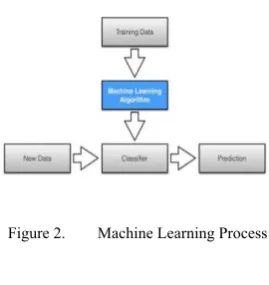
[image:1.595.51.275.542.676.2]Prediction of load prior the demand is an important and challenging problem. This can only be done through machine learning. Machine learning is the art by which computer learn and act without being explicitly programmed. Here the learner is a system which predicts the loads for each feeder and then checks the difference in predicted data set an actual one to
Figure 2. Machine Learning Process
II. LITRATURE SURVEY
consistently determine the current and voltage in its node at predefined sampling rate. Subsequently most of the nodes should synchronize with each other and shift the rotatary cam switch in locations which will result in minimum imbalance at root node. Results show that this method provides minimum load disbalance and power losses [1].In different areas data mining is used to solve the load balancing problem such as distributed heterogeneous environment[9] cloud computing[10] grid computing [11].Apriori algorithm is very much effective in finding frequent use item set and association rules .In[12] data mining is used to enhance the performance in multi core architecture using Apriori algorithm.
III. PROPOSED METHODLOLGY
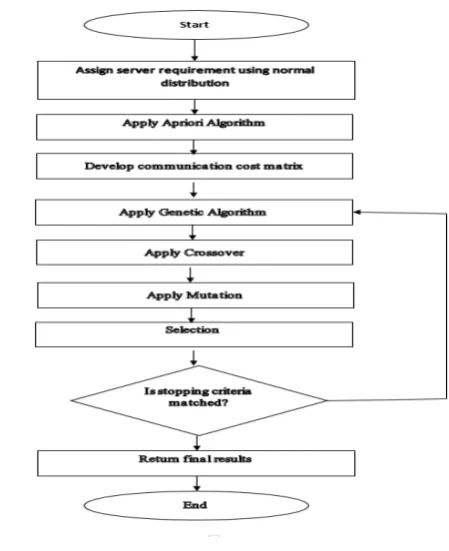
Apriori Machine Learning is a an efficient association rule based learning technique based on finding an association rules between frequent used item set in the given dataset. Modeling such a technique for power distribution network is an intriguing region of exploration and great deal of concepts have been brought ahead to intimate this goal. Machine Learning is such a well-known area, which has been freshly believed to deal with complex problems. Figure 5.1 depicts the outline of an algorithm.
In the proposed algorithm we start with first initializing the data center requirement. In this stage the servers are assigned the requirements using normal distribution. Apriori algorithm is then applied to the given dataset to find the best communication matrix from their past experience or reading to find the best arrangement in which loads are assigned to servers such that the servers remain balanced. After this we develop a communication cost matrix which decides how much cost is engaged in transferring load from one to another. Genetic algorithm follows this step to find the optimal solution of the problem in the minimal time as it uses probabilistic rules over deterministic one. It follows the genetic algorithm steps then select the solution if it balances the feeder/ server such that in three phase system the sum of all phases sum up to zero. After that we evaluate parameter such as overall gain and total disbalance in the current system.
For evaluation of the new proposed time three parameters are considered i.e. execution time, overall disbalance and overhead cost. Each parameter is further evaluated when we change number of servers and power distribution value respectively. Evaluation is further categorized into two parts when we have taken all the resources of same capacity i.e for homogenous resources and another one for heterogeneous resources. Three metrics for evaluation are explained below:
1.Execution Time
It is a time taken by system executing the task here task is swapping the loads over a three phase electric system. It is summation of communication time and computation time. If loads over network is balanced, execution time will be less and more useful the system will be.
2.Load Balancing Gain
This metric can be defined as how the work load is divided among the phases in other words variation of load among different phases.
s.
Where i=1,2,3...n Servers and Ui=Utilization
3.Overhead Time
It is defined as extra time required by the system to attain the required goal. It is also called communication time needed to make a coordination link with the different phases of feeders to which power is to be transferred in order to balance it. Our main goal is to decrease the overhead time.
A. Algorithm
Step1: Deploy Power Distribution Network and load the data Step2: Assign Server Requirements using normal distribution. Step3: Apply Apriori Algorithm
Step4: Deploy Communication cost matrix Step 5 Apply Genetic algorithm
Step 6: Apply crossover Step 7: Apply mutation Step 8: Selection
Step 9: if Stopping criteria fulfilled then go to step 10 else step 5
Step 10: return Final results
[image:2.595.335.560.366.642.2]B. Flowchart
Figure 3. Flowchart of proposed algorithm
IV. EXPERIMENTAL SETUP
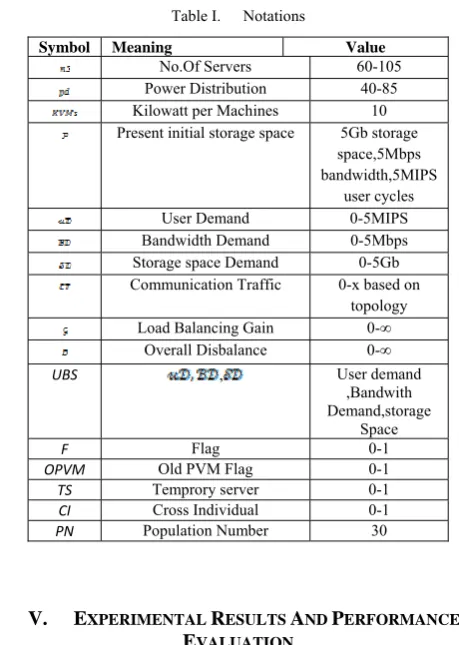
algorithm. Table 1 is representing various symbols used in the simulation work along with their respective range. However our work is not limited to these stated values, these values are only taken for better evaluation purpose
Table I. Notations
Symbol Meaning Value
No.Of Servers 60-105 Power Distribution 40-85 Kilowatt per Machines 10 Present initial storage space 5Gb storage
space,5Mbps bandwidth,5MIPS
user cycles User Demand 0-5MIPS Bandwidth Demand 0-5Mbps Storage space Demand 0-5Gb Communication Traffic 0-x based on
topology Load Balancing Gain 0-∞
Overall Disbalance 0-∞
UBS , User demand
,Bandwith Demand,storage
Space
F Flag 0-1
OPVM Old PVM Flag 0-1
TS Temprory server 0-1 CI Cross Individual 0-1 PN Population Number 30
.
V. EXPERIMENTAL RESULTS AND PERFORMANCE EVALUATION
This section provides cross validation and verification of existing and proposed techniques with respect to some well defined performance evaluation criteria The proposed method is evaluated over different performance metrics such as execution time, load balancing gain, overhead time ,overall disbalance with respect to number of servers and power distribution in comparison to existing technique.
A. Performance evaluation based on Execution Time
Execution time changes with change in number of servers. Here we have taken the value of number of servers from 60 - 105.
Figure 4. Comparision of execution Time Of existing and proposed over number of servers in homogenous environment
Figure 5. Comparision of execution Time Of existing and proposed over number of servers in homogenous environment
Figure 6. Comparision of execution Time Of existing and proposed over Power Distribution in homogeneous environment
[image:3.595.43.273.108.431.2]Figure 7. Comparision of execution Time Of existing and proposed over Power Distribution in hetrogenous environment
[image:3.595.64.265.610.775.2]Machine Learning Based DILB over execution time w. r. t Power Distribution for homogenous and heterogeneous environment. Bar graph clearly shows that the time evolved to swap the load over different phases has decreased in case of the proposed as compared to the Existing DILB. It is confirmed that the proposed algorithm is comparatively better than the existing techniques. This decrease represents improvement in the speed of swapping or reassignment of loads.
B. Load Balancing Gain
This metric can be defined as how the work load is divided among the phases in other words variation of load among different phases.
s.
[image:4.595.339.522.67.233.2]Where i=1,2,3...n Servers and Ui=Utilization
Figure 8. Comparision of Overall Gain Of existing and proposed over number of servers in homogenous environment
.
Figure 9. Comparision of Overall Gain Of existing and proposed over number of server in heterogenous environment
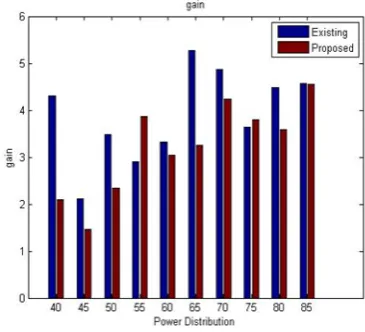
Figure 10. Comparision of Overall Gain Of existing and proposed over over Power Distribution in homogenous environment
[image:4.595.39.269.174.409.2]Figure 11. Comparision of Overall Gain Of existing and proposed over over Power Distribution in hetrogenous environment
Figure 8 and Figure 9. shows the comparison among Existing Dynamic Intelligent Load Balancing (DILB) and Proposed Data Mining Based DILB over gain w. r. t. No of Servers for homogenous and heterogeneous environment. Figure. 10and Figure.11 shows the comparison among Existing Dynamic Intelligent Load Balancing (DILB) and Proposed Data Mining Based DILB over gain w. r. t. Power Distribution for homogenous and heterogeneous environment Bar graph clearly shows that the increase in gain when we use machine learning to swap the load over different phases in case of the proposed as compared to the Existing DILB. It is confirmed that the proposed algorithm is comparatively better than the existing techniques.
C. Overhead Time
[image:4.595.332.530.278.435.2] [image:4.595.48.243.495.668.2]Figure 12. Comparision of Overhead Of existing and proposed over number of servers in homogenous environment
Figure 13. Comparision of Overhead Of existing and proposed over number of servers in hetrogenous environment
Figure 14. Comparision of Overhead Of existing and proposed over Power Distribution in homogenous environment
Figure 15. Comparision of Overhead Of existing and proposed over Power distribution network in hetrogenous environment
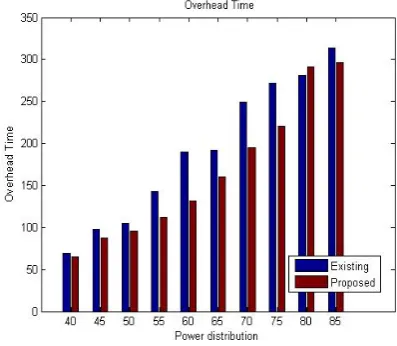
Figure12., Figure 13 shows the comparison among Existing Dynamic Intelligent Load Balancing(DILB) and Proposed Data Mining Based DILB with respect to overhead in homogenous and heterogeneous environment respectively. Bar graph clearly shows that the time evolved to swap the load over different phases has decreased in case of the proposed as compared to the Existing DILB. It is confirmed that the proposed algorithm is comparatively better than the existing techniques. This decrease represents improvement in the speed of swapping or reassignment of loads.
VI. CONCLUSION
After reviewing the literature it was found that there is no technique which considered machine learning or data mining to enhance the performance of PDN. The scheduling of loads over different phases at the time of overload is still an important issue in concerned field. Reconfiguration the whole network is regarded as expensive and time consuming job in which system has to be shut down. Phase swapping outlooks these drawbacks. But still it does not incorporated the idea machine learning for load prediction and balancing. We thereby presented a novel approach in solving load balancing problem by the use of Apriori machine learning algorithm. So the values we obtained from simulation environment clearly shows the improvement in performance of PDNs over existing technique. Moreover reduction in overhead and execution time clearly shows the superiority of proposed algorithm over existing literature..
VII. REFERENCES
[1] Vladimir Zdraveski, Mirko Todorovski, Ljupco Kocarev,
"Dynamic intelligent load balancing in power distribution networks", in International Journal of Electrical Power & Energy Systems on , vol. 73, pp. 157-162, May 2015 ,ISSN0142-06158
[2] Kuo C-C, Chao Y-T,"Energy managment based on aim/fm/gis
for phase balancing application on distribution systems", in EnergyConcers Manage on ,vol.51,No.3, 2010
[3] Gupta, N.; Swarnkar, A.; Niazi, K.R., "A novel strategy for
phase balancing in threephase four-wire distribution systems," in Power and Energy Society General Meeting, 2011 IEEE , vol., no., pp.1-7, 24-29 July 2011
[4] Jinxiang Zhu; Bilbro, G.; Mo-Yuen Chow, "Phase balancing
[image:5.595.74.248.58.230.2] [image:5.595.328.527.59.232.2] [image:5.595.61.257.512.691.2][5] Chia-Hung Lin; Chao-Shun Chen; Hui-Jen Chuang; Ming-Yang Huang; Chia-Wen Huang, "An Expert System for Three-Phase Balancing of Distribution Feeders," in Power Systems, IEEE Transactions on , vol.23, no.3, pp.1488-1496, Aug. 2008
[6] Huang, M.-Y.; Chen, C.-S.; Lin, C.-H.; Kang, M.S.; Chuang,
H.-J.; Huang, C.-W.,"Three-phase balancing of distribution feeders using immune algorithm," in Generation, Transmission & Distribution, IET , vol.2, no.3, pp.383-392, May 2008
[7] W.Siti, A. Jimoh and D. Nicolae,"Phase load balancing in
secondary distribution network using fuzzy logic and combinatorial; optimization based on newton raphson," in Proc. Intelligent Data Engineering and Automated LearningIDEAL, vol 5788, pp. 92-100, 2009.
[8] S. Senhadji, S. Khiat and H. Belbachir, "A dynamic load
balancing strategy for generating association rule mining under a grid environment," Sciences of Electronics, Technologies of Information and Telecommunications (SETIT), 2012 6th International Conference on, Sousse, 2012, pp. 976-981
[9] Tlili Raja and Slimani Yahya ," A Hierarchical Dynamic Load
Balancing Strategy for Distributed Data Mining,"in International
Journal of Advanced Science and Technology Vol. 39, February, 2012
[10] Priyanka R," Load Balancing In Public Cloud Combining The
Concepts Of Data Mining And Networking", International Journal of Research in Engineering and Technology, Vol.3 No.3,3 May 2014,pp167-171.
[11] Saeed Sharifian, Seyed A. Motamedi, and Mohammad K.
Akbari.," A predictive and probabilistic load-balancing algorithm for cluster-based web servers". Appl. Soft Comput. Vol.11,No.1, January 2011,pp. 970-981
[12] Kun-Ming Yu, Sheng-Hui Liu, Li-Wei Zhou, and Shu-Hao
Wu., "Apriori-based HighEfficiency Load Balancing Parallel Data Mining Algorithms on Multi-core Architectures".
[13] M.Eugin Lilly Mary, Dr.V.Saravanan, “Predictive Load