ePrints Soton
Copyright © and Moral Rights for this thesis are retained by the author and/or other
copyright owners. A copy can be downloaded for personal non-commercial
research or study, without prior permission or charge. This thesis cannot be
reproduced or quoted extensively from without first obtaining permission in writing
from the copyright holder/s. The content must not be changed in any way or sold
commercially in any format or medium without the formal permission of the
copyright holders.
When referring to this work, full bibliographic details including the author, title,
awarding institution and date of the thesis must be given e.g.
AUTHOR (year of submission) "Full thesis title", University of Southampton, name
of the University School or Department, PhD Thesis, pagination
FACULTY OF PHYSICAL AND APPLIED SCIENCES Electronics and Computer Science
On Automatic Emotion Classification Using Acoustic Features
by
Ali Hassan
Thesis for the degree of Doctor of Philosophy
ABSTRACT
FACULTY OF PHYSICAL AND APPLIED SCIENCES Electronics and Computer Science
Doctor of Philosophy
ON AUTOMATIC EMOTION CLASSIFICATION USING ACOUSTIC FEATURES by Ali Hassan
In this thesis, we describe extensive experiments on the classification of emotions from speech using acoustic features. This area of research has important applications in human computer interaction. We have thoroughly reviewed the current literature and present our results on some of the contemporary emotional speech databases.
The principal focus is on creating a large set of acoustic features, descriptive of different emotional states and finding methods for selecting a subset of best performing features by using feature selection methods. In this thesis we have looked at several traditional feature selection methods and propose a novel scheme which employs a preferential Borda voting strategy for ranking features. The comparative results show that our proposed scheme can strike a balance between accurate but computationally intensive wrapper methods and less accurate but computationally less intensive filter methods for feature selection.
By using the selected features, several schemes for extending the binary classifiers to multiclass classification are tested. Some of these classifiers form serial combinations of binary classifiers while others use a hierarchical structure to perform this task. We describe a new hierarchical classification scheme, which we call Data-Driven Dimensional Emotion Classification (3DEC), whose decision hierarchy is based on non-metric multi-dimensional scaling (NMDS) of the data. This method of creating a hierarchical struc-ture for the classification of emotion classes gives significant improvements over other methods tested.
The NMDS representation of emotional speech data can be interpreted in terms of the well-known valence-arousal model of emotion. We find that this model does not give
a particularly good fit to the data: although the arousal dimension can be identified
easily, valence is not well represented in the transformed data. From the recognition
results on these two dimensions, we conclude that valence and arousal dimensions are
In the last part of this thesis, we deal with the very difficult but important topic of improving the generalisation capabilities of speech emotion recognition (SER) systems
over different speakers and recording environments. This topic has been generally
overlooked in the current research in this area. First we try the traditional methods used in automatic speech recognition (ASR) systems for improving the generalisation of SER in intra– and inter–database emotion classification. These traditional methods do improve the average accuracy of the emotion classifier.
In this thesis, we identify these differences in the training and test data, due to speakers
and acoustic environments, as a covariate shift. This shift is minimised by using
importance weighting algorithms from the emerging field of transfer learning to guide
the learning algorithm towards that training data which gives better representation of testing data. Our results show that importance weighting algorithms can be used to minimise the differences between the training and testing data. We also test the effectiveness of importance weighting algorithms on inter–database and cross-lingual emotion recognition. From these results, we draw conclusions about the universal nature of emotions across different languages.
List of Figures ix
List of Tables xi
Nomenclature xiv
Abbreviations and Acronyms xvii
Declaration of Authorship xix
Acknowledgements xxi
1 Introduction 1
1.1 Current Issues in SER Systems . . . 2
1.2 Aims of the Thesis . . . 6
1.3 Applications of Work . . . 6
1.4 Thesis Contributions . . . 8
1.5 Thesis Organisation . . . 10
1.6 Publications . . . 11
2 Background and Literature Review 13 2.1 Description of Speech . . . 13
2.1.1 The Lungs and Vocal Folds . . . 13
2.1.2 The Vocal Tract . . . 14
2.2 Human Speech Production Model . . . 16
2.3 Emotion Production in Human Beings . . . 17
2.4 Theoretical Models for Emotion Taxonomy . . . 18
2.4.1 Discrete Emotion Theory . . . 18
2.4.2 Dimensional Emotion Theory . . . 19
2.5 A Review of Speech Emotion Recognition Systems . . . 21
2.5.1 Emotional Speech Databases . . . 22
2.5.2 Features for Speech Emotion Recognition . . . 26
2.5.3 Classification Methods . . . 28
2.6 Summary . . . 30
3 Classification Methods 31 3.1 Support Vector Machines . . . 31
3.1.1 Linear SVMs . . . 32
3.1.2 Soft-margin Linear SVMs . . . 34 v
3.1.3 Non-linear SVMs . . . 35
3.2 Validation Methods. . . 36
3.2.1 k−Fold Cross Validation . . . 36
3.2.2 Leave-One-Speaker Out Validation . . . 37
3.3 Evaluation Measures . . . 37
3.3.1 Weighted and Unweighted Average Accuracy . . . 38
3.3.2 Recall and Precision for a Multiclass Problem . . . 39
3.4 Databases . . . 40
3.4.1 Danish Emotional Speech Database . . . 40
3.4.2 Berlin Database . . . 41
3.4.3 Serbian Database . . . 41
3.4.4 Non-Acted Speech: AIBO Database . . . 41
3.5 Summary . . . 43
4 Features for Emotion Recognition from Speech 45 4.1 Current Issues in Feature Extraction . . . 45
4.1.1 Feature Representation . . . 46
4.1.1.1 Long-term Features . . . 46
4.1.1.2 Short-term Features . . . 47
4.1.2 Categories of Acoustic Features . . . 47
4.1.3 Combining Acoustic Features with other Information Sources . . . 50
4.2 Feature Extraction Methods . . . 51
4.2.1 Fundamental Frequency/ Pitch . . . 51
4.2.2 Energy Features . . . 53
4.2.3 Duration Features . . . 54
4.2.4 Spectral Features . . . 56
4.2.5 Formant Features . . . 57
4.2.6 Voice Quality Features . . . 59
4.2.6.1 Jitter and Shimmer . . . 61
4.2.6.2 Harmonics to Noise Ratio . . . 61
4.3 State of the Art Feature Set Generated by Brute Force . . . 62
4.4 Summary . . . 63
5 Feature Selection Methods and Results 65 5.1 Dimensionality Reduction by Domain Transformation . . . 66
5.2 Dimensionality Reduction by Feature Selection . . . 66
5.2.1 Wrapper Based Feature Selection Methods . . . 67
5.2.2 Filter Based Feature Selection Methods . . . 68
5.2.2.1 Correlation Based Feature Selection . . . 69
5.2.2.2 Mutual Information Based Feature Selection . . . 70
5.2.3 Hybrid Feature Selection Based on SVM Weights . . . 71
5.3 Feature Rank Fusion Using Preferential Borda Voting . . . 72
5.3.1 Soft Decision Feature Fusion . . . 74
5.3.2 Hard Decision Feature Fusion . . . 74
5.4 Results Using Full Feature Set . . . 74
5.4.1 Results on Three Acted Emotional Speech Databases . . . 74
5.4.1.2 Comparison Between Gender . . . 78
5.4.2 Results on Two Spontaneous Emotional Speech Database . . . 80
5.5 Results Using Feature Selection . . . 81
5.6 Search for Universal Features . . . 86
5.7 Summary . . . 87
6 Hierarchical Classification and Results 89 6.1 Motivation . . . 89
6.2 Four Methods of Multiclass Classification . . . 90
6.2.1 One-versus-Rest . . . 90
6.2.2 One-versus-One . . . 91
6.2.3 Directed Acyclic Graph (DAG) . . . 92
6.2.4 Unbalanced Decision Tree (UDT). . . 92
6.3 Classification Results using the Four Methods . . . 92
6.4 Visualising with Multidimensional Scaling . . . 94
6.4.1 Heat Plots. . . 94
6.4.2 Non-Metric Multi-Dimensional Scaling . . . 95
6.5 Data Driven Dimensional Emotion Classifier, 3DEC . . . 98
6.5.1 Determining the 3DEC Structure . . . 99
6.5.1.1 Data Partitioning for Determining Confusions . . . 99
6.5.1.2 Example 3DEC Structure . . . 100
6.5.2 Performance Evaluation of 3DEC . . . 100
6.5.3 Statistical Analysis . . . 101
6.6 Comparison with State-of-the-Art. . . 102
6.7 Summary . . . 103
7 Inter–Database Classification 105 7.1 Problem Statement and Motivation . . . 106
7.1.1 Problems with Inconsistent Databases . . . 106
7.1.2 State-of-the-Art in Inter-Database Emotion Recognition . . . 107
7.2 Traditional Methods for Adaptation . . . 108
7.2.1 Cepstral Mean Normalisation . . . 109
7.2.2 Maximum Likelihood Linear Regression . . . 109
7.2.3 Vocal Tract Length Normalisation . . . 110
7.3 Transfer Learning. . . 114
7.3.1 Introduction to Covariate Shift . . . 115
7.3.2 Verifying a Distribution Shift . . . 116
7.4 Calculating Importance Weights . . . 117
7.4.1 Kernel Density Estimation . . . 117
7.4.2 Kernel Mean Matching. . . 118
7.4.3 Unconstrained Least-Squares Importance Fitting . . . 120
7.4.4 Kullback–Leibler Importance Estimation Procedure . . . 122
7.4.5 Likelihood Cross Validation . . . 124
7.4.6 Differences between KDE, KMM, uLSIF and KLIEP . . . 125
7.5 Use of IW for Classification . . . 125
7.5.1 Importance Weighted Logistic Regression . . . 126
7.6 Illustration on Example Toy Data . . . 127
7.6.1 Testing on 2D One Class Data . . . 128
7.6.2 Testing on 2D Two Class Data . . . 129
7.6.3 Effect of Varying C. . . 130
7.6.4 Effect of Training Data . . . 132
7.6.5 Computational Costs of the Algorithms . . . 134
7.7 Evaluation Setup & Results for Emotion Classification . . . 134
7.7.1 Mapping of Emotion Classes . . . 136
7.7.2 Testing for Covariate Shift. . . 137
7.7.3 Results on Three Acted Databases . . . 138
7.7.4 Results on Spontaneous Emotional Speech Database . . . 143
7.8 Summary . . . 144
8 Conclusions and Future Work 147 A Pitch Extraction Methods 153 A.1 Autocorrelation Function . . . 153
A.2 Average magnitude difference function (AMDF). . . 154
A.3 YIN Algorithm . . . 155
A.4 Sub-harmonic Summation . . . 157
A.5 Linear Predictive Analysis . . . 158
A.6 Cepstrum Analysis . . . 159
B Non-Metric Dimensional Scaling Plots 163
2.1 The human speech production system . . . 14
2.2 Speech signals showing voiced and unvoiced speech samples . . . 15
2.3 A simplified view of human vocal tract as a combination of two tubes . . 16
2.4 Graphical representation of circumplex model . . . 20
2.5 Components of a typical speech emotion recognition system . . . 22
3.1 Separating hyperplane obtained for linearly separable data using SVMs . 32 3.2 Sample confusion matrix for a M-class problem . . . 38
4.1 Pitch contour of speech signal . . . 53
4.2 Bar plots of average f0 value per emotion for the four databases . . . 54
4.3 Power contour of speech signal . . . 55
4.4 Bark and mel frequency scale. . . 57
4.5 Block diagram for calculating MFCC . . . 58
4.6 Formant frequencies of a speech signal . . . 59
4.7 Mean and contour plots for the distribution of 1stand 2nd formant. . . . 60
5.1 SD–CV and SI–CV percentage UA classification accuracies in comparison with reported human accuracies for acted emotional speech databases . . 77
5.2 SI–CV gender specific results for acted emotional speech databases . . . . 79
5.3 SD–CV and SI–CV %age UA and gender specific results for Aibo database. 81 5.4 SD–CV %age UA accuracy with respect to the number of features selected for acted emotional speech databases . . . 83
5.5 SD–CV %age UA accuracy with respect to the number of features selected for Aibo emotional speech database. . . 84
6.1 Various architectures for combination of binary classifiers for 4 classes . . 91
6.2 Heat plot of confusion matrix for 7-class classification for Berlin database 95 6.3 DET plot of confusion matrix for 7-class classification for Berlin database 96 6.4 NMDS representation of SI–CV confusion matrices for 5 selected databases 97 6.5 NMDS plots for the 10 folds of the Aibo-Ohm database in the speaker-dependent case. . . 100
6.6 3DEC scheme for 5-class Aibo-Ohm database . . . 101
7.1 Example of quadratic VTLN warping function . . . 111
7.2 Box plots for VTLN warping factor α for the two genders . . . 113
7.3 Scatter plot showing how the training data his shifted towards the testing data by using KMM on a toy dataset . . . 128
7.4 Scatter plot showing the decision boundary using IW-SVM on the 2D toy
data. . . 130
7.5 Classification performance on 2D toy data by varyingC . . . 131
7.6 Classification performance on 2D toy data for varying ntr . . . 133
7.7 Average log time taken for calculating the IW for varyingnte . . . 135
A.1 Auto correlation function of a sine signal of 4 Hz . . . 154
A.2 Difference function of a sine wave of 200 Hz . . . 155
A.3 Results of YIN algorithm applied on sine wave . . . 156
A.4 Block diagram of LPC . . . 159
A.5 Block diagram of homomorphic deconvolution . . . 160
A.6 Block diagram of complex homomorphic deconvolution . . . 161
A.7 Capstrum transform of the speech signal . . . 161
B.1 NMDS plots for the 10 folds of the DES database in the speaker-dependent case. . . 163
B.2 NMDS plots for the 4 speakers of the DES database in the speaker-independent case. . . 164
B.3 NMDS plots for the 10 folds of the Berlin database in the speaker-dependent case. . . 164
B.4 NMDS plots for the 10 speakers of the Berlin database in the speaker-independent case. . . 165
B.5 NMDS plots for the 10 folds of the Serbian database in the speaker-dependent case. . . 165
B.6 NMDS plots for the 6 speakers of the Serbian database in the speaker-independent case. . . 166
B.7 NMDS plots for the 10 folds of the Aibo-Mont database in the speaker-dependent case. . . 166
B.8 NMDS plots for the first 6 speakers of the Aibo-Mont database in the speaker-independent case. . . 167
B.9 NMDS plots for the first 6 speakers of the Aibo-Ohm database in the speaker-independent case. . . 167
2.1 Basic emotion classification by different researchers and scientists . . . 19
2.2 Summary of common emotional speech databases. . . 23
3.1 Emotion classes and number of sentences per class for the four databases 42 4.1 Summary of the acoustic features used by different researchers. . . 52
4.2 Description of features derived using OpenEAR Toolkit . . . 63
5.1 Classification accuracy with standard deviation on the selected three acted emotional speech databases using linear SVM. . . 75
5.2 Classification accuracy with standard deviation on the selected three acted emotional speech database using linear SVM. . . 80
5.3 Confusion matrix for 5-class emotion classification for the DES database . 85 5.4 Confusion matrix for 7-class emotion classification for the Berlin database 85 5.5 Confusion matrix for 5-class emotion classification for the Serbian database 86 5.6 Confusion matrix for 5-class emotion classification for the Aibo-Mont database . . . 86
5.7 Confusion matrix for 5-class emotion classification for the Aibo-Ohm database . . . 86
5.8 List of Universal features selected from all of the five database . . . 87
5.9 UA and WA %age accuracies for SD–CV and SI–CV with selected features and universal feature sets . . . 88
6.1 UA and WA %age accuracies for SD–CV with four classifier schemes . . . 93
6.2 Confusion matrix for 5-class SI–CV emotion classification for the DES database using DAG classification. . . 94
6.3 UA %age accuracies for SD–CV and SI–CV using 3DEC model, DAG and S+C models . . . 101
6.4 SOA results on the four selected databases. . . 103
7.1 Details of traditional machine learning and transfer learning settings. . . . 115
7.2 Details of the methods used for importance weighting. . . 125
7.3 Details of the parameters used for illustrative 2D classification data taken from Tsuboiet al. (2008). . . 129
7.4 Classification performance on 2D toy data by varyingC . . . 131
7.5 Classification performance on 2D toy data for varying ntr . . . 133
7.6 Mapping of emotions on Arousal and Valence dimension . . . 137
7.7 Mapping of 5 emotional classes for Aibo database onto two cover classes . 137 7.8 Percentage of Uni-Large features failing the Kullback-Liebler test in SD–CV, SI–CVand inter–databasescenarios . . . 138
7.9 SD–CV and SI–CV classification results on acted databases . . . 139
7.10 SD–CV and SI–CV intra-database classification results on acted databases forarousal,valenceand 4-common classes . . . 140
7.11 Inter–database classification results on acted databases for arousal, va-lence and 4-common classes . . . 142
7.12 SD–CV and SI–CV classification results on spontaneous databases . . . . 145
5.1 Pseudo Code for Sequential Forwarding Selection (SFS) . . . 68
5.2 Pseudo Code for Sequential Floating Forwarding Selection (SFFS) . . . . 69
7.1 Pseudo Code for KMM. . . 120
7.2 Pseudo Code for KLIEP . . . 123
7.3 Pseudo Code for KLIEP model selection by LCV . . . 124
Data
x(n) Continuous input speech sample
x[n] Discretised x(n)
xi Input patterns xi ∈ X
xi(j) jth component of input patternxi
yi Classes labels of inputxi
X Input domain
n Total number of data examples
D Total number of features, dimension of X
d Number of features in a subset where d≤D
M Total number of classes
s Total number of speakers in a database
f0 Pitch
fs Sampling frequency
T0 Time period
Fi Centre frequency of ith formant
BWi Bandwidth of ith formant frequency
Rc Ranking criterion
L Total number of rankers
τmax Maximum lag
Vectors, Matrices and Norms
1 Vector with all entries equal to one
0 Vector with all entries equal to zero
I Identity matrix
A−1 Inverse matrix
hx, x′i Dot product between xand x′
||.|| 2-norm, ||x||:=phx, x′i
SVM-related
w Normal vector
C SVM misclassification tolerance parameter
b Constant offset
αi Lagrange multipliers
ξi Slack variables
IW-related
xtri Input training patterns xtri ∈ X
xtei Input testing patterns xtei ∈ X
ytr
i Training data classes ytri ∈[M]
ytei Testing data classes ytei ∈[M]
ntr Number of training examples
nte Number of testing examples
β Importance weights
3DEC Data-Driven Dimensional Emotion Classification
k-NN k Nearest Neightbour
AA Average Accuracy
ACF Autocorrelation Function
AMDF Average magnitude difference function
ASC Autism Spectrum Disorders
ASR Automatic Speech Recognition
CMN Cepstral Mean Normalisation
DET Detection Error Trade-off
EER Equal Error Rate
EER Equal Error Rate
GMM Gaussian Mixture Models
HCI Human Computer Interaction
HMM Hidden Markov Models
IW Importance Weighting
KDE Kernel Density Estimation
KLIEP Kullback–Leibler importance estimation
KMM Kernel Mean Matching
LCV Likelihood Cross Validation
LLD Low Level Descriptor
LPA Linear Predictive Analysis
LPC Linear Predictive Coding
MAP Maximum-a-posteriori
MFCC Mel-Frequency Cepstral Coefficients
MLLR Maximum Likelihood Logistic Regression
MLP Multi-Layer Perceptron
MMD Maximum mean Discrepancy
NMDS Non-metric Multi-Dimensional Scaling
PCA Principle Component Analysis
QP Quadratic Programming
SD–CV Speaker Dependent Cross Validation
SI–CV Speaker Independent Cross Validation xvii
SBE Sequential Backward Elimination
SER Speech Emotion Recognition
SFS Sequential Forwarding Selection
SOA State of the Art
SVM Support Vector Machines
UA Unweighted AA
uLSIF Un-constrained Least Square Importance Function
VTLN Vocal Tract Length Normalisation
I, Ali Hassan , declare that the thesis entitled On Automatic Emotion Classification Using Acoustic Features and the work presented in the thesis are both my own, and have been generated by me as the result of my own original research. I confirm that:
• this work was done wholly or mainly while in candidature for a research degree at
this University;
• where any part of this thesis has previously been submitted for a degree or any
other qualification at this University or any other institution, this has been clearly stated;
• where I have consulted the published work of others, this is always clearly
at-tributed;
• where I have quoted from the work of others, the source is always given. With the
exception of such quotations, this thesis is entirely my own work;
• I have acknowledged all main sources of help;
• where the thesis is based on work done by myself jointly with others, I have made
clear exactly what was done by others and what I have contributed myself;
• parts of this work have been published as: (Hassan and Damper,2009), (Hassan
and Damper, 2010), (Hassan and Damper, 2012), (Hassan et al., 2012a) and (Hassan et al.,2012b).
Signed:... Date:...
First and foremost, my heart felt gratitude and appreciation is addressed to my super-visor Professor Bob Damper for taking me as a research student under his valuable
supervision. His advice, discussions and guidance were the real encouragement to
complete this work. I admire his simplicity, generosity and work ethics. It has been an honour to work with him. I will always be thankful to him for the valuable times that he spent in supervising my progress, and the research opportunities he gave me during this time. I would also like to thank Professor Mahesan Niranjan who has spent time with me discussing various aspects of this thesis. I am really grateful to him for providing me great insight into some of the difficulties that I had during my PhD. I would also like to thank Dr. Sasan Mahmoodi who monitored my progress as a member of my MPhil/PhD committee at the University of Southampton. I am thankful to National University of Scieces and Technology, Pakistan for funding first two years PhD research. Being at the University of Southampton has been a great fun. I have been lucky to have such great friends who have given me so much love and support. I am really grateful to Ali Gondal, Basam, Banafshe, Fasih, Ke, Mohammad Tayarani, Mohsin, Musi, Ramanan, Umar Khan and Wei who have made this experience such a great pleasure and fun.
Nothing would have been possible without the support of my wife who took care of our children during my studies. I really appreciate her support for standing with me during the tough times that we have faced during this period. I have to thank my parents for their blessings and love without which none of this would have been possible.
Thank you all.
Introduction
Imagine you are driving on a highway, your in-car satellite navigation system (satnav)
tells you to ‘take the exit at next junction’ but you know that this is the wrong exit.
This will not take you through the shortest route to your destination. The exit that you
really want is the one after, but your satnav keeps on reminding you‘take the next exit’
. . . ‘200 metres to the exit’ . . . ‘100 metres to the exit’ . . . ‘turn left and take the exit’ . . . ‘re-calculating the shortest route to your destination’. How many times have you been in such situations and lost your temper by shouting at your satnav, although you know that it can not understand what you are saying. What if it could understand that you are loosing your patience, and adapt its further instruction accordingly or even try to sooth you by saying something nice? Similarly, what if your car could understand when you are feeling tired or frustrated with traffic, and caution you before you cause any road rage?
Such automated machines which can understand the current emotional state of their users and respond to them have been part of fiction films for some time. As an example, consider the film ‘I, Robot’ (released 2004), which is set in the year 2035 in which there is one robot for every five people in the world. The idea is to create robotic assistants who can understand the physical and emotional requirements of human beings and respond accordingly. In this film, Dr. Alfred Lanning, a scientist at U.S. Robotics, creates a robot named ‘Sonny’ which other than its usual tasks, can also understand and feel emotions. He even gets sentimental about dying.
There is another film titled ‘Stealth’ (released 2005), in which an unmanned combat aerial vehicle is introduced in the U.S. Navy flown by ‘EDI’, a computer with an artificial intelligence, alongside other fighting planes. At one stage in the film, the officials believe that EDI has become a liability and decide to destroy it by ordering it to fly to a remote Alaskan base. EDI recognises the stress patterns in the commander’s voice and decides to take evasive action.
Over the last decade, this research into developing such systems which can recognise the current emotional state of the speaker have shifted from fiction to a major research topic in human computer interaction (HCI) and speech processing. It came into the focus of pattern recognition and machine learning communities with the publication of
Picard’s influential book Affective Computing (Picard,1997). The aim of this research
is to develop speech emotion recognition (SER) systems that can not only understand the verbal contents, but also emotions in the speech to which any human listener would understand and react. This research has a lot of applications in spoken dialogue systems such as computer enhanced learning systems, automated response systems, etc. However, there are still many issues that need to be addressed before this technology becomes part of our daily life.
1.1
Current Issues in SER Systems
Darwin(1859) had argued that emotions are survival-related responses that have evolved to solve certain problems that all species have faced over their evolutionary lifecycle. Consequently, emotions have to be, in general, the same in all human beings. In addition, because of the common evolutionary past of humans and other animals, similarities in the emotions should be observable for closely-related species. Any social organism has means of communicating their emotions to their species. Each uses different means to communicate their current state ranging from secreting chemicals to using body gestures or language. If we take an example of ants, they secrete chemicals to communicate their messages to other ants, similarly, complex mammals like whales use body gestures like splashing their tail or making bubbles and singing songs to communicate their frustration or affection to other whales and sea creatures.
Human emotions are a complex phenomenon which are a combination of psychological and physiological factors. Emotions are expressed in humans in three different ways, which are:
• subjective experience (conscious experience)
• physiological changes in body (tense muscles, dry mouth, sweating, etc.)
• behaviour of individual (facial expression, flee, hide, etc.)
Emotional speech is a by-product of all of these processes. Emotions are imposed onto the speech when a person experiences some conscious disturbance. This produces physiological changes in the body which results in the production of speech that carries the emotional state of the speaker. Detecting this state just by speech is not very easy even for human beings who, with all their intelligence, still make many mistakes.
One important aspect of emotions is that according to Darwin’s theory of evolution, living in the same community with similar group of people does create a particular style of speaking which is generally common to all people of the society. However, each individual is different and has his/her own way of speaking and portraying emotions. There are several factors that affect this style. The style varies from each gender (male or female), age (child,adult or mature), language, culture, and social status of speakers. As we grow in age, our personality develops, we develop our attitude and our methods of interacting and representing ourselves become well defined. As we go through these changes, our method of portraying emotions also changes. Therefore, the way a 10 year old child portrays his/her emotions will differ from how a 40 years old portray their emotions.
As an example of cultural differences, there are several Asian cultures in which full blown
expression of angry emotions is not very much accepted in the society. Usually people
refrain from expressing full blown anger which is considered as a weakness of personal
control. Similarly, the style of expressing emotions in certain social classes varies from other social classes. The emotions expressed by a worker at the docks will be different from those expressed by a professor in a University. These differences make the task of emotion recognition even more difficult.
Emotions are usually defined as how other people perceive them. This is why we use human listeners to label the recorded speech subjectively in the listening tests i.e., according to how they perceive the corresponding emotions and not the way speaker intended to portray them. The early work on developing basic theories for emotion processing was done by psychologists on the basis of human perception. These basic theories were developed on the full-blown emotions for some discrete number of emotion
types mainly portrayed by actors, see for example Murray and Arnott(1993); Scherer
(2000).
In a broader sense, we can say that the way human portray emotions should not be significantly different from the way we perceive them. However, up till now, we have not come across any study which tries to link the two or establishes their relationship. As these theories have been developed using human perceptions models, they may not always fit exactly on the models derived directly from the audio speech data.
The most commonly used model for human emotion perception is the dimensional ‘valence–arousal’ model. All emotions are thought to be the combination of these two dimensions. It is based upon how human listeners perceive emotions rather than how human speakers portray the particular emotions. These methods are good for basic work in the field but the models generated by this type of data do not necessarily fit the
real world data. Increasingly, the evidence shows that recognising emotions in arousal
dimensions is much easier than those in valence. This is the prime example of a theory
Another major issue in speech emotion recognition is the identification of the base unit that should be used for recognising emotions. Some researchers advocate using the whole utterance or turn for recognising emotions, while others argue that there could be more than one perceived emotion in the spoken utterance. Therefore, a base unit smaller than the whole utterance or turn should be used. Based upon these different views, databases have been created which are either annotated on the whole utterance
level (Engberg and Hansen(1996); Burkhardtet al. (2005); Jovicic et al. (2004)) or on
word level (Batliner et al. (2004); Steidl (2009)). General consensus is towards using
whole utterance for acted emotional speech while each word for detecting emotions from spontaneous speech. However there are still researchers who use a different unit for this task. For example, FAU Aibo emotional corpus, also used in this thesis, have been labeled on ‘chunks’ which are predefined segments of speech by the creators.
Another problem is the identification of the features that work well under different emotion conditions. As there has not been much collaboration between researchers from the beginning, there exists many different types of hand crafted base features that have
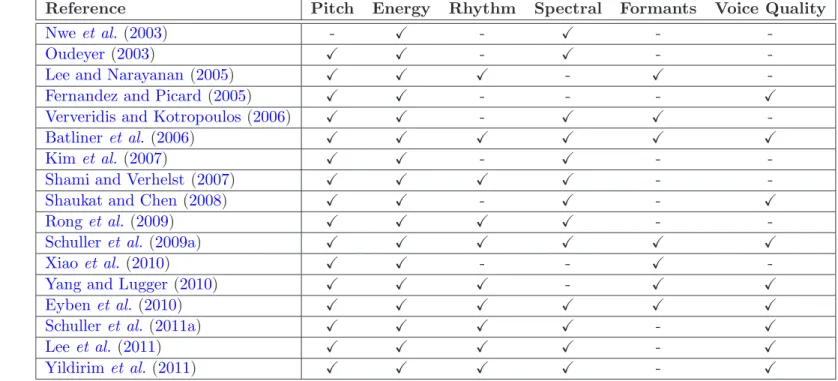
been found to be useful in their specific scenarios e.g., Oudeyer (2003), Fernandez and
Picard(2005),Lee and Narayanan(2005) each have used a different feature sets for the task of emotion recognition from speech. This situation seems to be changing by the
introduction of OpenEAR toolkit byEybenet al.(2009). This toolkit allows researchers
to extract a large number of emotion related features from the speech sample by brute force. This allows to set a base line method for extracting features. Afterwards one can apply some feature selection for the reduction of dimensionality.
Most of the commonly available databases for emotion recognition research are in dif-ferent languages. Apart from creating problems of language, speaker and recording environment differences, it presents an opportunity to test a very important question
Are emotions universal across different languages? This means by training on one or more databases and then testing on another which is in a different language, can we learn something about the underlying emotions even though we have no information about the language being spoken. There is evidence that young children can detect emotions and respond to them even though that they do not understand the language.
It is believed that human beings can recognise emotions from speech even if it is expressed in a foreign language that we do not understand. Similarly machines should be capable of understanding emotions regardless of the language and linguistics. Based upon the
results on several languages inRussellet al.(1989), the authors have argued that
valence-arousal model can be considered as a universal model for emotion perception across various languages. If we wish to test the presence of this universal model and corre-spondingly emotions across several languages from audio speech using machine learning algorithms, we have to establish a universal acoustic feature set that is independent of the language. This will allow us to apply multi-lingual emotion recognition and several emotional speech theories on different languages. Similarly, there have been some initial
experiments performed in which listeners were asked to identify emotions from foreign
languages (e.g. Tickle (2000); Abelin and Allwood(2000)). These experiments did find
the presence of universality of emotions over various languages. However, there are not many detailed experiments or methods been developed to verify this claim.
The question of the best performing set of features still remains unanswered. Selected features which perform well on one database may not perform as well on another database. Usually, we can not apply exhaustive search for the best performing feature set in a reasonable time, so we have to apply suboptimal and computationally inexpensive feature selection methods. The problem is exaggerated by the fact that best performing features selected by one feature selection method are not same to the ones selected by
another even on the same database. These leads to another related question, Can we
search for some universal features which perform equally well on all of the databases?
If we can identify a set of universal features which is common across all/most of the languages, it will allow us to perform cross lingual emotion recognition and answer the questions about the universality of emotions.
Other than learning universal features, another way to test universality of emotions is to learn from the available resources and then apply them on the unknown, not seen before but related tasks. One can take an example of the recently introduced personal assistant in iPhone called Siri by Apple Incorporation. This functionality is only available in English, French and German. The expected date for its release for other languages is more than one year later than the first release of the product. Could there be methods that can be used to learn from the available data and adapt the learned models for the new and unknown languages?
The researchers have started to combine several different classifiers to create an ensemble
classifier for emotion recognition. Schuller et al. (2005a) used an ensemble of support
vector machines, naive Bayes, C4.5 and k-NN classifier on Berlin emotional speech
database. However, the trends changed after the first Interspeech Emotion Challenge held in 2009. Most of the contributors in this challenge used binary classifiers arranged in a serial, parallel or a combination of both to form hierarchical classifier. These classifiers
have proved to perform better than the others. Lee et al. (2009) was the submission
which was declared as winner in the classifier sub-challenge. They used binary Bayes logistic regression classifiers to make a hierarchical structure which was based upon their ‘prior experience’. There was no formal method described to determine the hierarchical structure of the classifiers.
Most of the research in this domain does not consider the cultural and gender effect on the expressed emotions. Generally, there are no formal methods developed or applied to reduce the differences caused by inter-speaker or gender variations and acoustics of recording environments. Any gender independent SER should explicitly compensate for
these differences. This area of research has been generally overlooked by the researchers. In this thesis we shall try to tackle some of these issues and propose possible solutions.
1.2
Aims of the Thesis
Keeping in view the current issues in this domain, the following are the aims of this thesis:
• to develop effective algorithms for classification of human emotions from their
speech
• to identify different characteristics of human speech by applying novel feature
selection methods, that represent the emotional state of the speaker
• to address the issue of a universal feature set for emotion recognition that works
generally well on all databases
• to get insight into the commonly used ‘valence–arousal’ model by testing on these
two dimensions
• to test methods from different areas of research to improve the generalisation
capabilities of SER systems
• to test whether emotions are universal across different languages
1.3
Applications of Work
Call centres are one of the most popular applications of automated recognition of emotions from speech. On one hand, SER systems can provide human operators with information regarding the emotions that their voice might portray. This kind of system helps the users to improve their interaction skills. An example of such a system is
Jerk-O-Meter available athttp://groupmedia.media.mit.edu/jk.php(last visited on
2 June 2012), which is a real-time speech analysis application that monitors the activity of the user from speech, and gives feedback if they are ‘being a jerk’ on the phone. On the other hand, such a system may use knowledge of the user’s emotional state to select appropriate conciliation strategies and to decide whether or not to transfer the call to a human agent. An example of such a system is AT&T’s spoken dialogue system known as ‘How may I help you?’ in which an automated system responds to the callers and based upon their frustration level decides whether to transfer their call to a human agent or not. The same solution can be used to monitor the quality of the service providers.
Recently, emotion recognition methods have found their applications in computer en-hanced learning methods. The motivation behind these methods is to adopt the au-tomated tutoring system according to the emotional state of the student to enhance
the learning process. For example, Ai et al. (2006) used the features extracted from
the dialogue between the automated tutor and the student for emotion recognition in ITSpoke, which is an intelligent tutoring spoken dialogue system. The system adapts its tutoring style based upon the interest level of the student.
Hopkins et al. (2011) have used software called FaceSay for teaching social skills to children affected with Autism Spectrum Disorders (ASC). A total of 49 children with different levels of ASC were asked to interact with FaceSay routinely to teach them to recognise emotions and how to respond accordingly. An avatar mimicked several emotions and students were rewarded if they recognised and responded to corresponding emotions correctly. This study showed a significant improvement in the capability of students playing this game.
There has been recent work on emotionally aware in-car systems. This work is motivated by studies that provide evidence of dependencies between a driver’s performance and
his or her emotional state (Jones and Jonsson,2008). Emotion recognition from speech
in the noisy conditions of a moving car has been investigated in the FERMUS project (Schuller et al., 2007a). The aim is to categorise the current state of the speaker to improve and monitor in-car safety and the performance of the driver.
One of the important applications for advancement in this field is the use of emotion recognition in human computer interaction. Researchers are working to develop robots that can interact with humans and modify their actions according to feedback from human reactions. The Sony robot is one example in which a robot called artificial intelligent robot (AIBO) has been developed which can interact with human beings.
SER systems have a high potential in games (Jones and Jonsson,2008), e.g., Microsoft
XBox 360 released a concept game character called Natal which can monitor and react
precisely to the player’s style of speech. It can understand and behave accordingly to the emotional response of the player. Another commercial application of this research is the marketing industry. The Affective Computing Group at MIT has developed wrist bands which can monitor the physiological changes which correspond to the emotional state of the user. This information is potentially very useful for the retail industry which can identify the type of products that please or displease their customers.
All in all, SER systems have a large application potential for emotion aware speech recognition systems. However, there are many technical issues that need to be solved before these systems will become part of our daily life technology.
1.4
Thesis Contributions
Contributions of this thesis can be broadly divided into following three parts.
Feature Selection Methods
In this thesis, instead of using limited number of hand crafted features, we have used brute force method to generate a large number of acoustic features. To select the best performing features on an individual database, we have tested several wrapper and filter based feature selection methods. In our experiments, we found that wrapper methods perform better than filter based feature ranking methods but they are computationally expensive. Filter based methods are computationally inexpensive but they do not perform consistently. Two filter based feature selection methods may select different top performing features even when tested on the same database.
We propose a novel feature ranking method, based upon preferential Borda voting scheme. This method fuses the results of several computationally inexpensive filter feature ranking methods using soft and hard decision Borda voting. By fusing several ranked features, we achieve two goals; one is that we get rid of any random ranker, and second is that we find the overall best ranked features.
After selecting features that work well on individual databases, the next step is to search for a universal feature set. We propose to use Borda voting to select a universal feature set that performs reasonably well on all of the selected databases. The proposed methods return two universal feature sets. The classification results using these universal feature sets show the effectiveness of these features. We have used these universal features for inter–database emotion recognition tests where they prove to be very effective.
3DEC Hierarchical Classifier
Using the selected features, we compare four ways to extend binary support vector machines (SVMs) to multiclass classification for recognising emotions from speech—namely two standard SVM schemes (one-versus-one and one-versus-rest) and two other methods (DAG and UDT) that form a hierarchy of classifiers. Analysis of the errors made by these classifiers led us to apply non-metric multi-dimensional scaling (NMDS) to produce a compact (two-multi-dimensional) representa-tion of the data suitable for guiding the choice of decision hierarchy. The distribu-tion of emodistribu-tion classes on these NMDS representadistribu-tion can be interpreted in terms of the well-known valence-arousal model of emotion. We find that this model does
not give a particularly good fit to the data: although thearousaldimension can be
identified easily,valenceis not well represented in the transformed data. This is one
of the reasons that emotions in this dimension are difficult to classify. We describe a new hierarchical classification technique whose structure is based on NMDS,
which we call Data-Driven Dimensional Emotion Classification (3DEC). This new method performs significantly better than the other methods compared. One can use this systematic data driven approach to guide the hierarchical structure of the classifier.
Importance Weighted Inter–Database Classification
Each speaker has a different style of speaking. These differences are more pro-nounced between the male and female speakers. Secondly, different and changing acoustic environments are another source of inconsistencies in the data. Any gender and speaker independent SER must be able to generalise well for these varied conditions. This area of research have been generally ignored by the emotion recognition community. We test several algorithms that can be used to enhance the generalisation capabilities of a SER system across varied speakers and acoustic environments. We use standard algorithms like cepstral mean normalisation and maximum likelihood linear regression, which are used in automatic speech recog-nition systems to compensate for these differences. We identify these differences due to different speakers and recording environments as a covariate shift between
the training and testing data. We then propose to use algorithms from the
emerging field oftransfer learningto model this shift by calculating the importance
weights (IW) from input data. These IW are used to shift the decision boundary of the classifier towards those training samples which give better representation of the test data.
We have derived mathematical formulation to incorporate these IW into support vector machines (SVMs) which is one of the most commonly used machine learning algorithms. These importance weighted support vector machines (IW-SVMs) are used to cater for the covariate shift in the data. Our experiments on intra– database emotion classification show that transfer learning can be successfully used to compensate for the different speakers and acoustic environments even better than the standard methods used in ASR systems.
To test the real life scenario for a standard SER system, we apply inter–database emotion classification. These tests guarantee that the speakers and environments are different between the training and testing datasets as no part of them are common. To transfer the knowledge gained on the available resources to unknown datasets, we again propose to use transfer learning. Our comparative results show that these algorithms improve the generalisation capabilities of the classifier significantly across the databases which have different speakers and recording acoustic environments.
To answer the question about the universality of emotions across different lan-guages, we have applied inter–database emotion classification using transfer
learn-ing on the databases which are in different languages. The results are very
level proving thatthere are universal aspects of emotions that are common among different languages.
1.5
Thesis Organisation
In Chapter 2, we discuss background information about speech production in human
beings and the source-filter model used to describe this production system. The ba-sic models used by researchers for describing the emotional states and their inter-relationships are also discussed. A general review of current literature on SER systems is also given in this chapter. However, we have reviewed the related literature in every corresponding chapter separately.
Chapter 3 gives the details of the machine learning algorithms used for classification
tests. We have also given the details of the two validation techniques used to get the generalisation capabilities of the classifier. In the end we have given the differences between several evaluation measures being used to report classification results along with their mathematical details. This chapter also gives the introduction to the three acted and two spontaneous emotional speech databases which have been used to test the methods in this thesis.
Chapter 4 gives the details of different types of feature sets currently being used for
emotion recognition from speech. It gives the details of the large feature set generated by brute force that we use for emotion recognition.
Chapter5gives the details of several wrapper and filter based feature selection methods
tested in this thesis. It also gives the details of our proposed preferential voting based feature ranking method. Comparative results show the superior capabilities of our proposed method. In the end, we propose a unique way for searching ‘a universal’ feature set for emotion recognition from speech that works well for all of the databases.
Chapter 6 gives the comparison of four ways to extend binary SVMs to multiclass
classification. This chapter also gives the details of our proposed 3DEC hierarchical classifier for which the input data determines the structure of hierarchical classifier.
Chapter 7 gives the details of several algorithms used in ASR systems and the domain
of transfer learning, that can be used to enhance the generalisation capabilities of SER system. This is the first time that any such methods have been applied to SER systems. In this chapter, we also test on inter–database emotion classification by training on one database and testing on another unseen database. The question of ‘universality of emotions across different languages’ is also tackled in this chapter.
We give the future directions for research of this work and conclude this thesis in
1.6
Publications
The work in this thesis has contributed in part to the following publications:
• A. Hassan and R. I. Damper (2009) ‘Emotion recognition from speech using
extended feature selection and a simple classifier’. In Interspeech 2009, Brighton, UK. pp. 2403-2406.
• A. Hassan and R. I. Damper (2010) ‘Multi-class and hierarchical SVMs for emotion
recognition”. In Interspeech 2010, Makuhari, Japan. pp. 2354-2357.
• A. Hassan and R. I. Damper (2012) ‘Classification of Emotional Speech using
3DEC Hierarchical Classifier’ In Journal of Speech Communication. (Accepted for publication Feb 2012)
• A. Hassan, R. I. Damper and M. Niranjan ‘On Acoustic Emotion Recognition:
Compensating for Covariate Shift’ (In preparation)
• A. Hassan, R. I. Damper and M. Niranjan ‘On Acoustic Emotion Recognition:
Compensating for Covariate Shift – Supplementary Results’ Technical report (2012), Published by Faculty of Physics and Applied Sciences, University of Southampton.
Background and Literature
Review
In this chapter, we discuss background information about the production of speech in human beings and the source-filter model used to describe this production system. Emotion production in human beings is discussed along with the details of the theoretical models used for emotion taxonomy. We give a thorough literature review of the past work as well as the current trends in speech emotion recognition systems.
2.1
Description of Speech
The speech production system in human beings is capable of producing highly complex and variable sounds. A cross-section of human speech production system is shown in
Figure 2.1 which shows its different parts. All of these parts work in conjunction with
each other to produce speech which is radiated from the lips and nose. The quantity and quality of speech produced depends upon the the nature of excitation signal coming from the lungs and the shape and length of the vocal tract which modulates it to produce the final speech. The human vocal system can be divided into two sections: the lungs and the glottis which generate the source signal and the vocal tract which shapes the signal acoustically to produce different types of speech. The glottis is the combination of the vocal folds and the space in between the folds.
2.1.1 The Lungs and Vocal Folds
The power needed to generate the sound comes from the lungs via the breathing mech-anism. Mainly exhaled air is used for speaking and the respiratory system can be controlled by the brain so that breathing fits the type of speech being produced. Speech
Figure 2.1: The human speech production system, taken from Google Images.
can be voiced or unvoiced. For voiced speech, the vocal folds are brought together, temporarily blocking the flow of air from the lungs and leading to increased pressure. When this pressure becomes greater than the resistance offered by the vocal folds, they open letting the air out. The folds then close rapidly due to a combination of factors, including their elasticity, muscle tension, and the Bernoulli effect. If this process is maintained by a steady supply of pressurised air, the vocal folds will continue to open and close in a pseudo-periodic fashion. As they open and close, pulses of air flow through the glottal opening into the vocal tract. These regular pulses form the excitation signal. The
frequency of these pulses determines the fundamental frequency (f0) which is responsible
for the perceived pitch of the produced sound. This is the characteristic of voiced speech. During the process of opening and closing of the vocal folds, if steady pressure is not maintained, a random noise-like pattern is generated which is used to produce hiss-like sounds, the characteristic of unvoiced speech.
Figure 2.2 shows voiced and unvoiced speech signals. Periodicity of the speech signal
due to periodic excitation for voiced speech is clearly visible in Figure 2.2(a) while a
random pattern of excitation for unvoiced speech is seen in Figure2.2(b).
2.1.2 The Vocal Tract
The vocal tract is a passage that connects the larynx to the pharynx, through the mouth
and nose to the outside world as shown in Figure 2.1. The section of vocal tract, which
lets air out into the atmosphere, consists of mouth, tongue, jaws and lips to form the oral
cavity. When the soft velum, see Figure 2.1, is lowered, the oral cavity gets connected
to the nasal cavity. The second passage, between the larynx, nostrils and outside air, is called the nasal cavity. The vocal tract acts as an acoustically resonant tube in which
0 50 100 150 200 250 300 −0.02 −0.01 0 0.01 0.02 0.03 0.04 0.05 Time (ms) Amplitude
(a) Voiced speech signal.
0 50 100 150 200 250 300 −0.02 −0.01 0 0.01 0.02 0.03 0.04 0.05 Time (ms) Amplitude
(b) Un-voiced speech signal.
Figure 2.2: Two speech signals showing (a) voiced speech with clear periodic excitation; (b) unvoiced speech showing random pattern of excitation.
the oral and nasal cavities work together as a musical instrument to produce sound. Waves are reflected from the walls and mouth, and undergo interference which causes some frequencies to be suppressed while others are enhanced. The frequencies at which the vocal tract gives high resonance response are called formant frequencies. The centre frequency and bandwidth of formants are determined by the overall shape, length and volume of the vocal tract. Different sounds are produced by different shapes of the vocal tract. As its shape changes, so does the resonance response, which results in the production of different sounds.
Mouth
Nasal Cavity
Oral Cavity
Glottis Velum
Figure 2.3: A simplified view of human vocal tract as a combination of two tubes.
2.2
Human Speech Production Model
Regardless of different languages spoken, all human beings use the same basic mechanism to produce speech. By careful observation, researchers have generalised this into a simple model for studying its details and understanding and reproducing the human speech. To generalise the production of speech in human beings, the vocal tract is modelled as
a combination of two tubes: the nasal and oral cavity as shown in Figure2.3. Together
they act as an acoustic resonant tube which filters out some of the frequencies while enhancing others. Formant frequencies and their bandwidths are the main characteristics of the oral cavity. The resonant tube can be modelled as an all-pole filter in which the locations of the poles determine the formant frequencies. At the other end of the tube is the source of speech production that will generate the pulses of waves at regular pitch intervals for voiced sounds and random noise-like wave pattern for unvoiced sounds. Pitch and energy are the main characteristics of the source while formants are the characteristic of vocal tract. The idea of air from the lungs as a source and vocal tract as
a filter that shapes the sound is called thesource-filtermodel for speech production (Fant,
1960) and is regularly used in speech recognition, synthesis and coding applications.
Speech plays the most important part in the process of communication between
hu-man beings. Quast (2002) argues that a speech signal carries multiple communication
contents: verbal and non-verbal. The verbal contents are the language and words that represent ‘what’ is being said while the non-verbal contents contains the information of ‘how’ the words are being said. Every language has some particular words to express a specific emotional state, e.g., if a person is in a happy state, in English the speaker might
use words such asgreat,fantastic,brilliant, etc. Such linguistic features are a rich source
of information for humans to determine the current state of the speaker. Even when the verbal contents remain the same, non-verbal channels can carry different information. They convey the intentions of the message to the listeners. As an example “Yes, sure”
is a positive sentence in which the speaker is agreeing for something while “Yes, sure”
same, the non-verbal contents have changed. This change conveys the current emotional state of the speaker which is the main topic of interest of this thesis.
2.3
Emotion Production in Human Beings
The question about the nature of the emotions and their affect on speech is an old one. Some theories, like discrete emotion theory and ‘big six’ emotions, can be linked back to Darwin. Before we delve into their details, it is important to give an acceptable definition and the characteristics of ‘emotion’.
In his paper, Scherer (2000) has differentiated the emotions from other similar human
characteristics like mood and personal attitude. Emotions are usually observed in brief episodes in response to internal or external events of significance. A person’s ‘mood’ is a state of low intensity and can last for hours or days. It can be characterised as cheerful, gloomy, irritable, buoyant, etc. An individual’s personal ‘attitude’ is part of their personality and is unlikely to alter.
In this thesis we follow the following generally accepted definition byScherer(2000) who
defines emotions as:
“episodes of coordinated changes in several components in response to external and internal events of major significance to the organism”
The external events could be a change in the current situation, response of another person etc., while the internal events could be thoughts, memories and sensations. From this definition we can say the following about ‘emotions’:
• Emotions are episodic in nature, they occur again and again depending upon the
stimuli
• The effect of emotions on a person is noticeable and measurable
• The effect of emotions last for some measurable time
• The external and/or internal stimuli are very important to the generation of
emotions
• Emotions are generated in human beings as a result of complex neuro-physiological
processes, which affect several traits of normal human behaviour may it be verbal, physiological or facial behaviour.
According to psychological studies into the mechanism of emotion production, it has been found that under the influence of joy, anger and fear stimuli, the human nervous system is aroused. This causes an increase in heart rate, blood pressure, breathing patterns,
dryness of mouth and occasional muscle tremor. The resulting speech is correspondingly loud, fast and has high pitch range. In a contrasting situation like sadness, heart rate and blood pressure decreases and salivation increases, producing speech that is slow, low pitched, and low in energy. All of these changes in the human physiology affect the produced speech, facial expressions and human response to the stimuli like fleeing in case of fear. These physiological changes are also used in the polygraph test to check if a person is telling the truth or not.
2.4
Theoretical Models for Emotion Taxonomy
An important issue in developing a speech emotion recognition (SER) system is the need to determine and identify a set of emotions that are to be recognised and classified by a machine. In the last couple of decades, all the research related to emotion taxonomy is generally based upon two schools of thoughts. One assumes a discrete number of basic emotions that are representative of all other emotions. This is very similar to the idea of seven colours of light that can be combined to generate any colour. The second school of thought believes in continuous emotions and proposes to map all emotions on a low dimensional space, usually 2-3 dimensions, and argue that all emotions can be generated by combining the continuum of the underlying dimensions.
2.4.1 Discrete Emotion Theory
In the literature, up to 300 emotions have been identified by linguistics like O’Connor
and Arnold (1973), however identification and recognition of such a large number of emotions is very difficult especially by machines.
Therefore, based upon the idea of seven discrete colours of light, most researchers use the
‘palette theory’ (Scherer,2003) which argues that all of the emotions are a combination
of a few basic emotions. The number of basic emotions varies from 6–14. They are characterised by specific response patterns in physiology of human beings as well as their vocal and facial expressions. Many scientists have defined a list of emotions that they
consider to include the most basic and important emotions. Table 2.1 is reproduced
from Ortony and Turner (1990) which summarises the list of basic emotions used by various researchers.
The term ‘big six’ (Cowie et al.,2001) has become quite common for the description of
discrete emotions. It implies the existence of six basic emotions. Most commonly listed
emotion areangry,sad,surprised,happy,fearanddisgust withneutral sometimes added
Table 2.1: Basic emotion classification by different researchers and scientists (Ortony and Turner,1990).
Reference Basic Emotion
McDougall (1926) Anger, disgust, elation, fear, subjection,
tender-emotion, wonder
Watson (1930) Fear, love, rage
Mowrer (1960) Pain, pleasure
Izard (1977) Anger, contempt, disgust, distress, fear, guilt,
interest, joy, shame, surprise
Plutchik (1980) Acceptance, anger, anticipation, disgust, joy,
fear, sadness, surprise Ekman, Friesen, and
Ellsworth (1982)
Anger, disgust, fear, joy, sadness, surprise
Panksepp (1982) Expectancy, fear, rage, panic
Tomkins (1984) Anger, interest, contempt, disgust, distress,
fear, joy, shame, surprise
James (1984) Fear, grief, love, rage
Weiner and Graham (1984)
Happiness, sadness
Gray (1985) Rage and terror, anxiety, joy
Frijda (1986) Desire, happiness, interest, surprise, wonder,
sorrow Oatley and
Johnson-Laird (1987)
Anger, disgust, anxiety, happiness, sadness
2.4.2 Dimensional Emotion Theory
In order to understand how human beings conceptualise emotions, the approach used by the psychologists has been to seek the basic dimensions by which we perceive the similarities and differences among various emotions. The idea is to identify the basic dimensions which can define and map all different emotions using a lower dimensional space. This allows the researchers to visualise the complex mechanism of emotion production in human beings in a lower dimensional space. Often these studies on
several language have results in two bipolar dimensions,valenceand arousal. InRussell
(1980), the author suggested that only two dimensions, ‘valence’ and ‘arousal’ are enough
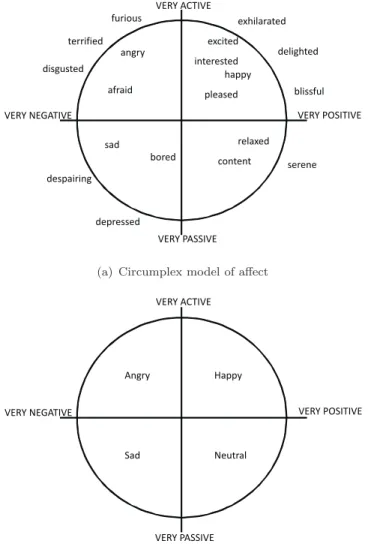
to characterise all emotions and proposed the circumplex model of affect for speech. He argued that emotions are spread around the perimeter of valence-arousal space. Arousal refers to the current state of activeness of the speaker while expressing a certain
emotion. Therefore, angry and happy should have high arousal while sad, bored and
relaxed have low arousal. The second dimension, ‘valence’ represents the positive and
negative feelings of the speaker. This dimension is used to separate angry from happy
emotions. Sometimes a third dimension namely ‘power’ or ‘control’ is added to this model.
VERY POSITIVE VERY NEGATIVE VERY ACTIVE VERY PASSIVE blissful delighted exhilarated excited interested happy pleased angry afraid disgusted terrified furious sad bored depressed despairing relaxed content serene
(a) Circumplex model of affect
VERY POSITIVE VERY NEGATIVE VERY ACTIVE VERY PASSIVE Angry Sad Happy Neutral
(b) Four primary emotions on the circumplex model of affect
Figure 2.4: Graphical representation of (a) circumplex model of affect with horizontal axis representing ‘valence’ and vertical axis representing ‘arousal’; (b) four primary emotions on circumplex model.
Similar to the spectrum of colour, emotions also lack the discrete borders that would clearly differentiate one emotion from another. Each can be understood as the linear
combination of these two dimensions. Figure2.4(a) shows a number of emotions spread
across the two dimensional space. Figure2.4(b)shows only four emotionsangry,happy,
sad and neutral on the circumplex model. These four emotions are quite extensively
used in our studies in this thesis as described in Chapter7.
Russell et al. (1989) have reported on two emotion perception studies; one using the speech from four different languages and the second using the facial expressions from three different languages. The languages used for these experiments were English, Polish, Greek, Estonian, Chinese and Gujrati. In all of their experiments, they identified the valence and arousal dimensions represented in the audio speech as well as in facial representation of emotions. All of these languages are very different from each other
and represent very varied cultures and speaking styles. From their experiments, they conclude that valence-arousal dimensions can be considered as an underlying universal model which is common across many if not all languages.
These traditional dimensions have been developed by psychologists by looking at how a layman perceives prototypical full-blown acted emotions. The situation is slightly different when we deal with real life in which spontaneous emotions are not always
full-blown. In such a situation, one can not always identify valenceand arousal dimensions
from the speech data. We have discussed this theory in further detail in Chapter 6 in
which we have used a data driven approach for identifying the underlying dimensions rather than psychological information.
However, these results must be interpreted with care. The results reported in Chapter6
are based upon how the several emotions can be mapped onto a lower dimensional space and how we interpret the basic underlying dimensions from the speech data. These dimensions are derived from the spoken speech data and therefore are slightly different from human perception based valence-arousal model.
The limitation of discrete classification of emotions is that we are trying to quantify emotions which is a subjective feeling. It is hard to quantify a subjective feeling as there are no discrete boundaries. However, to allow machines perform this task, somehow we have to define and discretise emotions into certain number of classes. Different emotional models try to quantify them by either using the discrete models or dimensional models. By using discrete models we are limiting ourselves or the machine to a certain number of emotion classes which will be portrayed in the acted speech but might not be present in the real world spontaneous speech data. The dimensional model gives a bit of flexibility that we can use the underlying dimensions to formulate the current emotional state of the speaker which might not be a standard, prototypical emotion and allows to model much more emotion classes.
2.5
A Review of Speech Emotion Recognition Systems
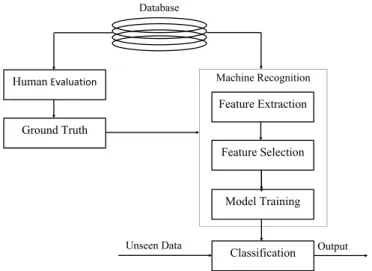
A SER system is a pattern recognition system that can take an unknown input speech sample and, by using information extracted from the sample, predict the current emo-tional state of the speaker. A typical SER consists of many components, as shown in
Figure2.5. The foremost requirement for any machine learning algorithm is a database
to learn from. For this task, sometimes actors are used to portray the specified emotions or spontaneous emotional speech is collected from speakers engaged in a conversation or wizard-of-oz scenario is used in which the participants complete the tasks without the knowledge that their emotionally coloured speech is of interest. To establish the ground truth on the recorded database, human listeners are used to give particular labels to each
Machine Recognition HumanEvaluation Ground Truth Feature Extraction Feature Selection Model Training Classification
Unseen Data Output
Database
Figure 2.5: Components of a typical speech emotion recognition system.
emotional speech sample. These labelled samples are used to train a machine learning algorithm which is late