BINARY FUSION PROCESS TO THE CIPHERING SYSTEM
“SEC EXTENSION TO BINARY BLOCKS”
1
ZAKARIA KADDOURI, 2FOUZIA OMARY AND 3ABDOLLAH ABOUCHOUAR
1
PhD student, Department of Computer Sciences. Faculty of Sciences, Mohamed V University, Rabat.
2 Professor, Department of Computer Sciences. Faculty of Sciences, Mohamed V University, Rabat.
3 PhD student, Department of Computer Sciences. Faculty of Sciences, Mohamed V University, Rabat.
LRI Laboratory (Ex: Networks and Data Mining Laboratory)
Department of Computer Science, Mohamed V University – Faculty of Sciences Rabat – Morocco. E-mail : 1[email protected], 2[email protected], 3[email protected]
ABSTRACT
In this paper, we present a new symmetrical encryption system based on the binary extension of the symmetric encryption system SEC, which transforms the encryption issue into a combinatorial optimization problem using basic tools such as evolutionary algorithms. Our main objective is to change the appearance frequencies of plaintext binary blocks, to make statistical cryptanalysis impossible. We designed a new encryption method called “Binary fusion Process (BFP)”, it is a preparatory step for the application of evolutionary algorithm, and can in fact generate a more interesting initial population. Through the key generated by our algorithm, we illustrate the process of encryption and decryption, and then we present our various applications while interpreting them. Finally, to evaluate our system we compare it to other well known systems. Moreover, the experimented results show that the robustness of our system is undeniable to any attack by frequency analysis.
Keywords:
Symmetric Encryption, Evolutionary Algorithms, Combinatorial Optimization, SEC ExtensionTo Binary Blocks, Frequency Analysis.
1. INTRODUCTION
Cryptography is the process of transcribing intelligible information to an unintelligible one by the application of secret conventions whose effect is reversible, i.e. transform with an encryption key a clear text into a ciphertext, so that the reverse transformation is only possible with the knowledge of the decryption key. Symmetric cryptography is the oldest form of encryption, it includes algorithms for which sender and receiver share the same secret key.
Evolutionary algorithms are a family of algorithms inspired by the theory of evolution to solve various problems. Thus, they evolve a set of solutions to a given problem, with a view to find the best results. These are stochastic algorithms, as they use random process iteratively. We note that they are useful in cryptography. The effectiveness of these algorithms is proved by solving combinatorial optimization problems, which are generally NP-complete or NP-hard [9].
The symmetric encryption system “SEC extension to binary blocks”
is based on evolutionary algorithm, whose main objective is to establish an exchange of
the appearance frequencies of the different binary blocks belonging to the message to be encrypted, as well as their own positions.
The main objective of this work is to strengthen the resistance of the encryption system “SEC extension to binary blocks”. The Binary Fusion process is introduced to change the appearance frequencies of binary blocks, and to reach equilibrium.
2. EVOLUTIONARY ALGORITHMS
2.1 Definition
Basically, the metaheuristics consist of creating the evolution of a baseline configuration by replacing it repeatedly by a new configuration chosen in its neighborhood. The evolutionary algorithm is a kind of the metaheuristics. It is useful for optimization when other techniques such as gradient descent or direct, analytical discovery are not possible. It incorporates aspects of natural selection or survival of the fittest and maintains a population of structures (usually randomly generated initially), that evolves according to rules of selection, recombination, mutation and survival, referred to as genetic operators. A shared "environment" determines the fitness or performance of each individual in the population. The fittest individuals are more likely to be selected for reproduction (retention or duplication), while recombination and mutation modify those individuals, yielding potentially superior ones [5].
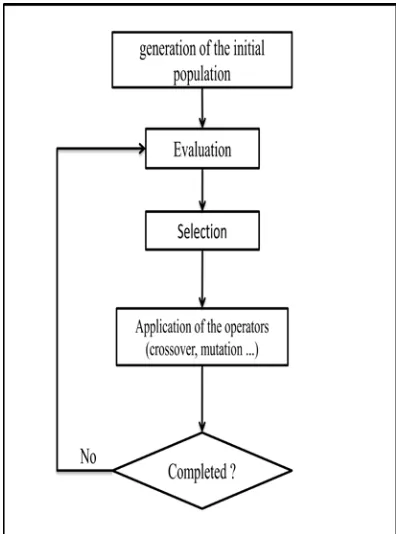
[image:2.612.102.300.391.658.2]We present the mechanisms involved in evolutionary algorithms in the flowchart in Figure1.
Figure 1: Flowchart of an evolutionary algorithm
In precisely, the contribution of our work consists of the design and implementation of
symmetric encryption systems with AE as basic tools.
2.2 Algorithm
An evolutionary algorithm generates an initial population P of μ individuals, and then makes the population P (generations) evolves following a repeated pattern.
• For every generation:
1) Select for reproduction: is chosen in the current population P, λ individuals which become parents (mating pool P’).
2) Vary operators: by applying the crossover and mutation on the individuals of P, a population P'' of λ children is obtained.
3) Evaluate the performance of elements of P'' (children).
4) Select for survival: the elements of P (current population) and P'' (children) the μ individuals are chosen among these elements which will generate the population P of the next generation.
3. DESCRIPTION OF “SEC EXTENSION TO BINARY BLOCKS”
In order to avoid methods of classical cryptography, target of cryptanalysis attacks, an encryption technique was introduced to modify the text characters and then their appearance frequencies starting their coding in binary [1].
3.1 Description of the method
Start with a binary coding of the text characters to be encrypted and prescribe an integer k (k> 1).
We can then consider the text as a series of blocks of k bits, called k-blocks. And we establish the respective lists of occurrences (or positions) of different k-blocks in the text. Then, we apply the AE used by the SEC lists obtained to reach a number in binary text. And finally, we convert the binary ciphertext characters according to the encoding used.
Let T be the message to be encrypted. T is a sequence of n blocks.
We notice that: Li∩ Lj= ø if i ≠ j,∀ i, j ∈ {1, 2,
…, m}.
Then L1, L2,…, Lm is a partition of the set {1, 2, …,
n}.
The goal of “SEC extension to binary blocks” is to establish the maximum disorders over the positions of binary blocks. In order to make it happen, we must repeatedly change the distribution lists over the different blocks of T. In other words, we must find a permutation σ of {1, 2, …, m} such that the difference between the cardinal of the new list Lσ(i) assigned to the block Bi and the cardinal of the initial list Li
reaches the maximum level. In this case, we are confronted with a combinatorial optimization problem. Nevertheless, the evolutionary algorithms are very effective in this kind of problem. So, they will be applied to permutations problems[8].
The main objective of this work is to change at the maximum level the positions and the appearance frequencies of the binary blocks. Note that “SEC extension to binary blocks” starts with randomly generated potential solutions using the processes of classical cryptography.
3.2 Algorithm of “SEC extension to binary blocks”
3.2.1 Coding
Use an individual (or chromosome) as a vector of size m.
Genes are the lists Lpi(1 ≤ i ≤ m).
Lpi is the ith gene which contains the
new positions that will take the block Bi.
3.2.2 Initialization
Creation of the initial population P0 consists
of q individuals: X1, X2, …, Xq.
Let Original-Ch be the chromosome which genes are L1, L2, …, and Lm lists (placed in this
order).These lists represent the message’s binary encoding before the application of the algorithm. We apply q permutations on Original-Ch in order to get an initial population formed by q potential solutions.
Set i :=0;
3.2.3 Evaluation of individuals
Let Xj is an individual of Pi whose genes are:
Lj1,Lj2,…,Ljm.
The evaluation function F is defined on the set of individuals X by:
F(Xj) = ∑𝑚𝑖=1| card(Lji) – card(Li) |
3.2.4 Selection of the best individuals
The conventional method of the roulette wheel retains the strongest individuals. A Control function is introduced to eliminate the individuals in whom the values of only a minority of genes have changed in comparison with the initial chromosome: Original-Ch.
Since this problem is narrowed to a permutation problem with constraints, the genetic operators have been adjusted to this kind of problems [6].
3.2.5 Crossover MPX (Maximal Preservative X)
This cross is applied to selected individuals with a very precise rate. The best rate is from 60% to 100%.
3.2.6 Transposition Mutation
Choosing the mutation consists of randomly swapping two genes of a chromosome. This operator is applied to individuals from crossing with an appropriate rate, preferably from 0.1% to 5%.
Place new offspring in a new population Pi+1.
Repeat steps 2, 3 and 4 until a stopping condition.
3.2.7 Stopping condition
The function F is bounded because 0≤ F(X) ≤ 2*m, for each individual X. In fact, the function F admits a maximum since it is bounded. According to some researches, the convergence result of fitness function is made but it can be a value close to Max, which can be experimentally determined. Final-Ch denotes the final solution given by our evolutionary algorithm.
Final-Ch denotes the final solution given by our evolutionary algorithm. From Original-Ch and Final-Ch, the symmetric key is constructed. This key is called a genetic key [8].
4. DEFINITION OF THE NEW SYSTEM USING THE BINARY FUSION PROCESS (BFP)
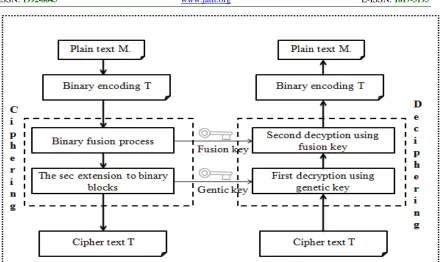
We apply this process on the binary blocks of the plaintext, which will generate an additional secret key which we call the fusion binary key, then we apply the "SEC extension to binary blocks." Figure 2. shows a presentation of our system.
4.1 Description
Let M be a plaintext that we code into binary and cut out in blocks B1, B2,…Bn of the same size k
(if the last block contains less than k bits, we complete it by bits of « 0 »). Then, we determine the positions of the various blocks constituting this plaintext, and instead of applying the evolutionary ciphering algorithm to the lists of binary blocks positions in the plaintext like in [2], we first apply the binary fusion process to the various blocks of the binary coded text.
• Fusion lists
The message "T" obtained in the first step is composed of blocks bit B1, ..., Bn, which are
associated with lists L1, L2, ..., Ln. These lists
usually have different sizes. The objective of the first part of our system is to merge the lists. In other words, we merge the lists of small and medium sized lists in others with large sizes. This will change the maximum appearance frequencies of binary blocks in the text and will establish more disorder in their positions.
• Encryption
The second part of the encryption system is to apply the "SEC extension to binary blocks" that we saw earlier. Thus, we obtain an encrypted message T '.
4.2 Formalization of the problem 4.2.1 Ciphering
First part: the fusion
We sort the set of the lists L1
,
L2, …,
Lnaccording to their sizes in the decreasing order then we divide it in tree subsets of sizes near to [n/3] (floor of n/3), named respectively : EL
,
Em,
Ep.Let us indicate respectively by NL
,
Nm and Npthe cardinals of EL
,
Em,
Ep. The process fusion isrecursive. It is described below.
Let us indicate by Lm andLp the smallest lists of
Em, Ep respectively and bySk the desirable key size
-If the merge of these tow lists brings to a key of undesirable size then fusion is applied only in Ep as
follows:
- Let us take randomly a number of lists Lp1
,
Lp2
,…,
Lpf in Ep.- applying fusion to these lists means:
-Replace the blocs Bp1
,
Bp2,…,
Bpfcorresponding to these lists by one bloc Bf chosen
and representing any other list. -Add the triplet:
([Bp1
,
Bp2,…,
Bpf ] ; [Lp1,
Lp2, …, Lpf] ; Bf)
to the fusion key.
Ep
←
Ep-{ Lp1,
Lp2,...,
Lpf }.
-Repeat the application of fusion on Ep until
reaching the size of the desired key.
-Else the fusion will be applied to Em U Ep as
follows:
- Let us indicate initially the lists which we indeed to merge. These lists are composed of Lp1
,
Lm1
,…,
Lpf,
Lmf such as f is taken randomly in{1,2,…, min
(
Nm,
Np)},
Lp1,
Lp2,…,
Lpf areselected in Ep in increasing order of their size, in
alternation with Lm1
,
Lm2,…,
Lmf which are takenin Em in the same order , while taking account of
the following iterative processing:
r←1; E←
repeat
E ← E U Lpr U Lmr
If size of E ≤ Sk thenr ←r+1 Until r=f or size of E is bigger than Sk
f ← r
-Applying fusion to the lists above means:
Replace the Blocs Bp1
,
Bm1,
Bp2,
Bm2, …,
Bpf
,
Bmf corresponding to these lists byone bloc Bf chosen randomly and not
representing any list. Add the triplet:
([Bp1
,
Bm1,
Bp2,
Bm2, …,
Bpf,
Bmf] ;
[Lp1, Lm1
,…,
Lpf,
Lmf] ; Bf)
To the fusionkey.
-Repeat the process of fusion on:
Em
←
Em-
{ Lm1,...,
Lmf };
Ep ← Ep – { Lp,...,
Lpf }
Until reaching the size of the desired key Sk.
- If we indicate by FO the number of fusion
applied then the generated key representative of these operations is a set of FO triplet of the from:
([
B𝑖1,
B𝑖2, …
B𝑖pi], [
L𝑖1,
L𝑖2, …
L𝑖pi],
Bi)
Where Bi is the substitute of the blocs B𝑖1
,
B𝑖2
,…,
B𝑖pi whose lists of respective positions inThus after fusion, the number of blocs (thus also of lists) is reduced to m (m<n). And the new ciphered text, Tf, will be denoted by the following:
Second Part: Application of Our Evolutionary Algorithm (see chapter 3.2)
4.2.2 Deciphering
We start by deciphering the second part of the system. We represent the encoded text T’ by a vector of list. Let‘s by B’1
,
B’2, …,
B’m thedifferent blocs of T’ and by L’1
,
L’2,…,
L’m theirrespective lists of positions. Thanks to the genetic key the blocks are going to recover their lists of corresponding positions in the text Tf obtained after
the first part of ciphering [8].
Indeed, the key can be represented by a vector, that we denote Key, of size m such that:
key(1)=p1,key(2)=p2,…, key(i)=1, …, key (m)=pm where:
The bloc B’p1 is going to be associated to the list
L’1
.
The bloc B’p2is going to be associated to the list
L
’
2.
…
The bloc B’m1 is going to be associated to the list
L’m
.
Thus we get the text Tf.
Then, thanks to the fusion key which is clear and direct, we can immediately re-after the merged lists Lfi into sub-lists of origin and assign to each of
latter its corresponding bloc. Thus we obtain initial text T.
5. EXPERIMENTATIONS
5.1 Configuration
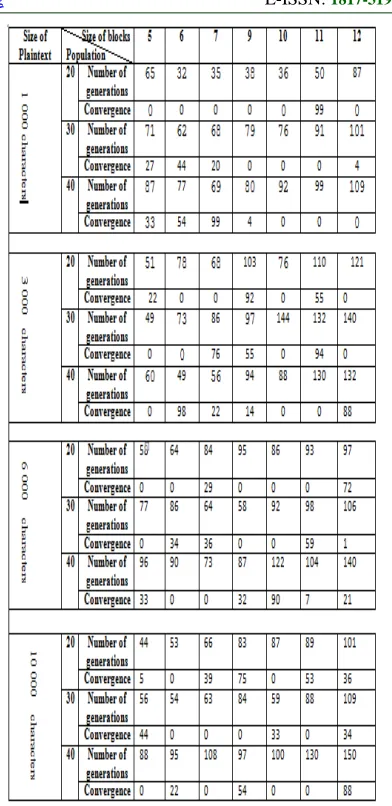
We apply our system on texts of different sizes and for each of them; we attempt to find the best parameters that can give an optimal solution. Then we record the important results to be known: average of convergence of the fitness function and number of generations reached at the time of this convergence.
These results are mentioned in Table 1.
We have noticed that the best results were found such as:
Size of blocks is: 6 Population size is: 20.
5.2 Key lengths calculation
For symmetric keys, encryption strength is often described in terms of the size or length of the used keys: key length is measured in bits and longer keys generally provide stronger encryption. The key of our system is composed of three elements: genetic key, the binary fusion key and the size of blocks “k”.
[image:5.612.325.521.82.485.2]Denote by Tr the average size of a triplet and Kf length of the binary fusion key :
Tr = ((M*k)+(M*8*L)+k).
- Hence The binary fusion key length is at most: Kf = Tr*F0≤ Sk.
Or SK is already fixed departing and
F0 =[Sk/ Tr]
• The size of genetic key is the product of the number of different blocs and 8 bits.
[image:6.612.319.531.303.352.2]To determine the size of keys, the table below shows a study on several texts of different sizes which help to extract the number of different blocks before and after BFP.
Table 2: Comparison Of The Number Of Binary Blocks Generated Before And After BFP
From the results of k=6, we concluded that:
The genetic key length is: 42* 8 bits=336 bits with 42 is the average of different blocks.
The binary fusion key length is at most: - Calculation of the average size of a triplet:
Tr = ((16*6)+(16*8*5)+6)) = 640
- If we take Sk = 1500 then Fo =2.
The binary fusion key length is: Kf = 640*2 = 1280
bits.
Then the key length of our system is the addition of the both keys below.
If we compare these results to length key of TripleDES; which is considered as one of the best bloc cipher system; we can deduce that our system is able to resist against brute force attack more than Triple DES for a long time. Another advantage of our system compared to Triple DES is that its key is considered as session key and randomly generated by our system.
5.3 Execution time
[image:6.612.100.296.312.527.2]The Second comparison is about the execution time between our new ciphering system with BFP, older ciphering system without BFP and TripleDES. The Table below gives an example of this comparison.
Table 3: Comparison to TripleDES
Adding the BFP to our ciphering system hasn’t really influenced the execution time and is still faster than TripleDES.
5.4 Comparison of the analysis frequencies
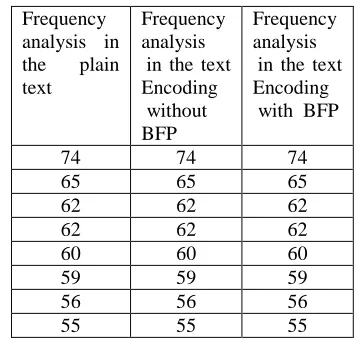
Comparing appearance frequencies is the main indicator of the performance of the new system. The table and figure below compare the appearance frequencies of the different blocks in the binary plaintext, then in the ciphertext using the BFP process and the ciphertext without BFP.
Table 3: Frequency Analysis In The Plaintext, The Ciphertext Using The BFP And The Ciphertext Without
BFP.
Frequency analysis in the plain text
Frequency analysis in the text Encoding without BFP
Frequency analysis in the text Encoding with BFP
74 74 74
65 65 65
62 62 62
62 62 62
60 60 60
59 59 59
56 56 56
[image:6.612.330.511.556.726.2]54 54 54
52 52 52
49 49 50
47 47 50
45 45 49
40 40 43
40 40 43
40 40 40
39 39 38
34 34 37
34 34 33
30 30 30
29 29 30
28 28 30
27 27 29
26 26 29
26 26 28
26 26 28
24 24 28
24 24 28
21 21 27
21 21 27
20 20 26
20 20 26
18 18 25
18 18 25
18 18 24
16 16 21
16 16 21
16 16 20
15 15 20
14 14 -
14 14 -
14 14 -
13 13 -
13 13 -
12 12 -
12 12 -
8 8 -
7 7 -
6 6 -
6 6 -
3 3 -
2 2 -
1 1 -
1 1 -
Actually, due to the Binary Fusion Process, the frequencies of the binary blocks are not recognized anymore; therefore, the cryptanalysis based on the study of appearance frequencies cannot rely on wrong statistics. Figure 4. shows a graphical representation of the apparition frequencies in the plaintext, the ciphertext using the BFP and the ciphertext without BFP.
As seen on the graphic above, the majority of binary blocks of the ciphertext using our new system (“SEC extension to binary blocks” with BFP) have almost the same appearance frequencies.
6. Conclusion and perspectives
Two goals have been achieved in this article. The first is the design of a new encryption method called "Binary Fusion Process" whose main advantage is to strengthen the system against the most threatening attacks (attack by frequency analysis and the brute force attack).
The second is the exploitation of the EA in order to conceive and realize a ciphering that benefits from all its qualities (simple genetic operations, performance,...). In addition the new system uses a variable-length encoding to represent a symbol of the data input, which allows encryption of any kind of information (text, image, sound ...).Finally, our system generates another secret key that we call "key binary fusion" which reinforces the genetic key.
Research works will be carried out by our team to find appropriate techniques that compress the sizes of the two generated keys and cipher them.
REFERENCES
System». 2006 International Conference on Hibrid Information Tchnology,Novembre 9th – 11th,2006.
[2] F.Omary, A.Tragha, A.Lbekkouri, A.Bellaachia, A.Mouloudi « An Evolutionist Algorithm to Cryptography». Brill Academic Publishers – Lecture SeriesAnd Computational Sciences Volume 4, 2005, pp.1749-1752
[3] F.Omary, A.Tragha, A.Lbekkouri, A.Bellaachia, A.Mouloudi « A New Ciphering Method Associated with Evolutionary Algorithm». Lecture Notes in Computer Science – Publisher : Springer Berlin / Heidelberg –ISSN: 0302-9743 –Subject :Computer Science-Volume 3984/ 2006. [4] F.omary, A.Tragha, A.Bellaachia, A.Mouloudi.
« Design and Evaluation of Two Symmetrical Evolutionist-Based Ciphering Algorithms ». International Journal of Computer Science and Network Security (IJCSNS) February 28, 2007 pp 181-190.
[5] Hans DelfsetHelmut Knebl, « Introduction to Cryptography :Principles and Applications». [6] Gareth Jones , « Genetic and Evolutionary
Algorithms ». University of Sheffield, UK [7] Menezes A.J., Oorschot, P.C. van et Vanstone
S.A., « Handbook of Applied Cryptography».(CRC Press, 1997).
[8] Thesis F.Omary, « Applications des algorithmes évolutionnistes à la cryptographie». University of science- Rabat 2006.
[9] Goldberg D.E, Genetic Algorithms in Search, Optimisation& Machine Learning. Addison-Wesley Publishing Company,Inc,1989.
Figure 2: Schematic Of Our Encryption System
[image:9.612.94.542.402.566.2]