Question Pre-Processing in a QA System on Internet
Discussion Groups
Chuan-Jie Lin and Chun-Hung Cho
Department of Computer Science and Engineering
National Taiwan Ocean University
No 2, Rd Pei-Ning, Keelung 202, Taiwan, R.O.C
[email protected]; [email protected]
Abstract
This paper proposes methods to pre-process questions in the postings before a QA system can find answers in a discussion group in the Internet. Pre-processing includes garbage text removal and question segmentation. Garbage keywords are collected and different length thresholds are assigned to them for garbage text identification. Interrogative forms and question types are used to segment questions. The best performance on the test set achieves 92.57% accuracy in garbage text removal and 85.87% accuracy in question segmentation, respectively.
1 Introduction
Question answering has been a hot research topic in recent years. Large scale QA evaluation projects (e.g. TREC QA-Track1, QA@CLEF2,
and NTCIR3 QAC and CLQA Tracks) are
helpful to the developments of question answering.
However, real automatic QA services are not ready in the Internet. One popular way for Internet users to ask questions and get answers is to visit discussion groups, such as Usenet
newsgroups4 or Yahoo! Answers5. Each
discussion group focuses on one topic so that users can easily find one to post their questions.
There are two ways a user can try to find
1 http://trec.nist.gov/data/qa.html 2 http://clef-qa.itc.it/
3 http://research.nii.ac.jp/ntcir/index-en.html 4 Now they can be accessed via Google Groups:
http://groups.google.com/
5 http://answers.yahoo.com/
answers. You can post your question in a related discussion group and wait for other users to provide answers. Some discussion groups provide search toolbars so that you can search your question first to see if there are similar postings asking the same question. In Yahoo! Answers, you can also judge answers offered by other users and mark the best one.
Postings in discussion groups are good materials to develop a FAQ-style QA system in the Internet. By finding questions in the discussion groups similar to a new posting, responses to these questions can provide answers or relevant information.
But without pre-processing, measuring similarity with original texts will arise some problems:
1. Some phrases such as “many thanks” or “help me please” are not part of a question. These kinds of phrases will introduce noise and harm matching performance.
2. Quite often there is more than one
question in one posting. If the question which is most similar to the user's question appears in an existed posting together with other different questions, it will get a lower similarity score than the one it is supposed to have because of other questions.
Therefore, inappropriate phrases should be removed and different questions in one posting should be separated before question comparison.
There is no research focusing on this topic. FAQ finders (Lai et al., 2002; Lytinen and Tomuro, 2002; Burke, 1997) are closely related to this topic. However, there are differences between them. First of all, questions in a FAQ set are often written in perfect grammar without
garbage text. Second, questions are often paired with answers separately. I.e. there is often one question in one QA pair.
There were some research groups who divided questions into segments. Soricut and Brill (2004) chunked questions and used them as queries to search engines. Saquete et al. (2004) focused on decomposition of a complex question into several sub-questions. In this paper, question segmentation is to identify different questions posed in one posting.
2 Garbage Text Removal
2.1 Garbage Texts
Articles in discussion groups are colloquial. Users often write articles as if they are talking to other users. For this reason, phrases expressing appreciation, begging, or emotions of writers are often seen in the postings. For example:
有關 powerpoint 問題 我想請問一下 1 該
如何把 access 的整個視窗放到簡報上撥放
謝謝2
(About Powerpoint, I’d like to ask1, how to
put the whole window seen in Access onto a slide? Thank you2!)
The phrases “我想請問一下” (“I’d like to ask”) and “謝謝” (“Thank you”) are unimportant to the question itself.
These phrases often contain content words, not stop words, and thus are hard to be distinguished with the real questions. If these phrases are not removed, it can happen that two questions are judged “similar” because one of these phrases appears in both questions.
A phrase which contributes no information about a question is called garbage text in this paper and should be removed beforehand in order to reduce noise. The term theme text is used to refer to the remaining text.
After examining real querying postings, some characteristics of garbage texts are observed:
1. Some words strongly suggest themselves being in a garbage text, such as “thank” in “thank you so much”, or “help” in “who can help me”.
2. Some words appear in both theme texts and garbage texts, hence ambiguity arises. For example:
“請教高手” (Any expert please help) “快閃高手” (Flash Expert)
The first phrase is a garbage text, while the second phrase is a product name. The word “expert” suggests an existence of a garbage text but not in all cases.
Because punctuation marks are not reliable in Chinese, we use sentence fragment as the unit to be processed. A sentence fragment is defined to be a fragment of text segmented by commas, periods, question marks, exclamation marks, or space marks. A space mark can be a boundary of a sentence fragment only when both characters preceding and following the space mark are not the English letters, digits, or punctuation marks.
2.2 Strategies to Remove Garbage Texts
Frequent terms seen in garbage texts are collected as garbage keywords and grouped into classes according to their meanings and usages. Table 1 gives some examples of classes of garbage keywords collected from the training set.
Class Garbage Keywords
Please 請問一下, 煩請,不好意思…
Thanks 感謝,謝謝,感恩,感溫…
Help 賜教,請教,幫我解答,救我…
Urgent 緊急,緊迫,急迫,急…
Table 1. Some Classes of Garbage Keywords
To handle ambiguity, this paper proposes a length information strategy to determine garbage texts as follows:
If a sentence fragment contains a garbage keyword and the length of the fragment after removing the garbage keyword is less than a threshold, the whole fragment will be judged as a garbage text. Otherwise, only the garbage keyword itself is judged as garbage text if it is never in an ambiguous case.
Different length thresholds are assigned to different classes of garbage keywords. If more than one garbage keyword occurring in a fragment, discard all the keywords first, and then compare the length of the remaining fragment with the maximal threshold among the ones corresponding to these garbage keywords.
In order to increase the coverage of garbage keywords, other linguistic resources are used to expand the list of garbage keywords.
thesaurus of Chinese words, are added into the list. More garbage keywords are added by common knowledge.
3 Question Segmentation
When a user posts an article in a discussion group, he may pose more than one question at one time. For example, in the following posting:
Office 2003 和 XP←有何不同之處呢? 哪
一 個 比 較 新 呢 ? 最 新 的 版 本
是???????????
(Office 2003 and XP ← What are the
differences between them? Which version is newer? What is the latest version???????????)
there are 3 questions submitted at a time. If a new user wants to know the latest version of Office, responses to the previous posting will give answers.
Table 2 lists the statistics of number of questions in the training set. The first column is the number of questions in one posting. The second and the third columns are the number and the percentage of postings which contain such number of questions, respectively.
Q# Post# Perc (%)
1 494 56.98
2 259 29.87
3 82 9.46
4 22 2.54
5 4 0.46
≥ 6 6 0.69
≥ 2 373 43.02
Total 867 100.00
Table 2. Statistics of Number of Questions in Postings
As we can see in Table 2, nearly half (43.02%) of the postings contain two or more questions. That is why question segmentation is necessary.
3.1 Characteristics of Questions in a Posting
Several characteristics of question texts in postings were found in real discussion groups:
1. Some people use ‘?’ (question mark) at the end of a question while some people do not. In Chinese, some people even separate sentences only by spaces instead of punctuation marks. (Note
that there is no space mark between words in Chinese text.)
2. Questions are usually in interrogative form. Either interrogatives or question marks appear in the questions.
3. One question may occur repeatedly in
the same posting. It is often the case that a question appears both in the title and in the content. Sometimes a user repeats a sentence several times to show his anxiety.
4. One question may be expressed in
different ways in the same posting. The sentences may be similar. For example:
A: Office2000的剪貼簿只能維持12個
項目?
B: Office2000的剪貼簿只能保持12個
項目?
(Can the clipboard of Office2000 only keep 12 items?)
“維持” and “保持” are synonyms in the meaning of “keep”.
Dissimilar sentences may also refer to the same question. For example,
(1) How to use automatic text
wrapping in Excel?
(2) If I want to put two or more lines in one cell, what can I do?
(3) How to use it?
These three sentences ask the same question: “How to use automatic text wrapping in Excel?” The second sentence makes a detailed description of what he wants to do. Topic of the third sentence is the same as the first sentence hence is omitted. Topic ellipsis is quite often seen in Chinese.
5. Some users will give examples to
explain the questions. These sentences often start with phrases like “for example” or “such as”.
3.2 Strategies to Separate Questions
(1) Separating by Question Mark (‘?’)
It is the simplest method. We use it as a baseline strategy.
(2) Identifying Questions by Interrogative Forms
Questions are usually in interrogative forms including subject inversion (“is he…”, “does it…”), using interrogatives (“who is…”), or a declarative sentence attached with a question mark (“Office2000 is better?”). Only the third form requires a question mark. The first two forms can specify themselves as questions by text only. Moreover, there are particles in Chinese indicating a question as well, such as “嗎” or “呢”.
If a sentence fragment is in interrogative form, it will be judged as a question and separated from the others. A fragment not in interrogative form is merged with the nearest question fragment preceding it (or following it if no preceding one). Note that garbage texts have been removed before question separation.
(3) Merging or Removing Similar Sentences
If two sentence fragments are exactly the same, one of them will be removed. If two sentence fragments are similar, they are merged into one question fragment.
Similarity is measured by the Dice coefficient (Dice, 1945) using weights of common words in the two sentence fragments. The similarity of two sentence fragments X and Y is defined as follows:
higher than a threshold are merged together. The weight of a word is designed as the weight of its part-of-speech as listed in Table 3. Nouns and verbs have higher weights, while adverbs and particles have lower weights. Note that foreign words are assigned a rather high weight, because names of software products such as “Office” or “Oracle” are often written in English, which are foreign words with respect to Chinese.
POS Weight
Vt (Transitive Verb),
FW (Foreign Word) 100
N (Noun) 90
Vi (Intransitive Verb) 80
A (Adjective) 40
ADV (Adverb), ASP (Tense), C (Connective), DET (Determiner),
P (Preposition), T (Particle) 0
Table 3. Weights of Part-of-Speeches
Before computing similarity, word segmentation is performed to identify words in Chinese text. After that, a part-of-speech tagger is used to obtain POS information of each word.
(4) Merging Questions with the Same Type
The information of question type has been widely adopted in QA systems (Zhang and Lee, 2003; Hovy et al., 2002; Harabagiu et al., 2001). Question type often refers to the possible type of its answer, such as a person name, a location name, or a temporal expression. The question types used in this paper are PERSON, LOCATION, REASON, QUANTITY, TEMPORAL, COMPARISON, DEFINITION, METHOD, SELECTION, YESNO, and OTHER. Rules to determine question types are created manually.
This strategy tries to merge two question fragments of the same question type. This paper proposes two features to determine the threshold to merge two question fragments: length and sum of term weights of a fragment. Length is measured in characters and term weights are designed as in Table 3.
Merging algorithm is as follows: if the feature value of a question fragment is smaller than a threshold, it will be merged into the preceding question fragment (or the following fragment if no preceding one). This strategy applies recursively until no question fragment has a feature value lower than the threshold.
(5) Merging Example Fragments
4 Experiments
4.1 Experimental Data
All the experimental data were collected from Yahoo! Knowledge+ (Yahoo!奇 摩 知 識+)6,
discussion groups similar to Yahoo! Answers but using Chinese instead of English.
Three discussion groups, “Business
Application” (商務應用), “Website Building”
(網站架設), and “Image Processing” (影像處理),
were selected to collect querying postings. The reason that we chose these three discussion groups was their moderate growing rates. We could collect enough amount of querying postings published in the same period of time.
The following kinds of postings were not selected as our experimental data:
1. No questions inside
2. Full of algorithms or program codes
3. Full of emoticons or Martian texts (火星 文, a funny term used in Chinese to refer to a writing style that uses words with similar pronunciation to replace the original text)
4. Redundant postings
Totally 598 querying postings were collected as the training set and 269 postings as the test set. The real numbers of postings collected from each group are listed in Table 4, where “BA”, “WB”, and “IP” stand for “Business Application”, “Website Building”, and “Image Processing”, respectively.
Group BA WB IP
Training Set 198 207 193
Test Set 101 69 99
Table 4. Numbers of Postings in the Data Set
Two persons were asked to mark garbage texts and separate questions in the whole data set. If a conflicting case occurred, a third person (who was one of the authors of this paper) would solve the inconsistency.
4.2 Garbage Texts Removal
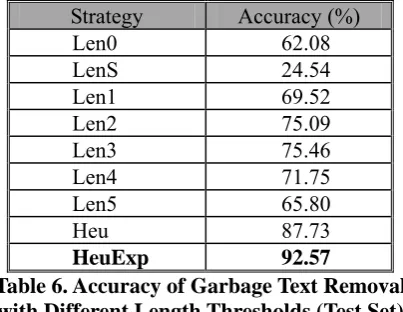
The first factor examined in garbage text removal is the length threshold. Table 5 lists the experimental results on the training set and
6 http://tw.knowledge.yahoo.com/
Table 6 on the test set. All garbage keywords are collected from the training set.
Eight experiments were conducted to use different values as length thresholds. The strategy Lenk sets the length threshold to be k
characters (no matter in Chinese or English). Hence, Len0 is one baseline strategy which
removes only the garbage keyword itself. LenS
is the other baseline strategy which removes the whole sentence fragment where a garbage keyword appears.
The strategy Heu uses different length
thresholds for different classes of garbage keywords. The thresholds are heuristic values after observing many examples in the training set.
Accuracy is defined as the percentage of successful removal. In one posting, if all real garbage texts are correctly removed and no other text is wrongly deleted, it counts one successful removal.
Strategy Accuracy (%)
Len0 64.21
LenS 27.59
Len1 73.91
Len2 78.43
Len3 80.60
Len4 78.26
Len5 71.91
Heu 99.67
HeuExp 99.67
Table 5. Accuracy of Garbage Text Removal with Different Length Thresholds (Training)
Strategy Accuracy (%)
Len0 62.08
LenS 24.54
Len1 69.52
Len2 75.09
Len3 75.46
Len4 71.75
Len5 65.80
Heu 87.73
HeuExp 92.57
Table 6. Accuracy of Garbage Text Removal with Different Length Thresholds (Test Set)
As we can see in both tables, the two baseline strategies are poorer than any other strategy. It means that length threshold is useful to decide garbage existence.
Heu is the best strategy (99.67% on the
the best strategy (80.60% on the training set and 75.49% on the test set) among Lenk, but it is far
worse than Heu. We can conclude that the
length threshold should be assigned individually for each class of garbage words. If it is assigned carefully, the performance of garbage removal will be good.
The second factor is the expansion of garbage keywords. The strategy HeuExp is the
same as Heu except that the list of garbage
keywords was expanded as described in Section 2.2.
Comparing the last two rows in Table 6,
HeuExp strategy improves the performance from
87.73% to 92.57%. It shows that a small amount of postings can provide good coverage of garbage keywords after keyword expansion by using available linguistic resources.
The results of HeuExp and Heu on the
training set are the same. It makes sense because the expanded list suggests garbage existence in the training set no more than the original list does.
4.3 Question Segmentation
Overall Strategies
Six experiments were conducted to see the performance of different strategies for question segmentation. The strategies used in each experiment are:
Baseline: using only ‘?’ (question mark) to
separate questions
SameS: removing repeated sentence
fragments then separating by ‘?’
Interrg: after removing repeated sentence
fragments, separating questions which are in interrogative forms
SimlrS: following the strategy Interrg,
removing or merging similar sentence fragments of the same question type
ForInst: following the strategy SimlrS,
merging a sentence fragment beginning with “for instance” and alike with its preceding question fragment
SameQT: following the strategy ForInst,
merging question fragments of the same question type without considering similarity
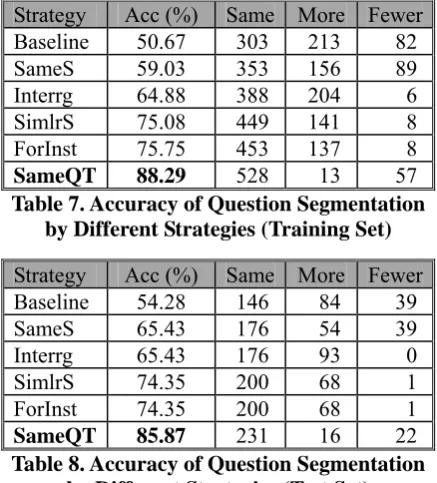
Table 7 and Table 8 depict the results of the six experiments on the training set and the test set, respectively. The second column in each table lists the accuracy which is defined as the
percentage of postings which are separated into
the same number of questions as manually tagged. The third column gives the number of
postings which are correctly separated. The fourth and the fifth columns contain the numbers of postings which are separated into more and fewer questions, respectively.
Strategy Acc (%) Same More Fewer
Baseline 50.67 303 213 82
SameS 59.03 353 156 89
Interrg 64.88 388 204 6
SimlrS 75.08 449 141 8
ForInst 75.75 453 137 8
SameQT 88.29 528 13 57
Table 7. Accuracy of Question Segmentation by Different Strategies (Training Set)
Strategy Acc (%) Same More Fewer
Baseline 54.28 146 84 39
SameS 65.43 176 54 39
Interrg 65.43 176 93 0
SimlrS 74.35 200 68 1
ForInst 74.35 200 68 1
SameQT 85.87 231 16 22
Table 8. Accuracy of Question Segmentation by Different Strategies (Test Set)
As we can see in Table 7, performance is improved gradually after adding new strategies.
SameQT achieves the best performance with
88.29% accuracy. Same conclusion could also be made by the results on the test set. SameQT
is the best one with 85.87% accuracy.
In Table 7, Baseline achieves only 50.67%
accuracy. That matches our observations: (1) one question is often stated many times by sentences ended with question marks in one posting (as 213 postings were separated into more questions); (2) some users do not use ‘?’ in writing (as 82 postings were separated into fewer questions).
SameS greatly reduces the cases (57 postings)
of separation into more questions by removing repeated sentences.
On the other hand, Interrg greatly reduces the
cases (76 postings) of separation into fewer questions. Many question sentences without question marks were successfully captured by detecting the interrogative forms.
SimlrS also improves a lot (successfully
reducing number of questions separated in 63 postings). But ForInst only improves a little.
examples.
SameQT achieves the best performance,
which means that question type is a good strategy. Different ways to express a question are usually in the same question type. Comparing with
SimlrS which also considers sentence fragments
in the same question type, more improvement comes from the successful merging of fragments with topic ellipses, co-references, or paraphrases. However, there may be other questions in the same question type which are wrongly merged together (as 49 failures in the training set).
Considering the results on the test set, Interrg
does not improve the overall performance comparing to SameS because the improvement
equals the drop. ForInst does not improve
either. It seems that giving examples is not common in the discussion groups.
Thresholds in SameQT
In the strategy SameQT, two features, length and
sum of term weights, are used to determine thresholds to merge question fragments as mentioned in Section 3.2. In order to decide which feature is better and which threshold value should be set, two experiments were conducted.
LenThr Acc (%) LenThr Acc (%)
0 75.75 9 85.62
3 76.25 10 86.62
4 78.60 15 88.29
5 81.94 20 88.13
6 84.95 30 88.63
7 85.79 40 88.29
8 86.29 ∞ 88.29
Table 9. Accuracy of Question Segmentation with Different Length Thresholds
70 75 80 85 90
0 3 4 5 6 7 8 9 10 15 20 30 40 ∞ Length Threshold
(%)
Figure 1. Accuracy of Question Segmentation with Different Length Thresholds
Table 9 depicts the experimental results of using length of sentence fragments as merging
threshold. The column “LenThr” lists different settings of length threshold and the column “Acc” gives the accuracy.
The performance is gradually improved as the value of length threshold increases. The best one is LenThr=30 with 88.63% accuracy.
However, “Always Merging” (LenThr=∞)
achieves 88.29% accuracy, which is also acceptable comparing to the best performance. Fig 1 shows the curve of accuracy against length threshold.
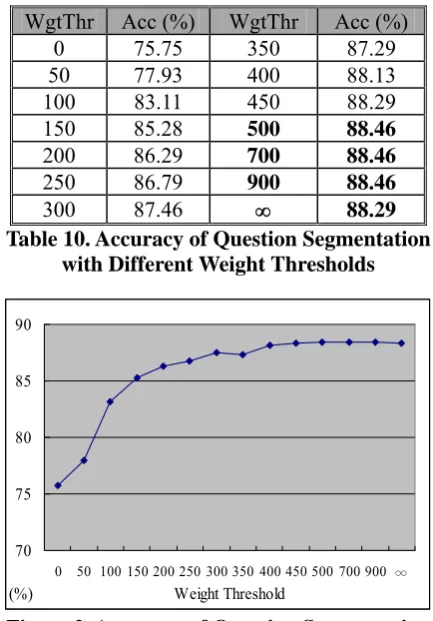
Table 10 presents the experimental results of using sum of term weights as merging thresold. The column “WgtThr” lists different settings of length threshold and the column “Acc” gives the accuracy.
The performance is also gradually improved as the value of weight threshold increases. When WgtThr is set to be 500, 700, or 900, the performance is the best, with 88.46% accuracy. But the same as the threshold settings of length feature, the best one does not outperform “Always Merging” strategy (WgtThr=∞, 88.29%
accuracy) too much. Fig 2 shows the curve of accuracy against similarity threshold.
WgtThr Acc (%) WgtThr Acc (%)
0 75.75 350 87.29
50 77.93 400 88.13
100 83.11 450 88.29
150 85.28 500 88.46
200 86.29 700 88.46
250 86.79 900 88.46
300 87.46 ∞ 88.29
Table 10. Accuracy of Question Segmentation with Different Weight Thresholds
70 75 80 85 90
0 50 100 150 200 250 300 350 400 450 500 700 900 ∞
Weight Threshold (%)
Figure 2. Accuracy of Question Segmentation with Different Weight Thresholds
threshold LenThr=30 achieves the best performance, “Always Merging” is more welcome for a online system because no feature extraction or computation is needed with only a little sacrifice of performance. Hence we choose “Always Merging” as merging strategy in
SameQT.
5 Conclusion and Future Work
This paper proposes question pre-processing methods for a FQA-style QA system on discussion groups in the Internet. For a posting already existing or being submitted to a discussion group, garbage texts in it are removed first, and then different questions in it are identified so that they can be compared with other questions individually.
An expanded list of garbage keywords is used to detect garbage texts. If there is a garbage keyword appearing in a sentence fragment and the fragment has a length shorter than a threshold corresponding to the class of the garbage keyword, the fragment will be judged as a garbage text. This method achieves 92.57% accuracy on the test set. It means that a small set is sufficient to collect all classes of garbage keywords.
In question segmentation, sentence fragments in interrogative forms are considered as question fragments. Besides, repeated fragments are removed and fragments of the same question types are merged into one fragment. The overall accuracy is 85.87% on the test set.
In the future, performance of a QA system with or without question pre-processing will be evaluated to verify its value.
New methods to create the list of garbage keywords more robotically should be studied, as well as the automatic assignments of the length thresholds of classes of garbage keywords.
New feature should be discovered in the future in order to segment questions more accurately.
Although the strategies and the thresholds are developed according to experimental data in Chinese, we can see that many of them are language-independent or can be adapted with not too much effort.
Reference
Burke, Robin, Kristian Hammond, Vladimir Kulyukin, Steven Lytinen, Noriko Tomuro, and Scott Schoenberg (1997) “Natural language processing in the FAQFinder
system: Results and prospects,” Proceedings of the 1997 AAAI Spring Symposium on Natural Language Processing for the World Wide Web, pp. 17-26.
Dice, Lee R. (1945) “Measures of the amount of ecologic association between species,”
Journal of Ecology, Vol. 26, pp. 297-302.
Harabagiu, Sanda, Dan Moldovan, Marius Paşca, Rada Mihalcea, Mihai Surdeanu, Răzvan Bunescu, Roxana Gîrju, Vasile Rus, and Paul
Morărescu (2001) “The Role of
Lexico-Semantic Feedback in Open-Domain Textual Question-Answering,” Proceedings of ACL-EACL 2001, pp. 274-281.
Hovy, Eduard, Ulf Hermjakob, and Chin-Yew Lin (2002) “The Use of External Knowledge in Factoid QA,” Proceedings of TREC-10, pp.
644-652.
Lai, Yu-Sheng, Kuao-Ann Fung, and Chung-Hsien Wu (2002) “FAQ Mining via List Detection,” Proceedings of the COLING Workshop on Multilingual Summarization and Question Answering.
Lytinen, Steven and Noriko Tomuro (2002) “The use of question types to match questions in FAQFinder,” Proceedings of the 2002 AAAI Spring Symposium on Mining Answers from Texts and Knowledge Bases, pp. 46-53.
Saquete, Estela, Patricio Martinez-Barco, Rafael Munoz, and Jose Luis Vicedo Gonzalez (2004) “Splitting Complex Temporal Questions for Question Answering Systems,”
Proceedings of ACL 2004, pp. 566-573.
Soricut, Radu and Eric Brill (2004) “Automatic Question Answering: Beyond the Factoid,”
Proceedings of HLT-NAACL 2004, pp. 57-64.
Zhang, Dell and Wee Sun Lee (2003) “Question Classification using Support Vector Machines,” Proceedings of SIGIR 2003, pp.