CSIDH on Elliptic Curves of the Form
y
2=
x
3+
Ax
2−
x
Xuejun Fan1,2, Song Tian1,2, Bao Li1,2, and Xiu Xu1,2
1 School of Cyber Security, University of Chinese Academy of Sciences. 2 State Key Laboratory of Information Security, Institute of Information Engineering,
Chinese Academy of Sciences, Beijing, China. [email protected]
Abstract. Isogenies between elliptic curves over a common finite field are of great interest in post-quantum cryptography. Many protocols have been proposed such as Supersingular Isogeny Diffie-Hellman key ex-change (SIDH) and Commutative Supersingular Isogeny Diffie-Hellman key exchange (CSIDH). The CSIDH uses supersingular elliptic curves of Montgomery form over finite fields Fp with p ≡ 3 (mod 8) whose
endomorphism rings are Z[√−p]. While we consider the supersingular
elliptic curves overFp withp≡7 (mod 8) and show that they can be
expressed uniquely in the form ofy2=x3+Ax2−xif and only if their endomorphism rings are isomorphic toZ[
√ −p+1
2 ], which is our first
con-tribution. The original motivation is to avoid the collisions in CSIDH where the vectors (e1, e2, . . . , en) and (e1 + 3, e2 + 3, . . . , en+ 3)
rep-resent the same ideal class. Wouter Castryck and Thomas Decru also show a similar idea and propose CSURF. While we use a different way from theirs to prove that the coefficientsAcan be the unique representa-tion of theFp-isomorphism classes. We also give formulae of 2-isogenies
corresponding to the ideal class [(2,π±12 )] in different ways and com-pare the cost of them. As our second contribution, we find collisions in the ideal representation in CSURF where the vectors (e0, e1, . . . , en) and
(e0+ 1, e1+ 2, e3+ 1, . . . , en+ 1) represent the same ideal class, and then
give a new ideal class representative that will avoid the duplications. The new ideal class representative can also help to avoid the computation of the largest isogeny in the protocol and thus offer a speed-up of about 6.02%. Moreover, we try to change the direction of the loop computing the action of ideal classes and get a speed-up of about 28.69%.
Keywords: CSIDH, Montogomery Curves, Endomorphism Ring, Colli-sion, Ideal Class Representative.
1
Introduction
an intractable problem on a quantum computer. Basing on this problem, he proposed a key agreement scheme which was rediscovered by Rostovtsev and Stolbunov [15] independently in 2006. Their key agreement scheme, which we will call CRS, uses the action of the ideal class groups of the endomorphism rings of ordinary elliptic curves. As pointed out by Childs, Jao and Soukharev [23], the underlying hard problem can be phrased as a hidden shift problem which is amenable to Kuperberg’s algorithm [17]. In contrast with the ordinary case, supersingular elliptic curves do not admit such an action of an abelian group. This difficulty is resolved by Jao and De Feo [16] by means of publishing the images of certain points under secrete isogenies. The resulting scheme named supersingular isogeny Diffie-Hellman key exchange (SIDH), on which one of the most competitive algorithms in NIST’s post-quantum standardization project called supersingular isogeny key encapsulation (SIKE) [19] is based.
In order to achieve reasonable efficiency in CRS, one should use elliptic curves whose order is a product of small primes. So far there is no known efficient algorithms to generate such kind of ordinary elliptic curves. Though some im-provements have been made by Luca De Feo et al. [18], the result is still not satisfactory. Recently, a CRS style key exchange based on supersingular elliptic curves has been proposed by Castryck, Lange, Martindale, Panny and Renes [9]. They notice that the set of Fp-isomorphism classes of supersingular ellip-tic curves over a prime fieldFp is also a ”homogeneous space” under the ideal class group of certain order in imaginary quadratic number field, and that it is much easier to choose supersingular elliptic curves which are suitable for im-plementation. Their scheme, which is named commutative supersingular isogeny Diffie-Hellman (CSIDH), is fairly efficient and thus receives lots of attention. For example, it is possible to construct reasonably efficient signature scheme [24].
The supersingular elliptic curves that CSIDH uses are over finite prime fields
Fp withp≡3 (mod 8). Their endomorphism rings (overFp) are isomorphic to Z[
√
−p], which is shown to be equivalent to that the curves can be expressed uniquely in Montgomery form. In this article, we consider the supersingular elliptic curves overFpwithp≡7 (mod 8) and show that they can be expressed
uniquely in the form of y2 =x3+Ax2−x if and only if their endomorphism
rings are isomorphic to Z[
√ −p+1
2 ]. This implies that the coefficient A can be
used to represent theFp-isomorphism class or public key. We also use different ways to compute the 2-isogenies between the supersingular elliptic curves of the formy2=x3+Ax2−x. Moreover, we find explicit collisions when elliptic curves
EA:y2=x3+Ax2−xoverFpwithp≡7 (mod 8) are used, namely, the vector
(e0, e1, . . . , en) and the (e0+ 1, e1 + 2, e2+ 1, . . . , en+ 1) represent the same
ideal class. To avoid the trivial duplications, we offer re-expressions of the ideal classes which also gives a speed-up for about 6.02% comparing to the original implementation. To get a higher performance, we change the direction of the loop in the implementation of CSURF and gain a speed-up of about 28.69% comparing to the original implementation.
that the proof of the link between Montgomery− form and endomorphism rings is different from theirs, and that the formulae for 2-isogenies, the analysis of the collision problem and the change of loop direction are new results.
Organization. In Section 2, we recall, besides CSIDH and CSURF, some basic results on ideal class groups and isogenies over Fp that will be used in later
sections. In Section 3, we give some essential conclusions about the case of EndFpE = OK as the analogue of EndFpE = Z[π] in [9], including the
for-mulae of `-isogenies and 2-isogenies, and the bijection between the coefficients and theFp-isomorphism classes. In Section 4, we discuss the collisions in CSURF
and offer a new ideal class representative, and then change the direction of the loop, which brings a speed-up. In Section 5, we give a conclusion.
2
Preliminaries
2.1 The Ideal Class Group and Its Action
LetK=Q(√−d) be an imaginary quadratic field. An order ofKis a subringO
which is also a lattice. It is well know thatK has a unique maximal orderOK,
which is the ring of integers. An orderO can be expressed as Z+fOK for an
integer f >0. The integerf is called the conduct ofO.
LetObe an order ofK. A fractional idealaofOis anO-module of the form
αa0, whereα∈K∗ and a0 is an integral ideal ofO. It is said to be invertible if there exists a fractional idealbsuch thatab=O. All invertible fractional ideals of O form an abelian groupI(O). A fractional ideal of form αO with α∈K∗
is called a principal fractional ideal. All principal fractional ideals are invertible and form a subgroupP(O) ofI(O). The quotient ofI(O) byP(O), denoted by cl(O), is called the ideal class group of O. We will denote by [a] the class of an invertible fractional ideala.
Now letE be a supersingular elliptic curve over Fp withp >3. Letπ be its Frobenius endomorphism. Then its endomorphism algebra is Q[π] 'Q(
√ −p), which implies that its Fp-rational endomorphism ring EndFp(E) is an order of the imaginary quadratic fieldQ(π). According to [21, Theorem 4.2], the conduct of EndFp(E) is prime to p. So EndFp(E) is isomorphic to eitherZ[√−p] or the maximal order ofQ(√−p).
Ifa is any integral ideal ofO= EndFp(E), then we can define a finite group scheme
E[a] =∩φ∈aKer(φ)
and an isogeny
ψa:E→E/E[a]
with kernelE[a]. Ifais invertible as a fractional ideal ofO, then theFp-rational
depends only on the class of a in cl(O). In this way, we actually have a well-defined action of cl(O) on the set ELL(O) of Fp-isomorphism classes of
su-persingular elliptic curves over Fp whose Fp-rational endomorphism rings are
isomorphic toO. And it turns out that the action is simply transitive.
We are interested in`-isogenies for primes`6=p, which correspond to prime ideals of Oof norm `. Of course, they might not exist if−pis a non-square in
Z/`Z. LetG(Fp, `) be the supersingular`-isogeny graph. The vertices correspond
to the Fp-isomorphism classes of supersingular elliptic curves, which are often
denoted by the corresponding j-invariants. The edges correspond to the equiv-alence classes of Fp-rational `-isogenies between different elliptic curves. The
following theorem gives a general picture of Fp, where by the surface (resp. the
floor) we mean that the corresponding curves have Fp-rational endomorphism
rings isomorphic toZ[1+ √
−p
2 ] (resp.Z[ √
−p]).
Theorem 1. When p ≡ 3 (mod 4), there are two levels in G(Fp, `) and for
` >2 with (−`p) = 1, there are two horizontal`-isogenies from each vertex.
– Ifp≡7 (mod 8), there are2-isogenies connecting the surface and floor with 1:1 and in the surface there are also two horizontal 2-isogenies from each vertex.
– Ifp≡3 (mod 8), there are2-isogenies connecting the surface and floor with 1:3 and no horizontal2-isogenies.
We give the example ofG(F167,3) by using modular polynomials [4,5] (See
Figure 1). There are 11 supersingular j-invariants in F167 in total [3]. Each j
-invariant in G(F167,3) corresponds to two Fp-isomorphism classes. Note that
bothE andEthavep+ 1 points, so they are isogeneous over
F167. This is very
different from the ordinary case where #E(Fp)6= #Et(Fp). Running clockwise
58
15 15
112 112
OK
89 89
151 151
59 59
58
30 30
132 132
Z[π]
131 131
27 27
0 0
Figure 1. G(F167,3). The curves on surface have endomorphism ring OK= Z[1+
√ −167
2 ] and those on floor haveZ[ √
−167] as endomorphism ring.
As is shown in [6], if the two eigenvalues λ and µ of the Frobenius map π
satisfy thatλr≡1 (mod`) andµr6= 1 (mod`), then the isogeny corresponds to
[`, π−λ] can be computed overFpr. So we can compute the action of [(3, π−1)]
over the base fieldFp. As for [(3, π+ 1)], we can compute it through its quadratic
twistEt by [(3, π+ 1)]E= ([(3, π−1)]Et)t to compute efficiently by using Fp
-rational points.
2.2 CSIDH and CSURF
CSIDH uses the commutative group action cl(O)× ELL(O) → ELL(O) with
O = Z[√−p] and p ≡3 (mod 8). Every Fp-isomorphism class in ELL(O) can be represented by a Montgomery elliptic curveEA:y2=x3+Ax2+xoverFp.
Since the coefficientAis unique, it is used to denote theFp-isomorphism class. The primepis chosen to be of the formp= 4·l1· · ·ln−1 withl1, . . . , ln small
primes. So there are prime ideals li = (li, π−1) of O of norm li. In CSIDH,
vectors (e1,· · ·, en) ∈ [−m, m]n, which represent the ideal classes [le11· · ·lenn ],
are used as private keys. The protocol with starting curve E0/Fp:y2=x3+x
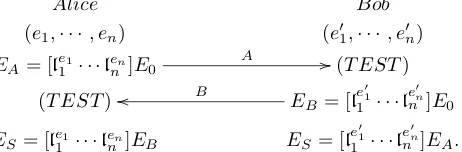
works as follows (see Figure 2).
Generation/Exchange:As her private key, Alice chooses a uniformly ran-dom vector (e1,· · ·, en). She then computes the Montgomery elliptic curveEA=
[le1
1 · · ·l en
n ]E0 and sends Bob the coefficientA. Likewise, as his private key, Bob
chooses a uniformly random vector (e01,· · · , e0n). He then computes the
Mont-gomery elliptic curveEB= [l e01 1 · · ·l
e0n
n ]E0 and sends Alice the coefficientB. Key Agreement:After receiving the coefficient from each other, they check the supersingularity of the receiving curves. And then Alice calculates [le1
by using her own secret key and Bob’s public keyB. In the same way, Bob calcu-lates [le
0
1
1 · · ·l e0n
n ]EA. Because of the commutativity of the class group, Alice and
Bob can get the same elliptic curveES= [l e1+e01
1 · · ·l en+e0n
n ]E0 and its coefficient
S∈Fpas their shared secret.
Alice Bob
(e1,· · ·, en) (e01,· · · , e0n)
EA= [le11· · ·lenn]E0
A //
(T EST)
(T EST) EB = [l
e01 1 · · ·l
e0n n ]E0 B
o
o
ES = [le11· · ·lenn ]EB ES= [l e01 1 · · ·l
e0n n ]EA.
Figure 2. CSIDH. The “(TEST)” represents that each party will test the supersingularity of the received curve by testing its order overFp.
CSURF changes the form of the curves into Montgomery−elliptic curves over
Fpwithp= 4·2·l1· · ·ln−1, which implies the endomorphism ring becomesOK= Z[1+π2 ]. And the whole protocol is similar with CSIDH apart from the different
beginning elliptic curve,E0/Fp:y2=x3−x, and range of the exponent vectors.
As in Figure 1, there is a one-to-one correspondence between the surface and floor, hence the alteration of endomorphism ring does not influence the security level of the protocol.CSURF implemented almost all of 2-isogenies corresponding to the ideal classes [(2,π±21)] on isomorphic Montgomery curves, while we give other formulae of 2-isogenies corresponding to the ideal classes [(2,π±21)] between Montgomery− curves in Section 3.2. And we find collisions in its private keys and propose a new representation to avoid them in Section4.1.
3
CSIDH on elliptic curves
E
A:
y
2=
x
3+
Ax
2−
x
In this section, we show that it is possible to construct CSIDH over finite fields
Fp with p≡7 (mod 8). First we give a formula to compute odd degree
isoge-nies between elliptic curves of the form y2 =x3+Ax2−x. Then we use this
formula to show that the elements in ELL(Z[1+
√ −p
2 ]) can also be represented
uniquely by coefficients of certain representatives. Finally, we study different ways of computing 2-isogenies.
3.1 Unique Representation for Fp-isomorphism class
Hence we get the formulae for`-isogenies on elliptic curves of this form without any loss of efficiency.
Proposition 1. LetKbe a field withchar(K)6= 2and√−1∈/K. LetG⊆E(K)
be a finite subgroup of order2d+ 1in an elliptic curveE/K :y2=x3+ax2−x with a ∈ K. Let φ be a separable isogeny with kerφ = G. Then there is a curve E0/K : Y2 = X3+AX2−X such that, up to post-composition by an isomorphism,
φ:E →E0: (x, y)7→(f(x), c0yf0(x)),
where
f(x) =x Y
T∈G\{OE}
xxT + 1
x−xT
, c20= Y
T∈G\{OE}
xT.
Moreover, we writeσ=P
T∈G\{OE}(xT +x1
T)and A=c 2
0(a−3σ).
The proofs of Proposition1are discussed in Appendix B, which are similar to those of Montgomery curves. We can conclude that, for elliptic curves in form of
E/Fp:y2=x3+ax2−xwitha∈Fp, given a finiteFp-subgroupGof odd degree,
there exists anA∈Fpand a separable isogenyφ:E→E0 :Y2=X3+AX2−X
defined over Fp with kernelG. In comparison to [2] on Montgomery curves, the
differences are only on the signs of items. While wheni=√−1∈K, there is a morphism:
ψ:EA:y2=x3+Ax2−x−→Emon:−iY2=X3+iAX2+X,
(x, y)7−→(X, Y) = (ix, y).
So EA : y2 = x3 +Ax2−x and Montgomery curve Emon : BY2 = X3+
A0X2+X are isomorphic, which immediately implies the same conclusion as
the Proposition 1 by [2, Theorem 1]. The conclusion will also be used in the latter proposition.
In general, the nodes in isogeny graph represent Fp-isomorphism classes of
elliptic curves [8], while a new unique representative forFp-isomorphism class
which may serve as a shared key instead of j-invariants was proposed by [9]. However, Castryck W. et al [9] only consider the finite field Fp with p ≡ 3
(mod 8), where the unique representation for elliptic curves of the form y2 =
x3+Ax2−x doesn’t exist. So we change the characteristic into p ≡ 7 (mod 8) and prove the one-to-one correspondence between theFp-isomorphism classes
and the coefficients A.
Proposition 2. Let p≡7 (mod 8) be a prime and letE/Fp be a supersingular elliptic curve. ThenEndFp(E) =Z[1+
√ −p
2 ] if and only ifE isFp-isomorphic to
EA:y2=x3+Ax2−xwith a unique A∈Fp.
Proof. LetEA:y2=x3+Ax2−xbe a supersingular elliptic curve overFp. We
have to show that EndFp(EA) is isomorphic toZ[ 1+√−p
2 ]. For this, we only need
EA(Fp) is not a two-torsion point, then by the group law we have anFp-rational
point
(−1
x0
, y0 x2 0
) = (x0, y0) + (0,0).
Sincep≡7 (mod 8),x06=−x10, soP,−P,P+(0,0) and−P+(0,0) are pairwise
distinct points. This implies that
#EA(Fp)≡#EA(Fp)[2] (mod 4).
Since #EA(Fp) =p+ 1≡0 (mod 8), #EA(Fp)[2] = 4 as required.
Now assume that EndFp(E) is isomorphic to Z[1+
√ −p
2 ]. Since the elliptic
curveE0:y2=x3−xoverFpis supersingular,O= EndFp(E0) is also isomorphic
to Z[1+ √
−p
2 ], so there exists an ideal class [a] ∈ cl(O) such that [a]E0 = E.
As we can always choose an O-ideal b ∈ [a] whose norm is relatively prime to 2p, E is Fp-isomorphic to E0/E0[b], which by Proposition 1 is of the form
EA:y2=x3+Ax2−x.
It remains to show the uniqueness ofA. Letφ:EB :Y2=X3+BX2−X →
EA be anFp-isomorphism. Then by [10, Proposition III.3.1(b)] we can write
φ((X, Y)) = (u2X+r, u3Y +su2X+t),
whereu∈F∗p andr, s, t∈Fp. Since (u3Y +su2X+t)2−(u2X+r)3−A(u2X+
r)2+ (u2X+r) is divisible byY2−X3−BX2+X = 0, we have
s=t= 0,
3r2+ 2Ar−1 +u4= 0,
−3r−A+Bu2= 0, r(Ar+r2−1) = 0.
Next we prove that r = 0. As we have seen, #EB(Fp)[2] = 4, so we can write
X3+BX2−X =X(X−b
1)(X−b2) withb1, b2∈Fp. We may assume thatb1is
a square. Then b2=−1/b1 is a non-square. SinceE(Fp)∼=Z/n1Z⊕Z/n2Zfor
integersn1|n2 and #E(Fp) =p+ 1≡0 (mod 8),E,EAandEB have points of
order 4. IfP = (x0, y0)∈EB(Fp) is a point of order 4, thenx(2P) = (x
2 0+1
2y0 )
26= 0
is a square in Fp, so 2P = (b1,0) and u2b1+r =x(2φ(P))6= 0 is a square. If
φ((b2,0)) was (0,0), then we would have u2b2+r = 0 and r= x(φ((0,0))) = −1/(u2b
1+r), sob2= 1/((u2b1+r)u2) is a square, which is impossible. It follows
fromr= 0 thatu4= 1, sou2= 1 andA=B.
This proposition guarantees the valid public keys consisting of coefficients
A ∈ Fp and efficient public-key validation. So the coefficients can serve as
shared secrets instead of takingj-invariants, which frees the computation fromj -invariants to equations of elliptic curves. Wouter Castryck and Thomas Decru[20] also propose the same conclusion at the same time. But we emphasize that the different proof. Our proof is a OK-version of the Proposition 8 in [9], while
3.2 Formulae for 2-isogenies
Proposition 1gives the formulae of isogenies of odd degree for elliptic curves in the form of y2 =x3+Ax2−x. For the 2-isogenies corresponding to the ideal
classes [(2,π±1
2 )], we have following Lemma which is proved in [20, Lemma 5].
We highlight that for a A square in Fp we denote by √
A the unique square root which is again a square, which can be computed through Ap+14 , and the
non-square can be gotten by changing the sign.
Lemma 1. Letp≡7 (mod 8)and considerEA:y2=x3+Ax2−x∈ ELL(OK). Then
EA[(2,
π−1
2 )] =h(
−A+√A2+ 4
2 ,0)i, EA[(2,
π+ 1
2 )] =h(
−A−√A2+ 4
2 ,0)i.
Castryck and Decru [20] used the rescalings to Montgomery curves and puted 2-isogenies between them. In this section, we study different ways of com-puting 2-isogenies: direct formulae, resacling to Edwards curves and using the map between the special points. Finally we compare the computational cost of them.
Direct Derivation Now we give direct formulae for the 2-isogenies, corre-sponding to the above ideal classes of norm 2, between the curves of the form
y2=x3+Ax2−x.
Proposition 3. LetEA:y2=x3+Ax2−xbe an elliptic curves over a field of characteristicp≡7 (mod 8). LetG− =EA[(2,π−21)]andG+=EA[(2,π+12 )],φ+ and φ− be the separable isogenies such that ker(φ+) =G+ andker(φ−) =G−. Then, up to composition with a isomorphism, there are curves EA0 :y2=x3+
A0x2−xandEA00:y2=x3+A00x2−xsuch that
φ−:EA→EA0 : (x, y)7→(
x2+Mx
2√ΘN(x−M)−
√
ΘN
2 ,
x2−2M x−1
(4ΘN)34(x−M)2
y),
whereM =−A+√A2+4
2 ,N = √
M2+ 1,Θ=−2N+ 2M + 1
M andA
0= Θ−4N 2√ΘN. And
φ+:EA→EA00 : (x, y)7→(
x2+ x
˜ M
2pΘ˜N˜(x−M˜)
−
p
˜
ΘN˜
2 ,
x2−2 ˜M x−1
(4 ˜ΘN˜)34(x−M˜)2
y),
whereM˜ = −A−
√ A2+4
2 ,N˜ =
p
˜
M2+ 1,Θ˜ =−(2 ˜N+2 ˜M+1
˜
M)andA
00= 4 ˜N−Θ˜ 2
√ ˜ ΘN˜.
Proof. Note that [(2,π−1 2 )]
−1= [(2,π+1
2 )] and quadratic twisting swaps the roles
of (−A+
√ A2+4
2 ,0) and (
−A−√A2+4
2 ,0), so we can simply flip the sign ofA and
LetM =−A+√A2+4
2 , it can be easily verified that the isogenyϕ
−with kernel
h(M,0)iof degree 2 can be written as
ϕ−:EA→E0: (x, y)7→(
x2+ x
M
x−M , y
x2−2M x−1
(x−M)2 ),
whereE0is of the formy2=x3+ (−4M− 2 M)x
2+ 1
M2x. To put everything back
to the curve of the formy2=x3+A0x2−x, we now give the isomorphism from
elliptic curvesE0 to elliptic curvesEA0 :y2=x3+A0x2−x:
ω−:E0 →EA0 : (x, y)7→(
1
2pΘ√M2+ 1
x−
s
Θ
4√M2+ 1,(
1
4Θ√M2+ 1)
3 4y),
whereΘ=−2√M2+ 1 + 2M+ 1 M andA
0= Θ−4√M2+1
2 √
Θ√M2+1. Soφ
− =ω−◦ϕ−can
be written as
φ−:EA→EA0 : (x, y)7→(
x2+Mx
2√ΘN(x−M)−
r
Θ
4N,
x2−2M x−1
(4ΘN)34(x−M)2
y),
where N =√M2+ 1,Θ =−2N+ 2M + 1
M and A
0 = Θ−4N
2√ΘN. Thenφ
+ can be
easily derived using the quadratic twist and hence the two assertions are proved.
The implementation only uses the coefficients of the elliptic curves, so we conclude Proposition 3 and get the following lemma. To reduce the computa-tional cost in each loop, knowing the initial value of A, we can make some precomputation to simplify the resulting coefficients.
Lemma 2. Let A ∈ Fp such that EA : y2 = x3+Ax2−x ∈ ELL(OK). We define
A0 = −6N+ 2M+
1 M
2q(−2N+ 2M + 1 M)N
, A00= 6 ˜N+ 2 ˜M+
1 ˜ M
2q−(2 ˜N+ 2 ˜M+ 1˜
M) ˜N
where M = −A+
√ A2+4
2 , M˜ =
−A−√A2+4
2 , N = √
M2+ 1 and N˜ =p
˜
M2+ 1.
Then
[(2,π−1
2 )]EA=EA0, [(2,
π+ 1
2 )]EA=EA00.
We can work with theXZ-only projective Montgomery coordinates and the projective parameters (A: 1) = (a:c) as in [25] to get further speed-up.
Rescaling to Edwards Curves Apart from the direct formula, we also try the rescaling to Edwards curves. First we give the 2-isogeny withe kernel h(M,0)i
ax2+y2= 1 +dx2y2 which will be used to compute the first 2-isogeny and the
final rescaling.
X= uy+
1 u
y−1 , y=
X+1u
X−u,
whereuis theX coordinate of the point of order 4 inE:Y2=X3+AX2−X
satisfyingu2−2M u−1 = 0 andu2=−qd
a. And then we give the 2-isogeny with
kernelh(0,−1)ibetween Edwards curves which will be used from the second to
|ei|-th 2-isogeny in the loop.
Proposition 4. Let Ea,d : ax2+y2 = 1 +dx2y2 be an elliptic curves over a field. Let G=h(0,−1)iand φ be the separable isogenies such thatker(φ) = G. Then, up to composition with a isomorphism, there are curvesEa0 :a0x02+y02=
1 +x02y02 such that
φ:Ea,d→Ea0 : (x, y)7→(αxy, β
y2−B1
y2−B
2
),
where α=
√ a
B1, β =−
B2
B1,a
0 =β2. The values of B
1, B2 can be solved through
B1+B2=2ad andB1B2= ad.
Proof. Writex0 =αxy and y0 =βy2−B1
y2−B2 withB1+B2=
2a
d = 2B1B2.
Substi-tuting them to the equation of elliptic curves a0x02+y02 = 1 +x02y02, we can
get
a0=β2,
B12β2=B22,
2α2β2(B2−B1) = (β2−1)d,
β1−B1
1−B2
= 1.
.
Soα=
√ a
B1,β=−
B2
B1,a
0=β2withB
1+B2=2ad andB1B2=ad.
Map the Point of Special Order Apart from the direct derivation of the isogenies, the correspondence between the points of special orders are always used to obtain the isogenies. Now to get the specific 2-isogenies between elliptic curves of the formy2=x3+Ax2−x, we used the∞and the points of order 2
and 4. Since we only need the coefficients of the resulting curves, we now give the resulting coefficients directly.
Proposition 5. LetA∈Fp such thatEA:y2=x3+Ax2−x∈ ELL(OK). Let
M = −A+
√ A2+4
2 ,M =
A+√A2+4
2 . Define
A0= 1
b −b and A
00=−(1
whereb=−2(M+√1 +M2)√Mp√1 +M2andb=−2(M+
q
1 +M2)
√
M
r q
1 +M2.
Then
[(2,π−1
2 )]EA=EA0 and [(2,
π+ 1
2 )]EA=EA00
Proof. Write EA : y2 = x(x−M)(x−M˜) where M = −A+ √
A2+4
2 is square.
LetP0(x0, y0) be the point of order 4 inEAsatisfying thatx20−2M x0−1 = 0.
Assume that the points of order 2 inEA0 :Y2=X3+A0X2−X are (0,0),(b1,0)
and (b2,0), so
A0=−(b1+b2), b1=−
1
b2
.
Then we can write thexcoordinate map of the 2-isogeny betweenEA andEA0
as X= αM(x+
1
x0) 2
x−M , which maps ∞and (M,0) to∞, (0,0) and (−A−M,0) to
(b1,0), (x0, y0) and (x0,−y0) to (b2,0), (−x1
0,
y0
x2 0
) and (−1 x0,−
y0
x2 0
) to (0,0). So
α2= x
4 0
x4 0−1
where x40−1 = 4x02M(x0−M),
b1=
−α x2
0
, b2=
x20 −α.
.
We must ensure thatx0−ais a square, sox0=M+ √
M2+ 1 and finally we
can obtain b2=−2(M + √
1 +M2)√Mp√1 +M2 andA0 =−(b
2−b12). The
proof of the 2-isogenies with kernel h(−A−
√ A2+4
2 ,0)iis omitted here because it
can be easily obtained by changing the sign and using the quadratic twist.
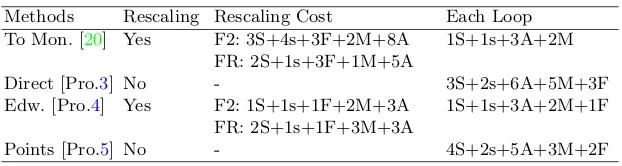
Comparation Finally we compare the computational cost of the 2-isogeny corresponding to [(2,π−21)] in Table 1.
Table 1.Compare the Computational Cost
Methods Rescaling Rescaling Cost Each Loop To Mon. [20] Yes F2: 3S+4s+3F+2M+8A 1S+1s+3A+2M
FR: 2S+1s+3F+1M+5A
Direct [Pro.3] No - 3S+2s+6A+5M+3F
Edw. [Pro.4] Yes F2: 1S+1s+1F+2M+3A 1S+1s+3A+2M+1F FR: 2S+1s+1F+3M+3A
Points [Pro.5] No - 4S+2s+5A+3M+2F
We use many abbreviations for the concision. The “Rescaling” represents whether rescalings are needed, the “Rescaling Cost” (resp. the “Each Loop”) is the cost of the rescaling process (resp. the cost of each loop to compute|ei|
iso-genies of degreeli). “F2” and “FR” are the cost of the first 2-isogeny and that of
4
Some Improvements to CSURF
We improve the implementation of CSURF from two way. One is offering a new ideal representation and gaining a speed-up of about 6.02%, the other is changing the direction of the loop and also gaining a speed-up of about 28.69%
4.1 Collisions in CSURF and A New Ideal Representation
In CSIDH, Castryck W. et al assumed the surjectivity of the group homomor-phism
Zn →cl(O), (e1,· · · , en)7→ n
Y
i=1
[l]ei i
and the uniformity of resulting distribution Qn
i=1[l] ei
i , with O = Z[π].
How-ever, Hiroshi Onuki and Tsuyoshi Takagi [11] found that (e1,· · ·, en) and (e1+
3,· · · , en + 3) represented the same ideal class in CSIDH-512. But the
colli-sions don’t exist in cl(OK) whenp≡7(mod 8). So in CSURF [20], the authors
chose a finite fieldFp withp= 4·2·3·(3·. . .·389)−1 and a near-optimal set
I= [−137,137]×[−4,4]3×[−5,5]46×[−4,4]25to sample exponent vectors, which can avoid the collisions in [11]. By assuming the surjectivity and the uniformity, they claimed that the near-optimal intervalI resulted in 2255.995distinct secret
vectors. Now we give another kind of collisions in CSURF.
We consider a more general case than CSURF and describe the notation first. Letp= 4·2·lr1
1 . . . l rn
n −1 be a prime, whereli are distinct odd primes andri
are positive integers. The imaginary quadratic field K =Q(π) with Frobenius map π has maximal order OK = Z[1+π2 ] and equation order O = Z[π]. As in
CSURF-512,π has two eigenvalues λ= 1 andµ=−1 inZ/liZ, so the primes
li split in O as liO = li·li for i = 1,· · · , n, where li = liO+ (π−1)O and
li=liO+ (π+ 1)O. The decomposition also exists inOK.
We now define ideals ofOK asl0= 2OK+π−21OK,l0= 2OK+π+12 OK.
Proposition 6. In the general case of CSURF,
l0lr11· · ·l rn n =
π−1
2 OK, l0l
r1
1 · · ·l rn n =
π+ 1
2 OK.
Proof. Note thatli=hli,(π−1)i=hli,π−21i, so
l0lr11· · ·l rn n =h2,
π−1
2 i · hl1,
π−1
2 i
r1· · · · hl
n,
π−1
2 i
rn
=h2lr1
1 · · ·l rn n ,
π−1
2 i=h 1−π2
4 ,
π−1
2 i
=hπ−1
2 i.
andl0l r1
1 · · ·l rn
n =hπ−21i=h π+1
The above proposition shows thatl0lr11· · ·lrnn is principal ideal, so in CSURF
the action of the ideal class corresponding to the vector (1,2,1, . . . ,1) is trivial. This directly implies the following corollary, which shows explicit collisions of the ideal class representation in CSURF.
Corollary 1. In CSURF, the exponent vectors
(e0, e1, e2, . . . , en) and (e0+ 1, e1+ 2, e2+ 1, . . . , en+ 1)
represent the same ideal class.
In general, one way to avoid the above collisions is to change the interval where we sample the exponents. For CSIDH, Meyer et al.[22] used different intervals for ei to gain a speed-up. To guarantee the security level and the
”al-most” surjective and uniform representation, we change the interval and get a new representation which omits [l74]. The final representation is of the form
[le0
0 l e1
1 · · ·l e73
73] for I
0= [−141,141]×[−4,4]3×[−6,6]13×[−5,5]33×[−4,4]24.
There are 283·927·1313·1133≈2255.999distinct secret vectors in I0 which guar-antees the 256-bit size class group. The interval from which we sample isogenies of degrees 3,5 and 7 is relatively small because of the high failure probabil-ity of finding torsion points. Intuitively, we economize on the computation of largest isogeny of degree 389 which will induce a speed-up. To evaluate the per-formance, we change the the source code of CSURF-512 which can be found at https://github.com/TDecru/CSURFand gain a speed-up of about 6.02%. The estimate is based on 2000 experiments in both settings in the computer algebra system Magma.
4.2 Change the Direction of the Loop
As the original implementation of CSIDH, CSURF goes through the primes in as-cending order in its implementation, starting with small degree isogenies. Michael Meyer and Steffen Reith [25] gave some faster ways to implement CSIDH, one of which is changing the direction of the loop. Going through the primes in de-scending order can eliminate the larger factors ofp+ 1 first, and therefore end up with multiplications by significantly smaller factors as we proceed through the loop. To verify the point in CSURF, we change the the source code of CSURF-512 and gain a speed-up of about 28.69% comparing to the original performance. The experiments are also implemented in the computer algebra system Magma.
5
Conclusion
In the article, we consider a new form of supersingular elliptic curves over Fp
ring OK and hence A can be a unique representation of the Fp- isomorphism
classes, which implies they can replace the curves in CSIDH. To prove the unique representation and efficient computation, we give some important lemmas and propositions. To our knowledge, Wouter Castryck and Thomas Decru also use curves of the same form in their protocol CSURF and obtain a speed-up, but we prove the uniqueness of the representative ofFp-isomorphism classes from a different perspective. We also offer some formulae for the 2-isogenies with com-paration. Moreover, we show there exists another kind of collisions in the ideal representation in CSURF. And to avoid the collisions, we offer a new represen-tation which enhances the efficiency for about 6.02%. We also try to change the direction of the loop in the implementation of CSURF, which gives a speed-up of about 28.69%.
References
1. P W. Shor Polynomial-Time Algorithms for Prime Factorization and Discrete Log-arithms on a Quantum Computer[M]. Society for Industrial and Applied Mathe-matics, 1997.
2. C. Costello, H. Hisil. A Simple and Compact Algorithm for SIDH with Arbitrary Degree Isogenies. Advances in Cryptology-ASIACRYPT2017-23rd International Conference on the Theory and Applications of Cryptology and Information Secu-rity.
3. C. Delfs , S D. Galbraith. Computing isogenies between supersingular elliptic curves overFp [J]. Designs, Codes and Cryptography, 2016, 78(2): 425-440.
4. R. Broker, K. Lauter, A. Sutherland . Modular polynomials via isogeny volca-noes[J]. Mathematics of Computation, 2012, 81(278): 1201-1231.
5. J H. Bruinier, K. Ono , A V. Sutherland. Class polynomials for nonholomorphic modular functions[J]. Journal of Number Theory, 2016, 161: 204-229.
6. L. De Feo, J. Kieffer, B. Smith. Towards Practical Key Exchange from Ordinary Isogeny Graphs. Advances in Cryptology - ASIACRYPT 2018 - 24th International Conference on the Theory and Application of Cryptology and Information Security. 7. D. Moody, D. Shumow. Analogues of V´elu’s formulas for isogenies on alternate
models of elliptic curves. Mathematics of Computation, 2016, 300: 1929–1951. 8. S. Galbraith. Isogeny graphs, algorithms and applications[J].
9. W. Castryck, T. Lange, C. Martindale, L. Panny, J. Renes. CSIDH: An Effi-cient Post-Quantum Commutative Group Action, Advances in Cryptology - ASI-ACRYPT 2018 - 24th International Conference on the Theory and Application of Cryptology and Information Security.
10. J H. Silverman. The Arithmetic of Elliptic Curves. GTM 106 (1986)[J].
11. H. Onuki, T. Takagi. On collisions related to an ideal class of order 3 in CSIDH. IACR Cryptology ePrint Archive, 2019, 1209.
12. N. Koblitz Elliptic curve cryptosystems[J]. Mathematics of computation, 1987, 48(177):203-209.
13. V S. Miller Use of elliptic curves in cryptography[C] Conference on the theory and application of cryptographic techniques. Springer, 1985: 417-426.
14. J M. Couveignes Hard Homogeneous Spaces[J]. IACR Cryptology ePrint Archive, 2006, 2006: 291.
16. D. Jao, L. De Feo. Towards quantum-resistant cryptosystems from supersingular elliptic curve isogenies[C]. International Workshop on Post-Quantum Cryptogra-phy. Springer, Berlin, Heidelberg, 2011: 19-34.
17. G. Kuperberg. A Subexponential-Time Quantum Algorithm for the Dihedral Hid-den Subgroup Problem. SIAM J. Comput. 35(1): 170-188, 2005.
18. L. De Feo, J. Kieffer, B. Smith. Towards Practical Key Exchange from Ordinary Isogeny Graphs. Advances in Cryptology - ASIACRYPT 2018 - 24th International Conferenceon the Theory and Application of Cryptology and Information Security. 19. R. Azarderakhsh, M. Campagna, C. Costello, L. De Feo, B. Hess, A. Jalali, D. Jao, B. Koziel, B. LaMacchia, P. Longa, M. Naehrig, J. Renes, V. Soukharev, D. Urbanik. Supersingular Isogeny Key Encapsulation Submission to the NIST¡¯s post-quantum cryptography standardization process, 2017.
20. W. Castryck, T. Decru. CSIDH on the Surface[M]. Post-Quantum Cryptography, 11th International Conference, PQCrypto 2020.
21. W C. Waterhouse. Abelian varieties over finite fields[J]. Annales Scientifiques de l ´Ecole Normale Sup´erieure, 1971, 2(4):56-62(7).
22. M. Meyer, F. Campos, S. Reith. On Lions and Elligators: An efficient constant-time implementation of CSIDH. PQCrypto 2019, LNCS 11505, 307-325 (2019). 23. A. Childs, D. Jao, V. Soukharev. Constructing elliptic curve isogenies in quantum
subexponential time[J]. Journal of Mathematical Cryptology, 2014, 8(1):1-29. 24. W. Beullens, T. Kleinjung, F. Vercauteren. CSI-FiSh: Efficient Isogeny Based
Signatures Through Class Group Computations. Advances in Cryptology-ASIACRYPT 2019-25th International Conferenceon the Theory and Application of Cryptology and Information Security.
25. M. Meyer, S. Reith. A Faster Way to the CSIDH. Progress in Cryptology -INDOCRYPT 2018 - 19th International Conference on Cryptology in India, New Delhi, India, December 9-12, 2018, Proceedings.
A
Lemma
3
Montgomery elliptic curves appeal to people by their properties. One can use
xthroughout and use the Montgomery Ladder to compute [l]E efficiently. The following lemma shows that the specific elliptic curves have similar properties.
Lemma 3. Let E be an elliptic curve given by an equationy2=x3+Ax2−x.
P1= (x1, y1)andP2= (x2, y2)are two points onE withx16=x2 andx1x26= 0. ThenP1+P2= (x3, y3)satisfies
x3(x1−x2)2x1x2=B(x1y2−x2y1)2, (1)
P1−P2= (x4, y4)satisfies
x4(x1−x2)2x1x2=B(x1y2+x2y1)2, (2)
and
x3x4=
(x1x2+ 1)2
(x1−x2)2
Proof. By the group law onE, we havex3=
(y1−y2)2
(x1−x2)2 −A−x1−x2.So
x3(x1−x2)2x1x2= (y1−y2)2x1x2−(A+x1+x2)(x1−x2)2x1x2
= (y1−y2)2x1x2−(
y2 1
x1 −y
2 2
x2
)(x1−x2)x1x2= (x1y2−x2y1)2.
Since P1−P2 =P1+ (−P2), the equation (2) can be obtained by replacing x3
andy2in (1) byx4 and−y2respectively. Then we have
x3x4=
((x2y1)2−(x1y2)2)2
x2
1x22(x1−x2)4
= (x1x2(1 +x1x2)(x1−x2))
2
x2
1x22(x1−x2)4
=(x1x2+ 1)
2
(x1−x2)2
.
B
Proof of Proposition 1
It is similar to the proof of [2, Theorem 1]. Assume that G =hPi is a cyclic group of order 2d+ 1. Letxi=x(iP) for i= 1, . . . ,2d. Then by Lemma 3, we
see that
X =x
2d
Y
i=1
xxi+ 1
x−xi
=x
d
Y
i=1
(xxi+ 1
x−xi
)2=x
d
Y
i=1
(τiP∗ x)·(τ−∗iPx) = Y
Q∈G
τQ∗x,
where τQ :E→E is the translation byQ∈E. One can show thatY =c0yX0
is a multiple ofP
Q∈Gτ ∗
Qy, so it is also invariant under translation by elements
ofG. We also see that the only poles ofF(X, Y) =Y2−X3−AX2+X are at
the points inG. Therefore ifF(X, Y) vanishes at∞, then it is zero.
To show thatF(X, Y) vanishes at∞, we consider its Laurent series expan-sion. Lett= xy ands=y1. Then dividingy2=x3+ax2−xbyy3 yields
s=t3+ast2−s2t.
Substituting the value forsinto the right hand side, we obtain
s=t3+a(t3+at2s−ts2)t2−(t3+at2s−ts2)2t
=t3+at5+ (a2−1)t7+ (a3−3a)t9+O(t11).
So
y=1
s =t
−3
(1−at2+t4+at6+O(t8)),
x=ty=t−2(1−at2+t4+at6+O(t8)).
Then we have
(xxi+ 1
x−xi
)2= (xi+ (x2i + 1)t
2+ (a+x
i)(x2i + 1)t 4+ (x2
so
X =x
d
Y
i=1
(xxi+ 1
x−xi
)2=X−2t−2+ (σ−a)X−2+X2t2+X4t4+O(t6), (3)
where
X−2=
d
Y
i=1
x2i, σ= 2 d
X
i=1
(xi+
1
xi
), X2=
1 + (3σ2−2aσ+ 4)X−22
5X−2
,
X4=
3a+ 5σ+ (−6a2σ+ 4aσ2+ 32a+ 10σ3)X−22
35X−2
.
A calculation shows that
F(X, Y) =Y2−X3−AX2+X=k0t−6+k1t−4+k2t−2+k3+O(t),
where
k0= (c20−X−2)X−22, k1= (−2c20a−3(σ−a)X−2−A)X−22,
k2= (4c20+c 2 0a
2
−2A(σ−a)−3X2)X−22−2c 2
0X−2X2−3X−32(σ−a) 2+X
−2,
k3= 4c20X−2(aX2−X4)−3X4X−22−6X2X−22(σ−a)−X 3
−2(σ−a)
3−2AX 2X−2
−AX−22(σ−a)2+X−2(σ−a).
It is easy to check that k1 = k2 = k3 = k4 = 0 when c20 =
Qd
i=1x 2 i, and
A =c20(a−3
P
T∈G\{OE}(xT − 1
xT)). Since the curve EA :y
2 =x3−Ax2+x
![Figure 1√−F√Z[ 1+. G(167, 3). The curves on surface have endomorphism ring OK =1672] and those on floor have Z[−167] as endomorphism ring.](https://thumb-us.123doks.com/thumbv2/123dok_us/7990027.1326112/5.595.211.406.128.320/figure-curves-surface-endomorphism-ring-oor-endomorphism-ring.webp)