Scalable Construction-Based Parsing and Semantic Analysis
John Bryant
Department of Computer Science
University of California at Berkeley
Berkeley, CA 94720
Abstract
In ScaNaLU 2002, Chang et al presented a scalable natural language formalism called Embodied Construction Grammar (ECG) (Chang et al., 2002). ECG makes deep un-derstanding systems possible because it is a rigorous, unified formalism that incorporates the semantic and pragmatic insights found in cognitive linguistics. The work described in this paper builds on (Chang et al., 2002) because it leverages the ECG formalism to perform deep, scalable construction-based parsing and semantic analysis.
1
Introduction
As described by (Chang et al., 2002), the semantic and pragmatic insights provided by cognitive linguistics must be incorporated into a language understanding system be-fore deep understanding can take place. Embodied Con-struction Grammar (ECG) (Chang et al., 2002), (Bergen and Chang, 2002) is a rigorous, formalism incorporat-ing such insight. It provides formal mechanism for de-scribing cognitive primitives like linguistic constructions (Goldberg, 1995), image schemas (Lakoff, 1987), frames (Fillmore, 1982), and mental spaces (Fauconnier and Turner, 2002), as well as cross-domain mappings.
From a system-building point of view, however, the importance of ECG lies in its scalability. Within its unification-based framework, constructions, frames and mental spaces are combined compositionally, yielding a network of entwined semantic and pragmatic structures representing the overall interpretation. This makes it pos-sible for ECG to scale to much more complex linguistic data that previous formalisms would allow.
The work described in this paper builds on this system-building perspective since it is a system that leverages the
ECG formalism to perform deep, scalable construction-based parsing and semantic analysis. It incorporates an implementation of ECG’s semantic and constructional primitives as well as integrating scalable language anal-ysis algorithms like level-based parsing (Abney, 1996). This system is called the constructional analyzer and it fits into a larger framework for scalable, simulation-based language understanding.
In a simulation-based model of language understand-ing, interpretation of an utterance is split into two phases: analysis and enactment. Analysis is the process of map-ping forms to context-independent meanings, providing the input parameters for enactment. Enactment uses an active, simulation-based model to generate context-specific inference. This process-level separation of anal-ysis and inference provides further scalability.
The next three sections describe the ECG formal-ism, simulation-based understanding and partial parsing. Then the constructional analyzer is described along with an example. The paper closes with a description of a lan-guage analysis task requiring the deep semantic represen-tation afforded by the constructional analyzer.
2
The Embodied Construction Grammar
formalism
The grammar formalism that makes constructional anal-ysis possible is the Embodied Construction Grammar. ECG combines a syntax and knowledge representation in a unification-based framework. This allows both con-structions and frame-based, schematic knowledge to be expressed succinctly in the same formalism.
schema Container
subcase of Image-Schema roles
interior : exterior : portal : boundary : schema SPG
subcase of Image-Schema roles
source : path : goal :
schema Trajector-Landmark subcase of Image-Schema
roles trajector : landmark :
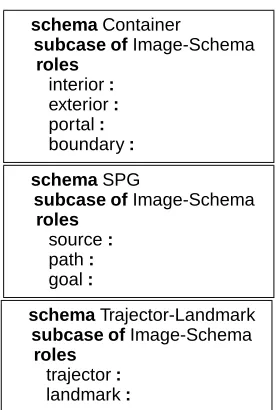
Figure 1: Some image schemas in ECG notation.
image schemas (Lakoff, 1987) and executing schemas (Narayanan, 1997) with frame-based knowledge (Fill-more, 1982) to completely specify the meaning of an ut-terance.
Meaning in ECG is represented by schemas. Schemas, much like frames, are schematic, role-based conceptual and semantic structures. But as they are intended to de-scribe an embodied, parameter-based representation of language, the schema formalism is augmented by special semantic operators that make cognitive linguistic insights easier to express.
As an initial starting point into the formalism, figure 1 shows three canonical image schemas in ECG notation. Each schema is initially defined by the keyword schema, and after the name, an optional subcase of line denotes the structures from which the current schema inherits. Much like frames, ECG schemas (and constructions) are arranged into a type hierarchy from which a schema can inherit structure. In this case, each image schema inherits from theImage-Schematype. Following the subcase of, comes the optional roles block, denoted by the roles key-word. Just like the roles of a frame, the roles of a schema are the parameters of the concept being described.
These simple image schemas do not show off all of ECG’s schema mechanism, however. For a more com-plete picture, we now focus on the Intoschema shown in figure 2. The Into schema subcases the Trajector-Landmark schema, and thus inherits the trajector and
landmarkroles from its parent. TheIntoschema further constrains thelandmarkrole by constraining it to be of typeContainer.
The Intoschema also introduces the new evokes op-erator which makes the specified type locally accessible
schema Into
subcase of Trajector-Landmark evokes s as SPG
roles
landmark : Container constraints
trajector !s.trajector
s.source !landmark.exterior
s.goal !landmark.interior
Figure 2: TheIntoschema.
construction IntoCxn subcase of Spatial-Relation form : Word
selff.orth ?“into”
meaning : Into
Figure 3: TheIntolexical construction.
via the given alias. In this case, the evokedSPGschema acts as the background frame, capturing into’s notion of motion. This is the primary virtue of the evokes opera-tor. It provides a way to place concepts such as bachelor into the context of their larger background frames, as de-scribed by (Fillmore, 1982).
After the roles block in theIntoschema, comes the op-tional constraints block. Constraints act as the semantic glue with the$identifying its two argument slots. When
a set of slots have been coindexed, a proposed filler to any one of those slots must satisfy the restrictions of all of them. In the Intoschema, the locally defined land-mark.interior1 role2 is identified with the evokedSPG’s goal role, while thelandmark.exteriorrole is coindexed with theSPG’ssourcerole. These constraints schemati-cally describe how the use of into suggests motion from outside some container to the inside of that container.
Figure 3 shows the Into lexical construction. Every construction starts with the keyword construction, fol-lowed by the name of the construction. Then comes the optional subcase of keyword that relates constructions to the constructional type system. The ECG version of the
Intoconstruction has a form and meaning pole, notated by the keywords form and meaning.
Constructions can type their form and meaning poles. In the case of ourIntoconstruction, the form pole is of schema typeWord3and the meaning pole is of typeInto
schema. A typed meaning pole indicates that a particu-lar construction denotes an instance of that type. Thus
1ECG uses slot chain notation. 2
Thelandmarkrole has aninteriorrole because it was con-strained to be of typeContainer.
3
ourIntoconstruction claims that the word into means an instance of the complex relation described by the Into
schema.
TheIntoconstruction also exhibits the assignment op-erator ( ). This operator fills a slot with an atomic value. In our Into construction’s form pole, the orth4 feature brought in from theWordschema is assigned the atomic string into.
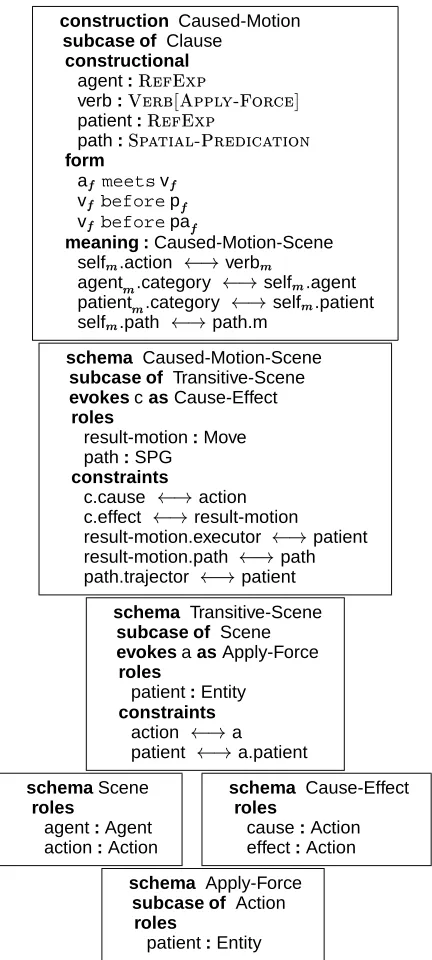
Figure 4 shows the clausal Caused-Motion construc-tion, an example of which is The basketball player threw
the ball into the basket. This construction has an agent
(the player) which acts upon a patient (throwing the ball) thereby moving it along a path (into the basket). Since theCaused-Motionconstruction links a particular syntactic form, that of a referring expression, a force-application verb, a referring expression and a path to a
Caused-Motion-Scene5, the construction is different from the ones we have covered so far in that it has constituents that are themselves constructions. Thus instead of typing the form block, the form block has constraints relating the constituents.
Each of the construction’s four constituents are defined in the constructional block. Each constituent is assigned a local name, and then after the colon, the constructional type is defined. If necessary, like in the case of theVerb
constituent, a semantic type is added in brackets. The ordering of these constituents is specified by adding form constraints to the form block. When the con-structional analyzer searches for instances of a construc-tion, these form constraints must be satisfied. The two supported constraints are before which requires that the left argument be somewhere the left of the right argument in the input, and meets which requires the left argument to be directly before the right argument in the input.
In the Caused-Motion construction, the form con-straints require that theagentbe directly before theverb
and theverbbe before thepathandpatient. Notice that the relative order of the path and patient is left unspec-ified6. Because ECG allows constituent order to be
un-specified like this, ECG can express with one rule what a CFG might have to express with an exponential number of rules.
The meaning pole of the construction uses the seman-tic machinery that has already been described. It links theagentm’scategoryto theagentof the scene as well as settingpatientm.categoryto thetrajectorof the specified path. Notice that the constraints use the m and f sub-scripts when referring to the constructional constituents’
4Orth
is short for orthography. 5
A caused motion scene is one where the agent applies force to the patient resulting in a shift in the position of the patient.
6
This might be a partial solution for dealing with what are called heavy NPs.
construction Caused-Motion subcase of Clause
constructional agent :RefExp
verb :Verb[Apply-Force]
patient :RefExp
path :Spatial-Predication
form
af meetsvf vf beforepf vf beforepaf
meaning : Caused-Motion-Scene selfm.action !verbm
agentm.category !selfm.agent
patientm.category !selfm.patient
selfm.path !path.m
schema Caused-Motion-Scene subcase of Transitive-Scene evokes c as Cause-Effect
roles
result-motion : Move path : SPG
constraints
c.cause !action
c.effect !result-motion
result-motion.executor !patient
result-motion.path !path
path.trajector !patient
schema Transitive-Scene subcase of Scene evokes a as Apply-Force roles
patient : Entity constraints
action !a
patient !a.patient
schema Scene roles
agent : Agent action : Action
schema Cause-Effect roles
cause : Action effect : Action schema Apply-Force
subcase of Action roles
patient : Entity
form and meaning poles, respectively, and can be applied to any construction as if they were just dotting into the structure.
With a formal language for describing constructions, many avenues are opened. The most important for the sake of this work, is that it is possible to translate ECG descriptions into feature structures. For the most part, this translation is straightforward. For example, schemas, constructions are represented as feature structures and their roles are represented (unsurprisingly) as roles.
The evokes operator, however, requires a little more care to properly model its nonlocal semantics. In this case, the evoked type is generated outside of the evok-ing structure. The evoked structure’s alias is represented as a local role coindexed with the nonlocal structure7.
3
Simulation-Based Language
Understanding
Simulation-based language understanding draws infer-ences about actions and events by executing an active model. The active models are called x-schemas (short for executing schemas) which are extensions to stochas-tic petri nets. In order to draw inferences about an action like walking, the system performs a simulation by exe-cuting its internal model of walking.
To tailor the inference to a particular scenario, the sim-ulator needs to set the parameters of the x-schema rep-resentation appropriately. These parameters are the free variables that control how the simulation executes. For example, the walking x-schema would have parameters for who the walker is and for the path (or direction) of motion. So in the sentence Harry walked into the cafe, the walker would be Harry and the path would be into
the cafe.
But before a language understanding system can uti-lize the virtues of such a model, the parameters must be extracted from the utterance. This is where the construc-tional analyzer comes in. If the constructions have fea-tures designed to interact with the simulator, each con-structional analysis will provide the parameters to the simulation, and the analyzer and simulator will interact to understand the utterance.
Researchers have integrated the constructional ana-lyzer with a simulation engine, creating a unique and powerful method for language understanding. Such a sys-tem would even be able to do “exotic” metaphorical in-ference with ease, since metaphorical inin-ference is just a special kind of parameterization8.
7
With this implementation, ECG does not require any exten-sions to standard unification algorithms.
8
See (Narayanan, 1997) for more information about metaphorical inference.
4
Syntactic Chunking
Traditional chunking is a simple parsing algorithm where each syntax rule is transformed into a finite state rec-ognizer. The recognizers are arranged into levels, con-trolling the order of the reductions. A chunker starts at the lowest level (and hopefully most-certain reductions) which are done by the part of speech tagger. Then it proceeds up the levels toward the less certain reductions. This bottom up approach assumes (obviously incorrectly) that reductions can be made locally and bottom-up with-out any notion of global context, giving the algorithm speed and state savings.
Within a single level, the reductions are done greedily. Going left to right through the input, whenever a particu-lar pattern is recognized, the longest match of that pattern is reduced. Figure 5 shows the steps that an Abney chun-ker goes through for the sentence, The woman in the lab
coat thought you were sleeping.
This figure exposes both the virtues and weaknesses of chunking–the weakness being the fact that the parse for the sentence does not attach the prepositional phrase in
the lab coat, treating it instead as a sister to the the woman
noun group. But it also illustrates the robustness of the system in that while the grammar has no rule for reduced relative, it still correctly labels the syntactic groups. In other words, the incompleteness of the grammar does not cause phrases to be rejected since there is no requirement that a successful parse converge to a complete sentence. Thus such a parser is well-suited for spoken language (Hinrichs et al., 2000), where Hinrichs, et al were able to get 93%“correctness”9at finding the various syntactic
groups from an error prone spoken language input. Un-surprisingly without any semantics, they were only able to achieve 54%“correctness” when generating the com-plete parse tree from the chunk analysis.
5
The Constructional Analyzer
Because the approach to constructional analysis we de-scribe in this report uses a level-based processing model, it can be considered a relative of such shallow informa-tion extracinforma-tion tools. But instead of doing shallow se-mantic analysis for the purposes of information extrac-tion, it utilizes both the semantic richness of construc-tion grammar and extended computaconstruc-tional mechanisms to do full constructional analysis, resulting in both a com-plete syntactic analysis and a deep semantic analysis. The constructional analyzer integrates the following computa-tional capabilities to make deep analysis possible.
Support for unification
9
L
3S
S
L
2NG
PG
V NG
V
L
1NG P
NG
V NG
V
L
0D
N P D N
N
V tns Pron Aux
V ing
the woman in the lab coat thought you were sleeping
Figure 5: A Partial Parse from (Abney, 1996). Since this processing model is bottom up, first the level 0 reductions are performed, then the level 1 reductions, then level 2 and finally level 3. In the nonterminals, G is used (for group) instead of p (for phrase) to clearly indicate that these are non-recursive chunks. Each grammar symbol spans all the input to its left until another grammar is encountered.
Support for multiple concurrent analyses with a
chart
Support for the more flexible form relations found
in ECG
Support for ECG’s semantic expressiveness
5.1 The Basics of the Constructional Analyzer Since ECG is a unification-based formalism, supporting unification is a necessary first step. Along with unifica-tion, a chart is employed by the system to keep track of the many possible analyses generated during rule-based language analysis.
On the form side, the analyzer cannot use finite state machines or even context free grammars to do matching because of ECG’s more relaxed notion of form. ECG does not require the grammar writer to specify a total ordering on a construction’s constituents, and thus rec-ognizers requiring a total ordering (like CFG parsers) in each rule are unusable. The constructional analyzer in-stead uses a computational unit called a construction
rec-ognizer.
A construction recognizer is the chunk of active knowl-edge into which a construction gets transformed. Each construction recognizer is designed to check both the form and meaning constraints of just the construction it models. In other words, instead of a monolithic parser that takes the grammar rules as input, the constructional analyzer itself is a collection of active construction rec-ognizers working together to generate the constructional analysis.
5.2 An Example
In order to make the previous discussion more concrete, let’s analyze an example sentence using the Caused-Motionconstruction described earlier. The sentence we will consider is The basketball player threw the ball into
the basket. Given a grammar that can handle simple
refer-ring expressions of the form (Det) Adj* Noun+ (making sure to add the appropriate semantics) and spatial phrases, we can arrange the rules into levels (see figure 6) and gen-erate analyses that use theCaused-Motionconstruction.
0. Lexical constructions
1. Noun noun compounds
2. Adjectives
3. Referring expressions
4. Spatial Predications
5. Clausal constructions
Figure 6: The levels used in the example analysis.
construction Noun-Noun-Compound subcase of Category
constructional a :Category
b :Category
form
af meetsbf meaning
selfm !bm
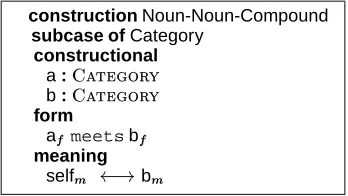
Figure 7: A GenericNoun-Noun-Compoundconstruction that just sets the meaning of the construction as a whole to be that of the second constituent. It relies on the struc-ture merging process (Bryant, 2003) to infer the correct relation between the twoCategoryconstituents.
Figure 7 shows an example noun-noun compound con-struction used in the analysis that puts constituents of typecategory10together to generate an instance of type
Noun-Noun-Compoundwhich is itself subtype of cate-gory. Thus the rule is recursive with itself and any other
categoryrequiring rule. Notice that it is on the same level that all othercategoryconstructions are assigned. The constructional analyzer allows the constructions assigned to the same level to be mutually recursive.
After theCategoryconstructions are processed, simple
10
path
patient
agent
verb
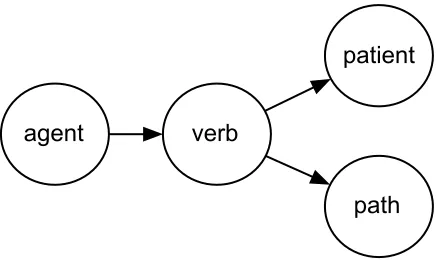
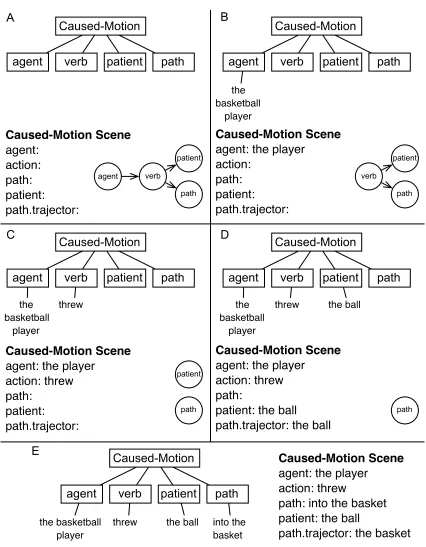
Figure 8: The constituent graph structure for the Caused-Motionconstruction. Each constituent corresponds to a node in the constituent graph. At any particular point, the construction recognizer is only allowed to search for con-stituents with no incoming edges. When a constituent is found, its node is removed from the graph along with any outgoing edges from that node. After removing a node, the construction recognizer is now allowed to search for different, newly-released constituents or if there are no nodes left, then a valid instance of the construction (at least with respect to the form constraints) has been found.
referring expressions are generated. After the referring expressions,Spatial-Predicationconstructions are recog-nized on the next level, and the constructional analyzer is finally ready to match theCaused-Motionconstruction. Figures 8 and 9 (and the rest of this section) describe the matching process schematically.
In frame A of figure 9, the construction recognizer is in its initial state and it has not found any of the con-stituents for the Caused-Motionconstruction. In B, the recognizer has found a referring expression correspond-ing to the basketball player, and since it unifies with the
agentrole of the Caused-Motionconstruction, it is ac-cepted as the first constituent. Notice how the node in the graph corresponding to theagentis removed indicating that it has been found.
In frames C and D, the same scenario takes place ex-cept it is the verb threw and the referring expression the
ball that satisfy the form and meaning requirements of
their corresponding constituents. Notice in C that the construction recognizer is now allowed to find either the patient or the path since both nodes have no incoming edges. In E, we see a completely matchedCaused-Motion
construction with a completeCaused-Motionscene and an empty constituent graph indicating that a complete in-stance of this construction has been found.
In short, the construction recognizer builds up a graph data structure to keep track of the constituents and an in-progress semspec to keep track of the semantics. Each
constituent that satisfies the form and semantic con-straints updates the constituent graph and the in-progress partial semspec. The final result for a successful match has the agent of the caused motion scene to be the player, the patient being the ball, and the goal of the path being the interior of the basket.
5.3 Computational Complexity
At its core, the constructional analyzer is just a unifica-tion parser that needs to support the quirks of a particu-lar grammar formalism. The quirk that most affects the computational complexity of the constructional analyzer is ECG’s support for partial constituent order.
Barton (1985) showed that parsing with unordered CFG rules is NP-complete. Since an ECG grammar can leave all constituency unordered, the worst case runtime must be exponential with respect to the utterance. An ac-tual grammar of this sort is unlikely, however, and thus it is useful to symbolically bound the runtime of the ana-lyzer in terms of the number of unifications it performs.
For purposes of the complexity analysis, call the num-ber of levels
l
, the number of recognizers at each levelr
, and assume an input ofk
words. Further assuming that there areO
(k
)states in each chart entry, and that thenumber of constituent orderings allowed by a grammar rule is
j
for the max ofc
constituents used in any rule. The worst-case runtime would then beO
(lrk
cj ) since
there would be
k
ccombinations of unifications for each of the
j
constituent orderings associated with a particular recognizer.Clearly any product of
c
andj
much over 2 makes the algorithm intractable for all but the smallest grammars. Consequently, an open area of research is a mechanism for concentrating effort on the most promising syntactic and semantic combinations using methods of the sort de-scribed in (Narayanan and Jurafsky, 1998) and (Bryant, 2003).6
Applications
The constructional analyzer is currently being put to use in two tasks that require the deep semantics that it pro-vides.The first task is that of Simulation-Based Language
Understanding (Narayanan, 1997) has already been
de-scribed. The second is the task of inductive learning of child constructions (Chang and Maia, 2001).
6.1 Child Language Learning
The language learning model used by Chang (Chang and Maia, 2001) is a comprehension-based model of language learning built on the following assumptions:
There is significant prior knowledge going into the
A
Caused-Motion Scene
agent: the player
action:
path:
patient:
path.trajector:
the basketball
player
B
Caused-Motion Scene
agent: the player
action: threw
path:
patient: the ball
path.trajector: the ball
the basketball
player
threw the ball
D
Caused-Motion Scene
agent: the player
action: threw
path:
patient:
path.trajector:
the basketball
player
threw
C
Caused-Motion Scene
agent: the player
action: threw
path: into the basket
patient: the ball
path.trajector: the basket
the basketball
player threw the ball into thebasket
E
Caused-Motion
agent
verb
patient
path
Caused-Motion
agent
verb
patient
path
Caused-Motion
agent
verb
patient
path
Caused-Motion
agent
verb
patient
path
Caused-Motion Scene
agent:
action:
path:
patient:
path.trajector:
agent verb
patient
path
verb
patient
path
patient
path path
Caused-Motion
agent
verb
patient
path
Figure 9: Snapshots of the internal state of theCaused-Motionconstruction recognizer on the sentence The basketball
The learning is incremental and based on
experi-ence.
The learning is tied to language use. i.e. Frequency
of language data affects the learning.
The model analyzes the incoming utterance using the current set of constructions that have been learned. If the current analysis generated by the constructional an-alyzer cannot explain all of the semantic content found in the current scenario associated with the utterance, the model hypothesizes new constructions. This hypothesis process pairs up the unused form relations with the miss-ing semantic relations to produce constructions that fill in the semantic/pragmatic gap. Since the hypothesis pro-cess is under-constrained, the model generates multiple constructions in an attempt to explain the same missing semantic content. The more useful of these constructions in later analyses are the ones that get reinforced while the others wither away.
This model of learning depends on the language an-alyzer to initially try and explain the semantics of the scene. But for such an analyzer to be useful it needs to be semantically focused. It also needs to be capa-ble of incremental analysis as well as tolerant of noise and missing constructions. These requirements line up perfectly with the constructional analyzer’s virtues pri-marily because the language learning task heavily influ-enced the design of the constructional analyzer. In effect, the constructional analyzer was built on the assumption that all grammars, not just grammars in the process of being learned, will lack coverage when faced with real language.
7
Conclusion
Cognitive linguistics has provided the theoretical basis for turning natural language systems into broad coverage systems, but a formal mechanism to describe these the-ories was a necessary first step before natural language systems could take advantage. ECG stepped in to provide such formal mechanism, and the first system to profit is the constructional analyzer.
The work is far from over, however. While the current system does (theoretically) scale with respect to linguistic coverage, it still does not scale with respect to computa-tional performance. Thus further computacomputa-tional work is necessary. The deep semantics must be leveraged to make the systems computationally faster and more robust. Ini-tial work in this direction has already begun (Narayanan and Jurafsky, 1998) (Bryant, 2003).
References
Steven Abney. 1996. Partial parsing via finite-state cas-cades. In Proceedings of the ESSLLI ’96 Robust
Pars-ing Workshop.
Benjamin Bergen and Nancy Chang. 2002. Embodied construction grammar in simulation-based language understanding. Technical Report TR-02-004, ICSI. To appear in Oestman and Reid, eds., Construction Gram-mar(s): Cognitive and Cross Lingusitic Dimensions. John Benjamins.
John Bryant. 2003. Constructional analysis. Master’s thesis, UC Berkeley.
Nancy Chang and Tiago Maia. 2001. Learning grammat-ical constructions. In Proceedings of the Conference of
the Cognitive Science Society.
Nancy Chang, Jerome Feldman, Robert Porzel, and Keith Sanders. 2002. Scaling cognitive linguis-tics:formalisms for language understanding.
Gilles Fauconnier and Mark Turner. 2002. The Way
We Think:Conceptual Blending and The Mind’s Hid-den Complexities. Basic Books.
Charles Fillmore. 1982. Frame semantics. In
Linguis-tics in the Morning Calm, pages 111–138. LinguisLinguis-tics
Society of Korea.
Adele Goldberg. 1995. Constructions: A Construction
Grammar Approach to Argument Structure. University
of Chicago Press.
Erhard Hinrichs, Sandra Huebler, Valia Kordoni, and Frank Mueller. 2000. Robust chunk parsing for spon-taneous speech. In Wolfgang Wahlster, editor,
Verb-mobil:Foundations of Speech-to-Speech Translation,
pages 163–182. Springer.
George Lakoff. 1987. Women, Fire, and Dangerous Things. University of Chicago Press.
Srini Narayanan and Daniel Jurafsky. 1998. Bayesian models of sentence processing. In Proceedings of the
Conference of the Cognitive Science Society.
Srini Narayanan. 1997. Knowledge-Based Action
Rep-resentations for Metaphor and Aspect. Ph.D. thesis,