431
From the Paft to the Fiiture: a Fully Automatic NMT and Word
Embeddings Method for OCR Post-Correction
Mika Hämäläinen♠ Simon Hengchen♦
♠
Department of Digital Humanities, University of Helsinki
♦COMHIS, University of Helsinki
Abstract
A great deal of historical corpora suffer from errors introduced by the OCR (optical charac-ter recognition) methods used in the digitiza-tion process. Correcting these errors manually is a time-consuming process and a great part of the automatic approaches have been relying on rules or supervised machine learning. We present a fully automatic unsupervised way of extracting parallel data for training a character-based sequence-to-sequence NMT (neural ma-chine translation) model to conduct OCR error correction.
1 Introduction
Historical corpora are a key resource to study so-cial phenomena such as language change in a di-achronic perspective. Approaching this from a computational point of view is especially chal-lenging as historical data tends to be noisy. The noise can come from OCR (optical character recognition) errors, or from the fact that the spelling conventions have changed as the time has passed, as thoroughly described byPiotrowski (2012).
However, depending on the NLP or DH task be-ing modelled, some methods can cope with the noise in the data. Indeed, Hill and Hengchen (2019) use a subset of an 18th-century corpus, ECCO,1 and its ground truth version, ECCO-TCP,2to compare the output of different common DH methods such as authorship attribution, count-based vector space models, and topic modelling,
1Eighteenth Century Collections Online (ECCO)
is a dataset which “contains over 180,000 ti-tles (200,000 volumes) and more than 32 million pages”, according to its copyright holder Gale:
https://www.gale.com/primary-sources/ eighteenth-century-collections-online.
2ECCO-TCP (Text Creation Partnership) “is a keyed
sub-set of ECCO, compiled with the support of 35 libraries and made up of 2,231 documents”. (Hill and Hengchen,2019)
and report that those analyses produce statistically similar output despite noisiness due to OCR. Their conclusion is similar toRodriquez et al.(2012) in the case of NER and toFranzini et al.(2018) in the case of authorship attribution, but different from Mutuvi et al. (2018) who, specifically on topic modelling for historical newspapers, confirm the often repeated trope of data too dirty to use. How-ever, reducing the noise of OCRed text by apply-ing a post-correction method makes it possible to gain the full potential of the data without having to re-OCR it and opens up the possibility to pro-cess it with the myriad of more precise NLP tools designed for OCR-error free text.
This paper focuses on correcting the OCR er-rors in ECCO. We present an unsupervised method based on the advances neural machine transla-tion (NMT) in historical text normalizatransla-tion3. As NMT requires a parallel dataset of OCR errors and their corresponding correct spellings, we propose a method based on word embeddings, a lemma list, and a modern lemmatizer to automatically ex-tract parallel data for training the NMT model.
2 Related Work
OCR quality for historical texts has recently re-ceived a lot of attention from funding bodies and data providers. Indeed,Smith and Cordell(2019) present a (USA-focused) technical report on OCR quality, and aim to spearhead the efforts on set-ting a research agenda for tackling OCR problems. Other initiatives such asAdesam et al. (2019) set out to analyse the quality of OCR produced by the Swedish language bank Språkbanken,Drobac et al.(2017) correct the OCR of Finnish newspa-pers using weighted finite-state methods, Tanner et al.(2009) measure mass digitisation in the con-text of British newspaper archives, while the
pean Commission-funded IMPACT project4 gath-ers 26 national libraries and commercial providgath-ers to “take away the barriers that stand in the way of the mass digitization of the European cultural heritage” by improving OCR technology and ad-vocating for best practices.
Dong and Smith (2018) present an unsuper-vised method for OCR post-correction. As op-posed to our character-level approach, they use a word-level sequence-to-sequence approach. As such a model requires training data, they gather the data automatically by using repeated texts. This means aligning the OCRed text automatically with matched variants of the same text from other cor-pora or within the OCRed text itself. In contrast, our unsupervised approach does not require any repetition of text, but rather repetition of individ-ual words.
Different machine translation approaches have been used in the past to solve the similar prob-lem of text normalization, which means converting text written in a non-standard form of a language to the standard form in order to facilitate its pro-cessing with existing NLP tools. SMT (statistical machine translation) has been used previously, for instance, to normalize historical text (Pettersson et al.,2013) to modern language and to normalize modern Swiss German dialects (Samardzic et al., 2015) into a unified language form. More recently with the rise of the NMT, research has emerged in using NMT to normalize non-standard text, for example work on normalization of medieval Ger-man (Korchagina,2017) and on historical English (Hämäläinen et al.,2018).
All of the normalization work cited above on us-ing machine translation for normalization has been based on character-level machine translation. This means that words are split into characters and the translation model will learn to translate from char-acter to charchar-acter instead of word to word.
3 Model
As indicated by the related work on text normal-ization, character-level machine translation is a vi-able way of normalizing text into a standard va-riety. Therefore, we will also use character-level NMT in building our sequence-to-sequence OCR post-correction model. However, such a model requires parallel data for training. First, we will present our method of automatically extracting
4http://www.impact-project.eu
parallel data from our corpus containing OCR er-rors, then we will present the model designed to carry out the actual error correction.
3.1 Extracting Parallel Data
To extract a parallel corpus of OCR errors and their correctly spelled counterparts out of our cor-pus, we use a simple procedure consisting of mea-suring the similarity of the OCR errors with their correct spelling candidates. The similarity is mea-sured in two ways, on the one hand an erroneous form will share a similarity in meaning with the correct spelling as they are realizations of the same word. On the other hand, an erroneous form is bound to share similarity on the level of charac-ters, as noted byHill and Hengchen(2019) in their study of OCR typically failing on a few characters on the corpus at hand.
In order to capture the semantic similarity, we use Gensim (Reh˚uˇrek and Sojkaˇ ,2010) to train a Word2Vec (Mikolov et al.,2013) model.5 As this model is trained on the corpus containing OCR er-rors, when queried for the most similar words with a correctly spelled word as input, the returned list is expected to contain OCR errors of the correctly spelled word together with real synonyms, the key finding which we will exploit for parallel data ex-traction.
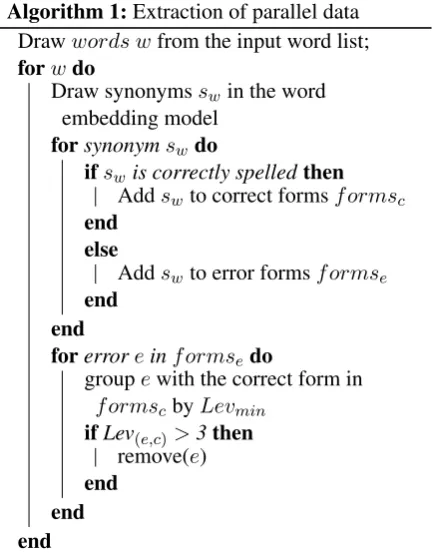
As an example to illustrate the output of the Word2Vec model, a query with the word friendship yields friendlhip, friendihip, friend-flip, friend-, affection, friendthip, gratitude, affe-tion, friendflhipandfriendfiipas the most similar words. In other words, in addition to the OCR errors of the word queried for, other correctly-spelled, semantically similar words (friend-, affec-tionandgratitude) and even their erroneous forms (affetion) are returned. Next, we will describe our method (as shown in Algorithm1) to reduce noise in this initial set of parallel word forms.
As illustrated by the previous example, we need a way of telling correct and incorrect spellings apart. In addition, we will need to know which incorrect spelling corresponds to which correct spelling (affetionshould be grouped withaffection instead offriendship).
For determining whether a word is a correctly spelled English word, we compare it to the
lem-5Parameters: CBOW architecture, window size of 5,
mas of the Oxford English Dictionary (OED).6 If the word exists in the OED, it is spelled cor-rectly. However, as we are comparing to the OED lemmas, inflectional forms would be considered as errors, therefore, we lemmatize the word with spaCy7(Honnibal and Montani,2017). If neither the word nor its lemma appear in the OED, we consider it as an OCR error.
For a given correct spelling, we get the most similar words from the Word2Vec model. We then group these words into two categories: correct En-glish words and OCR errors. For each OCR error, we group it with the most similar correct word on the list. This similarity is measured by using Lev-enshtein edit distance (Levenshtein, 1966). The edit distances of the OCR errors to the correct words they were grouped with are then computed. If the distance is higher than 3 – a simple heuris-tic, based on ad-hoc testing –, we remove the OCR error from the list. Finally, we have extracted a small set of parallel data of correct English words and their different erroneous forms produced by the OCR process.
Algorithm 1:Extraction of parallel data Drawwords wfrom the input word list;
forwdo
Draw synonymssw in the word embedding model
forsynonymswdo
ifswis correctly spelledthen
Addsw to correct formsf ormsc end
else
Addsw to error formsf ormse end
end
forerroreinf ormsedo
groupewith the correct form in
f ormscbyLevmin ifLev(e,c)>3then
remove(e)
end end end
We use the extraction algorithm to extract the parallel data by using several different word lists. First, we list all the words in the vocabulary of the
6http://www.oed.com.
7Using theen_core_web_md model.
source all >=2 >=3 >=4 >=5 W2V all 29013 28910 27299 20732 12843 W2V freq
>100,000 11730 11627 10373 7881 5758
BNC 7692 7491 6681 5926 4925
Table 1: Sizes of the extracted parallel datasets
Word2Vec model and list the words that are cor-rectly spelled. We use this list of corcor-rectly spelled words in the model to do the extraction. How-ever, as this list introduces noise to the parallel data, we combat this noise by producing another list of correctly spelled words that have occurred over 100,000 times in ECCO. For these two word lists, one containing all the correct words in the model and the other filtered with word frequen-cies, we produce parallel datasets consisting of words longer or equal to 1, 2, 3, 4 and 5. The idea behind these different datasets is that longer words are more likely to be matched correctly with their OCR error forms, and also frequent words will have more erroneous forms than less frequent ones.
In addition, we use the frequencies from the British National Corpus (The BNC Consortium, 2007) to produce one more dataset of words occur-ring in the BNC over 1000 times to test whether the results can be improved with frequencies ob-tained from a non-noisy corpus. This BNC dataset is also used to produce multiple datasets based on the length of the word. The sizes of these auto-matically extracted parallel datasets are shown in Table1.
3.2 The NMT Model
We use the automatically extracted parallel datasets to train a character level NMT model for each dataset. For this task, we use Open-NMT8 (Klein et al., 2017) with the default pa-rameters except for the encoder where we use a BRNN (bi-directional recurrent neural network) instead of the default RNN (recurrent neural net-work) as BRNN has been shown to provide a per-formance gain in character-level text normaliza-tion (Hämäläinen et al., 2019). We use the de-fault of two layers for both the encoder and the decoder and the default attention model, which is the general global attention presented by Luong et al. (2015). The models are trained for the de-fault number of 100,000 training steps with the
David A. Smith and Ryan Cordell. 2019. A research agenda for historical and multilingual optical char-acter recognition. Technical report, Northeastern University.
Sandeep Soni, Lauren Klein, and Jacob Eisenstein. 2019. Correcting whitespace errors in digitized historical texts. In Proceedings of the 3rd Joint SIGHUM Workshop on Computational Linguistics for Cultural Heritage, Social Sciences, Humanities and Literature, pages 98–103, Minneapolis, USA. Association for Computational Linguistics.
Simon Tanner, Trevor Muñoz, and Pich Hemy Ros. 2009. Measuring mass text digitization quality and usefulness. D-lib Magazine, 15(7/8):1082–9873.