R E S E A R C H
Open Access
Online adaptive complementation tracker
Guokai Shi
1, Tingfa Xu
1,2*, Jiqiang Luo
1, Jie Guo
1and Zhitao Rao
1Abstract
Correlation filter-based trackers have recently shown excellent performance in terms of motion blur and illumination changes, but they are notoriously sensitive to deformation. It has been demonstrated that the combination of the correlation filter-based tracker and the color histogram-based tracker can alleviate the deformation and keep advantages of the correlation filter-based tracker. However, the most existing complementary tracking algorithms, which use fixed complementary weights, limit the performance of every sub tracker. This paper introduces an adaptive complementary tracker by online learning dynamic complementary weights. The strategy enables inappropriate sub tracker to be down-weighted while increasing the impact of suitable one. We jointly learn the sub trackers and their reliability weights by regression analysis of the corresponding historical tracking results. The robustness of the model also can be improved by training each sub tracker with the result of historical tracking. Finally, both qualitative and quantitative evaluations demonstrate that our tracker achieves the state-of-the-art results in a wide range of tracking scenarios.
Keywords:Correlation filter, Online learning, Visual tracking, Complementary tracker
1 Background
Visual tracking plays an important role in computer vi-sion and has received fast-growth attention in recent years due to its wide practical application. In generic tracking, the task is to track an unknown target (only a bounding box defining the object of interest in a single frame is given) in an unknown video stream. This prob-lem is very challenging due to the limited set of training samples and the numerous appearance changes, e.g., ro-tations, scale changes, occlusions, and deformations.
For solving these problems, many effective tracking models have been proposed [1] in recent years. These models can be categorized into methods based on sub-space algorithms [2, 3], sparse representation [4–8], on-line classifiers [9–12], and so on. Recently, correlation filter-based tracking algorithms [13–17] have drawn in-creasing attention because of its dense sampling prop-erty and its fast computation in the Fourier domain.
Bolme et al. [13] propose the MOSSE tracker which finds a filter by minimizing the sum of squared error between the actual convolution outputs and the desired convolution outputs. The MOSSE tracker can handle several hundreds
of frames per second because of the fast element-wise multiplication and division in the Fourier domain. Henri-ques et al. [18] extend correlation filters to a kernel space, leading to the Circulant Structure of Tracking-by-Detection with Kernels (CSK) tracker which achieves competitive per-formance and efficiency. To further improve the perform-ance, the KCF method [19] integrates multiple features into the CSK tracking algorithm. The Discriminative Scale Space Tracker (DSST) tracker [20] utilizes one-dimensional correlation filters for online estimation of target scale to overcome a wide range of changes to target scale. Further-more, Montero et al. [21] propose a scalable kernel correl-ation filter which introduces an adjustable Gaussian window function and a key point-based model for scale es-timation. This strategy can deal with the fixed size limita-tion in the Kernelized Correlalimita-tion Filter.
Correlation filters are inherently confined to the prob-lem of learning a rigid template. By learning their model from circular shifts of positive examples, correlation filters fail to learn a component that is invariant to permutations. This makes them inherently sensitive to shape deform-ation. This is a concern when the target experiences shaped formation in the course of a sequence. Yao et al. [22] decompose the target object into several parts to ex-ploit the spatial information of the object appearances. Their strategies improve the tracker’s performance in * Correspondence:[email protected]
1School of Optoelectronics, Image Engineering &Video Technology Lab,
Beijing Institute of Technology, Beijing 100081, China
2Key Laboratory of Photoelectronic Imaging Technology and System,
Ministry of Education of China, Beijing 100081, China
situations like occlusions and deformations. In addition, color histograms were used in many early approaches to object tracking [23,24]; they have been demonstrated to be competitive in the Distractor-Aware Online Tracking (DAT) [25]. More recently, Luca et al. [26] propose a sim-ple linear combination of template and color histogram scores by a fixed weight to alleviate shape deformation. However, the fixed weight limits the performance of the combination model.
To solve the discussed problem above, this paper presents an online adaptive complementary tracker. The contributions of this work are twofold. First, we propose a novel formulation for jointly learning two sub trackers and their reliability weights. These sub trackers have better generalization ability, because they use more samples during training. Second, we online analyze the reliability of every sub tracking model in the current scene to real-time adjust their importance in the complementary model. By the ad-justment of the adaptive weight, our combination model shows better performance.
2 Methods
2.1 Problem formulation
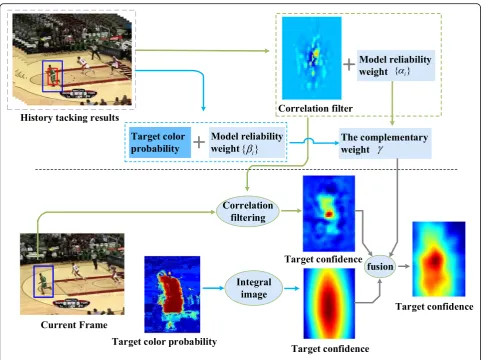
It is necessary to understand the real-time state of the scene for adaptively assigning the appropriate tracker to the current scene. We try to analyze the matching between every sub model and the scene by analyzing the regression deviation between the sub tracker and some history tracking results. This strat-egy is based on an assumption where all history tracking results are accurate and reliable. However, in practice, this assumption is uncertain. In order to avoid the unreliable assumption, we propose to jointly learn every sub tracking model and their corresponding reliability weights in a tracking-by-de-tection framework. Figure 1 shows the diagram of the proposed method.
Specifically, our method jointly learns both sub trackersh1andh2and their weightsαandβby minimiz-ing a sminimiz-ingle loss function. To the best of our knowledge, we are the first to introduce the joint optimization framework by the joint loss,
ℒðα;β;h1;h2Þ ¼X
Here, l1 and l2 denote two regression problems; they will be used to learn two sub models which make up our complementary appearance model. h1 is a correlation filter-based tracker, and its complementary trackerh2is based on color histogram scores. The weightεassuresl1 and l2 consistent value interval. ℛ1, ℛ2, and ℛ3 are three independent regularization terms.
2.2 Constructing and solving the sub trackerh1
We use the Background-aware Correlation Filters (BACF) model [27] as baseline model of h1 because it can effectively handle the boundary effect which is a fun-damental drawback to traditional correlation filter-based trackers. However, similar to many other correlation filter-based trackers, the BACF model also depends strongly on the spatial layout of the tracked object, so is sensitive to deformation. In addition, the BACF model ignores the problem of corrupted samples, and when those corrupted samples are included in the training set, the model drift may be caused.
Being motivated by [28], we develop the BACF model into Eq.2to learn our sub trackerh1:
ℒh1ð Þ ¼h1
whereP denotes transform matrix which is aE×Jbinary matrix for cropping midE elements of sample φdi, E≪J. The cropped patch corresponding to the peak of the cor-relation output displays the target (positive example), and those corresponding to the zero values of the correlation output display the background content (negative exam-ples). The transform matrix Pcan be pre-computed, and
Pφd
i can be efficiently performed via a lookup table.φis
expressed by Histogram of Oriented Gradients (HOG) features. Compared with [28], our method adopts the sampling strategy of the BACF, which introduces the transform matrix P into cyclic sampling to improve the distinction between samples. More importantly, the pro-posed optimization model of the parameter h1not only
purifies the training sample set, but also verifies the reli-ability of the model for current sequence.
For improving computing speed, Eq. 2 can be expressed in the frequency domain as:
^ The matrixIDis an D×Didentity matrix, and the oper-ator⊗is the Kronecker product. Aˆdenotes the discrete Fourier transform (DFT). The orthonormal matrix Fcan map anyJdimensional vectorized signal to the Fourier do-main.Tindicates the transpose operator, which computes the conjugate transpose on a complex vector or matrix.
Then, Eq. 6 is minimized by solving the normal
To design an efficient method, we solve Eq. 7 by the Gauss-Seidel iteration. Set A¼JμIDþPti¼1αiφ^iðjÞφ^iðjÞ
T
which is symmetric and positive definite. The Gauss-Seidel method decomposes the matrix A into a lower triangular component L and a strictly upper tri-angular component U, such that A=U+L. The filter ^g
ðjÞis then iteratively calculated by equation:
L^g jð Þðmþ1Þ¼Jμh1^ ð Þ−j J^ζð Þj
þXt
i¼1
αi^y jð Þφ^ið Þj
T−U^g jð Þð Þm: ð8Þ
Here, m is mth iteration in Gauss-Seidel iteration operation.
C. Lagrangian vector update
Then, we update the Lagrangian vector as:
^ζð Þjðnþ1Þ¼^ζ
where n indicates the nth iteration in the ADMM operation.
2.3 Constructing and solving the sub trackerh2
Similar to [26], we also use the color histogram-based model as the complementary tracker of h1. The differ-ence is that we extend the training set of the model in the time dimension. The expanded model, which makes use of more diverse training samples and has better ro-bustness, can be learn by optimizing Eq.10:
ℒh2
The regression problem can be described as:
l2ð Þ ¼h2 1
where O and B denote the target area and background area.
In the ridge regression problem, the solution of the per feature dimension is:
hd
2.4 Solving the reliability weightsαandβ
When h1and h2are obtained, Eq.1can be expressed as an optimization problem forα and β. The optimization problem aboutαandβcan be rewritten into the follow-ing form:
weights whose definition is similar with one in [28],pi> 0 andPti¼1pi¼1. In the control of the parameterpi,
re-cent fame is given larger attention to account for fast ap-pearance changes.
We can use the convex quadratic programming methods in Matlab’s Optimization Toolbox to solve the above optimization problem.
2.5 Solving the complementary weights
Our score function is a linear combination of template and histogram scores:
fmerge¼γfh1þð1−γÞ fh2: ð14Þ
fh1 denotes a template scores, which is the confidence map acquired by correlation operation between correl-ation filtergand spatial layout featuresφ.
fh1¼ℱ −1ð Þφ^^g ; ð15Þ
fh2 denotes a histogram scores, which is computed from an M-channel feature image.
fh2¼hT2 Xx∈ℋψ½ u=j jℋ
: ð16Þ
reliability weights of the nearestn(n= 10) frames to dy-namically adjust our weight γ. In addition, considering that correlation filter-based tracker is more favorable for accurate location than the color histogram-based tracker, we choose the template scores as the main tracking scores while the color histogram scores as accessorial ones. Based on the discussion above, we construct the following complementary weight model:
γ¼ spectively. Tlow and Tup are the lower threshold and upper threshold respectively.
3 Experimental results and discussion
The proposed method in this paper is implemented in MATLAB 2016a. We perform the experiments on a PC with Intel i7-4790 CPU (3.6GHz) and 16-GB RAM mem-ory, and the tracker runs at 15 fps. We extensively evalu-ate the performance of the proposed tracker with the total 100 challenging sequences from [30] and compare our tracker with the top 10 state-of-the-art trackers, including DSST [20], Structured Output Tracking with Kernels (Struck) [31], BACF [27], Tracking-by-Detection (TLD) [32], CSK [18], Spatially Regularized Discriminative Cor-relation Filters (SRDCF) [33], Tracking via Multiple Experts Using Entropy Minimization (MEEM) [34], Adap-tive Color Tracker (ACorT) [35], Staple, and DAT [25]. The DSST, the CSK, the SRDCF, and the ACorT belong to the correlation filter-based tracker, which more atten-tion to the structural attribute of the target. The Struck, the TLD, and the MEEM are tracking algorithms based on classifier learning, which divides the scene into target and background. The DAT belongs to the unstructured tracker, which is suitable for the tracking target with se-vere deformation. The Staple is a combined tracker, which has the strongest correlation with our algorithm.
3.1 Parameter setting
In the proposed tracking model, the HOG feature and the color histogram feature are two important factors affecting the computation. During the experiment, we set HOG fea-tures to 31 channels and use cell size of 4 × 4 pixels in
order to be unified with other algorithms, e.g., BACF, Staple, DSST, and CSK. The size of the search region is set to be 42times the size of the target area in all the algo-rithms. Then, we normalized samples to a fixed size by a 50 × 50 square, so that the fps is unaffected by the height and width of video sequence. In the Alternating Direction Method of Multipliers (ADMM) optimization, we set the number of iterations to 4, which is enough to ensure algo-rithm robustness. Although more iteration is beneficial to improve algorithm performance, it will affect computa-tional efficiency. The penalty factor μ is set to 0.25. The regularization factor λ`1andλ2are set to 0.001 and 0.01, respectively. The iterations of the Gauss-Seidel method are set to be 5, and the learning rate is adopted asη= 0.02. The lower thresholdTlow¼0:15 and the upper threshold
Tup¼0:8. Moreover, bin color histogram is set into 32 × 32 × 32, which has similar settings with the Staple tracker. All parameters remain fixed in all experiments. We run our approach approximately for 15 frames per second.
In practice, the penalty factor, the regularization factor, ADMM iteration number, and the Gauss-Seidel iteration number are independent of the specific scenario and only related to the proposed model itself. The cell size of HOG features, the size of the search region, and the bin color histogram, these three parameters will be affected by the target size and image resolution.
3.2 Qualitative evaluation
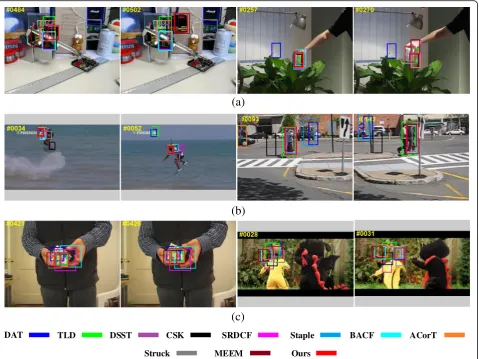
Figure2shows the tracking results of 10 state-of-the-art trackers and our tracker on some most challenging scenes (i.e., occlusion, deformation, fast motion, in-plane rotation, and out-plane rotation) in the OTB (object tracking benchmark) [30].
Figure 2a shows the tracking results on the Box and Cokesequences. In this figure, the targets undergo partial or short-term total occlusions. Our tracker can effectively track these objects, which benefits from two factors. First, our approach is capable of reducing or removing the im-pact of uncorrupted samples by readjusting the reliability weights of the sub model in training, thereby lowering the risk of drift and tracking failure. Second, the uncorrupted part of the targets and the background context can still form some uncorrupted samples for training and detec-tion, which is similar to BACF. Most of the traditional cor-relation filter-based trackers DAT, CSK, ACorT, and DSST may drift after occlusions or fail to track the targets because their search areas are limited and uncorrupted samples are used during the training. BACF and SRDCF can handle some slight occlusions, but when undergo se-vere occlusions, they all drift away.
motion. The figure shows that the proposed tracker gain outstanding performance handles. This can be mainly at-tributed to the correlation filters and the discriminative ability of the proposed method. The proposed method works well in all these sequences. On the one hand, the color histogram information can be used effectively to handle deformations by dynamically increasing the impact of color histogram-based tracker. On the other hand, when target is in fast motion, the impact of correlation filter-based tracker will be dynamically increased. The sub tracker can effectively handle fast motion because allows larger search region. Other trackers also have some abil-ities against target deformations (i.e., Stape and MEEM), but most of them are failed to track targets when severe deformations are coming.
Figure2cshows the tracking results on two represen-tative sequencesRubikandDragonBabys where the tar-gets are partially or fully occluded. Our tracker performs well in in-plane rotation and out-plane rotation. These properties mainly benefit from up-weighting color histogram-based tracker.
For the six representative sequences above, we compared center location error of every sequence frame-by-frame in Fig. 3. These comparison results show that our tracker is more stable and accurate.
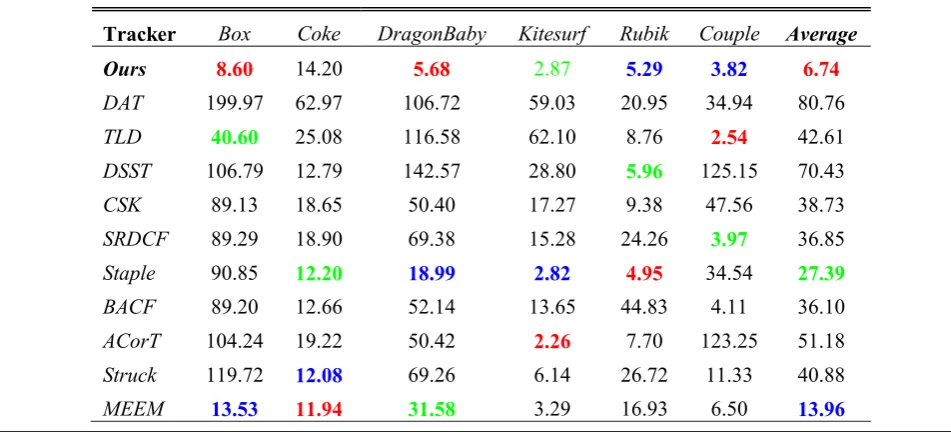
Table 1 reports average entry location errors for each compared tracker. In a descending order, the best three estimates are marked in red, blue, and green fonts. In one of the six sequences (theBoxandDragonBaby), our approach achieved the best results. In two of the remaining four sequences (the Rubik and Couple se-quences), our approach obtained the second best results and were very close to the best ones. In the remaining two sequences (CokeandKitesurf), our tracker also per-forms better. Generally, our method performed well against existing trackers.
3.3 Quantitative evaluation
We use the precision plots and the success plots metric [30] to compare all trackers on OTB-100. Precision plot reports the average distance precision score at 20 pixels for each method. In the evaluation of success plots, the
Ours
DAT TLD DSST CSK SRDCF Staple BACF ACorT
Struck MEEM
(a)
(b)
(c)
area under the curve (AUC) of success plots is used to rank the trackers.
The evaluation results of the proposed tracker and the 10 competitive trackers are demonstrated in Fig. 4. The legend of the precision plot reports the average distance precision score at 20 pixels for each method, and the legend of the success plot reports AUC
scores. The BACF tracker provides the second best results with precision plots of 82.0% and the success plots of 60.6%. The best results on this dataset is achieved by our tracker with a precision plot of 85.1% and a success plot of 62.8%, leading to a sig-nificant gain of 3.0 and 2.2% compared to BACF tracker in precision plots and success plots in turn. Fig. 3Frame-by-frame comparison of six representative sequences based on center location errors
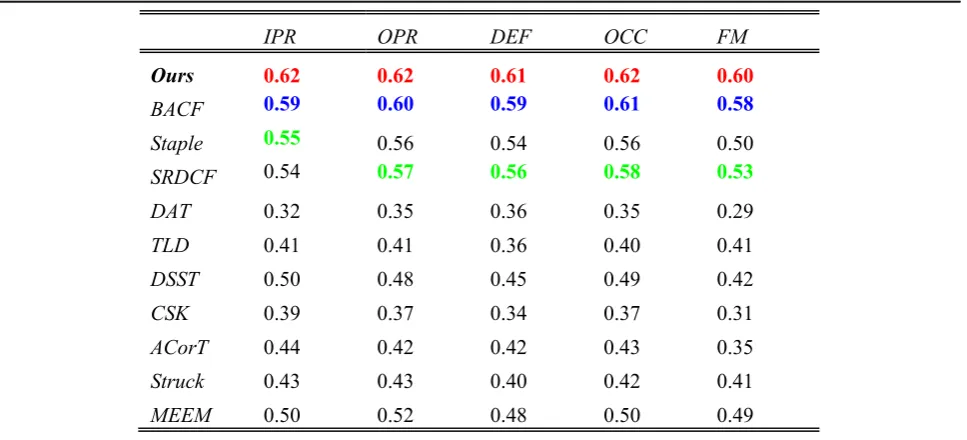
Table 2 reports the AUC scores of all the com-pared trackers under some challenging problems which were posed in the OTB sequences including 31 sequences with target in-plane rotation (IPR), 39 sequences with target out-of-plane rotation (OPR), 19 sequences with target deformation (DEF), includ-ing 29 sequences with target occlusion (OCC) and 17 sequences with target fast motion (FM). In a de-scending order, the top three results are shown in red, blue, and green fonts. Our tracker achieves highest AUC scores in all these challenging attributes.
4 Conclusions
In order to alleviate the deformation, this paper presents to online learn an adaptive complementation tracking algo-rithm. The proposed strategy can dynamically adapt the im-portance of each sub tracker according to the real-time status of the scene, making the tracker more robust for vari-ous target appearance changes. In addition to, joint learning model reliability weights and tracker can also effectively control the reliability of training samples and improved the discriminability of the tracker. Experimental results show that our approach outperforms state-of-the art tracking al-gorithms on many challenging videos from the OTB. Fig. 4Precision and success plots
Acknowledgements
The authors would like to thank Image Engineering &Video Technology Lab for the support.
Funding
This work was supported by the Major Science Instrument Program of the National Natural Science Foundation of China under Grant 61527802 and the General Program of the National Natural Science Foundation of China under Grants 61371132 and 61471043.
Availability of data and materials All data are fully available without restriction.
Authors’contributions
GS and TX conceived and designed the algorithm and the experiments. GS was responsible for most of the implementation of the algorithms. JL, JG, ZR, and GS analyzed the data. GS provided suggestions for the proposed method and its evaluation, and assisted in the preparation of the manuscript. All authors read and approved the final manuscript.
Competing interests
The authors declare that they have no competing interests.
Publisher’s Note
Springer Nature remains neutral with regard to jurisdictional claims in published maps and institutional affiliations.
Received: 10 April 2018 Accepted: 3 July 2018
References
1. AW Smeulders, DM Chu, R Cucchiara, S Calderara, A Dehghan, M Shah, Visual tracking: an experimental survey. IEEE Transactions on Pattern Analysis & Machine Intelligence 36, 1442–1468 (2014).
2. DA Ross, J Lim, R-S Lin, M-H Yang, Incremental learning for robust visual tracking. Int. J. Comput. Vis. 77, 125–141 (2008).
3. D Wang, H Lu, MH Yang, Online object tracking with sparse prototypes. IEEE Trans. Image Process. 22, 314–325 (2013).
4. X Mei, H Ling, inIEEE International Conference on Computer Vision. Robust visual tracking usingℓ1 minimization (2009), pp. 1436–1443.
5. H Lu, X Jia, MH Yang, inIEEE Conference on Computer Vision and Pattern Recognition. Visual tracking via adaptive structural local sparse appearance model (2012), pp. 1822–1829.
6. T Zhang, B Ghanem, S Liu, N Ahuja, Robust visual tracking via structured multi-task sparse learning. Int. J. Comput. Vis. 101, 367–383 (2013). 7. T Zhang, B Ghanem, C Xu, N Ahuja, inIEEE Conference on Computer Vision
and Pattern Recognition Workshops. Object tracking by occlusion detection via structured sparse learning (2013), pp. 1033–1040.
8. D Wang, H Lu, C Bo, Online visual tracking via two view sparse representation. IEEE Signal Processing Letters 21, 1031–1034 (2014). 9. S Avidan, Support vector tracking. IEEE Transactions on Pattern Analysis &
Machine Intelligence 26, 1064–1072 (2004).
10. S Avidan, Ensemble tracking. IEEE Transactions on Pattern Analysis & Machine Intelligence 29, 261–271 (2007).
11. B Babenko, MH Yang, S Belongie, inEEE Conference on Computer Vision and Pattern Recognition. Visual tracking with online multiple instance learning (2009), pp. 983–990.
12. J Ning, J Yang, S Jiang, L Zhang, M-H Yang, inIEEE Conference on Computer Vision and Pattern Recognition. Object tracking via dual linear structured SVM and explicit feature map (2016), pp. 4266–4274.
13. DS Bolme, JR Beveridge, BA Draper, YM Lui, inEEE Conference on Computer Vision and Pattern Recognition. Visual object tracking using adaptive correlation filters (2010), pp. 2544–2550.
14. M Danelljan, G Häger, F Khan, M Felsberg, inBritish Machine Vision Conference, Nottingham, September. Accurate scale estimation for robust visual tracking (2014), pp. 1–5.
15. H JF, R C., P M., J B., High-speed tracking with kernelized correlation filters. IEEE Transactions on Pattern Analysis\s&\smachine Intelligence 37, 583 (2014).
16. C Ma, X Yang, C Zhang, MH Yang, inEEE Conference on Computer Vision and Pattern Recognition. Long-term correlation tracking (2015), pp. 5388–5396.
17. M Wang, Y Liu, Z Huang, Large margin object tracking with circulant feature maps.IEEE Conference on Computer Vision and Pattern Recognition(2017), pp.4800–4808.
18. R Yao, S Xia, F Shen, Y Zhou, Q Niu, Exploiting spatial structure from parts for adaptive kernelized correlation filter tracker. IEEE Signal Processing Letters 23, 658–662 (2016).
19. JF Henriques, R Caseiro, P Martins, J Batista, High-speed tracking with kernelized correlation filters. IEEE Trans. Pattern Anal. Mach. Intell. 37, 583– 596 (2015).
20. M Danelljan, G Häger, FS Khan, inBritish Machine Vision Conference. Accurate scale estimation for robust visual tracking (2014), pp. 65.1–65.11.
21. AS Montero, J Lang, R Laganière, inIEEE International Conference on Computer Vision Workshop. Scalable kernel correlation filter with sparse feature integration (2016), pp. 587–594.
22. T Liu, G Wang, Q Yang, inIEEE Conference on Computer Vision and Pattern Recognition. Real-time part-based visual tracking via adaptive correlation filters (2015), pp. 4902–4912.
23. P Pérez, C Hue, J Vermaak, M Gangnet, Color-based probabilistic tracking. ECCV, 2002I, 661–675 (2002).
24. D Comaniciu, V Ramesh, P Meer, Kernel-based object tracking. IEEE Transactions on Pattern Analysis & Machine Intelligence25, 564–575 (2003). 25. H Possegger, T Mauthner, H Bischof, inIEEE Conference on Computer Vision
and Pattern Recognition. In defense of color-based model-free tracking (2015), pp. 2113–2120.
26. L Bertinetto, J Valmadre, S Golodetz, O Miksik, PHS Torr, inComputer Vision and Pattern Recognition. Staple: complementary learners for real-time tracking (2016), pp. 1401–1409.
27. HK Galoogahi, A Fagg, S Lucey, inIEEE Conference on Computer Vision and Pattern Recognition. Learning background-aware correlation filters for visual tracking (2017), pp. 1135–1143.
28. M Danelljan, G Häger, FS Khan, M Felsberg, inIEEE Conference on Computer Vision and Pattern Recognition. Adaptive decontamination of the training set: a unified formulation for discriminative visual tracking (2016), pp. 1430–1438. 29. S Boyd, N Parikh, E Chu, B Peleato, J Eckstein, Distributed optimization and
statistical learning via the alternating direction method of multipliers. Foundations & Trends in Machine Learning 3, 1–122 (2010).
30. Y Wu, J Lim, M-H Yang, Object tracking benchmark. IEEE Trans. Pattern Anal. Mach. Intell. 37, 1834–1848 (2015).
31. S Hare, S Golodetz, A Saffari, V Vineet, M-M Cheng, SL Hicks, et al., Struck: structured output tracking with kernels. IEEE Trans. Pattern Anal. Mach. Intell. 38, 2096–2109 (2016).
32. Z Kalal, K Mikolajczyk, J Matas, Tracking-learning-detection. IEEE Transactions on Pattern Analysis & Machine Intelligence 34, 1409–1422 (2012). 33. M Danelljan, G Hager, F Shahbaz Khan, M Felsberg, inIEEE International
Conference on Computer Vision. Learning spatially regularized correlation filters for visual tracking (2015), pp. 4310–4318.
34. Zhang J, Ma S, Sclaroff S. MEEM: robust tracking via multiple experts using entropy minimization.European Conference on Computer Vision(2014), pp. 188–203.