Volume 2008, Article ID 570624,9pages doi:10.1155/2008/570624
Research Article
MAP Channel-Estimation-Based PIC Receiver for
Downlink MC-CDMA Systems
Hakan Do ˘gan,1Erdal Panayırcı,2Hakan A. C¸ırpan,1and Bernard H. Fleury3
1Department of Electrical and Electronics Engineering, Istanbul University, Avcilar 34850, Istanbul, Turkey 2Department of Electronics Enginering, Kadir Has University, Cibali 34083, Istanbul, Turkey
3Section Navigation and Communications, Department of Electronic Systems, Aalborg University Fredrik Bajers
Vej 7A3 DK-9000 Aalborg, Denmark and The Telecommunications Research Center, Donau City Strasse 1, 1220 Vienna (ftw.), Austria
Correspondence should be addressed to Hakan Do˘gan,[email protected]
Received 15 May 2007; Revised 10 September 2007; Accepted 2 October 2007
Recommended by Arne Svensson
We propose a joint MAP channel estimation and data detection technique based on the expectation maximization (EM) method with paralel interference cancelation (PIC) for downlink multicarrier (MC) code division multiple access (CDMA) systems in the presence of frequency selective channels. The quality of multiple access interference (MAI), which can be improved by using channel estimation and data estimation of all active users, affects considerably the performance of PIC detector. Therefore, data and channel estimation performance obtained in the initial stage has a significant relationship with the performance of PIC. So obviously it is necessary to make excellent joint data and channel estimation for initialization of PIC detector. The EM algorithm derived estimates the complex channel parameters of each subcarrier iteratively and generates the soft information representing the data a posterior probabilities. The soft information is then employed in a PIC module to detect the symbols efficiently. Moreover, the MAP-EM approach considers the channel variations as random processes and applies the Karhunen-Loeve (KL) orthogonal series expansion. The performance of the proposed approach is studied in terms of bit-error rate (BER) and mean square error (MSE). Throughout the simulations, extensive comparisons with previous works in literature are performed, showing that the new scheme can offer superior performance.
Copyright © 2008 Hakan Do˘gan et al. This is an open access article distributed under the Creative Commons Attribution License, which permits unrestricted use, distribution, and reproduction in any medium, provided the original work is properly cited.
1. INTRODUCTION
Traditional wireless technologies are confronted with new challenges in meeting the ubiquity and mobility require-ments of cellular systems. Extensive attemps have therefore been made in recent years to provide promising avenue that makes efficient utilization of the limited bandwidth and cope with the adverse access environments. These include the de-velopment of several modulation and multiple access tech-niques. Among these, multicarrier (MC) and code division multiple access (CDMA) have gained considerable interest due to their considerable performance [1,2].
MC modulation technique, known also as OFDM (or-thogonal frequency division multiplexing), has emerged as an attractive and powerful alternative to conventional mod-ulation schemes in the recent past due to its various advan-tages. The advantages of MC which lie behind such a success are robustness in the case of multipath fading, a very reduced
system complexity due to equalization in the frequency do-main and the capability of narrow-band interference rejec-tion. OFDM has already been chosen as the transmission method for the European radio (DAB) and TV (DVB-T) standard and is used in xDSL systems as well. Supporting multiple users can be achieved in a variety of ways. One pop-ular multiple access scheme is CDMA. CDMA makes use of spread spectrum modulation and distinct spreading codes to separate different users using the same channel. It is well known that CDMA system has an ability to reduce user’s signal power during transmission using a spreading so that the user can communicate with a low-level transmitted sig-nal closed to noise power level. As a combination of MC and CDMA techniques, it combines the advantages of both MC and CDMA [1–3].
a significant performance gain compared to conventional noniterative receivers by using combined minimum mean square error-parallel interference cancellation (combined MMSE-PIC) detector [5] assuming perfectly known chan-nel impulse response. However, the performance of MC-CDMA-based transmission systems under realistic condi-tions critically depends on good estimate of the parameters, such as the channel parameters. In [4], different detection schemes were considered for least square estimation case as well as perfect channel case.
The quality of multiple access interference (MAI), which can be improved by using channel estimation and data es-timation of all active users, affects considerably the perfor-mance of PIC detector. Therefore, data and channel estima-tion performance is obtained in the initial stage has a sig-nificant relationship with the performance of PIC. So obvi-ously it is necessary to make excellent joint data and chan-nel estimation for initialization of PIC detector. Inspired by the conclusions in [4,5], including channel estimation into the iterative receiver yields further improvements. We there-fore consider iterative channel estimation techniques based on the expectation-maximization (EM) algorithm in this pa-per.
The EM algorithm is a broadly applicable approach to the iterative computation of parameters from intractable and high complexity likelihood functions. An EM approach pro-posed for the general estimation from superimpro-posed signals [6] is applied to the channel estimation for OFDM systems and compared with SAGE version in [7]. For CDMA sys-tems, Nelson and Poor [8] extend the EM and SAGE algo-rithms for detection, rather than for estimation of continu-ous parameters. Moreover, EM-based channel estimation al-gorithms were investigated in [9,10] for synchronous uplink DS-CDMA and asynchronous uplink DS-CDMA systems, respectively. Unlike the EM approaches, we adopt a two-step detection procedure: (i) use the EM algorithm to estimate the channel (frequency domain estimation) and (ii) use the estimated channel to perform coherent detection [11,12]. The paper has several major novelties and contributions. The major contribution of the paper is to obtain EM-based chan-nel estimation algorithm approach as opposed to the existing works in the literature which mostly assumed that the data is known at the receiver through a training sequence. Note that very small number of pilots used in our approach is necessary only for initialization of the EM algorithm leading to chan-nel estimation. Although, the joint data and chanchan-nel estima-tion technique with EM algorithm seems to be attractive in practice, it is known that the convergency of the algorithm is much slower, it is more sensitive to the initial selection of the parameters and the algorithm is more computation-ally complex than the techniques that deal with only chan-nel estimation. As it is known in the estimation literature, non-data-aided estimation techniques are more challenging mainly due to a data-averaging process which must be per-formed prior to optimization step. The proposed EM-MAP receiver compared with the combined MMSE-PIC receiver in the case of LS, LMMSE, and perfect channel estimation [4].
Another significant contribution of the paper comes from the fact that the proposed approach considers the
channel variations as random processes and applies the Karhunen-Loeve (KL) orthogonal series expansion. It was shown that KL expansion enable us to estimate the chan-nel in a very simple way without taking inverse of large-dimensional matrices for OFDM system [11,12]. However, this property will not help to avoid matrix inversion for the signal model in this paper as shown in Section 4. On the other hand, we show that optimal truncation property of the KL expansion help to decrease inverse matrix dimension so that reduction in computational load on the channel estima-tion algorithm can be done.
The rest of this paper is organized as follows. In Sections 2and3we introduce the model of a downlink MC-CDMA system and the corresponding channel model established, re-spectively. Using the discrete-time model, the maximum a posteriori (MAP) channel estimation algorithm is derived in Section 4. Moreover, in this section, truncation property of the KL expansion and complexity calculation of the proposed algorithm are also given. In the next section, PIC-detection scheme is then developed for the proposed channel estima-tion algorithm. Finally, computer simulaestima-tion results are pre-sented with detailed discussions in Section 6, and conclu-sions are drawn inSection 7.
Notation: Vectors (matrices) are denoted by boldface lower (upper) case letters; all vectors are column vectors; (·)T, (·)† and (·)−1
denote the transpose, conjugate trans-pose, and matrix inversion, respectively;ILdenotes theL×L
identity matrix; diag{·}denotes a diagonal matrix.
2. DOWNLINK MC-CDMA
Transmission of MC-CDMA signals from the base station to mobile stations forms the downlink transmission. The Base station must detect all the signals while each mobile is re-lated with its own signal. In the downlink applications, all the signals arriving from the base station to specific user propa-gate through the same channel. Therefore, channel estima-tion methods that is developed for OFDM systems can be appliciable for downlink application of MC-CDMA systems [11].
Letbk’s denote the QPSK modulated symbols that would
be send forkth user within mobile cellk=1,. . .,KwhereK
is the number of mobile users which are simultaneously ac-tive. The base station spread the databk’s over chips of length
Ncby means of specific orthogonal spreading sequences,ck=
(c1k,ck2,. . .,ckNc)
T
where each chip,cik, takes values in the set
{−1/Nc, 1/
Nc}. Then, the spreaded sequences of all users
ckbkare summed together to form the input sequences of the
At the receiver, CP is removed and DFT is then applied to the received discrete time signal to obtain the received vector expressed as
R=HCb+W, (1)
where C=[c1,. . .,cK] is theN
c×Kspreading code matrix,
b=[b1, . . .,bK]T
is theK×1 vector of the transmitted sym-bols by theKusers.His theNc×Ncdiagonal channel matrix
whose elements representing the fading of the subcarriers are modeled in the next section,Wis theNc×1 zero-mean, i.i.d.
Gaussian vectors that model additive noise in theNc tones,
with varianceσ2/2 per dimension. Note that due to orthog-onality property of the spreading sequences,CTC=I
K.
In this study, our major focus lies on the development of a MAP-EM channel estimation algorithm based on the observation model (1). However, in the sequel we will first present the channel model based on KL expansions.
3. CHANNEL: BASIS EXPANSION MODEL
The fading channel between the transmit and the receive antenna is assumed to be frequency and time selective and the fading process is assumed to be constant during each OFDM symbol. LetH=[H1,H2,. . .,HNc]
T
denote the cor-related channel coefficients corresponding to the frequency response of the channel between the transmit and the receive antenna. The KL expansion methodology has been applied for efficient simulation of multipath fading channels [14]. Prompted by the general applicability of KL expansion, we consider in this paper the parameters ofHto be expressed by a linear combination of orthonormal bases,
H=ΨG, (2)
whereΨ=[cψ1,ψ2,. . .,ψNc],ψi’s are the orthonormal basis vectors,G=[G1,. . .,GNc]
T
, andGiis the vector representing
the weights of the expansion. By using different basis func-tionsΨ, we can generate sets of coefficients with different properties. The autocorrelation matrixCH=E[HH†] can be decomposed as
CH=ΨΛΨ†, (3)
whereΛ = E{GG†}is a diagonal. Then (3) represents the eigendecompositionof CH. The fact that only the eigenvec-tors diagonalizeCHleads to the desirable property that the KL coefficients (G1,. . .,GNc) are uncorrelated. Furthermore,
in the Gaussian case, the uncorrelatedness of the coefficients renders them independent as well, providing additional sim-plicity. Thus, the channel estimation problem in this study is equivalent to estimating the i.i.d. Gaussian vectorG, namely, the KL expansion coefficients.
4. EM BASED MAP CHANNEL ESTIMATION
In MC-CDMA system, channel equalization is moved from the time domain to the frequency domain, that is, the chan-nel frequency response is estimated. Note that, it is pos-sible to estimate the channel parameters from the time-domain channel model (channel impulse response), in our
Rx
Pilot based initial estimation
OFDM demodulator
Calculation of Γ(q)
MAP channel
estimation PIC
Figure1: Receiver structure for MC-CDMA systems.
work, time-domain approach introduces additional com-plexity mainly because the frequency domain channel pa-rameters are required and directly employed in the de-tection process. Moreover, the frequency domain estima-tor presented in this paper was inspired by the conclu-sions in [15,16], where it has been shown that time do-main channel estimators based on a Discrete Fourier Trans-form (DFT) approach for non sample-spaced channels cause aliased spectral leakage and result in an error floor. Further-more, our proposed frequency domain iterative channel esti-mation technique employs the KL expansion which reduces the overall computational complexity significantly.
To find MAP estimate ofG, (1) can be rewritten by using the channel KL expansion as follows:
R=diag(Cb)ΨG+W. (4)
The MAP estimateGis then given by
G=arg max
G p(G|R) (5)
Direct maximization of (5) is mathematically intractable. However, the solution can be obtained easily by means of the iterative EM algorithm. A natural choice for the complete data for this problem is χ = {R,b}. The vector to be esti-mated isG, and the incomplete data isR. The EM algorithm stated above is equivalent to determining the parameter set
Gthat maximize the Kullback-Leibler information measure defined by
QG|G(q)=
b
pR,b,G(q)logpR,b,G, (6)
whereG(q)is the estimation ofGat theqth iteration. This algorithm inductively reestimateGso that a monotonic in-crease in thea posterioriconditional pdf (probability density function) in (5) is guaranteed.
Note that, the term logp(R,b,G) in (6) can be expressed as
logp(R,b,G)=logp(b| G) + logp(R|b,G) + logp(G). (7)
andbhave equala prioriprobability. The probability den-sity function ofGis known as a priori by the receiver and can be expressed as
p(G)∼exp−G†Λ−1G. (8)
Also, given the transmitted symbolsband the discrete chan-nel representationGand taking into account the indepen-dence of the noise components, the conditional probability density function of the received signalRcan be expressed as
p(R|b,G)
∼exp−R−diag(Cb)ΨG†Σ−1R−diag(Cb)ΨG, (9)
whereΣis anNc×Ncdiagonal matrix withΣ[k,k]=σ2, for
k=1, 2,. . .,Nc.
Taking derivatives in (6) with respect toGand equating the resulting equations to zero, we have
without violating the equalities in (10). Solving (10) forG, after taking average overb, the final expression of reestimate ofG(q+1)can be obtained as follows: abilitiesof the data symbols at theqth iteration step defined as
Γ(q)(k)=
b∈Sk
bP bk=b|R,G(q). (13)
Γ(q)can be computed for QPSK signaling as follows [11]:
Γ(q)=√1
Finally, the databtransmitted by each user can be estimated at theqth iteration step as
A truncated expansion vectorGr be formed fromGby
se-lecting r orthonormal basis vectors among all basis vec-tors that satisfy CHΨ = ΨΛ. The optimal solution that yields the smallest average mean-squared truncation error (1Nc)E[†rr] is the one expanded with the orthonormal
basis vectors associated with the first largestreigenvalues as given by
property of the KL expansion results in a low-rank approx-imation as well. Thus, a rank-r approximation ofΛcan be defined asΛr =diag{λ1,λ2,. . .,λr}by ignoring the trailing
Nc−rvariances{λl}Nl=cr, since they are very small compared to
the leadingrvariances{λl}rl=1.Actually, the pattern of eigen-values forΛtypically splits the eigenvectors into dominant and subdominant sets. Then the choice ofr is more or less obvious. For instance, if the number of parameters in the ex-pansion include dominant eigenvalues, it is possible to obtain a good approximation with a relatively small number of KL coefficients.
Complexity
Based on the approach presented in [17], the traditional LMMSE estimation forHcan be easily expressed as
c)”computational complexit y
×diag(Cb)−1R.
(18)
Since [CH+Σ(diag(Cb)diag(Cb)−1] −1
changes with data symbols, its inverse cannot be precomputed and has high computational complexity due to required large-scale matrix inversion.1Moreover, the error caused by the small fluctua-tions inCHandΣhave an amplified effect on the channel es-timation due to the matrix inversion. Furthermore, this effect becomes more severe as the dimension of the matrix, to be inverted, increases [18]. Therefore, the KL-based approach is needed to avoid large-scale matrix inversion. Using (2) and (11), the iterative estimate ofHwithKL expansion can be obtained as
H(q+1)=Ψ T†(q)T(q)+ΣΛ−1−1T†(q)
R. (19)
However, in this form, complexity of channel estimate is greater than the traditional LMMSE estimate. Therefore, to reduce the complexity of the estimator further we rewrite (19) as
H(q+1)=ΨΛΛT†(q)T(q)Λ+ΣΛ−1ΛT†(q)R (20)
1The computational complexity of anNc×Nc matrix inversion, using
Table1
and proceed with the low-rank approximations by consider-ing onlyrcolumn vectors ofΨandTcorresponding to ther
largest eigenvalues ofΛ, yielding
whereΣris anr×rdiagonal matrix whose elements are equal
toσ2.Ψ
r andTr are in (21) an Nc×r matrices which can
be formed by omitting the lastNc−r columns ofΨandT,
respectively. Equation (21) can then be rearranged as follows:
Thus, the low-rank expansion yields an excellent approx-imation with a relatively small number of KL coefficients. Computational complexity has been evaluated quantitatively and summarized inTable 1.
5. PARALEL INTERFACE CANCELLATION (PIC)
The estimated complex QPSK vectorbgiven by (16) is passed to a PIC module after last iteration. In this module, the cal-culation of all interfering signals for userkcan be written as
Rkint=HCb forbk=0. (23) Interfering signals for userksubtracted from the received sig-nalR, then passed to the single user detector. Finally, the PIC detector forkth user can be written as
bk
pic=(ck)T[H(R−Rkint)] fork=1,. . .,K. (24) For the last iteration, detected symbols for QPSK modulation are
Given the received signalR, the EM algorithm starts with an initial valueG(0)of the unknown channel parametersG. Cor-responding to pilot symbols, we focus on a under-sampled signal model and employ the linear minimum mean-square error (LMMSE) estimate to obtain the under-sampled chan-nel parameters. Then the complete initial chanchan-nel gains can easily be determined using an interpolation technique, that is, Lagrange interpolation algorithm. Finally, the initial val-ues ofG(0)μ are used in the iterative EM algorithm to avoid
divergence. The details of the initialization process are pre-sented in [11,17].
6. MODIFIED CRAMER-RAO BOUND
The modified Fisher information matrix (FIM) can be ob-tained by a straightforward modification of FIM as [11],
JM(G)−E
whereJp(G) represents thea prioriinformation.
Under the assumption thatGandWare independent of each other andWis a zero-mean Gaussian vector, the trans-mitted signals become uncorrelated due to the orthogonal spreading codes. The conditional PDF ofRgivenGcan be obtained by averagingp(R|b,G) overbas follows
p(R|G) =Eb{p(R|b,G)}. (27)
From (27), the derivatives can be taken as follows:
∂ln p(R|G)
Second term in (26) is easily obtained as follows:
∂lnp(G)
Taking the negative expectations, the first and the second term in (26) becomesJ(G) =(1σ2)I
Nc andJP(G)= Λ
−1,
respectively. Finally, (26) produces for the modified FIM as follows:
the main diagonal equaling the reciprocal of thoseJ(G) ma-trices.
7. SIMULATIONS
In this section, performance of the MC-CDMA system based on the proposed receivers is investigated by computer lations operating over frequency selective channels. In simu-lation, we assume that all users receive the same power. The orthogonal Gold sequence code is selected as spreading code and the processing gain equals to the number of subcarriers. The assumption of a full-load system is made throughout the simulations exceptFigure 4, that is the number of active users
K, is equal to the length of the spreading codeNc=128.
The correlative channel coefficients, H, have exponen-tially decaying power delay profiles, described byθ(τμ) =
Cexp(−τμ/τrms).The delaysτμare uniformly and
0 2 4 6 8 10 12 14 16 18
Eb/N0
10−3
10−2
10−1
100
MS
E
LS LMMSE EM-1 .it
EM-2 .it Allpilot MCRLB
Figure2: Comparison of different channel estimation algorithms (MSE).
the normalizing constant. Note that the normalized discrete channel-correlations for different subcarriers and blocks of this channel model were presented in [17] as follows:
CH(k,k)
= 1−exp
−L1/τrms+ 2π j
k−k/Nc
τrms
1−exp−L/τrms
1/τrms+j2π
k−k/N
c
(31)
where (k,k) denotes different subcarriers, L is the cy-clix prefix,Nc is the total number of subcarriers. The
sys-tem has an 800 KHz bandwith and is divided into Nc =
128 tones with a total period Ts of 165 microseconds, of
which 5 microseconds constitute the cyclic prefix (L = 4). We assume that the rms value of the multipath width is
τrms = 1 sample (1.25 microseconds) for the power-delay profile. With the τrms value chosen and to avoid ISI, the guard interval duration is chosen to be equal to 4 sample (5 microseconds)[17].
7.1. Performance evaluation
The performance merits of the proposed structure over other candidates are confirmed by corroborating simula-tions.Figure 2compares the MSE performance of the EM-MAP channel estimation approach with a widely used LS and LMMSE pilot symbol assisted modulation (PSAM) schemes [14], as well as all-pilot estimation for MC-CDMA systems. Pilot insertion rate (PIR) was chosen as PIR =1 : 8 That is one pilot is inserted for every 8 data symbols. It is ob-served that the proposed EM-MAP significantly outperforms the LS as well as LMMSE techniques and approaches the all-pilot estimation case and the MCRLB at higherEb/N0values. Moreover, the BER performance of the proposed system is also studied for different detection schemes inFigure 3. It is
0 2 4 6 8 10 12 14 16 18
Eb/N0
10−4
10−3
10−2
10−1
BER
LS-MMSE LS-MMSE-PIC LMMSE-MMSE LMMSE-MMSE-PIC EM-2 .it
EM-PIC Allpilot-MMSE Allpilot-MMSE-PIC Perfect-MMSE Perfect-MMSE-PIC
Figure3: BER performances of receiver structures for full load sys-tem.
0 10 20 30 40 50 60 70 80 90 100 System capacity (%)
10−4
10−3
10−2
BER
LS-MMSE LS-MMSE-PIC LMMSE-MMSE LMMSE-MMSE-PIC
EM-2 .it EM-PIC Allpilot-MMSE Allpilot-MMSE-PIC
Figure4: BER performances of receiver structures in terms of sys-tem capacity usage.
shown that the BER performance of the proposed receiver structure is much better that the combined MMSE-PIC re-ceiver in the case of LS, LMMSE while approaches the perfor-mance of the all-pilot and perfect channel estimation cases.
1 2 3 4 5 6 7 8 9 10 11 12 13 14 15 16 17 18 19 20 Eigen number
10−14
10−12
10−10
10−8
10−6
10−4
10−2
100
102
Eig
en
value
Figure5: Eigenvalue spectrum.
1 2 3 4 5 6 7 8 9 10 11
10−4
10−3
10−2
10−1
100
MS
E
7 8 9
Number of used KL expansion coefficients 9.15
9.16 9.17 9.18 9.19 9.2 9.21
MS
E
×10−4
Sufficient rank
12 dB 16 dB
Figure6: Optimal truncation property of the KL expansion.
show that the performance difference between MMSE and MMSE-PIC detection becomes more distinguishable as the total active users decreases.
7.2. The optimal truncation property
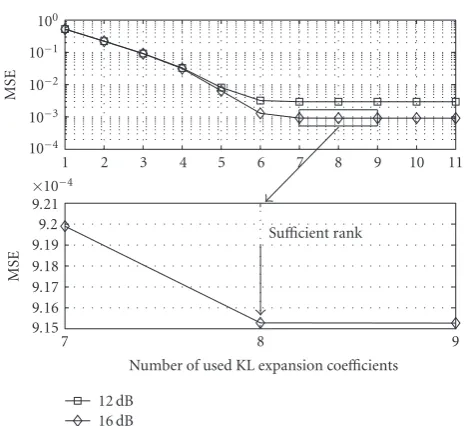
The KL expansion minimizes the amount of information re-quired to represent the statistically dependent data. Thus, this property can further reduce the computational load of the channel estimation algorithm. An example of the Eigen-spectrum is shown inFigure 5for the correlation matrix of the channel given in (31). Since the Eigenspectrum of the correlation matrix among different frequencies has an ex-ponential profile, a reduced set of channel parameters can be employed. Therefore, the optimal truncation property of the KL expansion is exploited inFigure 6where MSE perfor-mances versus the number of coefficient used KL expansion
are given for 12 dB and 16 dB. If the number of parameters in the expansion includes dominant eigenvalues (Rank=8), it is possible to obtain an excellent approximation with a rel-atively small number of KL coefficients.
7.3. Mismatch simulations
Once the true frequency-domain correlation, characterizing the channel statistics and the SNR values, is known, the chan-nel estimator can be designed as indicated in Section 4. In the previous simulations, the autocorrelation matrix and the SNR were assumed to be available asa prioriinformation at the receiver. However, in practice the true channel correla-tion and the SNR are not known. It is then important to an-alyze the performance degradation due to a mismatch of the estimator to the channel statistics to check its robustness to the variation of these parameters.
Correlation mismatch
We designed the estimator for a uniform channel correlation which gives the worst MSE performance among all channel models and evaluated it for an exponentially decaying power delay profile. Note that asτrmsgoes to infinity, the power de-lay profile of the channel given by (31) approaches to the uni-form power delay profile with autocorrelation
CH(k,k)=
⎧ ⎪ ⎨ ⎪ ⎩
1 if k=k
1−e−j2πL(k−k)/Nc
2π jL(k−k)/Nc if k=k.
(32)
Figure 7demonstrates the estimator’s sensitivity to the channel statistics as a function of the average MSE perfor-mance for the following mismatch cases.
Case 1. True statistic⇒τrms=1,L=4,Nc=128.
Mismatch⇒τrms= ∞,L=4,Nc=128.
Case 2. True statistic⇒τrms=1,L=8,Nc=128.
Mismatch⇒τrms= ∞,L=8,Nc=128.
From the mismatch curves presented in Figure 7, it is seen that for Case1, practically there is no mismatch degra-dation observed when the estimator is designed for mis-matched channel statistics specified above. Thus, we con-clude that the estimator is quite robust against the channel correlation mismatch for Case1. For Case2frequency selec-tivity of the channel is increased by increasing the channel lengthL. In this case, we observed that the mismatch perfor-mance of the estimator was degraded moderately. In fact, the performance degradation between true and mismatch cases is approximately 0.9 dB for BER=10−3.
InFigure 8, we investigate again sensitivity of estimator to the channel statistics between the true correlation with
τrms = 1 and the effective channel length L = 4 against
0 2 4 6 8 10 12 14 16
17
.
1 18 Eb/N0
10−3
10−2
10−1
100
MS
E
Mismatch-L=8,τrms= ∞
True-L=8,τrms=1
Mismatch-L=4,τrms= ∞
True-L=4,τrms=1
Figure7: Correlation mismatch forτrms.
0 2 4 6 8 10 12 14 16 18
Eb/N0
10−3
10−2
10−1
100
MS
E
Mismatch-L=2,τrms= ∞
Mismatch-L=3,τrms= ∞
Mismatch-L=6,τrms= ∞
Mismatch-L=5,τrms= ∞
Mismatch-L=4,τrms= ∞
True-L=4,τrms=1
Figure8: Correlation mismatch forLandτrms.
SNR mismatch
The BER curves for a design SNR of 5 dB, 10 dB, and 15 dB are shown inFigure 9with the true SNR performance. The performance of the EM-MAP estimator for high SNR (15 dB) design is better than low-SNR (5 dB) design across a range of SNR values (10–18 dB). These results confirm that the channel estimation error is concealed in noise for low SNR whereas it tends to dominate for high SNR. Thus, the system performance degrades especially at low-SNR region.
0 2 4 5 6 8 10 12 14 15 16 18
Eb/N0
10−4
10−3
10−2
10−1
BER
True SNR SNR design=5 dB
SNR design=10 dB SNR design=15 dB 5 dB design
10 dB design
15 dB design
Figure9: SNR mismatch.
8. CONCLUSIONS
In this work we have presented an efficient EM-MAP channel-estimation-based PIC receiver structure for down-link MC-CDMA systems. This algorithm performs an itera-tive estimation of the channel according to the MAP crite-rion, using the EM algorithm employing MPSK modulation scheme with additive Gaussian noise. Furthermore, the ad-vantage of this algorithm, besides its simple implementation, is that the channel estimation is instantaneous, since the sig-nal and the pilot are orthogosig-nal code division multiplexed (OCDM) and they are distorted at the same time. Moreover, it was shown that KL expansion without optimal truncation property did not enable us to estimate the channel in a very simple way without taking inverse of large dimensional ma-trices for MC-CDMA systems. Computer simulation results have indicated that the MSE and BER performance of the proposed algorithm is well over the conventional algorithms and approaches to the MCRLB by iterative improvement. Fi-nally, we have also investigated the effect of modelling mis-match on the estimator performance. It was concluded that the performance degradation due to such mismatch is negli-gible especially at low SNR values.
ACKNOWLEDGMENTS
REFERENCES
[1] N. Yee, J.-P. Linnarz, and G. Fettweis, “Multi-carrier CDMA in indoor wireless radio networks,” inProceedings of the 4th IEEE International Symposium on Personal, Indoor and Mobile Radio Communications (PIMRC ’93), pp. 109–113, Yokohama, Japan, September 1993.
[2] K. Fazel and L. Papke, “On the performance of convolution-ally-coded CDMA/OFDM for mobile communication sys-tem,” in Proceedings of the 4th IEEE International Sympo-sium on Personal, Indoor and Mobile Radio Communica-tions (PIMRC ’93), pp. 468–472, Yokohama, Japan, September 1993.
[3] S. Hara and R. Prasad, “Overview of multicarrier CDMA,”
IEEE Communications Magazine, vol. 35, no. 12, pp. 126–133, 1997.
[4] S. Iraji, T. Sipila, and J. Lilleberg, “Channel estimation and sig-nal detection for MC-CDMA in multipath fading channels,” inProceedings of the 4th IEEE International Symposium on Per-sonal, Indoor and Mobile Radio Communications (PIMRC ’93), Yokohama, Japan, September 1993.
[5] V. Kuhn, “Combined MMSE-PIC in coded OFDM-CDMA systems,” in Proceedings of the IEEE Global Conference on Telecommunications (Globecom ’01), pp. 231–235, San Anto-nio, Tex, USA, November 2001.
[6] M. Feder and E. Weinstein, “Parameter Estimation of super-imposed signals using the EM algorithm,”IEEE Transactions on Acoustics, Speech, and Signal Processing, vol. 36, no. 4, pp. 477–489, 1988.
[7] Y. Xie and C. N. Georghiades, “Two EM-type channel estima-tion algorithms for OFDM with transmitter diversity,”IEEE Transactions on Communications, vol. 51, no. 1, pp. 106–115, 2003.
[8] L. B. Nelson and H. V. Poor, “Iterative multiuser receivers for CDMA channels: an EM-based approach,”IEEE Transactions on Communications, vol. 44, no. 12, pp. 1700–1710, 1996. [9] A. Kocian and B. H. Fleury, “EM-based joint data detection
and channel estimation of DS-CDMA signals,”IEEE Transac-tions on CommunicaTransac-tions, vol. 51, no. 10, pp. 1709–1720, 2003. [10] A. A. D’Amico, U. Mengali, and M. Morelli, “Channel esti-mation for the uplink of a DS-CDMA system,”IEEE Transac-tions on Wireless CommunicaTransac-tions, vol. 2, no. 6, pp. 1132–1137, 2003.
[11] H. A. C¸irpan, E. Panayirci, and H. Dogan, “Nondata-aided channel estimation for OFDM systems with space-frequency transmit diversity,”IEEE Transactions on Vehicular Technology, vol. 55, no. 2, pp. 449–457, 2006.
[12] H. Dogan, H. A. C¸irpan, and E. Panayirci, “Iterative channel estimation and decoding of turbo coded SFBC-OFDM sys-tems,”IEEE Transactions on Wireless Communications, vol. 6, no. 8, pp. 3090–3101, 2007.
[13] S. M. Kay,Fundamentals of Statistical Signal Processing: Estima-tion Theory, Prentice-Hall, Englewood Cliffs, NJ, USA, 1993. [14] K. W. Yip and T.-S. Ng, “Karhunen-Loeve expansion of the
WSSUS channel output and its application to efficient sim-ulation,”IEEE Journal on Selected Areas in Communications, vol. 15, no. 4, pp. 640–646, 1997.
[15] B. Yang, Z. Cao, and K. B. Letaief, “Analysis of low-complexity windowed DFT-based MMSE channel estimator for OFDM systems,” IEEE Transactions on Communications, vol. 49, no. 11, pp. 1977–1987, 2001.
[16] O. Edfors, M. Sandell, J. J. van de Beek, S. K. Wilson, and P. O. Borjesson, “Analysis of DFT-based channel estimation for OFDM,”Wireless Personal Communications, vol. 12, no. 1, pp. 55–70, 2000.
[17] O. Edfors, M. Sandell, J.-J. van de Beek, S. K. Wilson, and P. O. Borjesson, “OFDM channel estimation by singular value de-composition,”IEEE Transactions on Communications, vol. 46, no. 7, pp. 931–936, 1998.
[18] J. Zhu and W. Lee, “A low-complexity channel estimator for OFDM systems in multipath fading channels,” inProceedings of 15th IEEE International Symposium on Personal, Indoor and Mobile Radio Communications (PIMRC ’04), vol. 3, pp. 1978– 1982, Barcelona, Spain, September 2004.