Face Detection Using a First-Order RCE Classifier
Byeong Hwan Jeon
Signal Processing Laboratory, School of Electrical Engineering, Seoul National University, Seoul 151-742, Korea
Institute of Intelligent Systems, Mechatronics Center, Samsung Electronics Co., Ltd. Suwon, Gyeonggi-Do 442-742, Korea Email:[email protected]
Kyoung Mu Lee
Department of Electronics and Electrical Engineering, Hong-Ik University, Seoul 121-711, Korea Email:[email protected]
Sang Uk Lee
Signal Processing Laboratory, School of Electrical Engineering, Seoul National University, Seoul 151-742, Korea Email:[email protected]
Received 9 September 2002 and in revised form 9 April 2003
We present a new face detection algorithm based on a first-order reduced Coulomb energy (RCE) classifier. The algorithm locates frontal views of human faces at any degree of rotation and scale in complex scenes. The face candidates and their orientations are first determined by computing the Hausdorffdistance between simple face abstraction models and binary test windows in an image pyramid. Then, after normalizing the energy, each face candidate is verified by two subsequent classifiers: a binary image classifier and the first-order RCE classifier. While the binary image classifier is employed as a preclassifier to discard nonfaces with minimum computational complexity, the first-order RCE classifier is used as the main face classifier for final verification. An optimal training method to construct the representative face model database is also presented. Experimental results show that the proposed algorithm yields a high detection ratio while yielding no false alarm.
Keywords and phrases:face detection, face model, Hausdorffdistance, clustering algorithm, RCE classifier.
1. INTRODUCTION
In recent years, due to the potential applications in many fields, including surveillance, authentication, video indexing, and so forth, face detection and recognition problems have gained much attention in computer vision society. The face detection problem is to locate human faces in a scene or a se-quence of images, and the face detection technique not only can be used as a key preprocessing step for face recognition but also has its own importance in several applications, such as tracking, video indexing, and so on. In general, the face detection problem is known to be very difficult due to the variations in race, gender, pose, expressions, adornments, il-lumination, and scale.
Face detection can be considered as a pattern recognition problem and can be solved by statistical pattern classifica-tion techniques [1,2], yielding the Boolean output: face or nonface. Functionally, well-organized parametric classifiers, such as Bayesian classifier [3], artificial neural network [4,5], support vector machine [6,7], have been used to classify the feature vectors by supervised classification techniques in the
feature space. These parametric classifiers for face detection use high degree of data abstraction such as a set of trained weights, coefficients, or probabilities. Usually, those parame-ters are extracted from the training sample faces.
Alternately, nonparametric clustering-based approaches for face detection or pattern classification have been also pro-posed [8,9,10]. A model-based clustering algorithm [11] tries to describe the face subspace using both representative face models and nonface models which are selected during the training step. In general, a clustering algorithm is eff ec-tive when the distribution of the feature vectors is not known in advance.
Note that the performance of the pattern classification or recognition can be improved substantially by selecting appropriate features [12], combining the multiple classifiers [13], or also by defining multiple similarity measures [14]. Various similarity measures and properties are analyzed in [15].
Input image pyramid
Extracted window
(21×21 pixels) Binarization
Estimation of the
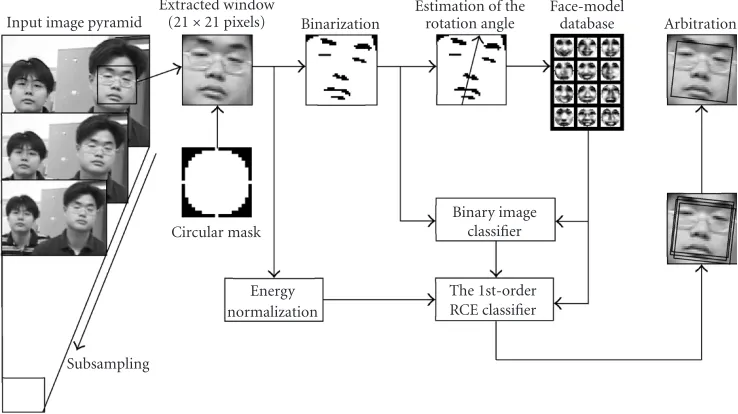
Figure1: The overview of the proposed face detection system.
Unlike conventional algorithms which describe the shape of the face subspace in the feature space by using parametric statistical pattern classifiers, the proposed algorithm tries to model the cluster covered by each training face model using a first-order reduced Coulomb energy (RCE) classifier with multiple distance threshold determined by false negatives in the feature space. The resultant shape of the face space is the union of those modelled clusters. As a result, the boundary of the modelled face space becomes more accurate so that the proposed face detection algorithm yields a high detection ra-tio while yielding a smaller number of false alarms than the conventional methods.
In order to cope with the rotation and scale problems, an image pyramid is constructed for an input image first. And then, candidate face regions are extracted and their orienta-tions are estimated by using the Hausdorffdistance [16,17] between each test window in pyramidal images and a set of rotated versions of a binary face abstraction model. Then, the proposed algorithm classifies those face candidates us-ing two subsequent face classifiers: a binary image classifier, and a first-order RCE classifier which is the extended version of the original RCE classifier explained in [18]. While the bi-nary image classifier is employed as a preclassifier to reduce the computational burden for selecting appropriate candi-date faces, the first-order RCE classifier is used for further and final verification. Experimental results demonstrate that the performance of the proposed face detection algorithm is quite satisfactory.
Section 2describes the overview of the proposed face de-tection system. A method to obtain face candidates is ex-plained inSection 3. Detailed description on the proposed first-order RCE classifier is given in Section 4. Section 5
presents the experimental results of the proposed algorithm on the Carnegie Mellon University (CMU) test images. The conclusions are drawn inSection 6.
2. THE SYSTEM OVERVIEW
Figure 1shows an overview of the proposed face detection system. The system is composed of several key processing modules and a face model database. A set of pyramidal im-ages of an input image is constructed first to cope with the scale problem of a face. In this image pyramid, the scale is reduced recursively by a factor of 1.2.
Every window, of size 21×21, in the pyramid is then ex-amined from the top to the bottom. In order to reduce the effect of hair or background region and consider the face re-gion exclusively, a circular mask is applied to each rectan-gular window. Then, a binary image in the circular mask is obtained and used for estimating the face orientation as well as measuring the binary similarity to the face models.
A simple binary face abstraction model and its rotated versions in 1 degree resolution are constructed to detect face candidates and determine their orientation. For a given bi-nary image window, the matching to all the face abstraction models is performed, and by identifying the best matching model and its score, we can determine not only whether the image window is a face candidate or not but also what the orientation of it is. Once the image window is decided to be a face candidate, further verification using both the binary im-age classifier and the first-order RCE classifier is performed.
A binary image classifier is employed to eliminate possi-ble nonfaces among the face candidates with less computa-tional complexity. If the input binary image is similar to the one in the face model database, the energy normalization is performed on the windowed image, and then it is classified by the first-order RCE classifier presented inSection 4.
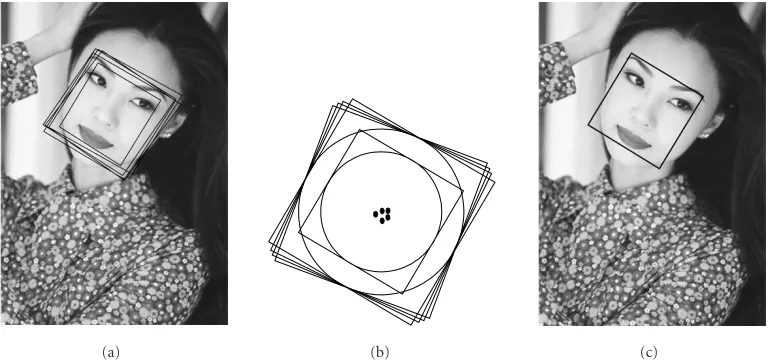
classified as nonface, many candidates will be classified as a face. In case of multiple detection for a face, the final face location is simply determined as the one yielding the mini-mum distance from (or the maximini-mum similarity with) a face model in the database.
The face model database consists of representative faces which are selected optimally from a set of sample faces. Each face model has 360 rotated versions of a binary image and an energy-normalized gray-level image. In addition, each face model has one corresponding nonface image detected as a false positive during the training step and 180 distance thresholds trained during the training step. A nonface image of a face model is used for calculating the reference direction presented inSection 4.
3. EXTRACTING FACE CANDIDATES
3.1. Obtaining binary face image
We observe that among face features, some features are al-ways darker than the skin area, regardless of human races, facial expressions, head poses, or illumination conditions, except for the extreme cases. And it is also found that the proportion of the area of those facial features, such as eyes, eyebrows, mouth, and nostrils, to that of the circular face mask under normal illumination conditions does not change rapidly, yielding a quasi-invariant information of human faces. Therefore, except some extreme cases such as severely slanted illuminations or blurring, this quasi-invariant prop-erty can be utilized with most natural face images. From re-peated experiments on various types of face images, it is em-pirically found that the area of those face features is approx-imately 20% of the total area of the circular mask. Thus, in this work, we use this value as the threshold for obtaining binary face images. Let N be the total number of pixels in the circular mask andnithe number of pixels with gray level
i. Then, a binary face image is obtained by segmenting the original image with the threshold valueTwhich satisfies the following equation:
Figure 2shows several examples of face images and the obtained binary face images.
3.2. Finding face orientation
In this research, in order to extract face candidates and their orientations in an input image pyramid, we employ a face abstraction model. By measuring the Hausdorffdistance be-tween each rotated version of the face abstraction model and the binary image window, candidate faces along with their orientations can be determined. Note that the orientation in-formation is very important to the subsequent binary image classifier as well as to the first-order RCE classifier.
3.2.1. Face abstraction model
Eyes play an important role in determining the orientation of a face. Once the positions of two eyes are determined
pre-Figure2: Examples of face images and the binary images obtained by using the quasi-invariant property of face images.
(a)
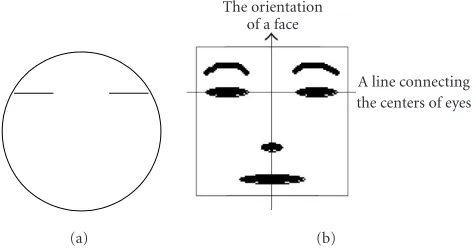
Figure3: The face abstraction model and the face orientation. (a) The face abstraction model with two eyes. (b) The orientation of a face is perpendicular to the line connecting two eyes.
cisely, the face orientation can be obtained easily. In terms of intensity characteristics, eyes and eyebrows are relatively static features, compared with the nose or mouth. Although eyes and eyebrows actually move due to facial expression, the movement is unnoticeable in a small face patch of size 21×21.
A face abstraction model is a simple binary sketch of a face with only two horizontal line segments representing the two eyes. It is noted that the orientation of a face in a frontal view is always perpendicular to the line connecting the two eye centers as depicted inFigure 3a.Figure 3bshows the orientation of a face which is perpendicular to the line connecting the centers of two eyes. The orientation or an-gle of the upright frontal view of a face is defined to be 0◦, and it increases counterclockwise. To cope with the orienta-tion, 360 rotated versions of face abstraction models are con-structed.
3.2.2. Hausdorff distance measure
Once a binary image patch in an input image is obtained, the existence and the orientation of a face in that patch are deter-mined by matching it to all the face abstraction models using the Hausdorffdistance measure. Note that by employing the simplified face abstraction models, the computational com-plexity of the Hausdorffdistance can be greatly alleviated as depicted inFigure 4.
(a) (b)
0◦ 1◦ 2◦ 359◦
· · ·
· · ·
(c)
Figure4: An example of the Hausdorffdistance measurement be-tween a binary face and the abstraction model with two eyes. (a) A gray-level face image, (b) a binary face image, and (c) the rotated versions of the face abstraction model to be matched.
is defined as
h(A, B)=max
a∈A minb∈Ba−b. (2)
The directed Hausdorffdistance measures the similarity between patternAand any part of patternBby identifying the point that is farthest from any point inB. Another way is to interpret it as the smallest radiusdsuch that every point inAis within the distancedof some point inB[16,17].
For test of face candidates, we use the directed Hausdorff distance from the face abstraction models to a binary input image. By the definition of Hausdorffdistance, if there arem
points in the face abstraction model andnpoints in a binary input image, then it is necessary to calculate the Euclidean distancem·ntimes. However, if the Hausdorffdistance is given byd, then there should be at least one point in the cir-cle of radius d centered at each face abstraction model, as shown inFigure 5. Thus, only Boolean operations are suffi -cient to calculate the Hausdorffdistance, resulting in a sig-nificant saving in the computational cost.
3.3. A binary image classifier
Once the face candidates are identified, each of them is then examined by measuring the similarity of it to the faces in the face model database in binary mode. We define the distance
Dbbetween two binary images to be the number of pixels that
do not match. Then, the similarity between an input binary face candidateu and themth binary face modelvm can be
defined by the following binary image distance:
Dm a function that counts the number of logic 1 (Boolean true).
(a)
d
(b)
Figure5: Illustration of the Hausdorffdistance measure. (a) Two sets to be matched,A(dots) andB(squares), in a multidimensional space, (b) matching by the directed Hausdorffdistanceh(A, B) with a thresholddis to check whether each circle of the radiusdcentered at each point inAincludes at least one point inBor not.
Now, once the distances to all the binary model faces are cal-culated, the face candidateuis decided to be a binary face if the minimum value of them is less than a prespecified thresh-old, otherwise not.
4. THE FIRST-ORDER RCE CLASSIFIER
4.1. Modelling the face space
We assume that a multidimensional feature space is com-posed of two subspaces: face space and nonface space. The face space is considered as the set of all the individual human faces with possible variations including poses, expressions, aging, adornments, and illumination changes.
Let F be the face space in a multidimensional feature space. Note that, although the exact shape ofF cannot be described visually, it will be very complex. In this research, instead of modelling the boundary of the face space in a parametric form, we attempt to represent it by the union of clusters of finite representative face samples. Letfm(m=
1, . . . , M) be theMrepresentative face models selected from the K (K > M) training samples in the face spaceF, and
Fmthe individual cluster covered byfm. Then, the whole face
spaceFcan be modelled by the union of each cluster, given by
whereFdenotes the modelled face space.
Note that, in general, since face images are highly corre-lated, the volume of the face space is much smaller than that of nonface space.
4.2. Several model-based approaches
fm
Figure6: An arbitrarily shaped 2-dimensional space composed of several clusters.
number of representative face models. Note that the shapes of the clusters are not the same, and each representative face model may not be located at the center of the corresponding cluster. Now, our goal is to find an efficient way to model each face cluster so as to represent the whole face space accurately with a finite number of representative face models.
There are several model-based clustering algorithms to model a cluster covered by a representative face model. Jeon et al. [11] proposed a clustering algorithm in which the face cluster of a representative face model is initially considered as a hyperball with a relatively large specified diameter (rf),
and then trimmed out by the cluster of nonface samples with smaller diameter (rq) as inFigure 7a. The nonface samples
are false positives (q), detected during a bootstrapping step using many nonface images. This method requires a larger number of nonface models than that of the face models, and the nonfaces located close to the face cluster can erode it, re-sulting in the degradation of the representation. The same problem also occurs in the 1-NN (nearest neighbor) method. By the 1-NN method, the face cluster is represented by the region where the distance to the representative face model is shorter than that to nonface samples, as shown inFigure 7b. Thus, if a nonface is located close to the true face cluster, the boarder of the face cluster can be altered severely by the non-face.
The RCE classifier [17] is an alternative way of the model-based clustering algorithm. The original RCE classifier em-ploys a modifiable threshold for the radius of a hyperball corresponding to a pattern. During training, the radius is ad-justed so that it becomes as large as possible without contain-ing patterns of another category. In face detection problem, each face model has a modifiable threshold, and the thresh-old, starting from a sufficiently large value, is adaptively re-duced by false positives detected in a training step. We refer to the original RCE classifier as the zeroth-order RCE clas-sifier since the clasclas-sifier employs only one distance thresh-old for a model with no angular component. So, the zeroth-order RCE classifier models the cluster of a face model as a minimum-bound circle (hyperball in the multidimensional space) as shown inFigure 7c. As a result, too many represen-tative face models are needed for the zeroth-order RCE clas-sifier to represent the face space sufficiently.Figure 7dshows the ideal first-order RCE classifier which can represent the cluster more accurately.
rq qi
rf
fm
(a)
qi fm
rf
(b)
qi
fm rf
(c)
q1
fm qi
(d)
Figure8: A 3-dimensional case of the energy-normalized feature space.
4.3. Higher order RCE classifiers
In anN-dimensional feature space, anMth (N ≥M > 0)-order RCE classifier is defined by a distance threshold func-tion of some M angular components centered at a certain vector such that
r(Θ), Θ=θ1, θ2, . . . , θN
T
, (5)
while the zeroth-order RCE classifier has a single distance threshold value which is the same for all angular directions.
For simplicity, we consider the representation of a clus-ter using RCE classifier in a 3-dimensional feature space. If we normalize the feature vectors so that they have unit en-ergy in the sense ofL2norm, they are all projected onto the surface of the unit sphere as shown in Figure 8. If we as-sume that the cluster corresponding to each representative model is relatively small, we can approximate the cluster as a dimensional region. To describe the boundary of the 2-dimensional region with respect to the given representative model in 1◦ angular resolution, 360 different distance val-ues are needed in 360 angular directions. Thus, we can rep-resent the 3-dimensional cluster shape by precisely using the distance (threshold) function of one angular variable, which is the first-order RCE classifier. Notice that a training pro-cedure is required to get those 360 different distance val-ues.
We extend this notion to theN-dimensional case. If the feature vectors are normalized, then they are projected onto the surface of the unit hyperball. We assume that the cluster of each face model is relatively small, then the feature vectors in the cluster lie in (N−1)-dimensional space. In the po-lar coordinate system, the (N−1)-dimensional space can be represented by one distance component and (N−2) angu-lar components. Thus, to represent the (N−1)-dimensional cluster ideally, we need an (N−2)th-order RCE classifier. However, this representation is impractical since, for largeN
as in the face vector case and sufficiently small angular res-olution ofmdegree, there should be as large as (360/m)N−2 threshold values for each face model.
Note that if we use a zeroth-order RCE classifier to de-scribe the (N−1)-dimensional cluster, the cluster is mod-elled by a hyperball since it assigns the same threshold for all angular directions.
4.4. The first-order RCE classifier
The goal of the first-order RCE classifier is to model the face cluster more accurately by assigning multiple distance thresholds for some specified directions as shown inFigure 7d. Those distance thresholds are also trained by false nega-tives.
In contrast to the conventional zeroth-order RCE classi-fier, the proposed first-order RCE classifier has not only one distance component but also one angular component to de-scribe an N-dimensional space. If we set the angular reso-lution to 1◦, there are 360 distance threshold values for the first-order RCE classifier.
We assume that all the normalized face images are located close to each others on the surface of theN-dimensional hy-perball, which can be approximated by (N−1)-dimensional space. Now, we denotefmto be the mth representative face
model andq1to be the first false positive of it. Then, the ref-erence direction vector becomes
rm=q1−fm. (6)
During the training stage, if a new false positive qoccurs, then the angle θbetweenrm andq−fm is calculated in 1◦
and the distance threshold for the mth representative face model along this angle,Tm,θ
g , is obtained by
Tgm,θ=q−fm. (8)
If a new false negative gives smaller distance fromfmthan the
old one, the threshold value for that angle is replaced by the new one. Thus, in this fashion, through the training process, the distance threshold values of the angular directions for each representative face model are repeatedly replaced with the new minimum value so that the boundary of each rep-resentative face model is specified by Tm,θ
g ,m = 1, . . . , M,
andθ =0, . . . ,179. Note that there exist an infinite number of vectors that have the sameθdegree as the reference vec-torrm, which lie on a hypercone in the (N−1)-dimensional
q1
Figure9: A family of vectors and its representative threshold asso-ciated with an angleθwith respect to the reference vector.
However, the first-order RCE classifier has two shortcom-ings. Since the arccosine function generates angles from 0 to
π(not from 0 to 2π), the shape of the modelled face cluster becomes symmetric. Moreover, since the angleθof each false positive in (9) is defined with respect to the reference direc-tion vectorrm, different choices of it (equivalently, the initial
false positiveq1detected during the training step) may result in different shapes of modelled face clusters. As a result, the modelled cluster may lose parts of the original shape. Two ex-amples are shown inFigure 10. Nevertheless, empirical study shows that the first-order RCE classifier is good enough to yield satisfactory results in face detection, which will be dis-cussed inSection 5.
In the classification stage, when a normalized input im-age patch vectorpis given, similar to the training stage, for all the representative face modelsfm,m=1, . . . , M, the
an-and the distances betweenpandfmalong this direction
Dm,θm
g =p−fm, m=1, . . . , M, (10)
are calculated.
Then, the input image patchpis decided to be a face can-didate if there exists anfi, i∈ {1, . . . , M}, which satisfies
Di,θi
g < Tgi,θi, (11)
where Ti,θi
g is the prespecified threshold for the ith face
model.
Figure10: Symmetry and initial point dependency of the modelled shapes by the first-order RCE classifier. (a) A case where the initial point is located at the 9 o’clock direction. (b) Another case where the initial point is located at the 12 o’clock direction.
5. EXPERIMENTAL RESULTS
5.1. Constructing the face model database
To evaluate the performance of the proposed face detec-tion algorithm, we have first constructed a face database for training. The face database was composed of 4,100 sample face images obtained from various sources including internet websites, academic face databases, such as Yale face database and Stirling face database, and some photo albums. From these images, each face region was manually cropped and normalized into the size of 21×21. Then, the rotated ver-sions of the binary and energy-normalized faces of each face region at 1◦resolution were obtained and stored.
In order to optimize the number of representative face models, we applied the sequential forward selection (SFS) al-gorithm [2] for selecting representative face models among face samples. The SFS algorithm is a feature-selection method which selects the best single feature first, and then add one feature at a time which, in combination with the se-lected features, maximizes a criterion function. After the dis-tance thresholds for each sample face model are determined in the first-order RCE training step, the represented face and nonface models for the experiments.
(a) (b) (c)
Figure11: Removing multiple detections. (a) An example of multiple detections on a face. (b) Selecting the best match among the cluster. (c) The final detection result.
(a) (b)
Figure12: Two examples of face clusters trained by the first-order RCE classifier. (The trained threshold values are plotted in polar form.)
Table1: The optimized number of the representative face and non-face models.
Methods No. of faces No. of nonfaces The model-based clustering [11] 258 356
The first-order RCE 227 0
training method, which means that the proposed optimiza-tion method removes 94.5% of the sample face images.
Table 1shows the number of the represented face and non-face models for the experiments.
We have tested about 4,200 nonface images to train 180 threshold values for each representative face model. Figures
12a and12b show the training results of the 180 distance thresholds corresponding to angles from 0◦ to 179◦for two representative face models in polar form, respectively. They are symmetric as expected. We can see that the thresholds for some angles are not trained, and thus set to be the default one.
Table2: The detection results on the rotated set of CMU test images and a comparison with the results of Rowley.
Proposed method Rowley [5]
Detection False Detection False
rate alarms rate alarms
91.0% 0 85.7∼90.1% 15∼303
5.2. Experimental results with a test set
The proposed face detection algorithm has been tested on the CMU face image database http://vasc.ri.cmu.edu/ idb/html/face/profile images/index.html, which consists of 50 images, containing 223 faces of arbitrary scales and ro-tations. It was observed that the proposed algorithm could detect 203 correct faces while yielding no false alarm.Table 2
that the proposed system yields a performance superior to the CMU’s not only in the detection rate but also in false alarms.
Moreover, unlike conventional algorithms [3,5,6] which enforce the same operations to every window regardless of being face or nonface, since the proposed algorithm em-ployed sequential face classifiers in the order of computa-tional complexity, most nonface windows were rejected in the early stages through simple binary tests so that the over-all complexity was greatly reduced. Generover-ally, the computa-tional complexity is directly proporcomputa-tional to both the num-ber of the representative face models and the rotational reso-lution. In our experiments, it was showed that the proposed algorithm with 227 representative face models and 1◦of rota-tional resolution run less than 1 minute for a 640×480 image with a 933 MHz Pentium 3 PC.
6. CONCLUSIONS
In this paper, a new face detection algorithm has been pre-sented. Face candidates and their orientations were extracted by using binary face abstraction models first and then two subsequent face classifiers: binary and first-order RCE classi-fiers were followed to verify those face candidates. The binary classifier was adopted to filter out nonfaces from the face can-didates by simple and fast operations, while the first-order RCE classifiers were used for final verification.
The novel first-order RCE clustering technique models the face and nonface subspaces in a feature space effectively with a finite number of the representative face models so that it classifies the face candidate robustly and accurately.
Experimental results showed that the proposed face detection algorithm could yield 91.0% of detection ratio and no false alarm with the CMU’s rotated face image database, demonstrating better performance than that of Roweley’s [5].
The proposed first-order RCE classifier-based face de-tection technique can be extended for nonfrontal views if the out-of-plane rotational views are sampled and modelled properly, which will be one of our future works.
REFERENCES
[1] K. Fukunaga, Introduction to Statistical Pattern Recognition, Academic Press, Boston, Mass, USA, 2nd edition, 1990. [2] A. K. Jain, R. Duin, and J. Mao, “Statistical pattern
recogni-tion: A review,” IEEE Trans. on Pattern Analysis and Machine Intelligence, vol. 22, no. 1, pp. 4–37, 2000.
[3] H. Schneiderman and T. Kanade, “Probabilistic modeling of local appearance and spatial relationships for object recogni-tion,” inProc. IEEE Conference on Computer Vision and Pat-tern Recognition (CVPR ’98), pp. 45–51, Santa Barbara, Calif, USA, June 1998.
[4] H. A. Rowley, S. Baluja, and T. Kanade, “Neural network-based face detection,” IEEE Trans. on Pattern Analysis and Machine Intelligence, vol. 20, no. 1, pp. 23–38, 1998.
[5] H. A. Rowley, S. Baluja, and T. Kanade, “Rotation invariant neural network-based face detection,” inProc. IEEE
Confer-ence on Computer Vision and Pattern Recognition (CVPR ’98), pp. 38–44, Santa Barbara, Calif, USA, June 1998.
[6] E. Osuna, R. Freund, and F. Girosi, “Training support vec-tor machines: an application to face detection,” in Proc. IEEE Conference on Computer Vision and Pattern Recognition (CVPR ’97), pp. 130–136, Puerto Rico, USA, June 1997. [7] J.-C. Terrillon, M. N. Shirazi, M. Sadek, H. Fukamachi, and
S. Akamatsu, “Invariant face detection with support vector machines,” inProc. IEEE International Conference on Pat-tern Recognition (ICPR ’00), pp. 210–217, Barcelona, Spain, September 2000.
[8] K. K. Sung and T. Poggio, “Example-based learning for view-based human face detection,” IEEE Trans. on Pattern Analysis and Machine Intelligence, vol. 20, no. 1, pp. 39–51, 1998. [9] T. D. Rikert, M. J. Jones, and P. Viola, “A cluster-based
statis-tical model for object detection,” inProc. IEEE International Conference on Computer Vision (ICCV ’99), pp. 1046–1053, Corfu, Greece, September 1999.
[10] S. Pittner and S. V. Kamarthi, “Feature extraction from wavelet coefficients for pattern recognition tasks,” IEEE Trans. on Pattern Analysis and Machine Intelligence, vol. 21, no. 1, pp. 83–88, 1999.
[11] B. H. Jeon, K. M. Lee, and S. U. Lee, “Rotation invariant face detection using a model-based clustering algorithm,” in Proc. IEEE International Conference on Multimedia and Expo (ICME ’00), pp. 1149–1152, New York, NY, USA, July–August 2000.
[12] W. K. Pratt,Digital Image Processing, John Wiley & Sons, New York, NY, USA, 2nd edition, 1991.
[13] J. Kittler, M. H. Hatef, R. Duin, and J. Matas, “On combin-ing classifiers,” IEEE Trans. on Pattern Analysis and Machine Intelligence, vol. 20, no. 3, pp. 226–239, 1998.
[14] I. Craw, N. Costen, T. Kato, and S. Akamatsu, “How should we represent faces for automatic recognition?,”IEEE Trans. on Pattern Analysis and Machine Intelligence, vol. 21, no. 8, pp. 725–736, 1999.
[15] S. Santini and R. Jain, “Similarity measures,” IEEE Trans. on Pattern Analysis and Machine Intelligence, vol. 21, no. 9, pp. 871–883, 1999.
[16] D. P. Huttenlocher, G. A. Klanderman, and W. A. Rucklidge, “Comparing images using the Hausdorff distance,” IEEE Trans. on Pattern Analysis and Machine Intelligence, vol. 15, no. 9, pp. 850–863, 1993.
[17] W. A. Rucklidge, Efficient Visual Recognition Using the Haus-dorffDistance, Springer-Verlag, Berlin, Germany, 1996. [18] R. O. Duda, P. E. Hart, and D. G. Stork,Pattern Classification,
John Wiley & Sons, New York, NY, USA, 2001.
Byeong Hwan Jeonwas born in Kyungnam, Korea in 1965. He received the B.S. and M.S. degrees in control and instrumentation en-gineering from Seoul National University, Seoul, Korea in 1988 and 1990, respectively. In February 1990, he joined Samsung Elec-tronics Co., Ltd., Korea, where he is now a Principal Engineer. He is working toward his Ph.D. degree at the School of Electri-cal Engineering, Seoul National University
Kyoung Mu Leereceived the B.S. and M.S. degrees in control and instrumentation en-gineering from Seoul National University, Seoul, Korea in 1984 and 1986, respectively, and the Ph.D. degree in electrical engineer-ing from the University of Southern Cali-fornia, Los Angeles in 1993. From 1993 to 1994, he was a Research Associate at the Sig-nal and Image Processing Institute at the University of Southern California. He was
with the Samsung Electronics Co., Ltd., Suwon, Korea as a Senior Researcher from 1994 to 1995, where he worked on developing in-dustrial real-time vision systems. In 1995, he joined the Depart-ment of Electronics and Electrical Engineering of the Hong-Ik Uni-versity in Seoul, Korea as an Assistant Professor, where he is cur-rently an Associate Professor. Dr. Lee is curcur-rently a member of the Editorial Board of the EURASIP Journal on Applied Signal Pro-cessing. His current primary research interests include computa-tional vision, shape from X, 2D, and 3D object recognition, human-computer interface, and visual navigation.
Sang Uk Leereceived the B.S. degree from Seoul National University, Seoul, Korea in 1973, the M.S. degree from Iowa State Uni-versity, Ames in 1976, and Ph.D. degree from the University of Southern California, Los Angeles in 1980, all in electrical engi-neering. From 1980 to 1981, he was with the General Electric Company, Lynchburg, Va, working on the development of digital mobile radio. From 1981 to 1983, he was