R E S E A R C H
Open Access
A new accelerated conjugate gradient
method for large-scale unconstrained
optimization
Yuting Chen
1,2, Mingyuan Cao
2and Yueting Yang
2**Correspondence:
2College of Mathematics and
Statistics, Beihua University, Jilin, China
Full list of author information is available at the end of the article
Abstract
In this paper, we present a new conjugate gradient method using an acceleration scheme for solving large-scale unconstrained optimization. The generated search direction satisfies both the sufficient descent condition and the Dai–Liao conjugacy condition independent of line search. Moreover, the value of the parameter contains more useful information without adding more computational cost and storage requirements, which can improve the numerical performance. Under proper assumptions, the global convergence result of the proposed method with a Wolfe line search is established. Numerical experiments show that the given method is competitive for unconstrained optimization problems, with a maximum dimension of 100,000.
Keywords: Conjugate gradient; Descent condition; Dai–Liao conjugacy condition;
Global convergence; Large-scale unconstrained optimization
1 Introduction
Consider the following unconstrained optimization problem:
minf(x), x∈Rn, (1)
wheref :Rn→Ris a continuously differentiable function, bounded below and its gradient
is denoted byg(x) =∇f(x). Conjugate gradient methods characterized by simplicity and low storage are efficient for solving (1), especially when the dimensionnis large.
Starting from an initial guess x0∈Rn, the conjugate gradient methods use the recur-rence
xk+1=xk+αkdk, k≥0, (2)
wherexk+1is the current iterate,αk> 0 is the step-length, which is obtained by some line
search, anddkis the search direction determined by
d0= –g0, dk+1= –gk+1+βkdk, k= 0, 1, 2, . . . , (3)
wheregk=g(xk). The scalarβkis called the conjugate gradient parameter. There are many
formulas to construct the scalarβk, such asβkPRP[28,29],βkHS[19] andβkFR[16].
The line search in conjugate gradient methods is usually based on the general Wolfe conditions [33,34],
f(xk+αkdk) –f(xk)≤ραkgTkdk, (4)
gkT+1dk≥σgTkdk, (5)
wheredkis a descent direction and the constantsρ,σsatisfy 0 <ρ≤σ≤1. However, in
order to establish the convergence and enhance the stability, the strong Wolfe conditions given by (4) and
gkT+1dk≤σgkTdk (6)
are needed.
Recently efforts have been made to modify conjugate gradient methods for minimiz-ing unconstrained optimization. In a natural way, Dai and Liao [8] extended the classical conjugate conditionyTkdk+1= 0 to
dkT+1yk= –tgkT+1sk, (7)
wheresk=xk+1–xk,yk=gk+1–gk andtis a positive parameter. Based on the Dai–Liao
conjugacy condition (7), [8] introduced the conjugate gradient parameterβDL
k as follows:
βkDL=g T k+1yk dTkyk
–tg T k+1sk dkTyk
. (8)
Having applied modified secant equations, many researchers have derived various con-jugate gradient methods [7,17,21, 22,25,26,30,35,44]. Moreover, combining with a quasi-Newton updating technique, conjugate gradient methods can be considered as a special type of quasi-Newton methods. From (3), (7) and Perry’s point of view in [27], we can rewrite the search direction as follows:
dk+1= –Qk+1gk+1, (9)
where
Qk+1=I– skyTk
sT kyk
+tsks T k
sT kyk
. (10)
Obviously, the Dai–Liao method can be considered as a special type of quasi-Newton method in which the matrixQk+1is used to approximate the inverse Hessian of the ob-jective function. Since the matrixQk+1is nonsymmetric and does not satisfy the secant condition, (9) cannot be regarded as a quasi-Newton direction from a strict point of view. To overcome the above shortcomings and improve the numerical performance of con-jugate gradient methods, Andrei [1,2] proposed the following matrixQA
k+1:
QAk+1=I–sky T k–yksTk
yTksk
+tsks T k
yTksk
to replace the matrixQk+1in (10). The parametertin the last term on the right-hand side is calculated witht= 1 +yk2
yTksk andt= 1 + 2
yk2
yTksk , corresponding to the THREECG method [1]
and the TTCG method [2], respectively. The search directions satisfy not only the descent condition but also the conjugacy condition, independent of the line search. Both of the methods can be regarded as modifications of the classical HS or of the CG_DESCENT conjugate gradient methods. Numerical results support this claim.
Motivated by [1] and [2], Deng and Wan [14] presented a symmetric matrix to estimate the inverse Hessian approximation as follows:
QBk+1=I–yks T k+yksTk
yT ksk
+tsks T k
yT ksk
, (12)
where t= 1 – yk2
yTksk . The search direction in this method (MTHREECG) is close to the
Newton direction and satisfies the Dai–Liao conjugacy condition. Then they restricted t = 1 –min{1,yk2
yTksk } and obtained the descent property. Numerical results show that
the MTHREECG method outperforms the THREECG method and the CG_DESCENT method.
More recently, Yao and Ning [37] suggested the following symmetric matrix:
QCk+1=I–tk
yksTk+yksTk
yTksk
+sks T k
yTksk
, (13)
where the positive parametertkis determined by minimizing the distance ofQCk+1and the self-scaling memoryless BFGS matrix in the Frobenius norm. In this method (NTAP), they
letak=sk
2yk2
(sTkyk)2 , thentkcan be expressed astk=min{ 1 1+ak,
sTkyk
yk2}. The sufficient descent property of the search direction depends neither on the line search, nor on the convexity of objective function. For relevant research see [3–6,10–13,20,23,24,31,32,36,38–43]. By focusing on the above research, we are interested in developing a new accelerated conjugate gradient method (NACG) for large-scale unconstrained optimization. The gen-erated search direction satisfies both sufficient descent condition and Dai–Liao conjugacy condition. The parameter in the given method provides more useful information and adds no extra computational and storage burden. In addition, the proposed method has an ob-vious improvement in computational performance, especially in dealing with large-scale unconstrained optimization problems.
The rest of this paper is organized as follows. In the next section, we will describe the framework of the new method and the choice of parameter in generated search direction. Global convergence results of the obtained method will be established under appropriate conditions in Sect.3. Section4is devoted to numerical experiments and comparisons with some other efficient conjugate gradient algorithms for solving unconstrained optimization problems with different dimensions. Conclusions are drawn in Sect.5.
2 The NACG method
It is well known that the BFGS method is one of the most efficient quasi-Newton meth-ods. By introducing two adaptive parameters for adjusting, we give the following matrix:
Qk+1=I–tk1
skyTk +yksTk
yTksk
+tk2 sksTk
yTksk
, (14)
where the parameterstk1andtk2 are determined in the following.
In a sense, the method of form (9) and (14) could be considered as a self-adaptive mem-oryless BFGS method. Substituting (14) into (9), we get
dk+1= –
I–tk1
skyTk +yksTk
yTksk
+tk2 sksTk
yTksk
gk+1
= –gk+1+
tk1 yT
kgk+1
yTksk
–tk2 sT
kgk+1
yTksk
·sk+tk1 sT
kgk+1
yTksk
·yk. (15)
Let
ak=tk1 yT
kgk+1 yT
ksk
–tk2 sT
kgk+1 yT
ksk
, (16)
bk=tk1 sT
kgk+1 yT
ksk
, (17)
then (15) takes the form of three-term conjugate gradient,
dk+1= –gk+1+aksk+bkyk. (18)
In what follows, we discuss the choices for the two parameterstk1andtk2. The parame-ters are selected in such a manner that the Dai–Liao conjugacy condition and the sufficient descent condition are satisfied from iteration to iteration.
Consider the Dai–Liao conjugacy condition (7) witht= 1, i.e.,
yTkdk+1= –sTkgk+1. (19)
Substituting (15) into (19), by simple calculation, we obtain
–yTkgk+1+tk1y T
kgk+1–tk2s T
kgk+1+tk1 sTkgk+1
yT ksk
·yTkyk= –sTkgk+1,
which yields
tk2=tk1 yT
kyk
yTksk
+tk1 yT
kgk+1 sTkgk+1
–y T kgk+1 sTkgk+1
Since the descent property of the search direction,gT
k+1dk+1< 0, is crucial for the con-vergence analysis. It is easy to see
gkT+1dk+1 = –gk+12+ 2tk1 yT
kgk+1·gkT+1sk
yT ksk
–tk2 (gT
k+1sk)2
yT ksk
≤–gk+12+ 2tk1|gk+1| ykgkT+1sk
yT ksk
–tk2
(gT k+1sk)2
yT ksk
≤–gk+12+tk1
gk+12+ (gT
k+1sk)2
(yT ksk)2
·yTkyk
–tk2
(gT k+1sk)2
yT ksk
= –(1 –tk1)gk+1 2–
gT
k+1sk
yT ksk
2 tk2y
T ksk–tk1y
T kyk
.
If we restrict|tk1|< 1 and take
tk2=tk1 yTkyk
yT ksk
, (21)
thengT
k+1dk+1< 0 holds. Substituting (21) into (20), we have
tk1= 1 – sT
kgk+1 yT
kgk+1
. (22)
If|1 –s T
kgk+1
yTkgk+1| ≥1, we settk1= 0. This implies a restarted scheme. Taking into consideration the acceleration technique, the new accelerated conjugate gradient method (NACG) can be suggested.
Algorithm 1(NACG)
Step 0. Choose an initial pointx0∈Rn,ε> 0, and computef0=f(x0),g0=∇f(x0). Set d0:= –g0andk:= 0.
Step 1. Ifgk<ε, stop, else go to Step 2.
Step 2. Compute a step-lengthαkby Wolfe line search (4) and (5). Step 3. Computexk+1by the acceleration scheme,
3.1. Computez=xk+αkdk,gz=∇f(z)andyz=gk–gz; 3.2. Computea¯k=αkgkTdkandb¯k= –αkyTkdk;
3.3. Acceleration scheme. Ifb¯k> 0, then computeξk= –a¯k/b¯kand update the variables asxk+1=xk+ξkαkdk, otherwise update the variables as
xk+1=xk+αkdk.
Step 4. Computefk+1=f(xk+1),gk+1=g(xk+1),sk=xk+1–xkandyk=gk+1–gk. Step 5. ComputesT
kgk+1,yTkgk+1,yTkskandyTkyk, respectively. Step 6. Computetk1 andtk2 by
tk1= ⎧ ⎨ ⎩
1 –sTkgk+1
yT
kgk+1, if0 <
sT
kgk+1
yT
kgk+1< 2, 0, else,
and
tk2=tk1 yT
kyk
yT ksk
, (24)
respectively.
Step 7. Computeakandbkby (16) and (17), respectively.
Step 8. Setdk+1= –gk+1+aksk+bkyk. Setk:=k+ 1and go to Step 1.
In Algorithm1, Step 3 corresponds to the acceleration scheme. In Step 6, the parameter tk1 defined by (23) satisfies|tk1|< 1, and the parametertk2 could be determined by the equality withtk1. Furthermore, the main computational cost lies insTkgk+1,yTkgk+1,yTkskand
yTkykin Step 5. It costsO(4n) operations to compute the values oftk1 andtk2, and further get the values ofakandbk. No additional storage cost is required during the calculation.
Compared with the existing effective algorithms TTCG [2], MTHREECG [14] and NTAP [37], the TTCG and the MTHREECG requireO(4n) operations, while the NTAP requires O(5n) operations. In one word, our algorithm NACG is competitive in computational cost. The sufficient descent condition and Dai–Liao conjugacy condition of the generated search direction holds independent of line search, a concept we discuss next.
Lemma 2.1 Suppose that the search direction dk+1is generated by Algorithm1.Then dk+1 shows sufficient descent,i.e.,gT
k+1dk+1≤–cgk+12,where the constant c> 0. Proof From (16)–(18), we have
gkT+1dk+1 = –gk+12+
tk1 yT
kgk+1 yT
ksk
–tk2 sT
kgk+1 yT
ksk
·gkT+1sk+tk1 sT
kgk+1 yT
ksk
·gkT+1yk
≤–(1 –tk1)gk+1 2–
gT
k+1sk
yT ksk
2 tk2y
T ksk–tk1y
T kyk
.
Combining with (23) and (24), it follows thatgTk+1dk+1≤–cgk+12withc:= 1 –tk1> 0. The
proof is completed.
Lemma 2.2 Suppose that the search direction dk+1is generated by Algorithm1.Then dk+1 satisfies the Dai–Liao conjugacy condition(19).
Proof From (16)–(18), we have
yTkdk+1= –yTkgk+1+
tk1 yT
kgk+1 yT
ksk
–tk2 sT
kgk+1 yT
ksk
·yTksk+tk1 sT
kgk+1 yT
ksk
·yTkyk
= –yTkgk+1+tk1y T
kgk+1–tk2s T
kgk+1+tk1 sT
kgk+1 yT
ksk
·yTkyk.
Substituting (23) and (24) into the above equality yields
yTkdk+1= –yTkgk+1+
1 –s T kgk+1 yTkgk+1
·yTkgk+1–tk1 yT
kyk
yTksk
·sTkgk+1
+tk1 sT
kgk+1 yTksk
= –yTkgk+1+ykTgk+1–sTkgk+1
= –sTkgk+1,
which completes the proof.
3 Convergence analysis
In this section, under appropriate assumptions, the global convergence of Algorithm1is established. Without loss of generality, we make the following basic assumptions.
Assumption (i) The level set
Ω=x∈Rn:f(x)≤f(x0)
(25)
is bounded, i.e., there exists a constantB> 0 such that
x ≤B, ∀x∈Ω. (26)
Assumption (ii) The functionf :Rn→Ris continuously differentiable and its gradient
is Lipschitz continuous in a neighborhoodNofΩ, i.e., there exists a constantL> 0 such that
g(x) –g(y)≤Lx–y, ∀x,y∈N. (27)
Under the above assumptions, we can easily see that there exists a constantΓ > 0 such that
g(x)≤Γ, ∀x∈Ω. (28)
Although the search directiondk+1generated by Algorithm1is always a descent direc-tion, in order to obtain the convergence of Algorithm1, we need to derive a lower bound for the step-lengthαk.
Lemma 3.1 Suppose that Assumption(ii)holds and{dk}is generated by Algorithm1.Then
the step-lengthαksatisfies
αk≥
(σ– 1)gT kdk
Ldk2
. (29)
The following lemma is called the Zoutendijk condition [45], which is often used to prove global convergence of conjugate gradient methods.
Lemma 3.2 Suppose that the assumptions hold.Consider the algorithm(2)and(18),where dkis a descent direction andαkis obtained by a Wolfe line search(4)and(5).Then
k≥0 (gT
kdk)2
dk2
The next lemma shows the sequence of gradient norms gk is bounded away from
zero only if k≥01/dk< +∞ for any conjugate gradient methods with strong Wolfe
line search (4) and (6).
Lemma 3.3 Suppose that the assumptions hold.Consider the algorithm(2)and(18),where dkis a descent direction andαkis obtained by a strong Wolfe line search(4)and(6).If
k≥0 1
dk2
= +∞, (31)
then
lim inf
k→∞ gk= 0. (32)
The proofs of Lemmas3.1–3.3refer to [1,2], which are omitted here.
For uniformly convex functions, we establish the following global convergence result of Algorithm1.
Theorem 3.1 Suppose that the assumptions hold.Let{xk}and{dk}be generated by
Al-gorithm1.If f is a uniformly convex function onΩ,i.e.,there exists a constantμ> 0such that
∇f(x) –∇f(y)T(x–y)≥μx–y2, ∀x,y∈N, (33)
then
lim
k→∞gk= 0. (34)
Proof From (27), it follows that
yk ≤Lsk. (35)
From (33), we have
yTksk≥μsk2. (36)
By the use of the Cauchy inequality and (36), it is obvious thatμsk2≤yTksk≤ yksk,
i.e.,
μsk ≤ yk. (37)
We get from (23) and (24)
|tk2| ≤ |tk1|
|yT kyk|
|yT ksk|
≤L2sk2
μsk2
=L 2
On the other hand, from the definition ofakandbkin (16) and (17), we obtain
|ak| ≤ |tk1| ·
|yT kgk+1|
|yTksk|
+|tk2|
|sT kgk+1|
|yTksk|
≤ΓL
μ ·
1
sk
+M0Γ
μ ·
1
sk
=ΓL+M0Γ
μ ·
1
sk
M1 1
sk
(39)
and
|bk| ≤ |tk1| ·
|sT kgk+1|
|yTksk|
≤ Γsk
μsk2
≤ΓL
μ ·
1
yk
M2 1
yk
. (40)
Therefore, using (39) and (40) in (18), we get
dk+1 ≤ gk+1+|ak|sk+|bk|yk
≤Γ +M1+M2M, (41)
showing that (31) holds. From Lemma3.3, it follows that (32) is true, which for uniformly convex functions is equivalent to (34). The proof is completed.
4 Numerical results
In this section, we report the numerical results for some unconstrained problems from [9] to show the efficiency of Algorithm1(NACG). All codes are written in Matlab R2013a and ran on PC with 1.80 GHz CPU processor and 8.00 GB RAM memory.
We compare NACG against TTCG [2], MTHREECG [14] and NTAP [37], which have a similar structure in search direction and have been reported to be superior to the classical PRP method, HS method and CG-DESCENT [18] method, etc.
The iteration is terminated by the following condition:
gk ≤ε or f(xk+1) –f(xk)≤εmax
1.0,f(xk). (42)
All algorithms have the same stopping criteria. We set the parameters asε= 10–6in (42), andρ= 0.0001,σ= 0.8 in a Wolfe line search (4) and (5). The other parameters are set as default. Table1lists the test problems and their dimensions.
According to a comparison of four algorithms for the 300 test problems with different di-mensions, we can see that there is only one problem that the NACG and the MTHREECG cannot solve, while the TTCG does 98 percent of problems and the NTAP does 84.2 per-cent of problems, respectively.
Table 1 The test problems and their dimensions
No. Prob dim
1. Penalty functionII 500,. . ., 900, 1000
2. Chebyquad function 500,. . ., 900, 1000, 2000,. . ., 5000 3. Nearly separable function 500,. . ., 900, 1000, 2000,. . ., 5000 4. Integral equation function 500,. . ., 900, 1000, 2000,. . ., 5000
[image:10.595.115.478.254.604.2]5. Penalty functionI 500,. . ., 900, 1000,. . ., 9000, 10,000,. . ., 90,000, 100,000 6. Extended Powell singular function 500,. . ., 900, 1000,. . ., 9000, 10,000,. . ., 90,000, 100,000 7. Variable dimension function 500,. . ., 900, 1000,. . ., 9000, 10,000,. . ., 90,000, 100,000 8. Schittkowski function302 500,. . ., 900, 1000,. . ., 9000, 10,000,. . ., 90,000, 100,000 9. Generalized Rosebrock function 500,. . ., 900, 1000,. . ., 9000, 10,000,. . ., 90,000, 100,000 10. Extended Rosenbrock function 500,. . ., 900, 1000,. . ., 9000, 10,000,. . ., 90,000, 100,000 11. Boundary value function 500,. . ., 900, 1000,. . ., 9000, 10,000,. . ., 90,000, 100,000 12. Broyden tridiagonal function 500,. . ., 900, 1000,. . ., 9000, 10,000,. . ., 90,000, 100,000 13. Separable cubic function 500,. . ., 900, 1000,. . ., 9000, 10,000,. . ., 90,000, 100,000 14. Yang tridiagonal function 500,. . ., 900, 1000,. . ., 9000, 10,000,. . ., 90,000, 100,000 15. Allgower function 500,. . ., 900, 1000,. . ., 9000, 10,000,. . ., 90,000, 100,000
Figure 1The number of iterations
Figure 2The CPU time
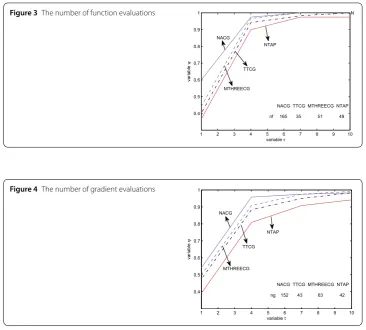
for which a method is the fastest (efficiency), while the vertical side gives the percentage (ψ) of the test problems that are successfully solved by each of the methods. Consequently, the top curve is the method that solved the most problems in a time that is within a factor of the best time.
Figure 3The number of function evaluations
Figure 4The number of gradient evaluations
From Fig. 1, it is obvious that the NACG exhibits the best performance subject to the number of iterations. For example, the NACG outperforms in 129 problems, the MTHREECG outperforms in 66 problems, while the other two methods outperform in 48 problems and 57 problems, respectively.
We see from Fig.2that the curve “MTHREECG” and “TTC” are very close, which are worse than the “NACG”. The NACG occupies the first place, which solves about 57% of the 300 test problems with the least CPU time.
Figures3and4show that if the values ofτ are controlled in the range of 1 to 4, the curve “NACG” is always on the top, which means that our new algorithm is competitive relative to function evaluations and gradient evaluations, respectively. Until we expand the tolerance, the performance of the MTHREECG and TTCG are almost as same as that of the NACG, while the curve “NTAP” is at the bottom all the time.
In one word, all numerical performances indicate that the efficiency and stability of the NACG is promising, even if the dimensions of the test problems exceed 5000. Moreover, we conclude that the restarted scheme is called rarely from the numerical results.
5 Conclusions
Conjugate gradient methods are widely used for solving large-scale unconstrained opti-mization problems, due to their simplicity and low storage. We employed the idea of BFGS quasi-Newton method to improve the performance of conjugate gradient methods. With-out affecting the amount of calculation and storage, the choice of the parameter in the pro-posed method provides more useful information. The generated search direction is close to a quasi-Newton direction and fulfills not only the sufficient descent condition, but also the Dai–Liao conjugacy condition. Furthermore, under proper conditions, we prove the global convergence of the proposed method with Wolfe line search. For a set of 300 test problems, compared with the existing effective methods, the performance profiles show that the proposed method is promising for large-scale unconstrained optimization.
It is worth emphasizing that conjugate gradient methods combining with BFGS updat-ing technique represent an interestupdat-ing computational innovation which produce efficient conjugate gradient algorithms. Our future work will be concentrated on developing some new methods to obtain superlinear convergence and extending the convergence results to general functions.
Acknowledgements
The authors are grateful to the editor and the anonymous reviewers for their valuable comments and suggestions, which have substantially improved this paper.
Funding
This work is supported by the Innovation Talent Training Program of Science and Technology of Jilin Province of China (20180519011JH), and the Science and Technology Development Project Program of Jilin Province (20190303132SF).
Availability of data and materials
Not applicable.
Competing interests
The authors declare that they have no competing interests.
Authors’ contributions
The authors conceived of the study and drafted the manuscript. All authors read and approved the final version of this paper.
Author details
1College of Mathematics, Jilin University, Changchun, China.2College of Mathematics and Statistics, Beihua University,
Jilin, China.
Publisher’s Note
Springer Nature remains neutral with regard to jurisdictional claims in published maps and institutional affiliations.
Received: 29 July 2019 Accepted: 28 October 2019 References
1. Andrei, N.: A simple three-term conjugate gradient algorithm for unconstrained optimization. J. Comput. Appl. Math.
241, 19–29 (2013)
2. Andrei, N.: On three-term conjugate gradient algorithms for unconstrained optimization. Appl. Math. Comput.219, 6316–6327 (2013)
3. Andrei, N.: A new three-trem conjugate gradient algorithm for unconstrained optimization. Numer. Algorithms68, 305–321 (2015)
4. Babaie-Kafaki, S., Ghanbari, R.: A descent family of Dai–Liao conjugate gradient methods. Optim. Methods Softw.29, 583–591 (2014)
5. Babaie-Kafaki, S., Ghanbari, R.: The Dai–Liao nonlinear conjugate gradient method with optimal parameter choices. Eur. J. Oper. Res.234, 625–630 (2014)
6. Babaie-Kafaki, S., Ghanbari, R.: Two optimal Dai–Liao conjugate gradient methods. Optimization64, 2277–2287 (2014)
7. Babaie-Kafaki, S., Ghanbari, R., Mahdavi-Amiri, N.: Two new conjugate gradient methods based on modified secant equations. J. Comput. Appl. Math.234, 1374–1386 (2010)
8. Dai, Y.H., Liao, L.Z.: New conjugacy conditions and related nonlinear conjugate gradient methods. Appl. Math. Optim.
9. Dai, Y.H., Yuan, Y.X.: An efficient hybrid conjugate gradient method for unconstrained optimization. Ann. Oper. Res.
103, 33–47 (2001)
10. Dai, Z.F.: Comments on a new class of nonlinear conjugate gradient coefficients with global convergence properties. Appl. Math. Comput.276, 297–300 (2016)
11. Dai, Z.F., Chen, X.H., Wen, F.H.: A modified Perry’s conjugate gradient method-based derivative-free method for solving large-scale nonlinear monotone equations. Appl. Math. Comput.270, 378–386 (2015)
12. Dai, Z.F., Chen, X.H., Wen, F.H.: Comments on “A hybrid conjugate gradient method based on a quadratic relaxation of the Dai–Yuan hybrid conjugate gradient parameter”. Optimization64, 1173–1175 (2015)
13. Dai, Z.F., Wen, F.H.: Comments on another hybrid conjugate gradient algorithm for unconstrained optimization by Andrei. Numer. Algorithms69, 337–341 (2015)
14. Deng, S.H., Wan, Z.: A three-term conjugate gradient algorithm for large-scale unconstrained optimization problems. Appl. Numer. Math.92, 70–81 (2015)
15. Dolan, E., Moré, J.J.: Benchmarking optimization software with performance profiles. Math. Program.91, 201–213 (2002)
16. Flether, R., Reeves, C.M.: Function minimization by conjugate gradients. Comput. J.7, 149–154 (1964)
17. Ford, J.A., Narushima, Y., Yabe, H.: Multi-step nonlinear conjugate gradient methods for unconstrained minimization. Comput. Optim. Appl.40, 191–216 (2008)
18. Hager, W.W., Zhang, H.C.: A new conjugate gradient method with guaranteed descent and an efficient line search. SIAM J. Optim.16, 170–192 (2005)
19. Hestenes, M.R., Stiefel, E.L.: Methods of conjugate gradients for solving linear systems. J. Res. Natl. Bur. Stand.49, 409–436 (1952)
20. Huang, C.X., Yang, Z.C., Yi, T.S., Zou, X.F.: On the basins of attraction for a class of delay differential equations with non-monotone bistable nonlinearities. J. Differ. Equ.256, 2101–2114 (2014)
21. Kou, C.X.: An improved nonlinear conjugate gradient method with an optimal property. Sci. China Math.57, 635–648 (2014)
22. Li, D.H., Fukushima, M.: A modified BFGS method and its global convergence in nonconvex minimization. J. Comput. Appl. Math.129, 15–35 (2001)
23. Liu, C.Y., Gong, Z.H., Teo, K.L., Sun, J., Caccetta, L.: Robust multi-objective optimal switching control arising in 1, 3-propanediol microbial fed-batch process. Nonlinear Anal. Hybrid Syst.25, 1–20 (2017)
24. Liu, S., Chen, Y.P., Huang, Y.Q., Zhou, J.: An efficient two grid method for miscible displacement problem approximated by mixed finite element methods. Comput. Math. Appl.77, 752–764 (2019)
25. Livieris, I.E., Pintelas, P.: A descent Dai–Liao conjugate gradient method based on a modified secant equation and its global convergence. ISRN Comput. Math.2012, Article ID 435295 (2012)
26. Narushima, Y., Yabe, H.: Conjugate gradient methods based on secant conditions that generate descent search directions for unconstrained optimization. J. Comput. Appl. Math.236, 4303–4317 (2012)
27. Perry, A.: Technical note—a modified conjugate gradient algorithm. Oper. Res.26, 1073–1078 (1978)
28. Polak, E., Ribiére, G.: Note sur la convergence des méthodes de directions conjuguées. Rev. Fr. Inform. Rech. Oper., 3e Année16, 35–43 (1969)
29. Polyak, B.T.: The conjugate gradient method in extreme problems. USSR Comput. Math. Math. Phys.9, 94–112 (1969) 30. Sugiki, K., Narushima, Y., Yabe, H.: Globally convergent three-term conjugate gradient methods that use secant
conditions and generate descent search directions for unconstrained optimization. J. Optim. Theory Appl.153, 733–757 (2012)
31. Wang, J.F., Chen, X.Y., Huang, L.H.: The number and stability of limit cycles for planar piecewise linear systems of node-saddle type. J. Math. Anal. Appl.469, 405–427 (2019)
32. Wang, J.F., Huang, C.X., Huang, L.H.: Discontinuity-induced limit cycles in a general planar piecewise linear system of saddle-focus type. Nonlinear Anal. Hybrid Syst.22, 162–178 (2019)
33. Wolfe, P.: Convergence conditions for ascent methods. SIAM Rev.11, 226–235 (1969)
34. Wolfe, P.: Convergence conditions for ascent methods, II: some corrections. SIAM Rev.13, 185–188 (1971) 35. Yabe, H., Takano, M.: Global convergence properties of nonlinear conjugate gradient methods with modified secant
condition. Comput. Optim. Appl.28, 203–225 (2004)
36. Yang, Y.T., Chen, Y.T., Lu, Y.L.: A subspace conjugate gradient algorithm for large-scale unconstrained optimization. Numer. Algorithms76, 813–828 (2017)
37. Yao, S.W., Ning, L.S.: An adaptive three-term conjugate gradient method based on self-scaling memoryless BFGS matrix. J. Comput. Appl. Math.322, 72–85 (2018)
38. Yuan, J.L., Zhang, Y.D., Ye, J.X., Xie, J., Teo, K.L., Zhu, X., Feng, E.M., Yin, H.C., Xiu, Z.L.: Robust parameter identification using parallel global optimization for a batch nonlinear enzyme-catalytic time-delayed process presenting metabolic discontinuities. Appl. Math. Model.46, 554–571 (2017)
39. Zhang, L., Jian, S.Y.: Further studies on the Wei–Yao–Liu nonlinear conjugate gradient method. Appl. Math. Comput.
219, 7616–7621 (2013)
40. Zhou, W.J.: A short note on the global convergence of the unmodified PRP method. Optim. Lett.7, 1367–1372 (2013) 41. Zhou, W.J.: On the convergence of the modified Levenberg–Marquardt method with a nonmonotone second order
Armijo type line search. J. Comput. Appl. Math.239, 152–161 (2013)
42. Zhou, W.J., Chen, X.L.: On the convergence of a modified regularized Newton method for convex optimization with singular solutions. J. Comput. Appl. Math.239, 179–188 (2013)
43. Zhou, W.J., Shen, D.M.: An inexact PRP conjugate gradient method for symmetric nonlinear equations. Numer. Funct. Anal. Optim.35, 370–388 (2014)
44. Zhou, W.J., Zhang, L.: A nonlinear conjugate gradient method based on the MBFGS secant condition. Optim. Methods Softw.21, 707–714 (2006)