198
ECONOMIC LOAD DISPATCH USING PARTICLE SWARM OPTIMIZATION
Sumit Singh Parihar
1,
Dr.Anuprita Mishra
2,
Prof.Nagendra Singh
3Department of Electrical and Electronics Engineering TIT& S, Bhopal, India
[email protected], [email protected],[email protected]
Abstract: The efficient optimal economic operation and planning of electric power generating system has always occupied an important position in the electric power industry. With large interconnection of the electric networks, energy crisis in the world, continuous rise in fossil fuel and tariff structure necessitates the optimal operation of committed power generating units. A small saving in the operation of generating system results a significant reduction in operating cost as well as in the quantities of fuel consumed. The classic problem is the economic load dispatch of generating systems to achieve minimum operating cost. In this work PSO is applied to find out the minimum cost for different power demand which is finally compared with the results. Data was taken from the published work in which loss coefficients are also given with the max-min power limit and cost function. The technique will be implemented in MATLAB software. Results obtained are better as compared to the previous work in the literature.
Key Words: ELD (Economic Load Dispatch), PSO
(particle swarm optimization), Constraints.
1. INTRODUCTION
The need of power is increasing day by day, and to fulfill its demand many various kind of power generation and efficient techniques are implemented. Currently the power industry is facing the challenges and much striation for operation as its constraints. Due to energy crises the price of energy is rising so the main concerned for the power engineers is the cost of products and its services, the
199
are highly sensitive to staring points and often converge to local optimum or diverge altogether. The dynamic programming has no limitations on the mature of curves. It can generate global solutions even for the nonlinear and discrete cost curves of generation units. However the later have a drawback of curse of dimensionality that worsens for large scale problems, resulting to extremely high computation time.
Later on, Stochastic techniques such as evolutionary programming (EP) (Yang, Yang & Huang,1996), genetic algorithms (GA) (Walter & Sheble, 1993), improved tabu search (Lin, Cheng, & Tsay, 2002), Clonal algorithm (Panigrahi, Yadav, Agarwal & Tiwari,2007) are being used to find global solution or near to global solution.
B. Mohammadi Ivatloo et.al presents a novel heuristic algorithm for solving economic dispatch (ED) problems, by employing iteration particle swarm optimization with time varying acceleration coefficients (IPSO-TVAC) method, Including valve-points and prohibited operation zones (POZs) in the generating units cost functions. G. Baskar et. al proposed a new technique is proposed known as Improved Particle Swarm Optimization (IPSO) on IEEE 14 bus system and 66 bus Indian Utility system have been considered, in which a new velocity strategy equation is formulated for a large scale system and the features of constriction factor approach (CFA) is also incorporated. Chengfu Sun et. al presented a modified quantum behaved particle swarm optimization for short-term combined economic emission hydro & thermal scheduling, which is modeled as a bi-objective problem: (i) minimizing fuel cost and (ii) minimizing emission cost. Immanuel Selvakumara et. al presented a new optimization strategy, civilized swarm optimization (CSO), by integrating society-civilization algorithm (SCA) with particle swarm optimization (PSO). Jong Bae Park et. al suggests a modified PSO (MPSO) mechanism is suggested to deal
with the equality and inequality constraints in the ED problem. Also a dynamic search space reduction strategy is devised to accelerate the optimization process. K.T. Chaturvedi et. al Explained that Economic dispatch (ED) is one of the key functions of the modern energy management system. The Conventional gradient based methods can be used to solve Economic Dispatch problem effectively only if the fuel cost curves of generating units are assumed to be linear, monotonically increasing in nature, otherwise these methods are likely to meet suboptimal or infeasible solutions. K. Vaisakh et. al presented a heuristic optimization methodology, namely, Bacterial foraging algorithm by integrating Bacterial Foraging Optimization Algorithm technique (BFOA), Particle Swarm Optimization (PSO) and Differential Evolution (DE) were used for solving non-smooth non-convex Dynamic Economic Dispatch problem.
2. ECONOMIC LOAD DISPATCH
200
A. Economic Load Dispatch without Losses In this case the economic load dispatch problem is that when transmission losses are neglected. Thus the total demand is equal to the sum of generation. And the cost function of each plant is known. The problem is to find the real power generated with satisfying that the cost of generation should be minimum and the generation should be within minimum and maximum limit. The simplified economic load dispatch problem can be represented by quadratic function as mentioned in given equation
Minimize
Where
FT: total generating cost; Fi: cost function of ith generation
unit; , , ,: cost coefficient of generator i; Pi: power of
generator i; n: number of generator. B. Constraints
There are mainly two types of constraints i) Equality constraints
ii) Inequality constraints
The inequality constraints on real power generation P1 for each generator is
Where and are the minimum and the maximum
value of real power allowed at generator i.
And the total power generated should exactly match with the load demand and losses which is mathematically represented by the equation
is the total generated power of N units, is the total
load demand, and are the total transmission losses.
3. PARTICLE SWARM OPTIMIZATION
Particle swarm optimization (PSO) is an evolutionary computation technique developed by Kennedy and Eberhart in 1995 Particle Swarm Optimization (PSO) could be a machine intelligence technique for solving global optimization problems. The Particle Swarm Optimization was originally proposed by J. Kennedy as an emulation of the behavior of birds’ swarms and fish school while
201
STEPS OF PSO
Understanding the conceptual basis of the PSO, the task then becomes to develop the algorithmic tools needed to implement the optimization.
Define the Solution Space: The first step toward implementation of the PSO is to pick the parameters that need to be optimized and give them a reasonable range in which to search for the optimal solution. This requires specification of a minimum and maximum value for each dimension in an N-dimensional optimization. This is referred to as Xmin and Xmax respectively, where ranges from 1 to N. Define a Fitness Function: This important step provides the link between the optimization algorithm and the physical world. It is critical that a good function be chosen that accurately represents, in a single number, the goodness of the solution. The fitness function should exhibit a functional dependence that is relative to the importance of each characteristic being optimized. The fitness function and the solution space must be specifically developed for each optimization; the rest of the implementation, however, is independent of the physical system being optimized.
Initialize Random Swarm Location and Velocities: To begin searching for the optimal position in the solution space, each particle begins at its own random location with a velocity that is random both in its direction and magnitude. Since its initial position is the only location encountered by each particle at the runs start, this position becomes each particle’s respective Pbest. The first Gbest, is
then selected from among these initial positions.
Systematically Fly the Particles through the Solution Space: Each particle must then be moved through the solution space as if it were a bee in a swarm. The algorithm acts on each particle one by one, moving it by a small amount and cycling through the entire swarm.
Evaluate the Particle’s Fitness, Compare to Pbest.
Gbest, the fitness function, using the coordinates of
the particle in solution space, returns a fitness value to be assigned to the current place. Let the value is greater than the value at the respective
Pbest for that particle, or the global Gbest, then the
appropriate locations are replaced with the current location.
Update the Particle’s Velocity: The manipulation of a particle’s velocity is the centre component of the entire optimization. Careful understanding of the equation used to specify the velocity is the key to understanding the optimization as a whole. The particle velocity is changed according to the relative locations of Pbest and Gbest. It is accelerated
in the directions of these locations of greatest fitness according to the following equation:
Move the Particle: Once the velocity has been determined it is simple to move the particle to its next location. The velocity is applied for a given time-step usually chosen to be one and new coordinate is computed for each of the dimensions according the following equation:
The particle is then moved to the location calculated by Equation 6. The composite nature of this algorithm composed of several independent agents makes it especially conducive to implementation on parallel processors.
5. RESULT AND DISCUSSION
PSO technique has been successfully applied to determine the optimal economic load dispatch of six units generating system. The technical details of the test system are mentioned in table I. Here a total load demand of 1263 MW has been considered. The economic load dispatch program for different trials is coded in MATLAB 7.10.
Experimental setting
202
each population size. Other PSO parameters adopted in present work are given below. C1= C2 = 0.01.
Table 1: Optimal cost of 6 unit test system by PSO at different trials
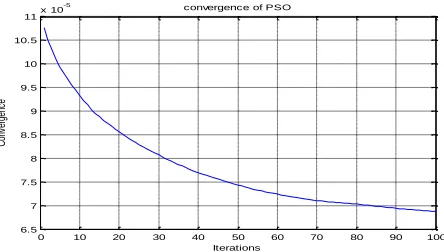
From the table1 above it has been clearly observed that population size 100 is giving minimum value i.e.14571.79 $/h Fig 6.1 to fig 6.2 shows the convergence v/s iteration for the population size of 100 and number of iterations 100.
Fig.1 Convergence characteristic of PSO during trial no.1
Fig.2 Convergence characteristic of PSO during trial no.2
Fig.3 Convergence characteristic of PSO during trial no.3
Fig.4 Convergence characteristic of PSO during trial no.4
Fig.5 Convergence characteristic of PSO during trial no.5
Fig.6.Convergence characteristic of PSO during trial no.6
0 10 20 30 40 50 60 70 80 90 100
7 7.5 8 8.5 9 9.5
10x 10
-5 convergence of PSO
Iterations Co nv erg en ce
0 10 20 30 40 50 60 70 80 90 100
7 7.2 7.4 7.6 7.8 8 8.2 8.4 8.6 8.8
9x 10
-5 convergence of PSO
Iterations Co nv er ge nc e
0 10 20 30 40 50 60 70 80 90 100
6.5 7 7.5 8 8.5 9 9.5 10 10.5
11x 10
-5 convergence of PSO
Iterations Co nv erg en ce
0 10 20 30 40 50 60 70 80 90 100
6.8 7 7.2 7.4 7.6 7.8 8 8.2 8.4 8.6 8.8x 10
-5 convergence of PSO
Iterations Co nv er ge nc e
0 10 20 30 40 50 60 70 80 90 100
7 7.5 8 8.5 9 9.5 10 10.5 11 11.5x 10
-5 convergence of PSO
Iterations Co nv er ge nc e
0 10 20 30 40 50 60 70 80 90 100
6.5 7 7.5 8 8.5 9 9.5 10 10.5
11x 10
-5 convergence of PSO
203
Wmin = 0.7, Itermax = 100. Results are simulated on
MATLAB 7.10 language on Intel( R ) Core(TM) i3-3110M CPU @2.40 GHz, 4.00 GB RAM.
6. CONCLUSION
The ELD problem assumes that the amount of power to be supplied by a given set of units is constants for a given interval of time and attempts to minimize cost of supplying this energy subject to constraints of the generating units. Therefore it is concerned with the minimization of total cost incurred in the system and constraints over the entire dispatch period. Here the economic load dispatch problem was solved for six units generating station for a total load demand of 1263 MW without considering complexity, ramp rate units and prohibited operating zones and without losses. The problem was solved by Natural exponent inertia weight strategy i.e. e1-PSO and e2-PSO with MATLAB 7.10 environment above mentioned two strategies has been successfully applied to determine the optimal generation schedule of the six unit test system. Detailed conclusions of the results are given below:
PSO is population based evolutionary optimization algorithm, hence results are taken at various population sizes i.e. 5, 70, 200, 300, 500 & it has been observed that 500 population size is giving optimal value of objective function i.e. 15275.56 $/h and 15275.55$/h for e1-PSO & e2-PSO respectively.
REFERENCES
[1]. Ahmed Y. Saber, Ganesh K. Venayagamoorthy “Economic Load Dispatch using Bacterial
Foraging Technique with Particle Swarm Optimization Biased Evolution” IEEE Swarm
Intelligence Symposium St. Louis USA, September, 2008, Page 21-23.
[2]. Aravindhababu P, Nayar K R. “Economic dispatch based on optimal lambda using radial basis function network”. Electronics Power Energy
System, Vol 24, Page 551–6, 2002.
[3]. Alrashidi MA, Hawary ME. “Impact of loading conditions on the emission economic dispatch”.
Proceedings of World Academy of Science and Engineering and Technology 2008 (May); Vol. 29, Page 148–151.
[4]. Basu M. “A simulated annealing based goal attainment method for economic emission load dispatch of fixed head hydrothermal power systems”. International Journal of Electrical Power
and Energy Systems 2005; Vol 27(2): Page 147– 53.
[5]. Chaturvedi K.T., Pandit M, Srvastava L, “Particle swarm optimization with time varying acceleration coefficients for non- convex economic power dispatch”(2009), Electrical Power and Energy
System, Vol 31, Page 249-257.
[6]. Chaturvedi K.T., Pandit M., Shrivastava L., (2008) “Self organizing hierarchical particle swarm
optimization for non convex economic dispatch”. IEEE Transaction on power system, Vol. 23(3), 1079-1087.
204
Trans. Power Syst., Vol. 20, No. 4, Page. 1690– 1699.
[8]. Cohelo SL, Lee SC, “Solving economic load dispatch problems in power system using chaotic and Gaussian particle swarm optimization approaches,” Electrical Power and Energy
Systems; Vol 30:297–307.
[9]. D. C. Walter and G. B. Sheble, “Genetic algorithm solution of economic load dispatch with valve point loading”, , Aug. 1993, IEEE Trans. Power
System, Vol. 8, No. 3, Page 1325–1332.
[10]. Da Silva, Nepomuceno L, Bastos. “An efficient Hopfield network to solve economic dispatch problems with transmission system representation”. Electrical Power Energy System
2004; Vol 26(9): Page 733–8.
[11]. Farheen, F.; Ansari, M.A.; Lardam, N. “Implementation of Particle swarm optimization for dynamic economic load dispatch problem”.
IEEE-ICEETS, 2013, Page 1273- 1278.
[12]. Gaing Z L. “Closure to Discussion of Particle swarm optimization to solving the economic dispatch considering the generator constraints”.
IEEE Trans Power System 2004; Vol 19(4): Page 2122–3.
[13]. J. Kennedy and R. Eberhart, “Particle swarm optimization,” in Proc. IEEE Int. Conf. Neural Networks (ICNN’95), vol. IV, Perth, Australia,
1995, pp. 1942–1948.
[14]. Jeyakumar DN, Jayabarathi T, Raghunathan T, “Particle swarm optimization for various types of economic load dispatch problems,” Electrical
Power & Energy System; Vol 28: Page 36–42. [15]. Jiejin C, Xiaoqian M, Lixiang L, Haipeng P,
“Chaotic particle swarm optimization for
economic load dispatch considering the generator constraints”, Energy Conversion & Management;
Vol 48: Page 645–653.
[16]. Jong-Bae Park, Member, Yun-Won Jeong, Joong-Rin Shin “ An Improved Particle Swarm
Optimization for No convex Economic Dispatch Problems” IEEE transactions On power system,
May 1992 ,Vol.25,Feb 2010.
[17]. Kumar J, Seble GB. “Clamped state solution of artificial neural network for real-time economic dispatch”. IEEE Trans Power System 1995; 10(2):
Page 925– 1.
[18]. Khamsawang S, Boonseng C, Pothiya S. “Solving the economic dispatch problem with tabu search algorithm”. In: IEEE International Conference on
Industrial Technology 2002, Bangkok, Thailand. [19]. Lin WM, Chen FS, and Tsay MT. “An improved
tabu search for economic dispatch with multiple minima”. IEEE Transition Power System 2002;
Vol 17(1): Page 108–12.