University of South Carolina
Scholar Commons
Theses and Dissertations
1-1-2013
A Pilot Intervention To Engage Nurses To Lead
Transformation of The Workplace
Molly Patton
University of South Carolina
Follow this and additional works at:https://scholarcommons.sc.edu/etd
Part of theNursing Commons
This Open Access Dissertation is brought to you by Scholar Commons. It has been accepted for inclusion in Theses and Dissertations by an authorized administrator of Scholar Commons. For more information, please [email protected].
Recommended Citation
A PILOT INTERVENTION TO ENGAGE NURSES TO LEAD TRANSFORMATION OF THE WORKPLACE
By
Molly Patton
Associate in Applied Science Wilkes Community College, 1995
Bachelor of Science George Mason University, 1999
Master of Science
Queens University of Charlotte, 2005
__________________________________________________
Submitted in Partial Fulfillment of the Requirements
For the Degree of Doctor of Nursing Practice in
Nursing Practice
College of Nursing
University of South Carolina
2013
Accepted by:
Beverly Baliko, Major Professor
Joan Culley, Co-major Professor
ii
iii DEDICATION
This DNP Project is dedicated to my family and friends who supported me through this
journey. My mom who called daily with continued support, encouragement, and love;
my dad who continually ensured me this would all be worth it in the end; my brother,
Andy and his family (Beth, Olivia, and Jake) who continually invited me to family events
knowing I may not show. To my friends CoCo, Shuna, Renee, and Mark who
unconditionally supported me through my incredible journey from surgery to defense. To
my friend Cathy who supported me, cooked for me and showed what true friendship is all
about. To my fiancé Johnny who is a Godsend, understands me, and made me laugh even
on my worst book report days! Each of them knows more about nursing leadership and
iv
ACKNOWLEDGEMENTS
First, I would like to acknowledge Jesus Christ who gave me the strength and courage to
travel this journey and overcome the many barriers along the way. To my dear friend and
colleague, Dr. Colleen Burgess, many thanks for the endless support, encouragement, and
most of all your sense of humor. To Brenda Haley, thank you for all of the time you spent
making sure I stayed focused on the details of the workshop. To Violet Cook-Castle
thank you for spending many hours reformatting. Thank you to Dr. JoAnne Herman who
offered your enthusiasm, knowledge, and wisdom throughout the DNP program and in
the development of my topic. To Dr. Beverly Baliko thank you for your time, dedication,
and support in completing this project. To Dr. Joan Culley, thank you for your time,
v ABSTRACT
The often toxic work environment in which nurses practice contributes to decreased
well-being, job dissatisfaction, and poor retention rates, while negatively impacting quality
and patient safety. Most leadership programs and resources target nurses in formal
leadership positions and are exclusive of the bedside nurse. The purpose of this research
utilization project was to determine immediate and short-term outcomes of an educational
leadership workshop for nurses, including intent to change the work environment and
subsequent action to change the work environment. The goal was to develop, deliver, and
evaluate an evidence-based educational intervention to empower nurses at all levels of
care to improve communication and conflict management in the workplace. A
transformational systems approach was used, collaboratives were formed, and
academic-practice relationships were built to provide a pilot workshop for 247 RNs in North
Carolina (NC). Surveys were used to measure the outcomes of this intervention
immediately following and six weeks after the workshop. The majority of participants
committed to one or more activities and to change a behavior to improve the workplace.
There was a significant weak positive relationship between intent to change the
workplace and participants’ engagement (r=.22), as well as coping behaviors (r=.33).
vi
(p=.005) regarding intention to change the work environment. Baccalaureate and
graduate prepared nurses, and those in staff nurse and manager roles, expressed greater
intention to change the work environment, relative to diploma/associate degree nurses
and administrators. Follow-up indicated that baccalaureate-prepared nurses and staff
nurses were pursuing activities focused on behavioral change and activism, and staff
nurses and managers were pursuing interests in research participation. A formative
evaluation indicated that the workshop was well-received. This collaborative effort
resulted in a sustainable intervention to provide leadership tools and resources for all
nurses in NC. Recommendations include establishing reliability and validity of the survey
instruments and utilizing evaluation feedback to guide future workshops. This pilot
intervention was a united endeavor to empower a diverse group of nurses to actively
engage in improvement of their work environments. Findings demonstrated the value of
vii
TABLE OF CONTENTS
DEDICATION ... iii
ACKNOWLEDGEMENT ... iv
ABSTRACT ...v
LIST OF TABLES ... ix
LIST OF ABBREVIATIONS ... xi
CHAPTER I INTRODUCTION ...1
CHAPTER II LITERATURE REVIEW ...23
CHAPTER III PROJECT DESCRIPTION ...45
CHAPTER IV RESULTS ...61
CHAPTER V DISCUSSION ...71
REFERENCES ...86
APPENDIX A. EVIDENCE OF THE TOXIC WORK ENVIRONMENT ...109
APPENDIX B. LEVELS OF EVIDENCE ...110
APPENDIX C. EVIDENCE TABLES ...111
APPENDIX D. SPECIAL PROJECTS GRANT ...126
APPENDIX E. WORKSHOP FLYER ...132
APPENDIX F. WORKSHOP AGENDA ...133
APPENDIX G. WORKSHOP TOOLKIT ...134
APPENDIX H. PARTICIPANT DEMOGRAPHIC SURVEY...163
APPENDIX I. NURSE SURVEY ...165
viii
APPENDIX K. STUDY PROTOCOL ...168
APPENDIX L. FORMATIVE PROGRAM EVALUATION ...171
ix
LIST OF TABLES
Table 1.1 Organization, Program or Resources Available, and the Strengths and
Weaknesses ...15
Table 1.2 Leadership Opportunities for Nurses In North Carolina ...16
Table 2.1 Concepts Searched, Key Terms and Number Of Articles Critiqued ...27
Table 2.2 Concepts and Application of the USA Model for Project Implementation ...43
Table A.1 Characteristics of a Toxic Work Environment. ...109
Table B.1 Melnyk’s Levels of Evidence ...110
Table C.1 Evidence Table for the Concepts of Communication, Conflict Management and Empowerment: USA Model: Construct 1 and Construct ...111
Table C.2 Evidence Table for the Concepts of Educational Best Practice: USA Model: Construct 3 ...114
Table C.3 Evidence Table for the Concepts of Systems Thinking and Transformational Leadership: USA Model: Construct 4...116
Table C.4 Evidence Table for the Concepts of Collaboration, Partnerships, Champions, Sustainability: USA Model: Construct 5 ...122
Table C.5 Evidence Table for the Concepts of IOM Aims and Organizational Culture: USA Model: Construct 6 ...123
Table M.1 Demographics by Age, Gender, Race, Education, Position, and Shift ...178
Table M.2 Work Stress and Life Stress as Measured by Visual Analog Scale ...189
Table M.3 Frequency and Percent of Responses to Communication and Conflict Management Satisfaction at Work ...180
Table M.4 Frequency and Percent of Responses to Current Engagement Activities ...181
Table M.5 Frequency and Percent of Responses to Coping Behaviors ...182
x
Table M.7 Comparison of Intention to Change the Work Environment by Selected
Demographic Variables Using Pearson Correlation (N=215) ...184
Table M.8 Comparison of Intention to Change the Work Environment by Race Using ANOVA (N= 212) ...185
Table M.9 Comparison of Intention to Change the Work Environment by Education Using ANOVA (N= 212) ...186
Table M.10 Comparison of Intention to Change the Work Environment by Employment Position Using ANOVA (N= 211). ...187
Table M.11 Frequency Distribution of Communication and Conflict Management
Actions by Education ...188
Table M.12 Frequency Distribution of Communication and Conflict Management
xi
LIST OF ABBREVIATIONS
RN ... Registered Nurse
AACN ... American Association of Critical Care Nurses
AACN ... American Association of Colleges of Nursing
AHRQ ... Agency for Healthcare Research and Quality
ANA ... American Nurses Association
AONE ... American Organization of Nurse Executives
AORN ... Association of periOperative Nurses
CAN ... Center for American Nurses
DNP... Doctor of Nursing Practice
FFNE ...Foundation of Nursing Excellence
IOM ... Institute of Medicine
NLN ... National League for Nursing
NCFON ... North Carolina Future of Nursing
NCFONAC ... North Carolina Future of Nursing Action Coalition
NCNA ... North Carolina Nurses Association
NTN ...Nurses Transforming Nursing
OSHA ... Occupational Safety and Health Administration
PPAC... Professional Practice Advocacy Coalition
SAS ... Statistical Analysis System
xii
1 CHAPTER I
INTRODUCTION
A large number of nurses are desperately unhappy due to the toxic work
environment in which they are forced to practice. Factors influencing this atmosphere are
oppressed group behaviors, especially lateral violence, a hierarchal system that devalues
nursing knowledge and expertise, and a perception among nurses that they are impotent
to effect change. Subsequently, nurses are experiencing job dissatisfaction, resulting in
poor nurse retention. In addition, the toxic work environment affects quality and patient
safety.
The Institute of Medicine (IOM) and other professional organizations proposed
that one solution to the problem was leadership training for bedside nurses. Traditionally,
nurses have had little educational preparation in leadership and few opportunities in the
work environment to gain these skills. The aim of this project was to develop an evidence
based intervention to increase leadership skills in bedside nurses. Chapter I includes a
discussion of the background and significance of the problem, an elaboration of the
factors supporting the problem, the consequences of the problem, an explanation of the
proposed solution, and a statement of the purpose of the project.
Background and Significance
The work environment in which nurses practice was depicted as warfare over 30
years ago by Roberts (1983). A significant amount of nursing research substantiated
2
environment (Barrett, Korber, & Padula, 2009; Briles, 1994; Embree & White, 2010;
Guidroz, Burnfield, Clark, Schwetschenau, & Jex, 2010; Hutchinson, Wilkes, Vickers, &
Jackson, 2008; Hutchinson, Vickers, Jackson & Wilkes, 2006; Rogers-Clark, Pearce, and
Cameron, 2009; Sheridan-Leos, 2008; Simons & Mawn, 2010). Additional terms used to
discuss the problematic workplace included aggression, lateral or horizontal violence, and
disruptive behavior (Purpora, Blegen, & Stotts, 2012; Rosenstein & O’Daniel, 2008).
Briles (1994) introduced the idea that these collective behaviors created a “toxic”
workplace.
A wealth of nursing knowledge exists that documents the breadth and depth of the
problematic behaviors within the work environment. Nurse scholars have diligently
pursued evidence to understand, define, describe, and investigate the work environment
(Barrett, Piatek, Korber, & Padula, 2009; Daiski, 2004; Duffy, 1995; Farrell, 1999;
Farrell, 1997, Gardner,1992; Griffin, 2004; Guidroz, Burnfield, Clark, Schwetschenau, &
Jex, 2010; Hutchinson, 2009; Hutchinson, Vickers, Jackson, & Wilkes, 2006; McKenna,
Smith, Poole, & Coverdale, 2003; Roberts, DeMarco, & Griffin, 2009; Rogers-Clark,
Pearce, & Cameron, 2009; Sheridan-Leos, 2008; Stanley, Martin, Michel, Welton, &
Nemeth, 2007; Vessey, DeMarco, Gaffney, & Budin, 2009). Nurses reported they
experienced or witnessed aggressive behavior, bullying, incivility, verbal abuse, refusal
of tasks, insulting or disparaging remarks, spreading malicious rumors or gossip about
another, refusing to speak to another or answer questions, failure to speak up in another’s
defense when she or he was unfairly criticized, sabotage, scapegoating, and professional
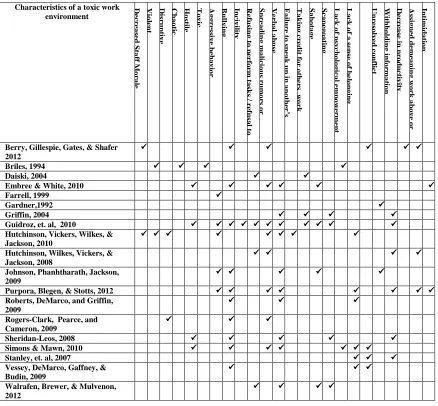
terrorism. Appendix Table A.1 contains a table displaying evidence in the literature of
3
Nurses are not the only ones involved in creating the toxic work environment.
Rosenstein (2002) first explored the impact of nurse-physician relationships on nurse
satisfaction and retention. One third of all nurses queried claimed they knew nurses who
left their positions due to disruptive physician behavior. Reported physician behaviors
included yelling, using profanity, throwing things, bullying, criticizing in public,
belittling, berating, intimidating, using sexual language, failing to respond, failing to
follow policies, and failing to complete administrative work (Goettler, Butler,
Shackleford, & Rotondo, 2011; Guidroz et al., 2010; The Joint Commission, 2008).
Physician and nurse behaviors directly impact the work atmosphere. Managers and
administrators who ignore or condone the negative behaviors only perpetuate the toxic
work environment (Johnston, Phanhtharath, & Jackson, 2009; Rosenstein, 2011;
Rosenstein & O’Daniel, 2008).
Hierarchical structure. In the early 1900’s, medicine became the dominant force
when care of the sick transitioned from the community to institutions. Along with the
transition of care, nursing education became dominated by the medical model and
literally moved into the hospital environment (Twaddle & Hessler as cited in Roberts,
1983). Soon after the transition to the hospital, Ducas (1962) noted that nurses were put
in the position of the physician’s hand maiden “…who did sick room housekeeping and
kept the patient quiet” (p. 12). Therefore, nurses were not viewed as a member of the
medical team.
Ducas (1962) described the education of nurses as led by physicians. Diploma
schools existed to provide a curriculum to equip a graduate to be a competent registered
4
skill in making patients comfortable. She compared collegiate schools and courses, at the
time, noting that the diploma nurse may have been more expert in techniques than the
collegiate nurse. Along with the designation of “handmaiden,” the nurses’ ability to have
power and influence was diminished and awarded to the physician.
Torres (1981) mentioned that collegiate nurse educators had long argued that the
dominance of oppressive forces had led to the loss of control over nursing education and
practice. Regardless of academic preparation, the dominance of nursing practice by
medicine and hospital administrators created a source of oppression over the practice and
education of nurses. As a result, nurses were forced to be dependent and submissive to a
powerful group (Stein, 1967). Stein described this domination as the nurse-physician
game. The nurse was expected to be bold, innovative, and make recommendations while
appearing passive. The nurse pretended the ideas were those of the physician rather than
her own.
Managers and administrators contributed to the problem. Roberts (1983) defined
nurse leaders as an elite marginalized group who were promoted based on their allegiance
to the status-quo. Cleland (1971) used the example of asking permission from male
authorities, physicians, when referencing questions relating to nursing. This male
dominated patriarchal system generally managed and controlled the hiring of nursing
administrators, hospital administrators, and higher education positions. Roberts (1983)
emphasized that only with continued development of nursing theory, research, and a
separate identity that nurses would be able to free themselves and the nursing profession
5
In fact, Cleland (1971) suggested that the most severe form of dominance was
when it becomes the norm. Torres (1981) addressed the widespread acceptance of
oppression of nurses and stated “…consistent with the theory of oppression, nurses have
been led to believe that it is right or natural for medicine to maintain control of the entire
health care enterprise” (p. 10).This longstanding history and acceptance of oppression has
contributed to a sense of impotence that has prevailed in the nursing profession. Research
conducted by Daiski (2004) provided more current evidence that nurses remain an
oppressed group and continue to be dominated by physicians. She commented that
nurses were aware that physicians continued to intrude into the business of nursing.
Powerlessness. Disempowerment and hierarchical structures perpetuate
oppressed group behaviors intra- and inter-professionally (Daiski, 2004). Garman, Leach,
and Spector (2006) elaborated on the disproportionate lack of power that nurses have
compared to physicians and administrators in the healthcare system. In addition to a
disproportionate lack of power, nurses are burdened with a tremendous level of patient
responsibility. In 2009, Buerhaus, Donelan, DesRoches, and Hess reported that less than
23 percent of nurses ranked their opportunities to influence decisions about the workplace
organization “excellent” or “very good.” Purpora, Blegen, and Stotts (2012) also
described the history and acceptance of oppression and the consequential devaluing of
nurses in the hierarchy of the healthcare system. Nurses are suffering from a persistent
erosion of self-esteem due to this disproportionate lack of power and literally internalize
a minimized self-worth.
Job dissatisfaction. Nurses are dissatisfied and leaving their employment in
6
McKenna, Smith, Poole, & Coverdale, 2003; Stanley, Martin, Michel Welton, & Nemath,
2007; Ulrich, Buerhaus, Donelan, Norman, & Dittus, 2005). The complexities of issues
that impact job satisfaction provide many challenges to nurse researchers. Some factors
influencing job dissatisfaction include, but are not limited to, a lack of psychological
empowerment, a sense of belonging and social support from co-workers, and stress
(Casey et al. 2004; Gardner, 1992; Larabee, et. al 2003; McPhee, Green, Bouthillette, &
Suryaprakash, 2011; Oermann & Moffitt, 1997; Winter-Collins & McDaniel, 2000). In a
study of RNs intent to stay or leave their employment (n=352), the authors reported that
job satisfaction was second only to family responsibilities as a significant predictor of
intent to leave (McCarthy, Terrell, & Lehane, 2007).
In order to better understand hospital nurse dissatisfaction and intention to remain
employed, Tourangeau, Cummings, Cranley, Ferron, and Harve (2009) conducted a
descriptive study using focus group methodology. Participants of the study included 78
nurses attending 13 focus group sessions. Thematic analysis was used to analyze the data.
They found nurses consistently reported the strong impact that coworker relationships
had on their intention to remain employed. Additional direct effects reported included
nurse characteristics, external factors, physical and psychological responses at work,
work rewards, patient relationships and job content, and organizational support and
practices. In light of job dissatisfaction and the reported impact of coworker relationships
on retention, organizational commitment is becoming a focus of nurse executives.
Poor retention. According to the United States Bureau of Labor Statistics
(USBLS, 2012), the number of open nursing positions by 2020 will be 1.2 million.
7
by 2020 due to the nursing shortage (Allen & Aldebron, 2008). The aging workforce is
the primary contributor to the impending shortage (AACN, 2012). The average age of the
nursing workforce is 43.8 years. One quarter of the 2.7 million nursing workforce is age
50 or older (AACN, 2012; USBLS, 2012). Compounding the shortage is poor retention of
nurses due to job dissatisfaction, faculty shortages, and the perception of the unhealthy
work environment (Buerhaus, Donelan, Des Roches, & Hess, 2009). Results of the
Buerhaus et al. study (n=468) indicated the top five reasons for leaving were: salary and
benefits (29%), more career options for women (18%), faculty shortages (30%),
undesirable hours (18%), and negative perception of the healthcare environment (14%).
With the looming shortage of nurses, it is critical that the influencing factors of nursing
turnover be addressed by organizations.
Nurse leaders are faced with the problem of poor nurse retention and turnover.
High nursing turnover burdens the organization with high cost (Halfer & Graf, 2006).
Jones and Gates (2007) estimated nurse turnover costs to be $22, 000 to greater than
$60,000 per nurse. The yearly turnover rate for newly registered clinical nurses ranges
from 55% to 61% (Halfer & Graf, 2006).
Patient safety. Finally, the toxic work environment impacts patient outcomes and
safety. Rosenstein (2005) investigated the relationship between intimidating and
disruptive behaviors in the workplace and the occurrence of medical errors. He reported
that disruptive behavior increases poor patient outcomes. In a root cause analysis of
sentinel events conducted by The Joint Commission (TJC), 67% of respondents,
including nurses (n=2846), physicians (n=944), administrators (n=40), and others
8
(Rosenstein & O’Daniel, 2008). These findings suggested that negative behaviors are
now threatening the safety of patients.
The Joint Commission (2008) issued a Sentinel Event Alert titled Behaviors that
Undermine a Culture of Safety. The alert discussed system flaws and the impact of
disruptive behaviors on patient outcomes. Requirements set forth by TJC addressed new
standards for leadership and system-wide interventions to address disruptive behaviors.
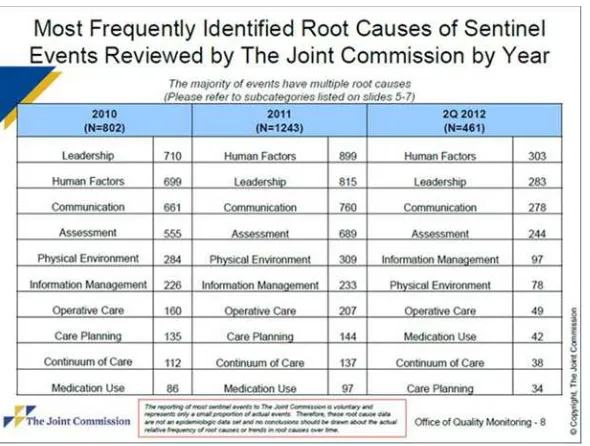
In order to better understand sentinel and adverse events, TJC (2012) identified
common root cause categories. Although each event may include multiple root causes,
the primary cause identified was leadership or communication. Leadership and
communication were included in the top three root causes for sentinel and adverse events
for the last three years, as noted in Figure 1, and have reigned in the top five categories of
identified sentinel events since 2004 (TJC, 2012).
Figure 1.1 Most Frequently Identified Root Causes 2010-2012
9
For example, communication was identified as the root cause 593 times out of 738 events
(80%) where a delay in patient treatment resulted in death or loss of permanent function.
Included in this report was information about infection related events (n=147).
Seventy-three percent of these sentinel events were related to lack of leadership. The top two root
causes for unintended retention of foreign objects were leadership and communication.
Of 727 patients, 580 incidents were related to leadership and 469 were related to
communication.
Analysis of Current Practice
Nurse scholars and sociologists defined and described the problematic hospital
work environment for nurses over 30 years ago. Yet, little has been done to solve the
problem until the last decade. Initiatives within the past few years included the Agency
for Healthcare Research and Quality (AHRQ) TEAMSTEPPS®; The Joint Commission
Leadership Standards; Occupational Safety and Health Administration (OSHA)
Workplace Violence; American Nurses Association (ANA) web tools and resources;
American Association of Critical Care Nurses (AACN) web tools, references, and
speakers bureau; Association of periOperative Nurses (AORN) publications and
protocols for patient safety; American Organization of Nurse Executives (AONE)
Healthful Practice/Work Environment; and the Center for American Nurses (CAN) guide
for writing organizational policy.
AHRQ (2008), in partnership with the United States Department of Defense,
collaborated to build a national training and support network to improve patient safety
through teamwork and communication called TEAMSTEPPS®: National
10
situation monitoring, and mutual support. TEAMSTEPPS® is evidence-based,
incorporates the IOM and assembles champions in regional centers for implementation.
The framework encompasses system dynamics, opinion leaders such as Lucien Liepe and
the promotion of change at all levels. TEAMSTEPPS® resources are available online and
contain train the trainer sessions and organizational readiness assessment. Also provided
are coaching and training to organizations, and national conferences. TEAMSTEPPS® is
a system intervention to promote patient safety. However, they do not specifically
address the work environment. Barriers for implementation of TEAMSTEPPS® may
include lack of financial commitment to sustain change initiatives, and lack of individual,
department, and unit champions to sustain the project. Hierarchical structures in hospitals
are often not conducive to open systems approaches, and the program is costly and may
be prohibitive financial to some organizations.
The Joint Commission accredits healthcare organizations that are committed to
certain performance standards. As the gatekeeper of accreditation and performance
standards nationwide, they have inspired healthcare systems to address in particular the
creation of a culture of safety and eliminating disruptive behavior that prevents healthy
communication among all staff (Schyve, 2009). TJC published leadership standards
specifically addressing communication and conflict management to alleviate disruptive
behavior and improve patient safety. Leadership standard LD.02.04.01 addresses the
hospital’s conflict management processes to protect the quality and safety of patient care.
Included in the leadership standard is implementing a process for managing disruptive
behavior, utilizing a team approach. In addition to policy addressing disruptive behavior,
11
evidence linking disruptive behavior to sentinel events, which prompted the addition of
leadership standards and recommendations addressing the workplace environment.
Although TJC set the stage for utilizing best practice and patient outcomes to impact a
change in the workplace environment, it remains at the discretion of individual
organizations to develop policies and commit to a change in the workplace culture.
The Occupational Health and Safety Administration (OSHA) assures safe and
healthful working conditions through regulation of employers. Workplace violence is
addressed in guidelines OSHA 3148-01R 2004, but delineates that the standard only
addresses violence from patient to staff. However, OSHA strongly recommends no
tolerance policies for all sources of violence in the workplace (OSHA, 2004). Although
OSHA publishes guidelines and brochures recommending protection from harassment,
emotional, and verbal abuse, there are no specific regulations.
The ANA is the full service professional organization that addresses standards of
nursing practice. It is their mission to advance the profession and improve health for all.
They promote the rights of nurses in the workplace through endorsement of an
established code of ethics and standards of practice, and by lobbying congressional and
regulatory agencies. The ANA recognizes that workplace violence is a problem and
provides resources to protect nurses. They compile statistics on violence in the workplace
and define lateral violence and bullying in nursing. They have published a position
statement on workplace violence, declaring that all nursing personnel have the”… right to
work in healthy work environments free of abusive behavior…” (ANA, n.d, para 2).
Currently, the ANA offers web-based interventions and educational tools such as tip
12
modules are available that describe conflict, lateral violence, and abusive power. Access
to these resources is limited to ANA members. In addition, even to members, resources
can be cost prohibitive. Although advocacy is listed as a function of the organization, the
website does not mention national policy initiatives to address the toxic workplace.
The American Association of Critical Care Nurses (AACN) Healthy Work
Environment Initiative offers a multitude of web based tools and resources for improving
the work environment. The AACN Standards for Establishing and Sustaining a Healthy
Work Environment are published on the website, as well as a Work Environment
Assessment, which is available to anyone. In addition, the AACN provides a link to
external resources that address lateral violence, communication, and conflict. Information
regarding speakers, research, and collaborative partners are also available. The majority
of the AACN resources are available regardless of membership. However, due to the
limited audience and lack of dissemination across specialties, these resources may have
not reached all nurses at the point of care. Lack of system dynamics presents a barrier for
dissemination of the AACN resources. Although implemented in critical care areas, many
of the initiatives have not been incrementally developed across specialties.
AORN has published numerous journal articles regarding disruptive behaviors in
the workplace. The published position statement focuses on creating a culture of safety
through communication, accountability, and a just culture (AORN, 2011). Resources for
the implementation of a just culture are posted on the website and are available only to
members. AORN (2012) has developed an educational survey for use in hospital
orientation. Incorporated into the survey are questions related to lateral violence and
13
for retention efforts. Continuing education journal articles are available on the AORN
Journal website; however, many require a membership log-in. The organization has done
a great deal of work to improve the work environment to benefit patient outcomes.
However, the resources are typically disseminated to perioperative nurses, which limit
the implementation outside of this specialty area.
AONE (2011) offers a workplace assessment tool along with references and
resources to refer to once the assessment is analyzed. Also available are the Nursing
Organizations Alliance principles and elements for a Healthful Practice Work
Environment (2004) which includes communication, collaboration, accountability, and
shared decision making. Guiding Principles for the Newly Licensed Nurse’s Transition to
Practice (2010) is inclusive of a no tolerance policy for lateral violence in the workplace.
In addition, the website offers the ANA/AONE Principles for Collaborative Relationships
between Clinical Nurses and Nurse Managers (n.d.) to improve communication in the
workplace environment. Although the resources are valuable, lacking is a systematic
approach to disseminating the information outside the nurse executive or manager arena.
The Center for American Nurses (2008) published a position statement on lateral
violence and nursing inclusive of a guide to writing organizational policy for no
tolerance. Currently ANA (2013) is incorporating CAN initiatives and resources to create
healthy work environments. Conflict competency training and workshops on lateral
violence and bullying are two of the top programs listed by CAN to improve the
workplace for nurses. The resources are available on the internet as a PDF; however, the
14
Some healthcare systems have included lateral violence education as a part of
employee orientation or continuing education programs. Organizations that incorporate
such education are supportive of a culture change. However, it is at the desire of
healthcare systems to incorporate these programs. In some cases, organizations who have
included lateral violence education have implemented no tolerance policies to support the
culture of no lateral violence.
All of the aforementioned organizations (i.e. ANA, AORN, AACN) have brought
the problem forward and increased national awareness of the toxicity within the work
environment. The organizations presented are calling for local or state organizations to
implement changes and policy.
Leadership training. Within the practice environment, few formal or informal
educational opportunities exist to allow registered nurses to evolve their leadership skills
(Cummings, Lee, MacGregor, Davey, Wong, Paul, & Stafford, 2008; Mahoney, 2001;
O’Neil, Morjikian, Cherner, Hirschkorn, & West 2008). A number of nursing
organizations have identified necessary leadership competencies such as communication,
conflict management, collaboration, self-awareness, advocacy, assertiveness,
empowerment, collaboration, mentoring, and change agent (AACN, 2005; AONE, 2004;
ANA, 2012; NLN, 2012). The call to action from the IOM (2011) is to produce leaders
from the bedside to the boardroom; however, upon review of existing initiatives at the
national, state, and regional level, it became evident that opportunities for the bedside
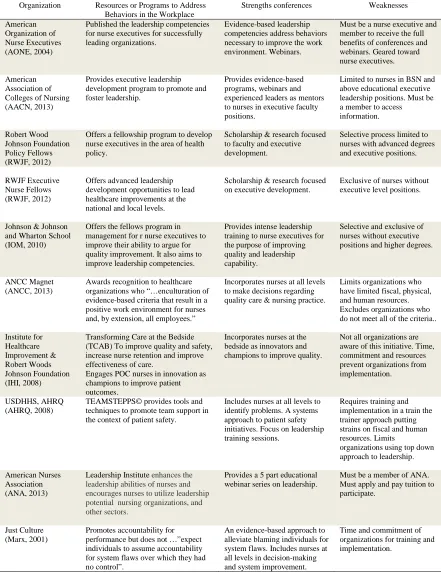
nurse were few, restrictive, and costly. Many of these resources are aimed at the nurse
15 Table 1.1
Organization, Program or Resources Available, and the Strengths and Weaknesses
Organization Resources or Programs to Address Behaviors in the Workplace
Strengths conferences Weaknesses American
Organization of Nurse Executives (AONE, 2004)
Published the leadership competencies for nurse executives for successfully leading organizations.
Evidence-based leadership competencies address behaviors necessary to improve the work environment. Webinars.
Must be a nurse executive and member to receive the full benefits of conferences and webinars. Geared toward nurse executives. American
Association of Colleges of Nursing (AACN, 2013)
Provides executive leadership development program to promote and foster leadership.
Provides evidence-based programs, webinars and experienced leaders as mentors to nurses in executive faculty positions.
Limited to nurses in BSN and above educational executive leadership positions. Must be a member to access information. Robert Wood
Johnson Foundation Policy Fellows (RWJF, 2012)
Offers a fellowship program to develop nurse executives in the area of health policy.
Scholarship & research focused to faculty and executive development.
Selective process limited to nurses with advanced degrees and executive positions.
RWJF Executive Nurse Fellows (RWJF, 2012)
Offers advanced leadership development opportunities to lead healthcare improvements at the national and local levels.
Scholarship & research focused on executive development.
Exclusive of nurses without executive level positions.
Johnson & Johnson and Wharton School (IOM, 2010)
Offers the fellows program in management for r nurse executives to improve their ability to argue for quality improvement. It also aims to improve leadership competencies.
Provides intense leadership training to nurse executives for the purpose of improving quality and leadership capability.
Selective and exclusive of nurses without executive positions and higher degrees.
ANCC Magnet (ANCC, 2013)
Awards recognition to healthcare organizations who “…enculturation of evidence-based criteria that result in a positive work environment for nurses and, by extension, all employees.”
Incorporates nurses at all levels to make decisions regarding quality care & nursing practice.
Limits organizations who have limited fiscal, physical, and human resources. Excludes organizations who do not meet all of the criteria.. Institute for Healthcare Improvement & Robert Woods Johnson Foundation (IHI, 2008)
Transforming Care at the Bedside (TCAB) To improve quality and safety, increase nurse retention and improve effectiveness of care.
Engages POC nurses in innovation as champions to improve patient outcomes.
Incorporates nurses at the bedside as innovators and champions to improve quality.
Not all organizations are aware of this initiative. Time, commitment and resources prevent organizations from implementation.
USDHHS, AHRQ (AHRQ, 2008)
TEAMSTEPPS© provides tools and techniques to promote team support in the context of patient safety.
Includes nurses at all levels to identify problems. A systems approach to patient safety initiatives. Focus on leadership training sessions.
Requires training and implementation in a train the trainer approach putting strains on fiscal and human resources. Limits
organizations using top down approach to leadership. American Nurses
Association (ANA, 2013)
Leadership Institute enhances the leadership abilities of nurses and encourages nurses to utilize leadership potential nursing organizations, and other sectors.
Provides a 5 part educational webinar series on leadership.
Must be a member of ANA. Must apply and pay tuition to participate.
Just Culture (Marx, 2001)
Promotes accountability for performance but does not …”expect individuals to assume accountability for system flaws over which they had no control”.
An evidence-based approach to alleviate blaming individuals for system flaws. Includes nurses at all levels in decision-making and system improvement.
16
Leadership training in North Carolina. Nurse leaders in North Carolina (NC)
thought it imperative that registered nurses at the point of care be afforded the
opportunity to develop leadership skills to become positive change agents for a healthy
workplace. North Carolina offers scarce opportunities for the bedside nurse to further
develop and practice leadership skills that were introduced in theory in their
undergraduate education. A number of other workforce leadership initiatives have been
introduced in NC, but they have operated independently of each other in silos, with the
majority through costly continuing education or membership dues (Table 1.2).
Table 1.2
Leadership Opportunities for Nurses in North Carolina.
Organization Opportunities
North Carolina Nurses Association
(NCNA, 2012)
Leadership Institute provides a series of leadership workshops, assists in sharpening leadership skills. This institute was created in response to the IOM, The Future of Nursing, Leading Change, Advancing Health.
North Carolina Nurses Association
(NCNA, 2012)
Hallmarks of a Healthy Workplace
promote workplaces who utilize leadership skills to create and foster a positive work environment.
NCONL
(NCONL, 2012)
Provides leadership, professional development and advocacy for its members.
Upon review of national, state, regional, and local initiatives it became evident
that a system-wide coordinated, concerted effort was in order to provide frontline
registered nurses in NC opportunities to develop leadership skills. Communication and
17
safety and outcomes (TJC, 2012). According to the TJC (2012), over the past three years
the three most frequent reasons that sentinel events occurred were problems with
communication, leadership, and human factors. In addition, critical to patient outcomes
is the opportunity for bedside nurses to commit to the development of communication
and conflict management skills and a shared vision for a positive change in the workplace
environment.
In collaboration with the North Carolina Future of Nursing Action Coalition,
North Carolina Nurses Association, nurse executives, and clinical nurse specialists,
communication and conflict management were identified and prioritized as the most
critical leadership skills to influence patient outcomes and address problematic behaviors
within the work environment. Nurses are the patient advocates in the healthcare system.
By disseminating recent knowledge to nurses that the toxicity of the workplace is now
impacting the safety of their patients, it is my belief that nurses will be motivated to
transform the work environment if they are made aware of the negative impact of toxic
workplaces on patient safety.
Purpose
The purpose of this project was to determine immediate and short-term outcomes
of an educational leadership workshop for nurses, including: (a) intent to change the work
environment (immediately post workshop); and, (b) action to change the work
environment six weeks later. After a comprehensive review of the literature on
communication, conflict management, educational best practices, transformational
leadership, and systems thinking, a collaborative educational workshop was developed
18 Research Utilization Questions
The research utilization questions that guided this intervention were:
1. What is the relationship between intent to change the work environment and
selected demographic variables (age, race, educational level, position, work
stress, life stress, engagement, and coping behaviors) immediately following
the educational intervention?
2. What is the relationship between communication and conflict management
actions six weeks post intervention and selected demographic variables
(educational level and position)?
Framework Project Development
The concepts of transformational leadership and systems thinking were utilized as
a framework for this project. Exposure to and knowledge of organizational theories gave
the Doctor of Nursing Practice (DNP) an advantage to lead changes in practice, policy,
and new models of care, as well as improve outcomes through best practice (AACN,
2006). DNP prepared nurses will lead the profession in the ever-changing healthcare
environment. Implementing changes by incorporating knowledge of transformational
leadership, complexity, and systems thinking is necessary for the DNP to be successful in
leading organizational change (AACN, 2006). The knowledge and skill attained from the
rigor of the DNP curriculum prepares nurses to lead the transformation of nursing
practice and health care delivery (Montgomery & Porter-O’Grady, 2010). The
transformation will occur through policy change and political activism, improving the
19
providing quality care through dissemination of nursing research (Hathaway, Stegbauer,
& Graff, 2006; AACN Essentials, 2006).
Transformational leadership. Burns (1978, as cited in Bass, 1985) was the first
to compare transactional leadership with transformational leadership and found that
transformational leaders motivated followers to go above and beyond the expected. Bass
(1985) discussed transformational leadership qualities and behaviors necessary for
followers to increase productivity and rise above individual needs for the sake of the
organization or group. Charismatic, inspirational, intellectually stimulating, and provides
individual consideration were the factors that highly correlated with effectiveness and
satisfaction with a leader.
Transformational leaders empower their followers to think creatively,
collectively, and proactively. The motivation of individuals and groups within an
organization by a transformational leader increases productivity, job satisfaction, and
organizational performance (Colbert, Kristof-Brown, Bradley, & Barrick, 2008).
Empowered followers produce innovative results when transformational leaders provide
a high level of psychological empowerment and a safe environment to challenge the
status quo (Colbert, Kristof-Brown, Bradley, & Barrick, 2008; Pieterse, Van
Knippenburg, Schippers, & Stam, 2009). Mentoring, coaching, and communicating a
shared vision are behaviors associated with transformational leadership. These behaviors
motivate, inspire, and encourage followers to value their work, contributions to teams,
and look beyond their individual interest for the good of the team and of the organization
(Munir & Nielson, 2009). The transformational leader must hold internal morals, values,
20
followers (Fu, Tsui, Liu, & Li, 2010). Intrinsic motivation allows the leader to want to
achieve more personally, for the team, and for the organization (Goleman, 1998).
“…followers have keen observational skills, are able to identify leaders’ deep-seated
values, and are affected by what they sense as much as what they see and hear” (p. 249).
Modeling transformational leadership was critical to this project to inspire and motivate
nurses to commit to change the work environment.
Systems thinking. Originally, systems theory was developed by a biologist, von
Bertalanffy (1968), as a “complex of elements in mutual interaction…” and … “each
individual part…depends not only on conditions within the whole, or within
superordinate units of which it is a part” (O’Connor, 2008, p. 315). The central principle
of systems thinking is the ‘whole is greater than the sum of its parts’. Utilizing systems
thinking allows a leader to view a system at macro level to identify issues, stakeholders,
relationships, culture, and solutions. Systems can be described as open or closed. A
closed system has clear boundaries and is subject to disorganization or chaos until it
eventually fails. Open systems have semi-permeable membranous boundaries that
self-regulate in relationship to their environment. Systems are complex intertwined
components that depend on each part for inputs, outputs, and feedback loops to contribute
to the whole system for continual interaction (O’Connor, 2008; Upenieks, Akhavan, &
Kolterman, 2008). A systems approach was selected for this project to look at the big
picture of the toxic work environment and consider the relationships of the interacting
factors for a systems change.
Nursing model. The University of South Alabama College of Nursing Model
21
addition to the model, guidelines are provided by the authors to critique system change
projects. The step-by-step process presented by this model was followed for the evidence
review, development, implementation, and evaluation of this systems-based research
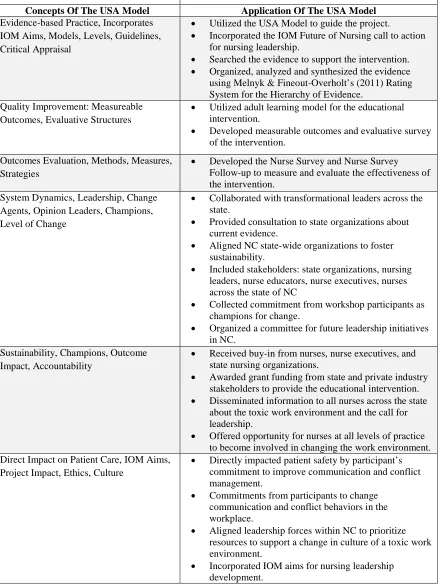
utilization project. A detailed outline of the application of the model as utilized in this
project is presented in Chapter II.
Discussion of Practice Innovation
This project was a state-wide effort in NC to engage nurses at all levels of
practice in skill building activities needed to improve the toxic work environment.
Creating partnerships that include all stakeholders and aligning state-wide organizations
will foster sustainability of a state-wide initiative to change the toxic work environment.
In reviewing prior initiatives, the inclusion of all nurses regardless of position or
membership was often lacking. In order to address the toxic work environment and
positively impact patient outcomes, bedside nurses must be given the opportunity to
develop self-awareness of their own behavior, strong communication and conflict
management skills, and leadership skills that will allow them to initiate change in their
work environment. The purpose of this project was to determine immediate and
short-term outcomes of an educational leadership workshop for nurses, including: (a) intent to
change the work environment (immediately post workshop); and, (b) action to change the
work environment six weeks later.
Conclusion
The number of national initiatives instituted to address health care work environments
attest to the priority of the problem and the urgency to solve it. The aforementioned
nursing organizations have developed standards, policies, resources, and programs, some
22
dissemination, and access. The target audience may be the nurse executive or the bedside
nurse. Ultimately, the knowledge embedded in these initiatives must be applied to
individuals within health care systems. This project specifically addresses the nurse at the
point of care as the recipient of an evidenced based intervention to empower change in
23 CHAPTER II
REVIEW OF THE LITERATURE
Introduction
The purpose of this project was to determine immediate and short-term outcomes
of an educational leadership workshop for nurses, including: (a) intent to change the work
environment (immediately post workshop); and, (b) action to change the work
environment six weeks later. This purpose is consistent with the call to action issued by
the IOM Future of Nursing document (2010). Chapter II provides a discussion of the
theoretical model guiding the project, description of the search process, identification of
the relevant literature, analysis of the literature, and statements of best practice drawn
from the literature.
The University of South Alabama College Of Nursing Systems Change Model
(USA Model) was used to guide the search process and organize the literature analysis
because it contained the essential intersecting constructs needed to implement a complex
systems level change project (Beene, 2011). At the core of the USA Model is the
construct of a systems change project. The surrounding constructs are evidence based
practice, quality improvement, direct impact on patient care, outcomes evaluation, system
dynamics, and sustainability. The USA Model does not propose relationships. Rather, it
identifies the elements necessary to implement a systems change project. Each of these
constructs has concepts subsumed under it. Figure 2.1 displays the constructs and
24
Figure 2.1. The University of South Alabama College Of Nursing Systems Change Model
From Project Planning and Management: A Guide for CNLs, DNPs, and Nurse Executives (p.86), by J.L. Harris, L. Roussel, S. E. Walters, & C. Dearman, 2011, Sudbury, MA: Jones & Bartlett. Copyright 2011 by Jones & Bartlett Learning, LLC. Reprinted with permission.
1
Evidence-based Practice, Incorporates IOM Aims,
Models, Levels, Guidelines, Critical
Appraisal
2
Quality Improvement: Measureable Outcomes, Evaluative
Structures 5
Sustainability, Champions, Outcome Impact, Accountability
6
Direct Impact on Patient Care, IOM
Aims, Project Impact, Ethics,
Culture System Change
Project Practice Focus
4
System Dynamics, Leadership, Change
Agents, Opinion Leaders, Champions,
Level of Change
3
Outcomes Evaluation, Methods, Measures,
25 Search Process
Because of the complexity of this model, multiple concepts were used in the
search process. Articles of interest included those related to communication, conflict
management, empowerment, and best educational practice. Also included were articles
related to systems thinking and transformational leadership consistent with the USA
Model.
A search for appropriate and pertinent articles was performed from the disciplines
of nursing, allied health, psychology, business, education, and medicine. Databases
searched for nursing, medicine and allied health included CINAHL Plus with Full Text
PubMed, Health Reference Center and Health Source: Nursing & Academic Edition
Medline, JoAnna Briggs Institute and Cochrane Library. Psychology articles were
searched in PSYCHinfo, Psychology & Behavior Sciences Collection, Annual Reviews
and ASSIA. The business databases searched included ERIC, Business and Company
Resource Premier, and Business Source Premier. Educational databases included in the
search were Academic Search Premier. ProQuest and Google Scholar were also included
in the search. The following professional organizations’ websites were searched for
pertinent information related to the concepts of this project:
• American Nurses Association
• American Association of Critical Care Nurses
• American Association of Colleges of Nursing
• National League for Nursing
• Association of Operating Room Nurses
26
• Agency for Healthcare Research and Quality
• Institute for Healthcare Improvement
• Robert Woods Johnson Foundation
• The Joint Commission
• Institute of Medicine
These organizations were included in the search because of their current
initiatives to provide resources for the development of leadership skills for nurses.
Articles were selected if they were written English and contained concepts consistent
with the USA Model. No date restrictions were initially selected due to the history of the
problem and the need to capture early work in the area. Commentary and opinion articles
related to the concepts were also selected. Although opinion and commentary are not
research based, they do provide interesting solutions to the problem. These articles and
reports are considered credible due to the experts involved in producing them. A myriad
of individual and combined search terms were used for each concept. In addition, there
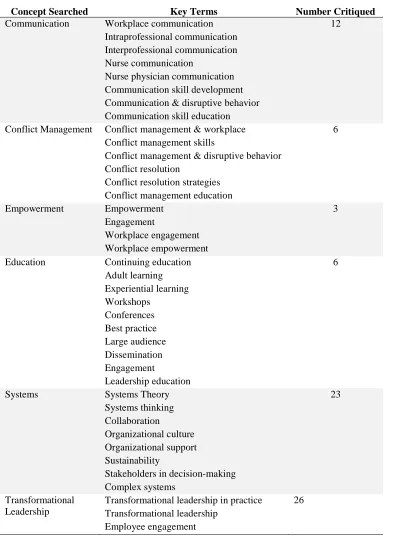
was overlap with articles pertaining to these concepts. Table 2.1 presents key search
terms and the number of articles analyzed for review. In addition to the utilization of
search engines and databases, a hand search of retrieved articles was used to identify new
27 Table 2.1
Concepts Searched, Key Terms and Number of Articles Critiqued.
Concept Searched Key Terms Number Critiqued
Communication Workplace communication
Intraprofessional communication Interprofessional communication Nurse communication
Nurse physician communication Communication skill development Communication & disruptive behavior Communication skill education
12
Conflict Management Conflict management & workplace Conflict management skills
Conflict management & disruptive behavior Conflict resolution
Conflict resolution strategies Conflict management education
6
Empowerment Empowerment
Engagement
Workplace engagement Workplace empowerment
3
Education Continuing education
Adult learning Experiential learning Workshops Conferences Best practice Large audience Dissemination Engagement Leadership education 6
Systems Systems Theory
Systems thinking Collaboration
Organizational culture Organizational support Sustainability
Stakeholders in decision-making Complex systems
23
Transformational Leadership
Transformational leadership in practice Transformational leadership
Employee engagement
28 Analysis of the Literature
Melnyk and Fineout-Overholt’s (2011) Rating System for the Hierarchy of
Evidence for Intervention / Treatment Questions (Melnyk’s levels of evidence) was used
to appraise the evidence (Appendix Table B.1). This hierarchy of evidence Level I-VII
rating system was used to assign each article a quality of evidence rating. Quantitative
studies were appraised for validity, reliability, and applicability. Three questions were
used to critique each article (O’Mathuna, Fineout-Overholt, & Johnston, 2011): (a) Are
the results of the study valid?, (b) What are the results?, and (c) Will the results assist to
guide the implementation of the project? The evidence is organized around the constructs
found in the USA Model and is further delineated by concepts of this project. Each table
contains the brief reference, level of evidence, study type, methods, sample, and
conclusions (Appendix Table C.1, C.2, C.3, C.4, C.5).
Concepts of Communication, Conflict Management and Empowerment
The need for the development of communication, conflict management, and
empowerment skills in the healthcare setting was addressed in the IOM Future of Nursing
(2010) report and prioritized by TJC Leadership Standards (2009). These documents
were reviewed in accordance with the hierarchy of evidence and are considered level VII
evidence. Literature pertaining to the concepts of communication, conflict management,
and empowerment were searched for evidence of quality improvement measures and
recommendations using 1 and 2 of the USA Model. Two of the three level V literature
reviews (Brinkert, 2010; Manojlovich, 2010) discussed the concepts of communication in
nursing and patient safety. These reviews recommended providing education and training
29
direct measures of conflict and communication interventions in order to build on the
knowledge of best practices.
In a review of business literature related to communication and conflict
management, Conrad and Newberry (2012) concurred with Brinkert (2010) and
Manojlovich (2010) that direct measures and education are necessary for communication
skill development. They further encouraged academia and business to work together to
develop curricula for contemporary practice. One level VI descriptive study by Tabak
and Koprak (2007) explored the tactics of conflict management skills used during
physician and nurse interactions. A statistically significant negative Pearson correlation (r
= - .25) (p =0.01) was reported between an integrating/dominance conflict management
style and the nurses’ level of stress. When nurses take control of the conflict resolution.
the nurse’s stress level is less. In contrast, an avoidance conflict management style (r
=.31), (p =0.001) was associated with an increased stress level. These authors agreed that
nurse managers should be afforded the opportunity to study conflict resolution,
collaboration. and cooperation. Baldwin and Daugherty (2008) concurred with the idea
that communication and conflict greatly impact patient safety. In addition to this idea, the
authors emphasized the necessity of organizations developing no tolerance for behaviors
that jeopardize patient safety.
Four level VI descriptive studies utilized self-reflective exercises such as case
studies and story-telling as interventions for improving communication and conflict
management (Cathcart, Greenspan, & Quin, 2010; Cleary, Freeman, & Sharrock, 2005;
Duddle & Broughton, 2007; White & Featherstone, 2005). Cathcart et al. (2010), in a
30
relational communication. They concluded that reflecting and articulating on experiential
learning strengthens and embeds knowledge and clinical judgments. White and
Featherstone added that listening, in addition to storytelling and reflection, is an essential
communication tool. Cleary et al. (2005) conducted a structured clinical leadership
program. Using the 30-item Nurse’s Self Concept Questionnaire (NSCO) and a pre-post
design, the authors discovered that leadership development for all participants was
beneficial. They reported a post-intervention increase for 15 items on the NSCO. Five of
these items directly measured leadership skill.
Duddle and Broughton (2007) conducted an explanatory case study about how
nurses relate and interact with each other. Three themes that emerged were a description
of interactions in the workplace as “difficult”, nurses negotiate the territory before
deciding to manage the conflict or avoid it, and resilience as a coping factor. They
concluded that creating positive work environments and appreciation of the factors that
cause conflict provides hope for a change in the workplace.
Eddy et al. (2007) investigated the concept of empowerment to better understand
communication and conflict management by nurses. This level VI descriptive qualitative
study and three quantitative level VI descriptive studies were reviewed. Armstrong and
Laschinger (2006) and Boev (2012) discussed the necessity of communication and
conflict management skills to increase nurse empowerment, thereby improving patient
safety. Sorenson, Iedema, and Severinsson (2008) added to the complexity of
communication issues in the workplace. They presented the hierarchical structure of
31
must operationalize nursing leadership knowledge and develop sophisticated
communication skills in order to become full partners in healthcare.
Whitworth (2008), in a level VI descriptive study, explored the influence of
personality on conflict management skills. There was no statistically significant
relationship between conflict resolution style and personality type. This finding gives
credence to the principle that conflict resolution skills can be taught and learned.
The majority of the aforementioned literature consists of level VI & VII evidence.
However, it is imperative to find a resolution to the negative work environment.
Knowledge development in this area is in its infancy and evidence from descriptive
studies and nurse experts is valuable and a reasonable place to start. The literature
supports the implementation of an educational intervention that addresses communication
and conflict management for nurses. The evidence further supports that such an
educational intervention will empower nurses to change the way in which they
communicate and manage conflict. Additionally, educational interventions that include
experiential learning, story-telling, and self-reflection for the development of these skills
helps the nurse to operationalize knowledge gained from the education experience.
Concept of Best Educational Practice
The USA Model construct 3 included a search for educational best practice.
Although the majority of evidence for the concept of educational best practice is level VI
and VII, these authors provide expert guidance on the best methods of delivering
leadership education. Two level VI articles of single descriptive studies (Sandau & Halm,
2011; Shekleton, Preston, & Good, 2010) offered education in a workshop format.
32
the hospital setting. The workshops had a positive influence on increasing knowledge,
skills, and attitudes of preceptors and orientees. Shekleton, Preston, and Good offered a
three day, eight hours per day workshop for CRNAs. The intent of the workshops was for
the development of leadership skills. Shekleton added the importance of incorporating
adult learning theory in the delivery of workshops.
Two level VII articles (Price, 2010; Swearingen, 2009) and one book (Knowles,
2005) of expert opinion discussed adult learning and the impact of a workshop format.
Best educational practice for adult learning is participation in active learning. Workshop
format facilitates adult learners sharing and drawing on life experience and knowledge
(Knowles, 2005). Price (2010) concurred with Knowles’ idea of active learning,
collaborative learning, and workshop formats to deliver education. The author
recommended case studies and target skills as a strategy to focus the workshop.
Engagement occurs through the use of reasoning and emotions and actions that are
brought together for discussion and analysis. Workshops can be used to refine, clarify, or
enhance the skills and knowledge participants already have. Leaders are required to
design and support activities rather than deliver information. Other benefits are that
workshops provide insight into a focused area of work and the ways in which reflection,
reason, and action can be combined. Workshops are more focused on the development of
knowledge, encouraging inquiry, and development of skills, than disseminating large
amounts of information (Knowles, 2005 & Price, 2010). Price added that barriers cited
include participants may not discover or achieve goals of the workshop and that the
33
Swearingen (2009) added to the recommendations of Price and Knowles, noting
that formal training for nursing leadership positions is scant or frankly absent in many
institutions. The author called for innovative leaders to attract and retain nurses to ensure
quality care for patients. The author recommended building a leadership development
curriculum that begins at the point of care nurse and builds upward. In addition,
Swearingen cautioned that the information must be relevant to day-to-day work in order
to engage nurses in the process, suggesting conflict management, team building,
communication, assertiveness, ethics, and patient satisfaction as relevant content. Three
eight hour classes were recommended over 3 months as a format for the workshop
sessions.
In contrast, Eddy et al. (2007), in a level VI single descriptive study,
recommended the development of a graduate level leadership curriculum targeted for
clinical practice nurses. The authors argued that a graduate leadership curriculum is
needed for the future of nursing leadership. This recommendation gives credibility to the
notion that there is a gap in leadership skill development in nursing education.
The evidence strongly supports educational offerings through workshops. The
literature supports workshops as a viable approach to disseminate knowledge and develop
skills. In addition, active learning in three eight hour workshops incorporating relevant
work issues engages learners in how to address the negative work environment. Three
eight hour workshops provide the learner an opportunity to process what was learned in
34
Concepts of Systems Thinking and Transformational Leadership
Literature pertaining to the concepts of systems thinking and transformational
leadership were searched for evidence of system dynamics and leadership following
construct 4 of the USA Model. The call for nurse leaders is not a new phenomenon.
Porter-O’Grady (2001) called for a paradigm shift in nursing leadership. The author
refers to the healthcare environment in which nurses practice as an institution and
dramatically depicts the workplace as lacking forward thinking and innovation. In 2003,
Porter-O’Grady called for a new skill set for nurse leaders to model transformation in the
work setting by repositioning the bedside nurse from the bottom of the organizational
pyramid to the center. Currently, few initiatives empower bedside nurses to develop
leadership skills.
In concert with Porter-O’Grady, a substantial amount of level V, VI, and VII
evidence supports the need for systems thinking and transformational leadership. Two
level V systematic reviews (Cummings et al., 2008; Pearson et al., 2007) provided a
foundation for the future development of nurse leaders and interventions to improve the
workplace. Both articles identified the essential leadership characteristics for nursing
leadership development. Pearson et al. (2007) identified attributes of leaders that impact a
healthy change in the workplace environment: (a) interdisciplinary collaboration, (b)
education of the leader, (c) emotional intelligence to include the ability to engage and
motivate, communicate, and manage conflict, (d) understanding of organizational climate
and structure, (e) continued professional development related to leadership, (f) expertise
in staff professional development and mentorship, and (g) qualities and behaviors of the