Optimum Design of Steel Moment Resisting
Frames Subjected to Seismic Excitation
G. Lalitha
1, K.Suresh
2K.Vijaya Bhaskar Reddy
3PG student, Dept. of Civil Engineering, CMRCET, Kandlakoya, Hyderabad, India1
Associate Professor and HOD , Dept. of Civil Engineering, CMRCET Kandlakoya, Hyderabad, India2
Professor Dept of Civil Engineering CMRCET, Kandlakoya, Hyderabad, India3
Abstract: The main aim of this project is to develop an interior penalty function (IPF) based algorithm to multi-storey steel frames for minimum weight of frames. The frames are intended for resisting lateral sway due to seismic loading along with gravity forces. Many structural systems are used for resisting seismic (lateral) forces; however steel moment resisting frames (MRF) are considered for the present work. The design methodology incorporates codal provisions of IS 800-2007, thereby obtains the frames with optimum weight for in-plane moments with lateral support of beam elements. Strength and buckling criteria are considered as behaviour constraints along with side constraints in formulating optimization problem. A computer program is developed that uses an interior penalty function (IPF) for weight minimization of two-dimensional moment resisting steel framed structures. The program uses MATLAB, performs one dimensional search, and structural design in an iterative procedure. The design examples have shown that the proposed algorithm provides an efficient tool for the practicing structural engineers. The program is applied to 6 and 9 storey (4 bays) moment resisting frames (MRFs). The program demonstrated its capability of optimizing the weight of two medium size frames. To obtain member forces in frames an analysis procedure has to be applied. In the present work Equivalent Lateral Force procedure (ELF) and material nonlinear time history analysis (NTH) are applied and optimum values obtained from both the analyses are compared.
Keywords:Text detection, Inpainting, Morphological operations, Connected component labelling.
I. INTRODUCTION
II. LITERATUREREVIEW
Considerable research has been conducted on the behaviour of steel moment resisting frames (MRF) and optimization techniques for minimum weight design under seismic ground excitation. Because of the rapid evolution of codes, much of this research is not necessarily consistent with modern construction detailing; however, many of the fundamental observations from these investigations are relevant to an assessment of modern design and analysis procedures. The available collection of literature extends over several decades and is rapidly growing. As such, it cannot adequately be summarized in a brief chapter. Instead, an overview of major references is provided here along with useful citations to previous works that contain detailed reviews of related literature.
The literature review in this chapter is separated below into two categories:
(i) Optimization of steel frames, which examines references that describe the optimum design of framed/braced steel structures of recent earthquakes in the United States, Mexico, Japan and India. (ii) Moment resisting frames, which discusses the previous experimental and analytical works on moment
resisting braced frames relevant to seismic applications.
Considerable literature also exists on numerical modeling of buckling restrained braces, anticipation of performance and behavior of various configurations of braced-frame/framed systems, and sensitivity of behavior to various ground motion and structural characteristics. This literature will not be reviewed in this chapter, but rather distributed throughout the remainder of the report where these particular topics are considered.
III.ANALYSISPROCEDURE
The job of a structural engineer is to ensure that the buildings modelled are built to withstand the tests of time and nature. And because of such, it has been proven necessary to apply a number of analysis techniques in building designs. Such two techniques presented in this work are time history analysis, a performance based analysis technique, and ASCE 7‐10’s Equivalent Lateral Force (ELF) procedure. The latter is a procedure that is analysed to mimic real loads caused by earthquakes, while the former is meant to test the building performance against an actual earthquake excitation. Six and nine-storey steel building frames were analysed according to both analysis procedures. The goal is to determine which method of analysis will produce the best results with the most minimal analysis specifications.
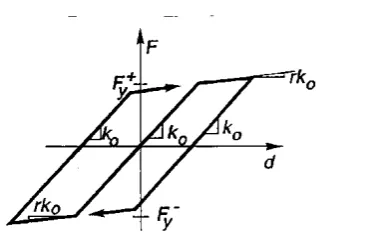
Figure 3.1 The simplest hysteretic model with no stiffness shown after yielding.
The design of MRFs is governed by Indian building code and recommended provisions are available in literature. Structural Engineers Association of California (SEAOC) group in association with various research agencies developed the recommendations.
The design dead and live loads of 9.87 kN/m and 13.77 kN/m respectively were used for analysis and design of above referred frames. The damping ratio for dynamic analysis was assumed to be 5% of the critical damping. The importance factor of 1.0 and zone factor 0.36 was used to obtain design base shear. The beams and columns were designed as per IS: 800-2007 and seismic provisions of IS: 1893 (Part-1)-2002. The MRFs were designed as per FEMA-450, in which the response modification factor 5 for MRFs. The yield stress of the structural steel was taken as 250MPa.
The considered model building frames details are given in table 3.1 and elevations are shown in Figures 3.2.1- 3.2.2.
Table 3.1 Steel Model Building Frame Details.
Model Building
Frame No. of Storeys
Storey Height
(m) No. of Bays Bay Width (m)
Total Frame Height(m)
MRF6 6 3.000 4 7.000 18.000
MRF9 9 3.000 4 7.000 27.000
IV.EXPERIMENTAL RESULTS
Design Variables and Objective Function Values for Six Storey MRF using ELF Procedure
Floor - 6 (Roof)
Column No
Design variables
Ø-Values
x1 (mm)
x2 (mm)
x3(mm)
x4 (mm)
(kg)
6
10.685
179.512
10.258
430.830
195.659
12
6.000
91.555
6.000
219.731
57.284
18
6.000
65.778
6.000
157.867
41.156
24
6.000
72.522
6.000
174.053
45.376
30
10.774
180.996
10.343
434.391
198.907
Total (kg)
538.382
Beam No
36
11.855
222.867
10.613
445.733
553.798
42
11.650
219.023
10.430
438.046
534.861
48
11.493
216.075
10.289
432.150
520.558
54
10.727
201.675
9.604
403.349
453.486
Total (kg)
2062.702
V. CONCLUSION
From the results obtained from the newly developed algorithm using interior penalty function method the following conclusions can be drawn;
ELF procedure is more conservative in comparison with Non-Linear Time History (NTH) analysis for the steel Moment Resisting Frames (MRFs) subjected to seismic loading along with gravity forces.
In multi storey steel frames the cost function decreases with the increase of floor height for low rise frames. For medium rise frames it decrease in moderate.
REFERENCES
[1] M. Bertalmio, G. Sapiro, V. Caselles, and C. Ballester, “Image inpainting”, in Proc. SIGGRAPH, pp. 417–424, 2000.
[2] A. Criminisi, P. Perez, and K. Toyama, “Region filling and object removal by exemplar-based image inpainting.”, IEEE Transactions on Image Processing, vol. 13, no.9, pp. 1200–1212, 2004.
[3] Marcelo Bertalmio, Luminita Vese, Guillermo Sapiro, Stanley Osher, “Simultaneous Structure and Texture Image Inpainting”, IEEE Transactions On Image Processing, vol. 12, No. 8, 2003.
[4] Yassin M. Y. Hasan and Lina J. Karam, “Morphological Text Extraction from Images”, IEEE Transactions On Image Processing, vol. 9, No. 11, 2000
[5] Eftychios A. Pnevmatikakis, Petros Maragos “An Inpainting System For Automatic Image Structure-Texture Restoration With Text Removal”, IEEE trans. 978-1-4244-1764, 2008
[6] S.Bhuvaneswari, T.S.Subashini, “Automatic Detection and Inpainting of Text Images”, International Journal of Computer Applications (0975 – 8887) Volume 61– No.7, 2013
[7] Aria Pezeshk and Richard L. Tutwiler, “Automatic Feature Extraction and Text Recognition from Scanned Topographic Maps”, IEEE Transactions on geosciences and remote sensing, VOL. 49, NO. 12, 2011
[8] Xiaoqing Liu and Jagath Samarabandu, “Multiscale Edge-Based Text Extraction From Complex Images”, IEEE Trans., 1424403677, 2006
[9] Nobuo Ezaki, Marius Bulacu Lambert , Schomaker , “Text Detection from Natural Scene Images: Towards a System for Visually Impaired Persons” , Proc. of 17th Int. Conf. on Pattern Recognition (ICPR), IEEE Computer Society, pp. 683-686, vol. II, 2004
[10] Mr. Rajesh H. Davda1, Mr. Noor Mohammed, “ Text Detection, Removal and Region Filling Using Image Inpainting”, International Journal of Futuristic Science Engineering and Technology, vol. 1 Issue 2, ISSN 2320 – 4486, 2013
[11] Uday Modha, Preeti Dave, “ Image Inpainting-Automatic Detection and Removal of Text From Images”, International Journal of Engineering Research and Applications (IJERA), ISSN: 2248-9622 Vol. 2, Issue 2, 2012