ISSN: 2319-8753
I
nternational
J
ournal of
I
nnovative
R
esearch in
S
cience,
E
ngineering and
T
echnology
(An ISO 3297: 2007 Certified Organization)
Vol. 2, Issue 10, October 2013
Production of Bioethanol from hitherto
underutilized agro waste (Field beans/Green
Pea pods waste) incorporating zero waste
generation technique
Upendra R.S
1, Pratima Khandelwal
2, Priyanka.S
3, Jagadish M L
3, Nandhini N J
3Assistant Professor
1,
Prof & Head
2, Dept. of Biotechnology, New Horizon College of Engineering,
Bangalore, Karnataka, India
1&2BE (Biotechnology), New Horizon College of Engineering, Batch
3(2009-2013), Bangalore, Karnataka,
India
3Abstract: With the inevitable depletion of world’s energy supply, there has been an increasing interest worldwide in
alternative sources of energy. Unlike fossil fuels, ethanol is a renewable energy source produced through fermentation of sugars and can be used as a partial gasoline replacement. Bioethanol market is expected to reach 100 x10^9 liters in 2015. Currently, bioethanol is being commercially produced only from edible feedstock such as corn-starch and sugarcane juice. These bioethanol production systems pose a concern about the rising competition with food and feed supplies. Agro-waste wastes are generated in large amounts throughout the year, and are the most abundant renewable resources on earth. Due to the large availability and rich in composition of polymers that could be used in other processes, there is a great interest on the reuse of these wastes, both from economical and environmental view points. Very scanty research documents were reported on using alternative sources like Agro- waste for the production of bioethanol. With these lacunae the present investigation aimed in using agro-waste, a rich energy source to produce bioethanol. A suitable low cost anaerobic fermenter was designed and fabricated for bioethanol production under submerged culture conditions using Yeast (Saccharomyces cerevisiae). Agro waste biomass (field bean pods, field bean seed coat and green peas pods) was pre-treated (physical and mild acid treatment) and saccharified using consortium of fungal strains (Aspergillus sp.). On completion of the process, 90g of glucose/ kg was obtained. Glucose obtained was taken for the SmF process using Saccharomyces cerevisiae and the end product ethanol was estimated qualitatively and quantitatively by specific gravity method, 7.725g in comparison with the weight of pure ethanol 7.639 and Gas Chromatography (70.2% ethanol). A Conversion rate of, 250 ml of ethanol /kg of agro waste calculated. The spent yeast was dried (50g/litre) and used as peptone.
Key words: Agro-Waste, Bioethanol, Aspergillus sp., Saccharomyces cerevisiae, Gas Chromatography
I. INTRODUCTION
ISSN: 2319-8753
I
nternational
J
ournal of
I
nnovative
R
esearch in
S
cience,
E
ngineering and
T
echnology
(An ISO 3297: 2007 Certified Organization)
Vol. 2, Issue 10, October 2013
Current ethanol production based on corn, starch and sugar substances may not be desirable due to their food and feed value [7]. It has been estimated that 442 billion liters of bioethanol can be produced from lignocellulosic biomass and that total crop residues and wasted crops can produce 491 billion liters of bioethanol per year, about 16 times higher than the actual world bioethanol production [8].
Biomass is a potential renewable energy source that could replace fossil energy for transportation. The use of food crops (like corn, maize, sorghum) for biofuel production may cause inflation of cost of these crops leading to food insecurity [9]. To alleviate such problems, alternative and non-edible agricultural products must be investigated. This brings us to the focal point of our project. The production of field beans and green peas is abundantly done in the region of Karnataka. 70% of the produce results in agro-waste, which is later used as animal fodder or discarded as garbage (solid waste) [4].
Table 1: Solid waste physical composition tabulated by BBMP (2009)
(Source: http://218.248.45.169/download/health/swm.pdf)
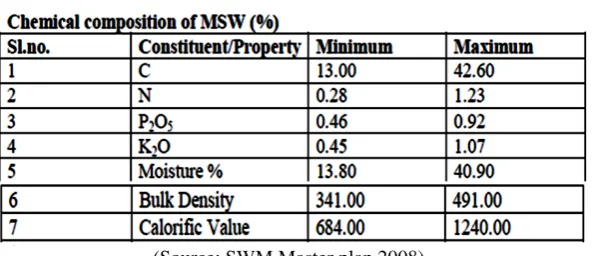
Table 2: Solid waste chemical composition tabulated by BBMP (2009)
(Source: SWM Master plan 2008)
The solid waste of field bean pods, field bean (Vicia faba) seed coat and green pea (Pisum sativum) pods are very rich in cellulose, hemicellulose and lignin. Thus, they can be transformed into being renewable resources for the production of ethanol. The above two type of solid agricultural waste is utilized as the starting material in our project.
II. MATERIALS AND METHODS
ISSN: 2319-8753
I
nternational
J
ournal of
I
nnovative
R
esearch in
S
cience,
E
ngineering and
T
echnology
(An ISO 3297: 2007 Certified Organization)
Vol. 2, Issue 10, October 2013
Culture maintenance: The yeast cultures Saccharomyces cerevisiae was maintained on yeast extract-malt extract-agar (YMA)medium. The liquid medium for the growth of inoculum is yeast extract-malt extract-peptone-glucose medium (YMP) [10]. The cultures (newly discovered strains) of Aspergillus terreus (nhceup) MTCC-11045, Aspergillus
terreus (NHCEUPBT) MTCC-11395, Aspergillus flavus(NHCEUPBTE) MTCC-11396 were employed in the present
study. All the cultures were initially screened for contamination and the pure cultures were maintained on potato dextrose agar (PDA) medium slants at 4°C and subcultured in 30-day intervals [11],[12].
Raw material: The three major agro-wastes to be procured were field bean pods, field bean seed coat and green pea pods. They are favourable for bioethanol production due to their availability throughout the year.
Pre-treatment by mechanical size reduction: The raw materials (agro wastes - field bean pods and green pea pods) procured were taken into a dry mixer jar and on application of power; the particle size was reduced to 0.8 and 3.2 mm [13].
Chemical (acid) pretreatment: 0.4% w/w of Sulphuric acid was added to physically pretreated substrates (agro wastes - field bean pods and green pea pods) and the contents were mixed thoroughly. The mixture was left for 18 hours at 210o C. After the time period, the mixture was neutralized to 7.7 pH using 0.1N NaOH [14], [15].
Biological pre-treatment: Saccharification process (Solid State fermentation): Neutralized treated biomass (agro wastes - field bean pods and green pea pods) was added with Aspergillus Sp (Aspergillus niger, Aspergillus terreus 11045, Aspergillus terreus 11345 and Aspergillus flavus 11396) mixed consortium and kept at room temperature for saccharification process (SSF). After the saccharification process, glucose was extracted and estimated by DNS method [16].
Extraction of glucose from saccharified agro wastes (field bean pods and green pea pods): The extractives are measured by exhaustive Soxhlet extraction of the biomass using ethanol as solvent. Agro-wastes (field bean pods and green pea pods) sample is weighed accurately (10g) and transferred into a 250ml round bottom flask with this 100 ml of ethanol is added. The reflux condenser is attached and digested for 3 hours over a heating mantle. After 3 hours the material is washed with distilled water and oven dried for 1 hour [17].
Estimation of glucose: The Glucose Extracted from the saccharified material was estimated using well known DNS method [18].
Submerged Fermentation process (SmF):The glucose extracted and quantified after the saccharification process was diluted to 60% and the SmF process were carried out using Saccharomyces cerevisiae in self designed and fabricated low cost fermentor [5].
Qualitative confirmation of bioethanol: The alcohol was separated from the water by distillation. The specific gravity of the distilled alcohol is then determined with a Specific gravity bottle method. Specific gravity of the liquid was determined by finding the ratio of the liquid and the weight of the distilled water at the same temperature in a specific gravity bottle. Initially the weight of the empty specific gravity bottle was found out followed by the weight of the bottle with the sample and later weight of the bottle with distilled water. The specific gravity of alcohol was then calculated using the given formula:
W2-W1
---X Density of water at Specific Gravity W3-W1
W1- weight of empty specific gravity bottle W2- weight of bottle with sample
ISSN: 2319-8753
I
nternational
J
ournal of
I
nnovative
R
esearch in
S
cience,
E
ngineering and
T
echnology
(An ISO 3297: 2007 Certified Organization)
Vol. 2, Issue 10, October 2013
Percentage of alcohol was read against the corresponding value of specific gravity association of analytical chemistry chart (AOAC) [19], [20].
Quantative estimation by gas chromatography (GC): To authenticate the qualitative and quantitative properties of Bioethanol, Gas Chromatography (GC) was performed. Analysis of Bioethanol was conducted using SRI GC model 8610C, equipped with a 60 m column (Restec MXT-1, Id0.53 mm, 5 µM), on-column injector and FID conditions: 250°C; H 2, 25 PSI, equivalent to 25 ml/min; air, 2 PSI, equivalent to 100 ml/min; gain set to 'medium'. The GC was also equipped with an internal air compressor and hydrogen generator. N2 was used as carrier gas with pressure control (24 PSI constant; equivalent to 27ml/min). The GC was connected to a computer running Peak Simple software version 2.8. Oven temperature (and hence column and injector temperature) was initially set at 50°C and then elevated at the rate of 7°C/min to 100°C, thus giving a total run time of 20 min. Furthermore, 2 µL sample was injected manually at time 0, using a 5 µl hamilton syringe and temperature cycle was started. Syringe was thoroughly washed with ethyl acetate between injections to avoid cross-contamination. Each injection was repeated three times, ethanol routinely came out at retention time equivalent to 65°C [21].
III. RESULTS
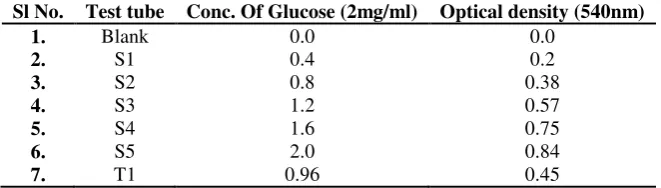
Estimation of glucose: Extracted glucose was estimated using DNS method. 90g of glucose/ kg of agro waste, was obtained
Table 3: Glucose estimation by DNS method (Table 3)
Sl No. Test tube Conc. Of Glucose (2mg/ml) Optical density (540nm)
1. Blank 0.0 0.0
2. S1 0.4 0.2
3. S2 0.8 0.38
4. S3 1.2 0.57
5. S4 1.6 0.75
6. S5 2.0 0.84
7. T1 0.96 0.45
Qualitative confirmation of bioethanol: The alcohol was separated from the water by distillation. The specific gravity of the distilled alcohol is then determined with a Specific gravity bottle method (Table 4).
Table 4: Specific gravity method for ethanol
Sl No Gravity bottle type Weight in grams
1. Weight of empty specific gravity bottle 19.405 g 2. Bottle + Distilled water 9.050 g
3. Bottle + Sample 27.13 g
4. Bottle + Pure Ethanol 27.044 g
5. Weight of Sample 7.725 g
6. Weight of Pure Ethanol 7.639 g
ISSN: 2319-8753
I
nternational
J
ournal of
I
nnovative
R
esearch in
S
cience,
E
ngineering and
T
echnology
(An ISO 3297: 2007 Certified Organization)
Vol. 2, Issue 10, October 2013
[1A]
[1b]
Fig-1: 1A) GC analysis of Standard ethanol showing peak at 4.589.1B) GC analysis of Sample ethanol showing peak at 4.587.
IV. DISCUSSION
On the onset of this project, the existing lacunae were understood, based on the review of literature, objectives were derived and successfully achieved at the end of the project. The designing fabrication of a suitable low cost anaerobic fermenter for Bioethanol production under submerged culture conditions was done. On procuring the raw materials (1kg), a process of pre-treatment (physical and mild acid treatment) was employed, giving rise to 632gm of substrates. Saccharification by SSF using a consortium of fungal strains (Aspergillus sp.) was done using the substrates. On completion of the process, we obtained 90g of glucose/ litre (estimation done by DNS method) and 100 gms/ litre of biomass was obtained. This was taken in for the next step, i.e. fermentation process using Saccharomyces cerevisiae
ISSN: 2319-8753
I
nternational
J
ournal of
I
nnovative
R
esearch in
S
cience,
E
ngineering and
T
echnology
(An ISO 3297: 2007 Certified Organization)
Vol. 2, Issue 10, October 2013
V. CONCLUSIONS
The use of alternate sources (hitherto underutilized agro-waste-field bean pods and green pea pods) for the production of ethanol has been found to be economical and effective. This way of utilizing the solid waste that are very rich in cellulose, hemicellulose and lignin, gives rise to zero waste generation techniques. Also, the by-products and residue obtained after each process are treated and used as fodder and peptone. The effective utilization of the agro waste collected (field bean pods and green pea pods) gave rise to 70.2% ethanol.
VI. ACKNOWLEDGEMENT
We owe a great many thanks to KSCST who selected and supported to carry out the project successfully. We wish to express our sincere gratitude to Chairman and Principal, New Horizon College of Engineering, Bangalore for providing us with all facilities to undertake research.
REFERENCES
[1] Sun, Y. and Cheng, J., Hydrolysis of lignocellulosic materials for ethanol production: a review. Bioresource Technology, Vol.83, pp.1-11, 2002.
[2] Oliveria, M., Vaughan, B. and Rykiel, J., Ethanol as fuel: energy, carbon dioxide balances, and ecological footprint. BioScience, Vol.55, pp.593-602, 2005.
[3] Kefale A, Mesfin Redi and Araya Asfaw., Potential of Bioethanol Production and Optimization Test from Agricultural Waste. The Case of Wet Coffee Processing Waste (Pulp). International Journal of Renewable Energy Research, Vol.2, Issue.3, pp.446-450, 2012. [4] Govindaswamy, S. and Vane, L., Kinetics of growth and ethanol production on different carbon substrates using genetically engineered
xylose-fermenting yeast. Bioresource Technology, Vol.98, pp. 677-685, 2007.
[5] Sarkar N, Sumanta Kumar Ghosh, Satarupa Bannerjee and Kaustav Aikat., Bioethanol production from agricultural wastes: An overview. Elsevier Renewable Energy, Vol.37, pp.19-27, 2011.
[6] Latika Bhatia, Sonia Johri and Rumana Ahmad., An economic and ecological perspective of ethanol production from renewable agro waste: A review. AMB Express. Vol.2, pp.65-84, 2012.
[7] Bai FW, Anderson WA and Moo-Young M., Ethanol fermentation technologies from sugar and starch feedstock. Biotechnology Advances,Vol.26, pp.89-105.2008.
[8] Paste. M., Industrial bioproduct: Today and tomorrow. U.S. Department of Energy, Office of Energy Efficiency and Renewable Energy, Office of the Biomass Program. Washington, D.C.2003.
[9] Moiser N, Wyman C, Dale B, Elander R, Lee YY, Holtzapple M and Ladisch M., Features of promising technologies for pretreatment of lignocellulosic biomass. Bioresource Technology,Vol.96, pp.673-686,2005.
[10] Umamaheswari, M., Jayakumari, M., Maheswari, K., Subashree, M., Mala, P., Sevanthi, T., and Manikandan, T., Bioethanol production from cellulosic materials,International Journal of Current Research, Vol.1, pp. 005-011, 2010.
[11] Upendra R.S, Pratima Khandelwal, Amiri Z R, Swetha L and Mohammed Ausim S Screening and Molecular Characterization of Natural
Fungal isolate Producing Lovastatin. J Microb Biochem Technol, Vol.5, Issue.2, pp.025-030,2013a.
[12] Upendra R.S., Khandelwal P and Mohammed Ausim A novel approach for enhancement of Lovastatin production using Aspergillus
species. International Journal of Agriculture and Environmental Biotechnology, Accepted for Publication. (2013b):
[13] Talebnia F, Karakashev D, Angelidaki I., Production of bioethanol from wheat straw: an overview on pretreatment, hydrolysis and fermentation. Bioresource Technology, Vol.101, Issue.13, pp.4744-4753, 2010.
[14] Balat M, Balat H, Oz C., Progress in bioethanol processing. Progress in Energy and Combustion Science, Vol.34, pp.551-573, 2008. [15] Cardona CA, Quintero JA, Paz IC., Production of bioethanol from sugarcane bagasse: status and perspectives. Bioresource Technology,
Vol.101, Issue.13, pp.4754-4766, 2009.
[16] Prasad S, Singh A, Joshi HC., Ethanol as an alternative fuel from agricultural, industrial and urban residues. Resources, Conservation and Recycling, Vol.50,pp.1-39, 2007.
[17] Spano L, Medeiros J and Mandels M., Enzymatic hydrolysis of cellulose wastes to glucose. Resource Recovery and Conservation, Vol.1, Issue.3, pp.279-294, 1976.
[18] Miller, G.L., Use of dinitrosalicylic acid reagent for determination of reducing sugar, Anal. Chem., Vol.31, pp.426-428, 1959. [19] AOAC: Official Methods of Analysis. 15th ed, Arlington, 1990.
[20] Fernandes.B, Lourdes Pereira, Tricia Pereira and Shruthi SD., Evaluation of Murraya extracts for controlling fungi growth on Zapota
through estimation studies. International Journal of Pharmaceutical Science and Research, Vol.3,Issue.7,pp.2196-2000, 2012.