University of South Carolina
Scholar Commons
Theses and Dissertations
1-1-2013
“Just Let Us Teach!”: Living Literacy Policy In And
Around Maplewood Elementary School
Cindy Anne Morton-Rose University of South Carolina
Follow this and additional works at:https://scholarcommons.sc.edu/etd
This Open Access Dissertation is brought to you by Scholar Commons. It has been accepted for inclusion in Theses and Dissertations by an authorized administrator of Scholar Commons. For more information, please [email protected].
Recommended Citation
“Just Let Us Teach!”: Living Literacy Policy In And Around Maplewood Elementary School
by
Cindy Anne Morton-Rose Bachelor of Arts
University of North Carolina at Wilmington, 1995
Masters of Arts
University of South Carolina, 2000
Submitted in Partial Fulfillment of the Requirements For the Degree of Doctor of Philosophy in
Language and Literacy
Department of Instruction and Teacher Education University of South Carolina
2013 Accepted by:
Susi Long, Major Professor Kara Brown, Major Professor Heidi Mills, Committee Member Michelle Bryan, Committee Member
Elaine Chun, Committee Member
Dedication
Acknowledgements
When I started this journey many, many years ago, Ella was only two months old. Hannah was just two. I had no idea what I was getting myself into; I just knew a few things. I knew from watching my mom raise my sister and I as a single mother that women are strong, and I could do anything. I knew from my Dad that love will follow you to the ends of the Earth and never let you go. I knew from my Mema and Pepa that the seeds of faith they planted in me would lead me to a place where I would find a greater purpose for my life in service to others. And Jill, well, I knew you would cheer me on every step of the way as you always have on every step of my journey through life. I love each of you. And to my extended family, thanks for all your support.
To all my dearest friends, old and new, thank you for all your support. A special thanks goes out to my fellow beach retreat writers, Sabina, Michelle and Lisa. It was motivating to talk with you in our final days of racing toward this finish line called Defense/Graduation. I could not share a graduation stage with more amazing, courageous women. Elizabeth, thanks for reminding me in my darkest hours that "God brought me to it, and God would see me through it.”
To my AMAZING committee, thank you. A special thanks goes to Susi and Kara. I would say they worked tirelessly, but whom would I be kidding? The labor of coaching anyone through a dissertation is exhausting. Susi and Kara, you pushed through with me, and I could never thank you enough.
Will, you picked up and moved to Columbia in faith. We had eight wonderful years in Columbia. We raised a family together. We went to the zoo. We ate Indian food at Five Points (Thanks Babita, Kumar, Nancy and Nelish). We worshiped at our church with our fabulous church family at Christus Victor. And now, the journey continues. Thanks for being the absolute best husband. You are my Earth bound arms of God. And God, thank you for never letting me go.
Abstract
Through a sociocultural lens this study explored how four teachers, a reading teacher, and their principal lived literacy policy in practice in and around Maplewood Elementary School. This work grew out of three questions: (a) How do six policy
stakeholders at one elementary school—four teachers, one administrator, and one reading
teacher—make meaning of literacy policies? (b) How do these stakeholders’
understandings shape the appropriation of these policies in their day-to-day literacy
practices? and (c) How does the meaning-making of other stakeholders—district, state,
and federal policy-makers—intersect with and inform the appropriation of policy by the
six focal stakeholders? In asking these questions I hoped to meet the goals of: (a)
contextualizing my study within the larger, historical policy environment; (b)
understanding local policy stakeholders’ lived experience with policy at Maplewood; and
(c) understanding the dialogic, co-constructed nature of policy among stakeholders at
multiple levels in the policy process.
An analysis of data suggests that participants made meaning of policies
dialogically as their personal and professional beliefs, experiences in the classroom, and
support from colleagues mediate their interpretations of those policies. Data suggest that
policymakers’ concerns about teacher quality and student achievement led to policies that
significantly impacted teacher practice. Data also illustrated how one principal, Ms.
Johnson, played a key role in mediating policies teachers encountered as she negotiated
Table of Contents
Dedication ... iii
Acknowledgements ... iv
Abstract ... vi
List of Tables ... xi
List of Figures ... xii 5 Chapter One: Noticing Policy at Maplewood Elementary School ...1 8 Significance of Study ...3
Research Purpose and Goal of Study ...7
Conclusion to Chapter One ...9
Chapter Two: Theoretical Frame and Review of Related Literature ...11
Theoretical Framework ...11
Review of Literature Supporting Theoretical Frame ...14
Review of Local, State, and National Literacy Policies Related to this Study ...39
Conclusion to Chapter Two ...60
Chapter Three: Research Methodology ...63
Methodological Stance: Making a Case for Qualitative Methodology ...64
Contexts ...67
Participants: Policy Stakeholders ...71
Research/Participant Relationships ...92
Data Analysis ...100
Trustworthiness ...103
From Methodology to Findings and Implications ...106
Chapter Four: “Just Let Us Teach!”: Policy Origins and Participants’ Responses to Policy ...108
Organization of Chapter Four Findings ...110
Federal, State, and Local Concerns about Teacher Quality and Student Student Achievement ...111
Policy as Mandate: Differing Perspectives ...113
Policy as It Positioned Teachers and Students ...121
Policy Designed to Improve Teacher Practice ...137
Conclusion ...170
Chapter Five: District and School Policies in Practice ...174
The Policy of Restricted Autonomy ...175
The Policy of Pacing Guidelines ...181
The Policy of Model Lessons ...188
The Policy of Professional Development: A District Perspective ...191
The Policy of Non-negotiable Literacy Practice ...205
The Policy of Curriculum Audits ...212
The Policy of Response to Intervention ...217
The Policy of Commercial Literacy Programs and Curricula ...228
The Policy of Empowering Writers ...248
Conclusion ...261
Chapter Six: Balanced Literacy: Policy in Practice ...266
Balanced Literacy Origins in the National Policy Discourse ...268
My View of a Balanced Literacy Approach ...272
Balanced Literacy: A State Perspective ...273
Balanced Literacy: A District Perspective ...275
Balanced Literacy: School/Teacher Perspectives ...281
Conclusion to Findings Chapters: Literacy Policies in Practice, “Just let us teach” ...317
Chapter Seven: Implications ...326
Implications for the Field ...328
Implications for Further Research ...363
Conclusion ...364
References ...366
Appendix A- Definition of Terms ...379
Appendix B- Interview Questions ...386
Appendix C- List of Federal Policy Documents Analyzed ...390
Appendix D-List of State Policy Documents Analyzed ...391
Appendix E- List of District Policy Documents ...392
Appendix F- List of School Policy Documents ...393
Appendix G- Consent Forms ...394
Appendix H- Summer Reading Tips ...395
Appendix I- District Corrective Action Letter ...397
Appendix K-Breakthrough to Literacy Sample Unit ...401
Appendix L-Sample First Grade ELA Pacing Assessment Guide ...403
Appendix M- Sample Model Lesson ...404
Appendix N-Overview of Professional Texts at Maplewood ...409
Appendix O- Non-negotiable Practices in the Physical Environment ...411
Appendix P- Informal Observation Checklist ...414
Appendix Q-Principal’s Walkthrough Notes ...415
Appendix R- Ms. Berling’s Summary of U46 Website Vocabulary Statistics ...417
List of Tables
List of Figures
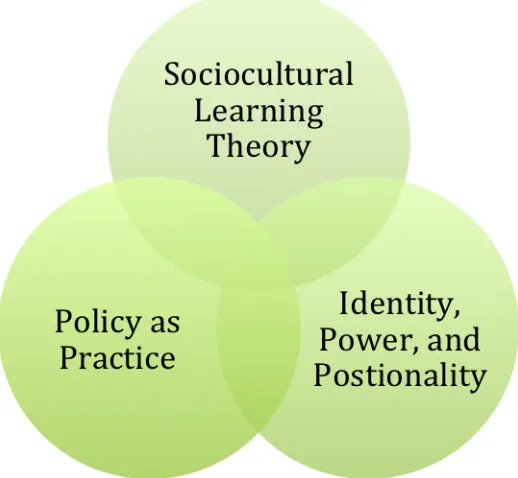
2.1 Model of Theoretical Frame ...13 46
2.2 Reading First Cartoon ...48
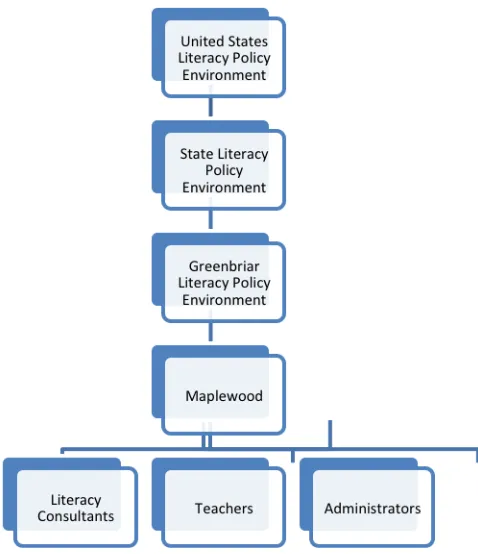
3.1 Multiple Levels of Policy ...64
4.1 Display of Student Writing ...132
4.2 State Academic Standards Posted ...140
4.3 Accelerated Reader Research ...158
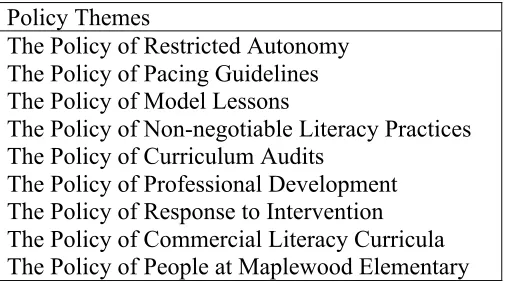
5.1 Policy Themes ...175
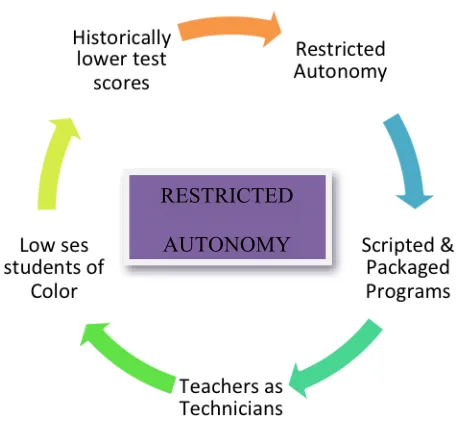
5.2 Test Score/Autonomy Cycle ...180
5.3 Professional Literature ...197
5.4 Data Wall ...198
5.5 Literacy Resources ...199
5.6 Word Wall ...207
5.7 Narrative Writing Diamond ...208
5.8 Literacy Programs ...230
5.9 Student Writing Sample ...254
5.10 Policies Impacting Practice ...262
6.1 Organization of themes ...267
6.2 Weaver balanced scale ...272
CHAPTER ONE
NOTICING POLICY AT MAPLEWOOD ELEMENTARY SCHOOL
The halls of Maplewood1 Elementary School were buzzing with the sounds of
administrators, parents, teachers, and students ready to start a new year. Policy of all
kinds significantly shaped literacy practices in this school; there was explicit and implicit
evidence of policy in practice everywhere. As I entered the school, I was greeted with
banners announcing accomplishments such as, “We made AYP!” (Adequate Yearly
Progress). Scores from the previous year’s State Assessment of State Standards (SASS)2
test were posted on the walls. I got the impression that this was a school where the
district’s motto, “Together, We Can,” was realized.
As the year progressed and I collected data about literacy policies, it became
clear that the path to success, particularly reading and comprehending texts on grade
level, at Maplewood Elementary School in the Greenbrier School District (pseudonyms)
was a complicated one. One month into the school year, I peeked into classrooms and
observed teachers diligently testing students, one-at-a-time, as other students sat at desks
busying themselves with worksheets. “When will we get around to teaching?” teachers
wondered aloud as testing consumed the first month of school. Visiting Maplewood
1 Names of participants, places, and state tests are pseudonyms to maintain confidentiality
2 A state standardized test administered at the end of the year to assess growth toward academic standards. 3 This citation is not included in references to maintain confidentiality
4 COP stand for Communities of Practice.
5 Titles VIII and IX outline the impact aid programs and general provisions respectively
and I do not address these specifically within this historical overview.
several months later, I saw district officials conducting walk-throughs, or “drive-bys” as
teachers called them, to “inspect what they expect” (Bridges, 2012, p. 49.)3. They
expected to see teachers following district pacing charts, using commercial literacy
curricula purchased by the district, and implementing non-negotiable literacy practices.
Title I literacy consultants monitored the learning environments to make sure that
teachers displayed alphabets, calendars, and other print media to meet district
expectations (“Office of Curriculum and Instruction”, 2009, pg. 7).
Literacy policy in the district and at Maplewood Elementary School changed
frequently. In faculty meetings and professional development sessions, some teachers
commented that the frequent changes in policy made it difficult to know what to expect.
Some teachers felt that these regular changes undermined their identity and agency as
they had little to no control over when or how these policy changes would take place. In
light of recent State budget cuts, there was a fear among teachers that jobs may be lost if
they did not meet policy expectations.
At Maplewood, as in schools across the nation, a wide range of stakeholders
develop, interpret, and appropriate literacy policies (Coles, 2003; Garan, 2004 & 2007;
Meir et al., 2004) as teachers; school, district, state and federal administrators; children;
and families, intentionally as well as unwittingly, play some kind of role in the policy
process. However, it is widely documented that their voices are heard more or less
depending on their place within the policy hierarchy (Levinson, Sutton, & Winstead,
2009; Shore & Wright, 1997; Sutton & Levinson, 2001). This study seeks to give
understand the dynamic policy process in which stakeholders’ interactions with each
other shape the way they voice their policy experiences and appropriate literacy policy.
Recognizing a national concern for the lack of stakeholders’ voices in the
policy-process (Levinson, Sutton, & Winstead, 2009) and because of my experiences observing
and interacting with teachers, administrators, and children at Maplewood, I was
motivated to conduct a multi-level qualitative study that would examine policy
stakeholders’ perspectives, lived experiences, and appropriation of policy—ways that
stakeholders take up policy, change it, or acquiesce to it — at each level of the policy
process (classroom, school, district, state, federal). The questions guiding this research
were:
• How do six policy stakeholders at one elementary school–four teachers, one administrator, and one reading teacher—make meaning of literacy policies.
• How do these stakeholders’ understandings shape the appropriation of these policies in their day-to-day literacy practices?
• How does the meaning-making of other stakeholders—district, state, and federal policy-makers—intersect with and inform the appropriation of policy by the six focal stakeholders?
Significance of the Study
No Child Left Behind (NCLB) is a federal education act resulting in some of the most
influential legislation to come along in the past 50 years. However, that influence has not
been viewed in the academic community, and in most public education communities, as
positive (Coles, 2003; Garan, 2004 & 2007; Meir et al., 2004). Explained in greater detail
in Chapter Two, NCLB had a long lasting impact on literacy policy at Maplewood
used programs backed by scientifically based reading research (SBRR), and urged
fidelity of implementation of SBRR practice to ensure students’ academic success.
At Maplewood School, many teachers seemed to feel that mandates from NCLB
literacy policies (including the state and district’s close monitoring of classrooms to
enforce compliance with mandates) in conjunction with the school’s on-again-off-again
Title 1 status—which brought consultants espousing a range of programs—made it
challenging for them to teach from their own knowledge and experience or appropriate
policies in ways that met the educational needs and interests of their students. This is not
unlike scenarios repeated across the country (Coles, 2003; Garan, 2004 & 2007; Meir et
al., 2004) as teachers feel a lack of attention to their own voices in the policy-making
process. However, in spite of studies that focus on literacy policy (Coburn, 2001) there is
little that focuses on understanding the co-constructed nature of literacy policy by
examining the intersection of views of a range of policy stakeholders.
Some, in the field of education, believe that researchers have contributed to this
silencing by adopting top-down approaches in the focus of their data collection—seeking
to understand policy design only from policy makers’ perspectives and by only
examining how policies succeed or fail at re-ordering behavior (Levinson, Sutton, &
Winstead, 2009). More recently, researchers have begun to examine policy from a
bottom-up perspective, focusing on implementation to understand local stakeholders’
sense-making related to literacy policies (Coburn, 2001). Both approaches, however, are
problematic because each addresses only a part of the policy process. Focusing on the
design of official policies at the macro (institutional) level, or on how those policies are
nature of the policy process that unfolds across and in between these levels. Furthermore,
these approaches neglect the role power plays in how stakeholders’ make meaning of
policy (Datnow & Park, 2009). In other words, these approaches alone are insufficient to
describe the dynamic process by which different levels of stakeholders dialogically
co-construct policies and their meanings within complex webs of power.
To avoid dichotomous approaches to policy study, educational anthropologists
and policy researchers have begun to describe policy appropriation as a multi-directional,
multi-layered, unified process that emphasizes the interrelationships between institutional
layers and actors (Datnow & Park, 2009). As educational anthropologists and
educational researchers examine policy appropriation in studies such as this one, they
create new opportunities for multiple stakeholders’ voices to be heard. They also create
opportunities for them to shape policy through participatory democracy—a process
through which marginalized local policy stakeholders can have great influence in shaping
policies that inform their practice. (Levinson, Sutton & Winstead, 2009). Participatory
democracy is particularly useful to thinking about the role teachers can play in shaping
literacy policy in schools, which largely dictate teacher practice.
This study was designed to contribute to the field of educational policy research
by considering the dialogic process of policy making among stakeholders with regard to
literacy policy in particular, “questioning dominant definitions of policy, proffering
alternative definitions, and reordering or de-ordering (i.e., liberating) behavior”
(Levinson, Sutton & Winstead, 2009, p.788). While there is much in the literature that
describes the discontent of educators regarding literacy policies, there is little that
Winstead (2009) argue that qualitative studies are needed to contribute to these goals as
they:
1. Question dominant assumptions and raise questions that are often silenced by traditional policy frameworks.
2. Enable researchers to see the practice that goes into creating and sustaining the sedimented common sense of policy.
3. Allow researchers to see the practice of policy appropriation, for which local interests and meanings (often in COP4) provide the basis.
4. Assay local conditions, excavate local knowledge, and represent such knowledge in a sympathetic albeit mediated language to policy elites.
5. Insert knowledge into a different circuit of social appropriation and social mobilization and expand the space of the public. In doing so, policy researchers can question the privileged status of scientific experts and reinvigorate public involvement in the policy process. (p. 788)
Because further studies are needed to move the field closer to the goal of
understanding the process of re-ordering and de-ordering literacy policy processes
(Levinson, Sutton, & Winstead, 2009), this study contributes to a limited body of
research by making visible the voices of multiple stakeholders in the policy process. By
examining the dialogic nature of their sense-making and appropriation of literacy policies
within complex webs of power, it is my hope that this study will offer evidence to
challenge dominant top-down policy theories—ones that support the view that policy can
be developed at higher school system levels, such as federal level, state, and district
levels and passed down to teachers to implement with fidelity—and contribute to an
environment where participatory democracy in the policy process would be increasingly
Research Purpose: Goals for the Study
Three goals guided this research. The first goal was to understand the policy
environment, including literacy policies themselves, across federal, state, and local levels
as those policies affected practice at Maplewood Elementary School. Policy stakeholders
typically shape their practice in particular contexts by drawing on widely circulating
concepts of how policy operates, their historical experiences with the policy process, and
various circulating literacy policies. I hoped that understanding the broader policy
environment as well as local (district and school-based) ones would help me understand
the context in which stakeholders make meaning of literacy policies at a particular
school, Maplewood. I developed this understanding by analyzing policy documents at
the national, state, and local levels; engaging in participant observation in teachers’
classrooms; and conducting informal and formal interviews with various stakeholders.
As part of this goal to understand the broader policy environment, I attended to
ways that stakeholders defined or framed issues related to literacy. I was guided in this
focus by the work of Goffman (1974) and Tannen and Wallat (1987). In his work,
Goffman discusses the nature of reality, situational meaning, and, “what one can be alive
to in any moment” (p. 8). He assumes that people make meaning of events in particular
situations with particular people by asking, “What is going on here?” (p. 10). Goffman
defines a frame as a, “definition of a situation… built up in accordance with principles of
organization which govern events—at least social ones—and our subjective involvement
in them” (p.10-11). Goffman’s notion of frame analysis then is an examination of the
organization of experience. Tannen and Wallat build on Goffman’s work to discuss an
which no utterance (or movement or gesture) could be interpreted” (p. 206). Coburn
draws on these notions of framing among others to understand how policy stakeholders
frame policy problems. Coburn (2006) asserts that the ways stakeholders frame policy is
important because it assigns responsibility and creates rationales that legitimize some
policy solutions while delegitimizing others. As a result, the ways that policy actors
frame issues greatly impacts the ways policy stakeholders at local levels can appropriate
policy and understanding their roles was an important goal of this work. This study drew
on these tenets by examining the ways participants’ described the factors that inhibited
literacy development and the reforms they promoted to increase students’ literacy
achievement.
The second goal of this study was to understand the lived experiences of
administrators and teachers with regard to literacy policies at Maplewood. I wanted to
understand, from a variety of perspectives, the process by which policy stakeholders
made meaning of literacy policies and how power structures supported and constrained
the ways literacy policy was practiced in the school community. I also was interested in
literacy consultants’ roles and walk-throughs in connection to NCLB policy and the
school’s Title I status. I wanted to understand how teachers responded to policy demands
based on their perceptions of policy officials’ expectations for their practice. To meet
this goal, I sought the perspectives of multiple stakeholders using participant observation,
interviews, and document collection and analysis at the school. I observed district
walk-throughs and interviewed observers about their roles in the school and their expectations
A third goal of this study was to understand the dialogic relationship (beyond the
typical macro-micro dichotomies) between stakeholders at local, state, and federal levels
as they co-construct literacy policies. To understand this process, I focused on the ways
policy stakeholders responded to each other’s policy moves within what Hubbard, Mehan
and Stein (2006) call, “intersection encounters” (p. 16). These are the formal and
informal interactions between stakeholders at multiple levels in the policy process shaped
by their cultural, political and historical knowledge of each other and of the related power
structures (Bahktin, 1981 & 1986). To meet this goal, I collected data at the district and
school levels by focusing on data settings (e.g., faculty meetings, grade level meetings,
professional development sessions, district meetings for principals, open house nights at
school) in which stakeholders encountered, shared, and discussed literacy policy
messages. At the national and state levels, data to meet this goal came from documents
(e.g., commentary, letters, emails, policy legislation, curriculums and program
descriptions etc.).
As I collected data to address the three goals of this study, participants used
numerous policy terms as they described their practice. To assist the reader in
understanding the key terms used throughout this study, a list of definitions are provided
in Appendix A. These terms are defined throughout the study, but given the numerous
novel terms encountered related to policy, terms likely unfamiliar to most readers, a
review of the definitions in Appendix A is suggested before reading further.
Conclusion to Chapter One
The goals and process of this study were designed to allow me to understand more
contribute to the body of work that seeks to replace existing technocratic models of
policy with those that encourage participatory democracy by engaging local stakeholders
in the production and interpretation of official legitimizing policies. To accomplish these
goals, I collected data at Maplewood Elementary School from January to December
2010. Maplewood is located in an urban school district. At the time of the study, the
school had 287 students, 21 teachers, and two administrators with two teachers at each
grade level from Child Development (four year olds) through fifth grade. Three teachers
led the physical education, art, and Spanish programs. One teacher, Ms. Berling, was the
reading teacher charged with working with small groups of children to promote literacy
achievement. Ms. Johnson was the school’s principal, and Mr. Baker was the curriculum
resource administrator. Using participant observation and interview (Spradley, 1980) at
the local level, I focused on four teachers, the principal, and the reading teacher. I also
collected and analyzed policy documents and interviewed policy stakeholders at federal,
state, and local levels to understand the ways stakeholders framed policy issues and their
solutions (Goffman, 1974; Tannen & Wallat, 1987). In these ways, I sought to develop
deeper understandings of policy ideologies and appropriation.
The following chapter begins by outlining the theoretical frame that guided the
development of this study’s purpose and methodological design, and interpretation of
data. It is followed by a review of each body of literature that was foundational to my
framework as well as a discussion of the specific literacy policies that were integral to
CHAPTER TWO
THEORETICAL FRAME AND REVIEW OF RELATED LITERATURE
This study of literacy policy at local, state, and national levels centered on
contexts important to literacy teaching at Maplewood Elementary School in an urban
setting within a moderately sized southeastern city. I was guided in the development of
this research project and the analysis and representation of data by a theoretical frame
that draws from several major bodies of thought. An overview of that framework is
provided in the first section of this chapter followed by an in-depth review of the bodies
of literature that informed the development of that frame. Those bodies of work are: (a)
learning as a sociocultural process, (b) policy as sociocultural practice, (c) identity as
practice, and (d) meaning-making and literacy policies. Thus, each of these areas of study
is presented in this chapter not only to provide a review of relevant literature, but also to
express how each area supports the theoretical framework that guides my work. In other
words, to understand the theoretical framework within which this study is situated, it is
important to unpack the research studies that led to my understanding of those theoretical
concepts. The final section of this chapter provides a review of policies pertinent to the
specific contexts of this study particularly the No Child Left Behind Act (NCLB).
Theoretical Framework
Several core beliefs guided my thinking as I set out to understand how literacy
I believe that all meaning making is a process of learning and all learning is a process of
meaning making. As a result, learning theory heavily influenced my understanding of the
ways teachers made meaning of literacy policy. In particular, I embrace a sociocultural
view of learning—a view that learning is socially situated, as people bring their cultural
understandings of the world to bear on a particular learning experience. Just as I believe
that learning is a sociocultural process, I similarly believe that policy is a sociocultural
practice in which policy stakeholders appropriate policies—taking them in and making
them their own within particular social settings and particular cultural frames of reference
(Sutton & Levinson, 2001; Shore & Wright, 1997). Following this pattern, I also believe
that teachers’ identities are formed through sociocultural processes in which teachers
negotiate their identities within specific sociocultural settings—settings steeped in issues
of power and expectations for who individuals can be and how they should participate in
particular communities of practice (Holland, Lachiotte, Skinner & Cain, 1998; Lave &
Wenger, 1991; Wenger, 1998). It is my belief that an understanding of sociocultural
learning, policy, identity and the negotiation of power is necessary for policy researchers
to construct a complex understanding of policy in practice that creates counter narrative
to notions of the implementation of top-down technocratic policies. It is these beliefs that
Figure 2.1. Three theoretical frames intersecting to support an understanding of teachers’ meaning making around literacy policy.
With these principles/understandings in mind, I designed a qualitative study to
examine the sociocultural nature of literacy policy in practice and how teachers
negotiated the socially situated meanings of those policies within school system power
structures. Critical to my ability to draw on this sociocultural foundation were
methodologies used in the collection of data: formal and informal interviews, extensive
time spent as a participant observer in the school, and engaging participants in frequent
member checking to assess my interpretations in light of their views. Building from my
beliefs in the roles played by power structures and the negotiation of teacher identity, I
began to construct an understanding of policy in practice.
I began developing this framework with the assumption that the way one
perceives learning directly influences the way one views the policy process and that
deeper understanding of theories of learning. For example, researchers who
conceptualize learning as an individual cognitive process in which information is
transmitted from one individual to another will conceptualize a linear policy process in
which policy is handed down to passive implementers (Wenger, 1998). However,
researchers who conceptualize learning as a social practice, as I do within this study, will
conceptualize a recursive policy process in which policy stakeholders dialogically,
co-construct meanings of policies related to literacy within particular sociocultural-historical
settings.
Review of Literature Supporting Theoretical Frame
Learning as a Sociocultural Process
At the heart of my work is a commitment to views of learning as a social and
cultural process. This belief is guided by many theorists but primarily by the work of
Vygotsky (1978), Bahktin (1981 &1986), Lave and Wenger (1991), Wenger (1998),
Holland, Lachiotte, Skinner and Cain, (1998), Shore and Wright (1997), Sutton and
Levinson (2001). These scholars, in particular, influenced my thinking about the ways
policy stakeholders make meaning related to literacy policies and how these meanings
shape the ways stakeholders appropriate policy. The following learning theories led to
my current understanding of sociocultural theory and, in particular, learning as a
sociocultural/dialogic process in which people are increasingly able to participate within
a community of practice (Bahktin, 1981 & 1986; Lave & Wenger, 1991 & Wenger,
1998): (a) learning through social action, (b) learning as legitimate peripheral
participation, (c) learning as the ability to negotiate new meaning, (d) policy as practice
intersections of these learning and policy theories, I use the terms learning and meaning
making synonymously because I believe the two to be integrally related. In other words,
I accept that meaning making is a central element of the learning process, and that,
conversely, learning always entails meaning making. I will describe the relationship
between meaning and learning later in this section as I conceptualize learning as a
practice in which we experience the world and our participation in it as meaningful
(Wenger, 1998).
Learning through social interaction. Vygotsky’s theory of learning through
social interaction informed my framework by challenging notions of learning as a process
of transmitting knowledge from one person to another and therefore challenging notions
that policy can be transmitted from one policy level or group of individuals to another.
Rather, policy—like learning—is a sociocultural process in which stakeholders actively
shape their participation based on culturally acceptable ways of behaving. Vygotsky was
one of the first to describe the sociocultural nature of learning and meaning making.
Vygotsky (1978) described learning and the development of higher psychological
processes as inherently social and historical, and challenged his fellow cognitive
psychologists’ prevailing theories of human development as an individual mental
process. Vygotsky viewed learning as social—as people grow into the intellectual lives
of those around them, and as historical—as people bring their previous experiences and
schema developed across microgenetic, ontogenetic, phylogenetic, and cultural-historical
timescales to bear on new learning events. Vygotsky proposed that this learning occurs
within a zone of proximal development (i.e., zpd). He conceptualized the zone of
the actual developmental level as determined by independent problem solving and the
level of potential development as determined through problem solving under adult
guidance or in collaboration with more capable peers” (p. 86). This concept emphasizes
the way learning occurs through social interaction between people in formal learning
communities.
While Vygotsky’s (1979) hypothesis brought new attention to learning through
social interaction, his focus as a cognitive psychologist remained on mental processes.
Therefore, he worked to understand the process by which human beings internalize
socially constructed knowledge and abilities in the mind and encouraged other
researchers to do the same. However, researchers who were contemporaries of
Vygotsky, such as Bakhtin (1981 & 1986), and those who came later, such as Wenger
and Lave (1991), conceptualized social theories of learning that challenged the
internal/external dichotomy between the social and psychological dimensions cognitive
psychologists emphasized. These theories further supported my understanding of policy
appropriation by stakeholders within (COP).
Learning as legitimate peripheral participation. I drew on the concept of
legitimate peripheral participation within this study to understand—and rethink—how
policy stakeholders participate in the sociocultural transformation of policy through
changing relationships between old-timers and newcomers. Lave and Wenger’s (1991)
view of learning as legitimate peripheral participation informs my framework, and
understanding of policy appropriation, by extending the importance of the informal
learning settings where people implicitly become full participants in communities of
recognized that existing theories of learning—including Vygotsky’s theory of the zone of
proximal development—focused on the way learners internalized knowledge—whether it
was, “discovered,” “transmitted” from others or “experienced in interaction” with
others” (p. 47). Lave and Wenger suggested these views of learning created dichotomies
between inner and outer knowing and framed the acquisition of knowledge a mental
process. Lave and Wenger argued that this dichotomy reduced learning to a process of
transmission and assimilation.
Lave and Wenger (1991) emphasized that issues of internalization were central to
Vygotsky’s theory even though he was explicitly concerned with the social nature of
learning. They argued researchers’ interpretations of Vygotsky’s zone of proximal
development shape the extent to which internalization affected the learning process.
Lave and Wenger suggested the common “scaffolding” interpretation that builds on
Vygotsky’s (1979) definition of the zone of proximal development as the distance
between what a learner can do working alone and what they can do under the guidance of
an adult or more experienced peer, reduced the social nature of learning to, “a small
‘aura’ of socialness that provides input for the process of internalization viewed as
individualistic acquisition of the cultural given” (Lave & Wenger, 1991, p. 48). Lave and
Wenger did not believe this interpretation accounted for the place of learning in the
broader context of the structure of the social world.
Lave and Wenger (1991) offered an alternative “collectivist” or “societal”
interpretation of Vygotsky’s theory based on activity theory and critical psychology.
They drew on Engestrom’s definition of the zpd as the, “distance between the everyday
collectively generated…in everyday actions,” to extend the study of learning beyond
pedagogical approaches toward an, “emphasis on connecting issues of sociocultural
transformation with changing relations between newcomers’ and old-timers in the context
of a changing shared practice” (p. 49). This became the basis for their conceptualization
of learning as practice within communities. This theory lead me to focus on the ways
teachers transform their practice, and thus their sociocultural contexts, as they interact
with colleagues to make meaning of literacy policies they encounter.
Lave and Wenger (1991) argued the meaning of learning was for an individual to
become a full participant in a sociocultural practice within a community. Becoming a
full participant in a community involved more than acquiring technical skills; it involved
developing relationships between individuals, activities, and the world over time in
relation to other communities of practice (Lave and Wenger, 1991). These communities
of practice exist everywhere where people live and work together to establish a habitable
way of life (Wenger, 1998). Communities of practice exist largely to reproduce
themselves but this often occurs in informal, implicit ways. When new members join a
community (e.g., religious, civic, professional) existing members initiate them into the
ways of being within the community through what Lave and Wenger refer to as
legitimate peripheral participation. This is also true for educators in the teaching
profession. As new teachers step into schools, their initiation into the figured worlds of
teaching, and more specifically their particular school culture, begins.
Lave and Wenger’s emphasis on connecting issue of sociocultural transformation
with changing relations between newcomers and old-timers resulted in an understanding
apprenticeships. Lave and Wenger present LPP as, “A particular mode of engaging as a
learner who participates in the actual practice of an expert, but only to a limited degree
and with limited responsibility for the ultimate product as a whole” (p. 14). To describe
this process, Lave and Wenger examined multiple apprenticeship models outside of the
classrooms (e.g., Yucatec Midwives, Vai and Gola Tailors, Naval quartermasters,
butchers, and alcoholics). Through their observations, they discovered that learning
through LPP in apprenticeships was more or less successful based on the nature of the
interactions between old-timers and newcomers within those apprenticeships. At times,
newcomers in communities of practice did not have equal access or opportunities to
develop knowledge that allowed them to become full participants in those communities.
This occurred either because of the quality of the apprenticeship or old-timers’ intentional
efforts to marginalize newcomers and prevent them from becoming legitimate peripheral
participants and engaging in new practices. Access to culturally appropriate ways of
participating in a community created continuity or displacement of participants within
those communities as they worked to reproduce themselves.These constraints on
developing professional knowledge provide a framework for understanding teachers’
frustrations when they claim they are unable to develop deep professional knowledge to
support their practice. This framework helped me consider whether or not teachers’
feelings of not being able to master their craft was due to a lack of access to quality
apprenticeship or intentional efforts to limit teachers’ ability to become autonomous, full
participants in the teaching profession.
Learning as the ability to negotiate new meaning. Wenger (1998) built on his
practice. Wenger’s perspective on learning was multifaceted. I focus only on the
meaning-making facet of his perspective on learning because it provides a framework to
understand policy stakeholders’ meaning making related to literacy policies.
According to Wenger (1998) learning is foremost the ability to negotiate new
meanings. Meaning is not a, “mechanical realization of some routine or procedure”
(Wenger, 1998, p.52). When teachers eat lunch with the same children in the same
cafeteria every day, even when they are familiar with the routine, they recreate the
experience anew each time they engage in the routine and produce a, “new situation, new
impression, and experience: we produce meanings that extend, re-direct, dismiss,
reinterpret, modify, or confirm—in a word, negotiate anew—the histories of meanings of
which they are part” (Wenger, 1998, pp.52-53). From this perspective, Wenger argues
that meaning neither exists in individuals nor in the world but in the dynamic relationship
of living in the world.
The process of negotiating meaning occurs through the dual process of
participation and reification (Wenger, 1998). Wenger defined participation as the process
of taking part or sharing with others in some activity or enterprise. However,
participation is not the equivalent to collaboration. Wenger argued participation,
“involves all kinds of relations, conflictual as well as harmonious, intimate as well as
political, competitive as well as cooperative” (p. 56). We see this kind of both conflictual
and harmonious participation in educational settings where policy is appropriated.
Wenger believes the transformative potential of an individual’s participation in a
community affects both the participant and the community itself. Likewise policy
meaning of literacy policies to transform their practice and their community. Wenger
argues the ability—or inability—to shape communities is also central to the experience of
participation (Wenger, 1998, p.57). Participation additionally cannot be turned off and
on because it is a constituent of our identities. Teachers, for example, do not cease to be
who they are when they go home at the end of a day. Rather their identities as teachers
exist alongside other identities (e.g., mother, father, Christian, democrat, soldier etc.)
people draw on to orchestrate their practices in various settings.
Participants also construct meaning in communities of practice through
reification. Reification is the process of projecting our meanings into the world and
perceiving them as existing in the world and having a reality of their own (Wenger,
1998). Through this projection we move from abstract to concrete representations of
experiences. People engage in reification when they create tools to perform activities.
The tools we use to reify—including historical records, poems, journals, etc.—change
our participation in activity as well as the activity itself (Wenger, 1998). When abstract
policies are made concrete through documents, reification occurs. But, through
reification, participants can interact with policy in unforeseen ways. The ways policy
stakeholders make meaning of policy for example can expand or constrain the intended
meaning of the policy.
Wenger (1998) emphasizes that participation and reification are dualities rather
than dichotomies. They are not opposites of each other the way something described as
tacit is therefore not explicit. Participation and reification shape one another. According
to Wenger, the negotiation of meaning through the interplay of participation and
participation and reification to more fully understand how participants in the policy
process at, and surrounding, Maplewood made negotiated the meaning of literacy
policies.
Learning as dialogue. Russian philosopher, Mikhail Bahktin (1981 & 1986)
conceptualized learning as a dialogic process. This concept shaped my understanding of
the policy process as one in which stakeholders appropriate policy. Mikhail Bahktin was
a contemporary of Lev Vygotsky (1979). While there is no evidence the two ever met,
they shared similar theoretical beliefs that learning, and the ways humans make meaning
of their worlds, is fundamentally social, cultural, and historical. Bakhtin researched
learning and meaning making through the study of speech. Bakhtin conceptualized
speech as dialogic and the psyche as a social entity rather than removed from the social
world. From Bahktin’s perspective, theorists such as Vygotsky, who concerned
themselves with the way learners internalized knowledge and abilities, and who created
dichotomies between social learning and the inner psyche, were misguided. Bakhtin
departed from a theory of internalization as he conceptualized speech as a dialogic act.
Bakhtin (1986) argued speech is dialogic. To explain this dialogic process in
speech, Bakhtin focused on the utterance as the unit of analysis. An utterance, according
to Bakhtin, was a unit of speech determined by a change in speakers. He further defined
the utterance by its necessity for a response. In so far as a single word or sentence
elicited a response, it could be considered an utterance. According to Bakhtin the
speaker’s expectancy of a response shaped the speakers communication and made speech
dialogic. Bakhtin wrote:
appropriates the word, adapting it to his own semantic and expressive intention. Prior to this moment of appropriation, the word does not exist in a neutral and impersonal language (it is not, after all, out of a dictionary that the speaker gets his words!), but rather it exists in other people’s mouths, in other people’s
contexts. Serving other people’s intentions: it is from there that one must take the word, and make it one’s own. (p. 77)
This dialogic nature of language causes the speaker to attend to the cultural world of the
addressee. In this process, a speaker’s position and power, in relation to their addressee,
greatly affects how they shape their utterance. Bakhtin argued that when we enter into
dialogue with another we are aware that they are, “Shot through with shared thoughts,
points of view, alien value judgments and accents. The word, directed toward the object,
enters dialogue” (p. 75). As we become aware of the cultural worlds of others we also
become aware of the relative power of their discourses. Bakhtin described this power in
terms of authoritative and personally persuasive discourses.
Bakhtin (1981) identified authoritative discourse as that which demands our
unconditional allegiance. According to Bakhtin people can accept them totally or reject
them totally. Teachers encounter these authoritative discourses regularly through literacy
policies aimed at changing their practice. These discourses are often attached to political
powers, institutions, or persons. When speakers encounter authoritative discourses and
accept them, they become what Bakhtin called internally persuasive discourses. Bakhtin
stated, “The semantic structure of an internally persuasive discourse is not finite, it is
open; in each new context that dialogize it, this discourse is able to reveal ever new ways
to mean” (p 79). This potential to dialogize discourse in new ways makes it possible for
people—and teachers in the case of schools—to liberate themselves from other’s
Connections between these sociocultural theories and this study. The theories
of Vygotsky (1979), Lave and Wenger (1991), Wenger (1998), and Bakhtin (1981 &
1986) help me understand learning and meaning making as a dynamic
sociocultural-historical process in which meaning is co-constructed through social interaction and
participation in communities. Bakhtin’s theory of dialogism particularly led me to
develop an understanding of policy as practice and appropriation. Just as I accept that
speech is dialogic, and must be populated with one’s own intentions, I also accept that
policy stakeholders appropriate policy and populate them with their own intentions as
well, thus making them their own. Therefore, understanding the meaning of policy to
stakeholders at various levels requires understanding the intentions with which they
populate a policy in relationship to the power structures that contextualize policy
discourse.
This view led me to reject perspectives that policy stakeholders should, or could,
passively comply with No Child Left Behind or other literacy policies. I accept that
policy stakeholders’ appropriation of policy, or meaning making around literacy policies,
occurs through practice as stakeholders’ increasingly are able to participate in social
situated activities of their communities. I also accept that certain authoritative policy
discourses, that demand stakeholders’ compliance to a variety of degrees depending on
the power they have in the policy hierarchy, make it difficult for policy stakeholders to
exercise agency as professionals and creates tension in the policy process.
Policy as Sociocultural Practice
Another belief foundational to this study is that policy is a sociocultural practice.
manage public spheres of life in rational and efficient ways (Sutton & Levinson, 2001).
This managerial approach to policy is still dominant in today’s society. From a
managerial perspective policy is often objectified as, “The ghost in the machine—the
force which breathes life and purpose into the machinery of government and animates the
otherwise dead hand of bureaucracy” (Shore & Wright, 1997, p. 5). According to Shore
and Wright, this approach to government treats policy as, “A tool to regulate society from
the top down through rewards and sanctions” (p. 5). As such, policy acts as a directive
that dictates actions to be carried out to reach desired social outcomes. This managerial
approach implies that policy unfolds in a linear fashion. Within this model, policy elites,
including government officials and social scientists, often presume they can identify a
pressing human problem, formulate a policy to address the problem, pass the policy down
to be implemented by “less powerful” policy actors such as administrators and teachers,
and later evaluate the policy’s success (Porter & Hicks, 1995 as cited in Sutton &
Levinson, 2001). Reality shows us that policy does not unfold in such a neat, linear
process. Sutton and Levinson (2001) and Shore and Wright (1997) suggest an alternative
approach to understanding policy. They suggest:
1. Policy is a complex sociocultural practice.
2. Policy as practice accounts for the situated logic of activities in various settings.
3. Policy—both official (government sanctioned) and unofficial (personal policies)—produces, reproduces, and contests social norms and identities.
Sutton and Levinson (2001) asked what policy would look like if they,
“re-conceptualized the notion of policy as a complex social practice, an ongoing process of
institutional contexts?” (p. 1). Policy, they concluded, would look like a more dynamic
and recursive process. There would be no need to categorize policy into stages of
formulation and implementation. If we re-conceptualized policy as a sociocultural
practice, we might see policies as, “Cultural texts, as classificatory devices with various
meanings, as narratives that serve to justify or condemn the present, or as rhetorical
devices and discursive formations that function to empower some and silence others”
(Shore & Wright, 1997, p.7).
Appropriation. Because of policy’s sociocultural nature, educational
anthropologists are more inclined to speak of policy appropriation rather than
implementation. Appropriation acknowledges that “official legalized policies” are
always negotiated in communities (Sutton & Levinson, 2001). More specifically,
appropriation is the process by which, “Creative policy agents ‘take in’ elements of
policy, thereby incorporating these discursive and institutional resources into their own
schemes of interest, motivation and action” (p. 3). An emphasis on appropriation over
implementation places culture at the center of policy researchers’ efforts to understand
the complexities of the policy process. Implementation is inherent to the policy process
rather than a separate process. Sutton and Levinson urge a more integrated approach to
policy that recognizes its sociocultural nature. These newer concepts of policy and its
co-construction among multiple policy stakeholders at multiple levels, builds on such a
sociocultural framework.
Sutton and Levinson also viewed policy actors as cultural beings and thus
examined values, beliefs, and identities as analytic tools to understand how policy actors
definition of practice, Sutton and Levinson (2001) argue practice, “has emerged as a way
of accounting for the situated logic of activities across a wide array of contexts” (p. 3).
Introducing the concept of practice to the examination of policy processes affirms the
agency stakeholders exercise at every stage of the policy process. This agency pushes
policy researchers to view policy as a cultural resource to be appropriated and contested
in many ways (Sutton & Levinson, 2001). To understand how policy actors appropriate
policy, it will help to distinguish between “official” and “unofficial” policies.
Official and unofficial policies. The studies in Sutton and Levinson (2001) and
Shore and Wright (1997) address both official and unofficial policies. “Official”
policies—policies legalized as government charters—are not given primacy in Sutton and
Levinson’s view. Both official and unofficial policies shape society in powerful ways.
Sutton and Levinson state that unofficial moral discourses—discourses that construct
social norms and are negotiated based on local values and beliefs—regulate participation
in communities in the absence of—and in the presence of—official policies. Sutton and
Levinson and Shore and Wright acknowledge, however, the power legalized policy has to
sanction and restrict certain administrative techniques, pedagogical practices, and other
behaviors. Sutton and Levinson (2001) suggest researchers work to, “Link the discursive
practices of normative control in any local-level community or institution with the
discursive practices comprising large-scale structures of law and governance” (p. 3).
Through this process researchers can better understand the relationship between policy
Power and Positionality Shape Identity as Practice
Policy stakeholders’ meaning making related to literacy policy is intimately
connected to issues of power, identity, positionality, and agency. For this study, I
adopted the framework of Holland Lachiotte, Skinner, and Cain (1998), who present a
theory of identity and agency that builds on Vygotsky, Bakhtin, and Lave and Wenger’s
theories of learning, to conceptualize identity and agency. This research connects to my
belief in learning as a sociocultural process within in communities of practice and
supports my belief that identity is also constructed in sociocultural practice as follows:
1. Identity is learned through social practice
2. Identity—or a person’s sense of self—forms in relation to ways of inhabiting roles, positions, and cultural imaginaries that matter to them.
3. Identities are dialogically improvised in relation to cultural and social factors.
4. Identity is constructed in relation to one’s position in the world.
5. Identity is continuously negotiated in ‘spaces of authoring.’
Holland et al. (1998) differentiated between two prevalent ways of
conceptualizing identity. The first is associated with the work of Erik Erikson who
described identity primarily as one’s sense of oneself. According to Erikson, achieving a
stable, consistent, and enduring identity is essential to healthy psychological processes.
Identity from this perspective is seen as the essence of a person. It is universal and
located within a person, rather than as a socioculturally constructed phenomenon.
According to Holland et al., researchers adopting an Eriksonian approach to identity
typically concern themselves with the processes and obstacles of creating an integrated,
The second way of conceptualizing identity is in line with the work of G.H.
Mead, as discussed by Holland et al. (1998). Mead conceptualized identity in line with
sociological and anthropological schools of thought in the American school of social
psychology (Holland et al., 1998). Mead theorized identity as, “Dense relations between
identities as aspects of self, and identities as social and cultural objects” (Holland et al.,
1998). Researchers such as Holland et al. (1998) extended this theory to suggest that
“people form senses of themselves—identities—in relation to ways of inhabiting roles,
positions, and cultural imaginaries that matter to them (e.g., as a skater, a punk, a radical
environmentalist)” (p. 103). Researchers taking a Meadian approach to identity typically
concern themselves with, “The means by which individuals form senses of self—
identities—in relation to roles, statuses, and cultural persona, and how these identities
organize affect, motivation, action, and agency” (p. 104). This is the way I wish to
conceptualize identity within this policy research. Vygotsky, Bakhtin, and Lave and
Wenger’s conceptualization of learning and language as a sociocultural process supports
this understanding of identity and agency. This is clearly demonstrated in the work of
Holland et al. as they look at identity construction and agency in cultural or figured
worlds.
The term figured worlds is used throughout Holland et al.’s (1998) work
interchangeably with the term cultural worlds. By figured worlds, they mean “socially
produced, cultural constructed activities” (p. 41). People historically develop figured
worlds that, through traditions and rituals, give their lives meaning. In these social
realms the positions, status and power of the people who participate in them matter
various ways based on their perceptions of their own positions and statuses in relation to
others. Individuals experience subjectification in these worlds as they appropriate and
internalize their discourses through practice.
Holland et al. (1998) differentiate between culturalist and constructivist
explanations of behavior, which influence scholars’ views on identity. Neither a
culturalist explanation of behavior with “a social emphasis on cultural logics,” nor a
constructivist explanation of behavior with an emphasis on “the calculus of social
position by actors,” adequately explained the agency Holland et al. saw displayed in their
case studies (Holland et al., 1998, p. 275). Rather, Holland et al. recognized a dialogic
relationship between cultural and social influences that often led people to improvise new
ways of being within their communities. Through acts of improvisation Holland et al.
argued that people exercise agency. They chose to focus on these moments of
improvisation in their research because they believed doing so provided opportunities to
support people in their moves toward liberation within figured worlds. In the world of
policy it is also neither the cultural logics of policy nor the social positions of policy
actors alone that mediates participation in communities. Rather, moments of
improvisation are key moments in the policy process as well and equally may support
people in their moves to liberate themselves from oppressive, technocratic policy
environments.
Positionality. The ways policy stakeholders are positioned in policy processes
significantly impact the ways these stakeholders appropriate policy. Holland et al.’s
statements on positionality provide a framework to understand how identity construction
power, status, and privilege. Our positional identities, as Holland et al. (1998) describe
them, define our place in the world in relation to others, but more importantly it involves,
“A person’s apprehension of her social position in a lived world: that is, depending on the
others present, of her greater or lesser access to spaces, activities, genres, and, through
those genres, authoritative voices, or any voice at all” (pp. 127-128). We develop an
awareness of our position within society across the life span, but as Holland et al.
illustrate, our place in the world in relation to others particularly begins early in life.
Holland et al. provide a powerful illustration of how people become aware—
beginning at a young age—of the positions afforded to them. They provide the
illustration of a young Nepalese female child’s playfully reaching out to touch an ox
drawn plow in the presence of her bother and other men. The figured world of women in
Nepal, with its strict delineation between men and women’s worlds, prohibited the young
girl from touching a plow—a semiotic mediating device that indexed the world of men.
By touching the plow she claimed a position that belonged to men. As a result, the men
ran out to scold and beat the child to remind her of her position in society. Through this
experience the child learned she could not participate in the community in the same ways
her brother could participate in the community (Holland et al. 1998). Her ability to act
was restrained by her position, Nepalese culture, and the behaviors of others. This
example shows that we often do not choose subject positions within figured worlds, but
rather they are often imposed upon us. Such is the case in the figured worlds of many
policy stakeholders. When policymakers decide who can and cannot create policy, and
when policy documents such as NCLB focus on improving the quality of instruction
While learning our position in figured worlds can happen through explicit
instructions—as in the case above—many of our understandings of how we are
positioned in the world are learned implicitly through countless daily interactions with
others in those worlds. As Lave and Wenger (1991) suggest in their theory of learning in
practice, learning is often implicit rather than explicit. According to Holland et al. (1998)
the social positions we learn become dispositions—or tendencies to act certain ways in
certain contexts—“Through participation in, identification with, and development of
expertise within the figured world” (p.136). Developing a disposition can mean either
rejecting or taking up particular ways of acting in figured worlds. While many
dispositions form over long periods of time largely through subconscious processes, these
positions can be modified. As Holland et al. demonstrated, as people participate in
figured worlds they may come to realize their own subordination in those worlds, fixate
upon them, develop resentments, and actively reject negative positionings. As they do
this, they author themselves in new ways and change the worlds in which they
participate.
This process is helpful to understanding the ways teachers function in the figured
worlds of schools and appropriate policy. This process is also useful for thinking about
the ways teachers form their identities and the extent to which teachers recognize their
subordination to powerful school system structures and the ways they negotiate their
roles within those structures.
In terms of positionality, I realize that policy stakeholders’ power, position, and
status matter as they dialogically construct their identities within figured worlds. As
administrators—the values, beliefs and power of others likely influences their response,
or ways of constructing their identities within these worlds. At my research site, the
school serves a predominantly African American population of children from lower
socioeconomic backgrounds. Half of the teachers in the school are African American,
while the other half of the teachers are White. Most teachers are female, but one assistant
administrator is male. As a result, I believe issues of race, social class, gender and myriad
other categories influenced stakeholders’ status, power, and position with the figured
worlds as stakeholders interact across policy levels.
Spaces of authoring. Spaces of authoring are particularly significant for
understanding the ways policy stakeholders have the potential to exercise agency in
figured worlds. A sociocultural perspective of identity and agency recognizes that
learning identity and agency—like other forms of learning—occurs in practice.
Likewise, identities are formed in practice as well rather than passed down across
generations. Holland et al. draw on Bakhtin’s (1981 & 1986) notion of dialogism to
emphasize the ways identities are constructed as people are addressed and address others.
Holland et al. contend that we author the world as we participate within it. Yet, in this
authoring process we cannot creatively construct any identities we wish (Holland et al.,
1998). We must engage in bricolage as we use the cultural materials around us to fashion
ourselves in new and creative ways. Just as language is not our own, neither are our
identities. And just as language exists in a contentious world of differing values and
meanings, so do our identities. Holland et al. posit that people orchestrate multiple
possible ways to identify themselves as they attend to the identities of others in their